

Year 5 Maths Curriculum Toolkit: Planning & Resources

Year 5 maths introduces concepts that require pupils to think differently. As 9 and 10-year-olds enter upper Key Stage 2, they must combine topics in ways they haven’t seen before – Fractions, Decimals, and Percentages begin to overlap; problem-solving demands deeper reasoning; and the step-up can feel significant for many learners.
This blog clarifies exactly what pupils need to know, how those concepts are taught across your scheme of work, and where confusion typically arises. You’ll find:
- Clear breakdowns of each Year 5 maths objective
- Practical teaching strategies for the trickiest topics
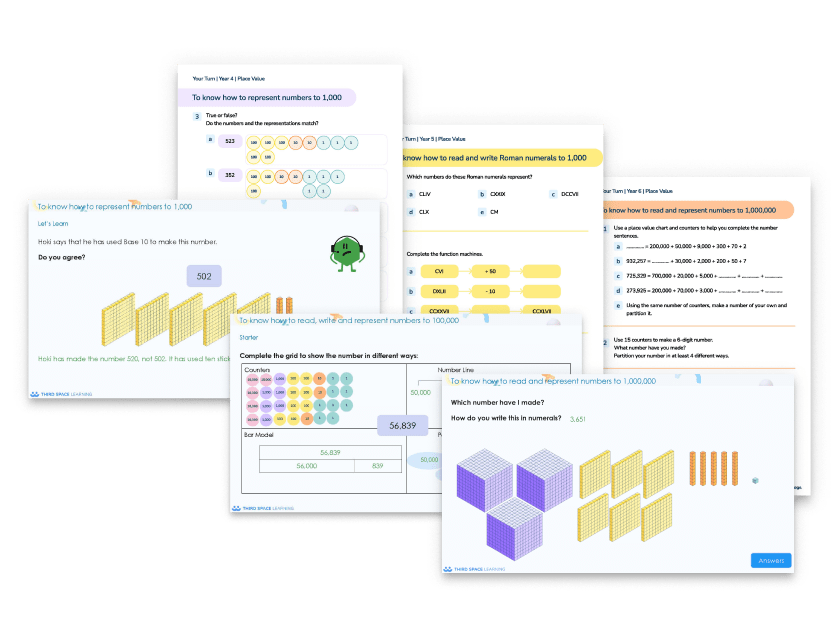
- Free downloadable resources: Year 5 maths worksheets and maths homework tasks
- Links to further subject knowledge support
These insights come from 12+ years of one-to-one tutoring experience across thousands of primary schools. Third Space Learning’s maths tutoring addresses the exact curriculum areas that confuse in Year 5, the misconceptions to anticipate, and the methods that help pupils succeed. That frontline teaching experience, captured across millions of tutoring sessions, shapes every recommendation in this guide.


Free Year 5 Maths Worksheets and Tests
Register now with the Third Space Maths Hub (Use Chrome) to download all our free Year 5 maths worksheets, workbooks and resources
Download Free Now!What the Year 5 maths curriculum says
Mathematics teaching in upper Key Stage 2 focuses on ensuring that pupils extend their understanding of the number system and place value to include larger integers. This should develop the connections that pupils make between multiplication and division with fractions, decimals, percentages and ratio.
Year 5 maths curriculum core objectives
- Problem solving: Pupils must develop their ability to solve a wider range of problems, including those involving increasingly complex properties of numbers and arithmetic. This demands the development of efficient written and mental methods of calculation.
- Introduction to Algebra: With a solid foundation in arithmetic, pupils are introduced to the language of algebra as a means for solving a variety of problems.
- Geometry and Measures: Teaching in Geometry and Measures must consolidate and extend the knowledge developed in Number. Ensure pupils can classify shapes using precise vocabulary with increasingly complex geometric properties.

To ensure every pupil achieves deep, sustainable understanding, Third Space Learning resources and tutoring are rooted in the Concrete Pictorial Abstract (CPA) pedagogical model. This mastery approach is key when teaching abstract Year 5 content.
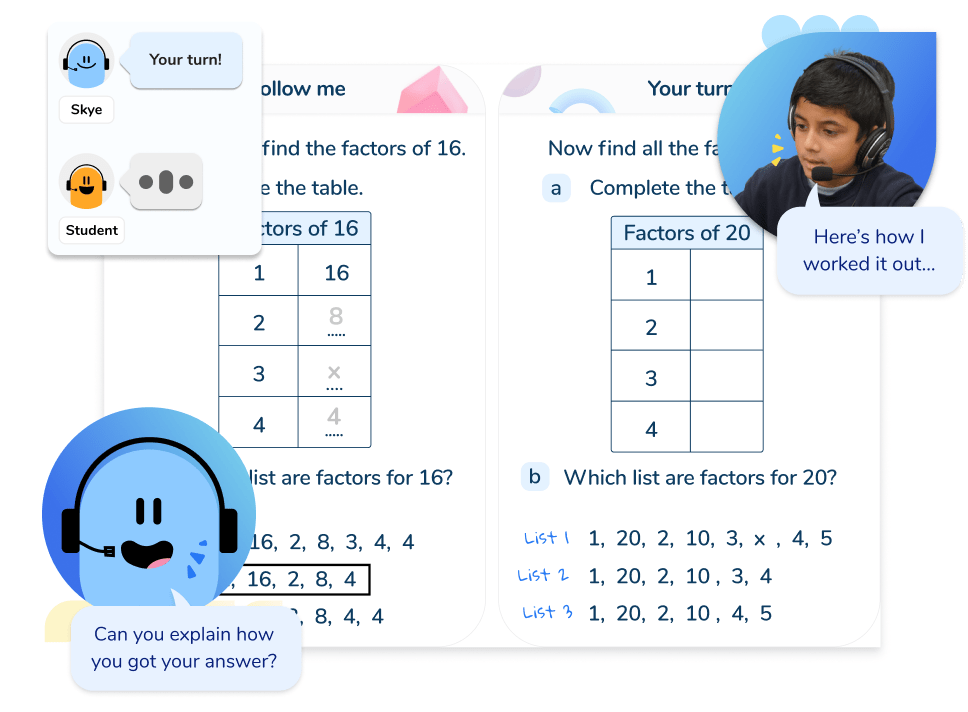
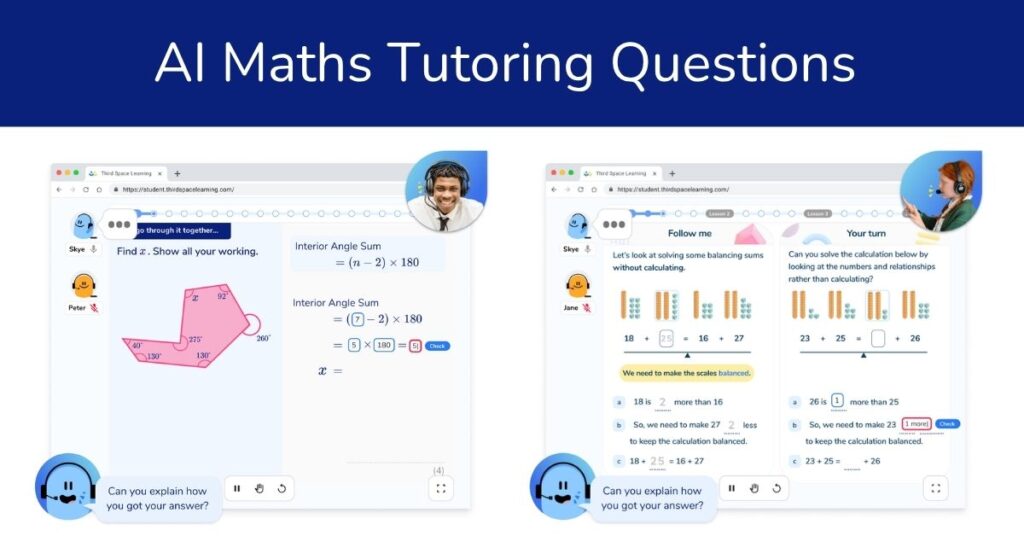
AI maths tutor Skye provides structured activities that move pupils from the concrete (manipulatives or real-life examples) to the pictorial (visual models like bar models or fraction diagrams) before they tackle the abstract symbolic notation. This scaffolded progression is key to mastering the more complex concepts of the Year 5 curriculum, such as solving relationships algebraically.
Topics in the Year 5 maths programme of study
The national curriculum states that in Year 5, the focus should be building a strong foundation for complex mathematical ideas that appear at secondary school.
This includes, but is not limited to, securing knowledge in:
- Place value: Reading, writing, ordering and comparing numbers to at least 1,000,000 and determining the value of each digit; interpreting negative numbers in context, count forwards and backwards with positive and negative numbers, including through 0.
- Addition and subtraction: Adding whole numbers with more than 4 digits using formal written methods.
- Multiplication and division: Multiplying and dividing numbers mentally, drawing upon known facts e.g. the times tables.
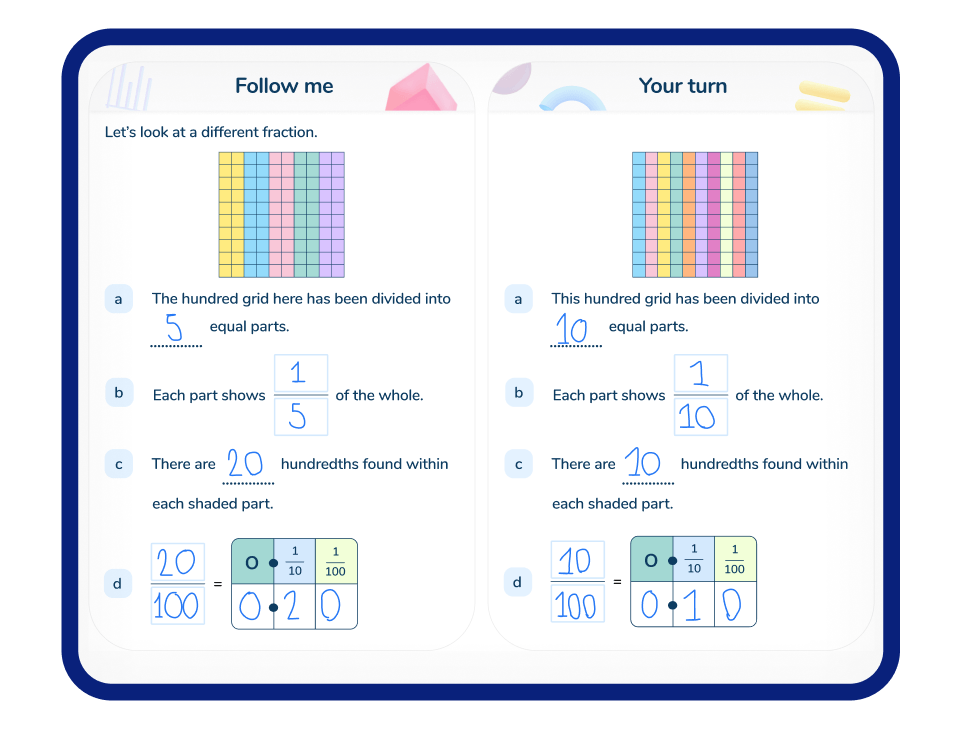
- Fractions: Multiplying proper fractions and mixed numbers by whole numbers; identifying, name and writing equivalent fractions of a given fraction, represented visually, including tenths and hundredths.
- Measurement: Converting between different units of metric measure; calculating and comparing the area of rectangles; solve problems involving converting between units of time.
- Geometry: Identifying 3D shapes and drawing angles; identifying, describing and representing the position of a shape following a reflection or translation.
To read more about the national curriculum for Year 5 maths (and Key Stage 2 as a whole), take a look at the government national curriculum website.
Topics covered in Year 5 White Rose Maths scheme of learning
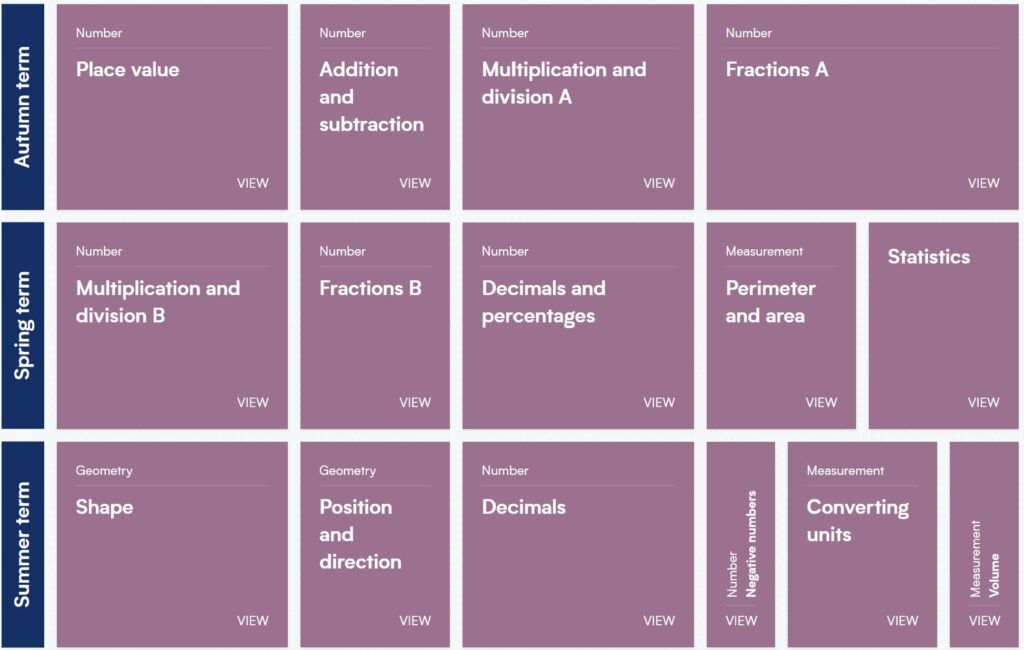
Approximately 80% of primary schools across the country use White Rose Maths. The White Rose Maths Year 5 scheme of learning (SOL) outlines which topics are taught, and when, throughout the autumn, spring and summer terms of Year 5, so it might give you an idea of when and in what order Year 5 pupils will be learning different topics.
The breakdown for Version 3 of the SOL is as follows.
Year 5 autumn term
- Place value
- Addition and subtraction
- Multiplication and division A
- Fractions A
Year 5 spring term
- Multiplication and division B
- Fractions B
- Fractions, decimals and percentages
- Perimeter and area
- Statistics
Year 5 summer term
- Shape
- Position and direction
- Decimals KS2
- Negative numbers
- Converting units
- Volume
The challenges of Year 5 maths
Year 5 introduces a significant step-up in cognitive challenge, and this acceleration can present pupils with a range of pressures, both academic and emotional. Having a supportive teacher who facilitates open dialogue is essential to help manage this transition.
Key challenges for Year 5 pupils include:
- Academic burden: Pupils may feel overwhelmed by the quantity of new knowledge being introduced.
- Emotional development: Many 9- and 10-year-olds experience shifts in friendship dynamics and develop self-image. These emotional changes can impact their focus and confidence in the classroom.
- Exam pressure: The awareness of impending academic assessment (such as SATs) begins to create very real pressure, making a smooth learning transition vital.
What follows are some of the key things pupils will face in maths this year, so that you can get a firm understanding of what maths for Year 5 is all about and what resources are available to you to support the children in your class.
Number sense and Place Value in Year 5 maths
The national curriculum says that in Year 5, children will learn to:
- read, write, order and compare numbers to at least 1,000,000 and determine the value of each digit
- count forwards or backwards in steps of powers of 10 for any given number up to 1,000,000
- interpret negative numbers in context, count forwards and backwards with positive and negative whole numbers, including through zero
- round any number up to 1,000,000 to the nearest 10, 100, 1000, 10,000 and 100,000
- solve number problems and practical problems that involve all of the above
- read Roman numerals to 1000 (M) and recognise years written in Roman numerals
Teaching Year 5 Place Value
Once pupils are feeling confident with most of the above place value topics, you can add prime numbers into the mix. Keep a place value chart to hand for the larger numbers Year 5 works with. This may be tough maths for 9-year-olds, but nobody improves without being challenged!
A prime number is defined as:
- “A whole number that cannot be made by multiplying other whole numbers together”;
- “Any number that is divisible only by itself and 1”
Prime numbers include 2, 3, 5, 7, 11 etc.
Try challenging your pupils to come up with as many numbers as possible that have only two factors. For example, the number five can only be made by multiplying one and five.
Alternatively, pupils can race against a partner to see who can name the most prime numbers in a minute.
If you find that any of your pupils are really struggling with the level of place value knowledge required in Year 5, it might be worth breaking things up a bit with some place value games. These are fun to do in class and will help pupils to build on their knowledge in a non-threatening way.
Year 5 Number and Place Value activity: prime numbers card game
Here is a great KS2 maths game that can help your child secure prime number knowledge using a deck of cards.
- Grab an ordinary deck of cards.
- Give each player half of the deck, but make sure they are dealt face down.
- Players take turns to flip a card over and place it in a pile in the middle. If the card that comes out is a prime number, the first person to exclaim “Prime!” wins the card and the rest of the stack.
- The winner is the player who manages to get the most cards when the game finishes. (We recommend ensuring that each game lasts for no longer than 5 minutes.)
Take a look at the video below to see how it works, and how you can bring a slight variation into the game if you want to speed it up!

Addition and Subtraction in Year 5 maths
In Year 5, the national curriculum says that children will learn to:
- add and subtract whole numbers with more than 4 digits, including using formal written methods (column addition and column subtraction)
- add and subtract numbers mentally with increasingly large numbers
- use rounding to check answers to calculations and determine, in the context of a problem, levels of accuracy
- solve addition and subtraction multi-step word problems in contexts, deciding which operations and methods to use and why.

READ MORE: Mental maths Year 5
Teaching Addition and Subtraction in Year 5 maths
By the end of Year 5, children should be able to add larger numbers using the formal written method, including four-digit numbers.
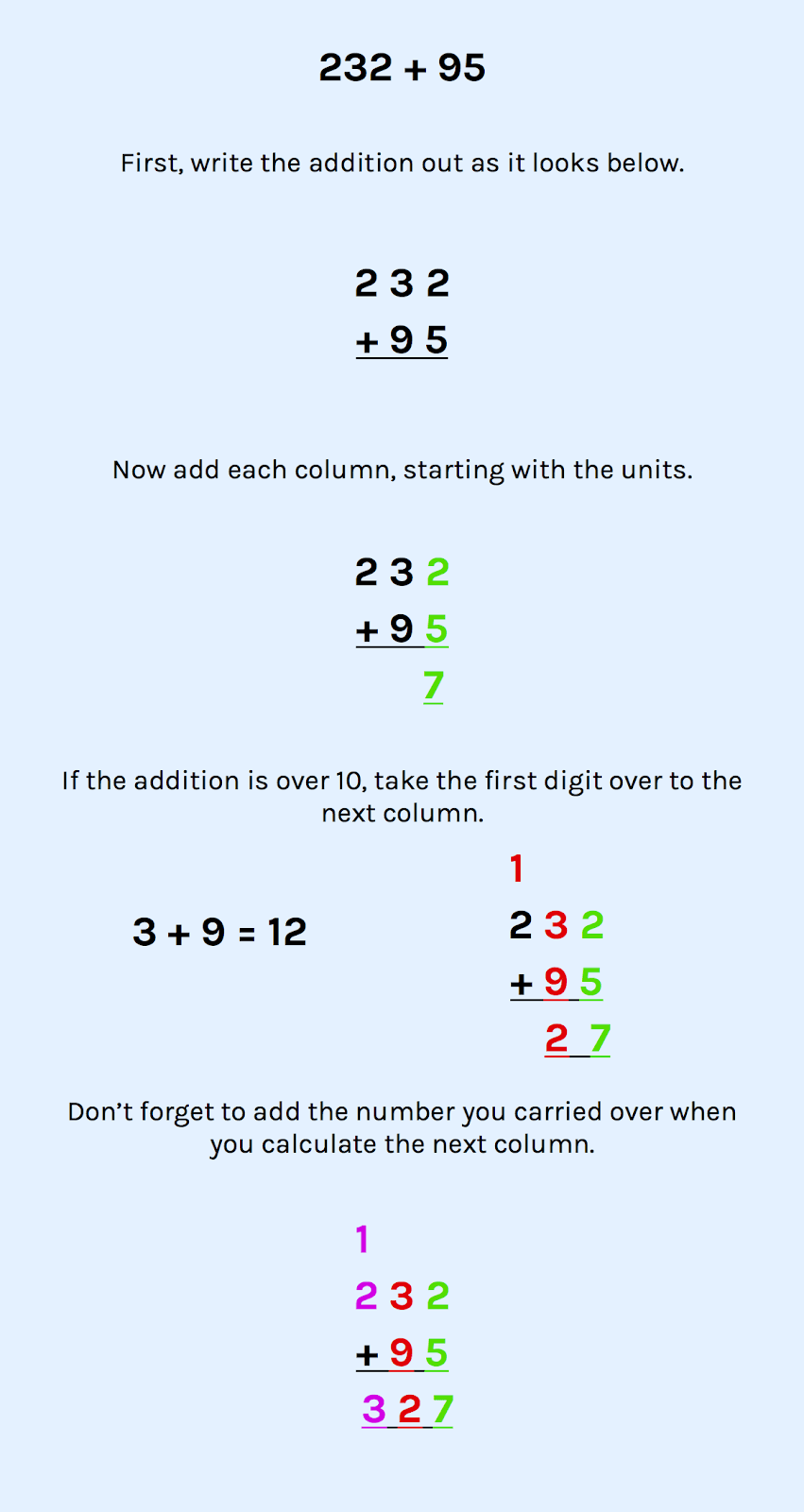
Below is an example of how to use the formal method of addition, broken down step by step. Having an example like this with you can be useful when pupils are practising addition, so they have something to refer to if they get stuck.
Subtraction
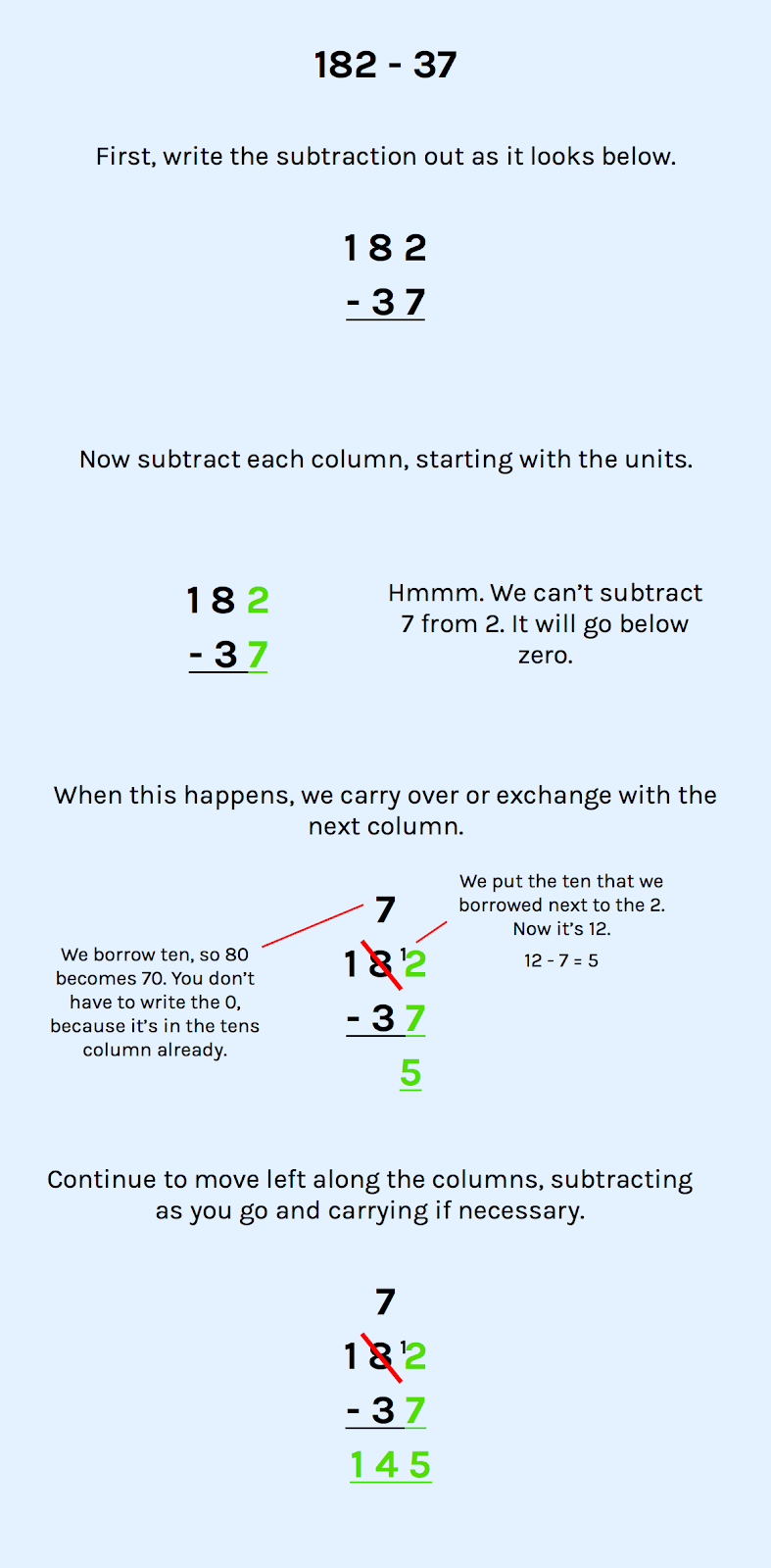
Make sure you practise subtracting larger numbers too, using the written method as broken down below.
Being able to carry numbers over accurately is a key part of written addition and subtraction, so it’s worth going over this with extra focus.
Multiplication and Division in Year 5 maths
In Year 5, the national curriculum says that children will learn to:
- solve problems involving multiplication and division, including scaling by simple fractions and problems involving simple rates.
- identify multiples and factors, including finding all factor pairs of a number, and common factors of two numbers
- know and use the key vocabulary of prime numbers, prime factors and composite (nonprime) numbers
- establish whether a number up to 100 is prime and recall prime numbers up to 19
- multiply numbers up to 4 digits by a one- or two-digit number using a formal written method, including long multiplication for two-digit numbers
- multiply and divide numbers mentally drawing upon known facts
- divide numbers up to 4 digits by a one-digit number using the formal written method of short division and interpret remainders appropriately for the context
- multiply and divide whole numbers and those involving decimals by 10, 100 and 1000
- recognise and use square numbers and cube numbers, and the notation for squared and cubed
- solve multiplication and division problems including using their knowledge of factors and common multiples, squares and cubes
- solve problems involving addition, subtraction, multiplication and division and a combination of these, including understanding the meaning of the equals sign
READ MORE:
Teaching Year 5 Multiplication and Division
Learning the formal written methods for long multiplication and short division with remainders in Year 5 is a crucial step in a pupil’s mathematical development. Mastering these efficient methods is essential preparation for the Key Stage 2 SATs, where fluency with multi-digit arithmetic is tested. These skills directly feed into Year 6 maths, enabling pupils to tackle complex problems involving fractions, decimals, percentages, and measurement conversions, as these often rely on accurate, quick calculation of larger numbers.
To demonstrate these essential skills and support your teaching, the following sections provide detailed, step-by-step worked examples using the formal written layout for both operations.
Long multiplication: step by step
Example Question: Calculate 453 x 32
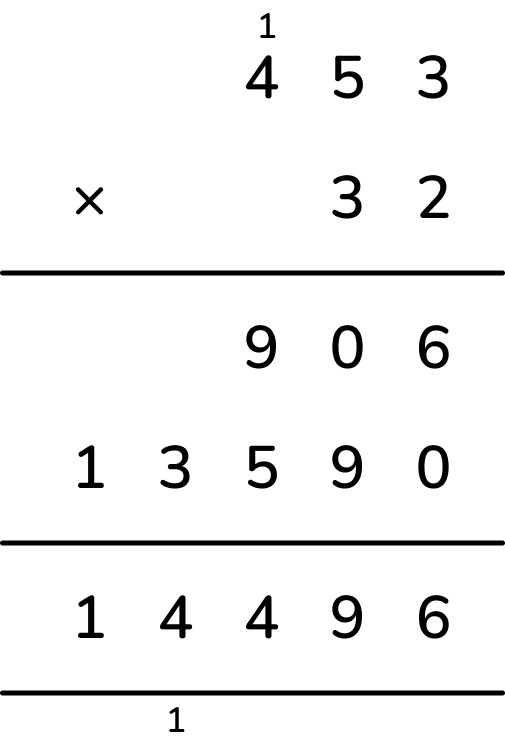
- Set up the question in the formal method, making sure the ones and tens digits, and so on, line up.
- Start the process of multiplication with the ones digit (2).
- Multiply 2 by 3 (the ones digit of 453).
- Write the answer down correctly (6). There is no regrouping.
- Multiply 2 by 5 (the tens digit). (2 x 5 = 10).
- Add anything that you have regrouped (nothing carried over).
- Write the answer down correctly – including any regrouping (write 0, carry 1 to the hundreds column).
- Multiply 2 by 4 (the hundreds digit). (2 x 4 = 8).
- Add anything that you have regrouped from the previous multiplication (8 + 1 = 9). Write the answer down correctly (9).
- Drop a zero as we are now multiplying with 3 tens (30).
- Multiply 3 by 3 (the ones digit of 453).
- Write the answer correctly (9 in the tens column).
- Multiply 3 by 5 (the tens digit). (3 x 5 = 15).
- Write the answer down (write 5, carry 1 to the hundreds column).
- Multiply 3 by 4 (the hundreds digit). (3 x 4 = 12).
- Add anything that you have regrouped (12 + 1 = 13).
- Write the answer correctly (13).
- Add the two answers (partial products) 906 and 13590 up together correctly.
- Final answer: 453 x 32 = 14496.
Short division: step by step
Example Question: Calculate 867 ÷ 4

- Set up the calculation using the ‘bus stop’ method.
- Divide the hundreds: Divide the first digit, 8, by 4.
- 8 ÷ 4 = 2. Write the 2 directly above the 8. There is no remainder.
- Divide the tens: Divide the next digit, 6, by 4.
- 6 ÷ 4 = 1 with a remainder of 2 (because 1 x 4 = 4, and 6 – 4 = 2).
- Write the 1 above the 6. Carry the remainder 2 over to the next digit (the 7 in the ones column). The 7 now becomes 27.
- Divide the ones: Divide the new number, 27, by 4.
- 27 ÷ 4 = 6 with a remainder of 3 (because 6 x 4 = 24, and 27 – 24 = 3).
- Write the 6 above the 7. The 3 is the final remainder.
- Final Answer: 867 ÷ 4 = 216 remainder 3 (or 216 r 3).
Now is also the time to clarify tricky maths vocabulary. At this age, pupils should know their measurements from their multiplication, but there are still a number of other mathematical words and phrases that could cause issues down the line if they are not understood now. See our primary maths dictionary for a full list.
Two key terms are factors and products. These terms might sound complicated, but they’re actually a great way of talking about multiplication without getting bogged down in the numbers.
If you’re feeling uncertain about factors and products, take a few minutes to look at this simple diagram which gives you some examples for each term.
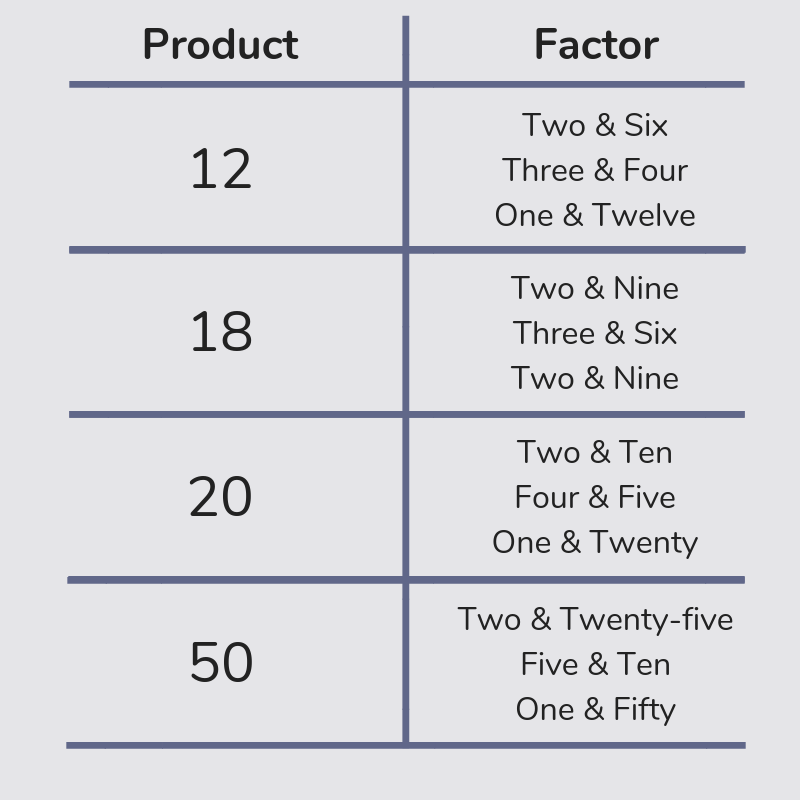
Year 5 Multiplication and Division activity: product, pair, factor
To effectively secure the concepts of factors and multiples in pupils, consistently integrating the correct mathematical vocabulary into classroom discussions is essential. This quick, engaging activity transforms simple practice into a dynamic fluency exercise.
The product, pair, factor game is a flexible, no-prep, whole-class oral exercise designed to drill the relationship between a product (the result of multiplication) and its factors.
Here it is step-by-step:
- The product: The teacher states a product (a number that can be made by multiplying two integers).
Example: “Twenty-four.” - The factors: A pupil is selected to respond by stating any factor pair that multiplies together to make that product. The pupil must use the correct terminology.
Example: “Eight and three are factors of twenty-four.” - Vocabulary reinforcement: After the pupil answers, the teacher immediately reinforces the relationship using the term multiple.
Example: “Excellent. That means twenty-four is a multiple of eight, and twenty-four is also a multiple of three.” - Extension and challenge:
- Finding all factors: Challenge the class to continue listing all possible factor pairs for a given product before moving on to a new number.
- Prime products: Introduce prime numbers (e.g., ’13’) and discuss why they only have one factor pair (‘one and thirteen’).
Fractions, Decimals and Percentages in Year 5 Maths
In Year 5, the national curriculum says that children will learn to:
- recognise the per cent symbol (%) and understand that per cent relates to ‘number of parts per hundred’, and write percentages as a fraction with denominator 100, and as a decimal
- compare and order fractions whose denominators are all multiples of the same number
- identify, name and write equivalent fractions of a given fraction, represented visually, including tenths and hundredths
- recognise mixed numbers and improper fractions and convert from one form to the other and write mathematical statements > 1 as a mixed number
- add and subtract fractions with the same denominator and denominators that are multiples of the same number
- multiply proper fractions and mixed numbers by whole numbers, supported by materials and diagrams
- read and write decimal numbers as fractions
- recognise and use thousandths and relate them to tenths, hundredths and decimal equivalents
- round decimals with two decimal places to the nearest whole number and to one decimal place
- read, write, order and compare numbers with up to three decimal places
- solve problems involving number up to three decimal places
- solve problems which require knowing percentage and decimal equivalents of ‘half’,’one quarter’, ‘one fifth’, ‘two fifths’, ‘four fifths’ and those fractions with a denominator of a multiple of 10 or 25.
Teaching Year 5 Fractions, Decimals and Percentages
It’s important to know the equivalent decimals and percentages to some common fractions by Year 6, so make sure pupils have a good grip on these:

Fractions, Decimals and Percentages in the KS2 SATs
Fractions, Decimals and Percentages frequently appear in the KS2 SATs papers across all three papers:
- Paper 1 (arithmetic): This paper usually has at least one or two questions that test knowledge of Fractions, Decimals and Percentages. For example:
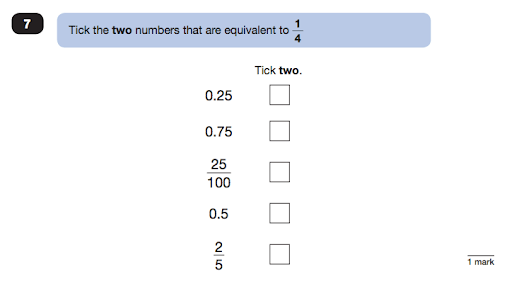
It will also include some more simple questions on multiplying, dividing, adding and subtracting fractions.
- Papers 2 and 3 (reasoning): Pupils will encounter questions that not only ask them to compare Fractions, Decimals and Percentages, but also solve problems with mixed numbers. For these sorts of questions a good understanding of the basics is key – if they already know that ‘half’ is the same as 0.5, pupils will find it easier to work out how to express 3.5 as a fraction, for example.
The arithmetic paper will also include some more simple questions on multiplying, dividing, adding and subtracting fractions.
RELATED RESOURCES:
Measurement in Year 5 maths
In Year 5, the national curriculum says that children will learn to:
- use all four operations to solve problems involving measure (for example, length, mass, volume, money) using decimal notation, including scaling.
- convert between different units of metric measure (for example, kilometre and metre; centimetre and metre; centimetre and millimetre; gram and kilogram; litre and millilitre)
- understand and use approximate equivalences between metric units and common imperial units such as inches, pounds and pints
- measure and calculate the perimeter of composite rectilinear shapes in centimetres and metres
- calculate and compare the area of rectangles (including squares), and including using standard units, square centimetres and square metres, and estimate the area of irregular shapes
- estimate volume (for example, using 1 cm^3 blocks to build cuboids (including cubes) and capacity, for example, using water)
- solve problems involving converting between units of time and time word problems
Teaching Year 5 Measurement
Year 5 mathematics marks a significant step-up in working with larger numbers, and Measurement is a core domain where this complexity is most evident. The ability to fluently convert between different units of measurement (e.g., centimetres to metres, millilitres to litres) is a crucial skill at this age, forming a necessary bridge to secondary mathematics and providing highly valuable life skills.
The shift from smaller to larger units – often involving multiples of 100 or 1000 – provides a rich context for strengthening understanding of decimal place value. Maths misconceptions surrounding decimal placement are easily revealed and addressed through practical conversion tasks.
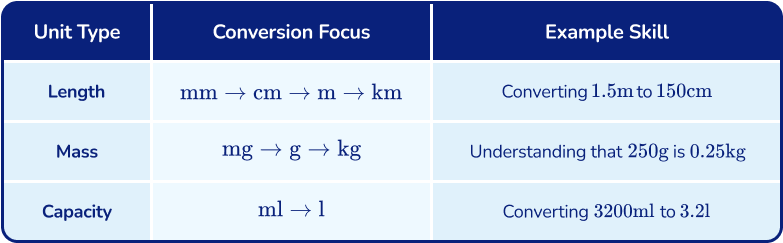
Year 5 Measurement activity: kitchen audit challenge
This activity aims to practice metric conversions (g → kg, ml → l) using real-world packaging data.
- Preparation: Collect various food and drink packaging (e.g., cereal boxes, fizzy drink bottles, tins) that clearly state their mass or volume in grams/millilitres.
- Implementation: Divide the class into small groups and provide each group with a selection of three to five items.
- Task: Each group must create a table listing the product and its original measurement. Their challenge is to convert all measurements into the larger unit (e.g., converting 750g to 0.75kg).
- Assessment: Have groups present their most challenging conversion, explaining the process and how the digits shift across the decimal point. This provides instant formative assessment on decimal understanding.
Year 5 Measurement activity: metric and imperial
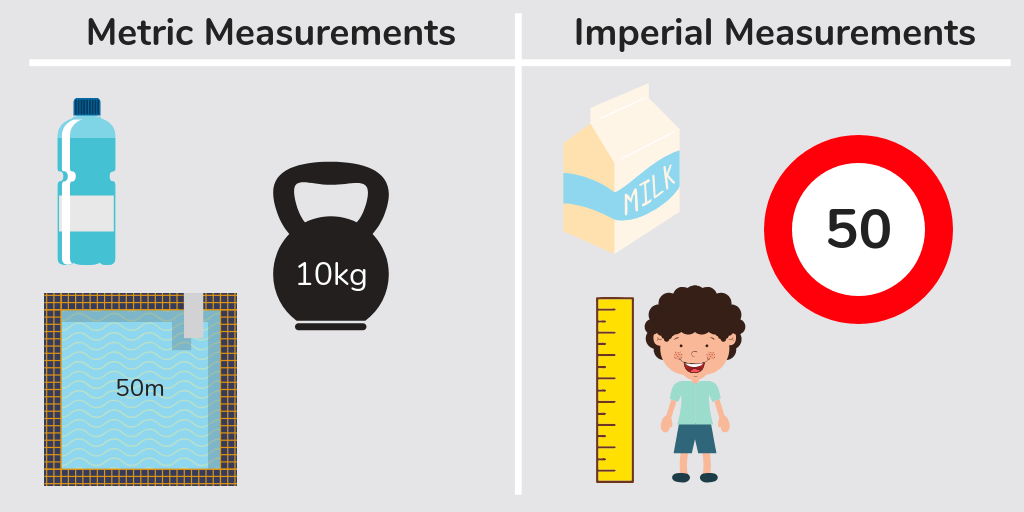
Fortunately, the main focus of the current curriculum is on the metric system. But in Year 5, pupils will need to know about imperial units like pints, pounds and inches too.
Although it only makes up a small part of the curriculum, it’s worth explaining to pupils that although we use the metric system for most things, there are still uses for imperial measurements (like pints of milk and gallons of petrol). The following activity can help pupils connect this to real-life contexts.
- Introduction: Discuss the historical and current use of imperial measures in the UK (e.g., road signs, body weight, beer/milk pints). Emphasise that this is about recognising their use, not complex conversion.
- Task: Assign small groups a specific real-world scenario (e.g., a supermarket, a road trip, a recipe).
- Presentation: Each group creates a short presentation or poster identifying which measurements in their scenario are metric and which are imperial.
- Supermarket Group: Milk (Pints/Litres), Bananas (Weight in kg/lbs).
- Road Trip Group: Distance (Miles/Kilometres), Petrol (Gallons/Litres).
Year 5 Measurement activity: practise telling the time together
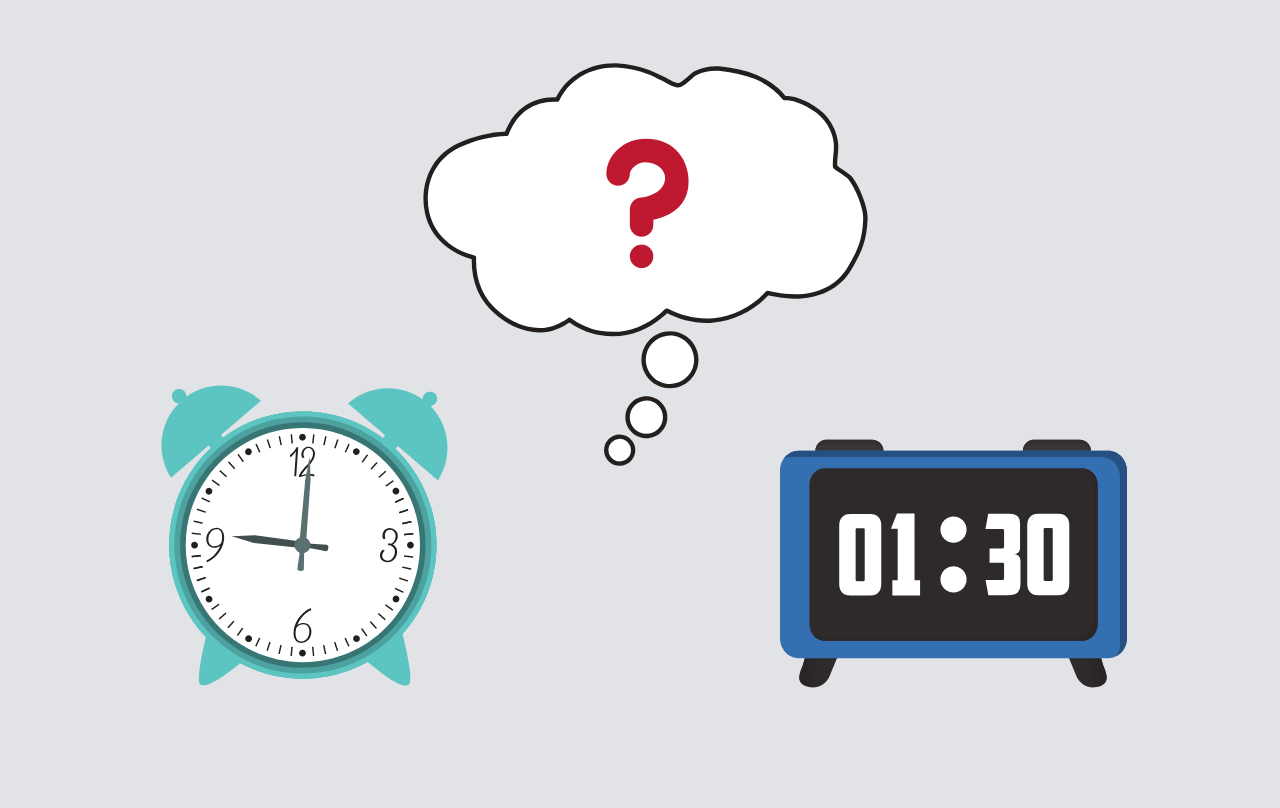
As the world becomes more and more digital, many children cannot read analogue clocks.
But telling time is an important part of Year 5 maths, so make sure you establish consistent reinforcement of time-telling, duration, and conversion skills in the classroom and clearly display an analogue clock.
Here are some simple ways your class can practise telling the time together.
The “start of the day” clock check
- Routine: Begin the day with a simple time calculation displayed prominently on the board.
- Skill focus: time interval/duration (past to future).
- Task examples:
- “How long until morning break (10:30)?” (Pupils calculate the time remaining from the current minute).
- “Maths lessons starts at 9:00 and lasts for 1 hour 15 minutes. What time will it end?” (Focuses on time addition).
The “break/lunch time” conversion
- Routine: As pupils transition to or from breaks, use the exact timing to practise conversion and duration.
- Skill focus: analogue/digital conversion and duration (past to past).
- Task examples:
- When the bell rings for lunch (e.g., 12:15), announce the time and challenge: “Lunch started at quarter past twelve. Write that time in the 24-hour digital format.” (Answer: 12:15 or 12:15 p.m.).
- “How long did we spend at lunch? We left at 12:15 and returned at 1:00 p.m.” (Answer: 45 minutes).
The “assembly/activity duration” report
- Routine: After a fixed-length school event (like assembly, P.E., or reading time), use the event’s duration as a calculation point.
- Skill focus: elapsed time and time subtraction.
- Task examples:
- Before assembly, note the start time on the board (e.g., 2:05 p.m.). When you return, note the end time (e.g., 2:40 p.m.). Ask: “How long was our assembly?” (Answer: 35 minutes).
- Ask a pupil to calculate: “If reading time was 25 minutes long and we finished at 11:35 a.m., what time did we start?” (Focuses on working backwards).
By making these moments routine, pupils stop seeing time calculation as a maths problem and start seeing it as an essential, relevant life skill.
Geometry in Year 5 maths
Properties of shapes
In Year 5, under properties of shapes, the national curriculum says that children will learn to:
- distinguish between regular and irregular polygons based on reasoning about equal sides and angles.
- identify 3-D shapes, including cubes and other cuboids, from 2-D representations
- know angles are measured in degrees: estimate and compare acute, obtuse and reflex angles
- draw given angles, and measure them in degrees (°)
- identify:
- angles at a point and one whole turn (total 360°)
- angles at a point on a straight line and half a turn (total 180°)
- other multiples of 90°
- use the properties of rectangles to deduce related facts and find missing lengths and angles
Position and direction
In Year 5, the national curriculum says that children will learn to:
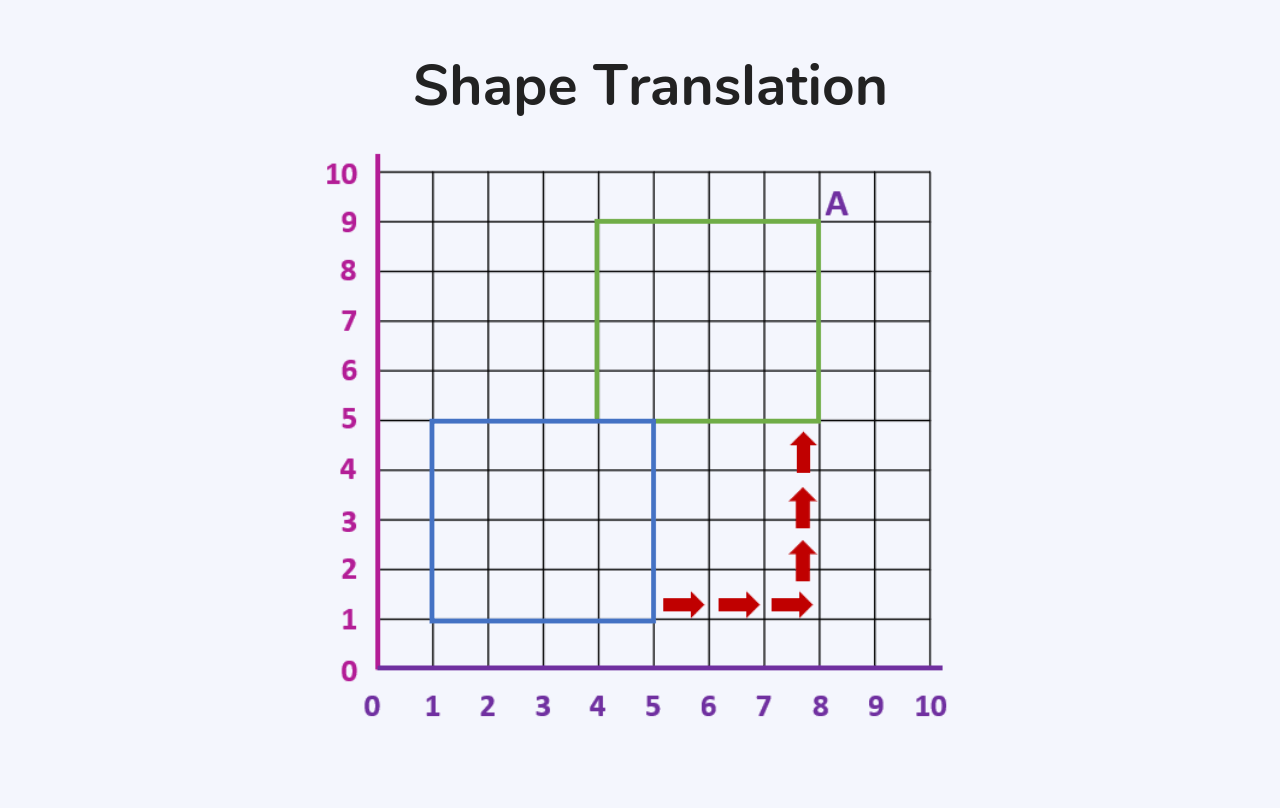
- identify, describe and represent the position of a shape following a reflection or translation, using the appropriate language, and know that the shape has not changed
Teaching Year 5 Geometry
Shape extends beyond simply recognising names and properties at this age. 9-year-olds need to know how to manipulate shapes on a grid. This is where accuracy matters, so remind pupils that reflection, rotation and translation all require careful attention and steady work. It’s very common for children who have strong number skills to find these three processes difficult, so be patient and practise often.
Refer to real life uses of these skills whenever you can. Transformations play a key role in animating cartoons, helping planes to take off and even in sports strategy.
Year 5 Geometry activities: transformation of shapes
Year 5 shape transformation using reflection
To begin with, practise reflection using a mirror.
To do this you’ll need to:
- Draw a selection of shapes on a grid, leaving enough room at the side for the next step.
- Reflect the shapes you have drawn by placing a small mirror next to the shape.
- Draw the reflected shape at the same distance from the mirror line as the original shape.
Note: You can use the squares to help you, but in secondary school, pupils will draw reflections without a grid. For now though, it’s more important to get a solid understanding of the concept.
Year 5 shape transformation using rotation
A slightly trickier skill to master than reflection, rotation can be a great way to help your 9-year-old learn about shape transformation in a fun and interactive way.
To do this you’ll need to:
- Get some tracing paper and lay it over a piece of regular paper which has shapes on it.
- Draw on a square grid and use a ruler to copy the shape onto the tracing paper.
- Next, draw a dot to mark the centre of the grid.
- Match up this point with the centre of the grid and place your pencil on the dot. You’ll be able to rotate the tracing paper around the grid to whichever position you want!
This is a great way to improve spatial awareness for rotation – the trick now is to practise drawing the rotated shape without the tracing paper.
Year 5 shape transformation using translation
Translation is the more challenging transformation of the three because it requires careful attention.This time, all you’re doing is moving the shape around the grid (without turning it). The easiest way to do this is to look at each corner (or vertex) of the shape at a time and follow the instructions for translation for each one. This way, you slowly piece the shape back together (rather than trying to move the whole thing at once, which can get confusing quickly).
Statistics in Year 5 maths
In Year 5, the national curriculum says that children will learn to:
- solve comparison, sum and difference problems using information presented in a line graph
- complete, read and interpret information in tables, including timetables.
Non-statutory guidance also suggests that pupils:
- begin to decide which representations of data are most appropriate and why.
- connect their work on coordinates and scales to their interpretation of time graphs.
Year 5 Statistics activity
Link your teaching to exciting current events, such as sporting events. The example below is based on information about the FA cup presented in a table format:
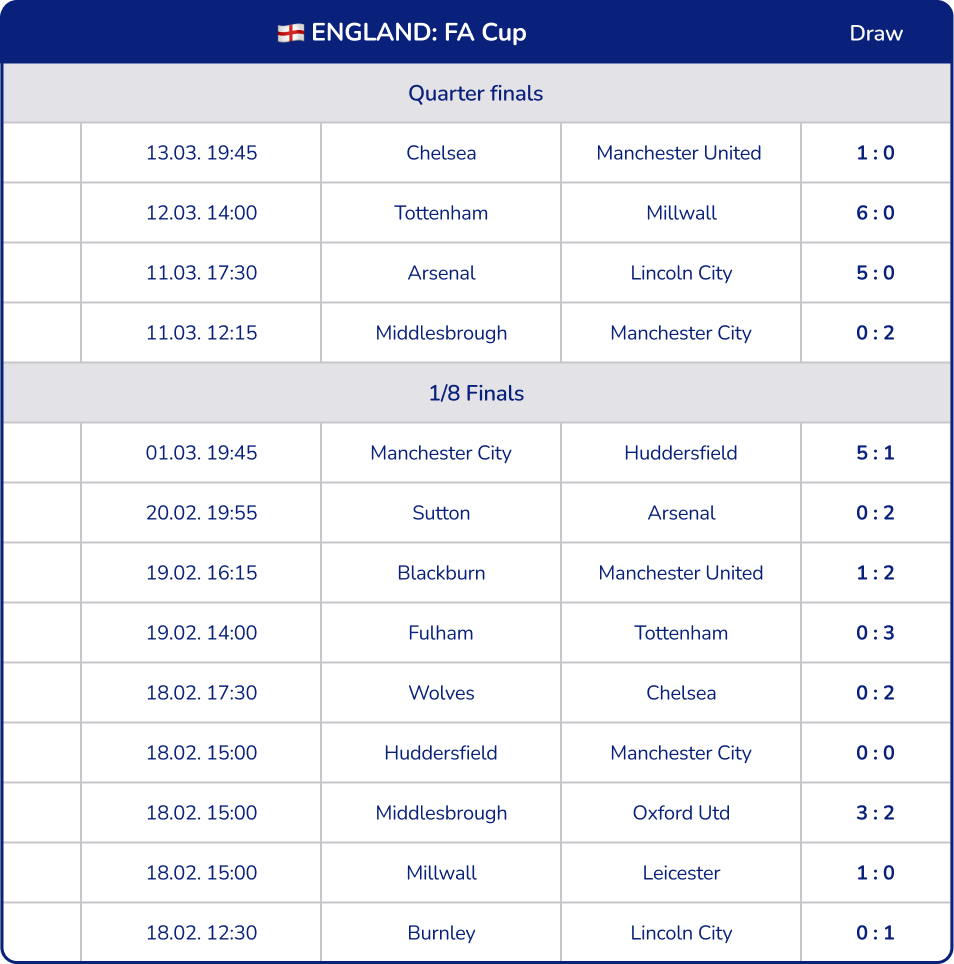
Use the table above to work out the answer to the following questions:
- How many goals were scored in total?
- Which team scored the highest number of goals in both rounds?
- Which teams scored three goals in both rounds?
- Which match had the largest goal difference?
- Which match resulted in a draw?
- Calculate the mean, median and mode number of goals scored. Round any decimal numbers to one decimal place.
Problem solving in Year 5 maths
Problem-solving is the crucial next step after mastering procedural fluency. Applying numerical skills to word problems provides a meatier challenge that develops independence and resilience – skills vital for confident mathematicians aged 9-10.
Confident mathematicians might find this frustrating at first, but if you take your time together, you’ll reap the reward of solving a tough problem.
Year 5 problem solving activity: deconstruct the word problem
The easiest way to make word problems more engaging is to own them. Instead of immediately solving word problems, focus on teaching pupils how to critically analyse the structure and clarity of the question itself.
- Analyse for clarity: Present the class with a range of word problems (good and poor examples). Discuss and decide, as a group, “What makes a great word problem?” and “What makes a terrible one?”
- Focus: Identify common issues like ambiguous wording, extraneous information, or a lack of essential data.
- Emphasise reading comprehension: Use this analysis to highlight the importance of careful, critical reading before attempting any calculation. Misreading the question is the most common pitfall.
- Promote Discussion: Even if confident pupils initially find this analysis frustrating, taking the time to discuss the problem’s design will ultimately foster stronger problem-solving habits and deeper understanding.
Year 5 problem solving activity: constructing word problem
Once pupils know their way around a good word problem, they can have a go at writing them for each other.
| Step | Teacher | Pupils |
| Drafting | Teacher provides a target: e.g., “Write a 2-step word problem involving subtraction and division.” | Pupils draft their own 1- or 2-step word problems for a peer or the teacher to solve. |
| Solving & Testing | Teacher models the working out of a student’s problem, thinking aloud about problem-solving strategies. | Pupils solve problems written by classmates. |
| Debugging | If a student’s problem is impossible to solve (e.g., missing information, contradictory data), the teacher discusses and elicits from the class what he or she needs to know in order to answer it. | Pupils learn to identify key information in word problems by identifying those that are impossible to answer. |
| Motivation | Encourage pupils to write a challenging (but solvable) problem specifically for the teacher. Outsmarting the teacher is a powerful motivator for this age group! |
RELATED RESOURCES: Primary School Guide To Problem Solving Techniques
Year 5 maths intervention: close attainment gaps in Long Multiplication & Fractions, Decimals and Percentages
Year 5 maths presents challenges for both pupils and teachers, often due to the cumulative nature of topics and the challenge of transitioning to upper Key Stage 2. Many pupils struggle with key conceptual building blocks like long multiplication and fractions, decimals & percentages, creating wide attainment gaps that hold students back and are difficult to address in a busy whole classroom environment.
Third Space Learning’s AI maths tutoring with Skye provides targeted intervention specifically designed to close attainment gaps in complex Year 5 topics. The program uses an initial diagnostic assessment to pinpoint individual knowledge gaps and then delivers personalised, one-to-one lessons to ensure every pupil masters the fundamental concepts. This early, targeted support is highly effective for building the confidence needed for KS2 progression and ensures pupils are equipped with the foundational knowledge to engage with mathematical discussion before they face the increased pressure and curriculum demands of Year 6.
Our Year 5 pupils now have that confidence to go and try it, maybe put their hands up and talk about maths which at the start of Year 6 is very valuable. It’s a good thing this is happening in Year 5 as by Year 6 it’s almost too late.
Tim Jackson, Maths Coordinator, Pangbourne Primary School
We noticed when Year 5s who’d been on the programme started Year 6 they were more confident. Before, their default sometimes was “I don’t know, I’ve never seen it before”. Giving them that little boost was perfect because now they start the lesson out of that deficit. We’re on the front foot already.
David Gooding, Assistant Headteacher, Harrison Primary School
Looking for more Year 5 maths support?
We’re here to help with any additional Year 5 maths support you need for your lessons so please explore our collection of resources, from our guides on division for kids and the long division method, to these fun maths games and times tables games for all children.
Also in this series:
- Year 3 Maths Curriculum Toolkit for 6 & 7 Year Olds
- Year 3 Maths Worksheets
- Year 4 Maths Curriculum Toolkit for 7 & 8 Year Olds
- Year 4 Maths Worksheets
- Year 6 Maths Curriculum Toolkit for 10 & 11 Year Olds
- Year 6 Maths Worksheets

DO YOU HAVE STUDENTS WHO NEED MORE SUPPORT IN MATHS?
Skye – our AI maths tutor built by teachers – gives students personalised one-to-one lessons that address learning gaps and build confidence.
Since 2013 we’ve taught over 2 million hours of maths lessons to more than 170,000 students to help them become fluent, able mathematicians.
Explore our AI maths tutoring or find out about primary school tuition for your school.


![Closing the Disadvantage Gap in Primary Maths: Two Schools, Two Approaches [Webinar]](https://thirdspacelearning.com/wp-content/uploads/2026/06/Screenshot-2026-06-17-at-09.31.13-1024x575.png)