



2026 SATs Papers: KS2 SATs Maths Papers Question Breakdown

Now that the confidentiality period for the key stage 2 2026 SATs papers has ended and SATs week already feels like a distant memory, it’s finally time to take a proper look at the content of this year’s maths papers and dig into the detail behind the questions.
In this article, we’ll break down the 2026 KS2 SATs maths papers question by question, looking at domain coverage, recurring themes and the areas pupils found most challenging. The aim is to give Year 6 teachers, maths leads, and school leaders useful insights to help inform SATs preparation for 2027.
As maths is our main focus at Third Space Learning, this analysis focuses solely on the maths SATs papers rather than the other national curriculum assessments – English grammar, punctuation and spelling or the English reading paper. It also doesn’t cover the English writing national curriculum test, which is assessed through teacher assessments rather than a formal written exam.
If you’re short on time or need a summary to share with staff, don’t miss the free download: Maths SATs 2026 Question Breakdown: Staff Discussion Points.
Key takeaways
We’ve completed a full question-level breakdown of all three KS2 SATs 2026 maths papers. As always, we take a close look at the two maths reasoning papers, which give pupils the best opportunity to show deeper mathematical understanding. We’ll also be looking at whether the arithmetic paper has followed the same formula as it has for the past five years.
Across all three papers, we explore:
- The level of difficulty and cognitive demand
- Year group coverage
- Content domain coverage
- Question types and structures
- How the 2026 papers compare with previous years
We also highlight any notable content gaps in the latest SATs tests and share practical, classroom-ready tips to help support preparation for the 2027 KS2 Maths SATs.

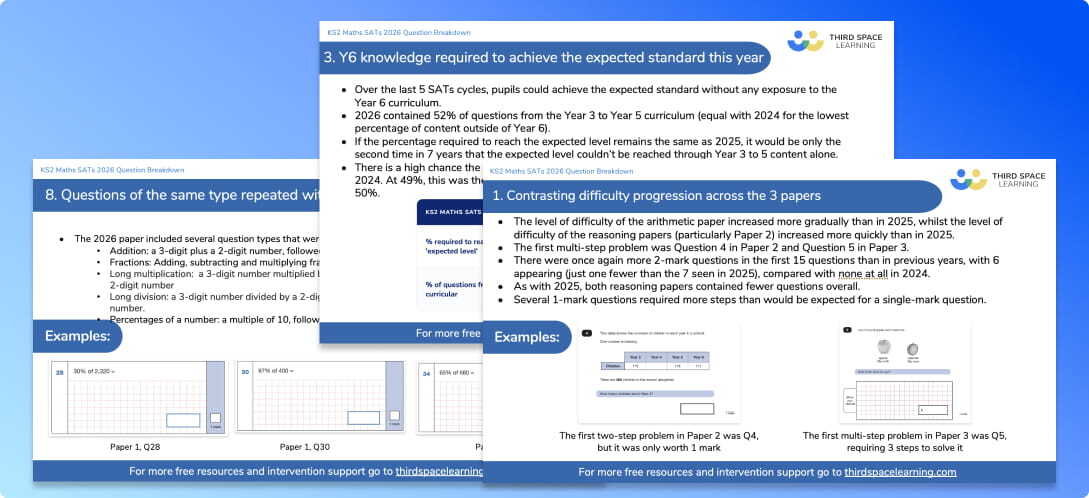
Maths SATs 2026 Question Breakdown: Staff Discussion Points
Download this presentation to take you through the key points from our question-level analysis of the 2026 KS2 SATs maths papers, includes example questions from the 2026 maths SATs papers. Can be used in staff meetings.
Download Free Now!SATs 2027: STAY UP TO DATE
Join our email list to stay up to date with the latest news and free resources for SATs 2027. As usual, our expert teachers will be on hand to provide one to one tuition support, revision resources, expert paper analysis, SATs teacher survey results and the SATs results 2027.
Difficulty and cognitive demand of the 2026 maths SATs papers
Before we jump into the 2026 SATs papers, let’s have a quick look at some of the key patterns and insights Third Space Learning has picked up from the last four years of the standard assessment tests.
KS2 SATS 2022 Maths Papers Question Breakdown
‘Mixed response to the level of difficulty and cognitive demand.….Fair in regards to challenging those children who should be aiming for greater depth in maths…..The question images tripped up some children on at least 2 examples….The proportion of questions testing Year 6 content has reduced…..Contexts for questions seemed much more relatable…..Question setters showed an impressive ability to over-complicate.’
KS2 SATS 2023 Maths Papers Question Breakdown
‘The lowest percentage of year 6 content of all the previous 5 cycles of SATS exams (36%)…. No cliff edge and a more gradual increase in difficulty……the number of marks did not always match the amount of work required……increased content from the year 3 curriculum….The expected standard could be achieved with no year 6 maths…..Contexts for questions were again generally relatable……The level of spatial awareness required was high.’
KS2 SATS 2024 Maths Papers Question Breakdown
‘A return to ‘cliff edge’ questions with both Paper 2 and 3 having clear turning points where the level of cognitive demand required stepped up suddenly….Too few marks offered for too much work…. Significant increase in the proportion of Year 6 content coverage….More difficult to reach the expected standard without any exposure to the Year 6 curriculum compared to the previous two SATS cycles…Content coverage broadly similar to previous years… Solid understanding of mathematical vocabulary was important…Reduced focus on spatial awareness and increased focus on the use of mathematical equipment
KS2 SATS 2025 Maths Papers Question Breakdown
‘A gradual increase in difficulty through the papers, compared to the ‘cliff edge’ seen in 2024…. the fewest total number of reasoning questions than we have seen in the past five SATs cycles, with an increase in 2 mark questions…. A slight increase in the proportion of content from Upper Key Stage 2, but a decrease in the proportion of Year 6 content from the 2024 SATS (still much higher than 2022 and 2023)….Analysis of the last 5 years’ arithmetic papers found the same question types and the number of each question type is repeated each year….Increased number of questions involving spatial awareness…
GET THE ANALYSIS ON PREVIOUS SATS
SATs have been running in their current incarnation for 7 years; there were no government standardised assessments in 2020 and 2021 as a result of the Covid-19 pandemic. Get all the analysis and results from previous national assessments below.
And find out which are the top 20 year 6 maths revision topics to focus on this year.
– SATs papers 2026
– SATs papers 2025
– SATs results 2025
– SATs papers 2024
– SATs results 2024
– SATs papers 2023
– SATs results 2023
– SATs papers 2022
– SATs results 2022
– SATs papers 2019
– SATs results 2019
– SATs papers 2018
– SATs results 2018
– SATs papers 2017
– SATs results 2017
– SATs results 2016
What did teachers think of the 2026 maths SATs papers?
Teachers across the country agreed, as per usual, that Reasoning Paper 2 was the trickiest of all three test papers. In Third Space Learning’s KS2 SATs teacher survey 2026 68% of teachers rated the first reasoning paper as difficult or very difficult, with just 2% describing it as easy.
“It seemed like a great paper for greater depth children. But not for the rest.”
Year 6 Teacher, Greater London
Teachers reported multi-step problems where pupils had to think through several stages, work through their reasoning, and arrive at an answer – all for a single mark. And, not forgetting the usual difficulty of the wording.
“It sometimes feels like the wording of the question overcomplicates it and takes it away from being a maths test and more of a comprehension test.”
Hannah Watson, Deputy Headteacher, Grange Primary School, Greater London
A few teachers also flagged that the paper drew on topics that haven’t featured as strongly in past SATs papers, which left some pupils unsure of how to begin.
“The range of topics meant that pupils had to retrieve a lot of information. It was very cognitively demanding.”
Fiona, Year 6 Teacher, Claydon Primary School, South East
The emotional response from pupils came through clearly. Several teachers described children feeling overwhelmed, unsure where to start, and finishing the paper with the sense that they hadn’t been able to show what they could do. Pupils on the cusp of working at the expected standard were particularly affected, with less time for the “quick wins” that build confidence early on in a paper.
Arithmetic landed broadly, as teachers expected. 91% rated it average or easier with only 8% calling it difficult or very difficult.
“Just a very nice paper! Even cuspy children finished with time to spare.”
Kate Butcher, Year 6 Teacher, Langenhoe Community Primary School, South East
Reasoning Paper 2 landed noticeably better than Paper 1. 64% of teachers rated it average or easier, with only around just 36% finding it difficult or very difficult, roughly half the proportion who said the same about Paper 1.
“This paper was far nicer – the language was much more straightforward and the questions were not as complex to work out the required maths.”
Alison McQuiston, Year 6 Teacher, Larkfield Primary School, North West
Overall consensus of the three maths SATS papers: Predictable Arithmetic, fewer reasoning questions and contrasting difficulty progression across the papers
It seems the Arithmetic Paper followed the same familiar format and style of questions that we’ve come to expect each year. The 2026 paper also returned to the more predictable, gradual increase in difficulty, after the 2025 paper threw in a few surprises, with some trickier questions much earlier on.
As we’ve seen over the last few years, Reasoning Paper 2 was once again noticeably more challenging than Reasoning Paper 3. Both reasoning test papers continued with the trend first seen in 2025 of having fewer questions overall, but with a higher number of 2-mark questions than we have typically seen in earlier papers.
That said, despite the reduction in the total number of questions and the increase in available 2-mark questions, there were still some 1-mark questions requiring a surprisingly large amount of working out and exam technique for just a single mark.
Arithmetic Paper 1
As in previous years, Arithmetic Paper 1 began with questions covering the four operations across the opening two pages. However, unlike the 2025 paper – which introduced a more challenging decimals questionunusually early on – this year’s paper returned to the more familiar pattern of gradually increasing in difficulty as pupils progressed through the test.
This year, pupils didn’t encounter a decimal question until Question 13, whereas in 2025 the first decimal question appeared much earlier on Question 4, within the first two pages of the paper. The first 2-mark question also appeared later this year, with the first long multiplication question coming at Question 20, compared with Question 14 in 2025.
Reasoning Paper 2
As with the 2025 paper, the overall number of questions was once again lower than we’ve typically seen in previous years, with just 23 questions in total. In earlier SATs cycles, this first reasoning paper usually contained around 26–27 questions, so there’s definitely a pattern of fewer questions overall, but with more of them carrying 2 marks than we were used to seeing in the past.
The 2026 paper also continued the recent trend of introducing more 2-mark questions much earlier in the paper. This year, 6 of the first 15 questions were worth 2 marks. That follows the noticeable change first seen in 2025, where 7 of the first 15 questions carried 2 marks, compared with none at all in the first 15 questions in 2024.
Additionally, the increase in difficulty was less gradual this year than it was in 2025. The first question requiring more than one calculation to solve it was the 4th question of the paper, and questions 5 and 6 were both word problem questions, which were again earlier than we saw in 2025. In comparison, last year’s Reasoning Paper 2, the first multi-step word problem wasn’t until question 11.
Reasoning Paper 3
The total number of questions on Reasoning Paper 3 has also continued to fall since 2023/24, with the 2026 paper containing just 21 questions in total. For comparison, there were 22 questions in 2025, 23 in 2024 and 24 in 2023. Once again, the trend seems to be moving towards fewer questions overall, but with more thought and work required for each one.
As with the last few years, Reasoning Paper 3 felt less demanding overall than Paper 2. The increase in difficulty was also more gradual than we typically see in Reasoning Paper 2. Only one of the first 10 questions required children to carry out more than one calculation to achieve the answer, compared to 4 questions in Paper 2. This gave the start of the paper a slightly more accessible feel, particularly after the earlier jump in difficulty seen in Paper 2.
The question writers also continued their apparent obsession with boxes, with not one but two “boxes” questions appearing in Question 11 and Question 13. Unlike the 2024 and 2025 papers, there wasn’t a truck involved this time, but the now-familiar “boxes” theme definitely made another appearance!
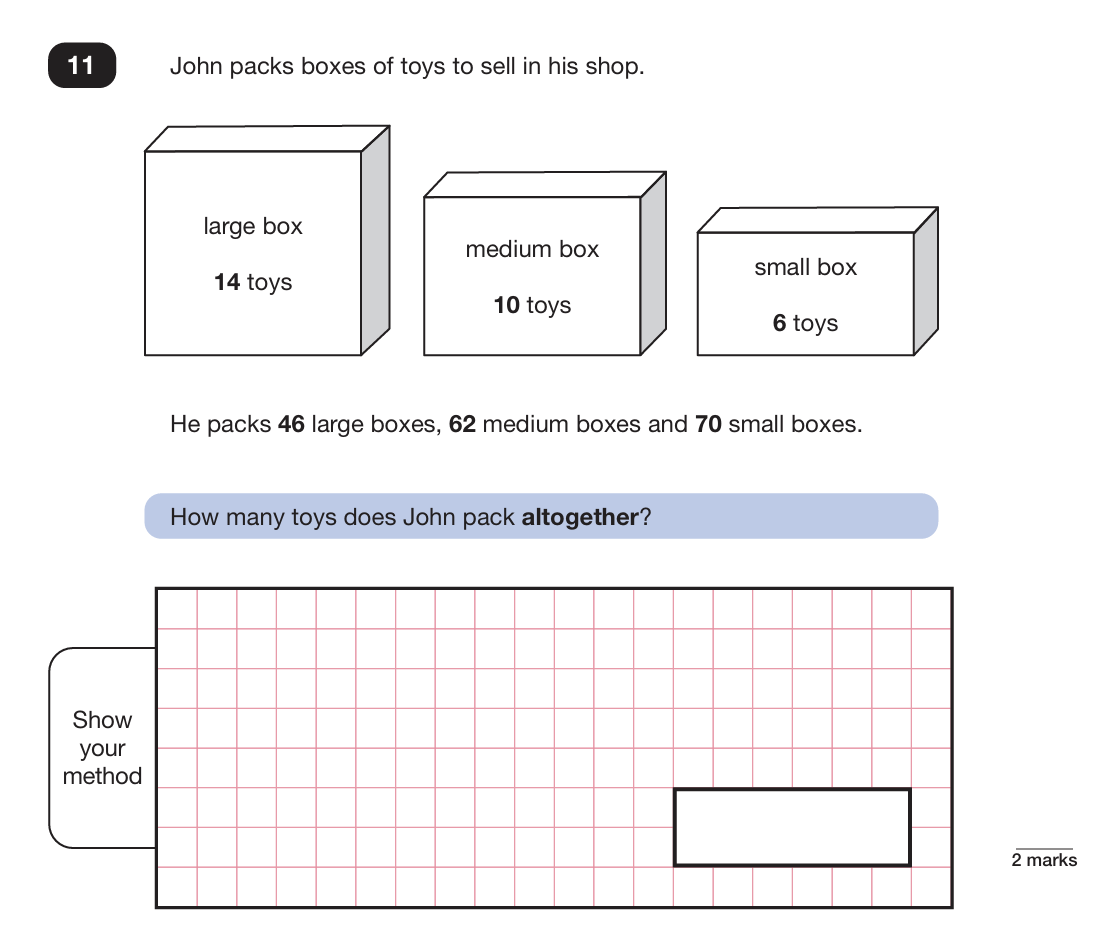
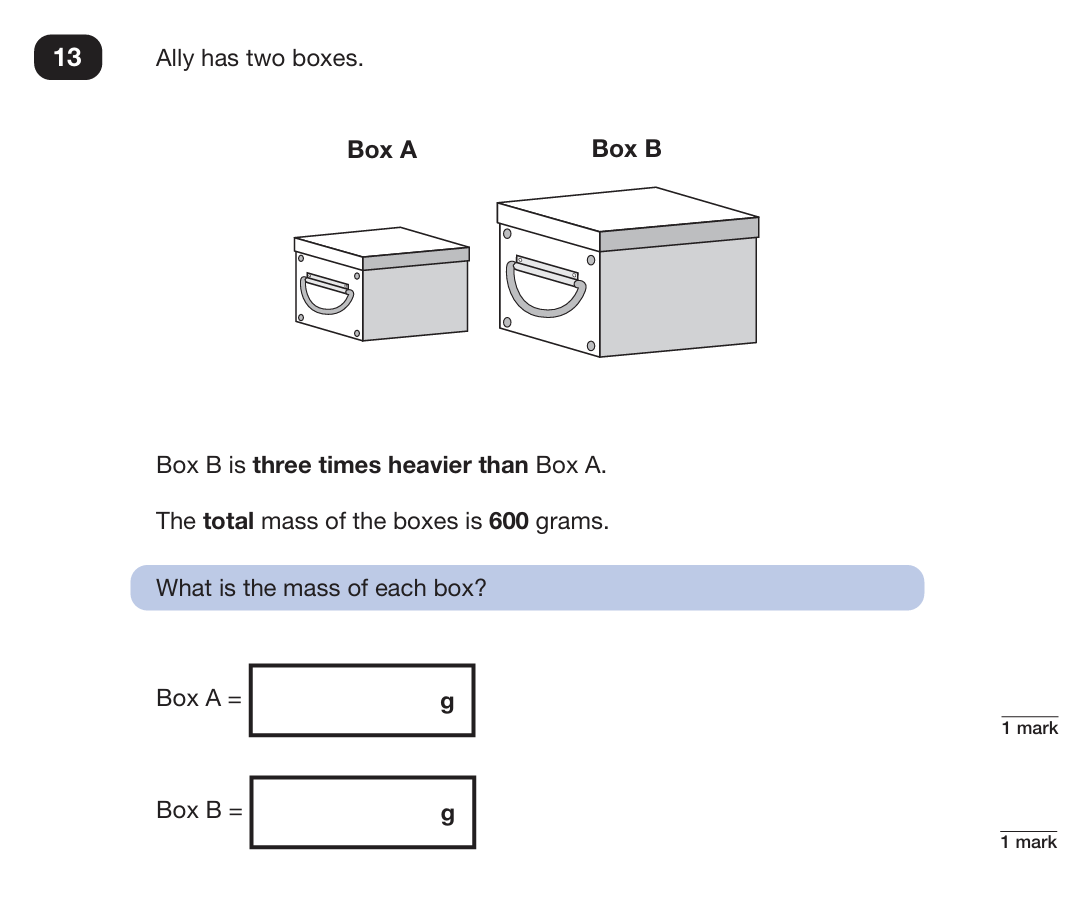
Reasoning Paper 3, Question 13.
Breakdown of the year group coverage by KS2 SATs papers 2026
Year 6 content rises slightly as overall Upper Key Stage 2 weighting remains stable
The distribution of questions by year group has remained broadly consistent since 2024, following the temporary reduction in Year 6 content seen in the two post-Covid SATs cycles.
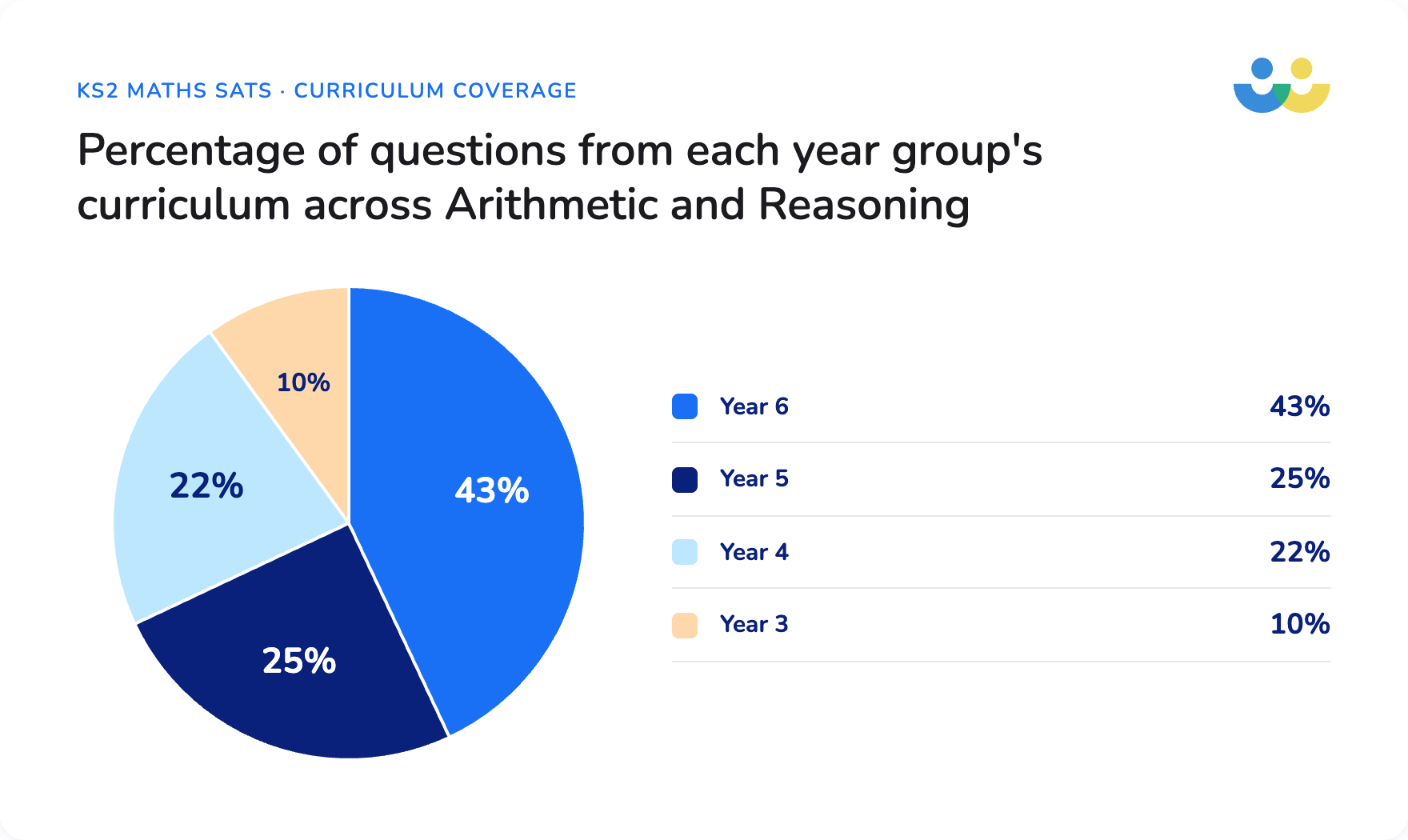
After a 6 percentage point drop in Year 6 content in 2025 (following a huge 12% increase in 2024), the proportion of Year 6 questions increased slightly in 2026 to 43% of the paper. However, this was offset by a 2 percentage point decrease in Year 5 content to 25%, meaning the overall proportion of Upper Key Stage 2 content fell very slightly from 69% to 68%.
Consequently, the proportion of Lower Key Stage 2 content increased by 1 percentage point overall. This increase came entirely from Year 4 objectives, while Year 3 content fell to 10% – its joint lowest level since 2022.
Looking across all eight SATs cycles from 2017 to 2026, the balance between Upper and Lower Key Stage 2 content has remained fairly constant. Except 2018, every paper has contained between 67% and 69% Upper Key Stage 2 content, suggesting a consistently similar overall curriculum weighting despite year-to-year fluctuations within individual year groups.
KS2 Maths SATS papers analysis Percentage of questions from each year group curriculum across Arithmetic and Reasoning | ||||||||
Year | 2017 | 2018 | 2019 | 2022 | 2023 | 2024 | 2025 | 2026 |
3 | 7% | 9% | 10% | 8% | 12% | 11% | 11% | 10% |
4 | 24% | 18% | 22% | 23% | 20% | 21% | 20% | 22% |
5 | 24% | 26% | 20% | 32% | 32% | 19% | 27% | 25% |
6 | 45% | 47% | 47% | 37% | 36% | 48% | 42% | 43% |
Arithmetic
Paper 1 – Arithmetic | |||||
| 2022 | 2023 | 2024 | 2025 | 2026 |
3 | 6% | 11% | 8% | 11% | 14% |
4 | 31% | 25% | 28% | 25% | 22% |
5 | 17% | 22% | 19% | 22% | 22% |
6 | 47% | 42% | 44% | 42% | 42% |
The distribution of content by year group has become increasingly familiar, with three of the last four SATs cycles containing 42% Year 6 content and 22% Year 5 content, meaning two-thirds of the paper came from Upper Key Stage 2 objectives.
Although the overall proportion of Lower Key Stage 2 content has remained broadly similar, 2026 saw a greater emphasis on Year 3 objectives within that content. Questions from the Year 3 curriculum made up 14% of the paper, a 3 percentage point increase on 2025 and a notable 6 percentage point increase on 2024, representing the highest proportion since 2017.
Question analysis shows that the types of questions used across the papers remain highly consistent year on year, with very little variation in question format. As a result, the small differences observed in year group content are down to the numbers used, rather then the types of questions.
Reasoning Paper 2
Paper 2 – Reasoning | |||||
| 2022 | 2023 | 2024 | 2025 | 2026 |
3 | 7% | 7% | 15% | 19% | 4% |
4 | 22% | 24% | 19% | 15% | 20% |
5 | 30% | 45% | 19% | 26% | 28% |
6 | 41% | 24% | 48% | 41% | 48% |
Like previous years, many teachers and pupils felt Reasoning Paper 2 was the most challenging of the three papers. This perception aligns with a significant increase in content from the Upper Key Stage 2 curriculum.
In 2026, Upper Key Stage 2 content accounted for 76% of the paper, a 9 percentage point increase on 2025 and the highest proportion seen across the last five SATs cycles. This represents a significant proportion of higher-level content within a single paper, reinforcing its position as the most demanding of the three.
The most significant change compared with 2025 was the increase in Year 6 content, which rose to 48% of the paper. This means almost half of all questions were drawn from the Year 6 curriculum, an increase of 7 percentage points from the 2025 paper and nearly double the proportion seen in 2023.
This increase was offset by a sharp reduction in Lower Key Stage 2 content, most notably in Year 3, where content fell to just 4%, a 15 percentage point decrease on 2025 and the lowest level recorded in the last five SATs cycles. Year 4 content remained broadly consistent with previous years, highlighting that the overall reduction in Lower Key Stage 2 coverage was almost entirely due to the removal of Year 3 content.
Overall, the 2026 Paper 2 shows a clear shift towards greater emphasis on Upper Key Stage 2, particularly Year 6, alongside a corresponding reduction in early Key Stage 2 content.
Reasoning Paper 3
Paper 3 – Reasoning | |||||
| 2022 | 2023 | 2024 | 2025 | 2026 |
3 | 13% | 19% | 12% | 4% | 11% |
4 | 13% | 8% | 15% | 19% | 22% |
5 | 58% | 31% | 19% | 35% | 26% |
6 | 17% | 42% | 54% | 42% | 41% |
As has become a common observation every year, Reasoning Paper 3 was once again generally regarded as the more straightforward of the two reasoning papers.
In contrast to Paper 2, Paper 3 contained the lowest proportion of Upper Key Stage 2 content seen across the last five SATs cycles. At 67%, this represents a 10 percentage point decrease compared to 2025 and is 6 percentage points lower than the previous five-year low.
The reduction in Upper Key Stage 2 content was mainly from a drop in Year 5 content, which decreased by 9 percentage points compared with 2025. In contrast, Year 6 content remained relatively stable at 41%, broadly consistent with the levels seen in 2023 and 2025. The main exceptions within the five-year period are 2024, when Year 6 content peaked at 54%, and the post-Covid 2022 paper, which contained only 17% Year 6 content.
Lower Key Stage 2 content increased in 2026, predominantly due to a rise in Year 3 content, which increased by 7 percentage points compared with 2025. This brings it back into line with the levels seen in 2022 and 2023, following the unusually low proportion seen in 2025.
Could children reach the expected level without exposure to any Year 6 content?
KS2 Maths SATS papers analysis | 2018 | 2019 | 2022 | 2023 | 2024 | 2025 | 2026 |
% required to reach the ‘expected level’ | 55 | 53 | 53 | 51 | 49 | 53 | TBC |
% of questions from Y3 to Y5 curricular | 53 | 53 | 63 | 64 | 52 | 58 |
Although the 2026 raw scores to scaled scores conversions have not yet been released to work out a child’s SATs results or school’s performance, the structure of the papers suggests, as in 2024, that there is a lower chance of reaching the expected standard using knowledge from only the Year 3–5 curriculum.
The proportion of Year 3–5 content in the 2026 paper is 52%, which is 6 percentage points lower than in 2025 and matches the low point seen in 2024. In that year, the threshold for reaching the expected standard was reduced, meaning pupils could still achieve it without needing exposure to Year 6 objectives.
If the 2026 scaled score threshold were to remain at last year’s level (53%), this would be only the second time in the last seven SATs cycles that it would not be possible to reach the expected standard using Year 3–5 knowledge alone. However, given the increased proportion of Year 6 content in 2026, there is a reasonable expectation that the threshold may be adjusted downwards compared with 2025, as has been seen in previous years with higher Year 6 weighting.
Breakdown of the 2026 KS2 SATs papers coverage by content domain
KS2 Maths SATS papers analysis (2026) Percentage of questions by content domain | |||||||
Content domain | 2018 | 2019 | 2022 | 2023 | 2024 | 2025 | 2026 |
Number & PV | 11 | 9 | 9 | 11 | 10 | 12 | 10 |
Calculations | 32 | 30 | 38 | 32 | 35 | 34 | 32 |
FDP | 27 | 24 | 23 | 26 | 26 | 24 | 23 |
Ratio & prop | 7 | 8 | 8 | 7 | 6 | 7 | 9 |
Algebra | 6 | 6 | 3 | 4 | 3 | 3 | 3 |
Measurement | 8 | 9 | 7 | 8 | 8 | 9 | 8 |
Shapes | 5 | 7 | 6 | 5 | 7 | 3 | 5 |
Pos & direction | 2 | 3 | 2 | 2 | 2 | 3 | 3 |
Statistics | 2 | 4 | 3 | 4 | 3 | 4 | 7 |
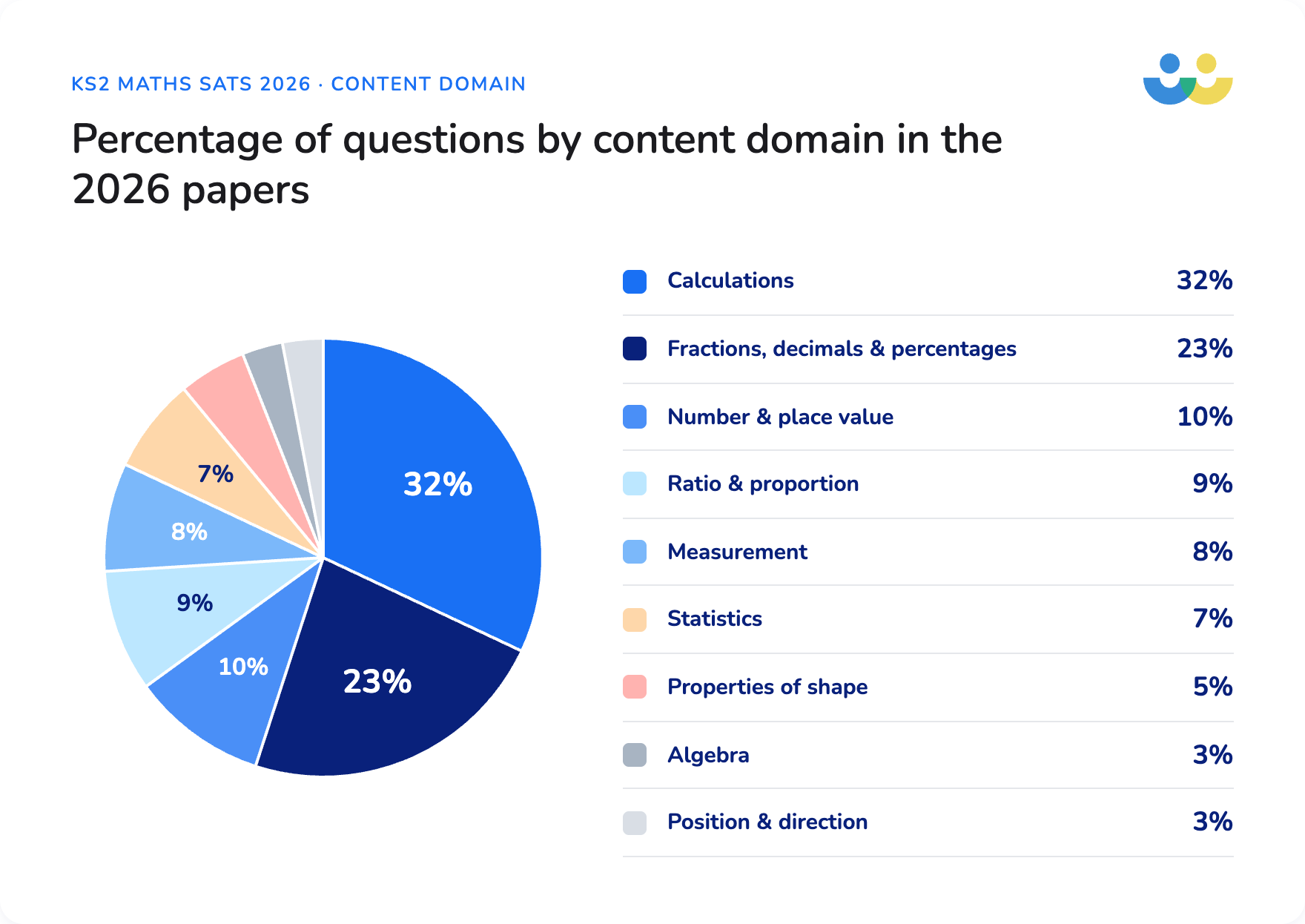
As always, the three core domains of number and place value, calculations, and fractions, decimals and percentages accounted for a substantial proportion of the paper, making up 65% overall. While still dominant across all three papers, this represents a 5 percentage point decrease on 2025 and the lowest combined share seen since 2019, suggesting a slight broadening of content in the 2026 paper.
In contrast, the 2026 paper featured the highest proportion of ratio and proportion questions in the last seven SATs cycles, at 9%. This is close to the 10% coverage of number and place value. Typically, in most years number and place value exceeds ratio and proportion by 4–5 percentage points.
Algebra, shape, and position and direction continued to account for relatively small proportions of the paper, consistent with previous years. However, statistics saw a noticeable increase in 2026, rising to 7%, which is around 3–4 percentage points higher than levels observed across the previous six SATs cycles.
Breakdown of arithmetic
As with previous years, there were no real surprises in this year’s Arithmetic Paper 1, with the questions following the familiar pattern of gradually increasing in difficulty as the paper progressed. This contrasts with the 2025 paper, where pupils were faced with some of the trickier decimal and 2-mark questions much earlier on, disrupting the usual flow of the paper.
With some structured practice beforehand, many pupils should have found this paper manageable.
Content Domain | Number of Questions | ||||
2026 | 2025 | 2024 | 2023 | 2022 | |
Place value | 1 | 1 | 1 | 0 | 0 |
Calculation | 18 | 18 | 18 | 18 | 18 |
Fractions | 8 | 9 | 9 | 9 | 9 |
Decimals | 5 | 4 | 4 | 5 | 5 |
Percentages | 3 | 3 | 2 | 3 | 3 |
Order of operations | 1 | 1 | 2 | 1 | 1 |
Arithmetic Paper pattern
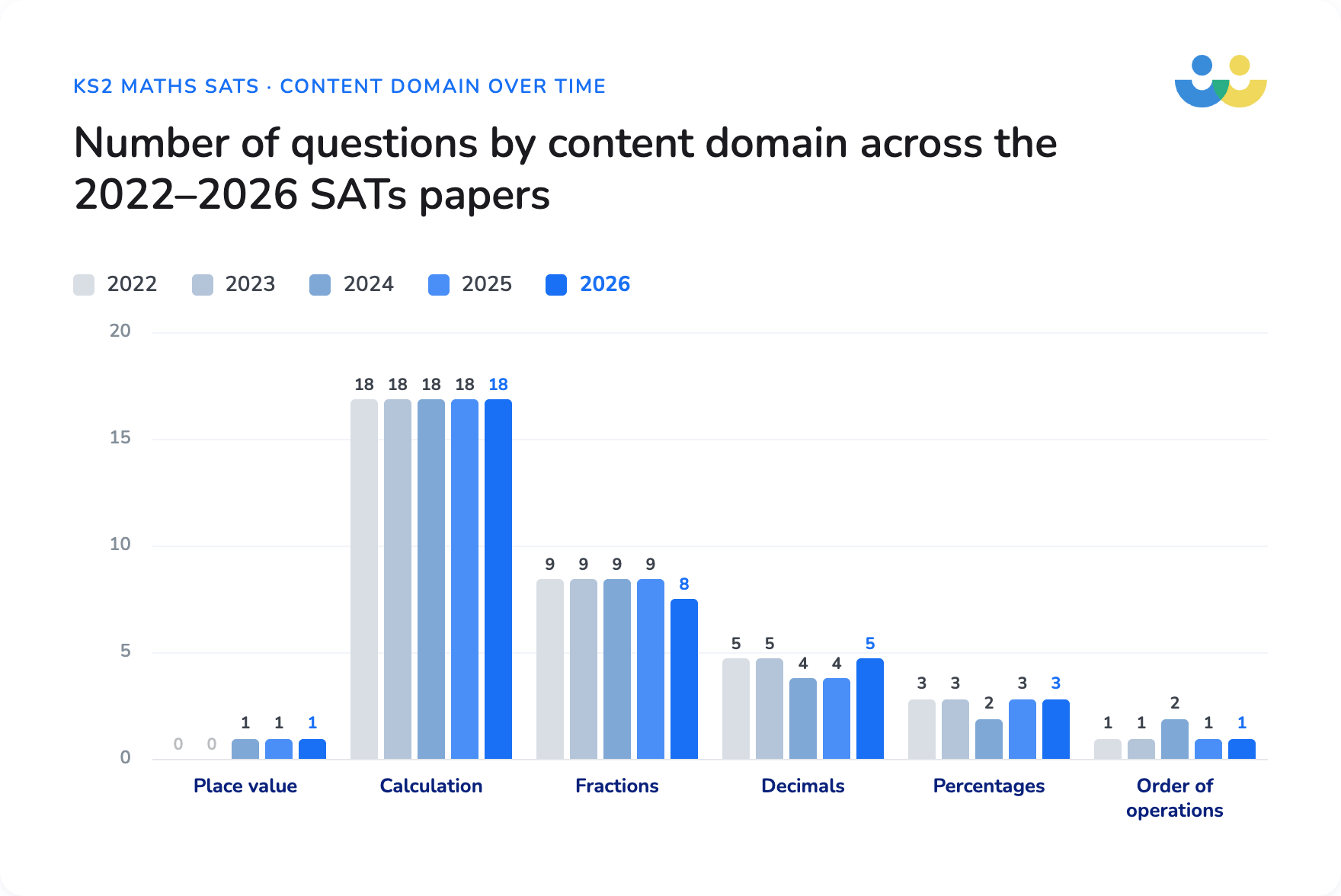
Last year, we analysed past SATS papers from the last five years and found that they followed an almost identical structure, with the only real differences being the numbers used and the order of the questions. This year’s paper was no exception. The familiar mix of place value, calculations, fractions, decimals, percentages, and order of operations once again shows just how consistent the paper format is. It also highlights the relatively narrow range of question types pupils need to be confident with in order to perform well in the arithmetic paper.
The table below shows a comparison of the average number of each question type over the past 5 SATS cycles compared to those seen on the 2026 paper.
Content domain | Avg number of qu’s in the last 5 years | No. of qu’s in 2026 | Topic overview |
Place value | 0-1 | 1 | Partitioning |
Calculation | 1-2 | 2 | Addition |
2 | 3 | Subtraction | |
Multiplication | |||
1 | 0 | Multiply 3 1-digit numbers | |
1 | 1 | Multiply by 10/100 | |
2-3 | 2 | Short multiplication | |
2 | 2 | Long multiplication (1 3-digit by 2-digit and 1 4-digit by 2-digit) | |
Division | |||
5 | 6 | Short division | |
2 | 2 | Long division (1 3-digit ÷ 2 digit and 1 4-digit ÷ 2-digit) | |
Fractions | 3 | 2 | Addition |
2 | 2 | Subtraction | |
3-4 | 3 | Multiplication | |
1-2 | 1 | Division | |
Decimals | 1 | 1 | Addition |
1 | 1 | Subtraction | |
1 | 2 | Multiplication | |
1-2 | 1 | Multiply/divide decimal by 10/100/100 | |
Percentages | 2-3 | 3 | Percentage of a number |
Order of operations | 1-2 | 1 | Order of operations |
As seen in past papers, there are only around 20 key question types that children need to be secure with, which means maths interventions focusing on arithmetic fluency can be targeted quite precisely, to support the best possible outcomes. If pupils are confident with calculations, fractions, decimals and percentages, they are already in a strong position to achieve high scores on the arithmetic paper.
In the 2026 paper:
- 50% of questions involved the 4 operations.
- 72% of questions are either calculation or fraction questions.
- 94%of the paper consists of calculations, fractions, decimals or percentage questions.
Question structures for the 2026 arithmetic paper
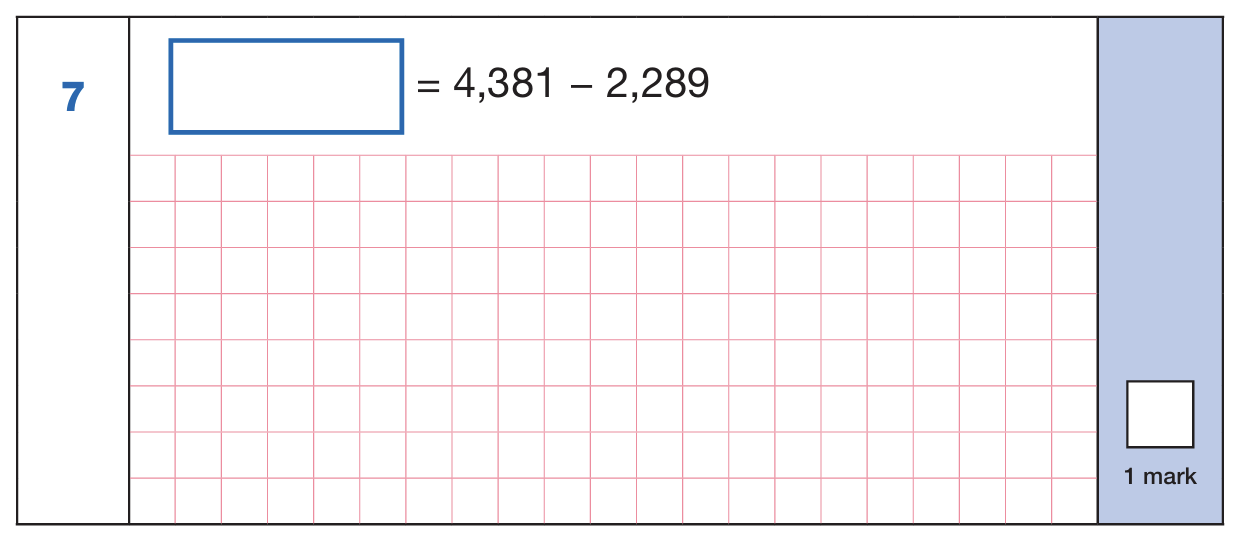
As with the 2025 paper, only one question was presented with the answer box first. This format was much more common in the 2023 and 2024 papers, but now appears to be more of an occasional feature than a regular style. Even so, it’s still important that children are familiar with this layout so they aren’t thrown by it in the exam.
Arithmetic Paper 1 – Question 7
For the first time in the past 6 SATs cycles, a fraction multiplied by a 3-digit number didn’t appear in the arithmetic paper this year
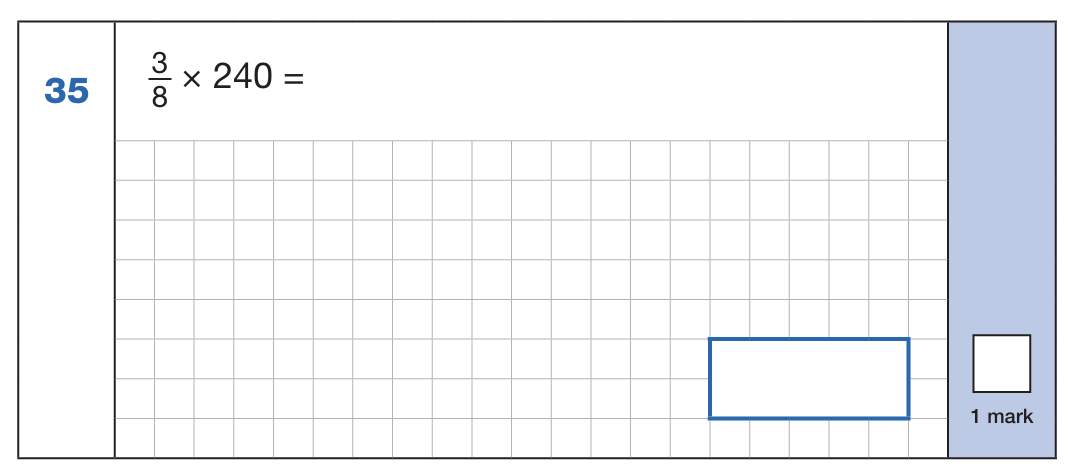
Arithmetic paper 1 2025 – question 35
Instead, children were presented with the question written in a format they’re more familiar with in class, with the word ‘of’ used rather than the multiplication symbol. It is still important that children are exposed to both styles of question, to ensure they understand the link between the word ‘of’ and the multiplication symbol
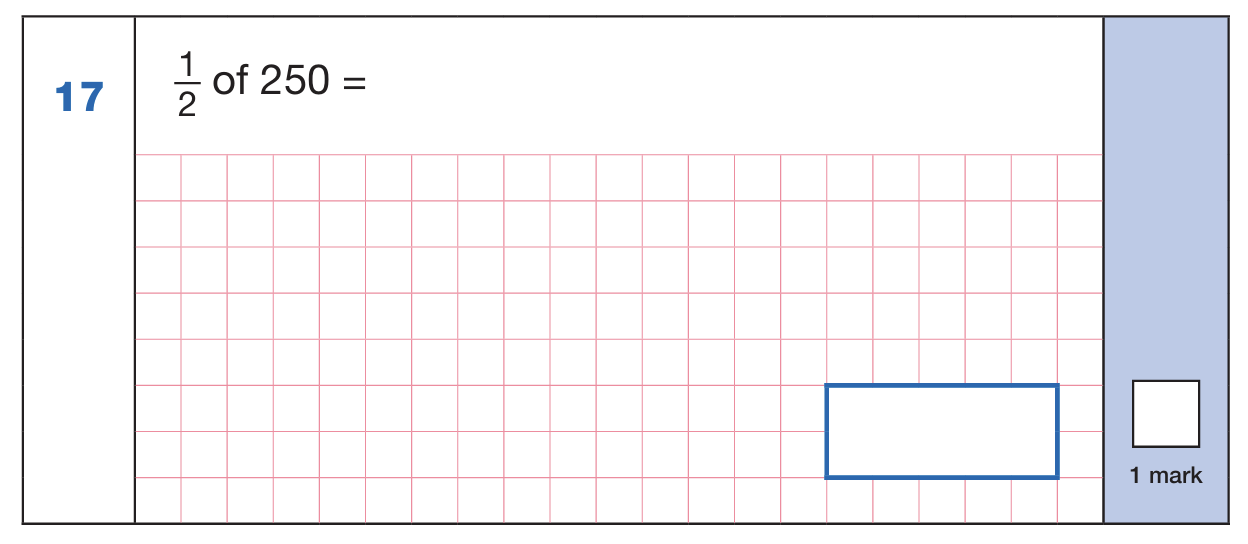
Arithmetic Paper 1, Question 17
As seen in previous years, the arithmetic paper again included three percentage of a number questions, with increasing levels of difficulty through the number of steps required to solve them.
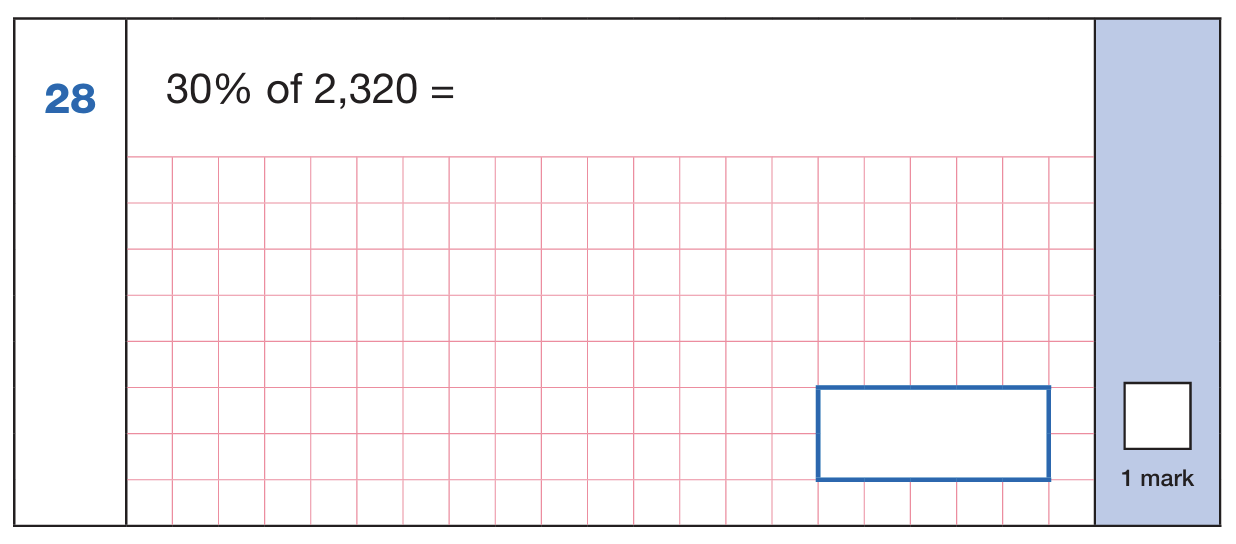
Arithmetic, Paper 1 – Question 28
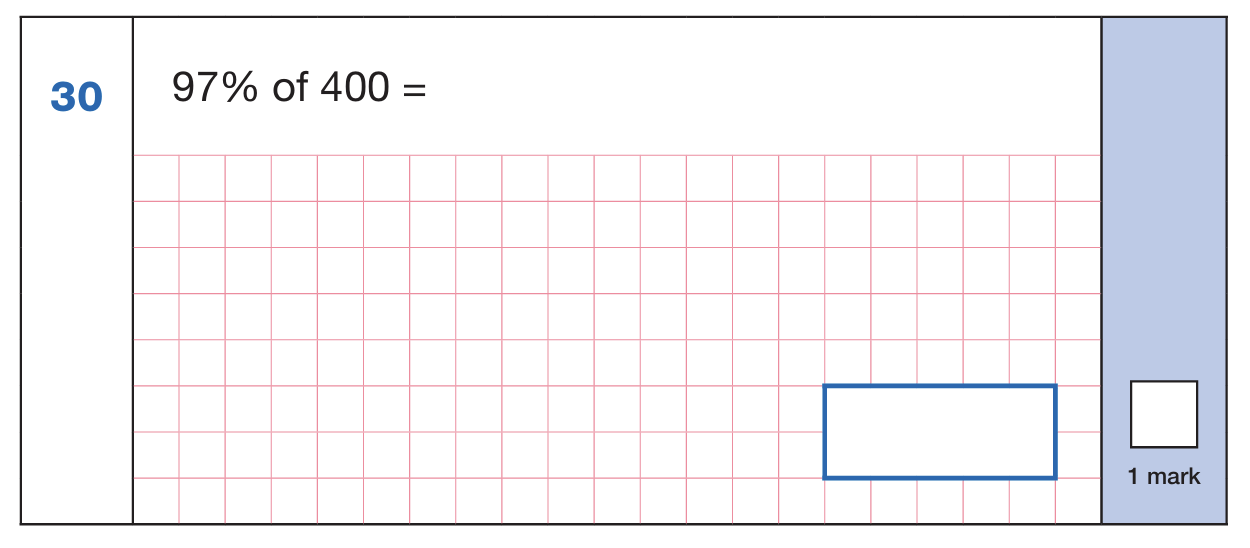
Arithmetic, Paper 1 – Question 30
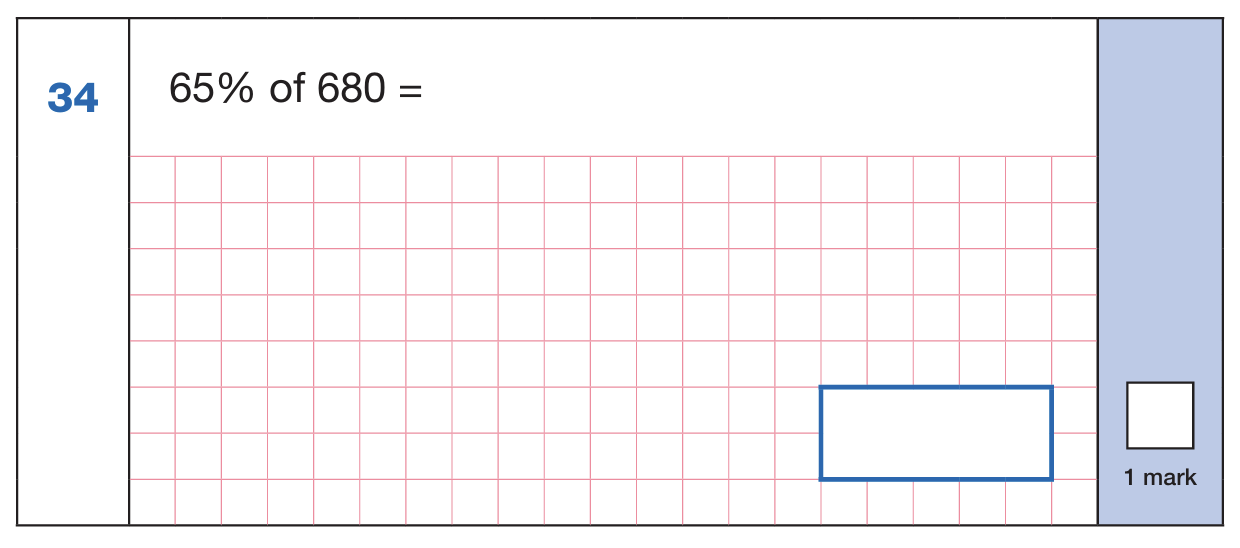
Arithmetic, Paper 1 – Question 34
The other repeated questions in the paper were questions involving the four operations and adding, subtracting and multiplying fractions and mixed numbers
In line with previous years, the paper included two long multiplication questions: one involving a 3-digit number multiplied by a 2-digit number, and another involving a 4-digit number multiplied by a 2-digit number.
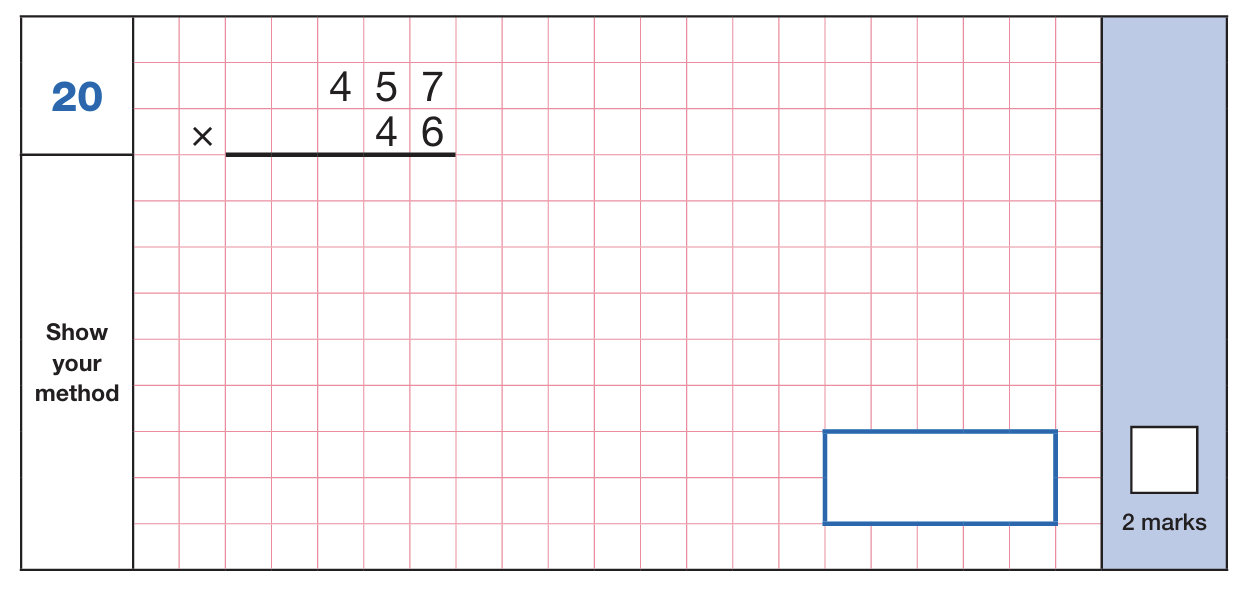
Arithmetic Paper 1 – Question 20
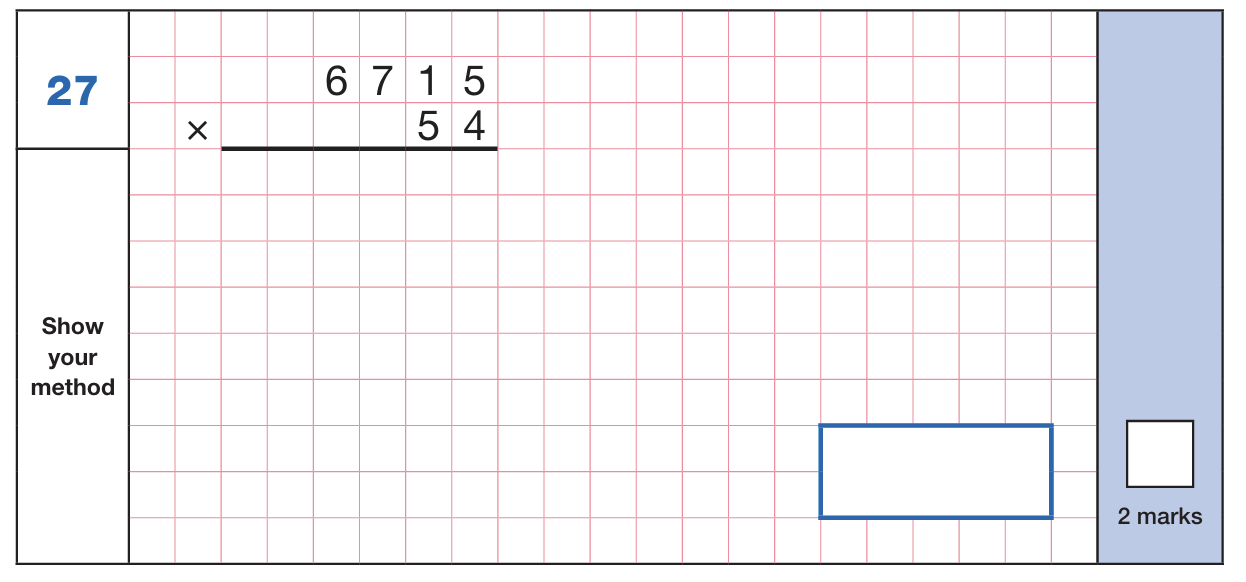
Arithmetic Paper 1 – Question 27
Similarly, with long division, the papers contained the familiar 3-digit number divided by a 2-digit number and a 4-digit number divided by a 2-digit number
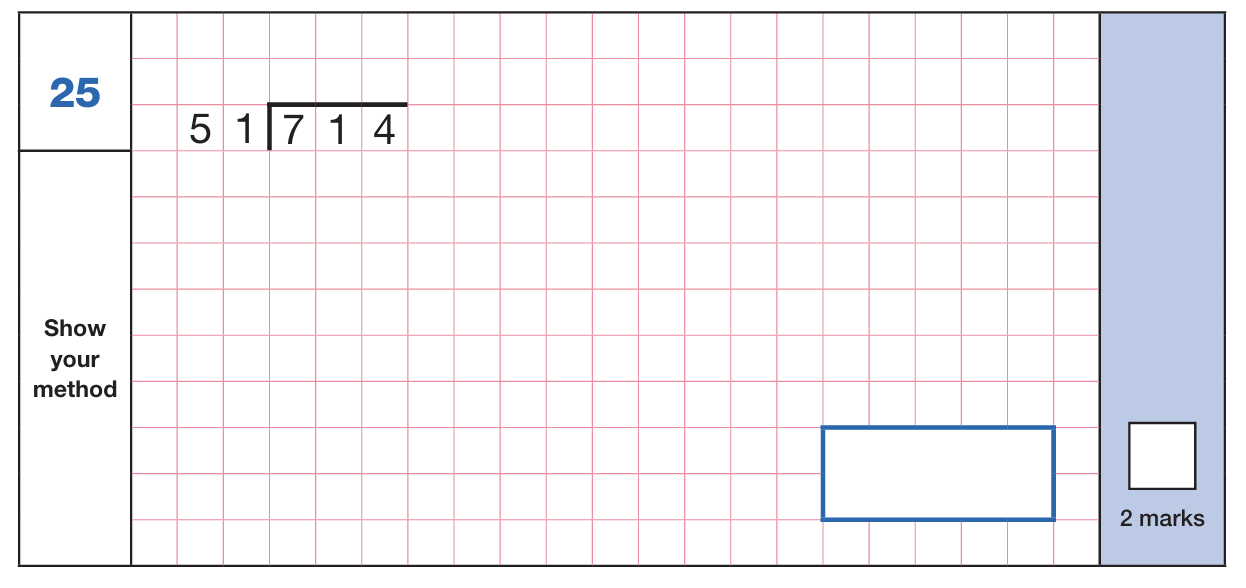
Arithmetic Paper 1 – Question 25
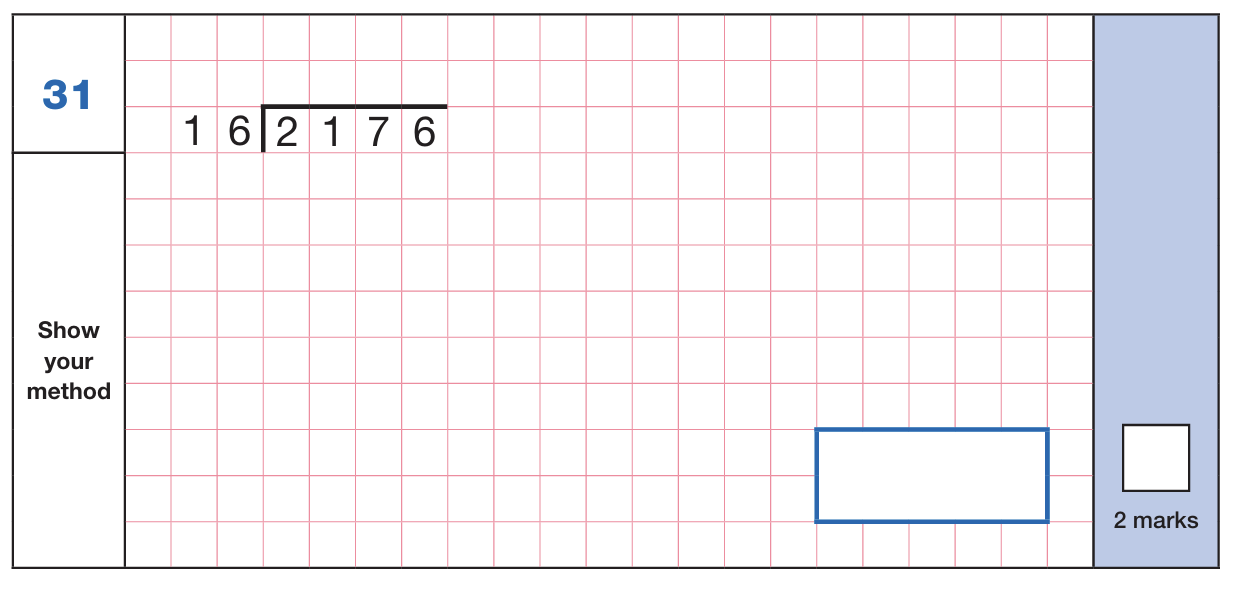
Arithmetic Paper 1 – Question 31
Breakdown of reasoning by content domain
2026 | 2025 | 2024 | 2023 | 2022 | 2019 | |
NPV | 13 | 19 | 15 | 16 | 14 | 11 |
Calculation | 19 | 21 | 21 | 20 | 29 | 19 |
Fractions Decimals | 13 | 15 | 19 | 18 | 16 | 15 |
Ratio and proportion | 10 | 6 | 6 | 5 | 4 | 6 |
Algebra | 6 | 6 | 6 | 7 | 6 | 9 |
Measurement | 13 | 15 | 13 | 13 | 12 | 15 |
Shape | 8 | 6 | 11 | 9 | 10 | 11 |
Pos & direction | 6 | 6 | 4 | 4 | 4 | 6 |
Statistics | 12 | 6 | 6 | 7 | 6 | 8 |
The overall reduction in number and place value, calculations, and fractions, decimals and percentages in 2026 can be attributed entirely to a decrease in these question types across both reasoning papers.
In 2026, these main content domains accounted for 45% of the two reasoning papers. While still forming the largest overall share, this is notably lower than the 54–59% range seen across the previous four SATS cycles.
In contrast, two domains saw marked increases. Ratio and proportion increased to 10%, the highest proportion in the last six cycles, increasing by 4 percentage points compared with both 2024 and 2025. Statistics also increased to 7%, again the highest level in the same period, and up 6 percentage points from the last two years.
All other content domains remained broadly consistent overall. The only minor change was in measurement, which fell by 2 percentage points following a temporary increase in the 2025 paper, returning closer to its longer-term baseline.
Question structures for the 2026 Reasoning Paper 2 and Paper 3
Single-mark questions requiring multiple steps continue to be used
A recurring complaint from teachers is the use of multi-step questions that are only awarded one mark. The 2026 reasoning papers were no different, with several questions requiring more work than the mark allocation would suggest.
The first example appeared very early in Paper 2, with Question 4 presenting pupils with a two-step problem involving the addition of three numbers followed by a subtraction calculation.
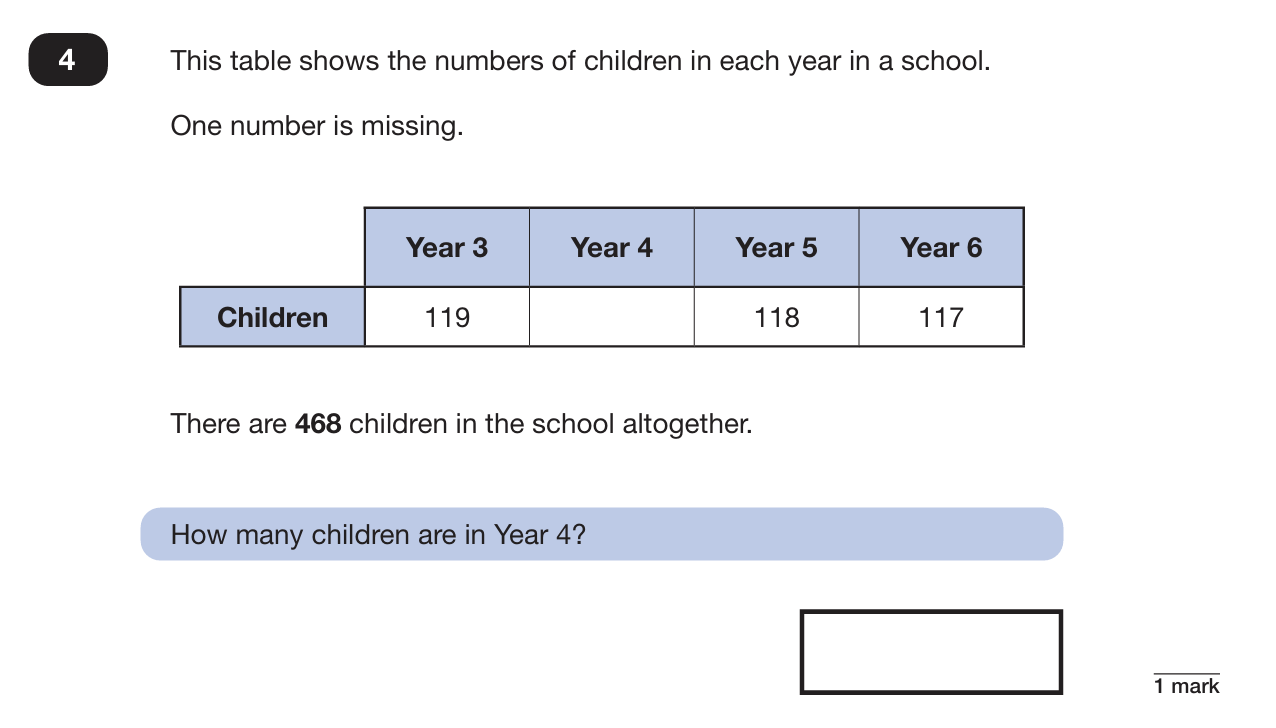
Reasoning Paper 2, Question 4
The second part of Question 16 could also have fallen into this category, if children had chosen to turn each fraction into an equivalent fraction, to identify which fractions were greater than {2}{5}. This is a question, which could have been solved much more quickly, if children spotted that {2}{5} was less than a half, but that 3 of the fractions given were greater than a half
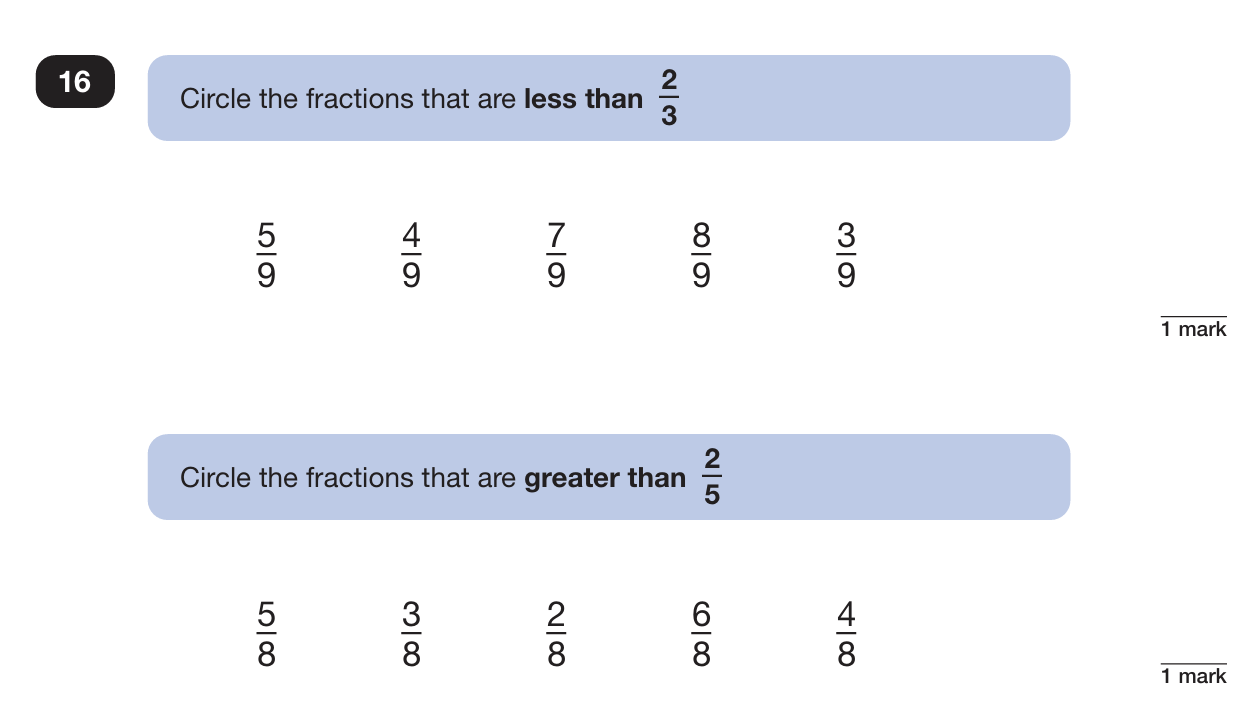
Reasoning Paper 2 – Question 16
Word problems made an earlier appearance than they have previously
The more “wordy” questions appeared much earlier in the 2026 paper than they did in 2025. This year, the first word problem appeared in Question 5, whereas in 2025 children didn’t encounter one until Question 9. This meant pupils were required to process and interpret written information much sooner in the paper, adding to the feeling that the difficulty ramped up more quickly than in previous years.
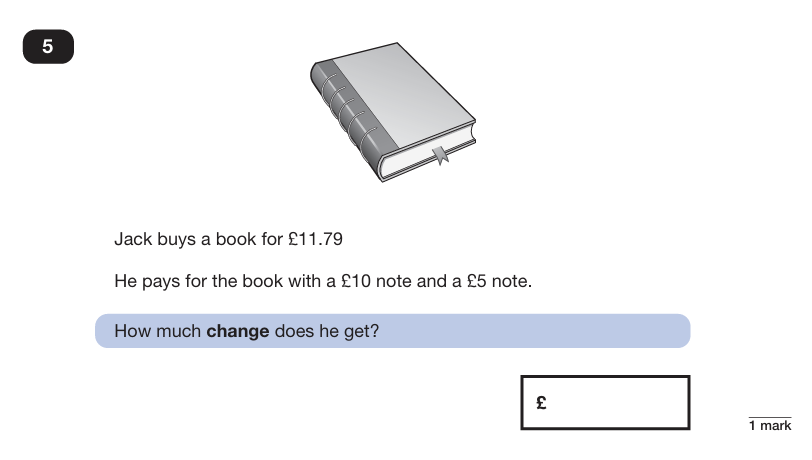
Reasoning Paper 2 – Question 5
Questions involving money and change continue to be popular
As with previous years, there were several questions across the two reasoning papers involving money. Unlike previous years, where children had to calculate totals, buying items in a shop, followed by the change required, this year’s change question required children to add the total amount of 2 notes and calculate the change required for 1 item.
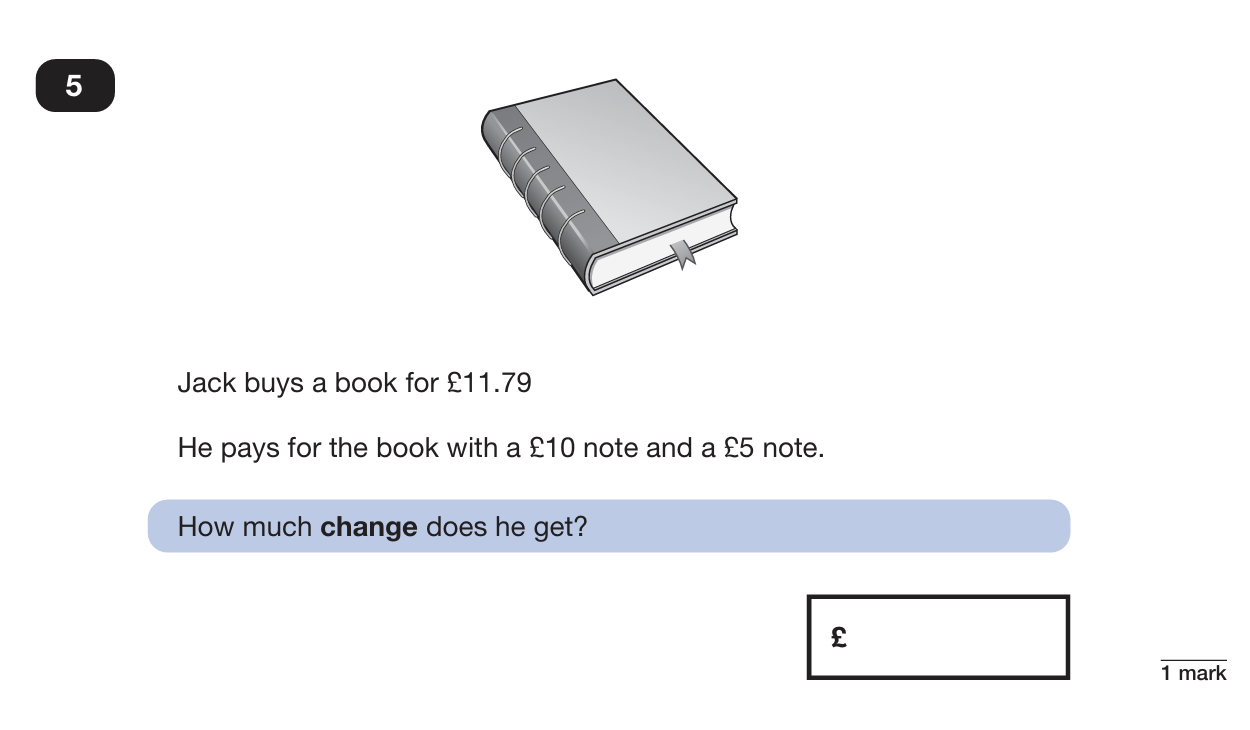
Reasoning paper 2, Question 5
Both Paper 2 and Paper 3 included questions requiring children to calculate the cost of items, with Question 5 in Paper 3 being a fairly straightforward “calculate the total” style question.
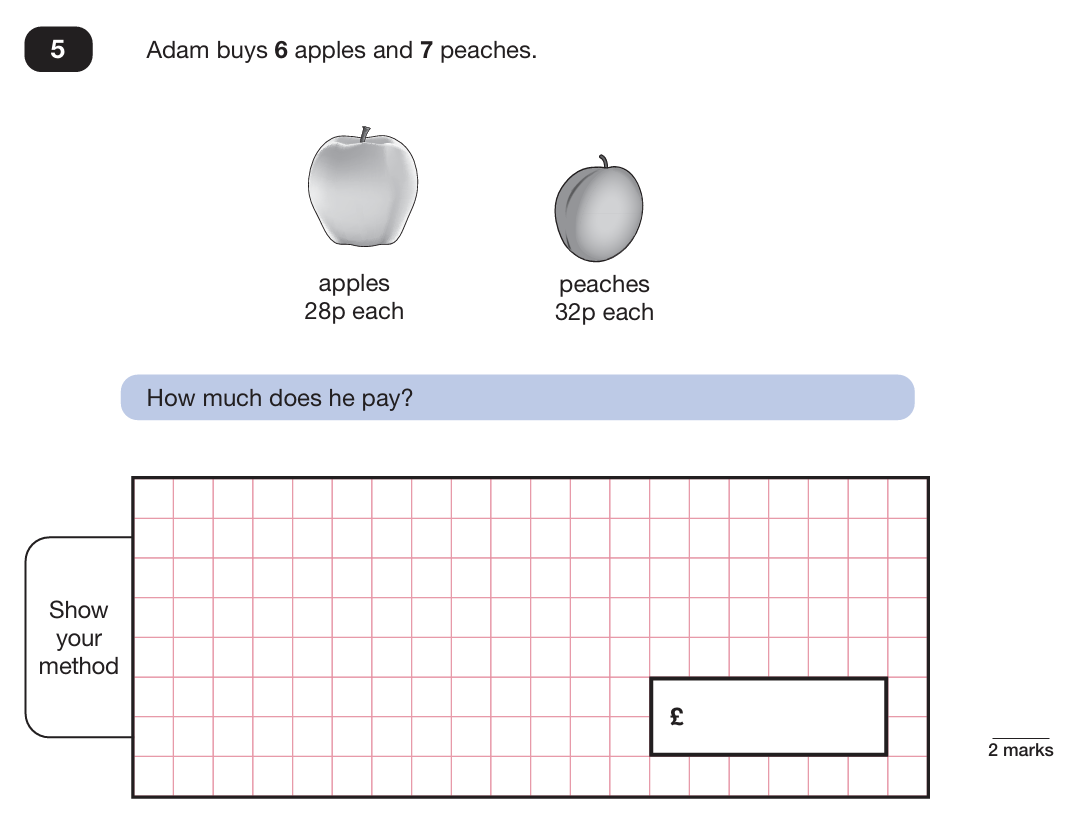
Reasoning Paper 3 – Question 5
In contrast, Question 14 in Paper 2 required children to tackle a slightly trickier money problem, working out the cost of one item using the cost of three other items alongside the overall total cost.
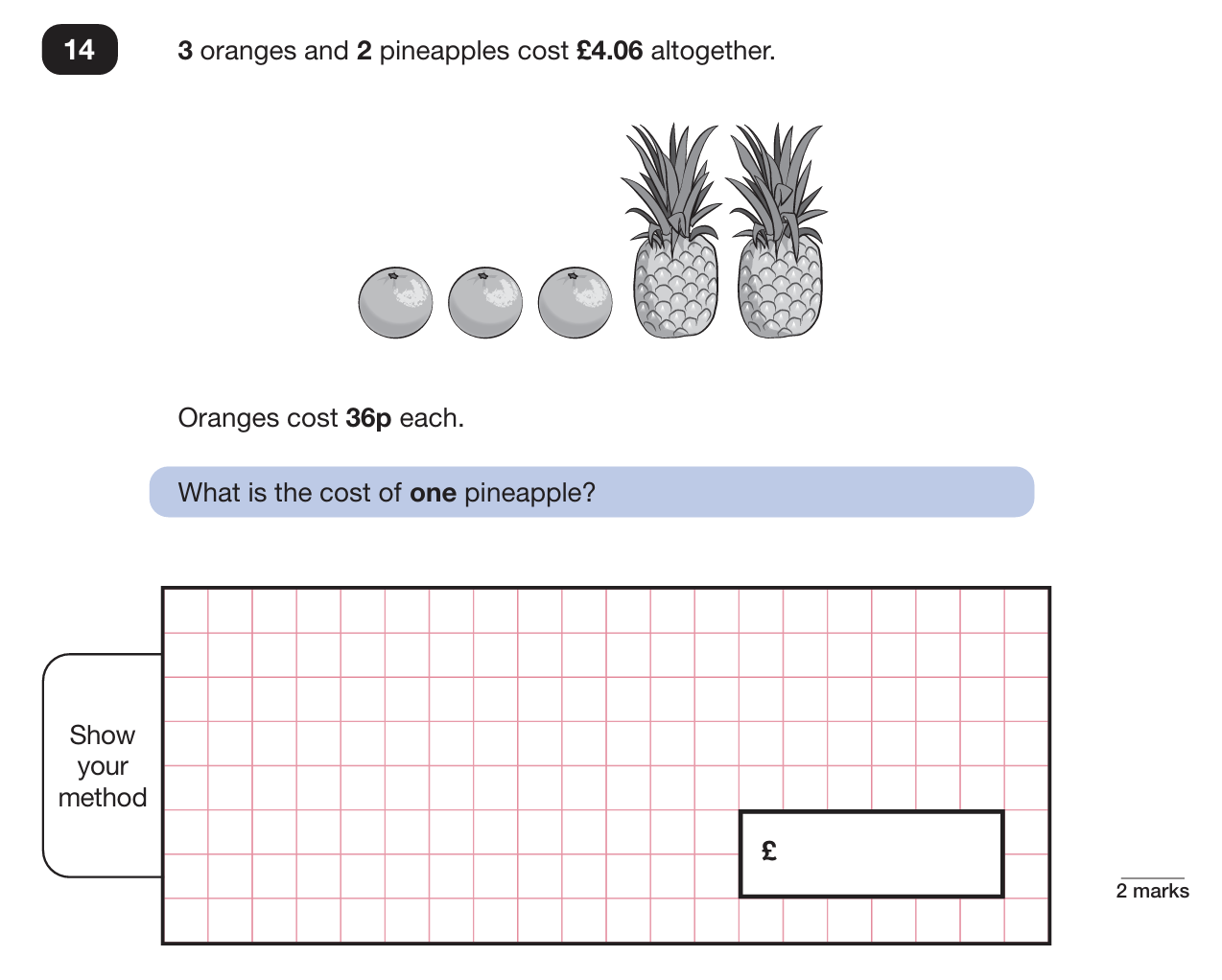
Reasoning Paper 2 – Question 14
Missing number calculations have made a reappearance his year
A popular style of reasoning question included in the reasoning papers in recent years, are missing number calculations for each of the four operations. Whilst there was only one this year, it shows it is important to ensure children are not only confident with written methods for the four operations, but also missing number calculations for each of the four operations.
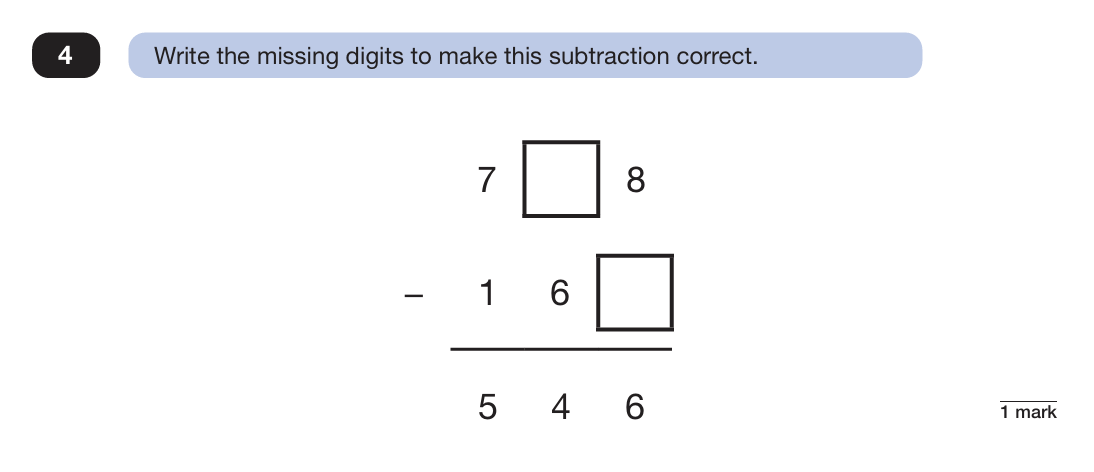
Reasoning paper 3 – Question 4
Knowledge of mathematical vocabulary continues to be important.
As in previous years, children needed to have a secure understanding of mathematical vocabulary, including words such as prime, square, cube, factor and multiple. Question 16 of Reasoning Paper 3 required children to demonstrate understanding of prime, square and multiples.
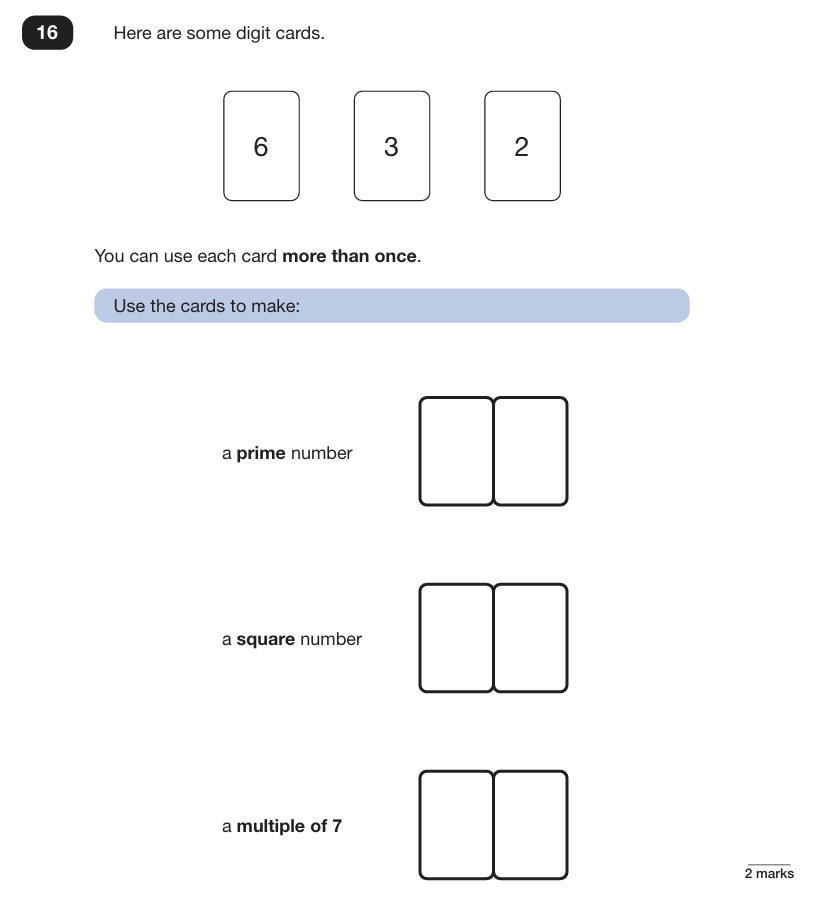
Reasoning paper 3 – Question 16
Return of missing angles questions in recent papers
Having been absent since 2022, missing angle questions made a reappearance in the 2025 paper, with one question. In 2026, there were two missing angles questions, with both Paper 2 and Paper 3 having one. Children needed knowledge on calculating missing angles in a right angle and on a straight line, and also knowledge of vertically opposite angles, whilst the 2025 required children to know how many degrees on a straight line, in addition to the number of degrees in a quadrilateral
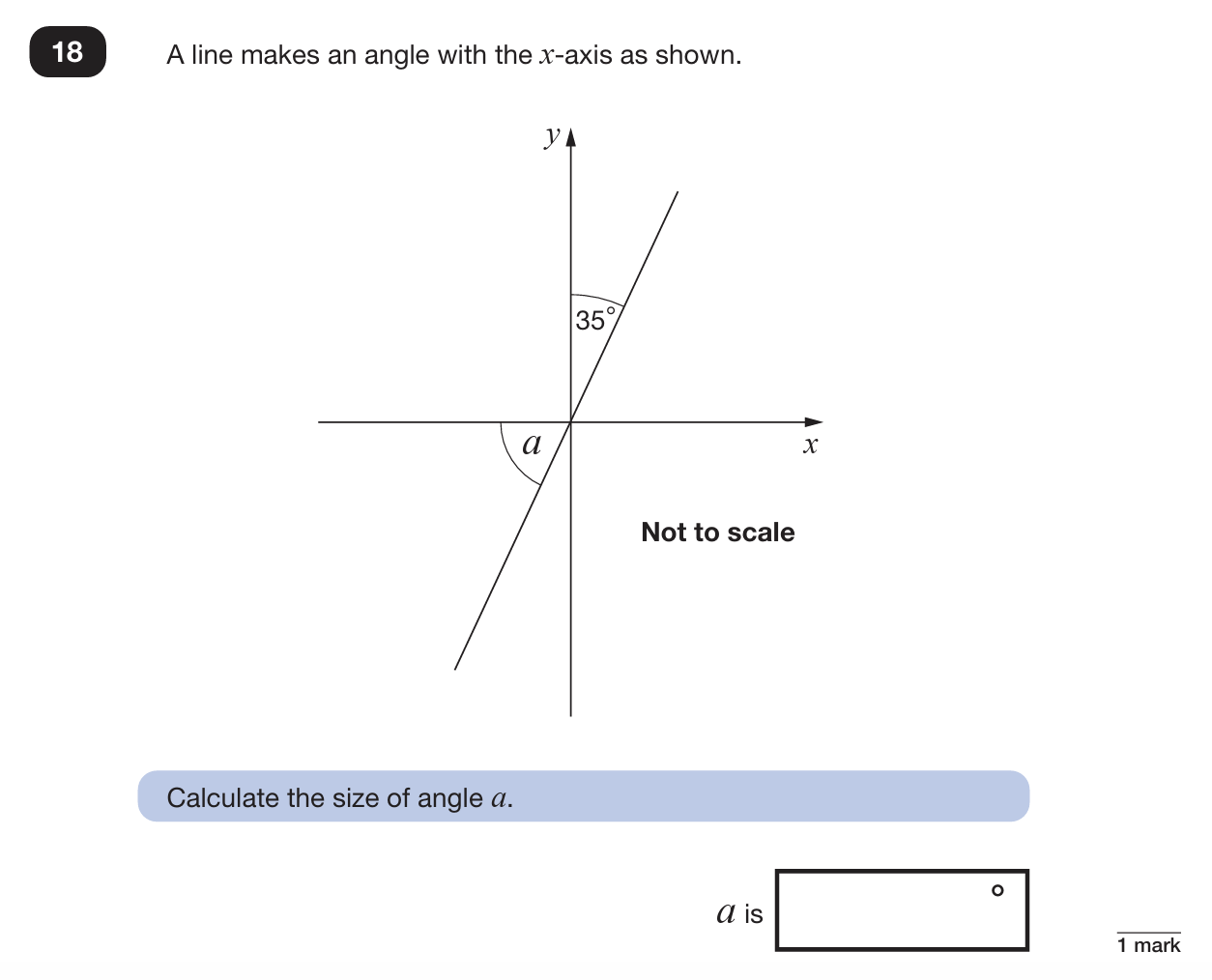
Reasoning Paper 2 – Question 18
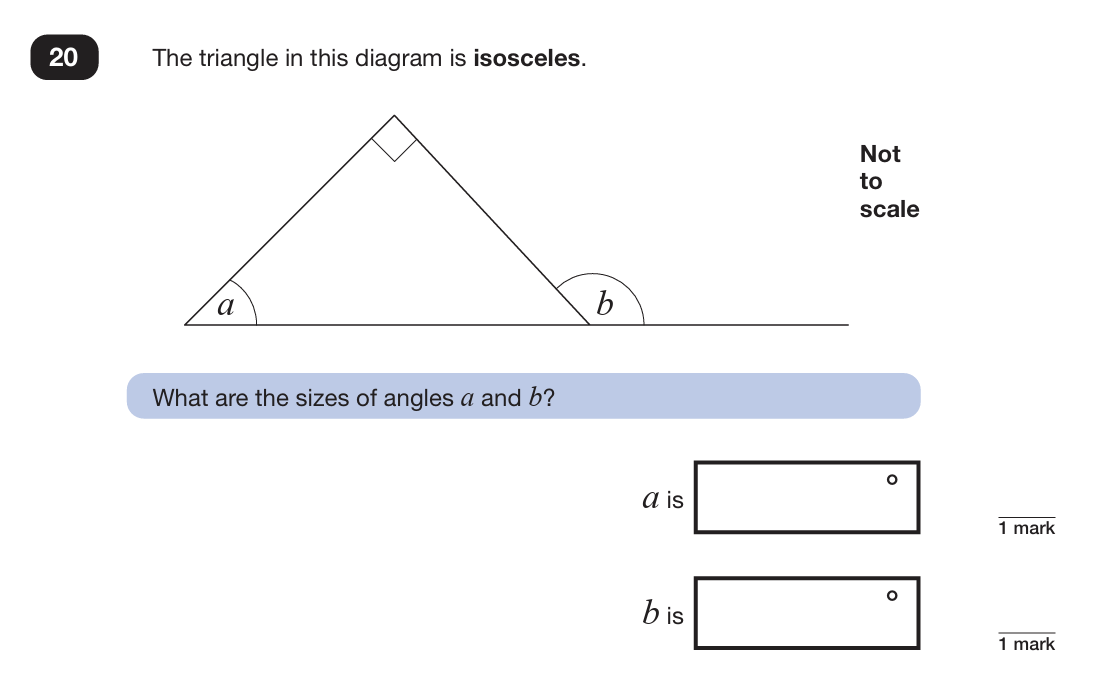
Reasoning Paper 3 – Question 20
Familiar questions presented in an unfamiliar way
Every year, certain question types are almost guaranteed to appear somewhere in the reasoning papers. In the 2026 Reasoning Paper 2, equivalent fractions, decimals and percentages featured once again, although this year the presentation was slightly different from the more familiar formats. Instead of straightforward matching or conversion questions, children were asked to match pictures of shaded circles to fractions, decimals and percentages.
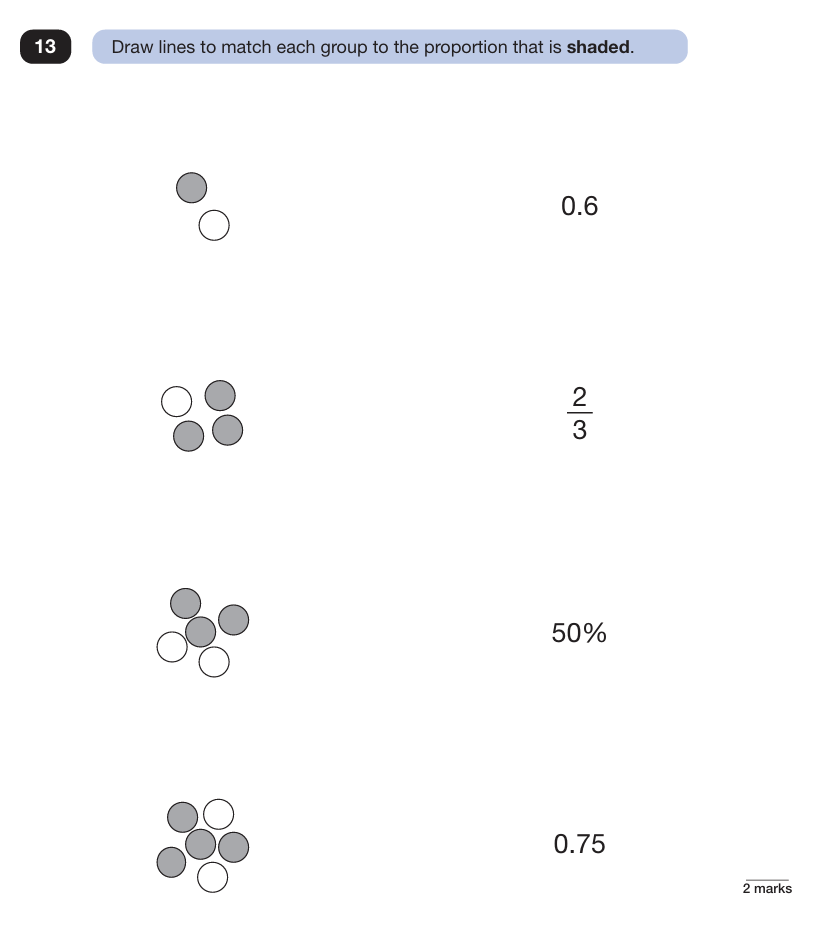
Reasoning paper 2 – Question 13
Question contexts continue to be more relatable than previous years.
Whilst past SATs writers have liked to throw in obscure question styles and contexts, there has been a continuing trend, since 2024, to include contexts which the children can relate to. As with the 2024 and 2025 papers, there were no questions with contexts which would have had no relevance to the children or questions which the children wouldn’t have been able to relate to.
The 3 mark question
As has become typical in recent years, the single 3-mark question in the maths SATs once again appeared in Reasoning Paper 3. Unusually, however, this year it was placed as the final question of the entire paper.
There was another noticeable difference, too. Rather than the more familiar multi-step problem-solving question involving the four operations, this year’s 3-mark question required children to use long multiplication to calculate the area of a rectangle, calculate the area of a triangle, and then subtract the area of the triangle from the area of the rectangle. It was a noticeably different style of 3-mark problem from the type usually seen in previous papers.
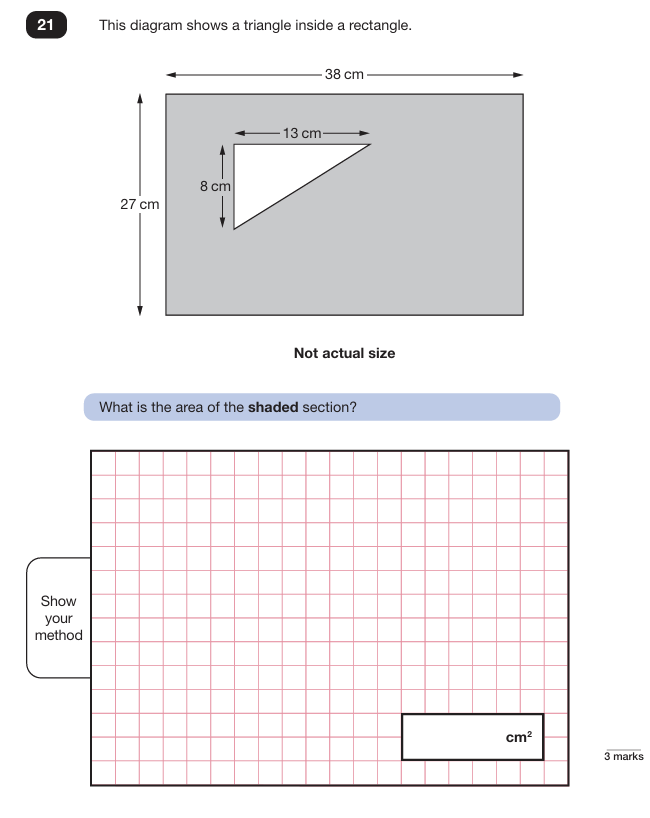
Reasoning Paper 3 – Question 21
Another year without Chen…
One of the biggest questions every year is whether the infamous Chen will make an appearance. After returning in 2023 – to everyone’s surprise as a girl – and appearing again in the 2024 paper, Chen was absent in 2025 and, sadly for fans, also failed to appear in 2026. Only time will tell whether Chen will make a comeback in 2027…
What content was missing?
Question 4 of the mark scheme details the content coverage of the 2026 KS2 maths SATS papers. According to the listed domains, the following were missing from the 2026 KS2 maths SATS papers:
- Roman numerals
- Interpreting remainders in context
- Scaling similar shapes
- Expressing missing number problems algebraically
- Using simple formulae
- Generating and describing linear number sequences
- Measuring/ comparing lengths/ masses/ volumes/ capacities
- Telling the time
- Comparing and classifying 2-D shapes.
- Describing 3-D shapes
- Symmetry in 2-D shapes
- Parts of a circle
- The mean
The detailed analysis below is of the content missing from both the 2025 and 2026 papers but included in the 2024 papers. Whilst we can’t predict what will be included in 2027, there is a high chance that many topics not seen for the past two years could make a reappearance in 2027.
| Content Domain | Description |
| 3F2 | Recognise and show, using diagrams, equivalent fractions with small denominators |
| 3G2 | Identify horizontal, vertical lines and pairs of perpendicular and parallel lines |
| 4C3 | Estimate and use inverse operations to check answers to a calculation |
| 4F10a | Solve problems involving increasingly harder fractions to calculate quantities and fractions to divide quantities, including non-unit fractions where the answer is a whole number |
| 4M7b | Find the area of rectilinear shapes by counting squares |
| 5N3b | Read Roman numerals to 1,000 (M) and recognise years written in Roman numerals |
| 5C8c | Solve problems involving multiplication and division including scaling by simple fractions and problems involving simple rates |
| 5F2b | Identify name and write equivalent fractions of a given fraction, represented visually, including tenths and hundredths |
| 5M4 | Solve problems involving converting between units of time |
| 5G4a | Know angles are measured in degrees: estimate and compare acute, obtuse and reflex angles |
| 5G4c | Draw given angles and measure them in degrees (o) |
| 6C7c | Divide numbers up to 4 digits by a two-digit number using the formal written method of short division where appropriate, interpreting remainders according to the context |
| 6F2 | use common factors to simplify fractions; use common multiples to express fractions in the same denomination |
| 6F6 | Use common factors to simplify fractions; use common multiples to express fractions in the same denomination |
| 6A3 | Associate a fraction with division to calculate decimal fraction equivalents (e.g. 0.375) for a simple fraction |
| 6G2a | compare and classify geometric shapes based on their properties and sizes |
| 6G2b | Compare and classify geometric shapes based on their properties and sizes |
| 6P3 | Describe simple 3-D shapes |
| 6S3 | Describe positions on the full coordinate grid (all four quadrants) |
Content domains missing in 2025 and 2026, but appeared in 2024
Tips to prepare pupils for the 2027 maths SATs papers
SATs may have only just finished for another year, but it’s never too early to start gathering useful insights into key revision areas to support planning for your next Year 6 cohort and help pupils prepare for the 2027 Key Stage 2 SATS.
While SATs 2027 preparation might not be top of your priority list right now, these ideas are still worth bookmarking for when you are ready to revisit them.
As always, any content that didn’t appear in this year’s paper could well feature next year. Use the list of omitted areas above, along with the tips below, as well as SATs past papers, SATs practice papers and mark schemes, to help guide your preparation for 2027.
Arithmetic Practice
- Focus on ensuring fluency to build speed with the 4 operations, using both smaller and larger numbers and with decimal numbers.
- Ensure children are confident using all 4 operations with both fractions and mixed numbers.
- Children need to be able to calculate a range of percentages of a number questions. Make sure they are able to calculate 10%, 5% and 1% of any number and apply this understanding to calculate any percentage of an amount.
- Teach children the link between ‘of’ and ‘x’ and to work out when it is easier to calculate an answer by finding the fraction of an amount and when it is easier to calculate it as a multiplying fraction. For example, recognising ½ x 250 is the same as ½ of 250.
Reasoning practice
- Ensure children have a secure knowledge of mathematical vocabulary, with a good understanding of words such as prime, square, cube, factor and multiple.
- Practice calculations involving money, including finding totals for a range of items, finding totals and change and working out the cost of one item, when the cost of other items and the final total are known.
- Make sure children understand the rules around missing angle calculations and are able to calculate a range of different missing angles.
- Expose children to missing number calculations using all four operations and not just focus on straightforward written method questions.
KS2 SATs 2026 papers are over: what now?
After eight intense months of helping your pupils prepare confidently for the KS2 maths SATs 2026, and with nearly two months of post-SATs fun left before the summer term holidays, there’s often the temptation to take the foot off the pedal with maths lessons.
Keep the momentum going. You may have covered some primary school curriculum areas quickly to prioritise key SATs content, and there may still be gaps in understanding that children need more support with to prepare them ahead of secondary school.
Once SATs results arrive in July, maths leads should take the opportunity to delve into the papers for a clear picture of how their cohort performed across different content domains. This SATs analysis can help pinpoint both strengths to build on and areas that may need greater focus moving forward.
For Year 6 teachers, the current priority, alongside end-of-year highlights like plays, assemblies and residentials, is helping pupils make a smooth and confident transition into secondary maths.
Above all, take time to celebrate the effort, growth and determination you and your pupils have shown throughout the year
How did Third Space Learning work out the year group and content domain coverage percentages?
Where two or more references are given, we have taken the primary reference as the reference that informs the data.
When converting to percentages, some figures have been rounded up or down. In such form, these are just shy of or over 100%.

DO YOU HAVE STUDENTS WHO NEED MORE SUPPORT IN MATHS?
Skye – our AI maths tutor built by teachers – gives students personalised one-to-one lessons that address learning gaps and build confidence.
Since 2013 we’ve taught over 2 million hours of maths lessons to more than 170,000 students to help them become fluent, able mathematicians.
Explore our AI maths tutoring or find out about year 6 SATs for your school.


![The Top 20 SATs Revision Topics For 2026 [Video]](https://thirdspacelearning.com/wp-content/uploads/2026/01/SATs-webinar-2025-social-image-6-1024x576.png)