

SATs Results 2026: Headlines & Next Steps For Senior Leaders

After a frustrating nine-day delay, the Key Stage 2 SATs results 2026 are finally here, so we can see how this year’s Year 6 pupils performed nationally. Whether you’re a school leader, class teacher or parent, these national assessments reveal a lot about attainment and the trends shaping teaching this year.
In this review of the 2026 Key Stage 2 national curriculum tests, maths specialist Emma Johnson explores how pupils performed nationally and compares the results with the Key Stage 2 SATs 2025. As a maths tutoring specialist, she focuses on the maths papers: the raw and scaled scores, question-level performance and content domains. Together, these show where pupils struggled most, how difficult the papers were and what that means for teaching and learning.
She also explains what the results mean in practice, drawing out the key trends to help you interpret the data and plan for the year ahead.
SATs 2027: STAY UP TO DATE
Join our email list to stay up to date with the latest news and free resources for SATs 2027. As usual, our expert teachers will be on hand to provide one to one tuition support, revision resources, expert paper analysis, SATs teacher survey results and the SATs results 2027.

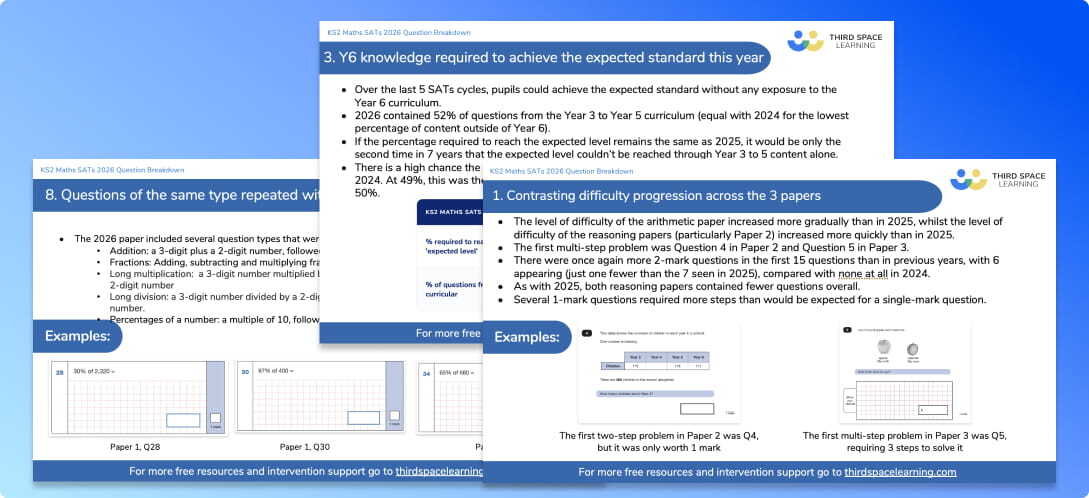
Maths SATs 2026 Question Breakdown: Staff Discussion Points
Download this presentation to take you through the key points from our question-level analysis of the 2026 KS2 SATs maths papers as you prepare for 2027. Includes example questions from the 2026 maths SATs papers. Can be used in staff meetings.
Download Free Now!2026 KS2 SATs results headlines
If you don’t have time to read the full report, here are the key stats for 2026:
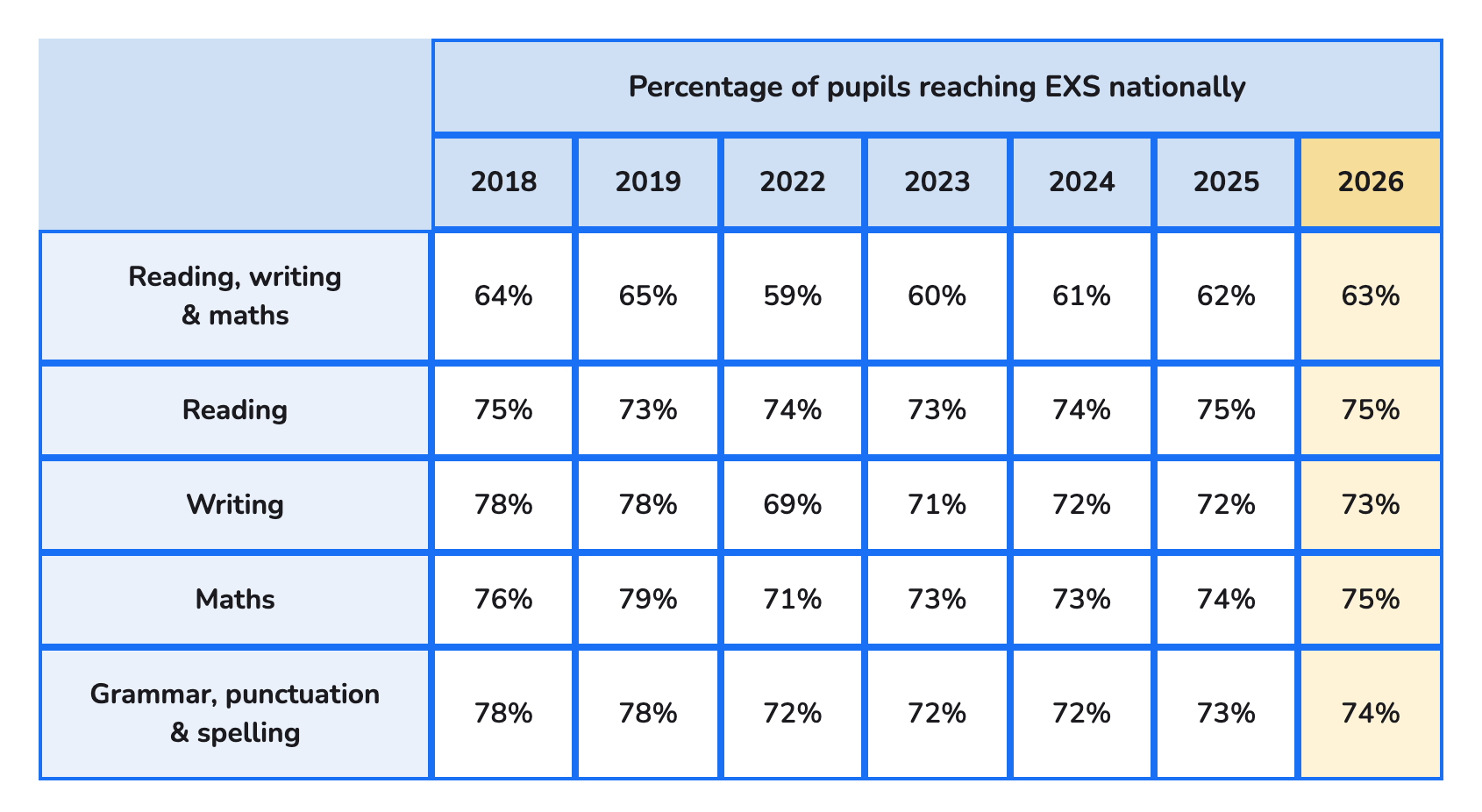
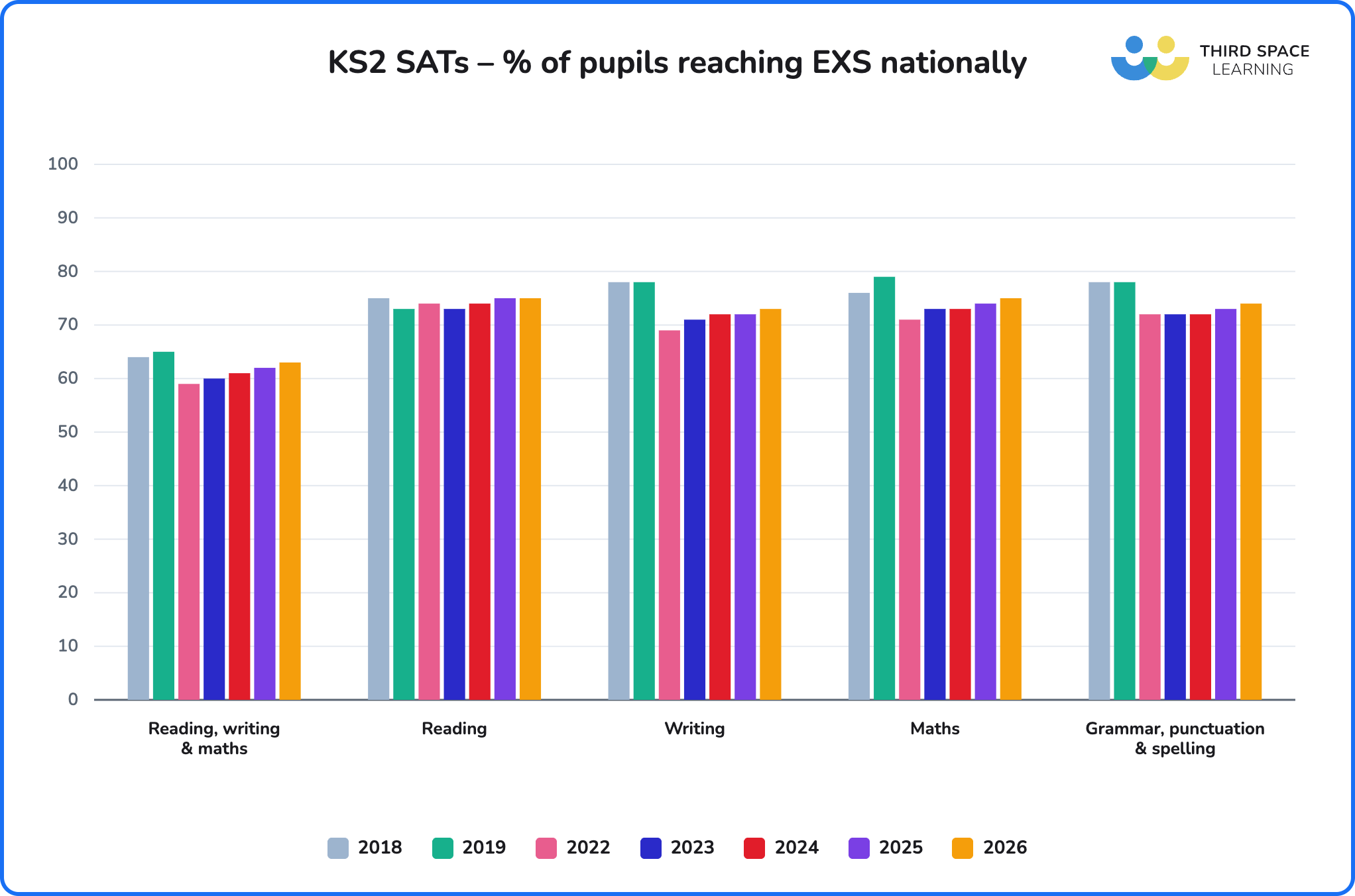
- 63% of pupils reached the Expected Standard in all of reading, writing and maths, up 1 % from 62% in 2025
- 74% of pupils reached the Expected Standard in English grammar, punctuation and spelling, up 1% from 73% in 2025.
- 75% of pupils reached the Expected Standard in reading, unchanged from 75% in 2025.
- 75% of pupils reached the Expected Standard in maths, up 1% from 74% in 2025
- 73% of pupils reached the Expected Standard in writing, up 1% from 72% in 2025
2026 key dates and when results are released
Here are the key dates school leaders need to know for the statutory Key Stage 2 tests in the summer term.
| Key dates | What’s happening on these key dates? |
| Thursday 16 July | Key Stage 2 test results and marked script images are available in the NCA Portal for Key Stage 2 schools |
| Thursday 16 July | Key Stage 2 test results available on the NCA Portal for local authorities, multi-academy trusts (MATs) and Key Stage 3 schools with a Year 7 intake |
| Thursday 16 July | Raw to scaled score conversion tables available on GOV.UK |
| Friday 31 July | Deadline for loacal authorities to submit information about external moderation of KS2 English writing TA on the NCA Portal |
| Monday 7 September | Deadline for schools to submit marking review applications on the NCA Portal by 11:59pm |
| Wednesday 9 September | Marking review outcomes returned to schools on the NCA Portal |
It is worth keeping the wider primary assessment calendar to hand too: the multiplication tables check and the phonics screening check both fall in June, and schools can run the optional Key Stage 1 tests in May. Looking ahead, the reception baseline assessment takes place when the next cohort enter Reception in September.
Understanding SATs Scores
SATs results for English reading, English grammar, punctuation and spelling, and maths are reported using scaled scores, ranging from 80 to 120.
Scaled scores for Key Stage 2 SATs
| Scaled score | What it means |
| 120 | The highest scaled score a pupil can achieve in the KS2 SATS. |
| 101-119 | Any score over 100 means that a child has exceeded the Expected Standard in the test papers. |
| 100 | The Expected Standard indicates children are working at age-related expectations. |
| 80-99 | Children with a scaled score of 80-99 are working towards the Expected Standard. |
| <80 | Pupils who do not achieve the lowest scaled score have not demonstrated sufficient understanding of the KS2 SATs and are HNM (have not met the Expected Standard). |
Writing is assessed separately, using teacher assessment judgements and is reported as:
- working towards
- expected
- greater depth
‘Greater depth’ isn’t officially used for reading, grammar, punctuation and spelling, or maths, but schools generally treat a scaled score of 110+ as greater depth.
Raw vs scaled score conversion
A pupil’s raw SATs score is the total number of marks they achieved across the test papers. On its own, though, this doesn’t tell you much, because each year’s SATs vary slightly in difficulty. To keep results comparable over time, raw scores are converted into scaled scores.
The conversion is carried out using the official scaled score conversion tables published by the Standards and Testing Agency (STA), allowing schools to interpret pupils’ performance and measure attainment against a national standard rather than the difficulty of a particular year’s test.
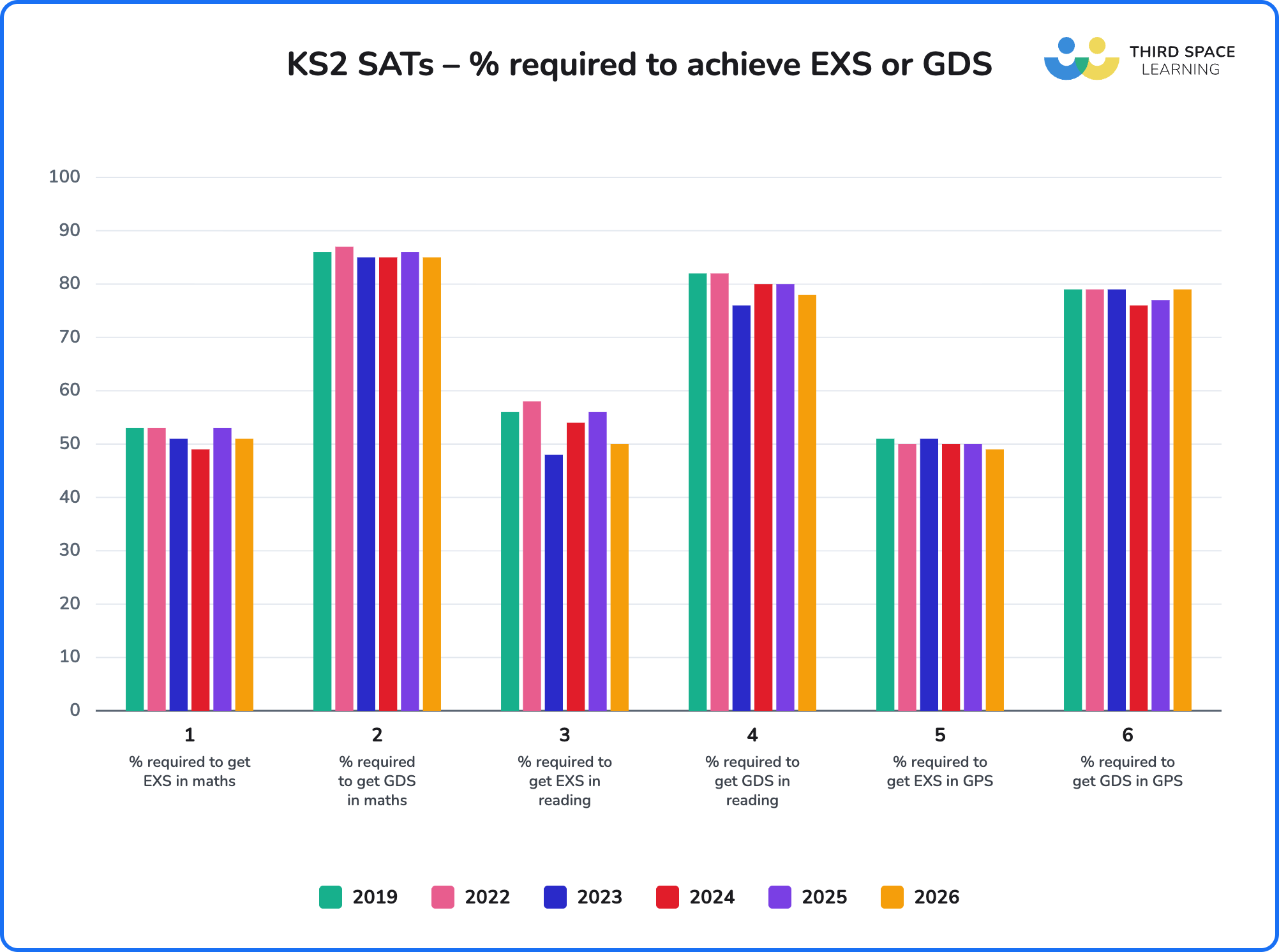
Raw and scaled scores for SATS 2026
| KS2 SATs scores | 2019 | 2022 | 2023 | 2024 | 2025 | 2026 | Changes from 2025 to 2026 | |||||||
| Raw score | % | Raw score | % | Raw score | % | Raw score | % | Raw score | % | Raw score | % | Rawscore | ||
| Maths/110 | EXS | 58 | 53 | 58 | 53 | 56 | 51 | 54 | 49 | 58 | 53 | 56 | 51 | -2 |
| GDS | 95 | 86 | 96 | 87 | 94 | 85 | 93 | 85 | 95 | 86 | 94 | 85 | -1 | |
| Reading/50 | EXS | 28 | 56 | 29 | 58 | 24 | 48 | 27 | 54 | 28 | 56 | 25 | 50 | -3 |
| GDS | 41 | 82 | 41 | 82 | 38 | 76 | 40 | 80 | 40 | 80 | 39 | 78 | -1 | |
| GPS/70 | EXS | 36 | 51 | 35 | 50 | 36 | 51 | 35 | 50 | 35 | 50 | 34 | 49 | -1 |
| GDS | 55 | 79 | 55 | 79 | 55 | 79 | 53 | 76 | 54 | 77 | 55 | 79 | +1 | |

READ MORE: Standardised scores in education
A decrease in raw score to achieve the expected level
Following an increase in the raw score required to reach the Expected Standard in the mathematics papers in 2025, it was perhaps unsurprising to see the threshold fall by two marks in 2026. This coincided with the proportion of Year 6 content increasing by six percentage points in the May 2026 papers compared with 2025.
This continues a familiar pattern seen in recent years, with the raw score required to achieve the Expected Standard closely mirroring changes in the proportion of Year 6 content within the test papers.
A decrease in raw score to reach the Expected Standard was seen across the board in English and maths
- Maths Expected Standard required a raw score of 56/110 – 2 marks lower than last year.
- Reading Expected Standard required a raw score of 25/50 – 3 marks lower than last year.
- Grammar, punctuation and spelling Expected Standard required a raw score of 34/70 – 1 mark lower than last year.
National Key Stage 2 SATs results 2026
Here’s how things look nationally for the 2026 SATs across the English reading papers, grammar, punctuation and spelling, mathematics papers, and all three combined.
Lowest pass marks on record, yet attainment keeps climbing
At first glance, this year’s headline numbers don’t add up. The raw marks needed to reach the Expected Standard were among the lowest on record – in maths, pupils needed just 56 out of 110, two marks fewer than in 2025 – yet the proportion reaching the Expected Standard in reading, writing and maths combined rose to 63%, its highest since before the pandemic.
So how can attainment rise while the pass marks fall? It comes down to how SATs are scored. Each year, raw scores are converted into scaled scores so that a scaled score of 100 always represents the same standard, whatever the difficulty of that year’s paper. When the raw threshold drops, it usually means the paper was harder, not that the bar was lowered – the Standards and Testing Agency sets the threshold to hold the standard steady.
That 63% figure points to a real, if slow, recovery in performance since 2022, even if attainment still sits just below the 64% and 65% reached in 2018 and 2019.
National attainment remains below pre-pandemic levels of 2019
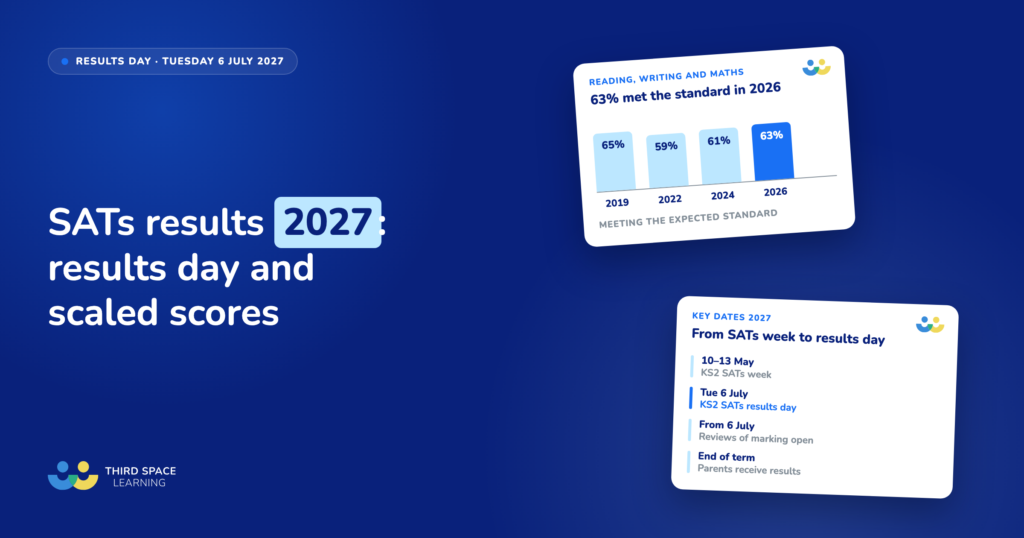
Despite year-on-year improvements in the percentage of pupils achieving the Expected Standard in reading, writing and maths combined since 2022, attainment remains below pre-pandemic levels. Since 2022, the combined figure has increased by one percentage point each year, rising from 59% in 2022 to 63% in 2026. However, this still falls short of the 64% and 65% achieved in 2018 and 2019.
The Covid pandemic may feel like a distant memory, but this cohort were in the middle of Reception year when schools first closed, with disruption continuing through Year 1. Given how important these early years are, it is unsurprising that the effects still show in national attainment.
As in previous years, reading continues to be the area least affected, with outcomes remaining broadly consistent both before and after the pandemic. The 75% of pupils achieving the Expected Standard in reading in 2026 matches the figure seen in 2025 and is two percentage points higher than the 73% achieved in 2019, the last assessment year before Covid.
English writing
Writing has shown a steady recovery since the pandemic, rising from 69% in 2022 to 73% in 2026, including a one percentage point increase on 2025. Despite this progress, attainment remains well below the 78% achieved in both 2018 and 2019.
Maths
Maths has also seen gradual improvement over recent years, increasing from 71% in 2022 to 75% in 2026. Whilst this upward trend is encouraging, attainment remains four percentage points below the national 79% achieved in 2019.
English grammar, punctuation and spelling
Grammar, punctuation and spelling (GPS) has also risen slightly to 74% in 2026. However, progress in this area has been slower than in writing and maths, with attainment increasing by just one percentage point since 2022 and remaining considerably below the 78% achieved in both 2018 and 2019.
KS2 maths SATs results 2026
This section takes a closer look at the Key Stage 2 maths papers, breaking down the results by content domain and year group coverage to give you a clear picture of how pupils performed.
As maths specialists, we’ll highlight the key patterns and trends emerging from this year’s papers, along with practical insights to help inform curriculum planning, classroom teaching and targeted intervention.
A slight increase in the percentage of Year 6 content compared to 2025
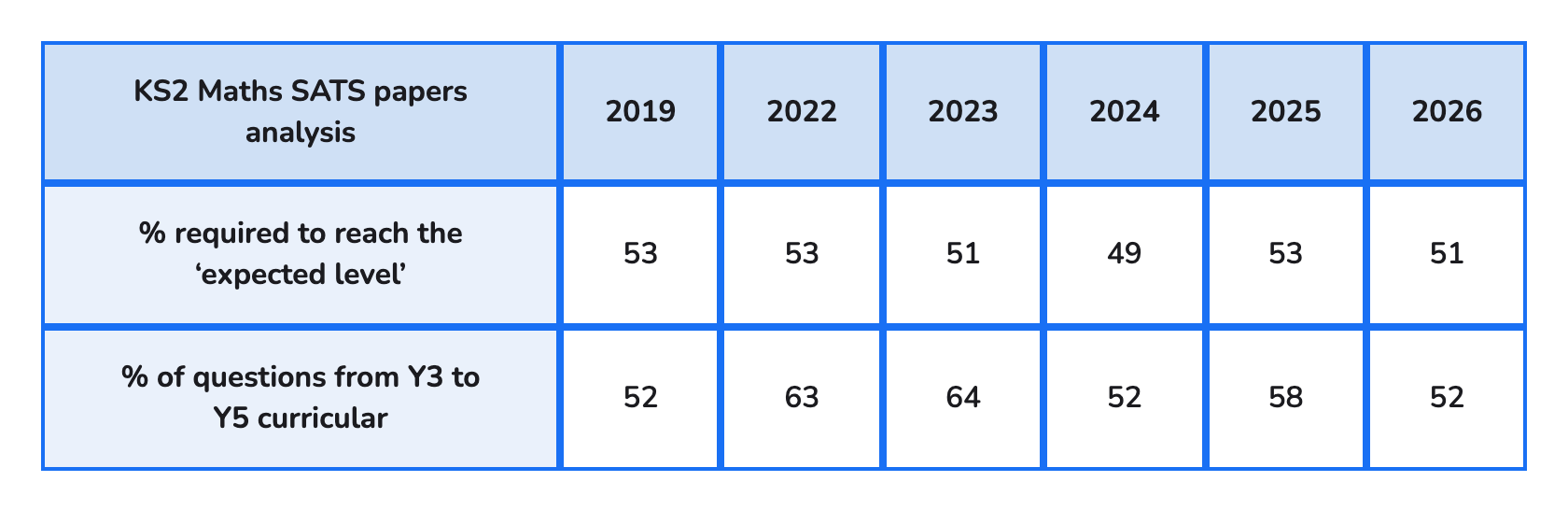
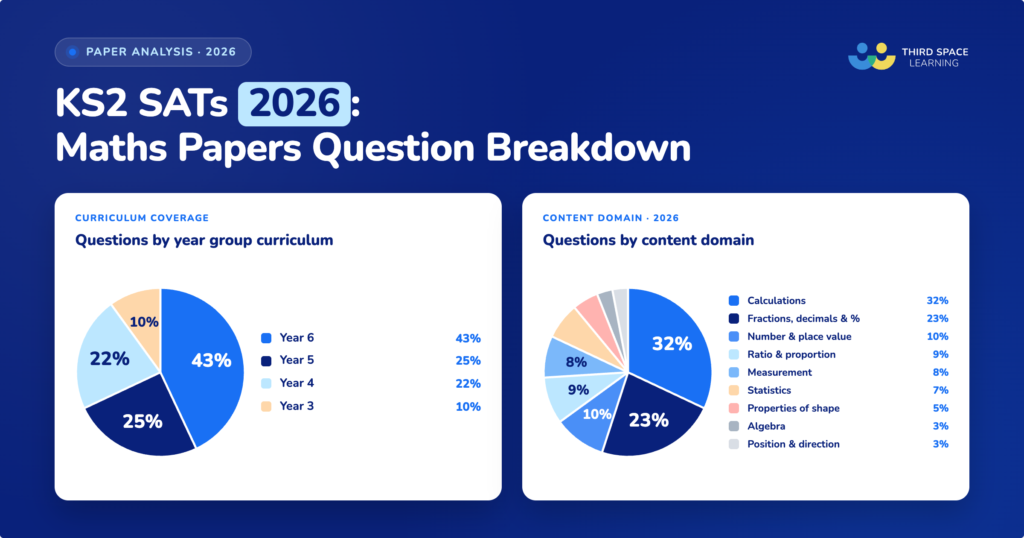
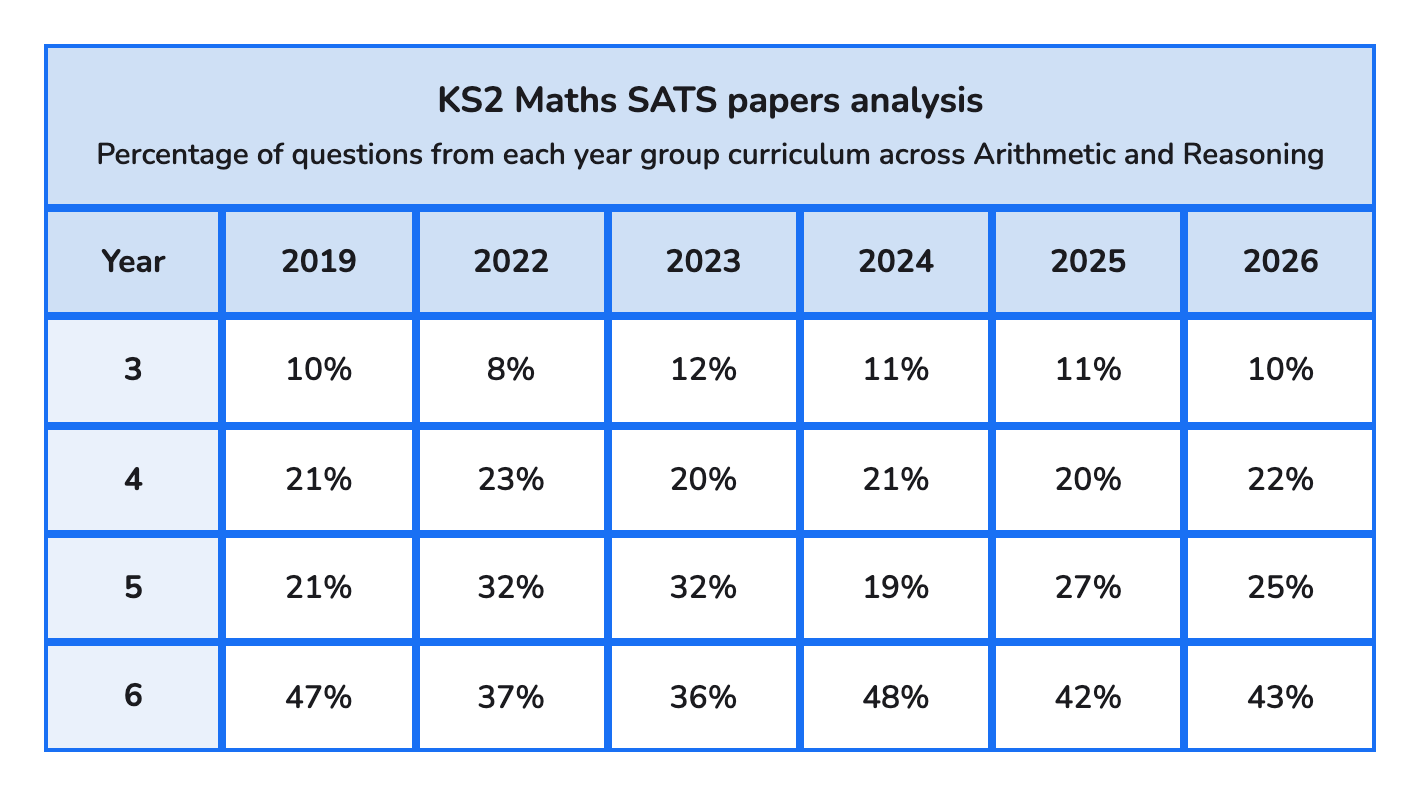
The proportion of Year 6 content in the maths SATs has been inconsistent in recent years. In 2024, there was a substantial 12 percentage point increase compared to 2023. This then fell by six percentage points in 2025, before rising once again in 2026 to return to the same percentage as 2024, with 48% of the paper drawn from the Year 6 curriculum. This is very close to the percentage of Year 6 questions seen in the final SATs cycle before the pandemic, when 47% of the content came from Year 6 objectives.
Achieving the Expected Standard with Years 3-5 content
One question that piques interest every year is whether pupils could achieve the Expected Standard in maths using only content taught in Years 3 to 5. Since 2022, the percentage required to achieve the Expected Standard has been lower than the proportion of questions drawn from the Year 3 to 5 curriculum, suggesting that this has indeed been possible without any knowledge of Year 6 content.
This remains true in 2026, but only just. The gap between the pass mark (51%) and the proportion of content drawn from Years 3 to 5 (52%) is just one percentage point – the narrowest margin seen since 2019, when the 53% required to reach the Expected Standard exactly matched the 53% of content taken from the Year 3 to 5 curriculum.
Although the proportion of Year 3 to 5 content in 2026 was identical to that seen in 2024, the percentage required to achieve the Expected Standard was two percentage points higher. This makes 2026 the most challenging year since 2019 in which pupils could theoretically have reached the Expected Standard relying solely on content taught before Year 6.
Despite this, over half of the content in the 2026 maths SATs was still drawn from the Years 3 to 5 curriculum. This continues to reinforce the importance of securing strong curriculum coverage throughout the whole of Key Stage 2, rather than focusing preparation solely on Year 6 content in the run-up to the tests.
Reaching the Expected Standard with two content domains
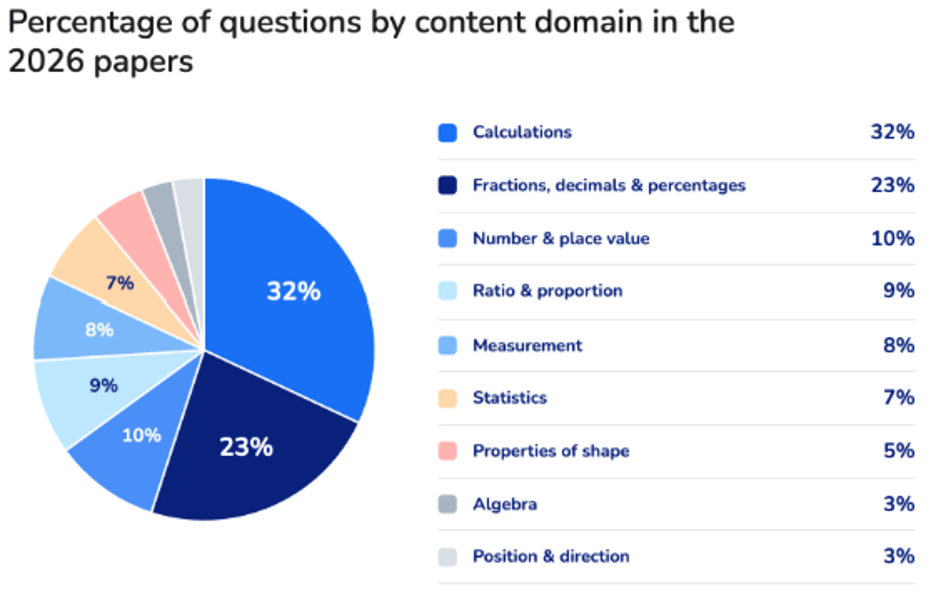
Whilst the proportion of content drawn from the two largest content domains – calculation and fractions, decimals and percentages (FDP) – has continued to decline, falling from 61% in 2024 to 58% in 2025, down to 55% in 2026, these areas continue to account for over half of the maths SATs paper. In fact, it would have been possible for pupils to achieve the Expected Standard of 51% with secure knowledge in these two domains alone.
Their continued dominance within the primary assessment tests reinforces the importance of developing strong foundations in calculation and FDP, as these skills underpin success across the wider maths curriculum.
For most content domains, coverage remained broadly consistent. However, 2026 saw a further increase in the proportion of questions focused on:
- Ratio and proportion: rising from 6% in 2024 to 7% in 2025 and 9% in 2026.
- Statistics: increasing from 3% in 2024 to 4% in 2025 and reaching 7% in 2026.
The arithmetic paper is key to maths success
As in previous years, the arithmetic paper is the most predictable of the three maths papers. The 2025 SATs question level breakdown showed that the proportion of questions from each content domain stays remarkably consistent year on year, and the 2026 question level breakdown found the same. This makes the arithmetic paper by far the easiest one to prepare pupils for.
KS2 SATs results 2026: next steps for your school
1. Compare your school performance to national data
You’ll want to know how your school compares to the national data for primary schools in England, for the combined reading, writing, and maths Expected Standard, as well as the Expected Standard levels for each subject.
Keep in mind that the smaller your cohort, the less statistically significant the national data will be.
You can find SATs KS2 results by school on the government’s school comparison service.
2. Carefully check whether any papers need to be submitted for remarking
Marking attracted particular scrutiny this year, following widespread reports of errors – which is part of why the review deadline was extended. That makes it more worthwhile than usual to check your borderline papers carefully before results feed into your planning.
When the SATs tests are marked, mistakes can occur, especially given the large volume of papers. Review your school’s results for each subject and identify a child’s raw score within three marks of reaching the expected level.
- Download the published mark scheme and carefully review the papers of these borderline pupils to ensure no marks have been missed.
- Pay particular attention to instances where pupils received a zero but should have earned marks for their calculations.
- Ensure that any workings outside the designated answer area have been considered.
If you believe a child may have received a lower score than they deserve, it is worthwhile to apply for a review and re-marking of those papers. The deadline for 2026 has been extended until Monday 7 September 2026.
Be aware: SATs paper marking errors can go either way!
While it is true that marks can be missed during the initial marking, it is also possible that marks have been awarded incorrectly. Be aware that when submitting papers for remarking, there is a risk that pupils could lose marks.
For example, if you identify missed marks on a maths paper and request a remark, all three papers will be reviewed. Therefore, it is crucial to check carefully before submitting. Additionally, there is a cost associated with the review if no changes are made to the original marking decision.
3. Analyse the results to identify areas of strength and development
Before the end of summer term, dedicate time to thoroughly review the SATs results to gain a comprehensive understanding of the cohort’s performance. Identify areas of strength and weakness among the topics covered. Use these insights to inform planning for the upcoming year.
Is there a disparity in attainment among any key groups? If so, what strategies can be implemented to bridge these gaps?
It is important to look at key groups such as Pupil Premium versus non-Pupil Premium, boys versus girls, and EAL (English as an Additional Language) versus non-EAL.
Analyse the data for any trends and patterns, and consider possible reasons for any disparities. Once identified, consider how these variations can be mitigated in future years to narrow any achievement gaps as effectively as possible.
As SATs tests assess the entirety of KS2, any interventions should span across all KS2 years, not just focusing on Years 5 and 6.
4. Progress scores are available for pupils in 2026
Unlike the 2024 and 2025 cohorts, this year’s pupils have KS1 statutory teacher assessment judgement data. This means your school’s KS1 to KS2 progress scores can be calculated for 2026.
Progress scores show how much progress your pupils have made from their KS1 starting point to the end of KS2, compared with pupils nationally who had a similar starting point. A score of 0 means your pupils made about the same progress as similar pupils; a positive score means they made more progress, and a negative score means they made less.
For this cohort, that gives you a like-for-like measure of how far your pupils have come during their time at your school, rather than a picture based on attainment alone. And because a progress score covers the full stretch from KS1 to KS2, it can tell a different story to your attainment figures.
5. Reporting KS2 SATs results to children and parents
Individual schools have a statutory responsibility to report the pupils’ SATs results to parents in terms of the child’s scaled score.
For pupils in KS2, end-of-year reports must include the following:
- The child’s SATs results, detailing their scaled score and whether they met the Expected Standard;
- The outcomes of statutory national curriculum Teacher Assessments in English writing assessments, and science;
- An explanation, if applicable, as to why any national curriculum test was not taken.
KS2 reports must also include comparative information about the attainment of pupils of the same age:
- In the school;
- In the core subject nationally.
It is also a legal requirement that you provide enough time for parents to have the opportunity to discuss the results if they wish.
6. Headteachers: remember to support your staff, regardless of the results
SATs results can be a stressful time for school leaders, but it’s crucial to remember that all staff members will also need your support.
If the 2026 SATs results are positive, it’s important to celebrate this achievement with all staff, not just the Year 6 teachers. Many other teachers and support staff have contributed to these results and deserve recognition and celebration.
On the other hand, if the results are not as expected, leaders must be there to support all staff, especially the Year 6 teachers who may feel a disproportionate level of responsibility. It’s essential to reassure these teachers that the outcomes are not solely their responsibility.
The key thing to remember is that KS2 SATs are a collective effort involving the entire school community, regardless of the outcome.
7. What else can you do for your Year 6 pupils?
Beyond the statutory letter, each school has the autonomy to decide how they handle SATs results.
It’s important to recognise that children will react differently to their SATs results. While some may accept them calmly, others might find them distressing.
Where possible, it’s beneficial to allocate time to sit with each child individually and discuss their test results alongside teacher assessments. This allows staff to demonstrate to pupils that SATs are not the only measure of their abilities.
It also provides an opportunity to help children understand that their progress throughout the entire year is what truly counts, not just their SATs scores.
Spend the last few weeks of summer term looking beyond SATs and ensuring your pupils are ready for secondary school.
8. Celebrate the positives in your 2026 SATs!
While it’s natural to occasionally dwell on the negatives, especially if your headline figures aren’t as expected, it’s equally important to seek out the positives.
These might include individual successes among children or groups or specific aspects of the tests where your entire cohort performed well. These achievements are all worth celebrating.
Certainly, use the results to identify areas for improvement in the coming year. However, it’s important to remember that your pupils are more than just the scores they achieved on their SATs.
How can Third Space Learning improve maths SATs results?
Since 2013, schools like yours have trusted Third Space Learning’s SATs revision programme and one-to-one online maths tuition to get more Year 6 pupils to the Expected Standard in maths. In a low-stakes, one-to-one setting, our AI maths tutor, Skye, provides hundreds of target pupils more support to clear up misconceptions and build confidence in the topics they find trickiest, so they walk into their SATs ready to show what they can do.
One of my children only came to the UK in October and spoke no English. She made great progress in Maths in Autumn term but only after using Skye she really picked the mathematical language and her skills shone. She passed her maths SATs.
Year 6 teacher
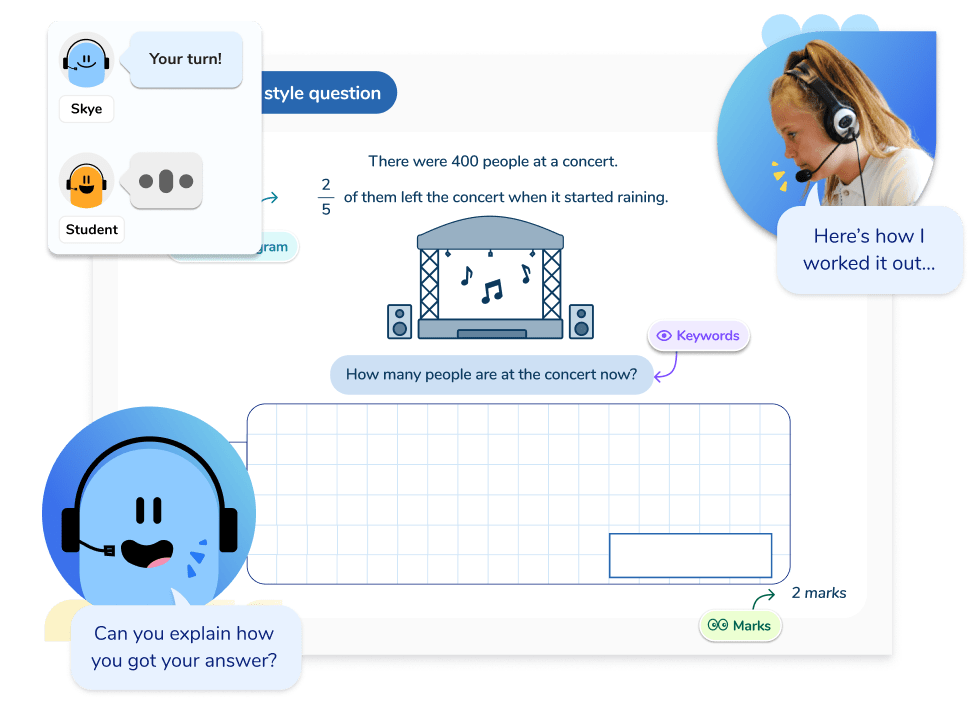
A Third Space Learning online SATs revision lesson.
When primary schools sign up for one to one maths tutoring with Skye, they receive unlimited sessions for unlimited pupils, meaning you no longer have to choose between the pupils who need help and what your school budget can afford. With Skye, you can support every Year 6 pupil, helping them succeed in their SATs and feel prepared for the transition to secondary school.
Find out more about AI tutoring for primary schools, including our SATs Revision Programme.
The one-to-one tutoring allowed additional time spent on areas that they found hard to grasp.
Jamie Addleton, Deputy Headteacher, One Degree Academy
SATs 2026 revision resources
Whether schools are signed up for targeted one to one tutoring or not, teachers can access the Third Space Maths Hub to support Year 6 pupils on their SATs journey.
Schools and teachers can access hundreds of free resources, including SATs practice papers and past papers and SATs worked examples, Year 6 maths SATS papers and a KS2 SATs revision page with links to all the resources you’ll need.
Those schools signed up for unlimited tutoring sessions also receive access to the premium Maths Hub resources for no additional cost.
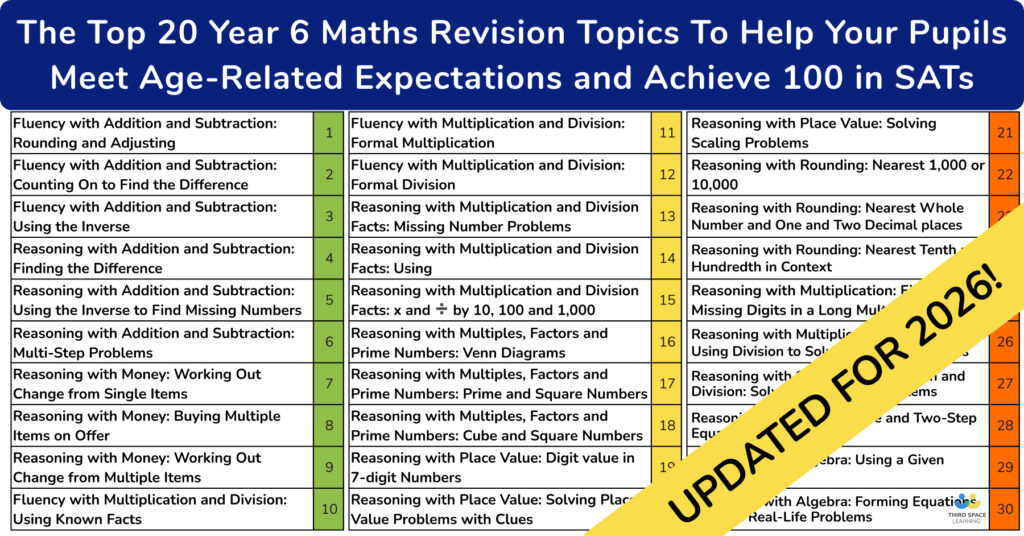
To really hone in revision on the most frequently occurring topics, you’ll want to use this carefully curated maths revision programme of the top 20 maths topics. It aims to help all students achieve a standardised score of at least 100 and improve school performance in maths.
Previous SATs results and analysis
GET THE ANALYSIS ON PREVIOUS SATS
SATs have been running in their current incarnation for 7 years; there were no government standardised assessments in 2020 and 2021 as a result of the Covid-19 pandemic. Get all the analysis and results from previous national assessments below.
And find out which are the top 20 year 6 maths revision topics to focus on this year.
– SATs papers 2026
– SATs papers 2025
– SATs results 2025
– SATs papers 2024
– SATs results 2024
– SATs papers 2023
– SATs results 2023
– SATs papers 2022
– SATs results 2022
– SATs papers 2019
– SATs results 2019
– SATs papers 2018
– SATs results 2018
– SATs papers 2017
– SATs results 2017
– SATs results 2016
Other statutory primary assessments in 2025/26
Statutory assessments are still required in other year groups at primary school, particularly in reception, Year 1 and Year 4.
Reception baseline assessment
All reception baseline assessment schools must administer the RBA to children in the first six weeks of the autumn term. This establishes a starting point for measuring progress to the end of key stage 2.
The assessment is carried out one-to-one and includes early maths, literacy and language tasks appropriate for the reception year. Schools must complete the assessment for all eligible children who enter reception in September.
Phonics screening check
The phonics screening check must be completed during the week commencing 8 June 2026. It applies to:
- All Year 1 pupils
- Any Year 2 pupils who did not meet the Expected Standard in Year 1 or did not take the check previously
Phonics screening check schools must administer the same test to all children and mark it using DfE guidance.
Multiplication tables check
The multiplication tables check window opens in June 2026. Schools can choose the date but must complete the check within the two-week national window from Monday 1 June 2026.
The check is statutory for all Year 4 pupils in multiplication tables check schools. Children answer 25 timed questions online, focusing on recall of multiplication tables up to 12 × 12.
SATs results 2026 FAQs
The scaled scoring system helps schools clearly identify which pupils have either:
met the Expected Standard
exceeded it
working towards it
However, what counts as a ‘good’ score can vary from child to child. It’s important to remember that SATs offer just a brief snapshot of performance on a single day. A pupil who hasn’t met the Expected Standard may still have made significant progress and it’s that broader journey over time that often tells the real story.
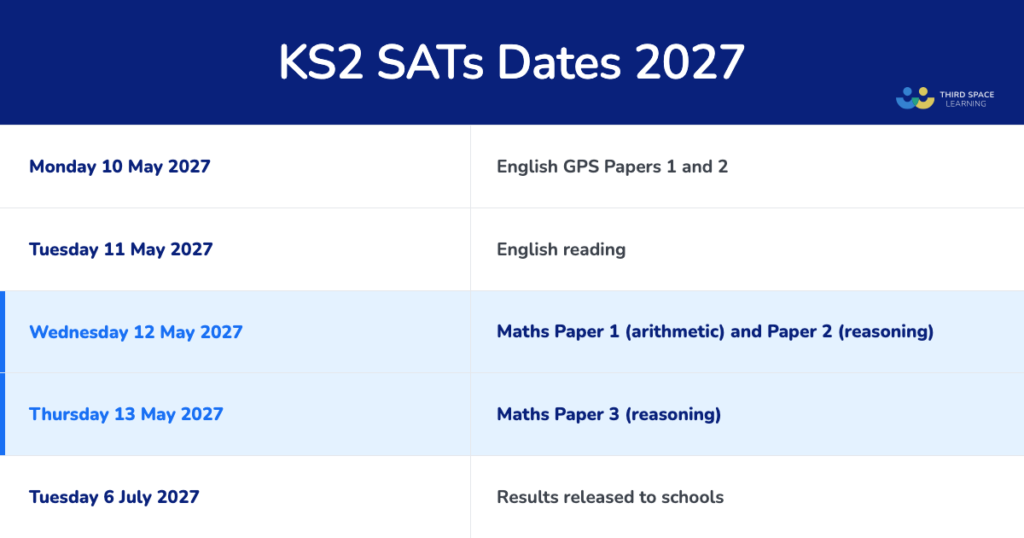
In 2026, Year 6 SATs week will take place on the week beginning Monday 11th May. The SATs tests will take place from Monday 11th to Thursday 14th May.
In addition to the KS2 SATs scores, the following codes are used for teacher assessment results.
EXS Working at the Expected Standard
GDS Working at greater depth within the Expected Standard
WTS Working towards the Expected Standard
HNM Has not met the Expected Standard
You can find all the details of the optional Key Stage 1 tests, the phonics screening check and the multiplication tables check from the child’s school, the class teacher or the DfE. The reception baseline assessment, taken when children enter Reception, sits at the other end of primary school.

DO YOU HAVE STUDENTS WHO NEED MORE SUPPORT IN MATHS?
Skye – our AI maths tutor built by teachers – gives students personalised one-to-one lessons that address learning gaps and build confidence.
Since 2013 we’ve taught over 2 million hours of maths lessons to more than 170,000 students to help them become fluent, able mathematicians.
Explore our AI maths tutoring or find out about year 6 SATs for your school.