Many students reach Year 10 and Year 11 with gaps in the key concepts that GCSE maths builds on, making new content harder to learn and revision less effective.
Skye works one-to-one with Year 10 and Year 11 students, teaching topics in depth, addressing misconceptions and building the secure understanding needed to succeed at GCSE.
Support is unlimited for one fixed cost, so every Year 10 and Year 11 student who needs it can have their own personal maths tutor.
Preview KS4 lesson

“I run these sessions myself; I’m not a maths specialist, which highlights a key benefit: Skye delivers the maths teaching while I act as a facilitator. This setup adds capacity without increasing workload and allows our maths teachers to focus on classroom teaching.”
Gareth Barratt, Key Stage 4 Director
Richard Rose Central Academy
Every teacher-designed Key Stage 4 maths tutoring lesson follows an “I do, we do, you do” structure, building understanding of the essential KS4 objectives before moving students on to independent practice.
Skye, our AI maths tutor, has been trained on every lesson in the curriculum, drawing on prompts designed for every individual question and lesson, adapting teaching to individual needs and addressing misconceptions.
Every Key Stage 4 maths tutoring session:
Starts with a short diagnostic assessment
Moves straight to independent practice if secure
Provides guided support where needed
Uses formative assessment throughout to identify misconceptions and provide targeted hints
Ends with a summative assessment to confirm understanding
For GCSE revision, our GCSE maths tutoring programmes use exam-style questions to help students reach target grades 3–7.
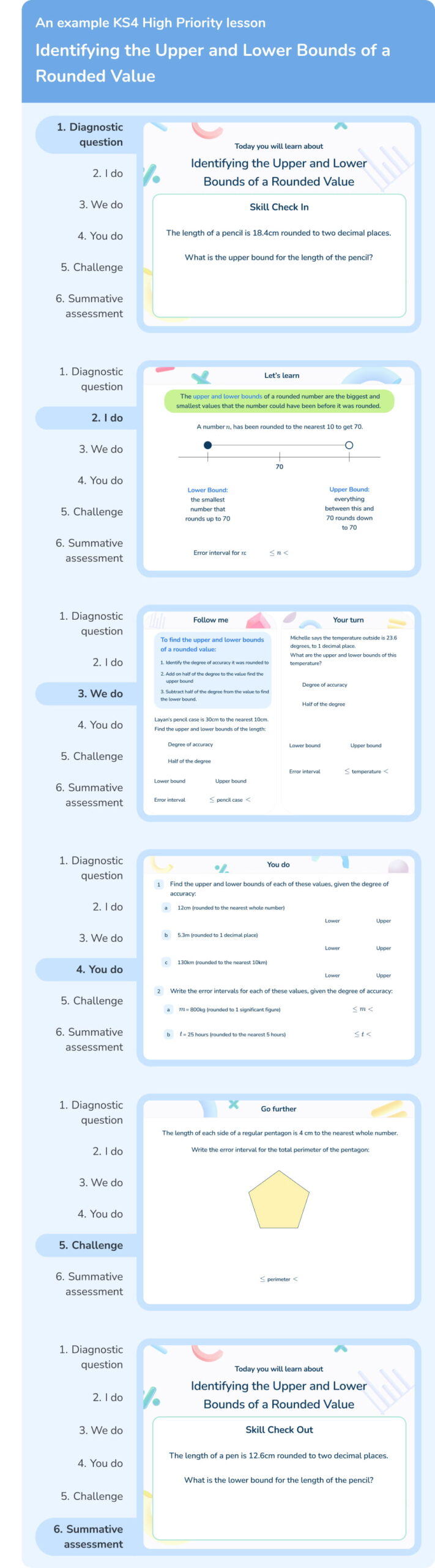
The High Priority Key Stage 4 Programme is available now, covering 51 high-priority topics designed to build a secure, deep understanding of the concepts and skills essential for KS4 maths success.
For exam revision, our GCSE programmes are available at all times, helping meet each student’s target GCSE grade with scaffolded lessons built around exam-style questions.
New Key Stage 4 learning programmes are launching through the 2026/27 academic year. Explore the lessons in each level.
High Priority Key Stage 4 Programme
View lessons
High Priority Key Stage 4 Programme
Learning objectives in this programme
All programmes begin with a diagnostic assessment to identify gaps
Adjusting numbers into standard form
Identifying the Upper and Lower bounds of a rounded value
Reverse Percentages – Calculating from a Difference
Reverse Percentages – from repeated percentage change
Average Speed and Density – Complex Problems
Ratio Problems – Subdividing Part of a Ratio
Ratio Problems – Subdividing a Whole Ratio
Factorising Quadratics (coefficient not equal to 1)
Factorising Quadratics (coefficient not equal to 1) – Difference of Two Squares
Parallel and Perpendicular Lines – Identifying Using y = mx + c
Finding Perpendicular Lines Through Points
Sectors – Finding a Missing Angle or Radius
Quadratic Sequences – Finding nth Terms in the Form n^2 + (bn) + c
Quadratic Sequences – Finding nth Terms in the Form an^2 + bn + c
Recurring Decimals – 1/2/3 repeated digits
Recurring Decimals – Calculating
Product Rule for Counting – One Item Per Set
Product Rule for Counting – More Than One Item Per Set
Product Rule for Counting – Selecting in Any Order
Triple Brackets – Expanding in the form (ax+b)(cx+d)(ex+f)
Triple Brackets – Expanding Raised to Powers
Triple Brackets – Expanding in Context
Using Negative Indices
Unit Fractional Indices
Indices – Non-unit Fractional Indices
Indices – Using Negative Fractional Indices with Integer Bases
Proportionality – Using Direct Proportion
Proportionality – Using Inverse Proportion
Algebraic Fractions – Simplifying by Factorising
Completing the Square – (x+b)^2+c
Completing the Square – solving simple quadratics
Surds – Simplifying Surds
Surds – Expanding Brackets with Surds
Surds – Rationalising Single term Denominators
Finding the Surface Area of Spheres
Finding the Volume of Spheres
Finding the Volume of Cones
Finding the Surface Area of Cones
Calculating with Column Vectors
Finding Routes using Vectors
Using Exact trig values
Solving Quadratics using the Formula
Using the Sine Rule to find Missing Sides
Using the Sine Rule to find Missing Angles
Pythagoras in 3D
Rearranging formulae involving factorising
Completing the Square – a(x+b)^2+c
Functions – Using Function Notation
Using the Cosine Rule to find Missing Sides
Using the Cosine Rule to find Missing Angles
Using 1/2abSinC to find the area of a triangle
About this programme
51 high-priority topics, each carefully crafted to cover the key concepts and skills essential for KS4 maths success. These targeted exercises help students build a secure, deep understanding of the topics that matter most.
How are lessons ordered?
The default order has been set by our academic team for the most appropriate sequence of learning as students develop skills. Teachers can re-order lessons at any point.
Key Stage 4: Level 5 (coming soon)
View lessons
Key Stage 4: Level 5 (coming soon)
Learning objectives in this programme
All programmes begin with a diagnostic assessment to identify gaps
Venn diagram set notation
Change the subject of a formula – formulae involving fractions
Adjusting numbers into standard form
Adding and subtracting numbers written in standard form
Multiplying and Dividing numbers written in standard form – Multiplying numbers written in standard form
Multiplying and Dividing numbers written in standard form – Dividing numbers written in standard form
Working on Mixed Index Law Problems (including zero index)
Factorising a quadratic expression into two brackets
Drawing graphs in the form y=mx+c
Finding gradients
Finding equations of straight lines in the form y=mx+c
Identifying the Upper and Lower bounds of a rounded value
Solving simple simultaneous equations by elimination
Calculating the volume of prisms
Finding the volume of cylinders
Generating a non-linear sequence from an nth term
Expanding Brackets (application e.g. perimeter and area)
Converting between metric units of area
Converting between metric units of volume
Compound interest
Compound depreciation
Reverse percentages – from original amounts
Finding the original given the fraction.
Solving inequalities with the unknown on both sides
Find missing terms in a sequence (algebraic)
Problems involving ratio and fraction of amount.
Area and Perimeter of semi circles and other sectors
Find arc lengths of sectors
Find area of sectors
Work fluently to find the area/arc, radius/diameter.
Finding the area of compound shapes – Cut outs and shaded regions (including circles and sectors)
Finding the equation of a line through 2 points (not y-intercept)
Calculating the distance between two points
Expand a double bracket – (ax+-b)(cx+-d) or (b+-ax)(d+-cx)
Factorise quadratic (x^2 coef =1) into two brackets and solve for when = 0.
Understand and be able to identify the roots of a quadratic graph
Understand and be able to identify the turning point of a quadratic graph
Use the graph to determine values for specific solutions. EXAMPLE: Find solutions for when x2 + 3x + 1 = 3
Draw a line at y = n and see where it intersect the curve; state the x coordinate.
Draw quadratic/cubic graphs given a table of values both non-calculator and calculator.
Sketching Graphs and recognising characteristics – quadratic
Sketching Graphs and recognising characteristics – cubic
Sketching Graphs and recognising characteristics – reciprocal
Sketching Graphs and recognising characteristics ALL
Solving Simultaneous Equations by elimination (no matching coefficients)
Forming and solving simultaneous equations from worded problems
Work with surface area in more complex scenarios.
Working with volume in more complex scenarios e.g. given a net
Flow rate
Reverse Volume of Cubes and Cuboids
Reverse Volume of Prisms
Enlarge shapes given a fractional scale factor.
Use parallel line rules to find missing bearings.
SOHCAHTOA – missing sides (harder)
Estimate using 1 significant figure Work with area, perimeter, volume to estimate calculations in context.
Estimating powers and roots
Problems involving fractional increase/decrease Interleave with best buy, area etc.
Choose and explain which statistic gives you the best information given a set of data.
Find missing frequencies given the mean/ estimated mean.
Understand how changes affect the MMMR.
Work out new mean dependent on new data or changing data.
Understand that the more trials the more accurate the probability.
Use experimental probability to scale to find estimates.
Work out the relative frequency based off number of times the outcome has arisen over total trials.
Finding scale factor and drawing pie charts when quantity is below and above 360.
Interpreting pie charts given a part or difference using angle proportion.
Using a tree diagram to represent outcomes of events.
Combine two or more ratios
Compare best buy problems involving fractions and percentage discounts.
Identify movement and speed from a Distance time graph.
DMV problems when more than one material is compared and worked with.
Work with DMV when the volume might need to be found from a shape.
PFA problems
Work with PFA when the area might need to be found from a shape.
Algebraic Fractions – 4 operations with simple denominators and numerators
Finding Parallel Lines Through Points
Writing an error interval for truncated values
About this programme
Part of our new Key Stage 4 learning programme, coming soon for the 2026/27 academic year. 77 lessons, each designed by qualified teachers and including teaching, guided practice and independent practice.
Levels are not limited by key stage. Teachers can place each student at the level that best matches their needs, whatever their year group, and move them between levels at any point.
How are lessons ordered?
The default order has been set by our academic team for the most appropriate sequence of learning as students develop skills. Teachers can re-order lessons at any point.
Key Stage 4: Level 6 (coming soon)
View lessons
Key Stage 4: Level 6 (coming soon)
Learning objectives in this programme
All programmes begin with a diagnostic assessment to identify gaps
Reverse Percentages – Calculating from a Difference
Indicating regions on a coordinate axes from inequalities
Reverse Percentages – from repeated percentage change
Tree Diagrams – Selection Without Replacement
Tree Diagrams – Conditional Probability Problems
Venn Diagrams – Finding Probabilites
Venn Diagrams – Completing Two Sets
Venn Diagrams – Completing Three Sets
Average Speed and Density – Complex Problems
Ratio Problems – Subdividing Part of a Ratio
Ratio Problems – Subdividing a Whole Ratio
Factorising Quadratics (coefficient not equal to 1)
Factorising Quadratics (coefficient not equal to 1) – Difference of Two Squares
Parallel and Perpendicular Lines – Identifying Using y = mx + c
Parallel and Perpendicular Lines – Identifying Using Graphs
Finding Perpendicular Lines Through Points
Sectors – Finding a Missing Angle or Radius
Quadratic Sequences – Finding nth Terms in the Form n^2 + (bn) + c
Quadratic Sequences – Finding nth Terms in the Form an^2 + bn + c
Recurring Decimals – 1/2/3 repeated digits
Recurring Decimals – Calculating
Product Rule for Counting – One Item Per Set
Product Rule for Counting – More Than One Item Per Set
Product Rule for Counting – Selecting in Any Order
Triple Brackets – Expanding in the form (ax+b)(cx+d)(ex+f)
Triple Brackets – Expanding Raised to Powers
Triple Brackets – Expanding in Context
Similar Shapes – Areas and Volumes
Similar Shapes – Solving Problems in Context
Completing Cumulative Frequency Tables
Drawing Cumulative Frequency Graphs
Finding Quartiles and Median from Cumulative Frequency
Finding Quartiles from listed data
Drawing Box Plots from listed data
Comparing Box Plots of Two Data Sets
Using Negative Indices
Unit Fractional Indices
Indices – Non-unit Fractional Indices
Indices – Using Negative Fractional Indices with Integer Bases
Proportionality – Using Direct Proportion
Proportionality – Using Inverse Proportion
Capture-Recapture – Estimating the Total Population
Capture-Recapture – Finding Other Amounts
Algebraic Fractions – Simplifying by Factorising
Completing the Square – (x+b)^2+c
Completing the Square – solving simple quadratics
Circle Theorems – Angles In Segments and At The Centre
Circle Theorems – Semicircles and Cyclic Quadrilaterals
Surds – Simplifying Surds
Surds – Expanding Brackets with Surds
Surds – Rationalising Single term Denominators
Finding the Surface Area of Spheres
Finding the Volume of Spheres
Finding the Volume of Cones
Finding the Surface Area of Cones
Calculating with Column Vectors
Finding Routes using Vectors
Using Exact trig values
Solving Quadratics using the Formula
Using the Sine Rule to find Missing Sides
Using the Sine Rule to find Missing Angles
Pythagoras in 3D
About this programme
Part of our new Key Stage 4 learning programme, coming soon for the 2026/27 academic year. 62 lessons, each designed by qualified teachers and including teaching, guided practice and independent practice.
Levels are not limited by key stage. Teachers can place each student at the level that best matches their needs, whatever their year group, and move them between levels at any point.
How are lessons ordered?
The default order has been set by our academic team for the most appropriate sequence of learning as students develop skills. Teachers can re-order lessons at any point.
Key Stage 4: Level 7 (coming soon)
View lessons
Key Stage 4: Level 7 (coming soon)
Learning objectives in this programme
All programmes begin with a diagnostic assessment to identify gaps
Rearranging formulae involving factorising
Indices – Using Negative Fractional Indices with Fractional Bases
Indices – solving equations by changing the base
Proportionality – Combining Proportional Relationships
Algebraic Fractions – Simplifying a Multiplication or Division
Algebraic Fractions – Simplifying an Addition or Subtraction
Completing the Square – a(x+b)^2+c
Completing the Square – Turning Points
Circle Theorems – Tangents and Alternate Segments
Surds – Rationalising Multi-term Denominators
Spheres and Cones – Compound Solids
Volume of a Pyramid
Histograms – Frequency Density
Histograms – Finding Proportions
Vectors – Using Ratios
Functions – Using Function Notation
Functions – Evaluating Composite Functions
Functions – Expressions for Composite Functions
Functions – Expressions for Inverse Functions
Functions – Solving Problems with Inverse Functions
Lower and Upper Bounds – Addition and Multiplication
Lower and Upper Bounds – Subtraction and Division
Lower and Upper Bounds – using bounds to find a suitable approximation
Transformations of Functions – Vertical Translations
Transformations of Functions – Horizontal Translations
Transformations of Functions – Reflections
Using the Cosine Rule to find Missing Sides
Using the Cosine Rule to find Missing Angles
Using Sine and Cosine rules to solve Bearings Problems
Using 1/2abSinC to find the area of a triangle
Using an iterative formula to generate a sequence
Locating a root in an interval
Solving an equation using iteration
Trigonometry in 3D
Understanding the Sine Graph
Understanding the Cosine Graph
Understanding the Tan Graph
Transformations of the Sine and Cosine graphs
Algebraic Proof – Odd and Even
Algebraic Proof – Multiples
Proof of congruence
Quadratic Inequalities
Average rates of change
Instantaneous rates of change
Distance from a Speed-Time graph – uniform acceleration
Distance from a Speed-Time graph – variable acceleration
Understanding the equation of a circle centre (0,0)
Finding a tangent to a circle centre (0,0)
Finding a tangent to a circle centre (a,b) at a point (c,d)
Solving linear and non-linear simultaneous equations algebraically
About this programme
Part of our new Key Stage 4 learning programme, coming soon for the 2026/27 academic year. 50 lessons, each designed by qualified teachers and including teaching, guided practice and independent practice.
Levels are not limited by key stage. Teachers can place each student at the level that best matches their needs, whatever their year group, and move them between levels at any point.
How are lessons ordered?
The default order has been set by our academic team for the most appropriate sequence of learning as students develop skills. Teachers can re-order lessons at any point.
Get in touch today to arrange a free maths tutoring taster session with Skye, our AI maths tutor. On a quick call, we’ll set everything up so you can see how unlimited maths tutoring can support your secondary school:
Trusted by more than 4,200 schools since 2013
Unlimited one-to-one tutoring for one low fixed cost
Developed by qualified secondary maths teachers for maximum academic impact
Built using insights from 2,295,000+ one-to-one tutoring sessions in schools
You can learn more about how we keep your data safe and secure in our privacy policy.