



SATs Results 2027: Results Day, Scaled Scores And What School Leaders Need To Know

Anyone who has taught Year 6 knows the feeling of refreshing a results page at 7.30am on a July morning. In 2026, schools kept refreshing for an extra nine days. SATs results 2027 are due to reach primary schools on Tuesday 6 July 2027. After last summer’s delay, you’ll want a clear picture of what to expect before you plan the final weeks of term.
KS2 SATs results are the scores pupils receive for the national curriculum tests they sit in May of Year 6, at the end of Key Stage 2. Official results for the 2027 cohort won’t exist until results day. The dates and scoring are already confirmed, and so are the accountability changes for this cohort.
SATs 2027: STAY UP TO DATE
Join our email list to stay up to date with the latest news and free resources for SATs 2027. As usual, our expert teachers will be on hand to provide one to one tuition support, revision resources, expert paper analysis, SATs teacher survey results and the SATs results 2027.


SATs Booster Toolkit
Download this free SATs booster toolkit to identify the topics your pupils need to prioritise for revision. Includes 6 KS2 maths SATs papers, SATs diagnostic assessment and answers, plus 3 SATs intervention lessons from our SATs Booster programme, with accompanying teacher notes.
Download Free Now!Key takeaways
- KS2 SATs scores reach schools on Tuesday 6 July 2027 through the NCA Portal. Parents receive them before the end of the summer term.
- Each pupil gets a raw mark, a scaled score between 80 and 120, and confirmation of whether they reached 100, the expected standard.
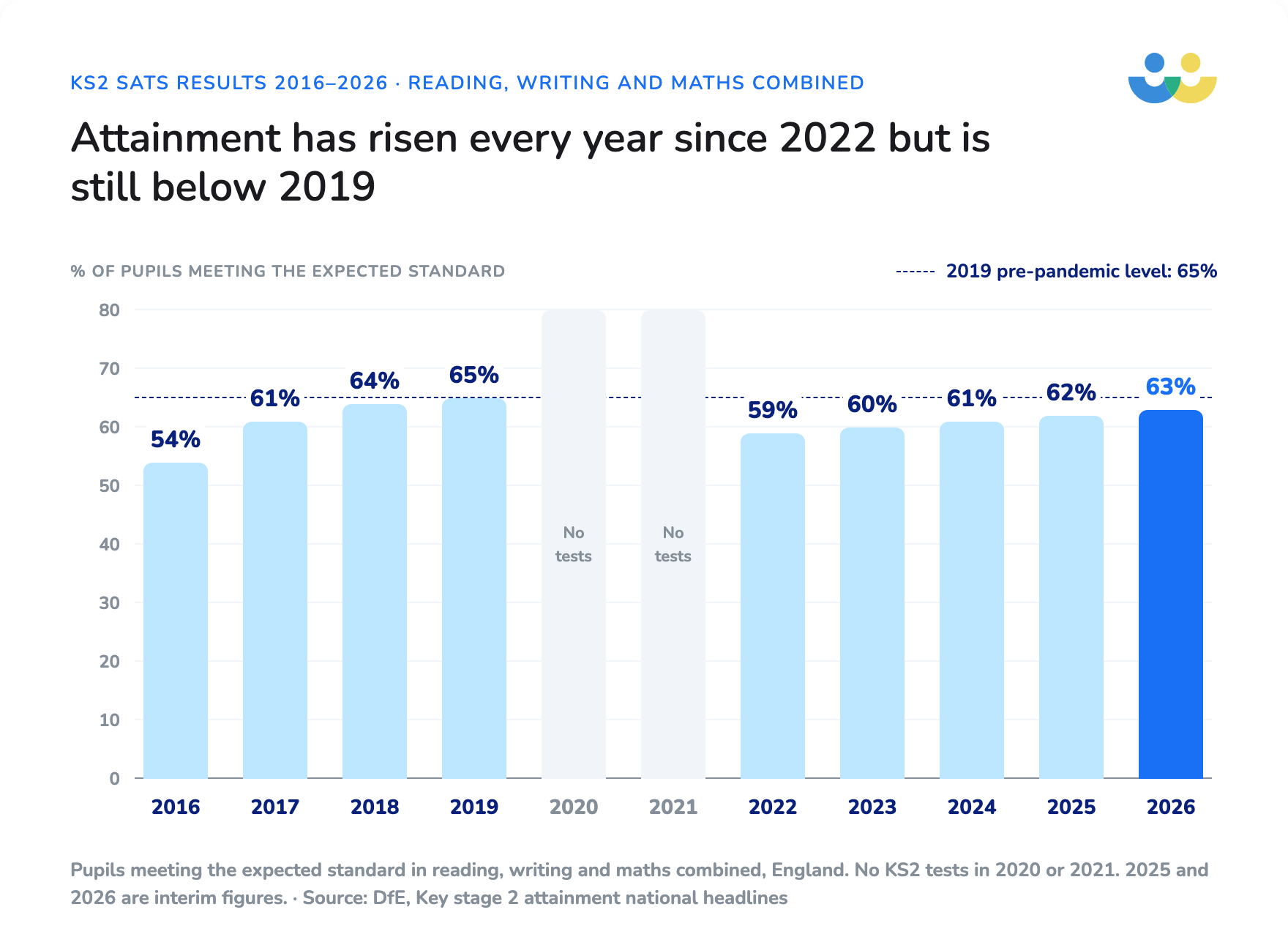
- In 2026, 63% of pupils met the expected standard in reading, writing and maths combined, up from 62% in 2025.
- 2026/27 is the final year of Key Stage 1 to Key Stage 2 progress measures. From 2028, progress will be measured from the reception baseline assessment.
- The 2027 deadline for reviews of marking will be confirmed in the 2027 assessment and reporting arrangements.
When is SATs results day 2027?
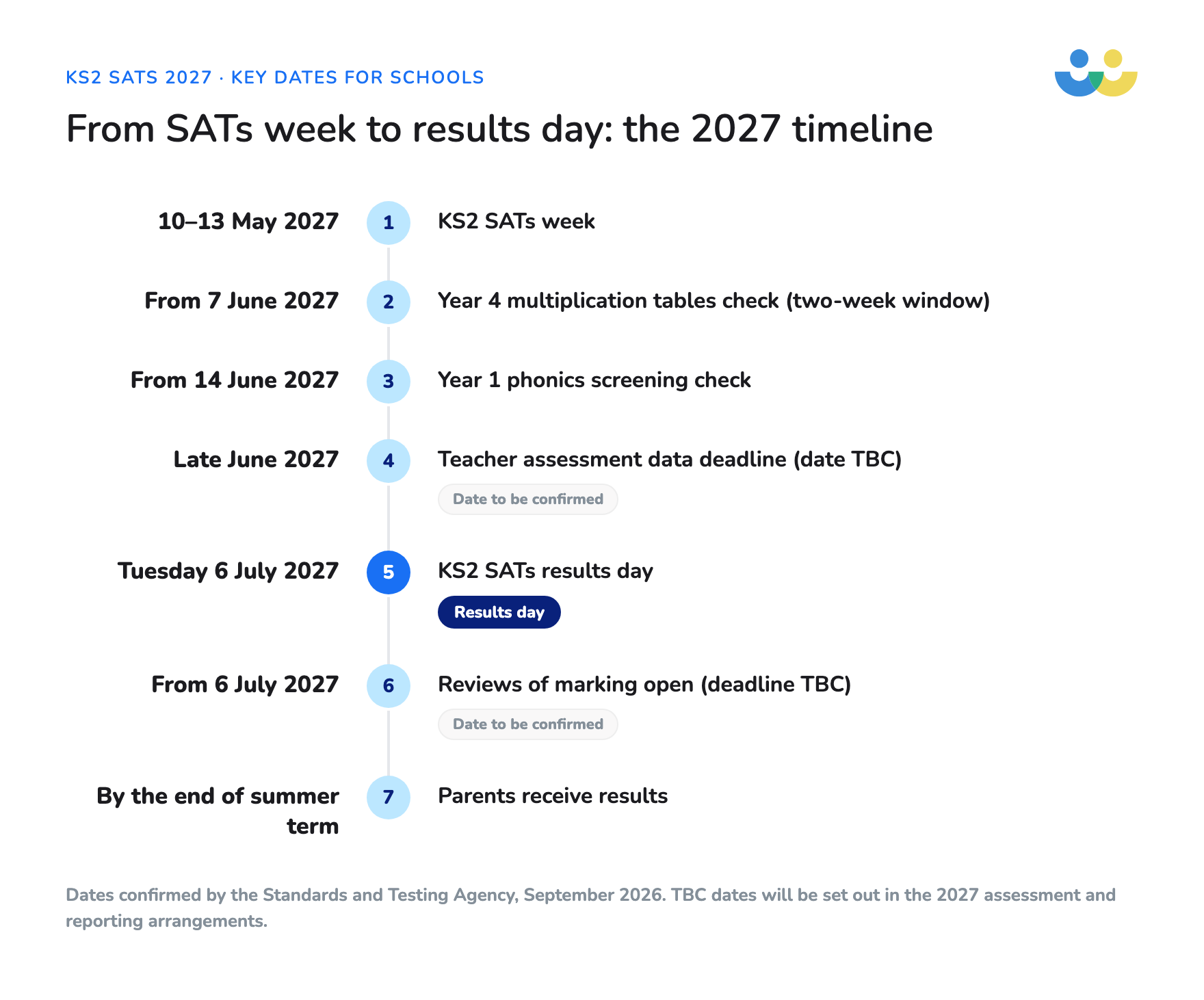
SATs results day 2027 is Tuesday 6 July 2027. From that morning, headteachers and senior leaders can log in and see results for every pupil who sat the Key Stage 2 SATs in May. The Standards and Testing Agency (STA) confirmed the date in its 2027 information for parents, published on 1 September 2026.
Schools then decide how to share results with families. Parents must receive their child’s results before the end of the summer term.
Key dates for the 2026/27 academic year
These are the specific dates confirmed so far for the KS2 SATs and the other statutory primary assessments this academic year.
| Key date | What happens |
|---|---|
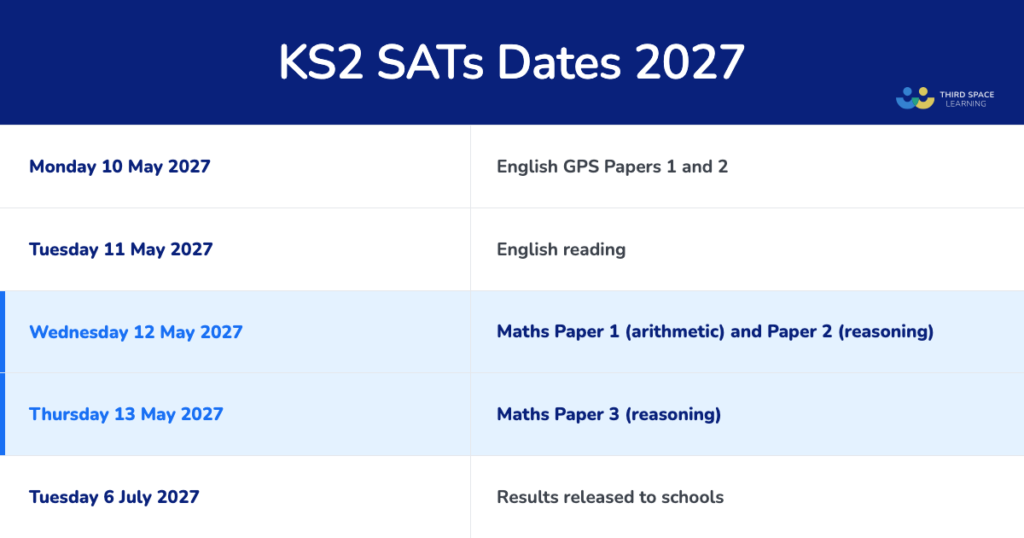
| Monday 10 May 2027 | KS2 SATs week begins: grammar, punctuation and spelling papers 1 and 2 (paper 2 is the spelling test) |
| Tuesday 11 May 2027 | English reading paper (60 minutes) |
| Wednesday 12 May 2027 | Mathematics papers 1 (arithmetic) and 2 (reasoning) |
| Thursday 13 May 2027 | Mathematics paper 3 (reasoning) |
| From Monday 7 June 2027 | Two-week window for the Year 4 multiplication tables check |
| From Monday 14 June 2027 | Year 1 phonics screening check week |
| Late June 2027 (date to be confirmed) | Deadline to submit teacher assessment data (26 June in 2026) |
| Tuesday 6 July 2027 | Results day: KS2 SATs scores and scaled score conversion tables released |
| From results day (deadline to be confirmed) | Applications open for reviews of marking |
| Before the end of the summer term | Parents receive test results and teacher assessment judgements |
Alongside these, the early years foundation stage profile assessment runs from April to June, and the reception baseline assessment takes place in the first six weeks after children enter reception. Your multiplication tables check and phonics screening check data arrive separately from your KS2 SATs data, so agree early who owns each set.
The STA lists future dates for statutory primary assessments on GOV.UK, including SATs dates for the next few academic years.
How schools access results on the NCA Portal
KS2 results come through the National Curriculum Assessments (NCA) Portal, which replaced the Primary Assessment Gateway and the older NCA tools website. Staff with the right access can view raw marks, scaled scores and test outcomes for each pupil, in summary or in detail. You can download results as a CTF, a CSV or ready-made results letters.
The STA publishes the scaled score conversion tables at 9am on results day. In 2026, the Department for Education also released national headline figures on results day itself. Final school-level performance data usually follows in December.
Before the summer term, check that at least two members of staff can log in to the NCA Portal. One absence on 6 July 2027 shouldn’t hold up the whole school’s results.
What happened to results day in 2026
Results were due on Tuesday 7 July 2026 but arrived on Thursday 16 July 2026, nine days late. Pearson, in its first year running the SATs marking contract, pointed to “technical issues with the new SATs platform Pearson uses to support markers” and apologised for the delay.
The STA extended the 2026 review of marking deadline to 7 September so schools could apply after the summer holidays. The Department for Education also asked Dame Christine Gilbert to lead a review into what went wrong, with a final report due to the education secretary in October 2026. We’ll update this post when the findings, and any changes to 2027 marking arrangements, are published.
What schools receive on results day
For every pupil registered for the statutory Key Stage 2 tests, schools receive a raw mark, a scaled score and confirmation of whether the pupil met the standard in each subject. These sit alongside the teacher assessment judgements you submitted in June.
Results for reading, maths and grammar, punctuation and spelling
The KS2 SATs tests cover three subjects: English reading, mathematics, and English grammar, punctuation and spelling (GPS). Year 6 pupils sit six SATs papers in total: one English reading paper, two GPS papers (a grammar and punctuation paper and a separate spelling paper) and three mathematics papers. The mathematics arithmetic paper comes first, followed by two reasoning papers.
Pupils sit every paper under formal exam conditions during SATs week. External markers then mark every paper, including the spelling paper, against a set marking scheme.
Outcome codes on the results sheet
Next to each score, you’ll see a short code. AS means the pupil has achieved the expected standard and NS means they have not. A shows the pupil was absent from one or more papers, and B shows they are working below the standard of the test.
Parents often ask about these codes, so add a one-line explanation of each to the letter that goes home.
Teacher assessment for writing and science
Schools judge English writing and science through separate teacher assessments, based on each pupil’s work across the year. Neither subject is part of the KS2 SATs tests, and schools submit this teacher assessment data before results day.
Writing judgements use three main standards: working towards the expected standard (WTS), working at the expected standard (EXS) and working at greater depth (GDS). Local authorities moderate the writing judgements of a sample of primary schools each year.
How Key Stage 2 SATs are scored
A pupil’s raw score is the number of marks they earn on a test. The STA converts it into a scaled score between 80 and 120. A score of 100 or more means the pupil has met the expected standard, sometimes still called the expected level. Pupils need at least 3 marks to receive a scaled score at all.
Why the mark needed for 100 changes each year
The tests follow the same curriculum and specification each year, but the questions change. That means one year’s paper can be slightly harder or easier than the last, and scaling adjusts for the difference.
In 2026, pupils needed 56 out of 110 marks in maths to reach 100, compared with 58 in 2025. In reading, the threshold dropped from 28 to 25 out of 50. Sometimes raw score thresholds move by three marks or more, which changes how near the line your borderline pupils were.
What counts as a high score
The Department for Education counts 110 or more as reaching the higher standard. In 2026, pupils needed 94 out of 110 in maths, 39 out of 50 in reading and 55 out of 70 in GPS to reach 110.
Nationally, 27% of pupils reached the higher standard in maths in 2026, so 110 is a strong result.
SATs results 2026: the benchmark for 2027
In 2026, 63% of pupils met the expected standard in reading, writing and maths combined, up one percentage point on 2025 and two on 2024. That slow, steady rise still leaves attainment below the 65% recorded in 2019, before the pandemic.
National Key Stage 2 results 2026 at a glance
| Measure | 2026 | 2025 |
|---|---|---|
| Reading, writing and maths combined | 63% | 62% |
| Reading | 75% | 75% |
| Writing (teacher assessment) | 73% | 72% |
| Maths | 75% | 74% |
| Grammar, punctuation and spelling | 74% | 73% |
| Science (teacher assessment) | 82% | 82% |
Maths, writing and GPS each rose by one point, while reading held steady at 75%.
Marks needed for 100 and 110 in 2026
| Test | Total marks | Marks for 100 | Marks for 110 |
|---|---|---|---|
| Grammar, punctuation and spelling | 70 | 34 | 55 |
| Reading | 50 | 25 | 39 |
| Mathematics | 110 | 56 | 94 |
Where the gaps sit: higher standard and writing
The share of pupils reaching the higher standard in reading fell from 34% to 31%, while maths rose by a point to 27%. Writing at greater depth stayed at 13% for the fifth year in a row.
For a school’s performance, the combined measure gets the most attention. A pupil who misses 100 in maths by two marks pulls the combined figure down even when their reading and writing are secure. That’s why many Year 6 teams focus maths catch-up on pupils sitting just below the line.
What changes for Key Stage 2 SATs in 2027
The Key Stage 2 SATs tests keep the same subjects, six papers and 80 to 120 scale in 2027. The changes for this cohort affect how results feed into school accountability.
The last year of Key Stage 1 to Key Stage 2 progress measures
This year’s Year 6 cohort sat their Key Stage 1 tests in 2023, the final year of statutory Key Stage 1 tests. That makes the 2026/27 academic year the last one in which the Department for Education calculates progress from Key Stage 1 to Key Stage 2.
Progress scores weren’t published for 2023/24 or 2024/25, because the pandemic cancelled those cohorts’ Key Stage 1 tests. They returned for 2025/26, so 2027 is the second and final year they will be published. If progress has been a strength for your school, plan now for how you’ll report it to governors once the measure changes.
Reception baseline assessment takes over from 2028
From the 2027/28 academic year, progress will be measured from the reception baseline assessment (RBA) instead. Children take the RBA in their first six weeks after they enter reception, and the first cohort to be measured this way started reception in 2021.
Key Stage 1 tests have been non-statutory since 2024, so the reception year baseline becomes the only national starting point for primary progress. For early years teams, that gives the reception baseline assessment far more weight in how a school’s progress is judged.
Curriculum and Assessment Review: what it means for future tests
The Curriculum and Assessment Review’s final report, published in November 2025, recommended replacing the GPS test with an amended version that better assesses composition and application. It also recommended strengthening the Year 6 writing assessment.
The report set no start date, and the 2027 KS2 SATs follow the same format as 2026. Look out for any timeline in the 2027 assessment and reporting arrangements and in plans for the new national curriculum.
After results day: reviews of marking and next steps
Once results are in, schools check for marks worth challenging, report results to parents, share data with secondary schools and plan for next year’s Year 6.
Requesting a clerical or marking review
Only the headteacher, or a senior member of staff they delegate, can apply for a review of a pupil’s KS2 SATs marks. Parents can’t apply directly. There are two types:
- Clerical review: for errors such as a script matched to the wrong pupil or marks added up incorrectly
- Marking review: for cases where you think a question has been marked wrongly
In 2026, schools paid £5 per pupil per subject for an unsuccessful clerical review and £9 for a marking review that didn’t meet the criteria. A marking review meets the criteria when it changes whether the pupil met the standard, or changes their mark by 2 or more.
Download scripts from the NCA Portal first, and start with pupils within a mark or two of 100 or 110. The 2027 deadline will be confirmed in the 2027 assessment and reporting arrangements.
Reporting results to parents
Schools choose how to share results, but every parent must receive them before the end of the summer term. Many primary schools send a letter with the child’s scaled score in each test, whether they reached 100 and the teacher assessment judgements for writing and science.
Add a short explanation of what 100 means and how the school’s results compare with national figures. Parents will want to know how their child’s school performed.
Sharing KS2 data with secondary schools
KS2 results move to secondary schools through the common transfer file. Secondary schools use the scores for setting, for spotting pupils who need catch-up and as the starting point for Progress 8.
Make sure Year 7 teams also hear the context behind the numbers, such as a pupil who was unwell during KS2 SATs week.
Using your results to plan for Year 6 in 2027/28
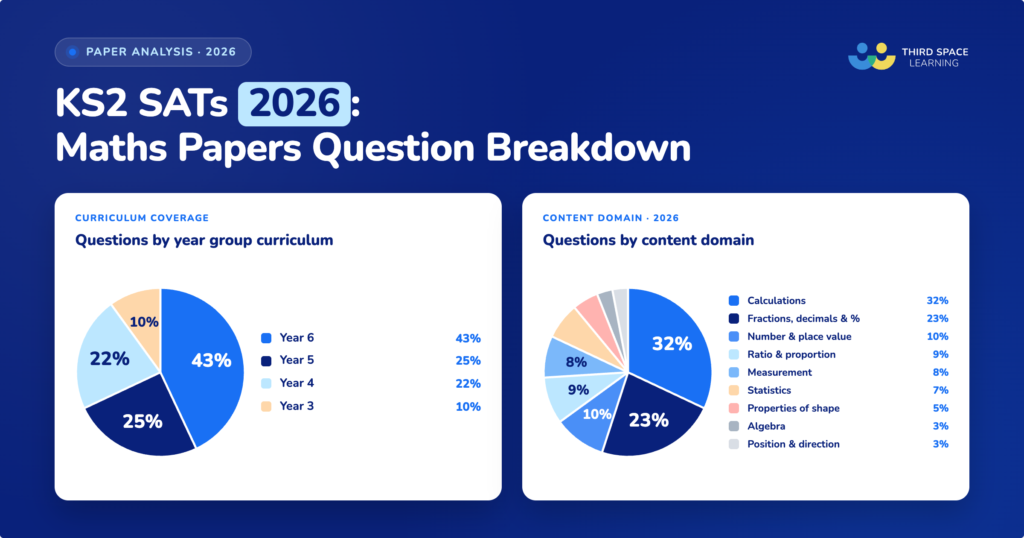
Question-level data is often the most useful thing you’ll download on results day. Look at which content domains cost marks across the cohort, and at pupils who finished within five marks of 100.
The arithmetic paper is worth 40 of the 110 maths marks, so gaps there are quick to spot and quick to close. Use past SATs papers and practice SATs papers to prepare children for the format once you know each pupil’s gaps. The STA’s past papers from 2016 onwards are free to download from GOV.UK.
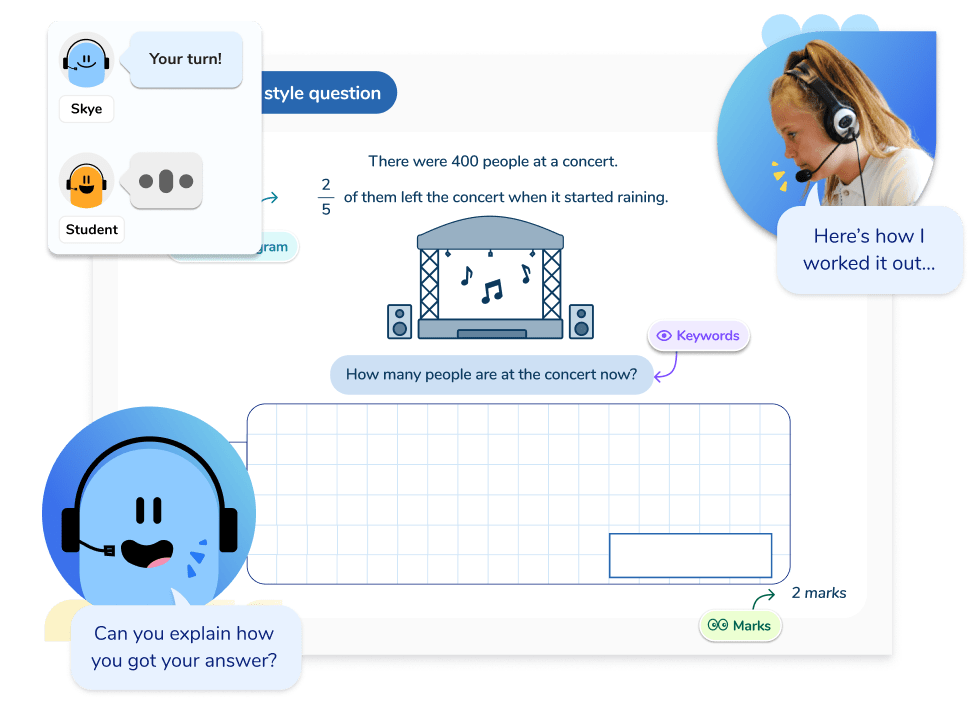
One-to-one maths time for every pupil near the line is hard to staff. Skye, Third Space Learning’s AI maths tutor, gives pupils spoken one-to-one maths sessions before, during or after school, without adding to staff workload. Its SATs Booster Programme is a 60-lesson intervention built around the 20 topics that make the biggest difference to pupils reaching the expected standard.
In a spring 2025 survey of schools using Third Space Learning for their Year 6 pupils, 78% of pupils receiving tutoring reached the expected standard in maths, compared with 74% nationally.
Supporting Year 6 maths ahead of Key Stage 2 SATs 2027
The data you download on 6 July 2027 feeds a whole year of Year 6 planning. Sort your NCA Portal logins early and use this summer’s data to decide which of next year’s pupils need support first. We’ll keep this page updated as the 2027 arrangements and the Gilbert review findings are published.
Key Stage 2 SATs results FAQs
Results day for the 2027 KS2 SATs is Tuesday 6 July 2027. Schools can access results through the NCA Portal from that morning, then decide how to share them with families. Parents must receive them before the end of the summer term. The Standards and Testing Agency confirmed the date in its 2027 information for parents, published in September 2026.
No. There is no government website where parents can look up individual KS2 SATs scores. Results go to schools through the NCA Portal (formerly the NCA tools website), and the school then shares them with families, usually in a letter or report. Some schools also use their own parent app. If nothing has arrived by the end of the summer term, parents should contact the school.
Yes. A score of 110 or more means a pupil has reached the higher standard, well above 100. It is a strong result in any of the three tests. In 2026, 27% of pupils nationally reached the higher standard in maths, and 31% did so in reading.
Individual pupil results are never published. The Department for Education releases national headline figures, and school-level results appear later on the Compare School and College Performance service. For 2027, these will include Key Stage 1 to Key Stage 2 progress scores. Schools check their data in the autumn checking exercise before it goes public.
Greater depth describes pupils working above the expected standard. In the reading, maths and GPS tests, it means a scaled score of 110 or more, known as the higher standard. In writing, it is a teacher assessment judgement recorded as GDS. Nationally in 2026, 13% of pupils were assessed as working at greater depth in writing.

DO YOU HAVE STUDENTS WHO NEED MORE SUPPORT IN MATHS?
Skye – our AI maths tutor built by teachers – gives students personalised one-to-one lessons that address learning gaps and build confidence.
Since 2013 we’ve taught over 2 million hours of maths lessons to more than 170,000 students to help them become fluent, able mathematicians.
Explore our AI maths tutoring or find out about year 6 SATs for your school.


![The Top 20 SATs Revision Topics For 2026 [Video]](https://thirdspacelearning.com/wp-content/uploads/2026/01/SATs-webinar-2025-social-image-6-1024x576.png)