



SATs 2027: Key Dates, Timetable And What School Leaders Need To Plan For

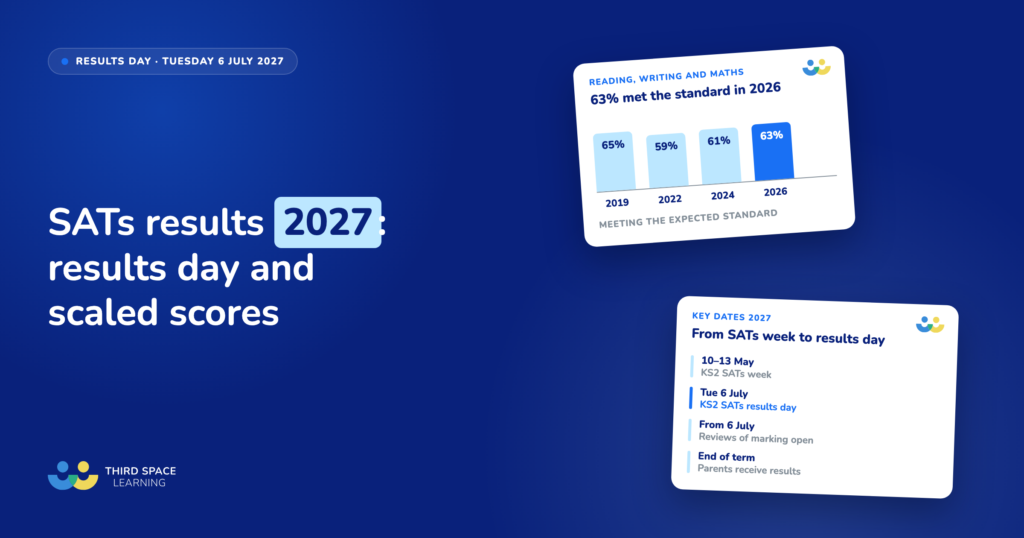
KS2 SATs 2027 will take place from Monday 10 May to Thursday 13 May 2027. Year 6 pupils in England sit six papers across three subjects, and schools receive their results on Tuesday 6 July 2027.
Every Year 6 teacher knows the shape of the spring term before it arrives. The gap analysis, the arithmetic starters that quietly become the most valuable ten minutes of the day, the moment in April when you realise there are only four weeks left. Planning for SATs week starts long before May.
This guide sets out every confirmed date for the 2027 national curriculum assessments, the full KS2 timetable with paper timings, and the changes school leaders should have on their radar. It is updated as the Standards and Testing Agency publishes new information for the 2026/27 academic year.
SATs 2027: STAY UP TO DATE
Join our email list to stay up to date with the latest news and free resources for SATs 2027. As usual, our expert teachers will be on hand to provide one to one tuition support, revision resources, expert paper analysis, SATs teacher survey results and the SATs results 2027.


SATs Booster Toolkit
Download this free SATs booster toolkit to identify the topics your pupils need to prioritise for revision. Includes 6 KS2 maths SATs papers, SATs diagnostic assessment and answers, plus 3 SATs intervention lessons from our SATs Booster programme, with accompanying teacher notes.
Download Free Now!Primary assessment key dates 2026/27
The Department for Education has confirmed the following statutory dates for the 2026/27 academic year. Every primary assessment sits in one place below, with KS2 SATs first.
Assessment | Date or window |
|---|---|
KS2 SATs tests | Monday 10 May to Thursday 13 May 2027 |
KS2 SATs results released to schools | Tuesday 6 July 2027 |
Reception baseline assessment | Within the first six weeks of a child entering reception. RBA 2026 activity open from Monday 24 August 2026 to Friday 23 July 2027 |
RBA headteacher’s declaration form deadline | Friday 6 November 2026 |
Early years foundation stage profile | Between April and June 2027 |
Optional key stage 1 tests | During May 2027 |
Multiplication tables check | Two-week window from Monday 7 June 2027 |
Phonics screening check | One-week window from Monday 14 June 2027 |
SATs week 2027 follows the established pattern. Key stage 2 SATs always fall in the second full week of May, and 2027 is no exception, so the SATs dates below should hold firm.
The KS2 SATs 2027 timetable in detail
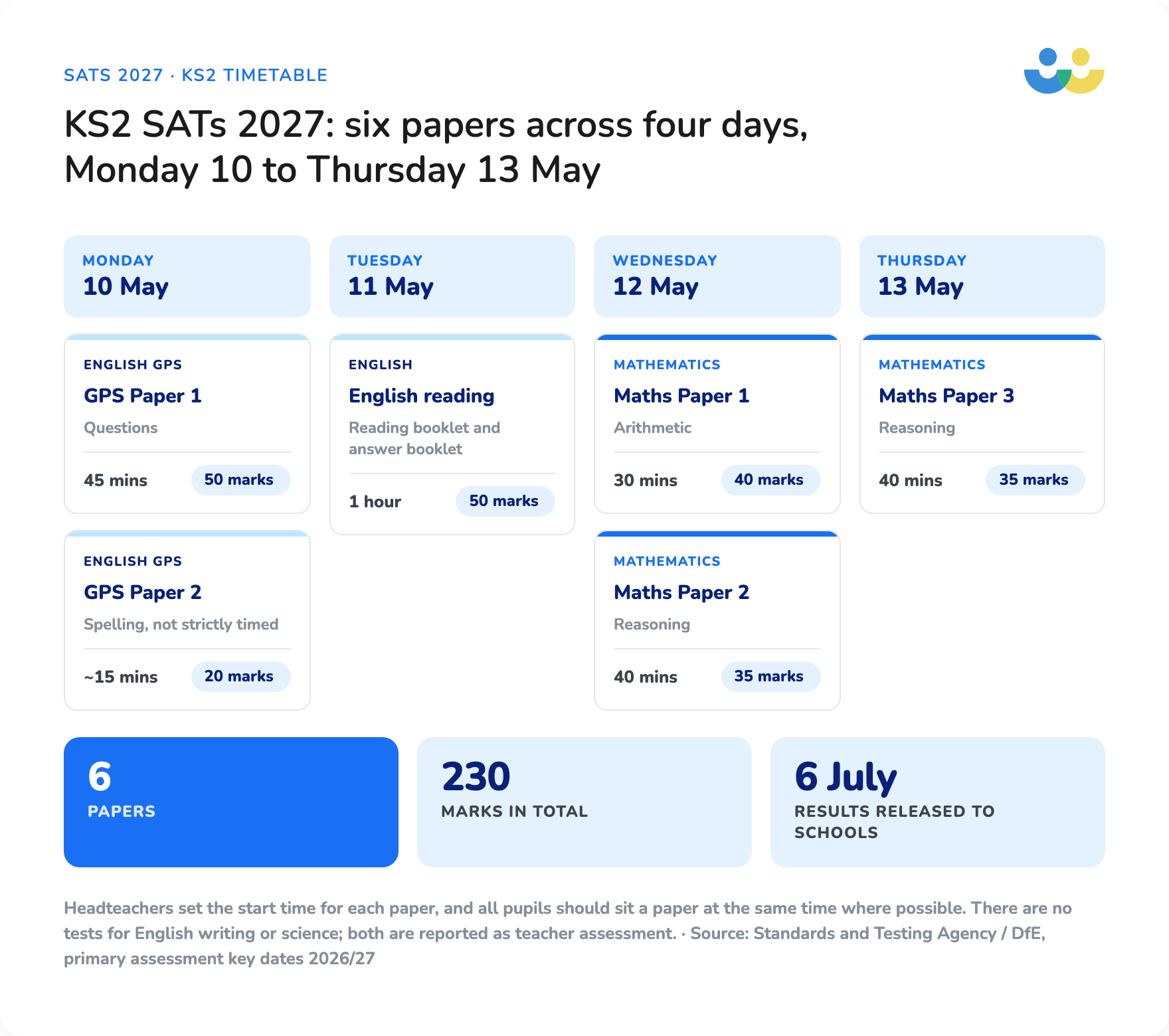
Six papers across four days. The detailed timetable below matches the order the Standards and Testing Agency has confirmed for 2027 and mirrors previous years.
Date | Papers |
|---|---|
Monday 10 May 2027 | English grammar, punctuation and spelling Paper 1: questions. English grammar, punctuation and spelling Paper 2: spelling |
Tuesday 11 May 2027 | English reading |
Wednesday 12 May 2027 | Mathematics Paper 1: arithmetic. Mathematics Paper 2: reasoning |
Thursday 13 May 2027 | Mathematics Paper 3: reasoning |
Monday 10 May 2027: English grammar, punctuation and spelling
Pupils take both grammar, punctuation and spelling papers on the same day. Paper 1 gives pupils 45 minutes to answer short answer questions on grammatical terminology, punctuation and word class. Expect questions on subordinate clauses, subjunctive verb forms and relative pronouns.
Paper 2 is the spelling test. Pupils have approximately 15 minutes to complete 20 words read aloud by a test administrator, usually the class teacher, and the paper is not strictly timed. Schools can use the spelling test audio file provided by the Standards and Testing Agency, or read the script themselves.
Tuesday 11 May 2027: English reading
Pupils get one hour to read three texts in the reading booklet and answer the questions in the answer booklet. The texts increase in difficulty across the paper, and pupils manage their own time between reading and answering.
Reading comprehension carries the most marks of any single English paper, and it is usually where the spread across a Year 6 cohort shows most clearly.
Wednesday 12 May 2027: Mathematics Papers 1 and 2
Maths Paper 1, listed on the STA timetable as mathematics arithmetic, gives pupils 30 minutes to answer 36 questions worth 40 marks, covering the four operations, fractions, decimals and percentages. Long multiplication and long division carry two marks each.
Paper 2 is the first reasoning paper, with 40 minutes to answer questions worth 35 marks. Reasoning papers test whether pupils can apply arithmetic in context, so a pupil who can calculate 10% of 60 in isolation still needs to recognise when a word problem is asking for it.
Thursday 13 May 2027: Mathematics Paper 3
Paper 3 is the second reasoning paper. Pupils again have 40 minutes for questions worth 35 marks. Together, the three maths papers total 110 marks.
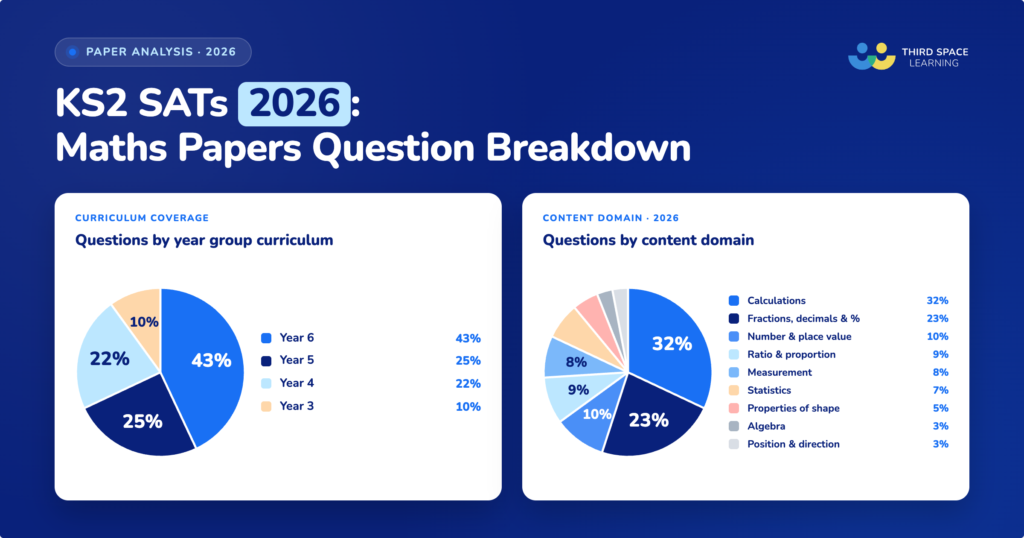
Our breakdown of the 2026 KS2 maths papers shows how the question types were distributed last year, which helps when you are deciding which are the top SATs topics to focus revision on.
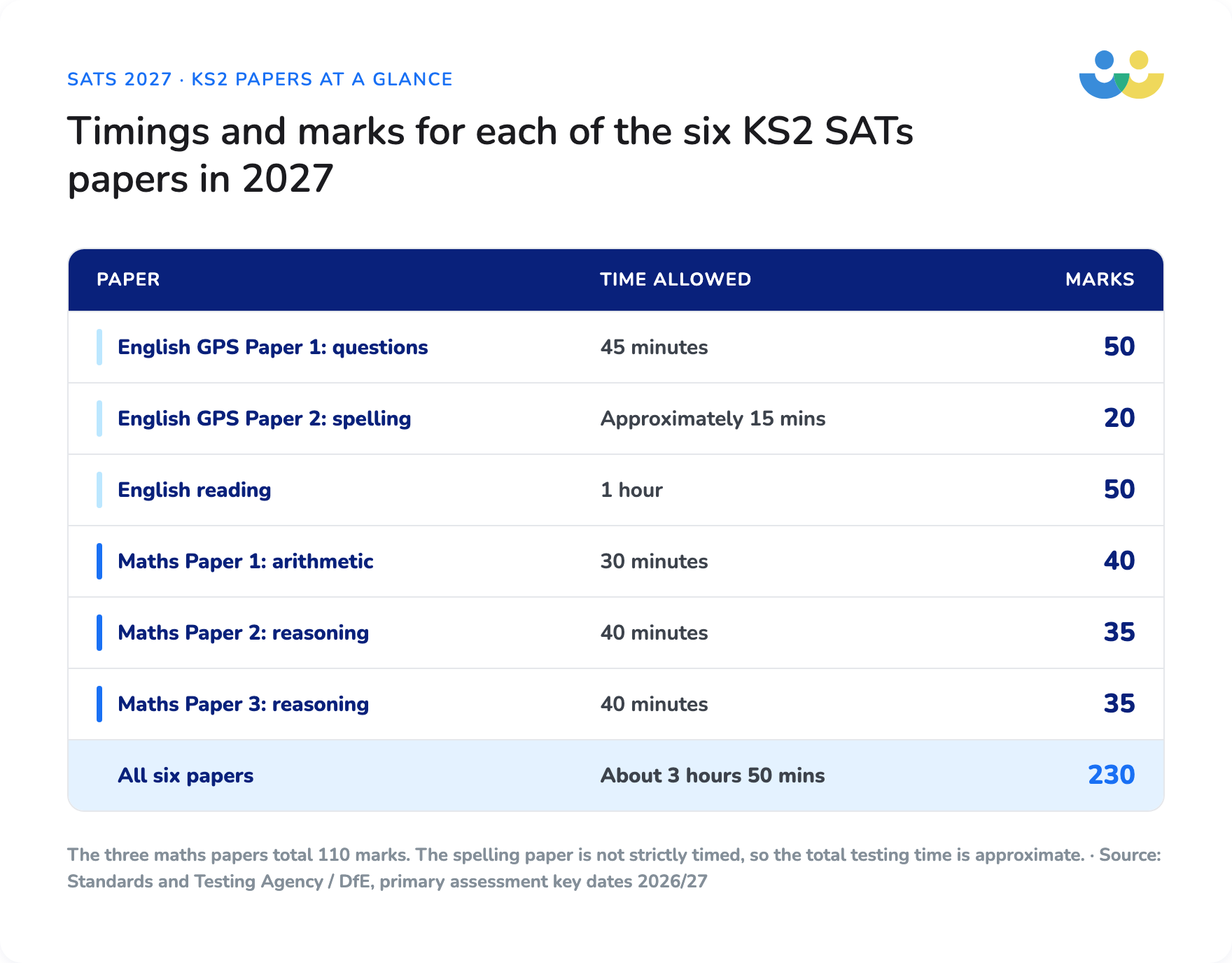
KS2 SATs papers 2027 at a glance
Paper | Time allowed | Marks |
|---|---|---|
English GPS Paper 1: questions | 45 minutes | 50 |
English GPS Paper 2: spelling | Approximately 15 minutes | 20 |
English reading | 1 hour | 50 |
Maths Paper 1: arithmetic | 30 minutes | 40 |
Maths Paper 2: reasoning | 40 minutes | 35 |
Maths Paper 3: reasoning | 40 minutes | 35 |
There are no tests for English writing or science at the end of key stage 2. Performance in both subjects is reported as a teacher assessment judgement instead.
All papers except writing and science are marked externally. Schools submit teacher assessment data through the NCA tools website, and the 2027 deadline will be confirmed in the ARA. In 2026 the deadline fell on Friday 26 June.
SATs dates for the next three years
Forward planning gets easier when you can see the pattern. The DfE has published statutory dates through to 2028.
Academic year | KS2 SATs week |
|---|---|
2025/26 | Monday 11 to Thursday 14 May 2026 |
2026/27 | Monday 10 to Thursday 13 May 2027 |
2027/28 | Monday 8 to Thursday 11 May 2028 |
Other key dates in the coming years
The multiplication tables check opens on Monday 5 June 2028, and the phonics screening check falls in the week from Monday 12 June 2028.
When do the KS2 SATs 2027 results come out?
Schools receive KS2 SATs 2027 results on Tuesday 6 July 2027. Results arrive through the NCA tools website.
Schools then share results with parents before the end of the summer term. Each pupil’s report includes their raw score, scaled score, and whether they met the expected standard in reading, maths, and grammar, punctuation and spelling.
National and school-level results are published later. Provisional national figures usually appear in July, and the performance tables follow in December 2027.
If your school wants to challenge a mark, the review process opens after results day and the deadline is confirmed in the ARA. Our write-up of the 2026 SATs results sets out how last year’s national picture compared with previous cohorts.
What changes for the 2027 SATs and MTC
Nothing changes about the papers themselves for 2027. Year 6 pupils sit the same six papers, assessed against the same national curriculum, in the same order.
The government’s response to the Curriculum and Assessment Review confirmed it will “maintain the existing structural architecture of subjects, key stages, assessments and qualifications – including national primary assessments”. SATs are staying.
Three things worth watching if you lead maths or assessment in a primary school:
- Writing assessment. The government has committed to improving the assessment of writing at key stage 2, with a greater focus on fluent writing.
- Grammar, punctuation and spelling. The Standards and Testing Agency will review the GPS assessment to address concerns about grammar being taught in isolation.
- The multiplication tables check. The timed element stays, because it exists to assess fluent recall. The DfE will work with the STA on minimising unintended effects.
A revised national curriculum will be published in 2027 for first teaching in 2028. That makes the 2027 cohort the last to sit SATs assessed wholly against the current curriculum.
The 2027 key stage 2 assessment and reporting arrangements (ARA) have not yet been published. The ARA usually appears in the autumn term and confirms submission deadlines, review windows and access arrangement processes. Until it lands, the 2026 ARA is the best guide to how the year will run.
The purpose of SATs and how results are used
Key stage 2 SATs assess how well pupils have mastered the national curriculum by the end of primary school. Every state-funded primary school in England takes part, and the statutory key stage 2 test dates are set nationally so that all primary schools assess on the same days.
Results serve three purposes.
- Provide secondary schools a baseline for incoming Year 7 pupils.
- Give parents a scaled score showing how their child performed against the expected standard.
- Feed school accountability measures, including the published performance tables that appear in December 2027.
Test results also identify where pupils need additional support before secondary transition. Schools that use their KS2 data well treat SATs as diagnostic rather than final, and plan Year 7 catch-up on the back of it.
How KS2 SATs are marked and what a scaled score means
Each pupil receives a raw score, which is then converted to a scaled score. Scaled scores run from 80 to 120, and a scaled score of 100 means a pupil has met the expected standard.
The conversion changes slightly each year, because the raw score needed for 100 depends on the difficulty of that year’s papers. A pupil scoring 100 in 2026 and a pupil scoring 100 in 2027 have demonstrated the same standard, even if their raw scores differ.
Our full explanation of what each scaled score means and how to read a results sheet covers the marking scheme in more detail, including how greater depth is reported for writing.
SATs timetable planning for 2027
Test timing in your school
Headteachers decide the start time for each test. All pupils should sit each paper at the same time where possible, which usually means a morning slot before break.
If a pupil or group needs a different arrangement, tests can be administered in multiple sittings between 7am and 7pm on the scheduled day. Pupils must be supervised at all times, and a test administrator accompanies any pupil who needs to leave the room.
Timetable variations and special consideration
Schools can apply for a timetable variation if a pupil is unable to sit a paper on the scheduled day. Pupils can take the test up to five school days after the scheduled test day, and applications go through the NCA tools website ahead of the published deadline.
Special consideration applies where a pupil sat the test but was affected by circumstances outside their control, such as illness on the day or a recent bereavement.
Access arrangements
Access arrangements should reflect normal classroom practice rather than being introduced for SATs week. The main arrangements are additional time, a reader for the maths and GPS papers, a scribe, a prompter, rest breaks and early opening for modified papers.
Decide these in the autumn term. A pupil who has never used a scribe will not benefit from one in May.
SATs 2027 preparation for Key Stage 2
Where to start in the autumn term
The schools that handle SATs week best tend to front-load curriculum coverage in the autumn term and keep the spring for consolidation. Teaching new content in April rarely ends well.
A practical sequence:
- Autumn 1: Baseline with a past paper under formal exam conditions, then teach to the gaps rather than the calendar.
- Autumn 2: Build arithmetic fluency daily. Ten minutes of targeted practice on the four operations, fractions and percentages compounds over two terms.
- Spring 1: Introduce reasoning question types explicitly. Pupils need to recognise a multi-step problem before they can solve it.
- Spring 2: Full practice papers under timed conditions, with gap analysis after each one.
- Summer 1: Consolidate. Reduce new content and focus on exam technique, pacing and confidence.
Best revision resources for the 2027 SATs
Past papers remain the most useful preparation resource, because they show pupils the exact question style they will meet. Our archive of past SATs papers from 2016 onwards includes mark schemes for every paper.
Once pupils have worked through the real papers, practice SATs papers give you fresh material without repeating questions they already recognise. We have Year 6 SATs practice papers with answers and a set of Year 6 maths reasoning questions organised by topic.
Schools running targeted intervention alongside class teaching often find the gap is confidence rather than content. One-to-one SATs tutoring gives pupils the space to explain their thinking and be corrected in the moment, which is difficult to replicate with 30 in the room.
Keeping revision varied matters more in the summer term than it does in September. Our 15 teacher tips for making SATs revision less of a slog has practical ideas that hold up in a real Year 6 classroom.
Other statutory primary assessments in 2026/27
SATs week is the main headline for primary assessments, but four other statutory assessments sit in the primary calendar.
Optional KS1 SATs tests in 2027
Key stage 1 tests became non-statutory in 2023. Schools that choose to use them should administer the optional key stage 1 tests during May 2027. The Standards and Testing Agency sets no specific dates, so each school picks its own test dates within that month.
The optional papers cover:
- KS1 maths: an arithmetic paper and a reasoning paper
- KS1 English reading: two papers of increasing difficulty
- KS1 English grammar, punctuation and spelling: a spelling paper and a questions paper
Results are not reported to the DfE. Schools use them internally, usually to inform lower key stage 2 grouping and intervention.
Reception baseline assessment
The reception baseline assessment is a short, activity-based check of early literacy and maths. It provides the starting point for the progress measures this cohort will be judged against at the end of key stage 2 in 2033, which is why the administration detail is worth getting right.
The RBA is fully digital and needs a minimum of two devices: a practitioner device that guides the assessment, and a touchscreen pupil device the child responds on. A reception teacher or teaching assistant administers it one to one, and most pupils complete both components in under 20 minutes.
Two components are assessed:
- Literacy, communication and language (LCL)
- Mathematics
Question routing means pupils skip questions based on how they answer, so no two pupils take an identical path through the assessment.
Practitioners administer the RBA within the first six weeks of a pupil starting reception. That window runs from each pupil’s own start date, so pupils joining later in the year get their own six weeks rather than working to a single whole-school deadline.
What is new for 2026/27
Four things have changed for this year’s reception cohort, and school leaders should have all four in the autumn diary.
Change | Detail |
|---|---|
Separate activity by academic year | The “RBA 2026” activity opened on Monday 24 August 2026 and closes on Friday 23 July 2027 |
No monitoring visits | Schools will receive no monitoring visits relating to RBA administration in the 2026 to 2027 academic year |
New device pairing training | A training topic supporting device pairing and connection launched on Monday 1 June 2026 |
Earlier guidance publication | The 2026 administration guidance and modified administration guidance were published on Monday 1 June 2026, giving schools longer to prepare |
The removal of monitoring visits is the change most likely to affect how your school handles the RBA. The Standards and Testing Agency now monitors administration through data review and selective outreach instead, so nobody is coming to watch. That puts more weight on the headteacher’s declaration form, which confirms the assessment was administered correctly and must be submitted by Friday 6 November 2026.
Narrative statements are available from 21 September through the assessment service. They give a snapshot of each pupil’s performance, and while they are not used for accountability, they are useful for reception planning and for conversations with parents.
Schools can preview the assessment using two devices during the preparation period. Worth doing, because a pairing problem discovered on a child’s first week in reception is a pairing problem at the worst possible moment.
Phonics screening check
Year 1 pupils take the phonics screening check within the one-week period from Monday 14 June 2027. Pupils who do not meet the expected standard retake it in Year 2. The government has set an ambition for 90% of children to meet the expected standard by the end of Year 1.
Multiplication tables check
Year 4 pupils take the multiplication tables check within the two-week period from Monday 7 June 2027. Pupils answer 25 questions on the times tables up to 12 × 12, with six seconds allowed per question.
The check rewards fluent recall rather than calculation. A pupil working out 7 × 8 by adding on will run out of time, so the daily practice you build in from Year 2 does the heavy lifting here.
Early years foundation stage profile
Reception year teachers complete the EYFS profile between April and June 2027, assessing each child against the early learning goals. Local authorities collect the data.
Helpful GOV.UK links for KS1 and KS2 SATs 2027
- Primary assessments: future dates
- 2027 key stage 2 national curriculum tests: information for parents
- Key stage 2: assessment and reporting arrangements
- Key stage 2 test administration guidance
- Key stage 2: submitting teacher assessment data
- National curriculum assessments: key stage 2 tests
How one-to-one tutoring supports SATs 2027 preparation
By the spring term, a Year 6 class rarely shares one gap. Some pupils need place value secured. Others can calculate accurately but stall on a multi-step reasoning question. A few need confidence more than content, and they are usually the quietest about it.
One-to-one tutoring closes that distance. A pupil explains their thinking out loud, a misconception surfaces in the moment, and the next question responds to what they have just said. Thirty in a room makes that difficult.
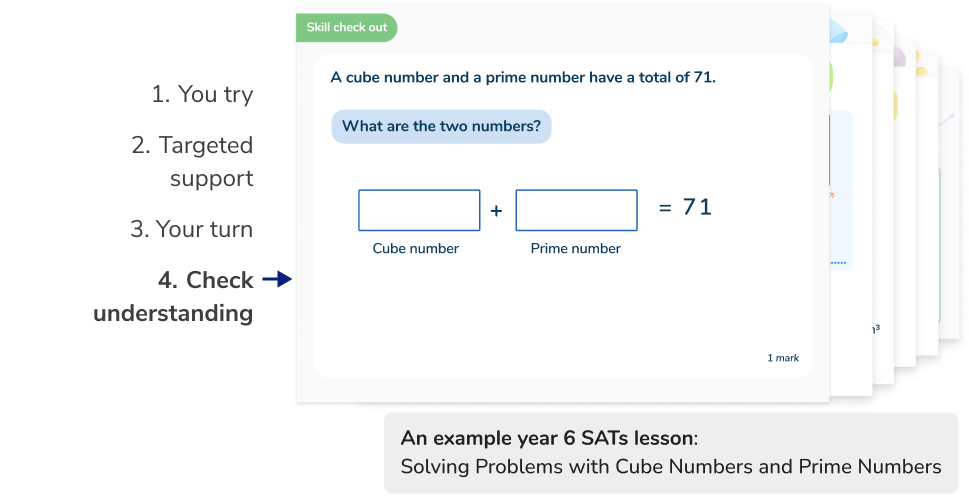
Skye, our spoken AI maths tutor, builds that into the session itself. Each session opens with a Skill Check In and ends with a Skill Check Out, so you can see what a pupil could do at the start and what changed by the end.
Schools tend to run sessions weekly alongside class teaching, and SATs tutoring does more from the autumn term than it can from April.
FREE SATS REVISION RESOURCES
As part of the Third Space Learning offer to schools, the personalised Year 6 SATs revision programme of online one to one SATs tutoring can be supplemented by hundreds of free SATs revision resources. The most popular of these include:
– free SATs papers
– free Year 6 maths reasoning questions
– over 250 more free SATs questions
The best way to access these and more is to join the Third Space Learning online maths hub. Registration is free, and if you like the free resources, you can sign up for the premium resources too such as Fluent in Five and Rapid Reasoning.
FAQs: SATs 2027
SATs week 2027 runs from Monday 10 May to Thursday 13 May 2027. Year 6 pupils sit six papers across those four days.
Year 6 SATs start on Monday 10 May 2027 with the English grammar, punctuation and spelling papers, and finish on Thursday 13 May 2027 with maths Paper 3.
Yes. Key stage 2 tests take place in the second full week of May each year. The 2028 tests run from Monday 8 to Thursday 11 May 2028.
Key stage 2 tests are statutory for state-funded schools in England, and schools are required to administer them to all eligible pupils. There is no formal opt-out for parents, though headteachers can disapply individual pupils in specific circumstances set out in the ARA.
Six papers across three subjects: two English grammar, punctuation and spelling papers, one English reading paper, and three maths papers.
A scaled score of 100 means a pupil has met the expected standard. A score of 110 is comfortably above that, and pupils scoring 110 or more in reading and maths are working at a higher standard.
Schools receive results on Tuesday 6 July 2027 and share them with parents before the end of the summer term.
Key stage 1 tests became optional in 2023. Schools can still use the papers during May 2027, but results are not reported to the Department for Education.

DO YOU HAVE STUDENTS WHO NEED MORE SUPPORT IN MATHS?
Skye – our AI maths tutor built by teachers – gives students personalised one-to-one lessons that address learning gaps and build confidence.
Since 2013 we’ve taught over 2 million hours of maths lessons to more than 170,000 students to help them become fluent, able mathematicians.
Explore our AI maths tutoring or find out about year 6 SATs for your school.


![The Top 20 SATs Revision Topics For 2026 [Video]](https://thirdspacelearning.com/wp-content/uploads/2026/01/SATs-webinar-2025-social-image-6-1024x576.png)