


Review of Maths SATs 2026: Teacher Survey Results

This article was originally published on Thursday, 14th May 2026
For most schools, the 2026 KS2 SATs are done. We’ll be publishing our full analysis once the timetable variation period ends on 22nd May. Until then, here are the early reflections from our teacher-led review of this year’s maths SATs.
The picture from teachers is a familiar mix of relief, frustration and a few raised eyebrows. Arithmetic largely held its shape, reasoning kept teachers (and pupils) on their toes, and the cohort sitting these papers is the one whose earliest years of school were shaped by Covid.
Every year, thousands of teachers tell us what they thought of the maths papers and how their pupils got on. To build a proper picture of the 2026 maths SATs, we’ve also been following the conversation on social media and speaking directly with many of the 4,325 schools that have used our one-to-one primary school tutoring over the years.
Thank you to every teacher who filled in our maths SATs 2026 survey or shared their thoughts online. If you’ve still got something to add, we’d love to hear from you. Use #SATs2026 or tag @thirdspacetweet.
This blog looks at the overall difficulty and feel of the papers rather than going question-by-question. After 22nd May, you’ll find our full 2026 SATs paper breakdown and analysis here too.

Want to see how the 2026 teacher survey compares with previous years?
- Review Of Maths SATs 2025: Results Of Our Teacher Survey
- Review Of Maths SATs 2024: Results Of Our Teacher Survey
- Review Of Maths SATs 2023: Results Of Our Teacher Survey
Which 2026 KS2 SATs papers did we ask teachers about in our survey?
- Paper 1: Arithmetic 13th May 2026
- Paper 2: Reasoning 13th May 2026
- Paper 3: Reasoning 14th May 2026


Post-SATs Maths Survival Toolkit
A selection of our most popular free maths SATs resources plus bonus fun activities to use with your class after SATs.
Download Free Now!Influences on the 2026 SATs experience
Three themes ran through this year’s survey responses.
- The first was the everyday squeeze on schools – budget pressure, staffing changes and a growing volume of access arrangements to support Year 6 pupils with adjustments.
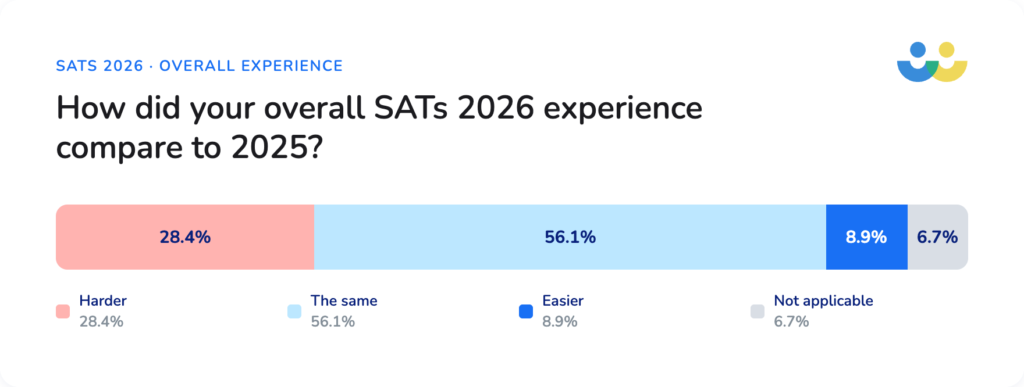
- Second was the feel of the papers themselves. Most teachers said the experience was roughly in line with 2025, but more than half found the maths papers harder than last year. Reasoning Paper 1 attracted the strongest reaction.
- The third was AI. Just over a third of teachers (37%) used AI to prepare pupils for SATs this year. Among the rest, the most common reason wasn’t a lack of confidence – it was a lack of time.
The Covid cohort
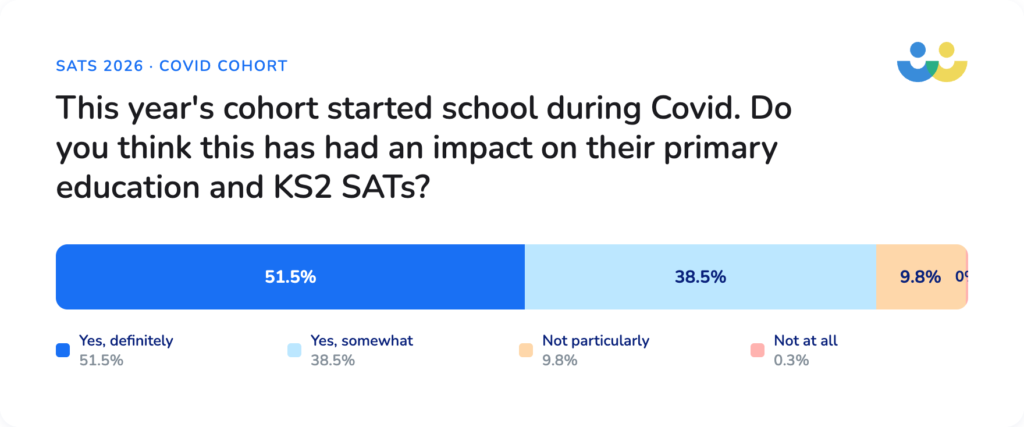
This year’s Year 6 cohort is the one whose Reception year was disrupted by the pandemic, and almost every teacher who responded to our survey said the impact is still being felt. Nine in ten teachers said Covid had definitely or somewhat affected this cohort’s primary education and KS2 SATs with just over half saying it had definitely had an impact.
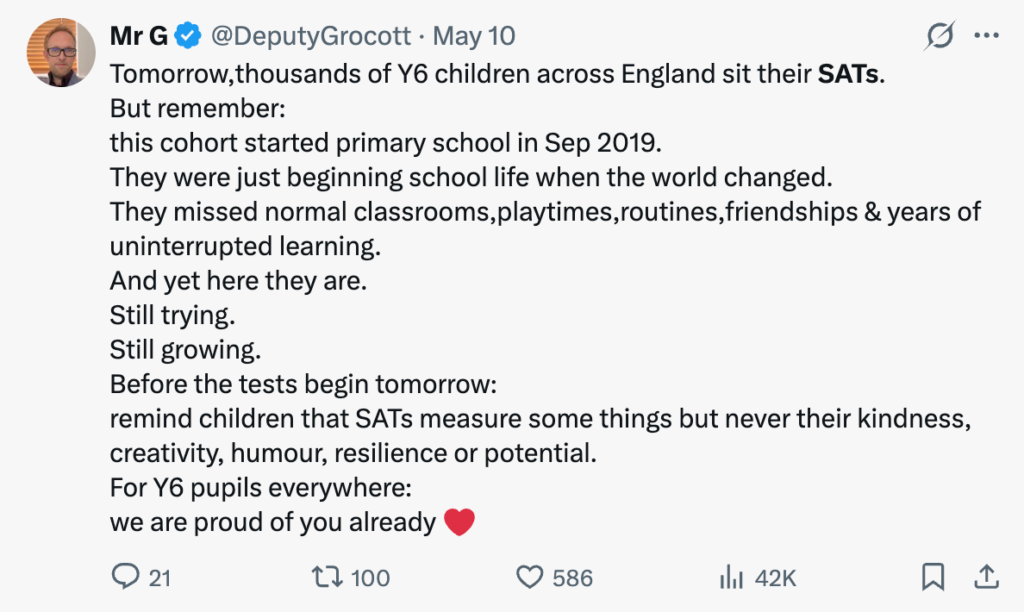
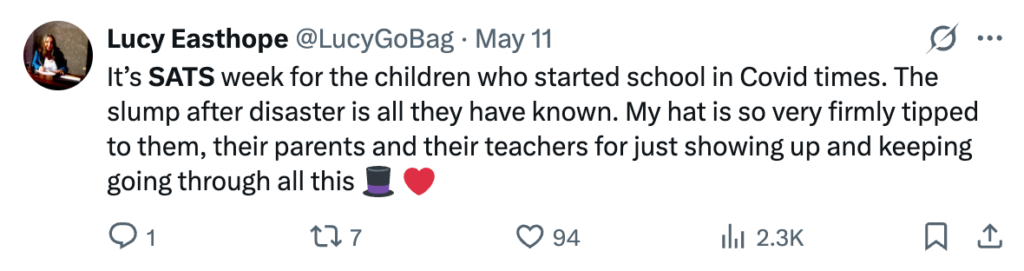
Themes in the open responses were consistent: gaps in foundational number facts, weaker number sense, less embedded fluency, and a cohort that hit Year 6 with stamina and behaviour-for-learning challenges that earlier cohorts simply didn’t carry.
“Their approach to testing this week has been different to year groups that came before – much more emotional, less resilient. Retention of concepts has proved a massive challenge.”
Year 6 Teacher, Greater London
“Their starting point was so much lower than previous cohorts. Many basic skills were missing or not embedded. Their behaviour for learning and stamina was incredibly low – most could not physically concentrate for 30 minutes of arithmetic at the start of the year.”
Stuart O, Year 6 Teacher, All Saints’, Greater London
In practice, the work of Year 6 in 2026 has been less about polishing what pupils already knew and more about plugging gaps that should, in a typical year, have been closed in earlier year groups. Several teachers told us this came at the cost of depth elsewhere – a theme that runs through the curriculum coverage responses, too.
2026 SATs papers vs 2025: harder but recognisable
56% of respondents said the overall SATs experience felt the same as in 2025. Just over a quarter (28%) described it as harder, with only 9% finding it easier.
“The questions were more accessible in terms of wording so more children were able to give the maths a go even if they did not get the correct answer.”
Andy, Deputy Headteacher, Crofton Hammond Junior School, South East
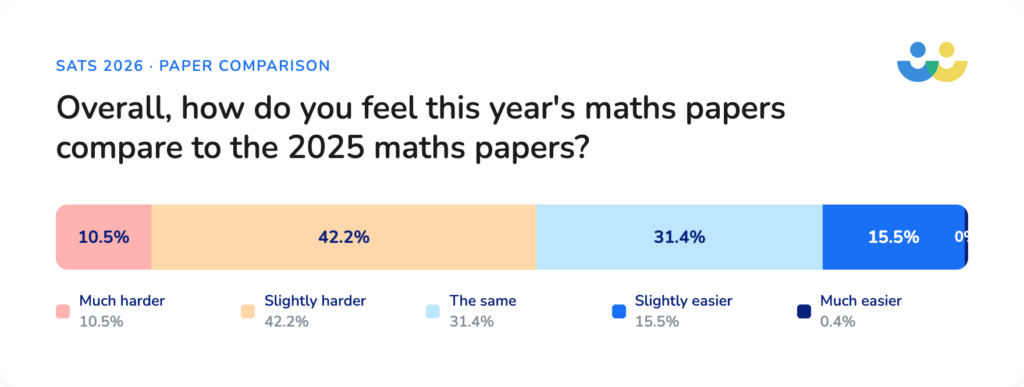
When asked specifically about the maths papers, 53% rated them harder than 2025. 31% said the experience was about the same, and 16% found them slightly easier.
The more measured responses pointed to the wording and structure of the papers as a genuine improvement on previous years.
And as ever, the question on every teacher’s lips throughout the papers: any sign of Chen? We’ll have the answer in our full paper breakdown after 22nd May.


Maths SATs papers 2026: arithmetic delivered, reasoning divided
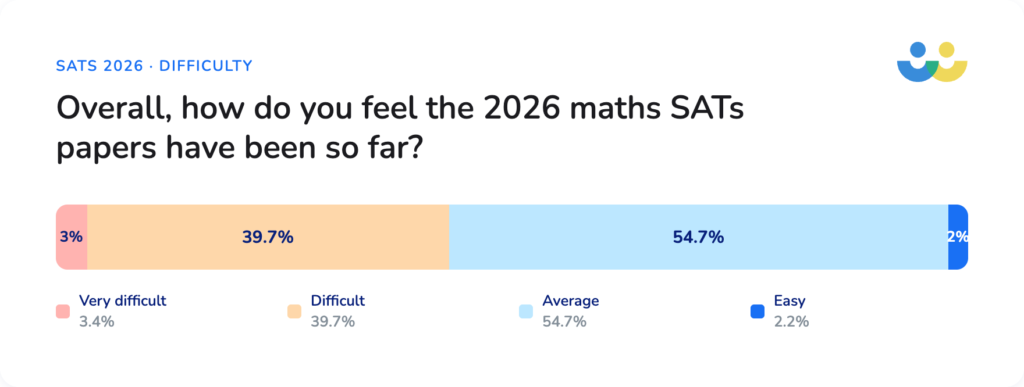
When teachers compared the 2026 maths papers paper-by-paper, a clear pattern emerged. The arithmetic paper landed close to where most of you expected it. The reasoning papers – Paper 1 in particular – were where the difficulty lay. Several respondents told us the issue wasn’t unfamiliar content, but the way familiar content was presented: multi-step thinking for a single mark, less common topics weighted more heavily, and a few questions that pupils simply didn’t know how to start.
Paper 1: arithmetic
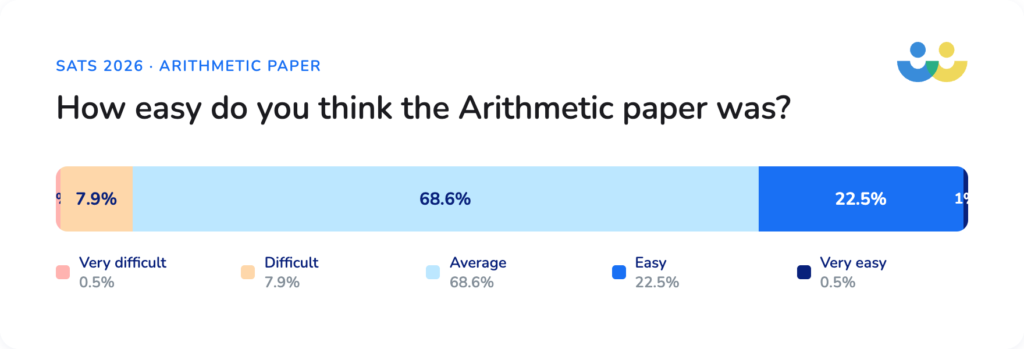
The arithmetic paper landed broadly, as teachers expected.More than nine in ten teachers (91%) rated it average or easier with only 8% calling it difficult or very difficult. Several respondents noted a friendlier order of questions than last year, and the paper structure drew positive comments overall.
“It felt straightforward and nothing there to confuse them.”
Hannah Watson, Deputy Headteacher, Grange Primary School, Greater London
“Just a very nice paper! Even cuspy children finished with time to spare.”
Kate Butcher, Year 6 Teacher, Langenhoe Community Primary School, South East
“Arithmetic was a very fair representation of what you’d expect. It was lovely to see how confident the children felt and how the test was designed to be very user-friendly.”
Sam Stewart, Year 6 Teacher, Crawley Down Village C of E School, South East
The most common observation was around cognitive load: some teachers felt a number of questions later in the paper required more working out than the single mark seemed to warrant. We’ll dig into the specifics in our full paper breakdown after 22nd May.
“As mentioned previously, numbers that were chosen were designed to catch children out rather than test their understanding of calculation methods.”
Harry Walklett, Maths Coordinator, Coppice Primary School, West Midlands
Daily arithmetic practice was the strategy teachers consistently named as the one that made the biggest difference, with Fluent in Five the most-cited resource for delivering it:
“We have implemented Fluent in Five across the school, starting from Year 1 to improve arithmetic knowledge and boost scores in tests.”
Taylor Steele, Deputy Headteacher, Pinvin CofE Academy, West Midlands
Paper 2: reasoning
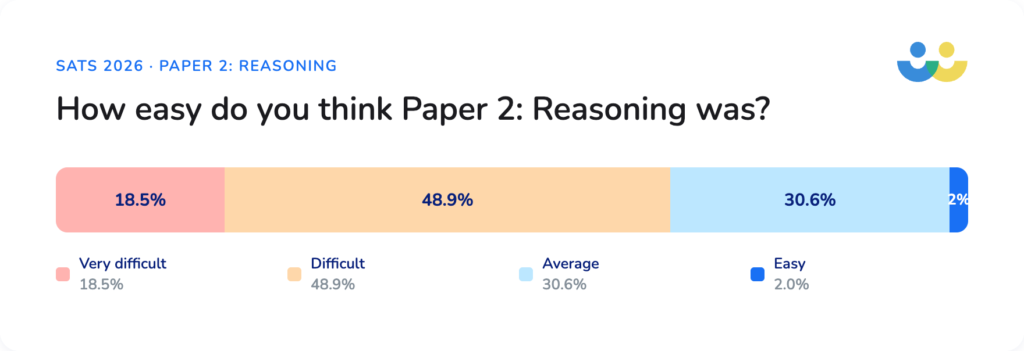
Reasoning Paper 2 was the standout, difficult maths paper. 68% of teachers rated it difficult or very difficult, with just 2% describing it as easy. For many of you, this was the paper that defined the maths experience this year.
“It seemed like a great paper for greater depth children. But not for the rest.”
Year 6 Teacher, Greater London
Teachers told us about multi-step problems where pupils had to think through several stages, work through their reasoning, and arrive at an answer – all for a single mark. Phrases like “deliberately confusing”, “hard to access” and “didn’t know where to start” came up repeatedly in the open responses.
“It sometimes feels like the wording of the question overcomplicates it and takes it away from being a maths test and more of a comprehension test.”
Hannah Watson, Deputy Headteacher, Grange Primary School, Greater London
A handful of teachers also flagged that the paper drew on topics that haven’t featured as strongly in past SATs papers, which left some pupils unsure of how to begin.
“The range of topics meant that pupils had to retrieve a lot of information. It was very cognitively demanding.”
Fiona, Year 6 Teacher, Claydon Primary School, South East
The emotional response from pupils came through clearly. Several teachers described children feeling overwhelmed, unsure where to start, and finishing the paper with the sense that they hadn’t been able to show what they could do. Pupils on the cusp of working at the expected standard were particularly affected, with less time for the “quick wins” that build confidence early on in a paper.
Paper 3: reasoning
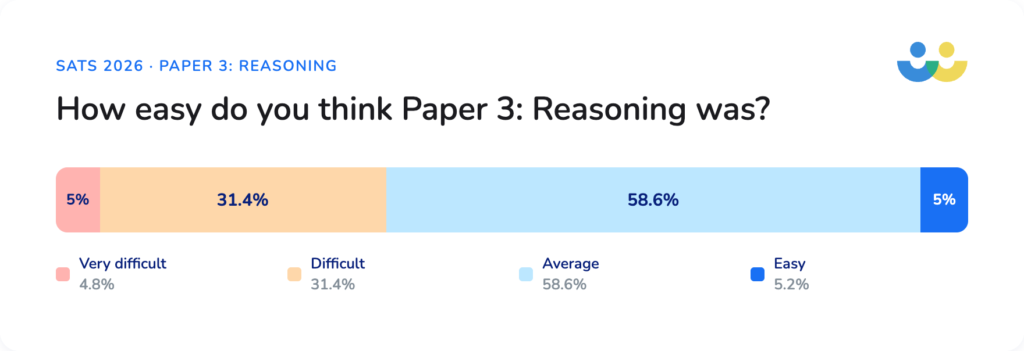
Reasoning Paper 3 landed noticeably better than Paper 2. 64% of teachers rated it average or easier, with only around just 36% finding it difficult or very difficult – roughly half the proportion who said the same about Paper 1.
“This paper was far nicer – the language was much more straightforward and the questions were not as complex to work out the required maths.”
Alison McQuiston, Year 6 Teacher, Larkfield Primary School, North West
“Loved the range of questions and how they were far less word heavy. The layout and format was clear and not over busy. Straightforward requests and questions. Good range and interesting.”
Lindsey Robins, Year 6 Teacher, North Mundham Primary School, South East
Where Paper 2 was defined by cognitive load, Paper 3 was defined by accessibility. Teachers consistently described the wording as more straightforward, the questions as covering a wider range of skills, and the balance between fluency and reasoning as more familiar.
“I felt these questions were more reasonable and covered a wider range of skills.”
Annabelle Cavey, Year 6 Teacher, Holy Trinity and St John’s CofE Primary School, South East
The most common reaction was relief. Several teachers noted that pupils arrived at Paper 2 with a fresh mindset, and that the wording let them apply their arithmetic skills more readily than the first reasoning paper had.
“Good balance of simpler, fluency type questions and more complex reasoning and problem solving. Didn’t feel like there were any overly complicated questions.”
Headteacher, South East
That isn’t to say it was without its challenges. Where teachers did flag difficulty, the issues echoed those of Paper 1: wordy phrasing, multi-step thinking for a single mark, and questions that asked pupils to retrieve and combine knowledge from across the curriculum.
“Unusually worded questions, lots to do for a few marks.”
Michael Kuipers, Year 6 Teacher, Crudwell CE Primary, South West
SATs 2026: a fair reflection on pupil potential?
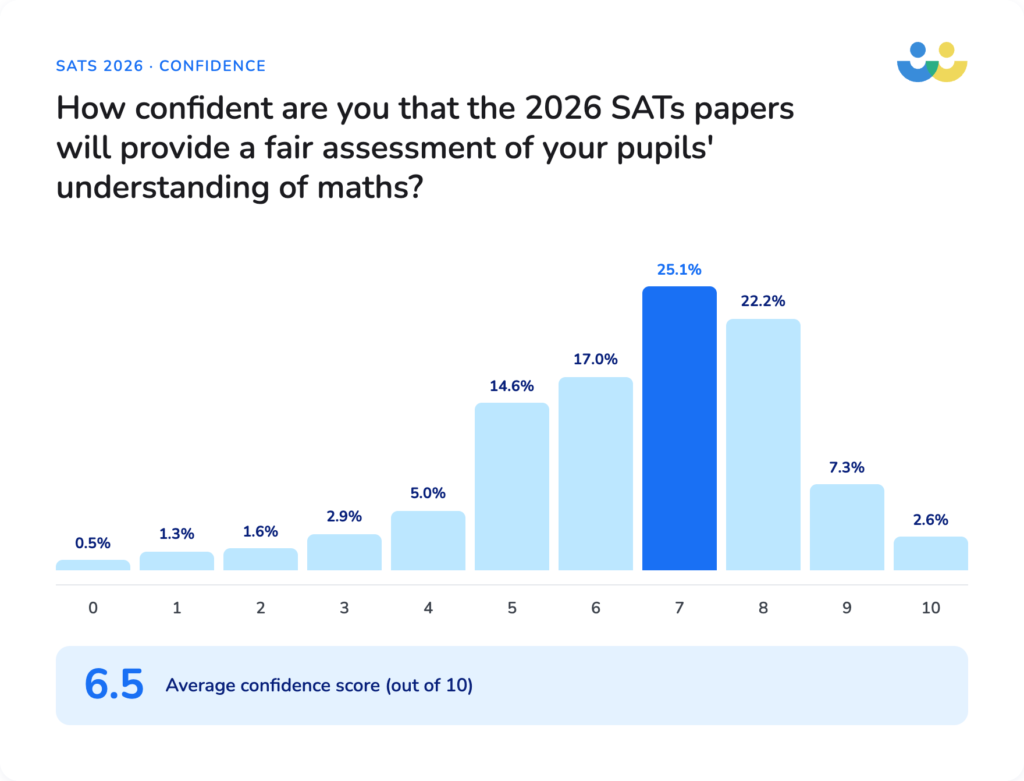
Teachers’ confidence that the 2026 papers will provide a fair assessment of pupils’ maths is mixed. Just over half (57%) rated the papers 7 or higher on a 1–10 fairness scale, with a mean score of 6.5. But that average masks a meaningful split – a quarter of teachers (26%) rated the papers 5 or below.
“Tests were fair and had a good representation of the curriculum areas.”
David Quinlan, Deputy Headteacher, Swavesey Primary School, South East
The strongest concerns came from teachers who felt Reasoning Paper 1 didn’t allow pupils on the cusp of working at the expected standard to demonstrate what they could do.
“The SATs are just a snapshot in the ocean of the child’s learning. It shows that they are able to cope well under pressure rather than actually complete the maths.”
David Pearce, Year 6 Teacher, St Bees Village Primary School, North West
SATs 2026 grade boundaries
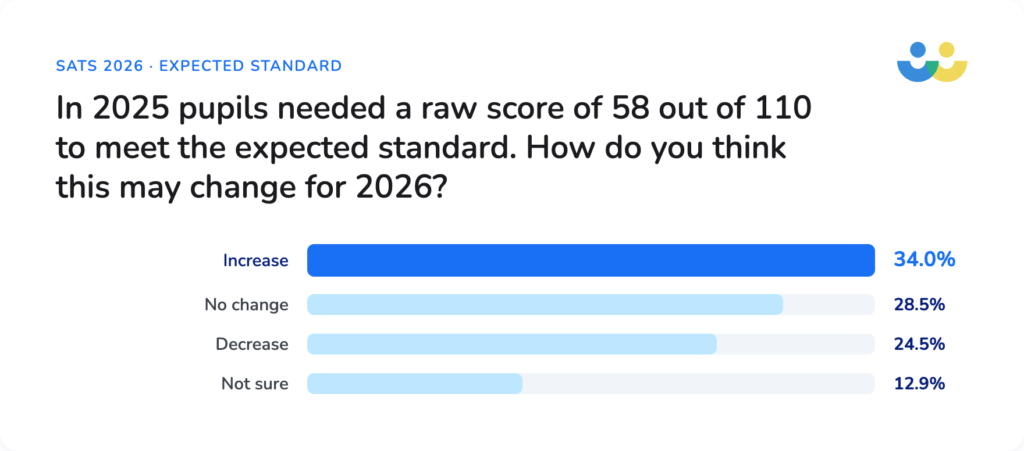
Teachers are split on what will happen to the raw score needed for the expected standard. 34% expect it to rise from 58, which would continue the upward direction seen between 2024 and 2025, when the boundary jumped 4 marks. 28% think it’ll stay the same, while 25% predict a drop in response to Reasoning Paper 1. The remaining 13% aren’t sure.
“It’s the highest it’s been for a while. Government uses tests to raise standards so I can’t see that it will be lowered.”
Alex Madeley, Year 6 Teacher, Swanton Morley VC Primary, South East
Comments split along a familiar fault line: those who thought Paper 1 was unusually hard generally expected the boundary to fall or hold, while those who thought the experience was fair expected it to rise as it has in each of the last few years.
“Difficulty of [Reasoning] Paper 2 should reduce pass mark.”
Jake Armour, Year 6 Teacher, High Crags Primary Leadership Academy, Yorkshire and Humber

Teacher confidence in pupil preparation
Overall preparedness
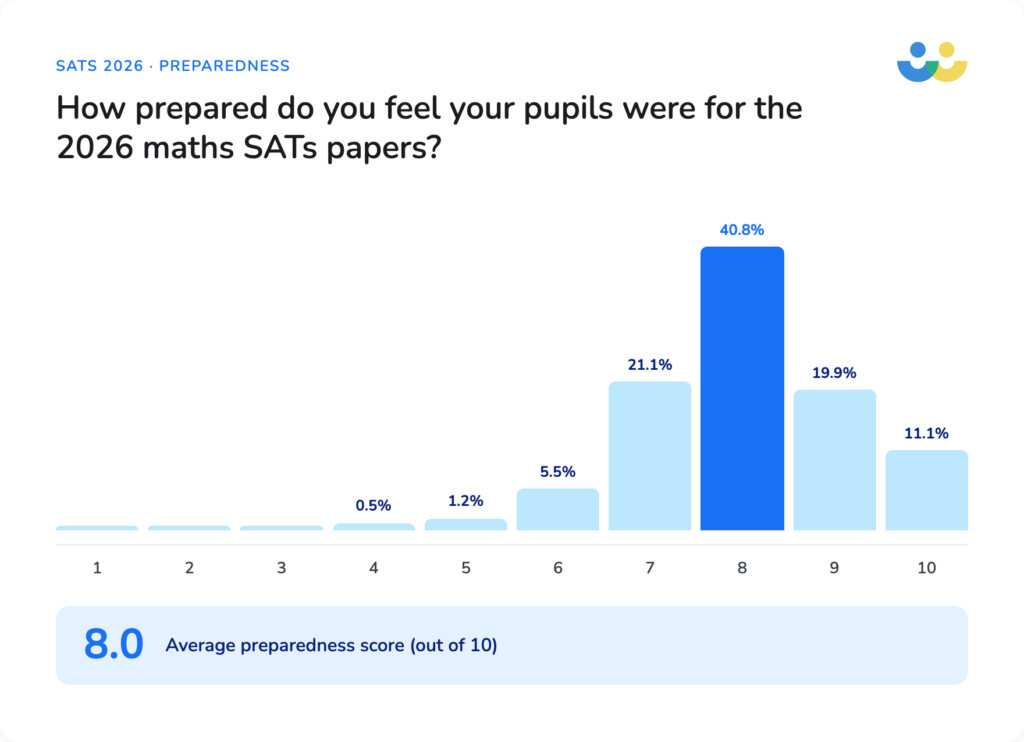
Teacher confidence in pupil preparedness is one of the more encouraging parts of the survey. More than nine in ten teachers (93%) rated their pupils’ readiness 7 or higher on the 1–10 scale, with 72% scoring 8 or above and a mean rating of 8.0.
Where preparedness scores were high, teachers consistently named the same factors: daily arithmetic practice, targeted small group work, and consistent investment in maths fluency from earlier year groups.
“Daily arithmetic drills have improved fluency. Online practice has enabled children to get support in a bespoke manner.”
Andy, Deputy Headteacher, Crofton Hammond Junior School, South East
Where they were lower, the reasons clustered around two things: pupils only just working at the expected level with limited exposure to multi-step problems, and the cohort-specific gaps that several teachers traced back to Covid disruption in their early years.
“This is the penultimate year of the children who perhaps had covid-impacted early years/KS1. On wobbly foundations that schools have fought tooth and nail to overcome, our children have covered the full curriculum, have had high-quality teaching from experienced teachers, benefitted from booster and intervention groups but still found those multi-step problems confusing.”
Year 6 Teacher, South East
Content coverage
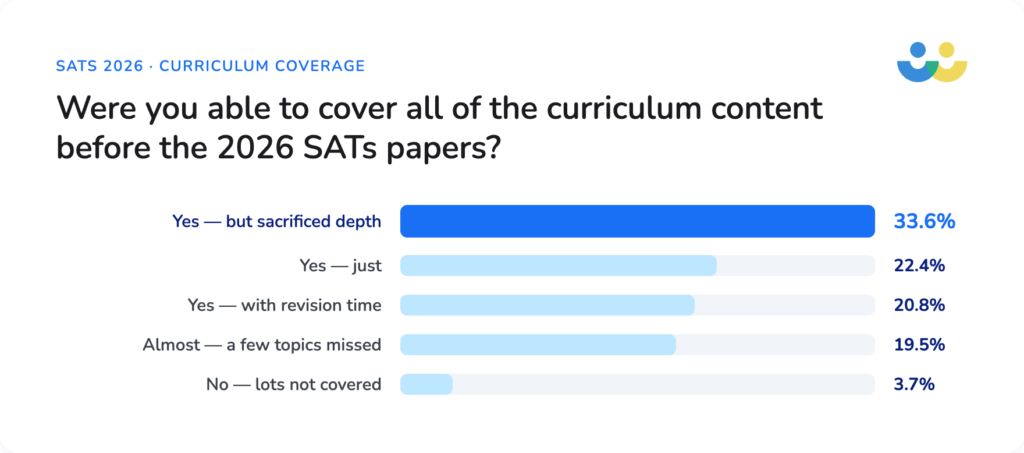
A third of teachers (34%) covered the full curriculum but had to sacrifice depth to do so. Roughly equal proportions covered everything just in time (22%) or with plenty of time for revision (21%), with 23% saying they missed at least some topics.
Comments here painted a familiar picture: the curriculum continues to be ambitious for the time available, especially for cohorts who carry gaps from earlier year groups. Several teachers noted that the time spent embedding fluency in arithmetic earlier in the year paid off, but at the cost of depth elsewhere.
“[Measurement] is the one area which seems to be rushed (or missed) in earlier year groups, so there is too much ground to cover in year 6.”
Maths Coordinator, South East
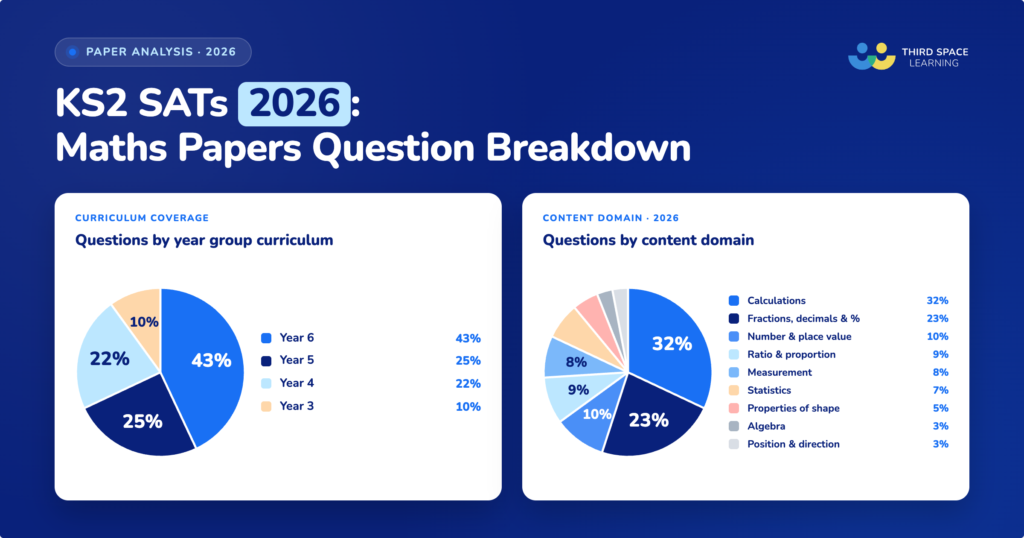
To help schools prioritise the topics most likely to appear in the maths SATs papers, our academic experts annually update the list of the top 20 topics to revise – all based on an analysis of the past maths SATs papers since 2016.
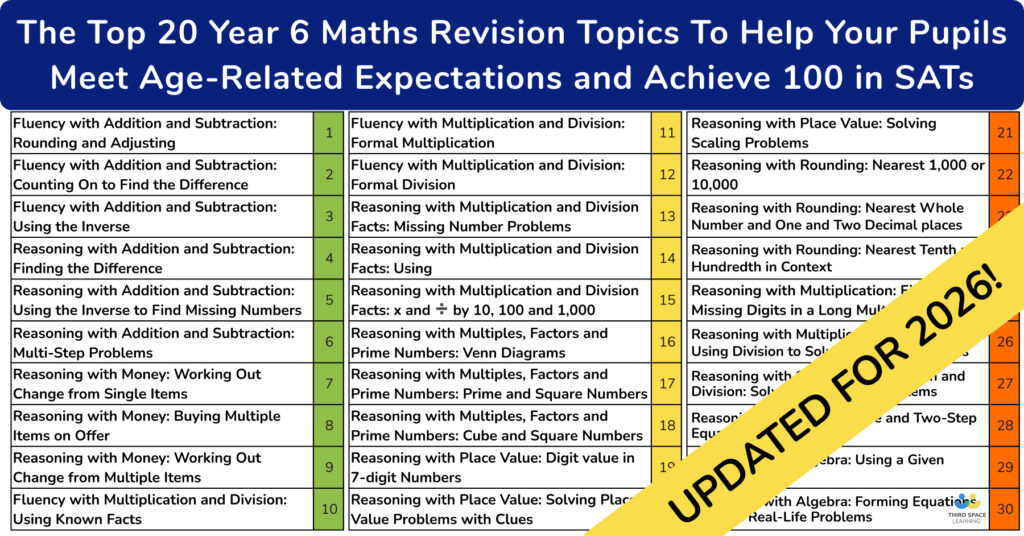
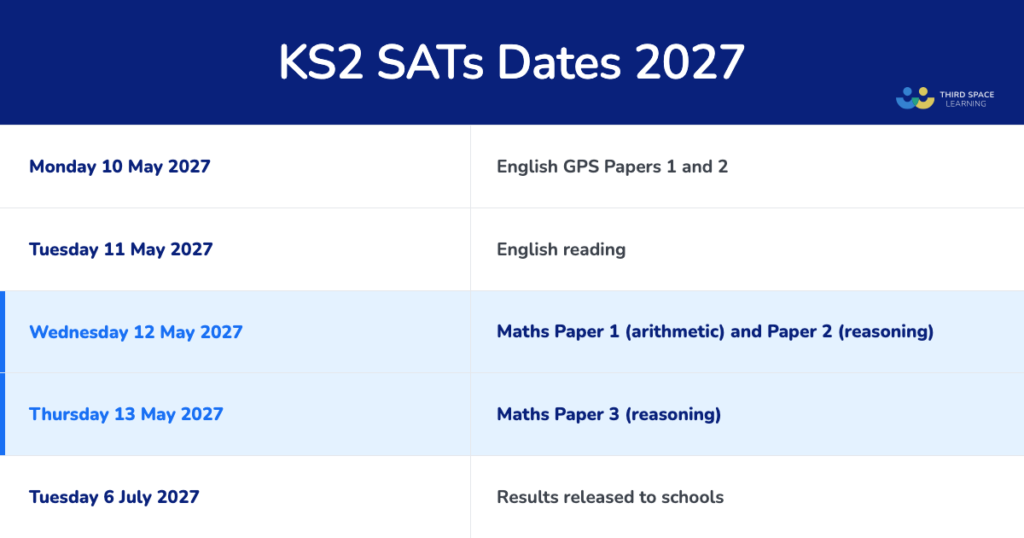
Keep an eye out for the updated topic list for the 2027 maths SATs released in the 26/27 Autumn term.
Most popular scheme of work
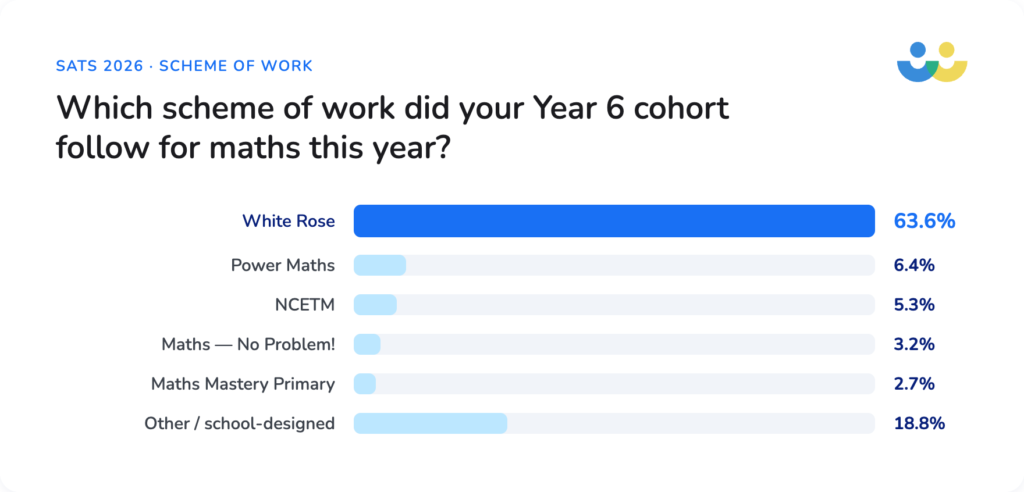
White Rose remains the dominant scheme by some distance, used by almost two thirds of respondents (64%).
Power Maths, NCETM and Maths – No Problem! made up a smaller second tier, with a long tail of schools using their own school-developed schemes or hybrid approaches.
Third Space Learning’s maths teachers ensure our library of primary maths resources aligns with the White Rose Maths scheme of work, including the Ready-to-go, adaptable maths lesson slides.
Difficult curriculum topics
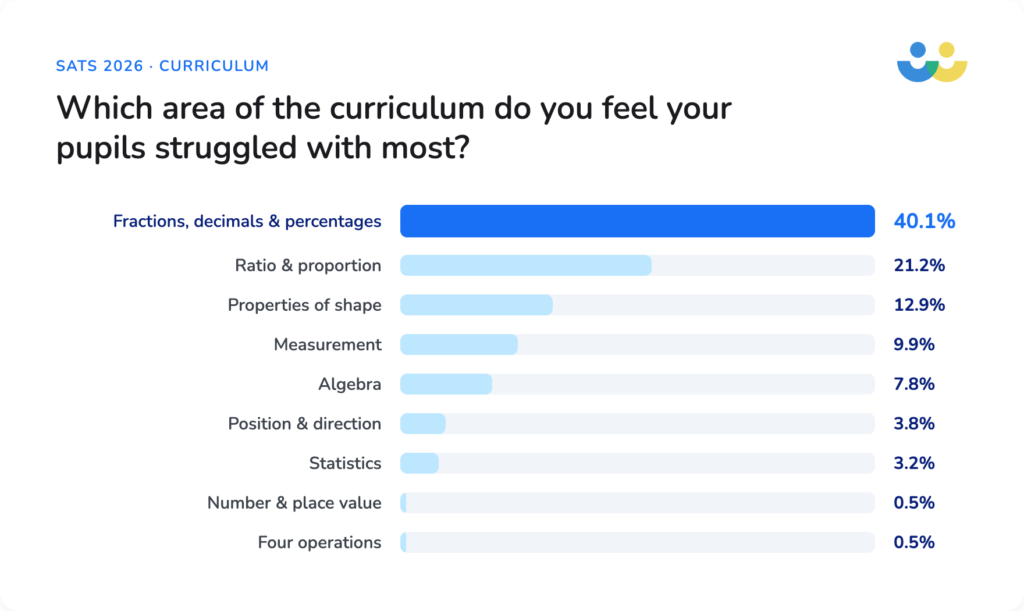
It came as no surprise that fractions, decimals and percentages was the area teachers said pupils struggled with most – cited by 40% as the hardest topic. Ratio and proportion came second (21%), with properties of shape and measurement rounding out the top four.
“Fractions always seem to be the biggest barrier and with a large chunk of marks available, it becomes one we go over and over.”
Sam Stewart, Year 6 Teacher, Crawley Down Village C of E School, South East
“There are so many things within fractions, decimals and percentages to know, remember and cover and many children lack the foundational fraction knowledge and understanding of what fractions actually are/mean.”
Year 6 Teacher, East Midlands
The reasons teachers gave consistently traced back to the same root causes: weaker times tables knowledge, gaps in foundational understanding from earlier year groups, and pupils’ understanding concepts in isolation but struggling to apply them in multi-step contexts.
Effective tutoring: closing the maths attainment gap
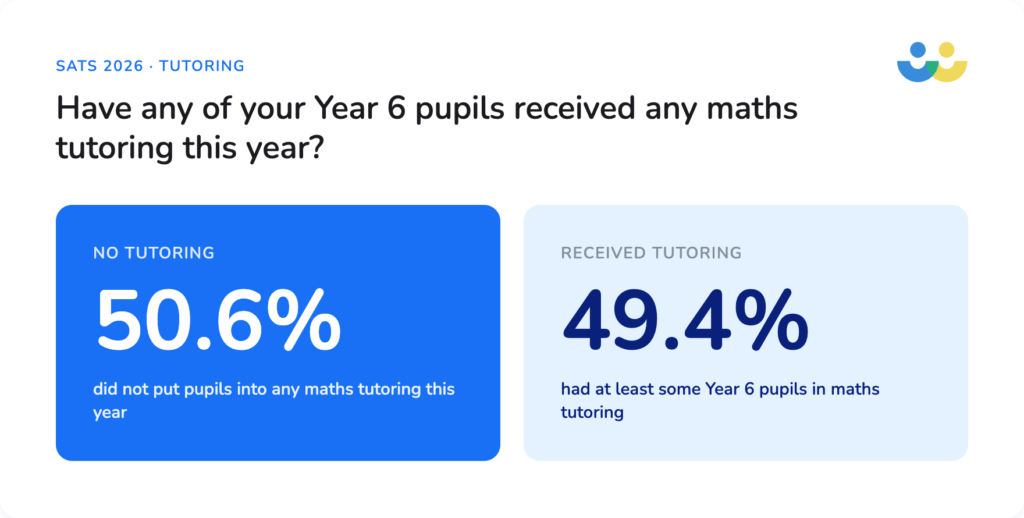
Schools can clearly see the benefits of tutoring; it continues to be one of the most consistent themes in teachers’ SATs preparation strategies. Nearly half (49%) of respondents had at least some pupils receive maths tutoring this year, usually for the same reason: pupils who needed more support than the timetable could stretch to.
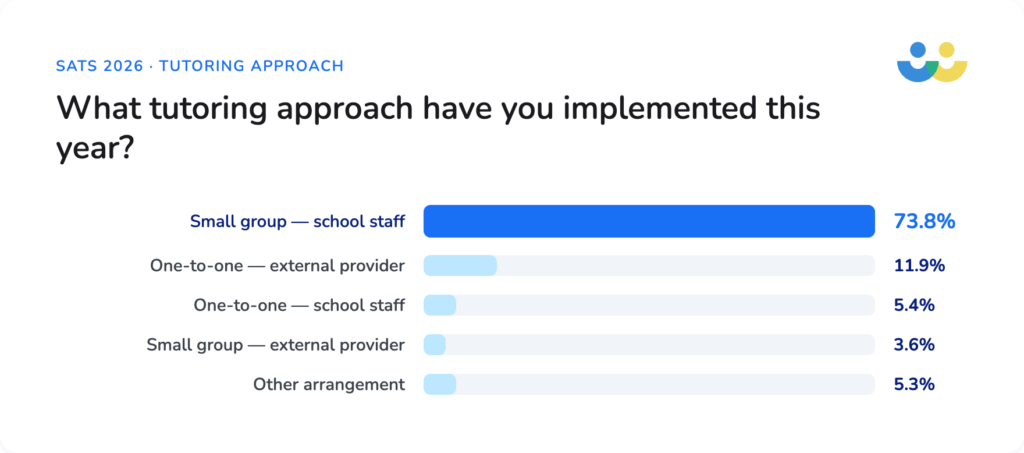
The most common approach used by 74% of schools was small group tutoring delivered by school staff – typically existing teachers and TAs running interventions during the school day. Around one in eight (12%) also used one-to-one tutoring delivered face-to-face by an external provider, with smaller numbers turning to online tutoring or one-to-one sessions led by school staff.
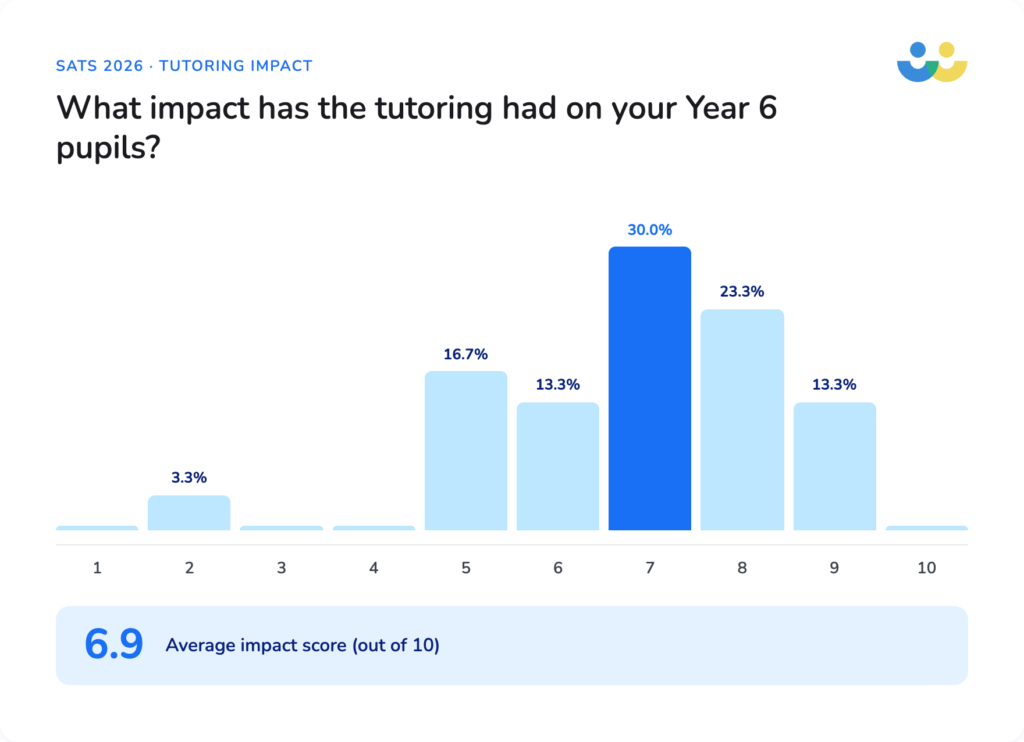
Whatever the tutoring format, teachers rated the impact on their Year 6 pupils highly. The clear majority rated their tutoring’s impact in the upper part of the 1-10 scale, with more than half scoring it 8 out of 10 or above. This echoes research from the EEF, who state that tutoring can improve progress by up to 5 months.
One to one AI maths tutoring with Third Space Learning
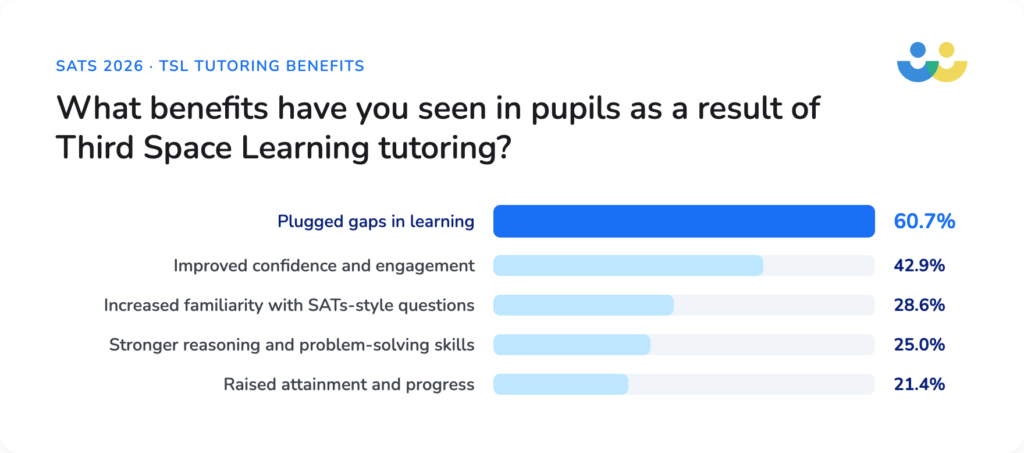
Among teachers whose schools used Third Space Learning’s one-to-one AI tutoring this year, nine in ten rated it effective or very effective for SATs preparation. The benefits of the online tutoring that teachers named most often were stronger reasoning and problem-solving, plugging gaps in learning, and growing familiarity with SATs-style questions. Asked what made the difference, the answers were consistent: confidence, the one-to-one element, and a consistent approach across the year – pupils returning to class with the confidence to attempt a problem they’d have backed away from earlier in the year, and a sustained programme rather than a final-week scramble.
“For those who just needed more practice, Third Space Learning has helped. For those with gaps, it has supported understanding alongside teacher intervention.”
Deputy Headteacher, East Midlands
The tension teachers named, though, is the one that runs through every conversation about tutoring: the pupils who would benefit most are often the ones it’s hardest to find room for. Tutoring budgets that stretch to three or four pupils when there are twelve who’d benefit. Timetable squeeze that means interventions fall on the same staff already running boosters. The most useful conversations we’re having with schools at the moment are about how to give more pupils the one-to-one maths support they need without adding to either of those pressures.
That’s the gap Skye, our AI maths tutor, is built to close. Skye delivers personalised one-to-one maths lessons that follow an “I do, we do, you do” structure – giving pupils hints rather than answers, and addressing misconceptions as they come up. Sessions are supervised in school. Where traditional tutoring limits support to a handful of pupils, Skye makes it possible to give every Year 6 pupil who needs it the kind of one-to-one maths support that’s usually reserved for the few.
“For those who just needed more practice, Third Space Learning has helped. For those with gaps, it has supported understanding alongside teacher intervention.”
Deputy Headteacher, East Midlands
SATs, SATs, SATs
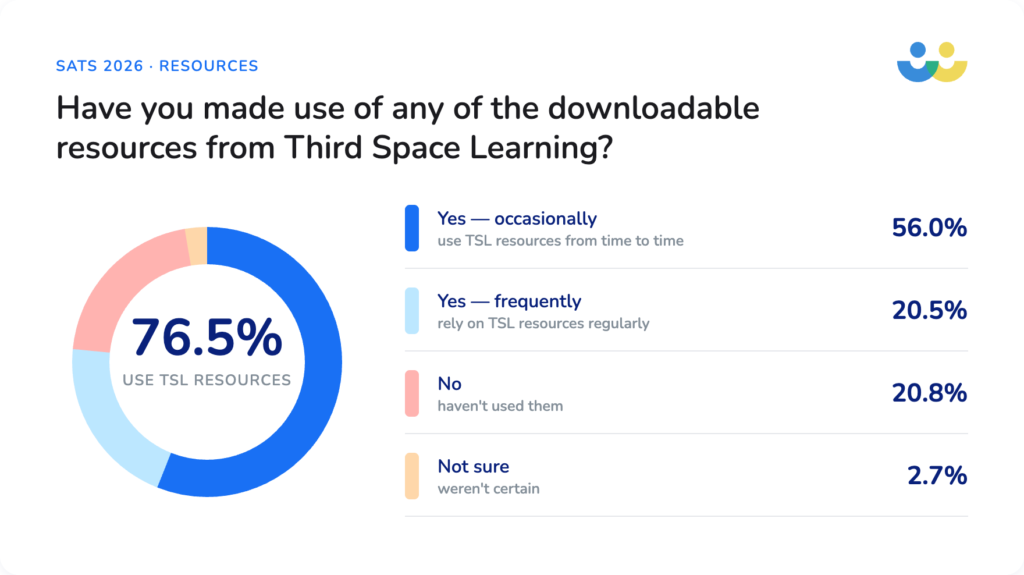
When teachers told us what landed in the final weeks of preparation, the same handful of resources came up over and over. More than three quarters (76%) of respondents had used Third Space Learning’s free downloadable maths resources this year – most occasionally, with a committed one in five reaching for them frequently. Among those who used them, 96% rated them very or somewhat helpful.
Top SATs resources
Two resources dominated the responses: Fluent in Five (named by 59% of resource users) and Rapid Reasoning (53%).
Teachers consistently named Fluent in Five as the strategy that made the biggest difference to pupils’ arithmetic fluency – the daily, low-stakes practice that builds confidence through repetition rather than pressure.
“Fluent in Five is really helpful to develop arithmetic.”
Vicki Parker, Year 6 Teacher, Highfields Primary School, East Midlands
Rapid Reasoning came up just as often, with several teachers describing it as the closest match to the cognitive demand of the reasoning papers themselves. Maths intervention packs, worked examples and word problems made up a strong second tier of the most-cited resources.
One teacher mentioned using a completed paper as a marking exercise – getting pupils to spot errors and correct them – which is exactly the thinking behind our worked examples.
“It was useful having the children mark a completed paper, getting them thinking about their mathematical processes.”
Kerry Donovan, Year 6 Teacher, St John’s Upper Holloway CE Primary School, Greater London
“We used the completed papers for children to mark. These held the children’s attention when they were fed up of revision!”
Anna Orchard, Year 6 Teacher, St James’ Catholic Primary School, Millom, Cumbria, North West
What teachers told us they valued was less about any single feature and more about the time saved: ready-made, pre-checked resources they didn’t have to build themselves, that pupils could pick up and use without long explanations. As one respondent put it, the resources are:
“Just handy to have them pre-made without teachers having to think and prepare.”
Hannah Watson, Deputy Headteacher, Grange Primary School, Greater London
Third Space Maths Hub
If you haven’t already signed up, the Maths Hub is the home of all our free maths resources, including Fluent in Five, Rapid Reasoning, SATs Practice Papers and Worked Examples. And our Year 6 Survival Pack brings them all together in one place. Create a free account to access hundreds of free math resources:
- Fluent in Five: daily arithmetic practice for KS1 and KS2. Download 6 weeks free.
- Rapid Reasoning: Fluent in Five’s reasoning counterpart for KS2. Download 6 weeks for free.
- SATs Practice Papers: 6 free papers with accompanying mark schemes. Download 6 free papers.
- SATs Worked Examples: a complete set of worked SATs papers to help pupils spot mistakes. Download free worked examples.
- Maths Intervention Packs: topic-specific intervention lessons designed to close learning gaps. Download 8 free maths intervention packs.
Prioritising pupil and staff well-being
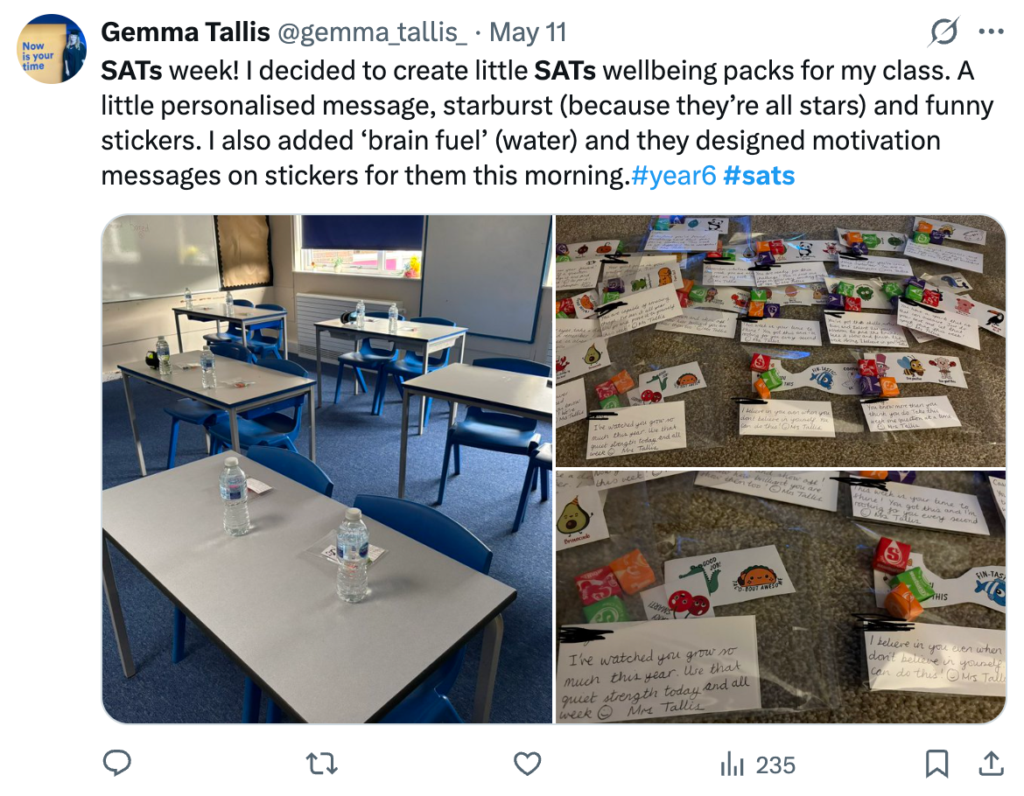
SATs week and Mental Health Awareness Week falling on the same week is becoming an annual irony – and another year of teachers doing the quiet, creative work of looking after pupils through it. The well-being responses in this year’s survey were one of the most generous sections to read, with a huge range of approaches shared.
The most common threads were short, regular movement and brain breaks across the week; mindfulness sessions before papers; one-to-one check-ins with the pupils teachers knew would feel the pressure most; and the now-traditional SATs breakfasts that several teachers credit with setting a calm, communal tone before papers.

“Mindfulness activities, movement breaks, check-ins with key children experiencing anxieties and other challenges.”
Year 6 Teacher, West Midlands
A handful of schools added more relaxed booster sessions in the lead-up to the week, with hot chocolate and biscuits cited more than once. Flexible timetabling, outdoor activities, music, singing and even dancing all came up.
“Small group provision for anxious children. Mindfulness. Free Year 6 toast and pastries club at 8am each day of SATs.”
Jo Jones, Deputy Headteacher, Dovedale Primary School, North West
Teacher workload was a quieter story this year, but worth surfacing. More than half of teachers (52%) said their workload during SATs week was heavier than a typical week, with managing access arrangements, invigilation and pastoral support for anxious pupils named as the biggest contributors.
“More children needed extra support during SATs – extra time, readers etc.”
Ruth Kukula, Year 6 Teacher, Cawthorne CE (VC) Primary, Yorkshire and Humber
The practical logistics of SATs week land on the same staff who are also trying to hold the wellbeing piece together.
And to lighten the mood after a heavy week, Lee Parkinson, aka @ICT_MrP, captured SATs week as only a teacher can – with his take on the types of teacher you’ll find in every school during SATs week:
Types of teachers during a SATs test, which one are you? pic.twitter.com/yg1oy6fucu
— Mr P MBE (@ICT_MrP) May 10, 2026
Use of AI in SATs preparation
37% of respondents used AI to help prepare pupils for SATs this year. Generating SATs-style maths questions was by far the most common use, named by more than four in five AI users (82%). Lesson planning, generating curriculum-aligned maths questions, and AI maths programmes followed. ChatGPT, Gemini and Copilot were the most-named tools.
“I started with ChatGPT, which quickly learned what I was looking for. Because this was an open-source platform, I regularly used up my free chats. I moved over to Copilot because this is part of my school’s Microsoft account; it has taken additional time to learn how to use it and for it to learn from me. I often use ChatGPT and Copilot together, running scenarios through both to identify errors or find better solutions.”
Amanda Pangbourne, Year 6 Teacher, St. Alban’s CE (Aided) Primary School, South East
Among teachers who didn’t use AI, the most common reason was a lack of time to explore the tools (cited by 36% of non-users), with a similar proportion (32%) saying they preferred not to rely on AI in their SATs preparation – a significant strand of “AI-cautious” voices in the responses. Only 8% said they lacked confidence using AI tools.
Where AI did save time, teachers said it was in lesson and question generation. Where it didn’t, the limitations were specific: UK curriculum alignment, the way questions are presented, and AI-generated content not quite matching the format pupils needed to see.
“Repeated question styles. Difficulty too high or too low.”
Sean Hall, Deputy Headteacher, Scotholme Primary School, East Midlands
Looking ahead, there’s no clear consensus on where AI fits in SATs preparation. A small group of teachers are already integrating it into their day-to-day. A much larger group are watching and waiting for tools that are properly tailored to UK primary maths.
Looking ahead to SATs 2027: what you would do differently
It comes as no surprise that the most consistent thread across the data was the value of starting earlier: daily arithmetic practice, targeted small group work, and time spent on multi-step reasoning across the year – not just in the weeks before SATs.
Schools that invested in fluency from earlier year groups consistently reported higher pupil preparedness scores, and the gaps that teachers traced back to Covid disruption underline how much of Year 6 success depends on what’s happened before pupils get there.
It’s evident that there’s no single approach to preparing pupils for SATs, but here are some respondents’ suggestions for 2027:
- Build reasoning skills across the year – particularly multi-step problem solving – not just in the weeks before SATs
- Start maths interventions earlier, building knowledge and fluency from earlier year groups rather than scrambling in Year 6
- Embed arithmetic fluency as a daily habit – the single most-named strategy that made a difference this year
- Focus on mathematical vocabulary to help pupils unpick the wordy reasoning questions
- Familiarise pupils with SATs-style questions and past SATs papers to build confidence with unfamiliar phrasings and multi-step formats
- Build stamina through regular timed practice so pupils can sustain focus across the full paper
- Prioritise pupil wellbeing alongside academic preparation, particularly for the Covid cohort, where stamina and resilience are part of the readiness picture
More key takeaways
Reasoning was the other clear takeaway. With Reasoning Paper 1 setting the tone for the difficulty of the week, more time spent on multi-step problem solving – and on the language of reasoning – feels like the area most likely to pay off in 2027. Several teachers also pointed to the importance of giving pupils on the cusp of working at the expected standard more exposure to the kinds of questions that don’t yield a quick win.
AI is the open question for next year. A small but growing group of teachers are using it to generate questions, plan lessons and save time on the parts of SATs preparation that take hours. For those who aren’t yet, the most common barrier was time to explore tools, not confidence in using them. Whether AI plays a bigger role in 2027 will depend on whether the tools available genuinely fit the UK primary maths context.
And for schools looking ahead, Skye – our spoken AI maths tutor – is designed to slot in as part of that 2027 planning. Sustained, weekly one-to-one maths support across the year tends to land better than concentrated boosters in the final weeks – and it’s the same principle teachers in our survey kept coming back to: start earlier, build fluency, give pupils more time with multi-step reasoning before the SATs window.
Let’s hear it for you, wonderful teachers and pupils
As ever, we are so grateful to all the teachers and school staff who took the time to complete our annual SATs survey.
“I enjoy SATs week. It is lovely to see how far the children have progressed and for them to show of their best selves – however, I do feel for those children who struggle academically.”
Stephanie Field, Year 6 Teacher, Moorthorpe Primary School with Inclusion Resource, Yorkshire and Humber
We can’t mention every response, but we can celebrate you all.
It’s been a pleasure to be part of this year’s SATs journey. Whether you’ve read our blogs, used our free maths resources or your pupils have benefited from our online one-to-one maths tutoring, we hope you’ve felt supported.
Good luck to the 7,233 Year 6 pupils we’ve worked with this year across more than 105,800 sessions, and we’re looking forward to meeting the next cohort of pupils.
Remember to download your free Year 6 Survival Pack for plenty of fun maths investigations and games to see you through the rest of the year and give you a head start next year with our sought-after Fluent in Five.

DO YOU HAVE STUDENTS WHO NEED MORE SUPPORT IN MATHS?
Skye – our AI maths tutor built by teachers – gives students personalised one-to-one lessons that address learning gaps and build confidence.
Since 2013 we’ve taught over 2 million hours of maths lessons to more than 170,000 students to help them become fluent, able mathematicians.
Explore our AI maths tutoring or find out about year 6 SATs for your school.


![The Top 20 SATs Revision Topics For 2026 [Video]](https://thirdspacelearning.com/wp-content/uploads/2026/01/SATs-webinar-2025-social-image-6-1024x576.png)