

Review of Maths GCSEs 2026: Teacher Survey Results

For most of you, the 2026 maths GCSEs are complete! A huge well done to you and your students for all of the hard work you put in. While you wait for the results, we’re back with our teacher survey for a second year.
Last year, for the first time, we asked those of you who saw your Year 11 cohort through their maths GCSEs to share your opinions on the papers. The response was so valuable that we’ve made it an annual fixture.
Whether your students sat the Edexcel, AQA, OCR, or WJEC exam board, or any others, we wanted to hear your opinions on the 2026 maths GCSE experience.
A huge thank-you to everyone who completed our 2026 maths GCSE survey or joined the conversation online. If you still have insights to add, we’d love to hear them. Use #GCSEs2026 or tag @thirdspacetweet.
This blog focuses on the overall difficulty and experience of the papers, including your students’ preparation, rather than question-level detail. After results day on the 20th August, we’ll return with a full 2026 maths GCSE breakdown and results analysis.
GCSE MATHS 2026: STAY UP TO DATE
Join our email list to stay up to date with the latest news, revision lists and resources for GCSE maths 2026. We’re analysing each paper during the course of the 2026 GCSEs in order to identify the key topic areas to focus on for your revision.
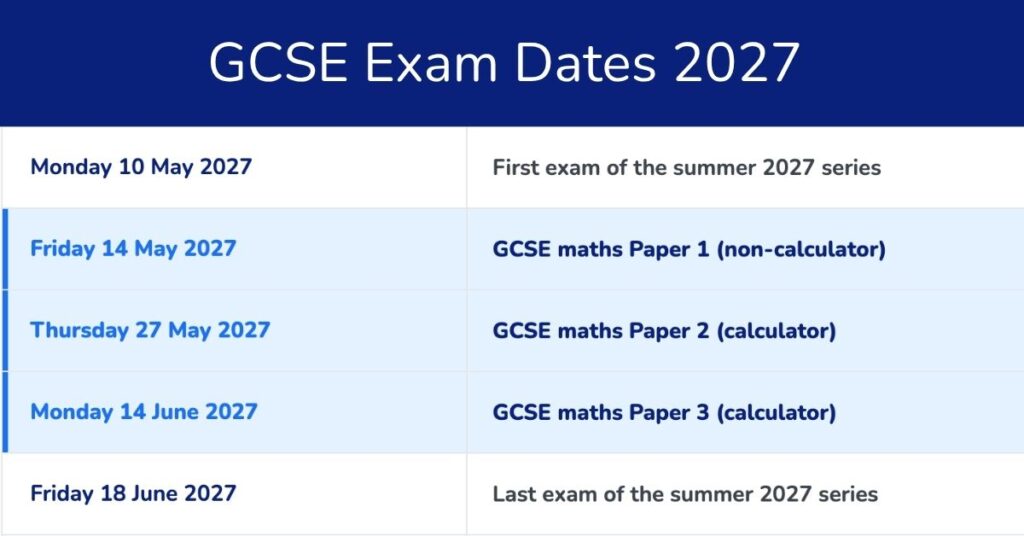
GCSE dates 2026
GCSE results 2026
Get ahead on revision with the GCSE maths papers analysis from 2026:
Analysis of GCSE Maths Paper 1 2026
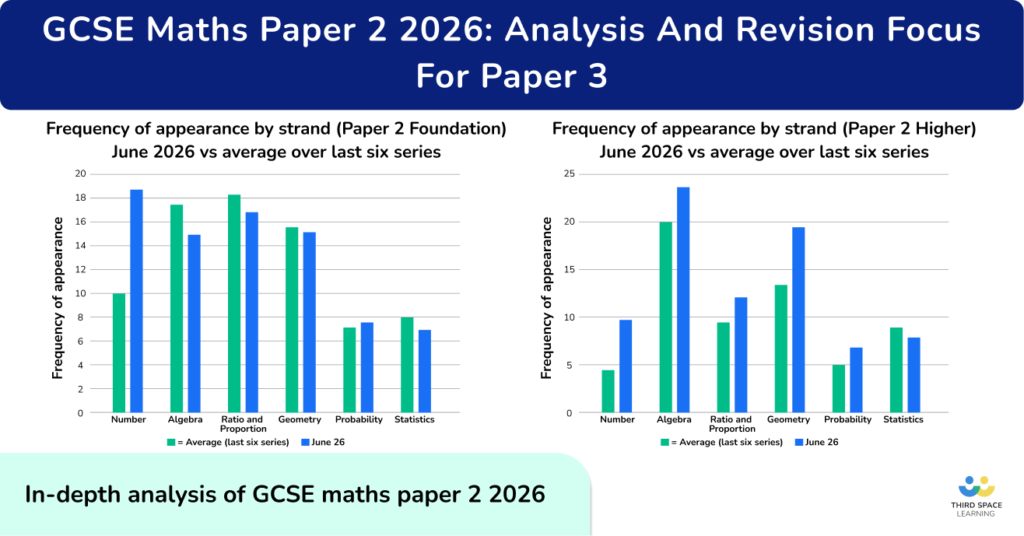
Analysis of GCSE Maths Paper 2 2026
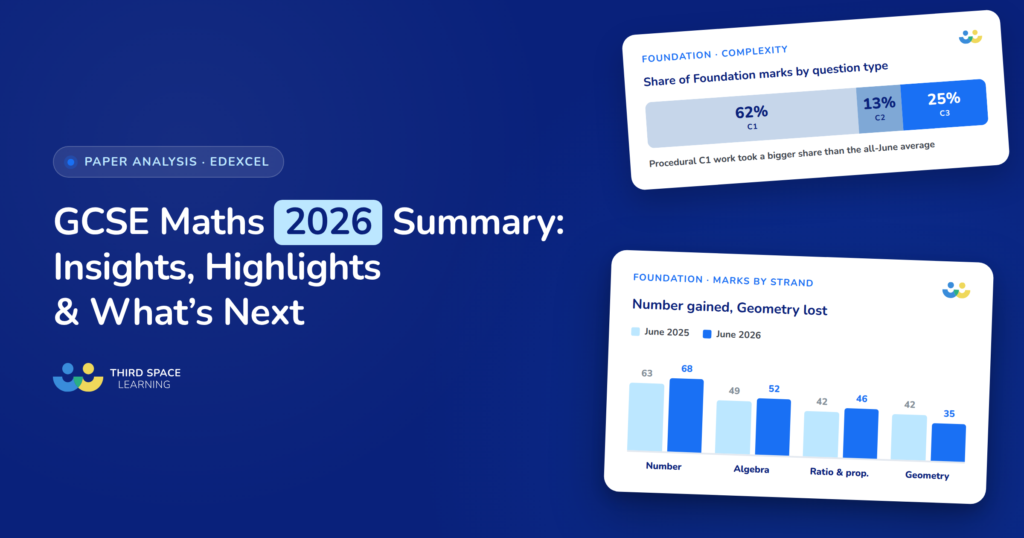
GCSE Maths Paper Analysis and Summary 2026
GCSE Maths Teacher Survey Results 2026

GCSE Maths Starter Kit
Get ahead with GCSE maths planning for your next cohort with a selection of GCSE resources to improve your students’ automaticity and confidence ahead of their exams.
Download Free Now!Which 2026 GCSE maths exam boards did we ask teachers about in our survey?
We opened the survey up to everyone, whichever exam board your students sat. A smooth exam series – or a tricky one – is rarely the same story from one board to the next, so we wanted the full picture.
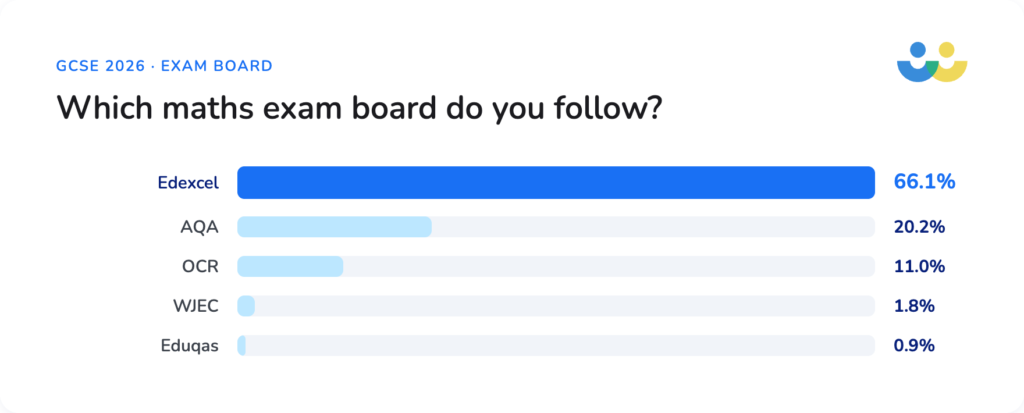
Most of the teachers who took part follow Edexcel, which led the way by some distance: just over two-thirds (67%) of responses. AQA came next at 19%, then OCR at 11%, with a smaller number of schools sitting WJEC (2%) and Eduqas (1%). Here’s how the split looked across everyone who took part:
Influences on the 2026 GCSE experience
Every exam season has its own backdrop, and 2026 was no different. Looking across your responses, three themes stood out as shaping how the year played out:
- The rise of AI in the classroom – comfortably the biggest shift this year, with almost half of you turning to it in some way to help prepare your students.
- The long tail of Covid – still showing up in this cohort’s foundations and confidence, six years on from the first lockdowns.
- Budget pressure – a genuine strain for some departments, though most schools managed to protect their GCSE prep this year.
We’ll come back to each of these in more detail later on. First, though, the big question: how did 2026 measure up against 2025?
2026 GCSE maths papers vs 2025: same again, just a touch tougher
For those of you who’ve steered a few cohorts through GCSEs, we asked how 2026 stacked up against last year. The verdict? Reassuringly familiar, with the faintest lean towards tougher.
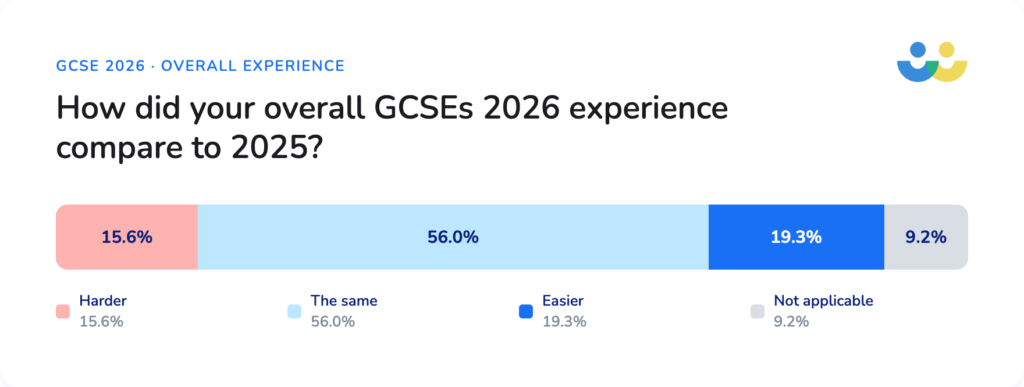
Looking at the overall experience first, most of you (56%) felt this year was much the same as 2025. Where opinions did shift, slightly more leaned towards ‘easier’ (19%) than ‘harder’ (16%), with the rest meeting Year 11 for the first time this summer.
On the papers themselves, the picture was just as even – but with the needle nudging the other way. Around two in five (39%) judged them on a par with 2025, while 30% found them slightly harder and 27% slightly easier. Only a handful felt they were dramatically different in either direction.
Put it together and 2026 looks like a steady year: seven in ten of you (70%) rated the papers ‘average’ overall, and well over half (57%) found them about what you’d expected.
“I felt each paper was more fair with the harder questions spread across all three papers instead of one challenging paper or easier paper.”
– Jenni Ward, Head of Maths, Hope Academy, North West
“Children are all saying how easy it felt.”
– Tim Tompkins, SEN Teacher, Felpham Community College and Sixth Form, South East
Maths GCSE papers 2026: a deeper dive
With the big picture in place, let’s go paper by paper. We asked how each one felt on the day, from the non-calculator opener through to the final calculator paper – and a clear pattern emerged: the further into the series your students got, the tougher the going.
Paper 1 (non-calculator)
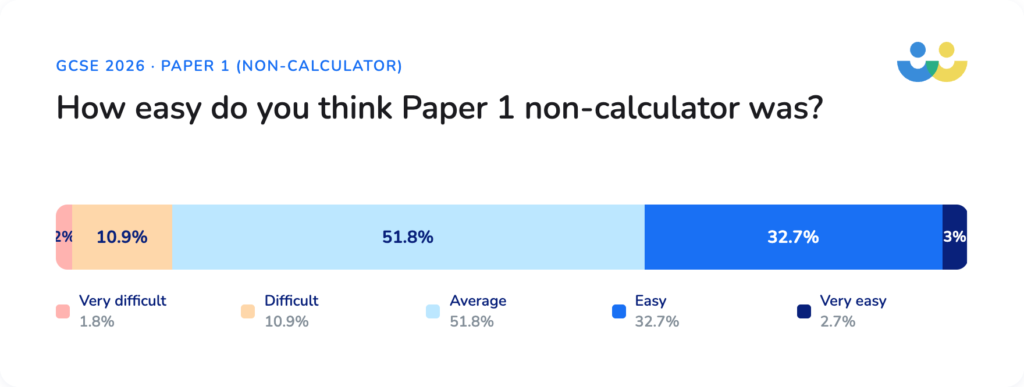
Paper 1 was the most comfortable of the three. Around a third of you (35%) rated it easy or very easy, just over half (52%) found it about average, and only around one in eight (13%) thought it difficult. For plenty of students, the overriding feeling on the way out was relief – a lot of them were convinced it had gone well.
That said, an easy-feeling Paper 1 wasn’t all good news. A few of you noted it lulled students into a false sense of security ahead of Papers 2 and 3, and others were quick to point out that strong performance still came down to secure knowledge rather than exam-day luck.
“Most pupils came out of the exam saying it was easy.”
– Lauren Miles, Maths teacher, Lift Tamworth, West Midlands
“Paper 1 was quite easy and set the students into complacency as they felt that paper 2 and 3 would be easier than last year’s.”
– Karolyn, Head of Maths, Reintegr8, South East
“If pupils had the knowledge and knew the skills they performed well. It did not suit pupils who’d practised lots of past papers without studying and understanding topics.”
– Stephen Bodman, Head of Maths, King’s Leadership Academy Liverpool, North West
“Same topics appearing. The last few questions were much more difficult – as usual.”
– Roger O’Brien, Maths teacher, DN Colleges, Yorkshire and Humber
“The students said it was too wordy.”
— Nasrin Dahir, Maths teacher, City of Bristol College, South West
Paper 2: Calculator
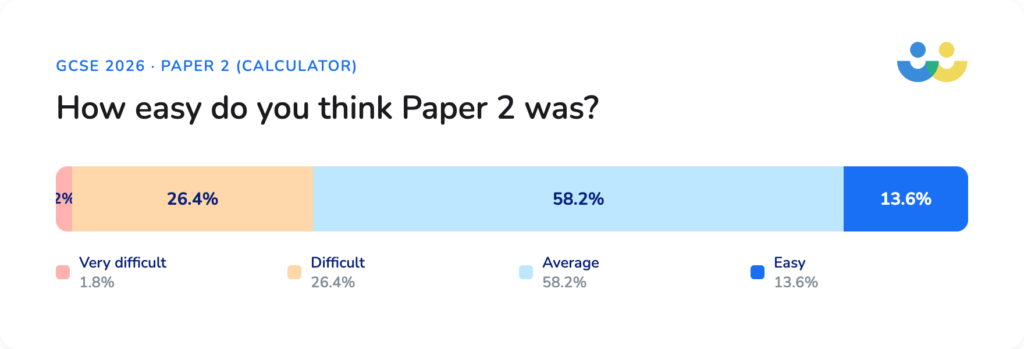
Paper 2 felt like a step up. The majority (58%) called it average, but the share finding it difficult climbed to 28%, while just 14% thought it easy. For some of you, the jump from an approachable Paper 1 to a meatier Paper 2 was the talking point of the whole series.
“Paper 2 felt broadly average in difficulty compared with recent years, with a balanced paper structure and no sections that significantly deviated from expectations.”
– Sam Lloyd-Clarke, Maths teacher, Lift New Rickstones, South East
“Students struggle with the first calculator paper.”
– Sarah King, Head of Maths, Holy Trinity C of E, South East
“Not as accessible to grade 5/6/7 students.”
– Maame Tenkorang, Maths teacher, Newport Girls’ High School, West Midlands
Paper 3: Calculator
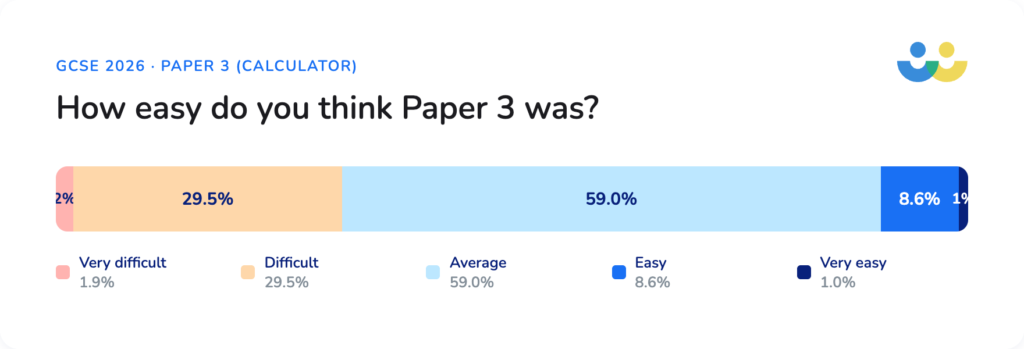
By Paper 3, demand was at its highest. Nearly six in ten (59%) rated it average, but just under a third (31%) found it difficult – the biggest “difficult” share of any paper – and only one in ten (10%) found it easy. Several of you put this down to the cumulative, problem-solving-heavy nature of the final paper, where students have to choose the method rather than simply apply it. With results day looming, plenty of you will be keeping a close eye on the grade boundaries.
“Pupils said this was the hardest exam.”
– Lauren Miles, Maths teacher, Lift Tamworth, West Midlands
“Higher students were disappointed, and foundation students all couldn’t complete the paper on time.”
– Bella, Head of Maths, Christ’s College Finchley, North West
Strong preparation, stubborn revision habits
Overall preparedness
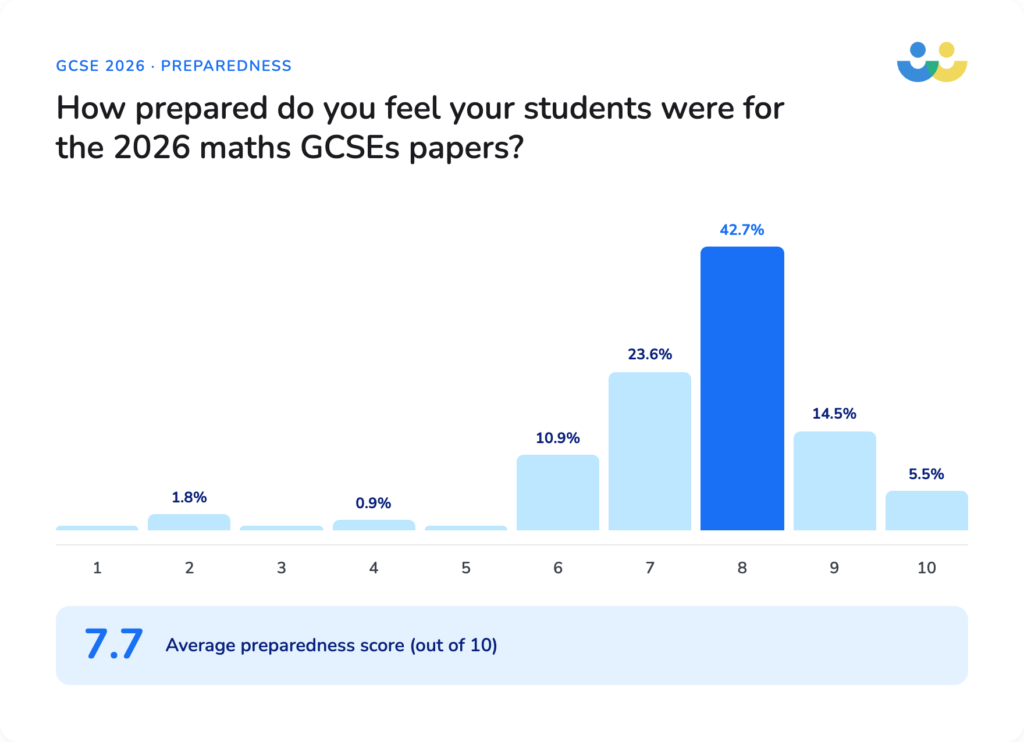
If there’s one thing this year’s survey makes clear, it’s how much work you put in. On average, you rated how well prepared your students were at 7.7 out of 10 – a strong vote of confidence in the teaching, intervention and sheer graft that went on behind the scenes.
And many of you went well beyond timetabled lessons: booster classes before and after school, lunchtime drop-ins, predicted-paper practice and walking-talking mocks all featured heavily in your answers.
If there was a shared frustration, it was the part you can’t control: getting students to revise independently. Time and again you told us the resources and sessions were there, but motivation outside the school gates was the missing piece.
“Resources from Third Space and AQA were really helpful.”
– Emma Donald, Maths teacher, Haybrook College, South East
“A lot still struggle to revise independently.”
– Helen Tyrrell, Maths teacher, Commonweal School, South West
“This cohort lacked aspiration and drive. They only wanted to settle for a grade rather than strive for a high one.”
– Head of Maths, North West
Content coverage
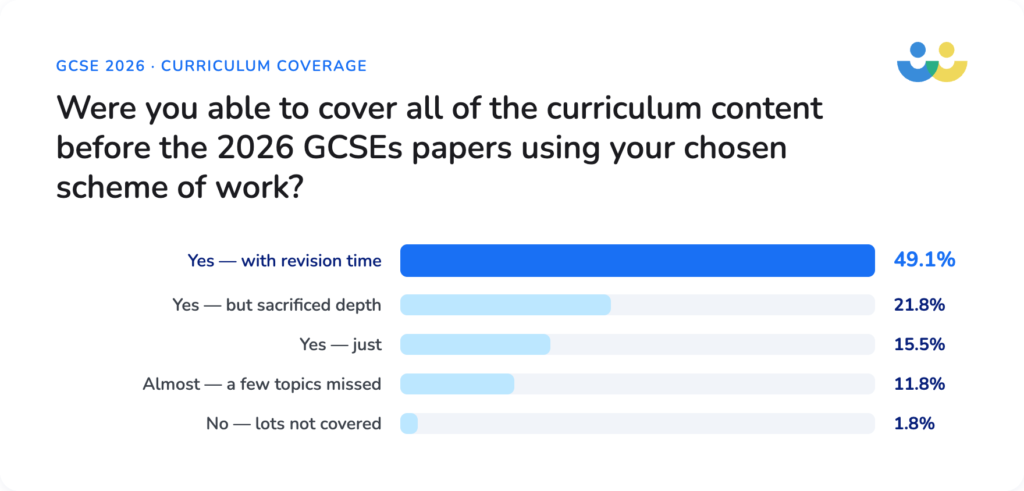
Encouragingly, most of you got through the curriculum with room to spare. Just under half (49%) had covered everything with plenty of time for revision, and once you add in those who finished ‘just’ in time or traded a little depth for coverage, around 86% made it through the full content before the exams.
Most followed their exam board’s scheme of work, with a handful using White Rose, Maths Genie or a bespoke scheme of their own – and whichever route you took, the vast majority of students reached the exams having seen the lot.
Tricky topics
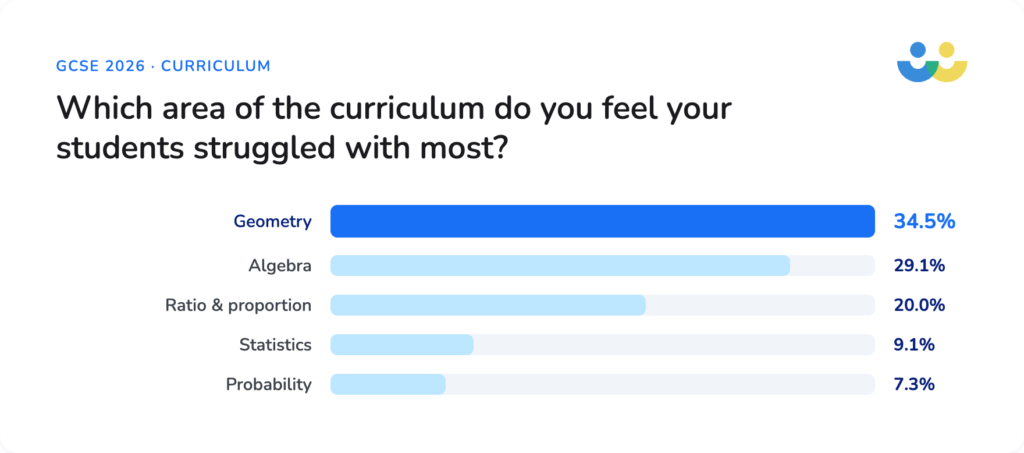
Covering a topic and cracking it, of course, aren’t the same thing. When we asked which area students struggled with most, Geometry came out on top (35%), followed by Algebra (29%) and Ratio and Proportion (20%), with Statistics and Probability some way back.
So why these topics? Two themes ran through your answers. The first is missing foundations – gaps that, for many, trace right back to Covid-disrupted primary years. The second is relevance: students who can’t see how a topic connects to the wider subject, or to real life, tend to find it much harder to hold on to.
“I still blame a loss of learning on COVID for the current Year 11s. The Year 6 SATs they missed and all the learning that went with it – those foundations were not there.”
– Natalie Delaney, Year 11 lead, Westborough High School, Yorkshire and Humber
“They did not like trigonometry and couldn’t see its relevance.”
– Diane Brown, Teaching Assistant, Hutton CE Grammar School, North West
“Students often struggle to retrieve prior knowledge, such as the formulae for areas of shapes, to help them form equations in geometric problem-solving questions.”
– Bob Kiabi, Head of Maths, Shirley High School Performing Arts College, Greater London
“Algebra tends to be a little weaker than the others due to the types of questions often asked on the exam papers, with a big reliance on numeracy.”
– Emma Taylor, Head of Maths, The Sir John Colfox Academy, South West
Maths GCSEs 2026: overcoming the challenges
Use of AI in GCSE preparation
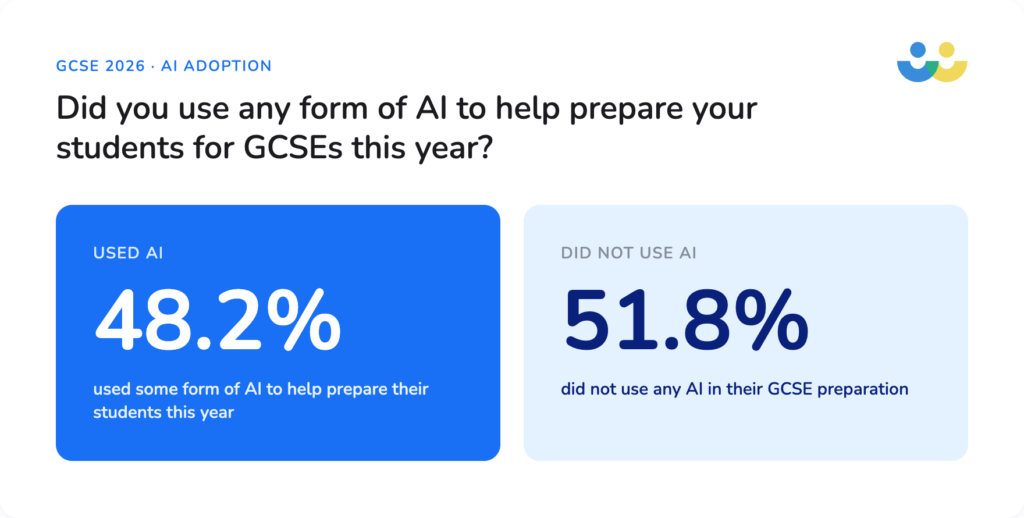
If one theme defined 2026, it was AI. Nearly half of you (48%) used some form of AI to help prepare students this year – close to double the share who said the same in 2025.
For most, it was a workload tool. By far the most common use was generating GCSE-style questions (79% of AI users), followed by curriculum-aligned questions (35%) and lesson planning (27%). And it’s clearly saving you time: 81% said AI had freed up at least some of their workload, with ChatGPT the most-named tool, just ahead of Gemini.
Not everyone is sold, though. Among those who steered clear, the most common reason was simply preferring not to rely on AI, followed by not having found a tool that fits, a lack of time to explore it, and a lack of confidence. A few of you also raised a real classroom worry: that AI makes it easier for students to mask gaps in their understanding rather than close them.
“Limitations – it still needed to be proof-read. Pros – fast resource development and clearly differentiated questions.”
– Ryan Brown, Maths teacher, Laurence Jackson School, North East
“I think learners will hide the gaps in their knowledge by using AI to answer questions while they do independent work.”
– Sim, Maths teacher, BMet Sutton, West Midlands
“It’s not quite good enough to do what I was hoping in terms of saving time. I’ve had to give quite a number of hours to learning it.”
– Maths teacher, South West
That tension – between AI’s potential and whether it’s genuinely good enough at maths – is one we know well. It’s exactly why we built Skye, our spoken AI maths tutor, with teachers and AI experts at every step.
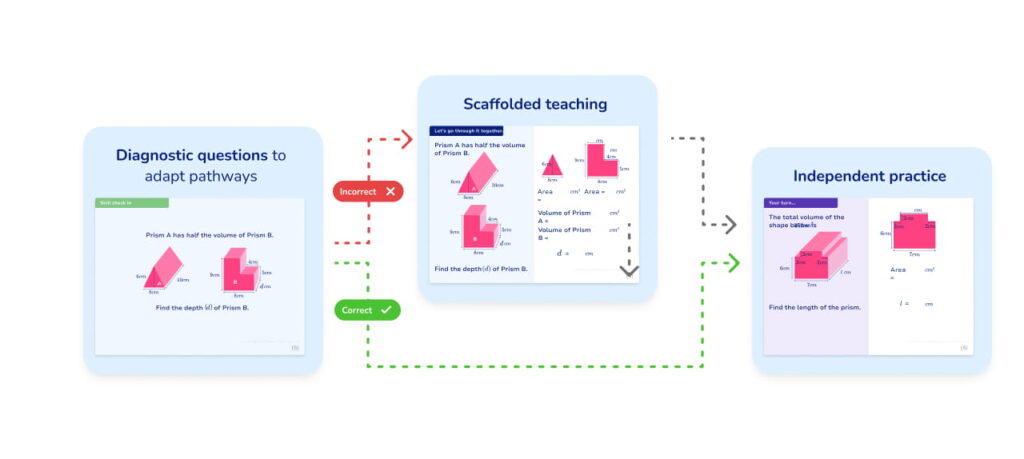
Rather than generating its own content, Skye works through a curriculum of lessons written by former teachers. Each session opens with a short Skill Check-In, a quick assessment that tells Skye what a pupil already knows. From there, the route adapts to their answers: revisiting prior learning where there are gaps, or moving straight on to independent practice and challenge questions where a pupil is secure. When a pupil gets something wrong, Skye offers up to two targeted hints before modelling the method, guiding rather than handing over the answer.
A Skill Check Out at the end then confirms what has actually stuck.
It’s a world away from asking a chatbot for the answer, and it’s why we’re confident that, used well, AI really can help students learn maths – but only with the right training, structure and safeguarding behind it.
Interested in how AI maths tutoring with Skye teaches maths to real students? You can try a free session for yourself.

Lasting impact of Covid-19
Six years on from the first lockdowns, Covid still casts a long shadow over this cohort. These are students who were in primary school when the doors closed, and many never sat their KS2 SATs – which made this summer’s GCSEs their first set of formal external exams.
That showed up in two ways in your responses.
- The first is academic: gaps in foundational knowledge that trace right back to those disrupted primary years.
- The second is behavioural – a cohort that, for some of you, found it harder to build exam stamina, revise independently, or fully grasp how much was riding on the summer.
“Cohort seemed more affected by COVID. Lack of motivation.”
– Lauren Binks, KS3 Coordinator, Macmillan Academy, North East
“Students seemed unaware of the level of work required – they seemed to think attending a one-hour revision session was enough.”
– Lauren Binks, KS3 Coordinator, Macmillan Academy, North East
Budgets and staffing
When it comes to budgets, 2026 tells a more reassuring story than 2025. For most of you – around 69% – school finances didn’t dent your GCSE preparation at all.
Where money did bite, it tended to show up in two places: resources and external support. Around 17% of you had to stop paying for resources and 12% reduced or stopped external tutoring, with a handful also trimming revision sessions or staff hours.
What stands out, though, is how you adapted. Rather than cutting back on students, you got creative: shifting timetables to free up maths staff for Year 11, swapping printed worksheets for on-screen resources, leaning on free materials, and – in more than one case – quietly dipping into your own pockets.
“I ended up having to spend my own money as I wanted the best for my class.”
– Miss Ray, Maths teacher, Oakwood, South East
“Reduced budget meant we couldn’t print past papers, so students completed them on paper in a computer room. We also didn’t subscribe to a website we normally use.”
– Maths teacher, North West
Effective tutoring: closing the maths attainment gap
2025/26 marked the second year schools have had to manage without any extra funding from the National Tutoring Programme (NTP). And yet, tutoring clearly hasn’t fallen by the wayside: Around 6 in 10 of you still provided some form of in-school maths tutoring for your Year 11s this year.
For most, that meant small-group sessions led by your own staff (around two-thirds of those who tutored), with one-to-one and external provision much rarer – unsurprising, given the budget and staffing realities we’ve already covered. Across all approaches, you rated the impact of that tutoring at a solid 7.4 out of 10.
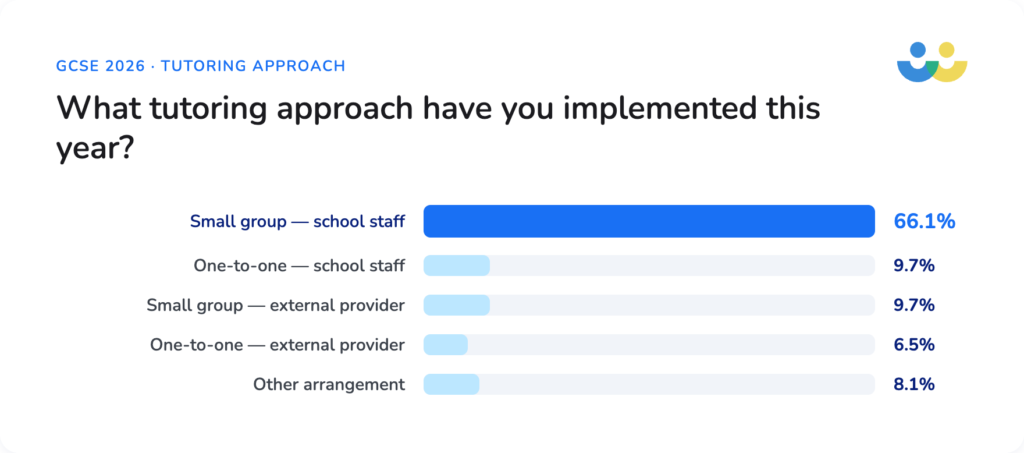
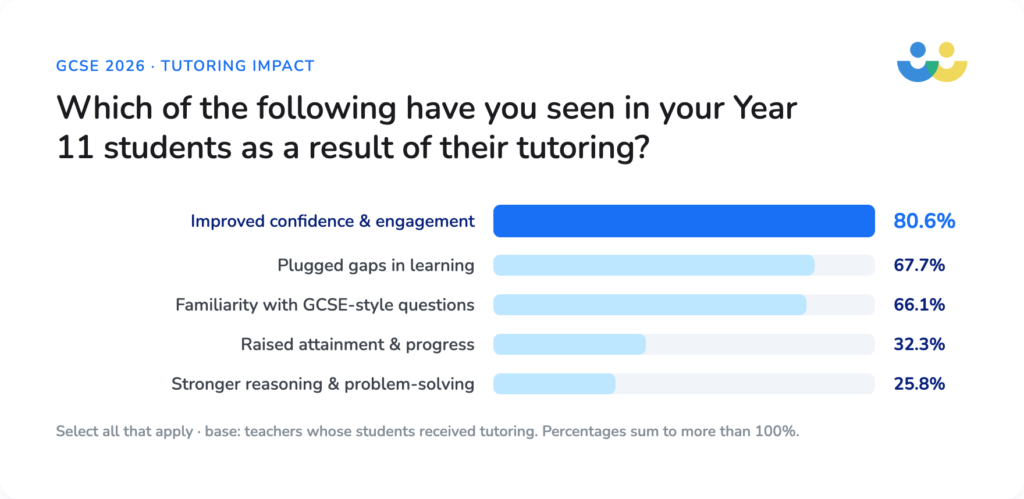
The benefits you saw were tangible, too. Improved confidence and engagement came out on top, closely followed by plugging gaps in learning and growing familiarity with GCSE-style questions, with a good number also pointing to raised attainment and stronger reasoning.
It’s exactly that kind of impact we built our tutoring to deliver.
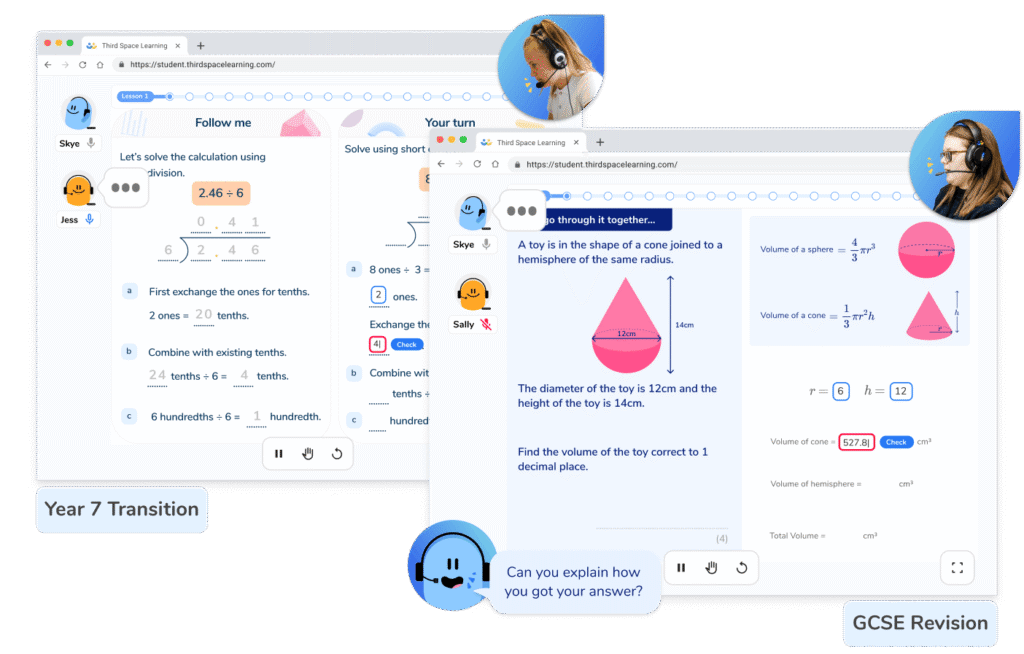
Schools also use online one-to-one tutoring from Third Space Learning to give their Year 11s extra, individual support, and the feedback was overwhelmingly positive: 100% of the schools that used it rated it effective. What teachers value most is the personalisation: every session is one to one, built around the specific gaps and misconceptions a student needs to close, at a pace that suits them.
That tutoring runs on a curriculum of lessons designed by former teachers, with each programme aligned to the GCSE grade a student is working towards. Sessions follow a clear “I do, we do, you do” structure, so students move from worked examples to guided practice to tackling questions independently – the kind of scaffolded, confidence-building support that’s hard to replicate at scale in a busy classroom.
“One of the biggest strengths is the personalisation. Tutors can focus closely on individual misconceptions and adapt explanations in real time, which is difficult in a busy classroom – particularly valuable for students not yet secure with core GCSE foundations.”
– Sam Lloyd-Clarke, Maths teacher, Lift New Rickstones, South East
“Helps them focus on their weaknesses.”
– Maame Tenkorang, Maths teacher, Newport Girls’ High School, West Midlands
The revision resources that earned their keep
Budgets may have trimmed what some schools could spend on paid materials, but free resources clearly picked up the slack. Almost all of you (96%) found Third Space Learning’s GCSE resources helpful in getting students ready for the summer, and 95% had dipped into them at some point across the year.
So, which earned their place in your revision toolkit? Past papers and worksheets topped the list, just ahead of exam questions, with revision mats and revision guides rounding out your top five.
You’ll find all of these – and plenty more – to download for free in our Secondary Resource Library:
- GCSE Past Papers: 40+ past papers for Edexcel, AQA and OCR
- GCSE Worksheets: topic-specific worksheets to help students prepare for their GCSEs
- GCSE Exam Questions: exam-style questions suitable for Edexcel, AQA and OCR
- Revision Mats: complete revision mats covering the key skills across the six topic areas
- Revision Guides: step-by-step guides, worked examples and practice questions
- Diagnostic Questions: multiple-choice questions to check key skills and surface misconceptions
- Maths Intervention Packs: detailed revision lessons on selected topics for GCSE grades 3–7
- Fluent in Five: five questions a day to sharpen key skills
- Revision PowerPoints: ready-to-use revision slides covering key GCSE topics
“The predicted papers and revision mats were very useful in narrowing down topics.”
– Lauren Miles, Maths teacher, Lift Tamworth, West Midlands
“Reliable and trustworthy quality.”
– Robert Jones, Head of Maths, Co-op Academy North Manchester, North West
“Revision mats are great and very engaging.”
– Maths teacher, East Midlands
Student wellbeing
Exams are stressful, and it’s clear from your responses just how much thought went into helping students through them. Wellbeing support ran right the way through the survey, from the practical to the genuinely creative.
For many, that meant extra revision sessions, masterclasses and lunchtime drop-ins for students who needed a confidence boost. Others leaned on pastoral systems, mentoring and regular check-ins to keep an eye on how students were coping. And a fair few went further still: breakfast wellbeing meetings, quiet spaces for reflection, early-morning sessions (toast included) and night-before catch-ups all featured.
If there was a frustration, it was a familiar one: getting students to actually turn up. More than one of you noted that the optional sessions were there, but attendance didn’t always follow.
“Maths staff were available every break and lunchtime in the lead-up to GCSEs. Early morning sessions (with toast) were provided before every exam.”
– Diane Brown, Teaching Assistant, Hutton CE Grammar School, North West
“Revision twice a week and drop-ins every day. Very low attendance to these.”
– Head of Maths, North West
“One member of the department offered online support one evening a week.”
– Elvis Rughoobeer, Head of Maths, Daubeney Academy, East Midlands
“There were well-being sessions for students who were most vulnerable in terms of well-being and exam stress.”
– Bob Kiabi, Head of Maths, Shirley High School Performing Arts College, Greater London
Looking ahead to maths GCSEs 2027: what you would do differently
The 2026 exams may have only just wrapped up, but plenty of you already have one eye on next year’s cohort. We asked what you’d do differently, and while there’s no single magic formula, a few clear themes came through. If now isn’t quite the moment, bookmark these for September.
Teacher impressions line up closely with the paper data – our analysis of all three 2026 papers sets out what appeared, what was missing and how the boundaries moved.
• Start early. Whether it’s interventions, exam practice or covering the high-tariff topics, the message was to begin sooner rather than leaving it to the spring term.
• Build in regular exam exposure. Consistent past-paper and exam-style practice, woven across the whole year, came up again and again.
• Diagnose, then adapt. Regular diagnostic assessment to spot gaps early and shape teaching around them.
• Get to grips with AI. Plenty of you see real potential in AI for next year – provided you can find the time and training to use it well.
“We used predicted papers and covered high-tariff topics again. Revision started in January and after-school revision was offered each week.”
– Ann, Maths teacher, Warden Park, South East
“We worked through loads of past papers. We even made up our own questions on different grade bounds, and looked at the harder questions from other exam boards.”
– Jay, Maths teacher, Fidelis College, Greater London
“Joined mid-year and felt there were some students who could have had specific interventions earlier.”
– Maths teacher, South East
If you’re keen to start maths interventions early – addressing gaps and building confidence through personalised one-to-one lessons – we’re already signing schools up for September 2026. You can learn more about our GCSE maths tutoring and how to keep tutoring going after the end of NTP funding.
Here’s to you, wonderful teachers and students
To every teacher, head of maths and member of school staff who took the time to share their experience with us – thank you. We couldn’t include every response, but we’ve read them all, and we’re grateful for each one.
It’s been a privilege to play a small part in your 2026 GCSE journey. Whether you’ve read our blogs, downloaded our free resources, or your students have learned with our tutoring, we hope you’ve felt supported along the way.
To the thousands of Year 11 students who sat their maths GCSEs this summer: the hard work is done, and we’re wishing you all the very best for results day. And to the teachers already turning their attention to next year’s cohort, we’ll be right here alongside you.
Before you switch off for the summer, don’t forget to download your free GCSE Starter Kit – a head start for your next Year 11 group.

DO YOU HAVE STUDENTS WHO NEED MORE SUPPORT IN MATHS?
Skye – our AI maths tutor built by teachers – gives students personalised one-to-one lessons that address learning gaps and build confidence.
Since 2013 we’ve taught over 2 million hours of maths lessons to more than 170,000 students to help them become fluent, able mathematicians.
Explore our AI maths tutoring or find out how our GCSE maths tutoring programmes could support students in your school.