


What’s Next? Analysis of 2026 GCSE Maths Paper 2 Topics With Recommended Revision List For GCSE Maths Paper 3

The final GCSE Maths exam paper of the series lands on Wednesday 10th June. With Paper 1 and Paper 2 behind them, Year 11s have one week to make their last bit of revision count. Edexcel Paper 2 has given teachers a clearer steer on where to focus that time.
In this blog, GCSE maths specialist Christine Norledge breaks down what came up on maths Paper 2 and what it suggests for Paper 3. The headline finding: Number content carried significantly more marks than usual, particularly at Higher, where the allocation was around double the typical level for a single paper.
This analysis covers the 2026 Edexcel Foundation and Higher Paper 2 only. It is not relevant to other exam boards including AQA, OCR or IGCSE, and focuses on GCSE mathematics rather than A Level. The recommendations are Christine’s own interpretation of Paper 2 and are not endorsed by Edexcel. The official question papers and GCSE maths mark schemes are yet to be released.
What Paper 2 told us
Two papers in, students and teachers are tired. The aim of this blog is not to add another long revision list to the pile, but to help you focus the final week: which topics now look most likely to appear on Paper 3, and which have already been covered in enough depth that they’re less of a priority.
Look at the other side of that data and a few notable gaps emerge. At Higher, simultaneous equations (usually a near-certainty across a GCSE series) haven’t shown up yet. At Foundation, there’s been no work on integer powers or laws of indices, and there’s been very little on speed, distance and time at either tier. Paper 3 is the last chance for these topics to be examined.
GCSE MATHS 2026: STAY UP TO DATE
Join our email list to stay up to date with the latest news, revision lists and resources for GCSE maths 2026. We’re analysing each paper during the course of the 2026 GCSEs in order to identify the key topic areas to focus on for your revision.
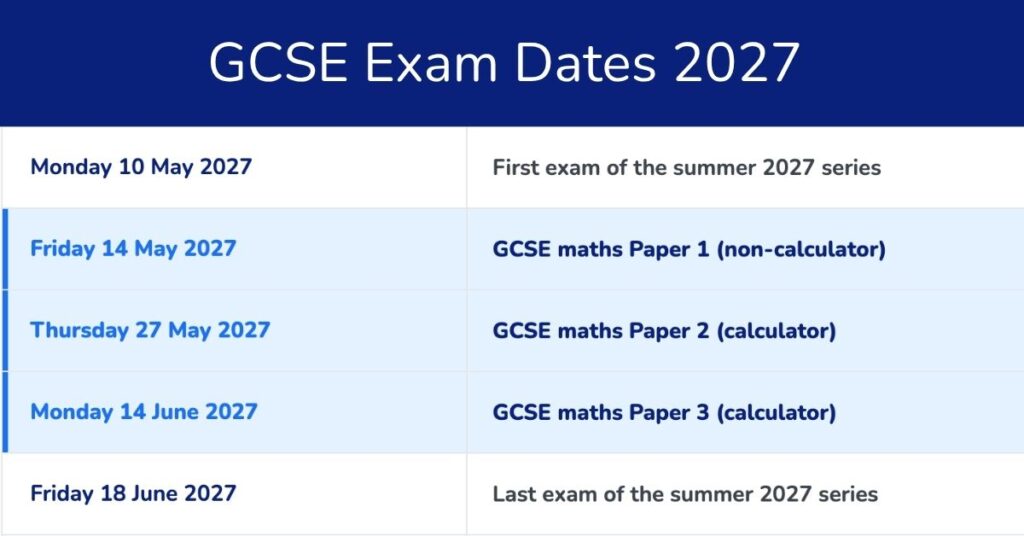
GCSE dates 2026
GCSE results 2026
Get ahead on revision with the GCSE maths papers analysis from 2026:
Analysis of GCSE Maths Paper 1 2026
Analysis of GCSE Maths Paper 2 2026
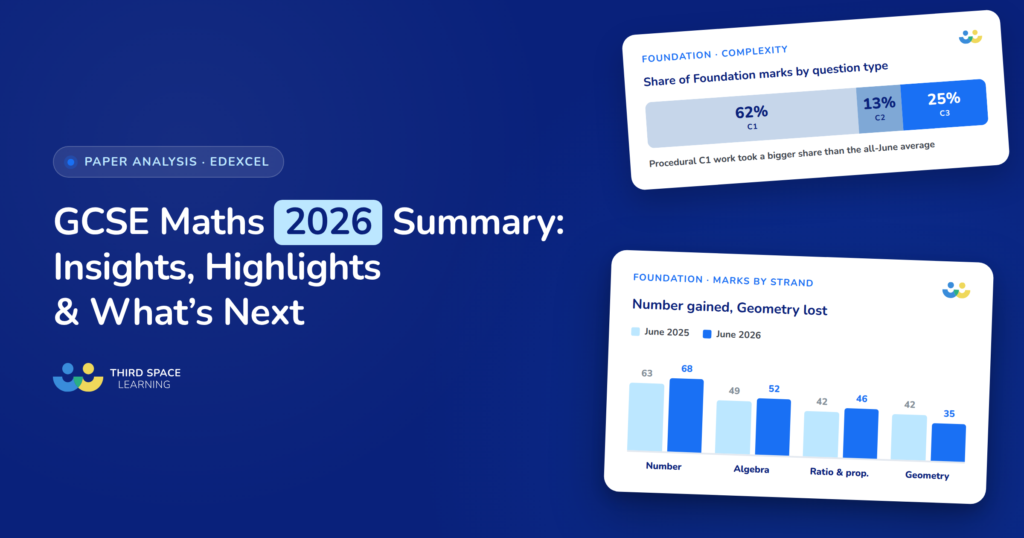
GCSE Maths Paper Analysis and Summary 2026
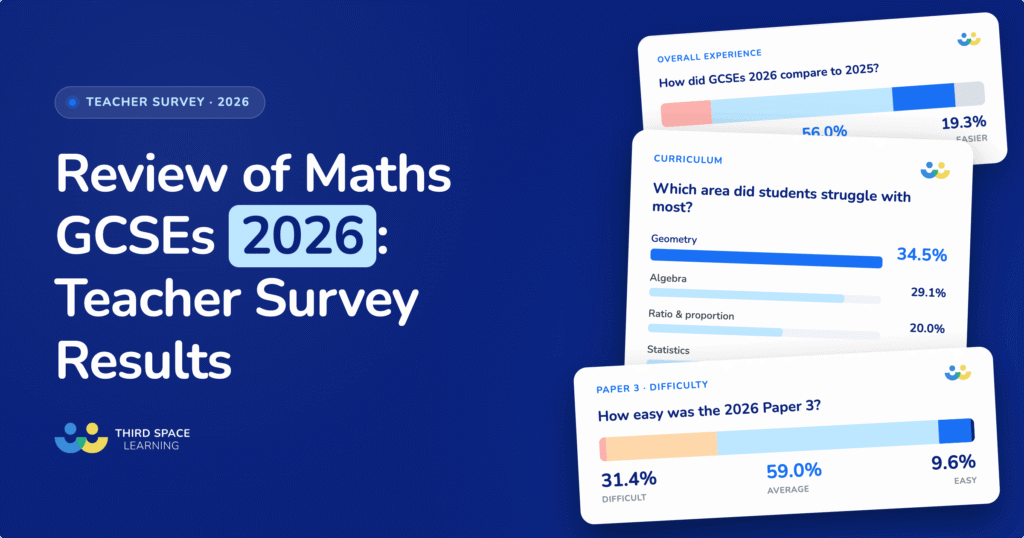
GCSE Maths Teacher Survey Results 2026
Edexcel revision focus lists for Foundation and Higher Paper 3
If you want to jump straight into the key revision areas for Edexcel GCSE Maths Paper 3, keep scrolling.
Or, you can download the lists with links to the relevant revision resources below:


GCSE Maths Revision List for Paper 3 (2026)
Revision lists for the Higher and Foundation Edexcel GCSE Maths paper 3 for 2026 with links to free GCSE maths revision resources.
Download Free Now!These are the Foundation and Higher topics that we recommend students prioritise first for Paper 3. They are suggested, non-exhaustive lists, not guaranteed predictions of what will appear on the final exam papers. Remember, any topic can still come up, regardless of whether it’s already been covered in Papers 1 or 2.
These lists are updated versions of our earlier GCSE Maths 2026 Paper 1 blog, adjusted to take Paper 2 content into account. Bold topics denote those that have a high likelihood of appearing on Paper 3.
Here are the key revision areas for GCSE Maths Paper 3. These are the topics I’d recommend students can answer questions on fluently before the next paper. Anything in bold is highly likely to appear.
List of priority Foundation tier maths paper 3 topics
These are the Foundation GCSE maths topics I’d recommend learners focus on answering practice papers on fluently before the next paper:
| Topic | |
| Number | Ordering integers or decimals Calculator use Factors and multiples Product of primes (HCF and LCM both on Paper 2) Listing and combinations Integer powers and laws of indices Place value FDP calculations Fraction and percentage representation Rounding |
| Algebra | Algebraic expressions Formulae including change of subject Laws of indices Equation of a line (use y = mx + c, perhaps in context) Parallel lines Identify non-linear graphs Solve linear equations Represent and solve linear inequalities |
| Ratio and Proportion | Compound measures with volume and surface area Distance- and speed-time graphs Proportion and other real-life graphs Ratio calculations Direct proportion |
| Geometry | Properties of circles Angle facts and properties (particularly problem-solving) Constructions and loci Transformations (likely rotation or translation by a vector) Congruence and similarity Measure lines and angles Perimeter and area of circles and part-circles Perimeter and area of compound shapes Pythagoras and trigonometry in RA triangles |
| Probability | Tree diagrams |
| Statistics | Data collection and sampling Bar chart or pie chart Stem and leaf plots Time-series data Frequency polygons Grouped data calculations |
List of priority topics for your Higher tier paper 3
These are the Higher GCSE maths topics I’d recommend learners focus on answering practice papers on fluently before the next paper:
| HIGHER | Topic |
| Number | Calculator use Product of primes (HCF and LCM both on Paper 2) Negative and fractional indices Surds (as proof or show that) FDP calculations Bounds, including calculation in context |
| Algebra | Substitution and formulae, particularly change of subject Factorise expressions including DOTS Higher laws of indices Algebraic proof Midpoint and length of a line segment Equation of a line (use y = mx + c, perhaps in context) Parallel and perpendicular lines Non-linear graphs, including quadratic, cubic and reciprocal graphs Graph and equation of a circle Solve linear equations/inequalities (probably in context) Simultaneous equations (linear and non-linear systems) Iteration Quadratic and geometric sequences, other non-linear sequences |
| Ratio and Proportion | Compound measures including speed Compound measures with volume and surface area Distance/speed time graphs Ratio (all skills, including split, combine, ratio and fraction links) Proportion equations, including squares, cubes and roots Percentage increase and decrease Reverse compound change |
| Geometry | Proof using properties of polygons Angle facts and properties (particularly problem-solving) Constructions and loci Transformations and invariance Congruent triangle proofs Perimeter and area of compound shapes Volume and surface area of compound 3D shapes, including frustums Pythagoras and trigonometry in context Further trigonometry (e.g. sine rule, cosine rule, area of triangle) |
| Probability | Sets and Venns Tree diagrams AND rule for independent events Solving probability problems using combined events |
| Statistics | Sample sizes Time-series dataFrequency polygons Cumulative frequency graphs Grouped data calculations including estimate the mean |

Please bear in mind that it is not possible to accurately predict the content of exams. Any lists given in this article should be viewed as suggested topics for revision focus and should not be used to narrow the spectrum of content revised. We recommend that students continue to cover the full syllabus in their revision for Papers 2 and 3.
How best to share revision recommendations
If you’re concerned that students might overinterpret these suggestions and prematurely narrow their revision, you could provide them in a different format – for example, as a booklet of past exam questions on selected topics.
Within the accompanying resource for this blog, you’ll find links to targeted maths revision materials, such as questions and worksheets for each of the key topics. This could be a good starting point for producing Paper 3 revision materials.

Free GCSE Maths Paper 3 revision bundle
To make it easier, we’ve already created a free Paper 3 revision bundle. You’ll find links to targeted GCSE Maths 2026 revision materials, including exam-style questions, worksheets and predicted papers for each of the key topics. This could be a handy starting point for Papers 3 revision materials.
You’ll find links to specific GCSE maths revision resources for everything you need for each of the hit list revision topics, including:
Topics tested in depth
The next two sections look at what was already tested in detail on the Foundation and Higher 2026 Edexcel GCSE maths Paper 2, and what’s now less likely to appear on the next paper.
Foundation paper
With the exception of Number, topic frequency on Foundation Paper 2 was broadly in line with the average across the previous six series. Number content was lighter than average on Paper 1, so as anticipated, this balance has been redressed on Paper 2. However, this variation remains within normal ranges and is not statistically significant.
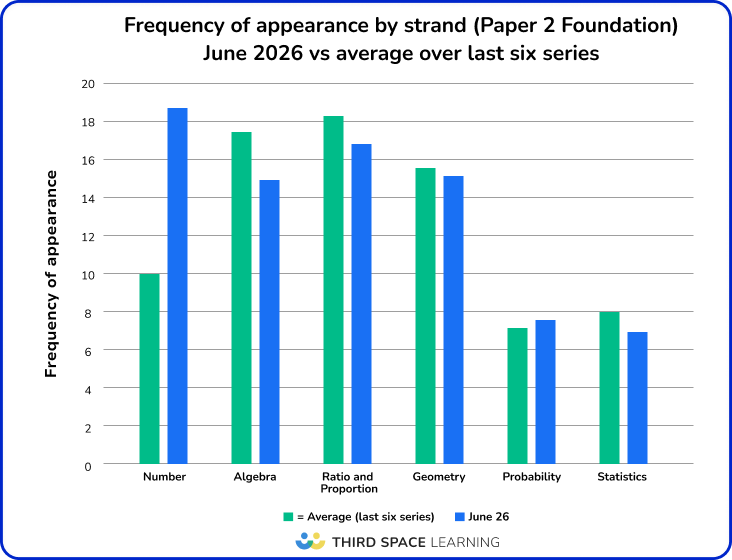
The following topics appeared on Foundation Paper 2 as main topics or in depth, and are therefore less likely to appear again on Paper 3:
- Simple percentages of amounts
- Round to integers (nearest 10)
- Identify cube number
- Multiply fractions
- Convert and compare FDP
- Compare and use equivalent fractions
- HCF and LCM
- Standard form conversion and calculation problem-solving
- Error intervals
- Function machines
- Find terms in a quadratic sequence
- Expand double brackets
- Solve linear equations with unknowns both sides (but could be in context)
- Find roots and estimate solutions from quadratic graph
- Context-based proportion
- Compound interest
- Identify angle using letter notation
- 3D shapes – faces, vertices and edges
- Simple transformations – find scale factor and reflection on grid
- Scale drawing and bearings
- Angles in polygons
- Draw vector on diagram
- Frequency trees
- Set notation with Venn diagrams
- Mean from list of data (simple)
- Pictogram
Higher paper
As for the Foundation paper, Higher Paper 2 featured a higher proportion of Number content than the six-series average, likely compensating for the lighter presence of Number on Higher Paper 1 this series. In fact, the allocation of marks to Number was around double the usual level. As a result, Algebra, Ratio & Proportion, and Geometry appeared less frequently on Higher Paper 2. While this isn’t statistically significant, it does suggest we may see a slight increase in Ratio & Proportion and Geometry on Paper 3, particularly as these areas were also relatively light on Paper 1.
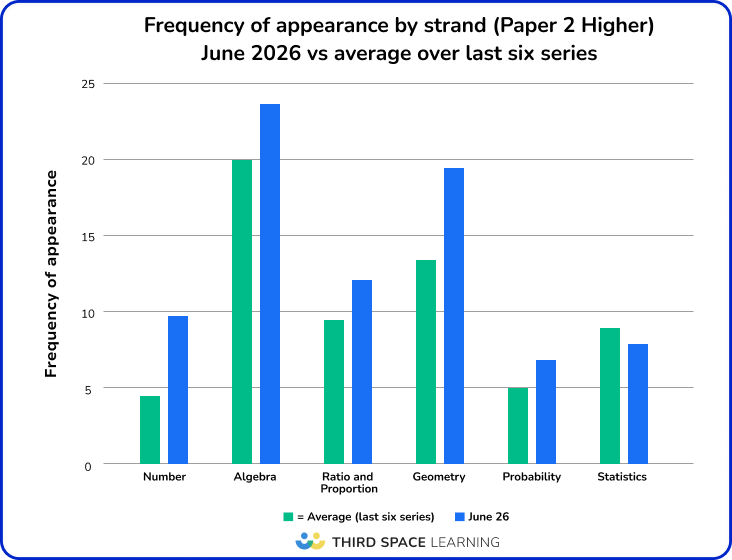
The following topics appeared on Higher Paper 2 as main topics or in depth, and are therefore less likely to appear again on Paper 3:
- HCF and LCM
- Standard form conversion and calculation problem-solving
- Error intervals
- Combinations
- Expand double brackets (simple)
- Solve linear equations with unknowns both sides (but could be in context)
- Solve double inequality
- Use the quadratic formula
- Calculate or estimate gradient or area (depreciation)
- Graph transformations
- Add and subtract algebraic fractions
- Functions (inverse and composite)
- Compound interest
- Pressure, force, area (problem-solving)
- Angles in polygons
- Arc length and area of sectors
- Vector problems using 2D shapes
- Pythagoras and trigonometry in 3D
- AND rule for independent events
- Draw box plot and compare distributions
- Capture-recapture
- Solve problems using mean
Topics likely to come up on Paper 3
We can’t be certain which topics will or won’t appear on the final paper in this series. However, gap analysis from the previous two papers, combined with patterns from previous series, suggests the topics below now have a higher probability of featuring on Paper 3. This information could help you to support your students in shaping an effective, focused revision plan.
Foundation papers
Number
So far in this series, there’s been little work on ordering integers (including negative numbers) or decimals. Paper 2 also didn’t include a calculator use question, and with rounding to simple cases so far, we might see a two-parter on this on Paper 3.
Beyond simple questions about squares and cubes, Foundation candidates haven’t answered any questions about integer powers or laws of indices (crossing over with Algebra), so this is another one to watch for Paper 3.
Although candidates have already been asked to work on context-based problems including money, these are favourites and are likely to appear again. There will probably be something more on FDP calculations as well.
Algebra
There are a few clear gaps in Algebra at Foundation. The linked topics of algebraic expressions (writing from contexts) and writing and using formulae stand out: one of these is likely to be examined on Paper 3.
Laws of indices are also untouched at Foundation. If they appear on Paper 3, expect an algebraic simplification rather than a number evaluation.
Although straight line graphs were on Paper 1, it’s a big topic that is often assessed on more than one paper. Students may see use of y = mx + c, perhaps in context, on Paper 3. This looks slightly less likely now that Foundation students dealt with quadratic graphs on Paper 2.
Ratio and Proportion
Ratio and proportion are both so wide-ranging that they’re assessed on multiple papers each year, so expect more on Paper 3. Proportion graphs (perhaps unit conversions) or similar real-life graphs are a likely angle. Neither tier has had much on speed, distance and time so far, which makes that another live possibility.
Geometry
Transformations has been assessed in a very straightforward manner, with only a simple grid reflection and finding a scale factor appearing on Paper 2. This means that we may see a graph-based transformation for candidates to carry out in Paper 3, possibly a translation using vector notation or a rotation.
Foundation students have had nothing yet on angle facts and reasoning (using angles in parallel lines or combinations of polygons), which makes this a likely candidate for a common question on Paper 3.
Probability
There has been quite a bit of focus on probability now on both Foundation papers, so we’ll probably see less of it on Paper 3. Big content gaps currently include two way tables and tree diagrams, or potentially a problem-solving question in combination with ratio or fractions.
Statistics
Students have had broad brush-strokes across a lot of the Statistics content at Foundation, and there are no major standouts for Paper 3. Grouped data calculations (estimate the mean is the classic) are a regular feature of Calculator papers. They didn’t appear on Paper 2, so they’re a strong bet for Paper 3.
Foundation candidates have encountered a pictogram, but they may see another simple chart (bar or pie), or perhaps one of the less-examined topics such as time-series data or frequency polygons. Stem and leaf featured on Higher but not on Foundation for Paper 2, so this may be another one to watch.
Higher papers
Number
Powers and indices are thin on the ground at Higher too, with only a two-mark simplification on Paper 1. Paper 3 is likely to revisit them, possibly with higher-only content such as fractional indices.
Candidates may have had a calculator use question in the common section of the paper, but this is less frequently assessed as a standalone topic at Higher level. More likely is something on bounds, particularly a context-based calculation.
Algebra
The biggest gap at Higher is simultaneous equations. It would be very unusual for this not to appear at all in a GCSE series, so it’s a strong bet for Paper 3, probably as two linear, or one linear and one quadratic.
Laws of indices may appear at Higher too, picking up the gap flagged in the Number section. Straight line graphs are another live area. Higher candidates haven’t had much yet, so Paper 3 could include y = mx + c in context, or problems involving parallel or perpendicular lines.
The final topic to watch is quadratic, geometric or Fibonacci sequences. Higher students have had linear sequences (two marks on Paper 1) but no non-linear work yet. Foundation students have already had a quadratic sequence substitution on Paper 2, which suggests Higher is due something similar.
Ratio and Proportion
Higher candidates can expect more ratio and proportion on Paper 3. Both topics are wide-ranging enough that they tend to appear across multiple papers in a series.
A complex compound measures problem closed out Paper 2, so further work in that area is now less likely. Speed, distance and time, however, has barely featured at Higher, which makes it a likely focus for Paper 3.
Geometry
Higher candidates have had nothing on transformations yet, which is unusual for a topic this broad. The same goes for sine and cosine rule in 2D shapes, which typically appears at least once across a GCSE series. Both are strong candidates for Paper 3.
Simple angle facts and reasoning (using angles in parallel lines or combinations of polygons) has barely featured at Higher either. This could appear as a common question on Paper 3.
Probability
Coverage of Probability so far has been mostly focused on lower-end topics; consequently, we’re likely to see more problem-solving using combined events on Paper 3, possibly in combination with fractions or ratios.
While Venn diagrams (specifically set notation) has appeared on Paper 2 for Foundation, Higher students haven’t seen this topic yet; if it appears, it is likely to be Higher-only, potentially involving conditional probability.
Statistics
Statistics coverage at Higher has been broad, with no major standouts for Paper 3. The common questions could feature grouped data calculations (estimate the mean) or frequency polygons.
The only stand-out Higher-only topic that hasn’t appeared yet is cumulative frequency graphs, which makes it a strong candidate for Paper 3.
Which topics have appeared on most Calculator papers so far?
These lists are an updated version of the ones appearing in the Paper 1 blog, with identical methodology used to identify frequently-assessed calculator topics.
The topics in these lists are either:
- Frequently examined topics with a high proportion (80%+) of appearances on the Calculator papers;
- Topics which have appeared on 75% or more of all series of live exam papers, either on Paper 2, or Paper 3, or both.
This would be a good list of topics to start with when collating a “general Calculator Paper” practice booklet.
Anything relevant to the June 2026 Paper 1 is noted in italics. Topics in bold are ones that have a very high likelihood of appearing on Paper 3.
Foundation paper
| Topic | |
| Number | Ordering numbers (integers or decimals) Money calculations, particularly shopping and budgeting Use a calculator accurately Find fractions of amounts (problem-solving on 1F) Factors and multiples (HCF and LCM on 2F) Integer powers Standard form (convert and calculate on 2F) Convert percentages (simple fraction to percentage on 1F) Error intervals (on 2F) Rounding (on 2F but briefly) |
| Algebra | Algebraic expressions Quadratic graphs (on 2F) Solve linear equations (context-based on 1F) Linear sequences, particularly finding terms (examined in depth on 1F) |
| Ratio and Proportion | Standard measures and unit conversions (simple conversions on 1F) Compound measures (speed on 1F) Ratio notation and calculations Direct proportion Compound interest and depreciation (CI on 2F) |
| Geometry | Angle facts and properties (naming angles on 2F) Transformations (on 2F, so 3F could be rotation or translation) Scale drawing and bearings (simple scale calculation on 1F) Volume and surface area, particularly cylinders and prisms (volume and surface area of cuboid on 1F) Pythagoras and trigonometry in RA triangles |
| Probability | Single-event probability (lots of probability on 1F already) Recording frequency of outcomes (frequency trees on 2F) |
| Statistics | Pictogram (on 2F), bar chart or pie chart Grouped data calculations |
Higher paper
| Topic | |
| Number | Standard form (convert and calculate on 2H) Errors and bounds (error intervals on 2H) |
| Algebra | Expand triple brackets (appeared on 1H) Algebraic fractions (minor appearance on 1H) Quadratic graphs Represent linear inequalities (appeared graphically on 1H) Quadratic and geometric sequences |
| Ratio and Proportion | Compound measures (complex PFA on 2F) Ratio calculations Compound interest and depreciation (CI and depreciation graph on 2F) |
| Geometry | Circle theorems (proof on 1H) Transformations Congruence and similarity (similar surface area/volumes on 1H) Perimeter and area of circles and part-circles (arc length and sector on 2H) Pythagoras and trigonometry in right-angled triangles (appeared 1H) Further trigonometry, particularly sine and cosine rule (3D problem on 2H) |
| Probability | Independent and dependent combined events (and rule on 2H) |
| Statistics | Histograms (appeared on 1H) Cumulative frequency graphs and box plots (box plots on 2H) |
What’s next for GCSE maths?
The date for the final GCSE Maths paper is Wednesday 10th June.
I’ll be back in August to bring you all the live news as students receive their GCSE results, and wrap this series coverage up in September with a detailed summary of all the June 2026 papers, looking at implications for the next round of exams.
Practical revision and exam tips
If, after the first two exams you think your students are still struggling with mapping out their revision effectively, then it’s also worth reviewing the guidance and resources available for them here:

DO YOU HAVE STUDENTS WHO NEED MORE SUPPORT IN MATHS?
Skye – our AI maths tutor built by teachers – gives students personalised one-to-one lessons that address learning gaps and build confidence.
Since 2013 we’ve taught over 2 million hours of maths lessons to more than 170,000 students to help them become fluent, able mathematicians.
Explore our AI maths tutoring or find out how our GCSE maths tutoring programmes could support students in your school.