
AI in schools: what’s really working in UK classrooms, and what isn’t

AI in schools is no longer a question of whether teachers will use it, but how and under what ground rules. Walk into almost any staffroom now, and you’ll find AI somewhere between the photocopier chat and the safeguarding briefing.
The official picture comes from the DfE. Its data for 2024 to 2025 shows 44% of teachers already using generative artificial intelligence (AI) for school activities, and they lean on it for planning and preparation far more than for live lessons or marking. Independent surveys point even higher. Twinkl’s 2025 poll of more than 10,000 teachers put adoption closer to 60%, with almost a quarter using AI daily, and the trend has only continued since. The National Education Union’s State of Education 2026 survey, which asked more than 9,000 teachers in February 2026, put everyday use at 76%, up from 53% the year before.
Frequent use is not the same as classroom use, though. Recent Teacher Tapp polling suggests only around one in five teachers turned to AI to plan their most recent lesson. The rules have lagged behind the habit. Around three quarters of teachers report no meaningful AI training, roughly half of schools still have no AI policy at all, and two thirds have no rules covering how pupils use AI.
That gap between reality and readiness is what this piece is about. How are UK schools actually using AI? What’s genuinely helping? Where is it already causing problems? And what rules of thumb, including the much discussed “30% rule”, can help teachers and school leaders keep pupils’ thinking, safety and integrity at the centre?
If you want the policy backdrop, read this alongside our sister article on DfE generative AI guidance. For a wider view of the education sector, see our AI in education hub.

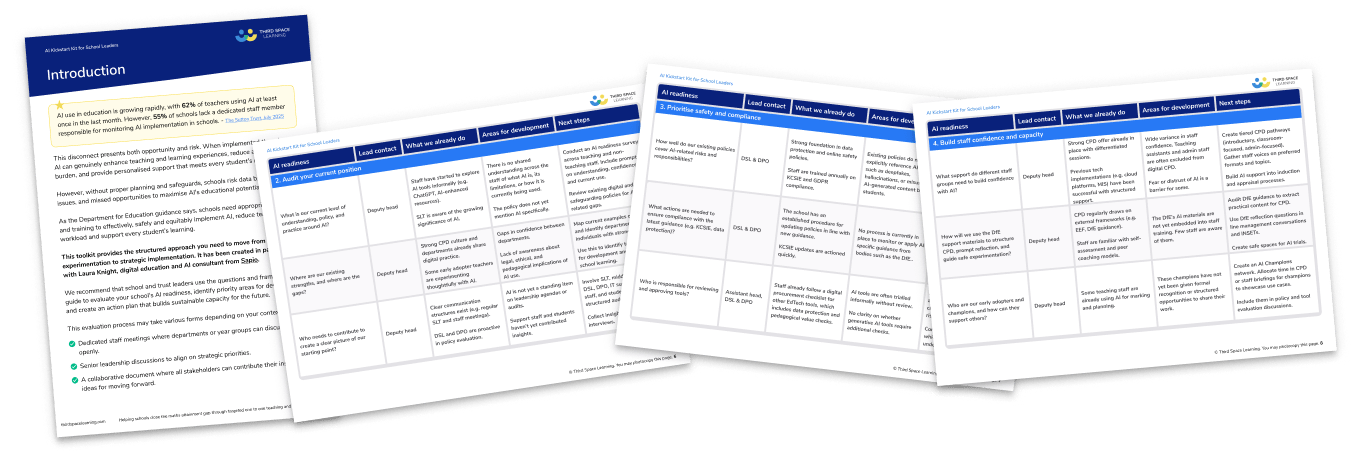
AI Kickstart Kit for School Leaders
A practical planning tool aligned with the DfE guidance on artificial intelligence. Covers the essential questions you need to ask when implementing new AI tools in your school and includes a completed and editable AI integration planning tool.
Download Free Now!How AI tools are being used in schools
Most UK teachers who use AI tools are not doing anything flashy. They’re using it for the two things schools never have enough of: time and content.
Planning and curriculum design
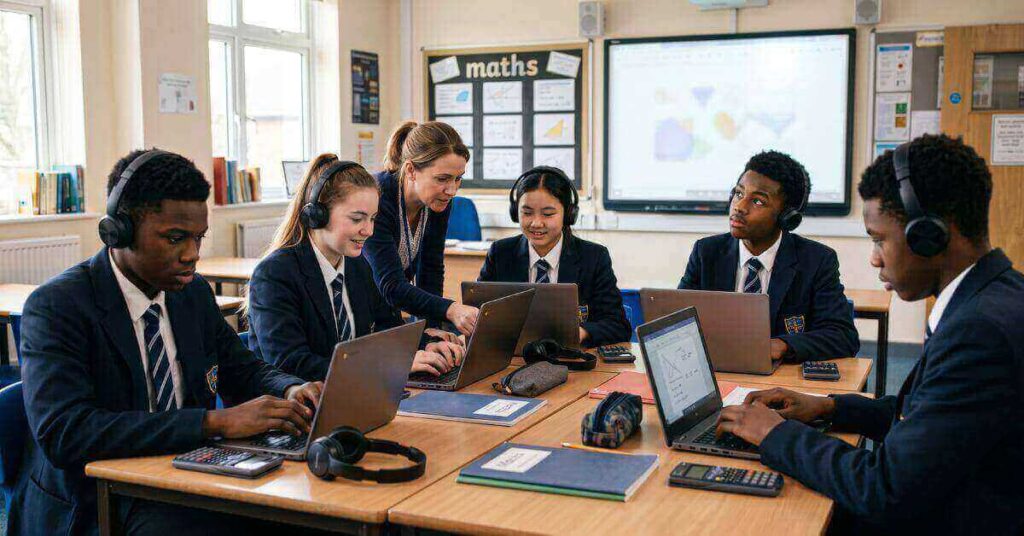
Across every survey, the most common use of generative artificial intelligence in schools is lesson planning and resource creation. Lesson planning is where most teachers first meet these AI tools, and it remains the stickiest habit. Teachers turn to general-purpose AI tools like ChatGPT, Copilot and Google Gemini, or education-specific ones like Oak National Academy’s Aila, to generate starter questions, retrieval quizzes and example explanations. Oak National Academy is one of a growing number of AI in education providers building tools around the curriculum rather than bolting AI on afterwards. They ask AI to suggest ways of introducing a tricky concept to different age groups, or to re-sequence a topic to avoid overload. And plenty use it as a sounding board when they’re stuck, brainstorming likely misconceptions or variations on a task they already know works.
Done with a critical eye, AI becomes a kind of tireless junior colleague: full of suggestions, sometimes wrong, never in charge.

READ MORE: AI teaching assistants
Resource creation and adaptive teaching
The second big use case is adapting rather than creating from scratch. Teachers use AI to adjust reading texts up or down in complexity, swap in different context examples, or produce simpler explanations of the same idea. It’s also being used to generate scaffolded versions of tasks for pupils who need more structure (sentence starters, writing frames, partially completed worked examples) and to translate or rephrase content for EAL learners.
Used this way, AI is less “write me a worksheet” and more “help me adapt this good learning material so more pupils can use it”.
Marking and feedback
Despite many vendors’ enthusiasm about AI marking your books, UK teachers are cautious here. The DfE technology survey found that only 5% of teachers used AI for marking, compared with 35% for planning and just 7% for delivering live lessons. Teachers tend to be more comfortable using AI to draft feedback comments which they then edit, rather than letting it mark work unsupervised.
There’s an emerging norm in practice: AI can help phrase or structure feedback, but professional judgement on grades and next steps stays with the teacher.
Administrative tasks, reports and communication
Many support staff and teachers use AI for administrative tasks, not teaching. AI is useful to automate tasks, such as summarising meeting notes for SLT or governors. Drafting letters to parents which are then tailored and checked. Turning bullet points into more polished policy text before a human edits it. Routine tasks like these are where the tools are at their least controversial. This is close to the DfE’s own examples of safe staff use: administrative drafting where adults stay firmly in control of content and decisions. It isn’t glamorous, but these everyday use cases keep control where it’s needed, while AI handles the repetitive tasks.
Personalised practice and tutoring
At pupil level, two patterns are emerging: informal use and structured use.
1. Informal use
Pupils use general-purpose generative AI tools for homework help, explanations and worked examples, often without teachers knowing. Surveys suggest most young people who use AI do so for ideas, understanding and homework support, alongside entertainment.
2. Structured use
Schools adopt specific platforms for practice, feedback or tutoring. The government’s Every Child Achieving and Thriving white paper explicitly backs AI tutoring tools for disadvantaged pupils, framing them as a way to scale one-to-one support without replacing teachers.
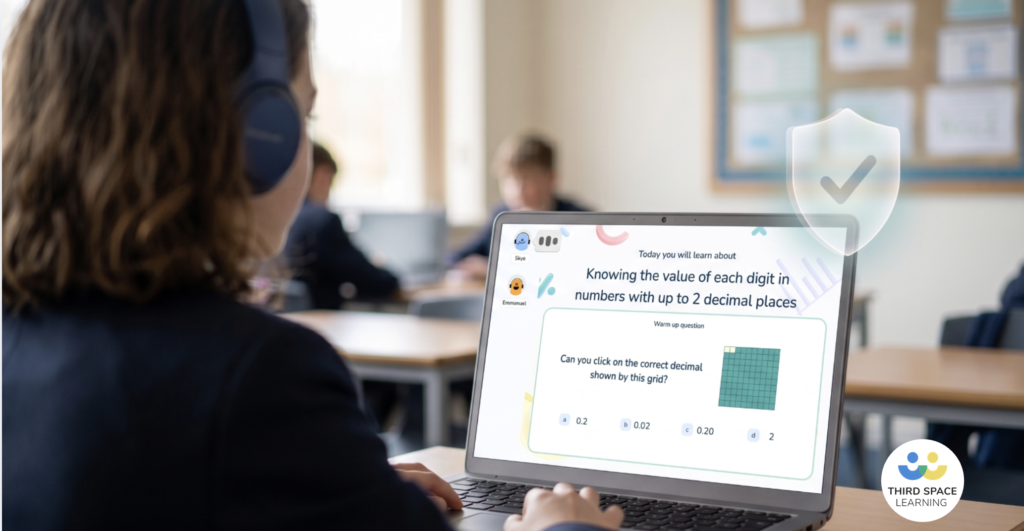
For example Third Space Learning’s spoken AI maths tutor Skye uses teacher-designed lessons to provide one-to-one practice at scale, with strict safety controls and DSL oversight.
Where AI works in educational settings
The evidence is still emerging, but several threads keep appearing across UK and international reviews.
Time saved on the right tasks
The clearest win is teacher workload, when AI is used thoughtfully. Reducing teacher workload is the outcome most school leaders point to first when they weigh up AI adoption. The EEF’s ChatGPT lesson-planning trial found a 31% reduction in planning and resource creation time (about 25 minutes per week on average) with no noticeable drop in lesson quality.
Twinkl’s 2025 survey and Teacher Tapp polling both suggest teachers’ main uses are planning, resources and admin, which are exactly the tasks you want to automate so teachers can spend more time on live teaching and feedback.
The time savings are not automatic, though. They appear when schools provide guardrails and training, such as:
- a short guide showing staff how to write better prompts,
- checking outputs, and
- avoiding doing tasks twice.
Better scaffolding and access
AI can be a genuinely useful tool for inclusion when used deliberately. Teachers report using it to adjust reading levels for struggling readers, create alternative examples and generate multiple practice questions targeted at specific misconceptions. Surveys of young people suggest this kind of tailored support helps them with ideas and understanding, and can build confidence where they’d otherwise be reluctant to ask for help.
Differentiation stays in the teacher’s hands. What AI adds is speed, making high-quality scaffolds and variants quicker to produce, which matters most in large classes with complex needs.
Personalisation at scale, with caveats
Systematic reviews of AI tutoring tools tend to agree. On average they improve learning, and the effect shows up most clearly in structured subjects like maths, though the wider evidence still places them below the best one-to-one tutoring.
England has its own evidence too. The Education Endowment Foundation’s 2026 evaluation of Maths-Whizz, an adaptive tutoring system, ran across 63 primary schools and found pupils made an extra month’s progress in maths on average. For disadvantaged pupils, that rose to two months. Even so, it falls short of the gains from the best one-to-one human tutoring. The white paper has a different gap in mind. It positions AI tutoring as a way to bring one-to-one style support to the pupils least likely to get a human tutor.
The caveat is that design matters. Tools grounded in good pedagogy and curriculum, with clear learning goals and teacher oversight, perform better than generic chatbots asked to “tutor” on anything.
AI concerns in the education sector
If this were only a story about time saved and personalised support, it would be a simple one. It isn’t. Several serious concerns show up again and again in the data.
Over-reliance and cognitive offloading
The DfE’s product safety standards explicitly warn against cognitive offloading and deskilling. Tools that just give answers, rather than supporting the learning process, are now classed as a risk to cognitive development, and UK surveys back this up. National Literacy Trust research found that about one in four 13 to 18 year olds who used generative AI for literacy activities said they usually just copied what AI told them, and fewer than half said they routinely check whether its outputs are accurate. Oxford University Press’s report on the “AI-native generation” found that many students worry AI encourages copying over original work and makes it harder to know what’s accurate. In the NEU’s 2026 survey, 66% of secondary teachers felt pupils’ critical thinking had declined because of AI, compared with 28% of primary teachers.
The risk is that AI quietly becomes the default first brain, especially for older pupils under pressure.
Hallucination, bias and misinformation
While Generative AI models are generally improving, they can produce fluent nonsense, fabricate sources and reproduce stereotypes in ways that are hard for young people to spot. Over half of 13 to 18 year olds in OUP’s study worried that AI resources may be biased or reinforce untrue stereotypes, and both UNESCO and the OECD warn that AI adoption in education is outpacing policy and critical-literacy skills, which makes it easier for misinformation to creep into teaching and learning.
For schools, this means AI use has to be paired with explicit critical-thinking and source-checking routines. It cannot be treated as a magic answer box.
Academic integrity and cheating
Higher education is a useful early warning here. The HEPI/Kortext student survey found that 88% of UK undergraduates used generative AI for assessments in 2025, up from 53% the year before, and by 2026 the share pasting AI-generated text directly into assessed work had risen to 12%, from just 3% two years earlier. School-age data is thinner, but qualitative reports from teachers and pupils tell similar stories: AI used secretly for essays, homework that suddenly sounds too polished, and group work dominated by the one pupil willing to paste prompts into a chatbot.
AI detectors have not solved this. They are fallible, biased against certain writing styles, and unreliable as evidence on their own, which is why universities and exam boards warn against leaning on them as sole proof. The most valuable free tool we recommend here is the Wikipedia page on signs of AI writing.
Safeguarding and harmful content
The safeguarding risks associated with AI tools are no longer hypothetical. The Internet Watch Foundation found 3,440 AI-generated child sexual abuse videos in 2025, up from just 13 the year before, and 65% were in the most severe category. A Teacher Tapp poll for The Guardian in December 2025 found about one in ten secondary teachers knew of pupils at their school making sexually explicit deepfakes, often involving younger pupils.
The DfE’s product safety standards now treat manipulation, mental health impacts and emotional or social risks as equal to content and data risks, and require tools to detect distress signals and route concerns to human help via the DSL.
The training and policy gap
Perhaps the most fixable problem is the one underneath all the others: staff training and school policy. Twinkl’s 2025 survey found 76% of UK teachers had not had any meaningful AI training or guidance from their school, and only 19% felt AI was sufficiently regulated. The NEU’s 2026 State of Education: AI report found that half of schools (49%) have no AI policy for staff or students, and two thirds (66%) have no policy specific to pupil use. The union warns of “an institutional stasis that is not keeping up with changing trends”.
In other words, AI use is already widespread, but the guardrails are mostly informal, stitched together by individual teachers trying to do the right thing.
The 30% rule for generative AI usage: a helpful myth, if you handle it carefully
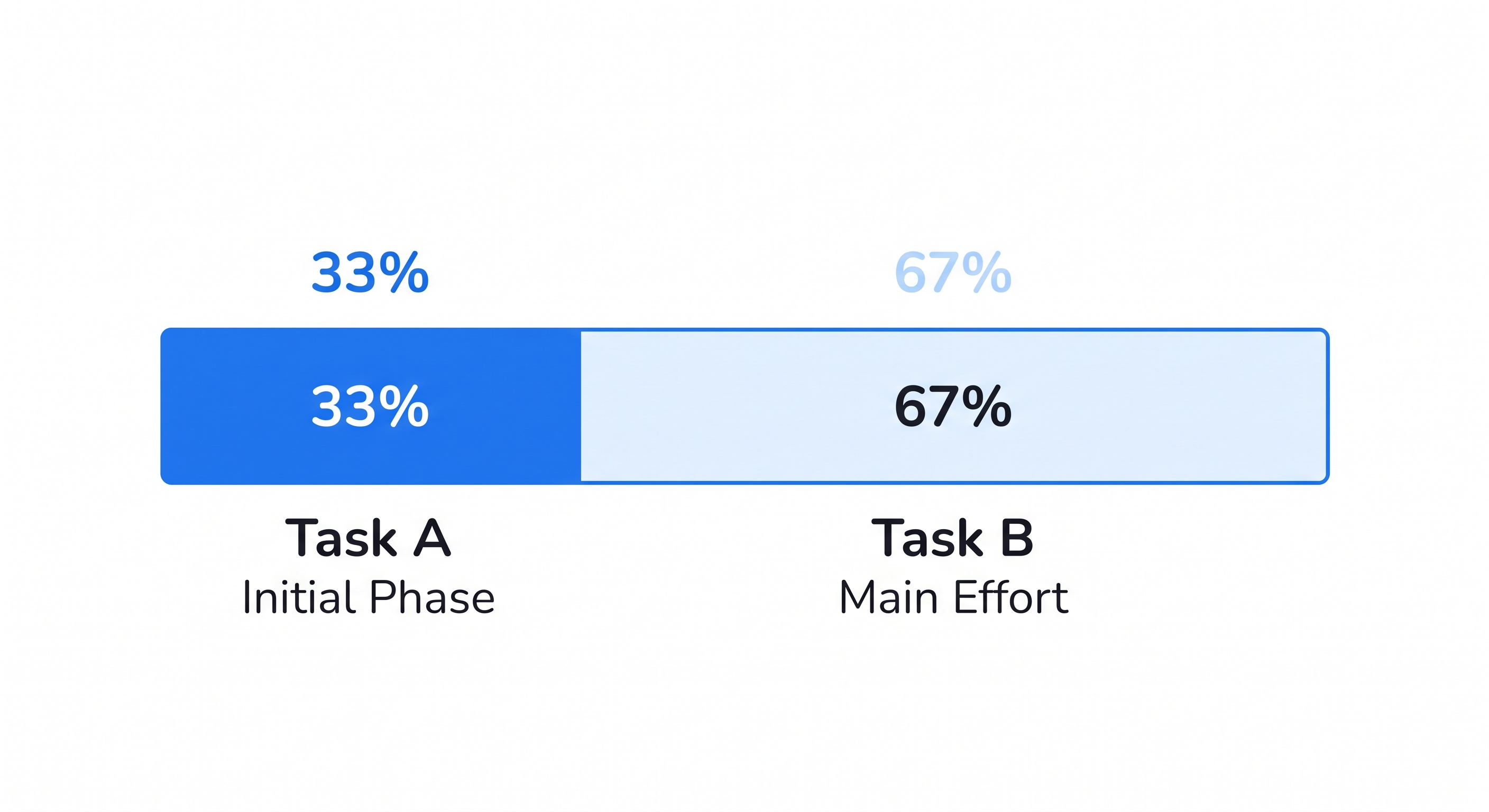
You’ll increasingly hear talk of a “30% rule” for AI in education: the idea that AI should only ever do about 30% of the work on a task, with the rest coming from the pupil or teacher. It surfaces in staffrooms and CPD sessions rather than policy documents, and it’s worth being clear about what it isn’t. There is no line in DfE guidance, no Ofqual rule, no exam board handbook that says 30% AI is fine and 31% is not. The number is simply a metaphor, not a measuring jug. It exists to prompt a conversation about balance and ownership, not to magic away the hard questions about judgement, context and integrity.
Used in that spirit, the rule is genuinely useful. AI helping with the setup of a task (some question stems, a suggested structure, a model paragraph to pick apart with the class) is very different from a pupil feeding the question into a chatbot and tidying the punctuation on what comes back. If the rule is helpful in your school, let it open up questions with staff and pupils: which bit of this task should be AI-free? Where do we most need your own voice? Just don’t let it harden into folklore that 29.9% AI is automatically acceptable. The real test is simpler and more demanding: could this pupil still do the intellectual heavy lifting if the AI vanished tomorrow?
Giving teachers a run for their money: will AI technologies replace the workforce in schools?
The question of whether AI will replace teachers keeps coming up in headlines and staffroom debates, so it’s worth answering plainly: no, and the government’s own policy now says so.
The Every Child Achieving and Thriving schools white paper is explicit that simply using general-purpose AI in education often has negative outcomes, because it tends to give answers rather than helping children learn and build their cognition. There are “promising signs” for well-designed tools built for education and rooted in good pedagogy, but these are framed as supports, not replacements. AI tutoring tools for secondary pupils are to be co-designed with teachers and industry, tested in schools, and used to complement high-quality face-to-face teaching rather than replace it.
International reports say much the same. Both the OECD and UNESCO argue for teacher-centred AI: systems built to support teachers, giving them better information and automating low-value tasks, while leaving human professionals in charge of relationships, motivation, pastoral care and professional judgement. The most useful AI technologies here are the ones designed to support staff rather than sideline them.
In practice, there are tasks AI can and should take over. First-drafting a letter or policy that a leader will edit. Generating practice questions for a concept the teacher already understands deeply. Summarising assessment data or highlighting pupils who might need more support. But the actual work of teaching (diagnosing misconceptions in the moment, handling behaviour, noticing when a child is not quite themselves, motivating a bored class, weaving curriculum across years and subjects) is nowhere near automatable at system scale.
Primary vs secondary: different pressures, similar themes
The broad patterns are similar across primary and secondary schools. Teachers reach for AI first for planning, admin and resources. But the pressure points differ.
Primary teachers are more likely to be using AI quietly for planning, differentiation and admin, and less likely to let pupils interact directly with AI tools. Concerns at this phase centre on age-appropriateness, safeguarding, and the risk of shortcutting early literacy and numeracy practice.
Secondary staff are more exposed to pupil-driven AI use for homework and assessments. They are more likely to report worries about cheating, loss of critical thinking, and essays that no longer sound like the pupil. The NEU’s 2026 survey shows the sharpest concern about AI’s impact on critical thinking sits in secondary, not primary.
The result is that secondary schools feel most of the assessment and integrity pressure, while primaries feel more of the safeguarding and curriculum-foundation pressure.
Personalised learning and tutoring at scale: Skye as a worked example
Within the bigger AI picture, AI tutoring is where policy ambition and classroom reality collide most directly. Third Space Learning’s AI maths tutor Skye is one example of what that can look like when it’s built from the ground up for schools: one-to-one maths support delivered at scale, aimed squarely at the pupils least likely to access one-to-one support.
Skye is a spoken AI maths tutor that delivers high-impact one-to-one tutoring sessions using lessons designed by expert maths teachers. Pupils talk and listen as it guides them through problems, working from a shared interactive classroom of pre-approved, teacher-written content. The AI is the delivery mechanism, not the curriculum designer, and that is the point: Skye has no access to the wider internet and cannot generate anything beyond the lessons it has been given.
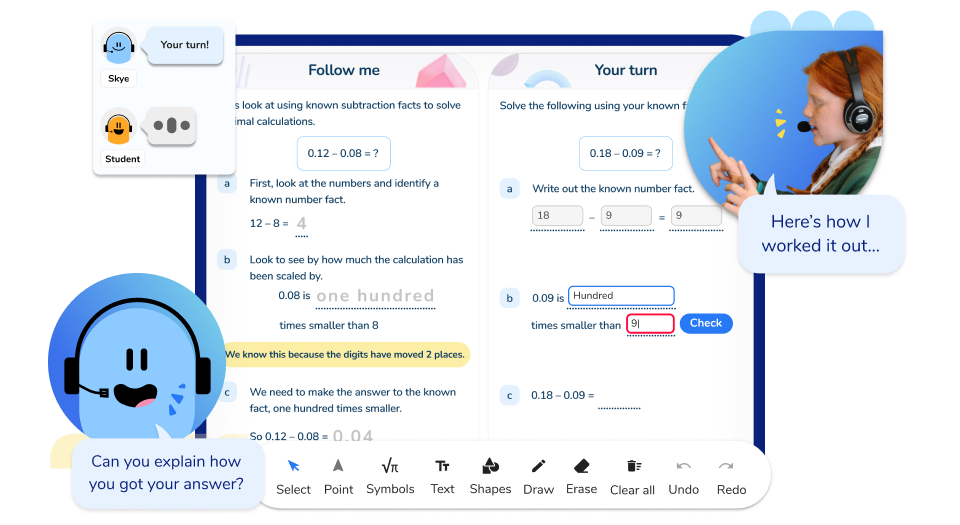
The early evidence is encouraging. An independent evaluation by Educate Ventures Research, drawing on data from 9,320 Skye sessions, found pupils answered just 34% of diagnostic “check-in” questions correctly at the start of a session but 92% by the check-out questions, consistent with meaningful within-session learning and consolidation. Confidence moved the same way, with 59.4% of pupils ending sessions more confident and 66% showing session-on-session confidence gains over time. Two groups benefited most: anxious or quiet pupils who hesitate to ask for help in class, and those who needed immediate consolidation after teaching.
The guardrails are built in rather than bolted on. All sessions are recorded and transcribed, with concerns flagged for a person to review rather than judged by the AI, and routed via the school’s DSL, in line with KCSIE and the DfE’s product safety standards. The tool is hosted on AWS in the UK and EU, with Third Space Learning as data processor and the school as data controller, which keeps responsibilities for student data clear under UK GDPR and the ICO Children’s code. Getting this right from the start is what lets school leaders adopt tools like Skye with confidence.
For all that promise, the company is careful not to over-claim on long-term attainment without controlled trials, and that caution is itself instructive. The most promising AI in schools is narrow, structured, curriculum-aligned and teacher-shaped, not a general-purpose chatbot let loose on everything.
Getting unstuck: adopting AI safely in your school
Adopting AI in schools does not have to be all-or-nothing. If your school feels stuck in the gap between teacher experimentation and whole-school strategy, a simple way to start using AI safely is to work in three steps.
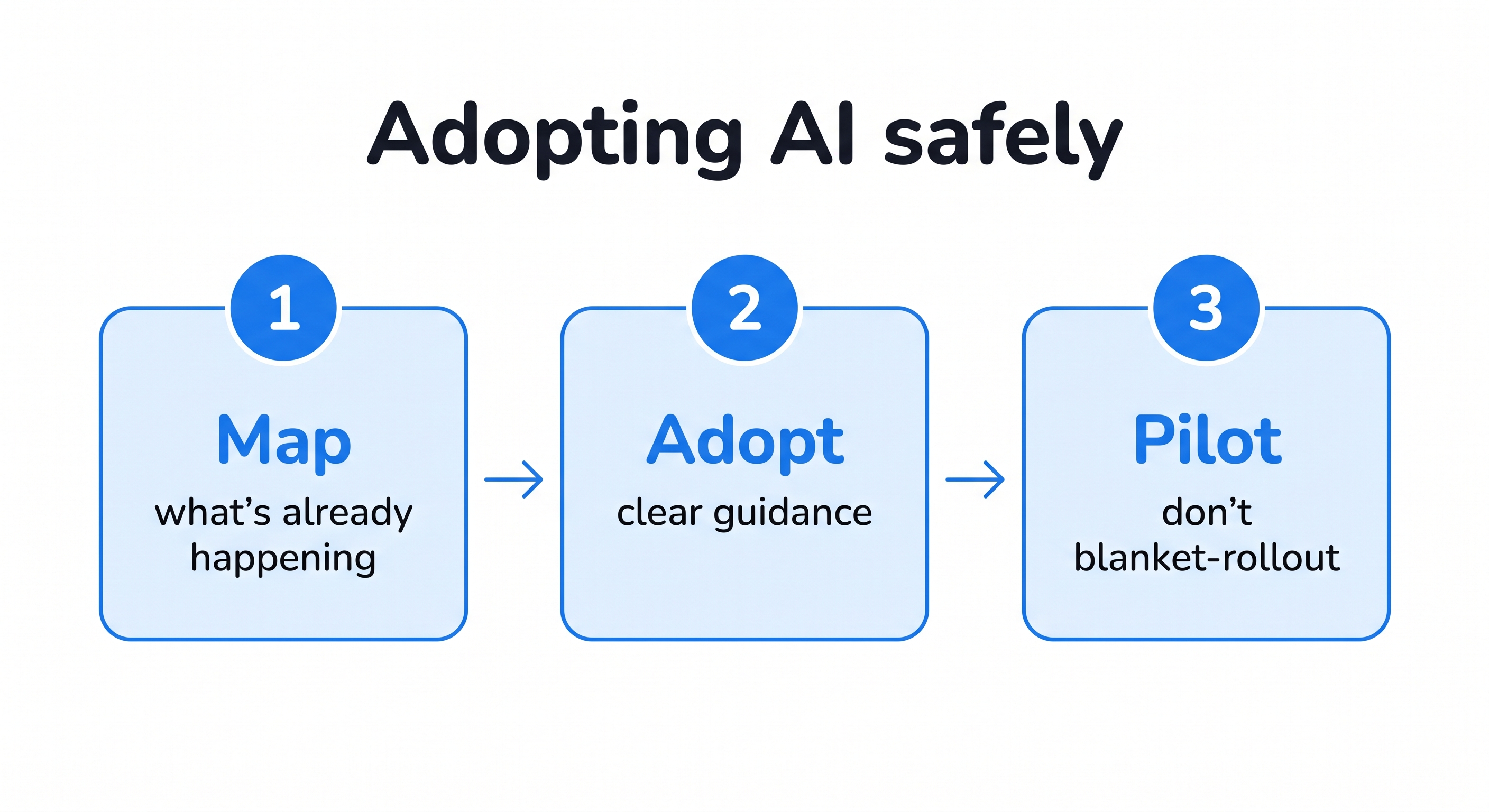
Map what’s already happening
Ask staff where they already use AI, whether that’s planning, resources, admin, tutoring or the MIS. Ask pupils how they’re using AI for schoolwork at home. Put it all on one page and call it your current reality.
Adopt clear guidance
Use the DfE’s Generative AI: product safety standards as your checklist for any pupil-facing tools, and use the Using AI in education settings support materials to build a basic staff CPD sequence, starting with the module on safe use. Check the age restrictions on any general-purpose tools pupils might reach for, and update homework policies so pupils and parents know what’s allowed. Agree classroom-level rules of thumb like the 30% rule, but label them clearly as your school’s guidelines rather than official thresholds.
Pilot, don’t blanket-rollout
Choose one or two low-risk, high-benefit staff use cases (planning and admin are the obvious ones) and one carefully chosen pupil use case, such as structured maths practice. Then evaluate them explicitly. Does this save time? Do pupils learn more, or better? Does it create new safeguarding issues, or widen the digital divide? Adjust, extend or stop based on evidence rather than marketing, as you would with any other educational technology.
Access great support
If you’d like structured support with all of this, it’s well worth looking at the Good Future Foundation’s AI Quality Mark. It’s a self-assessment framework written by senior school leaders and reviewed by AI specialists, covering leadership, curriculum, professional development and safeguarding, with Bronze, Silver and Gold awards moderated by the foundation’s assessors. Crucially, it’s free for schools, and even without going for accreditation the framework is a genuinely useful audit tool for working out where your school sits and what to tackle next. Well over a hundred schools and trusts including international schools have already been through the process, so there’s a growing community to learn from too.
DfE generative AI guidance provides a deep dive into the official guidance behind these guardrails.
AI in schools FAQs
Most teachers use AI for planning, resource creation and admin, with smaller but growing use in marking support and structured tutoring tools. The key is keeping teachers in charge of decisions and pupils in charge of thinking.
It’s an informal classroom guideline that AI should handle roughly 30% of a task, usually the repetitive drafting or idea generation, while at least 70% remains the pupil’s own thinking and human judgement. It is not an official DfE or exam board limit.
The main issues are over-reliance and copying, hallucination and bias, academic integrity worries, new safeguarding risks like deepfakes, and a large training and policy gap that leaves staff improvising.
No, AI will not replace teachers. Policy and evidence both point to AI as a support for teachers, automating low-value tasks and enabling more targeted support, rather than a replacement for the relational, pastoral and complex instructional work that human teachers do.