

Screen Time in Schools: What the Evidence Says

If a parent stops you at the classroom door this week to ask how much screen time at school their child is getting, there’s a good chance they have seen the news. On 12 October 2026 more than 150 clinicians wrote to the Education Secretary, Lucy Powell, and the Health Secretary, Yvette Cooper, about screen time in schools, and the story was on the BBC and LBC the next morning. One primary head told us that parents ask about screen time even when the screen is showing a maths PowerPoint.
Third Space Learning is an EdTech company, and pupils being taught by our AI maths tutor, Skye, have lessons via a screen.
For parents who are trying to cut their children’s screen time, educational or not, even the term “educational technology” can be off-putting.
We’ve worked with 4,200 schools since 2013, and in that time we’ve had to think hard about when time on a screen is worth it for a child and when it isn’t. This guide sets out what researchers have found and how screen use for learning differs from screen use for leisure. It then gives you two questions to ask of any screen-based activity, and finishes with wording you can share with parents.
Key takeaways
- There is no official UK screen time limit for school-age children, and guidance for 5 to 16-year-olds is due this autumn.
- Most KS2 pupils spend little time on computers or tablets in school, according to teachers surveyed by Teacher Tapp in June 2026. Across OECD countries, 15-year-olds in PISA 2025 reported 1.7 hours a day on devices for learning at school.
- In both phases, you can judge any screen activity with two questions: what is the evidence, and is it worth the time?
- The EEF rates one to one tuition as having a moderate impact, based on moderate evidence, and it works best as short, regular sessions linked to class teaching. Most of that evidence comes from studies with human tutors.

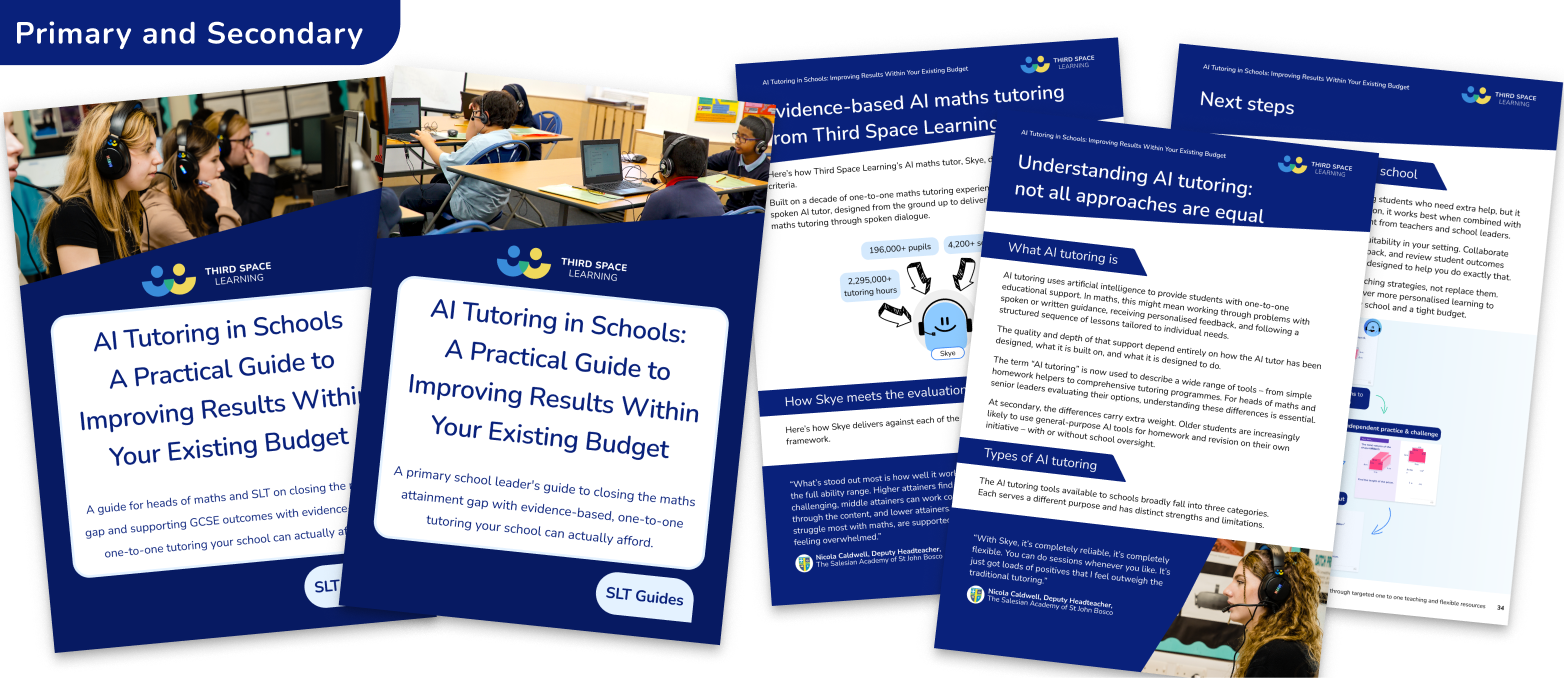
AI Tutoring in Schools: A Practical Guide to Improving Results Within Your Existing Budget
Use this clear step-by-step roadmap built on evidence-based impact to decide whether AI tutoring is right for your school.
Download Free Now!Why screen time in schools is in the news
The letter was organised by SafeScreens, a parent-led campaign, and Health Professionals for Safer Screens. The signatories, who include GPs, paediatricians, ophthalmologists and speech and language therapists, say that about £900 million a year is spent on educational technology in English schools without any check on children’s physical health. They point to rising short-sightedness and to children with SEND being steered towards screen-based learning. There is no single answer on SEND, and your SENCO and the family can decide about screens for each pupil.
SafeScreens wants early years and primary settings to be device-free by default. For secondary schools, it wants pupil-facing educational technology and AI tools suspended until their safety, privacy and educational benefit have been independently verified, and it wants parents to have a legal right to opt their child out of screen-based activity. Many parents will share those concerns.
The Department for Education ran a call for evidence on screen use by children aged 5 to 16 in June 2026, with a separate part on screens in schools. It has said the guidance for families, due this autumn, “will avoid blanket rules”. The DfE has also promised a consultation on independent safety certification for school technology, including generative AI.
Screen time, social media and AI: three different worries
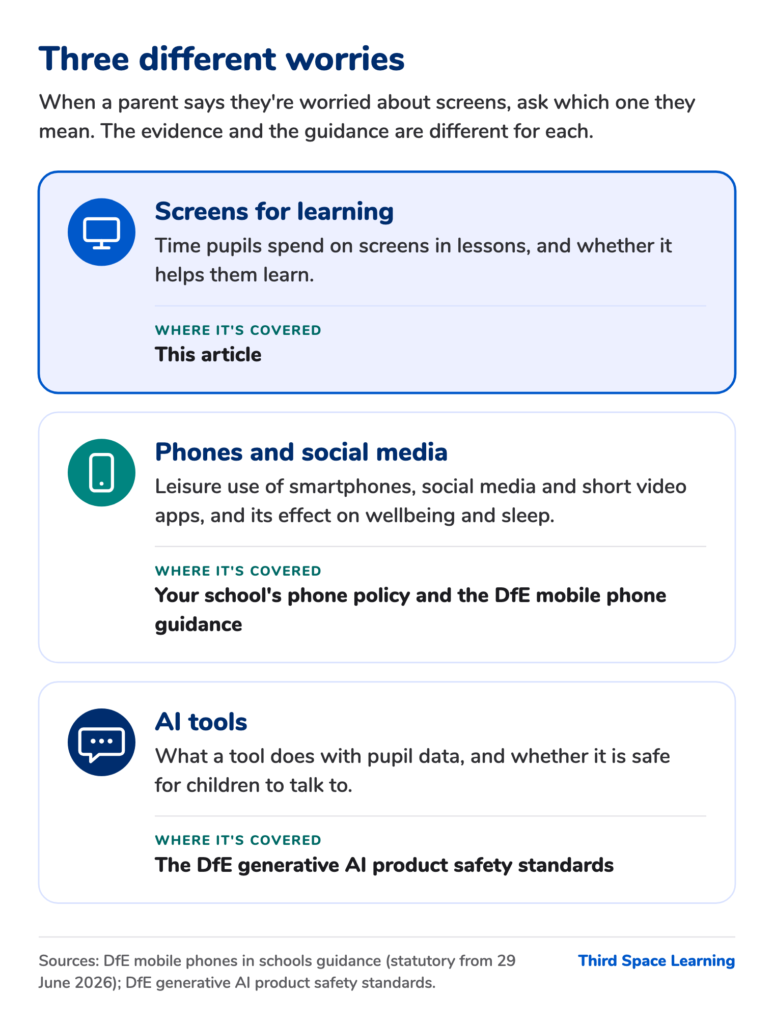
When a parent says they’re worried about screens, you can ask them what they have in mind. Phones and social media, screens used in lessons and AI tools often come up in the same news story, but the evidence and the guidance are different for each.
Social media and phones are a different problem
Most of the evidence parents read about harm from screens is about leisure use, such as social media, short video apps and video games, and its effect on young people’s mental health, wellbeing and sleep. Schools in England already have rules on mobile phones: the DfE’s mobile phone guidance became statutory on 29 June 2026, and schools have been expected to follow it since 1 September. If it’s phones the parent is worried about, you can point them to your school’s phone policy.
AI safety has its own standards
If a parent asks about AI, such as what a tool does with pupil data or whether it is safe to talk to, you can answer that on its own. The DfE has published product safety standards for generative AI in education, and we have written a guide to the DfE generative AI product safety standards that you can share with colleagues.
The rest of this article is about the time pupils spend on screens for learning.
What the evidence says about screen use for children
There is no UK screen time limit for school-age children (yet)
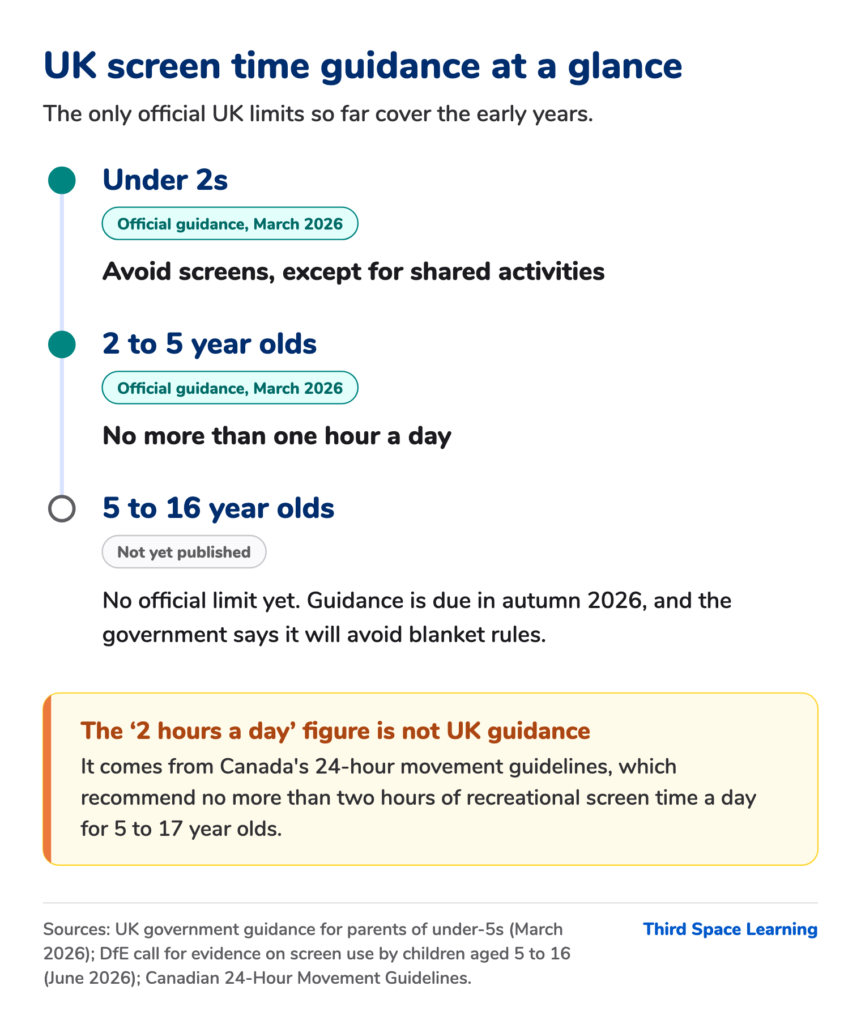
You’ll often hear that children should have no more than two hours of screen time a day. That figure comes from Canada’s 24-hour movement guidelines on recreational screen use, and it is not UK guidance.
In 2019 the UK Chief Medical Officers said the research was not conclusive enough to set guidelines on how much screen time is right for children, and the Royal College of Paediatrics and Child Health said it was unable to recommend a cut-off.
The government’s first official guidance to limit children’s screen use came in March 2026 and covers the early years only: no more than one hour a day for 2 to 5-year-olds, and screens avoided for under-2s except for shared activities. The expert panel behind that guidance said that not all screen use is equal, and that the limits do not apply in the same way to assistive technologies for children with SEND.
Leisure and learning are not the same
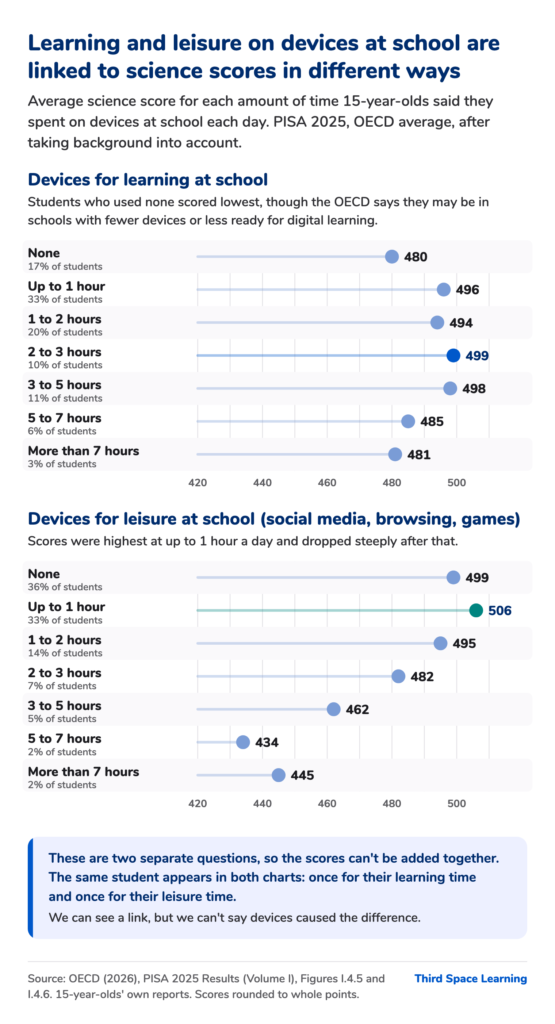
The best large-scale evidence is from PISA, the OECD’s study of 15-year-olds, so it is most relevant to secondary schools. In PISA 2022, students who used digital devices for learning at school for up to an hour a day scored 14 points higher in maths than students who used none, once the OECD had taken their background into account. Above an hour a day, for learning or for leisure, scores fell. The OECD put it down to “the overuse and/or misuse of digital devices”.
In PISA 2025, published in September 2026, the OECD looked at science scores. Students who used devices for learning at school for anything up to 5 hours a day scored higher than students who used none, although the OECD says that gap may be partly down to schools with fewer devices or less preparation for digital learning. For leisure use at school, such as social media, browsing and games, scores were highest at up to an hour a day and dropped steeply after that.
Both studies are correlational, so we can say there is a link, but we can’t say the devices are the reason for the difference in scores. The two studies differ on learning use, but in both, students who used devices for leisure at school for more than about an hour a day had lower scores.
There is less research with younger children, and recent research suggests the type of use matters for them too. In a large review in Nature Human Behaviour covering children and young people, Sanders and colleagues (2024) linked children’s media use with lower literacy, except when parents watched alongside them.
How much time do pupils actually spend on screens at school?
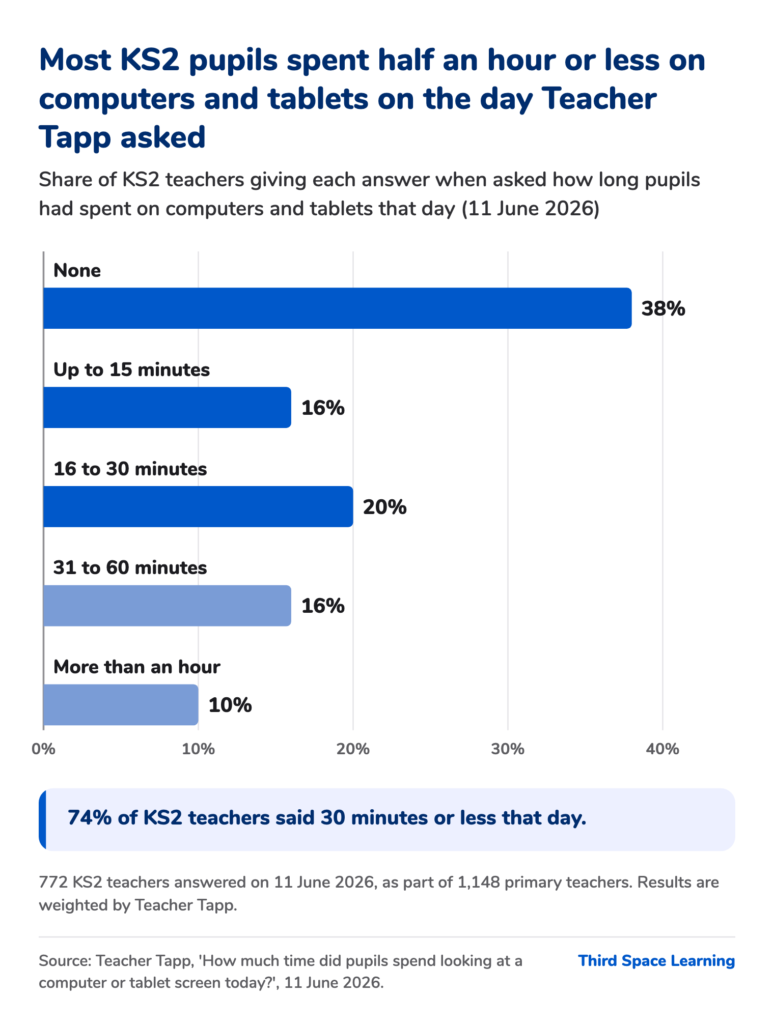
In June 2026 Teacher Tapp asked primary teachers how long their pupils had spent on screens that day. For computers and tablets, 38% of KS2 teachers said none and 74% said 30 minutes or less. Only 10% said more than an hour.
In a poll of 2,000 parents commissioned by SafeScreens, parents said that 6% of primary pupils were on their own device in nearly every lesson. Teacher Tapp only asked primary teachers, so for secondary the best guide is PISA, where 15-year-olds answer the questions themselves. Across OECD countries, 15-year-olds in PISA 2025 reported 1.7 hours a day using digital devices for learning at school and 1.1 hours for leisure while at school.
Screens do not raise attainment on their own
The EEF’s guidance report on digital technology says that giving every pupil a tablet is unlikely to raise attainment, and that technology works best when it supports good teaching. The House of Commons Education Committee, in its 2024 report on screen time, said that, on the evidence it received, the harms of screen time and social media outweigh the benefits for young children, while limited and “genuinely educational uses” of digital technology can benefit older children.
Ask two questions of any screen time in school
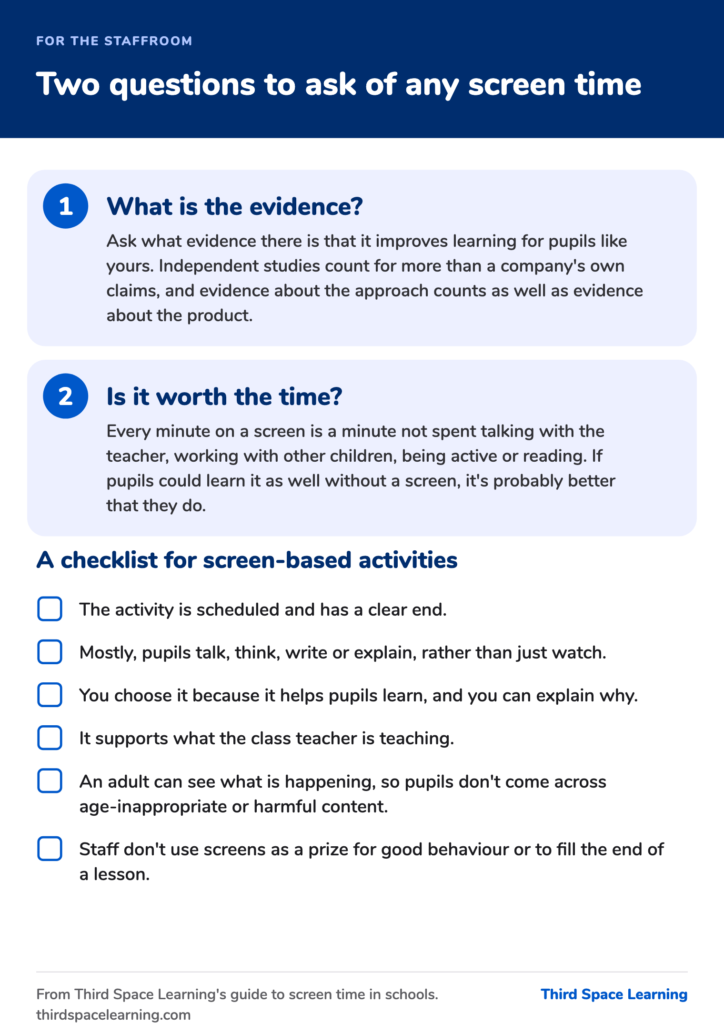
What is the evidence?
Before any screen-based activity goes on the timetable, ask what evidence there is that it improves learning outcomes for pupils like yours. Independent studies are stronger evidence than a company’s own claims, and evidence about the approach (such as tutoring or retrieval practice) counts as well as evidence about the product.
Is it worth the time?
Every minute on a screen is a minute not spent on something else: talking with the teacher, working with other children, physical activity or reading a book. If pupils could learn something as well without a screen, it’s probably better that they do.
A checklist for screen-based activities
You can use these points to agree how staff use digital tools in either phase:
- The activity is scheduled and has a clear end.
- Mostly, pupils talk, think, write or explain, rather than just watch.
- You choose it because it helps pupils learn, and you can explain why.
- It supports what the class teacher is teaching.
- An adult can see what is happening, so pupils don’t come across age-inappropriate or harmful content.
- Staff don’t use screens as a prize for good behaviour or to fill the end of a lesson.
Good practice in primary and secondary
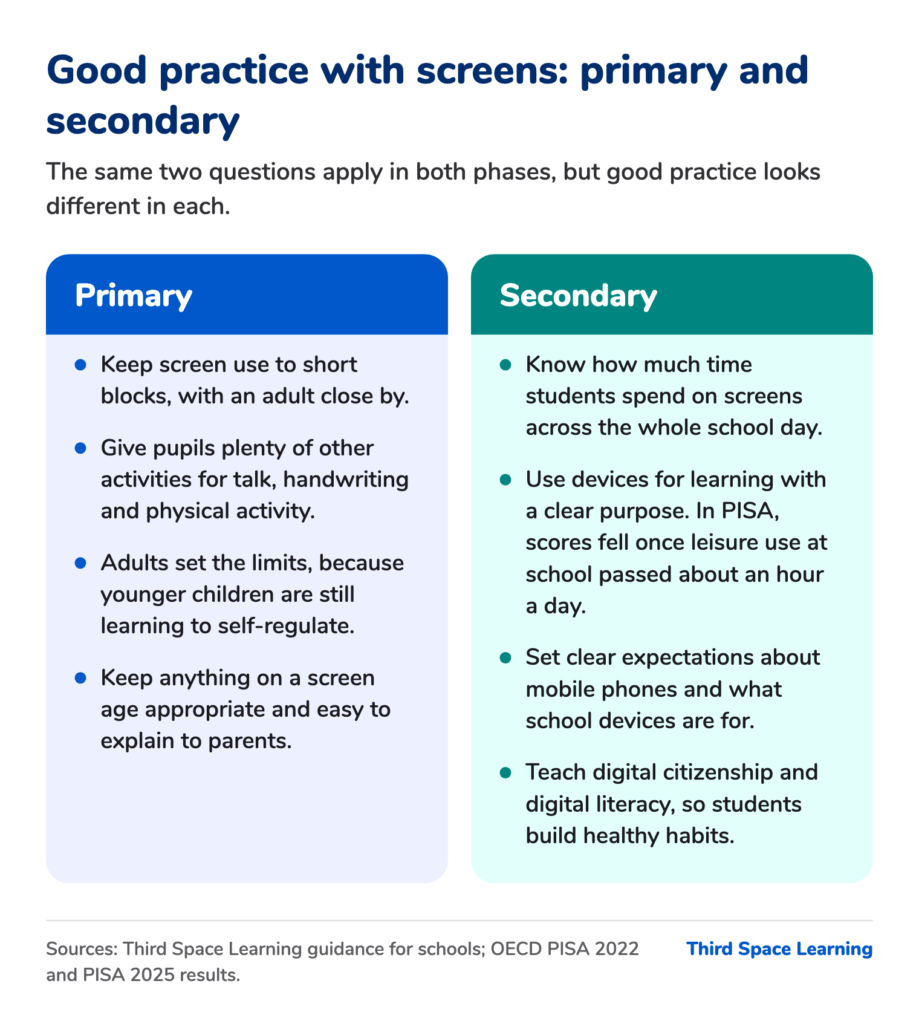
What good practice looks like in primary
In primary schools, you can keep screen use to short blocks with an adult close by, and make sure pupils have plenty of time for talk, handwriting and physical activity. Younger children are still learning to self-regulate their technology use, so adults set the limits, and anything on a screen should be age appropriate and easy to explain to parents. Most Reception children are under 5 for part of the year, so parents who follow the March 2026 guidance for under-5s may ask how time on screens at school fits with its advice of no more than an hour a day.
What good practice looks like in secondary
In secondary schools, it’s worth knowing how much time students spend on screens across the whole school day. Going by recent PISA results, scores fall once leisure use at school is more than about an hour a day. You can set clear expectations about mobile phones and about what school devices are for, so older students learn to manage their own tech use. If you teach digital citizenship and digital literacy, students build the habits of healthy screen use they will need outside school.
Why one-to-one online tutoring passes the test
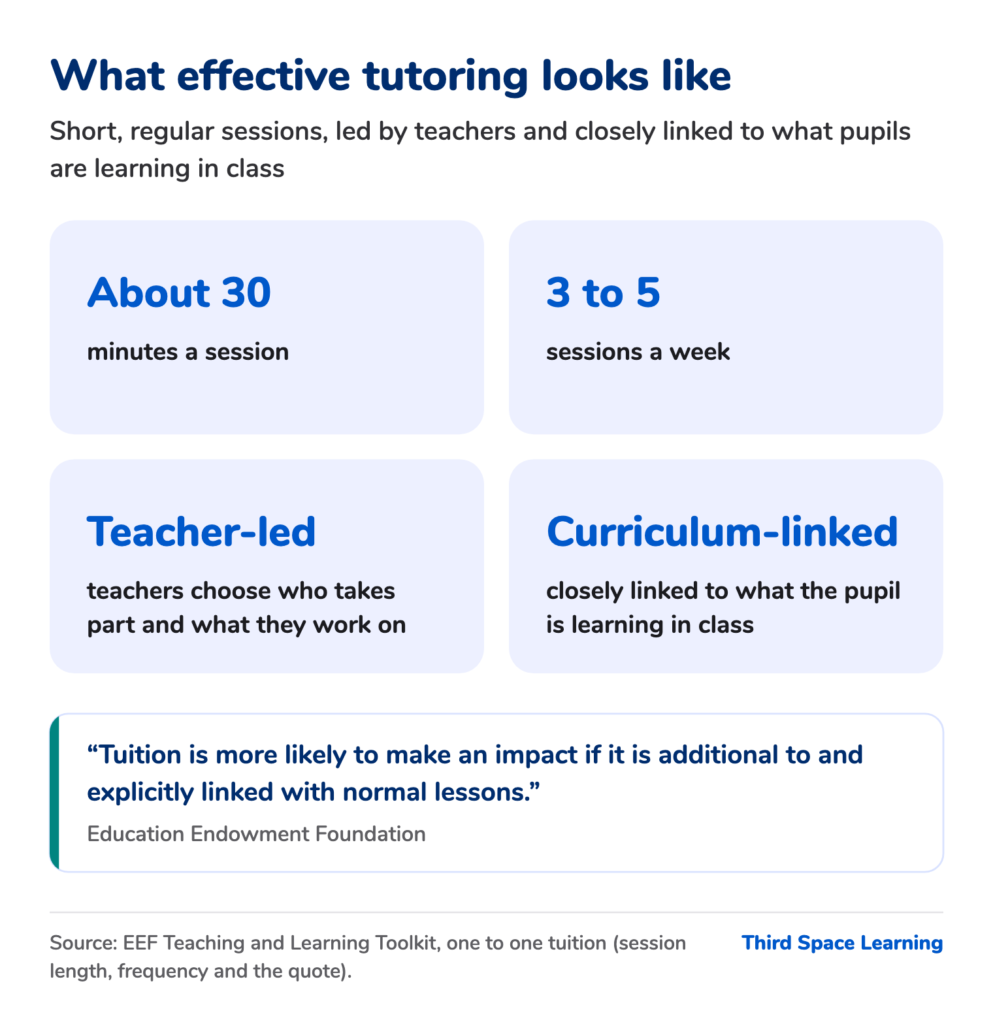
In its Teaching and Learning Toolkit, the EEF rates one to one tuition at around five months of additional progress on average across subjects, based on 123 studies, with moderate cost and moderate evidence. The average for maths studies is lower, at two months, while primary studies average six months and secondary studies four.
The EEF also says tuition is “more likely to make an impact if it is additional to and explicitly linked with normal lessons”, and that the most effective pattern, often called high-dosage tutoring, is sessions of about 30 minutes, three to five times a week.
According to the EEF’s guide for schools, Making a difference with effective tutoring, younger pupils are likely to benefit from more regular, shorter sessions. The guide also says that if pupils are taken out of class for tutoring, the tutoring should at least make up for the time they spend away. The studies behind these findings were with human tutors, so we can say that tutoring works as an approach, but not that any particular product does.
Within a school timetable, the most personalised approach a child can receive for the implementation recommended by EEF will likely be via an online tutor. At Third Space Learning we use our AI maths tutor, Skye; other companies use human tutors. There is early evidence that the impact can be similar: in an exploratory trial with 165 students in five UK secondary schools, Eedi and Google DeepMind found that students tutored by an AI model, with expert tutors checking its messages, did at least as well as students tutored by humans alone.
We have summarised the current evidence on AI tutoring, including how the results differ depending on the way schools use it.
AI tutoring also covers very different approaches, from chatbots that generate answers on the spot to structured lessons written by teachers and delivered by an AI tutor, and you can’t assume that evidence for one approach applies to another.
So when a school uses screen time for tutoring, the evidence is that it works best as short sessions, several times a week, linked to what the class is learning, for pupils who need the extra support.
Applying the two questions to our own sessions
Here is how we answer the same two questions about Skye.
What is the evidence for Skye?
In an independent evaluation of Skye, Educate Ventures Research found that quiet and anxious pupils were often more willing to engage, because being corrected felt less judgemental. Educate also notes that EAL learners and pupils with speech recognition difficulties may need closer adult presence and scaffolds. Schools get best results when sessions are supervised and run in a quiet space with suitable headsets.
In the same evaluation by Educate across 9,320 pupil sessions, pupils more than doubled their correct answers after a single lesson with Skye, from 30% to 70%, beating the human tutoring benchmark of 66%. Although this was not standardised attainment impact, it’s a very promising direction of travel.
SafeScreens has asked for pupil-facing AI tools in secondary schools to be suspended until they are independently verified. We think schools are in the best place to make the decision about AI usage for their own students as cohorts can differ immensely from region to region and even year to year. The important thing is that they make an informed decision, based on an agreed AI strategy for their school, and that they ask for that evidence from any AI tool, including ours.
We also support the government’s plan for independent safety certification of school technology. You can see how Skye handles pupil data and safeguarding on our trust and compliance page and specifically how we measure up against the Generative AI product safety standards.
Is Skye worth the time?
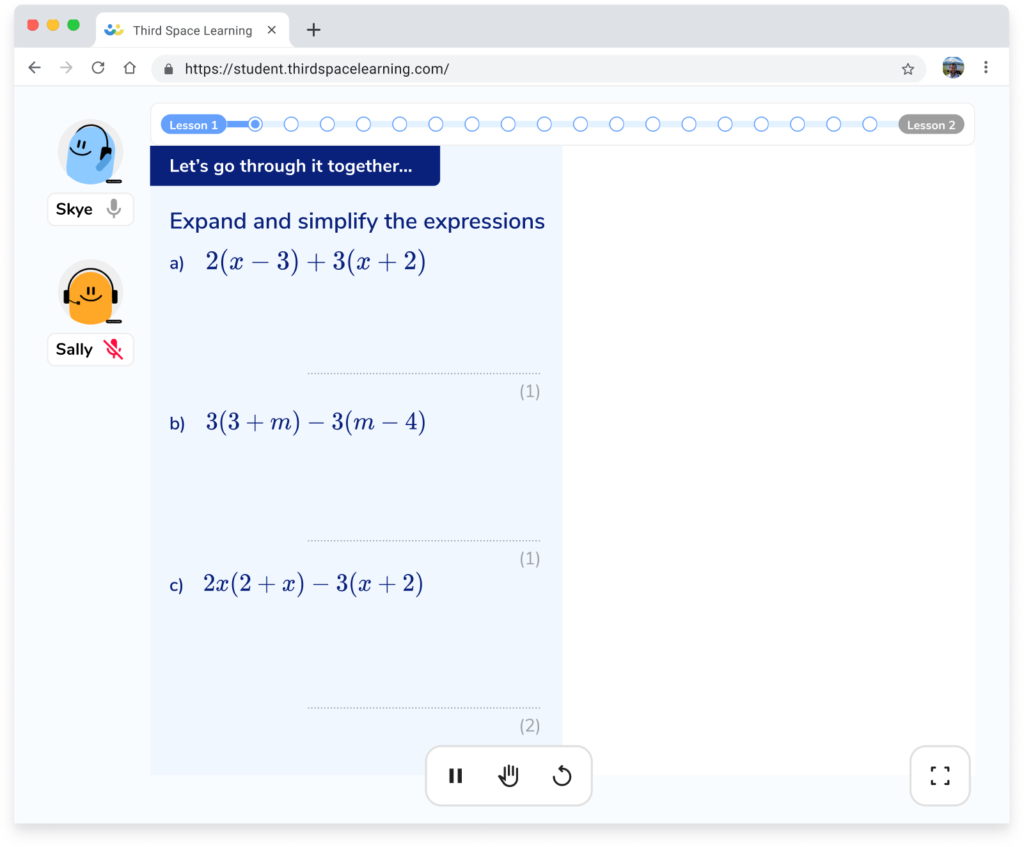
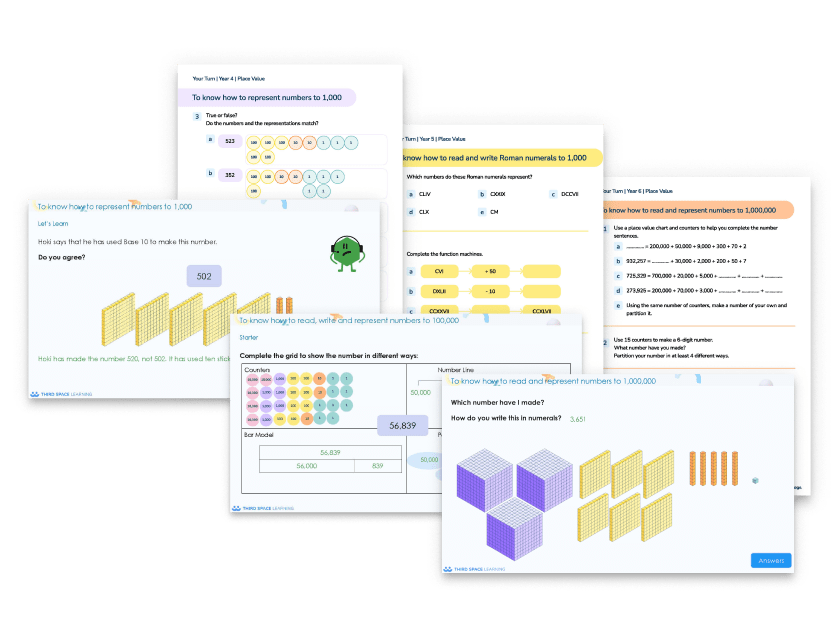
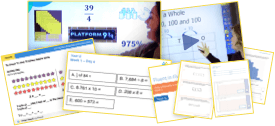
Skye is a spoken AI maths tutor. Pupils talk through their reasoning out loud and answer questions as they go, and the lesson slides are written and approved by our academic team.
Some older students are self-conscious about talking out loud at first. Gareth Barratt, Key Stage 4 Director at Richard Rose Central Academy, told us: “Once students get past that initial hesitation, they tend to just get on with the learning.”
The school decides how long each session lasts, how often it happens and when it runs, so sessions fit around class time. Pupils can only launch sessions themselves if the school has switched that on.
Schools choose which pupils have sessions and in which topics, so they are using screen time deliberately. Skye guides and prompts students through each lesson step by step, and the screen shows only the lesson slides, so pupils have nothing else to browse and can concentrate on the maths. Teachers can reorder lessons to match what they are teaching, from Year 3 to GCSE. David Gooding, Assistant Headteacher at Harrison Primary School, told us: “I like that I can listen in to sessions in real-time.”
What about sessions at home?
Schools can also set sessions at home as homework, and teachers choose the lessons, so a home session can follow on from the topic the class covered that day. A home session is still screen time, so agree with your DSL how home sessions fit your online safety policy before you offer them, and tell parents when they are set and how long they last. Home sessions also need a device, a headset and a quiet space, which not every family has.
What to tell parents about screen time at school
You can copy or adapt either version below for a newsletter, your website or parents’ evening. Change anything in square brackets to match your school.
Wording for primary schools
You may have seen news stories about screen time in schools. We know that families take different approaches to screens, and many of you would like your children to spend less time on them. Here is how we use them in school.
- Most of your child’s learning happens without a screen.
- When we do use one, it is for a set length of time, and the teacher has planned what pupils will do and how it will help them learn.
- [Pupils are supervised when they use screens, and our filtering and monitoring systems block unsuitable content.]
- We don’t use screens as a reward or to fill time.
For some pupils, including some with special educational needs, a device is part of how they learn, and we agree this with their families.
Pupils don’t use mobile phones or social media during the school day, in line with government guidance. [Some pupils have short one-to-one maths tutoring sessions on a screen, for example 30 minutes, three times a week. Teachers choose these pupils to help with specific topics, and we will tell you if your child is one of them.]
If you would prefer your child didn’t use screens for [homework or extra support], or you have any questions, please speak to your child’s class teacher.
Wording for secondary schools
You may have seen news stories about screen time in schools. We know that families take different approaches to screens, and many of you would like your children to spend less time on them. Here is how we use them in school.
- When students use devices in a lesson, it is usually for part of the lesson [in subjects such as computing, they use them for longer].
- Teachers plan when devices are used and for how long, and choose activities they believe will help students learn.
- [Our filtering and monitoring systems block unsuitable content, and] we teach students to use technology safely and sensibly.
- We don’t use devices to fill time.
For some students, including some with special educational needs, a device is part of how they learn, and we agree this with their families.
Students [in Years 7 to 11] don’t use their own mobile phones during the school day, in line with government guidance [add your phone policy, for example pouches or lockers]. [Some homework is set online. If your child doesn’t have a suitable device or internet at home, please let us know and we will help.] [Some students have short one-to-one maths tutoring sessions on a screen, for example 30 minutes, three times a week. Teachers choose these students to help with specific topics, and we will tell you if your child is one of them.]
If you would prefer your child didn’t use screens for [homework or extra support], or you have any questions, please speak to your child’s form tutor or head of year.
Answering parents about screens with confidence
When a parent asks about screens, you can tell them honestly that not all screen use is the same, and that you keep screen use for learning short and purposeful.
If you would like to see how a short, spoken one-to-one maths session works, you can find out more about Skye, our AI maths tutor.
Frequently asked questions
There are no official UK limits for school-age children. The only limits, published in March 2026, are for the early years: no more than one hour a day for 2 to 5-year-olds, and screens avoided for under-2s except for shared activities. The government has said its guidance for 5 to 16-year-olds, due this autumn, will avoid blanket rules.
The French psychiatrist Serge Tisseron came up with the 3-6-9-12 rule in 2008. It is a set of age milestones rather than daily limits: no screens before 3, no personal games console before 6, no internet before 9 (and then only with an adult) and no unsupervised internet before 12. It is not UK guidance, but some families find it useful.
There is no official UK limit. Across OECD countries, 15-year-olds in PISA 2025 reported about 6 hours a day on digital devices on weekdays, in and out of school, for learning and leisure combined, and the OECD found that scores were lower among students with heavy leisure use at school. It’s also worth asking what a child is doing.
The clinicians who wrote to the government cite an analysis of 276 studies in which researchers found short-sightedness among children and adolescents rose from around 24% in 1990 to almost 36% in 2023. It covers short-sightedness in general rather than screens in school, and the letter says “some of this evidence is still surfacing”. The UK Chief Medical Officers advise taking a break after a couple of hours sitting or lying down using a screen.
Key sources
- The clinicians’ letter to the Education Secretary (12 October 2026)
- OECD, PISA 2025 Results (Volume I) (September 2026)
- EEF Teaching and Learning Toolkit: one to one tuition
- Teacher Tapp: screen time in schools (June 2026)
- House of Commons Education Committee: Screen time – impacts on education and wellbeing (May 2024)

DO YOU HAVE STUDENTS WHO NEED MORE SUPPORT IN MATHS?
Skye – our AI maths tutor built by teachers – gives students personalised one-to-one lessons that address learning gaps and build confidence.
Since 2013 we’ve taught over 2 million hours of maths lessons to more than 170,000 students to help them become fluent, able mathematicians.
Explore our AI maths tutoring or find out about maths intervention programmes for your school.