


High-Dosage Tutoring: Proven Strategies for Success in Your School

High-dosage tutoring represents one of the few evidence-based interventions demonstrating significant positive effects on maths attainment. Research suggests this approach can increase pupil learning by 3 to 15 months, making it one of the most effective methods for recovering maths knowledge gaps, and lingering COVID-related learning loss.
However, pupils who most need intensive subject support through such programmes often lack access outside of school. School leaders and MAT leaders must ensure equitable access to these effective one-on-one interventions for socioeconomically disadvantaged populations facing the greatest challenges.
This article covers everything schools need to know about high-dosage tutoring: what it is, the research behind it, and how to implement it effectively.
High-dosage tutoring: key takeaways
- High-dosage tutoring involves a minimum of three 30–45 minute weekly high-frequency sessions over sustained periods. It significantly accelerates pupil achievement through 3–15 months of additional learning gains.
- Research demonstrates particular effectiveness for pupils from lower socioeconomic backgrounds, with one-on-one tutoring proving the most impactful approach.
- High-impact tutoring particularly benefits disadvantaged pupils and those working below age-related expectations, addressing learning loss and building confidence
- It is most effective when delivered one-on-one or in small groups (maximum three pupils), with sessions scheduled during the school day to ensure consistent attendance
- Programmes should include periodic formative assessments and progress monitoring to track pupil learning and inform maths instruction
- Tutor training and development is crucial to student success, regardless of the tutor’s professional background
- Schools can utilise pupil premium, recovery premium, and other government funding routes to implement high-dosage tutoring programmes
- Online delivery can be just as effective as in-person sessions when delivered at high frequency

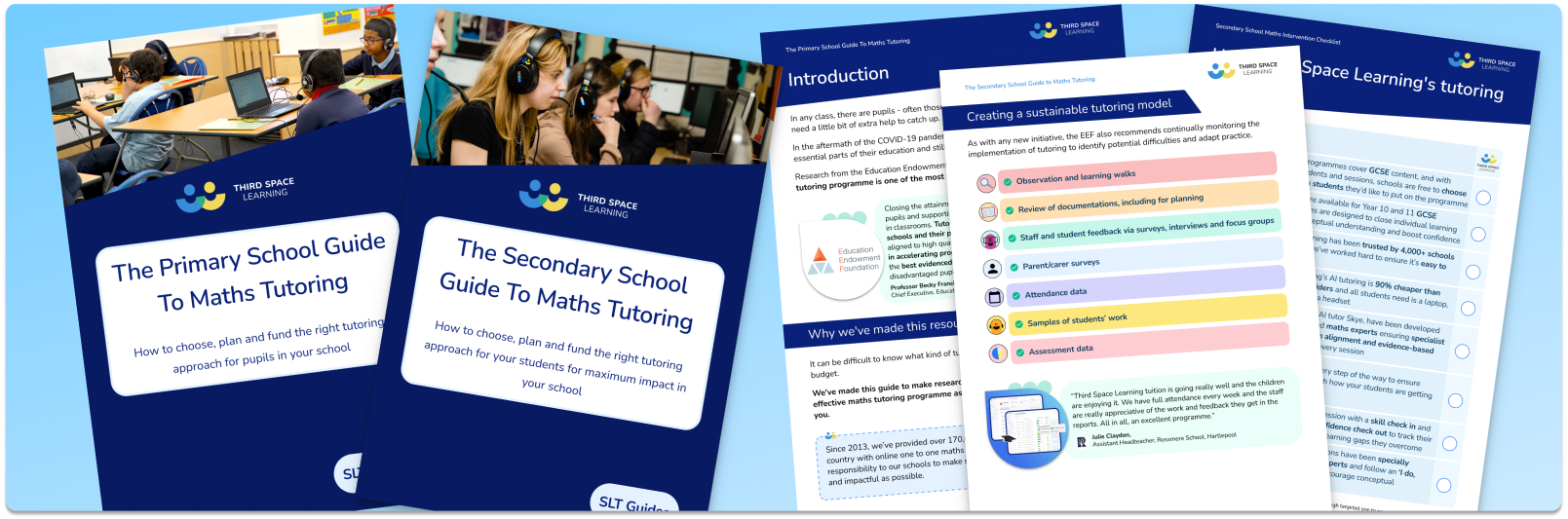
The Ultimate School Guide to Maths Tutoring
How to choose, plan and fund the right tutoring approach for your students for maximum impact in your school.
Download Free Now!What is high-dosage tutoring?
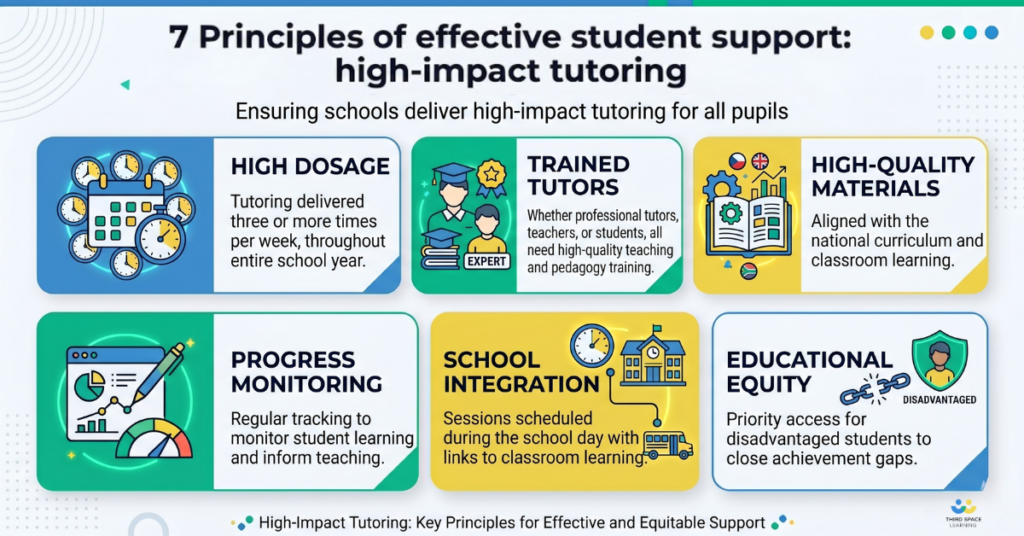
High-dosage tutoring involves intensive instruction where a pupil meets with the same tutor at least 3 times per week for 30–45 minute sessions over a sustained period. The critical difference between high-dosage tutoring and standard tutoring services is the necessarily high frequency of sessions. Schools should continue these programmes for at least one school year to achieve significant learning gains.
Each session, the tutor delivers tailored instruction designed to address individual needs and promote independent practice. Common applications include:
- Addressing learning gaps caused by school closures or absence
- Building pupil confidence through interactive instruction
- Getting pupils to age-related expectations before national assessments
While high-dosage tutoring can occur one-on-one or in small groups, one-to-one tutoring remains the most effective approach. Personalised instruction allows intensive support tailored to individual needs.
Group tutoring remains effective with up to three or four pupils per tutor. Larger small groups show reduced impact.
Effective high-dosage tutoring typically runs for a minimum of 12–15 weeks with at least 90 minutes of weekly instruction. It can be delivered through in-person sessions or online delivery, with research suggesting both approaches produce measurable learning outcomes when properly structured.
High-dosage tutoring criteria
- One-on-one or small group instruction (maximum three pupils)
- At least three high-frequency 30-minute sessions per week
- High-quality, curriculum-aligned instructional materials
- Expertly trained tutors with consistent pupil–tutor pairing, ensuring the same tutor works with pupils throughout
How effective is high-dosage tutoring?
This intervention demonstrates clear effectiveness when compared against several comparably complex interventions. While it benefits all pupils, high-impact tutoring proves particularly effective for disadvantaged pupils.
The Education Endowment Foundation (EEF) Teaching and Learning Toolkit identifies one-on-one tuition as one of the most impactful interventions, as detailed in the EEF tutoring report, with evidence suggesting it can boost pupil progress by up to 5 additional months. Small group tuition, meanwhile, shows an average of 4 months’ additional progress.
The National Student Support Accelerator at Stanford University states that for pupils from lower-income families, tutoring is one of the most impactful educational approaches available. A 2017 meta-analysis examining interventions that improve educational achievement for pupils from lower socioeconomic backgrounds in primary school and secondary school found tutoring to be both the most common and the most effective among all interventions examined.
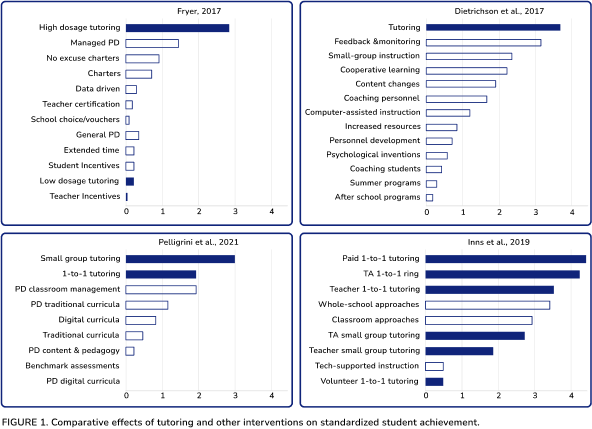
Research from Matthew Kraft at Brown University cites four major studies (Fryer 2017, Dietrichson et al. 2017, Pellegrini et al. 2021, Inns et al. 2019) presenting one-on-one and high-dosage tutoring as the most effective interventions for improving standardised pupil achievement. Brown University research also highlights that pupils participating in these programmes can potentially cover 50% more material in a single year compared to traditional teaching methodology alone.
High-impact tutoring has also been shown to improve overall pupil attendance by up to 7%, demonstrating benefits beyond academic achievement.
High-dosage tutoring works best when:
- School leaders use data to implement high-impact tutoring and refer pupils who need it most
- Tutors employ ongoing assessment and periodic formative assessments to personalise instruction
- Sessions occur during the school day, ensuring pupil attendance
- Instruction remains one-on-one, with the same tutor building a strong relationship with each pupil
Ensuring high-dosage tutoring success
High-dosage tutoring proves effective across primary school, secondary school, and post-16 settings as a school intervention, though impact is generally greatest in primary maths, secondary maths, primary English and secondary English. Research suggests that effective tutoring can support progress monitoring and chart learner achievements across all these subjects.
1. Opt for scheduled programmes
Scheduled high-dosage tutoring programmes significantly outperform on-demand alternatives. Research indicates that on-demand tutoring often suffers from poor utilisation and a lack of evidence-based foundations.
Many schools’ response to COVID-related learning loss included implementing structured, timetabled high-impact tutoring as part of wider school reform efforts. Schools that embedded tutoring into scheduled slots saw stronger outcomes than those offering ad hoc or on-demand tutoring sessions. The evidence is clear: it is not only what you do, but how well-organised and coherent the programme is, that creates a positive impact on pupil achievement.
2. Schedule sessions during the school day
Whether addressing post-pandemic learning gaps or increasing the number of pupils working at age-related expectations, high-impact tutoring proves most effective when delivered during school hours. While after-school tutoring can work, consistent attendance remains challenging.
Scheduling sessions during the school day increases educational equity. It ensures pupils in state schools who lack resources at home still access the support they need. When pupils participate during the school day, attendance and engagement improve significantly.
The EEF’s evaluation of the National Tutoring Programme found that school-led tutoring, delivered by school staff during timetabled slots, reached more disadvantaged pupils than other routes. This is particularly important for closing attainment gaps and supporting socioeconomically disadvantaged populations.
3. Invest in tutor training and development
Research confirms that well-trained tutors are essential for delivering high-impact tutoring. What matters more than a tutor’s background is the quality of their training. Whether the tutor is a classroom teacher, teaching assistant, or university student, all can excel with continuous training and mentoring. This includes assessment preparation and professional development to ensure tutors are equipped to support progress monitoring and deliver effective tutoring aligned with core instruction.

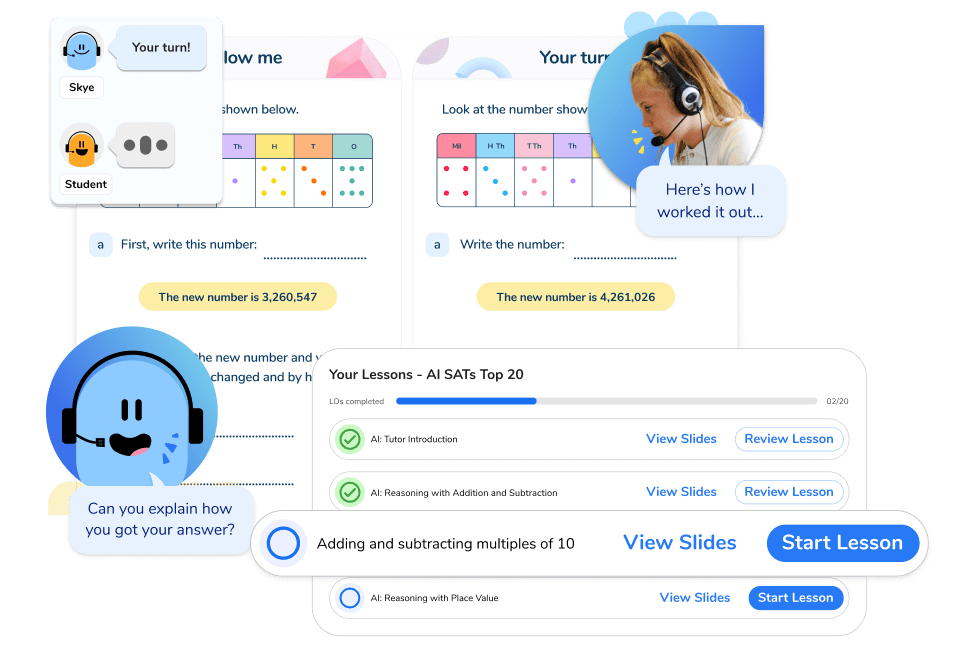
Third Space Learning’s AI maths tutor, Skye, receives training from qualified teachers and maths specialists. Teachers create and review every lesson, ensuring alignment with the national curriculum and pedagogical best practice. Skye’s teaching methodology combines interactive instruction with opportunities for pupils to develop independent practice and cooperative learning skills. Specialists continuously review and update Skye’s prompts and training, reflecting current methods.
4. Curriculum-aligned instruction and resources
High-dosage tutoring should align with classroom teaching. When outsourcing, school leaders should verify that the provider covers the national curriculum. Tutors need a thorough understanding of the relevant key stage expectations and curriculum content, including primary maths, secondary maths and secondary English.
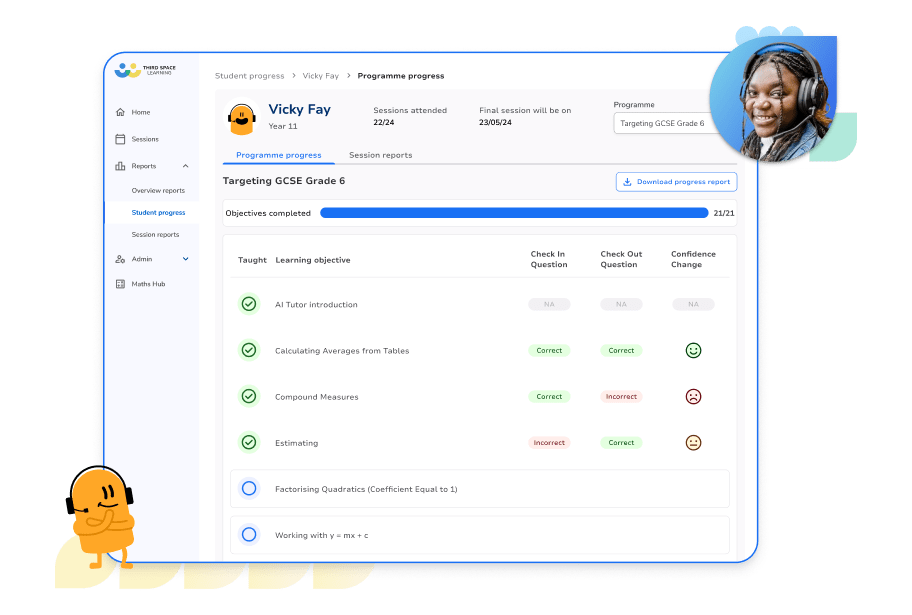
Reputable programmes support progress monitoring by providing post-session lesson reports. Each session, pupils’ needs and achievements are documented. The tutor writes lesson reports after every session, and classroom teachers receive lesson reports showing pupil progress and remaining learning gaps. These lesson reports help leaders chart learner achievements and refer pupils for additional support where needed.
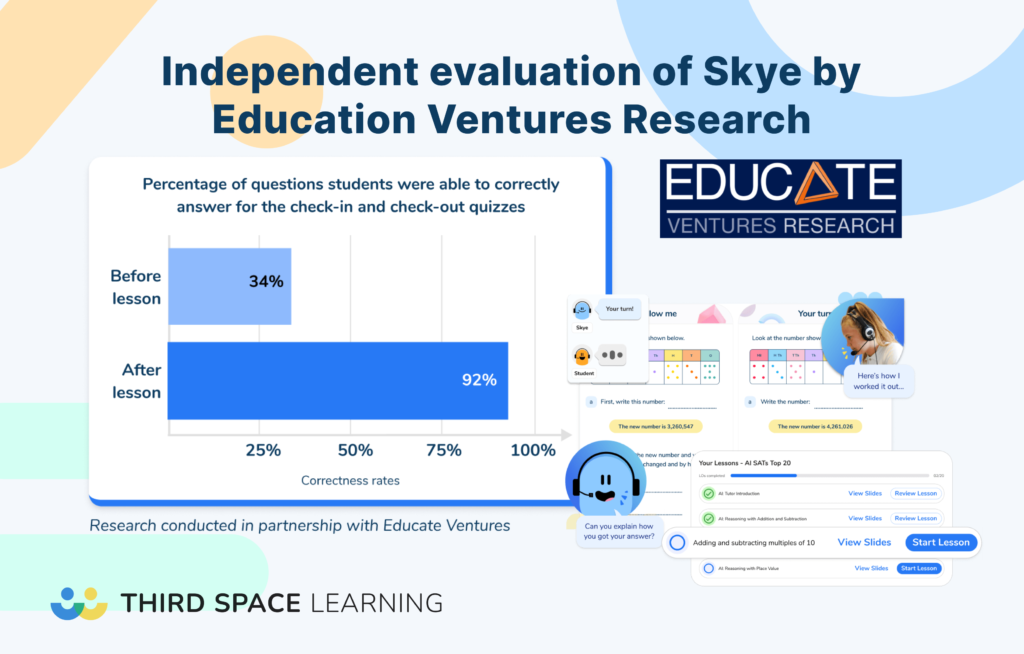
Every one-to-one maths tutoring session with Skye begins with a diagnostic skill check-in question and ends with a skill check-out question. This helps assess each pupil’s progress across all lessons and lesson objectives.
Schools receive reports on demand after each session to help monitor pupil progress, lesson to lesson and across each programme.
5. Consider online delivery and virtual tutoring
High-dosage tutoring can be delivered online just as effectively as through in-person sessions. Virtual tutoring offers flexibility, particularly for schools in rural areas or those struggling to recruit local tutors. Computer-assisted instruction and online delivery have both been shown to produce measurable learning outcomes when combined with high-frequency, structured sessions.
Whether delivered online or in person, the high-frequency nature of high-dosage tutoring is what drives pupil progress. Schools can also blend approaches to maximise coverage.
How much does high-dosage tutoring cost?
While there is universal agreement on effectiveness, traditional delivery can appear expensive.
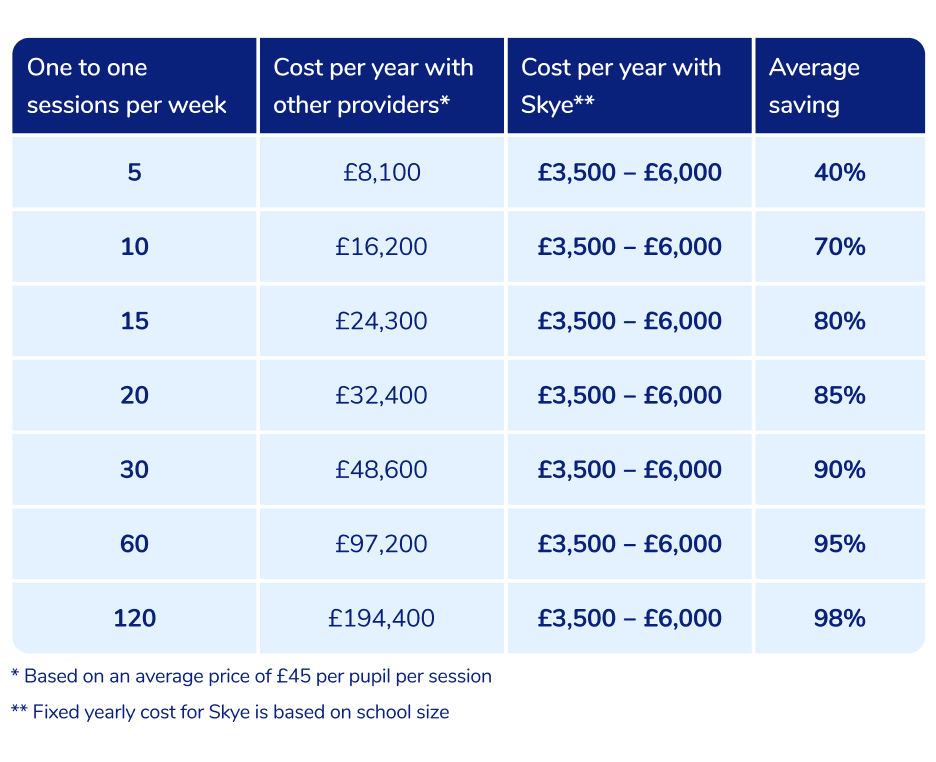
Average one-on-one tutoring in the UK costs approximately £40 per hour. A 12-week programme with 3 weekly sessions would therefore cost around £1,440 per pupil, excluding recruitment or training expenses.
However, it need not cost this much. Third Space Learning has spent over 10 years determining how to reduce costs so that more pupils can access the benefits of one-on-one tutoring through affordable maths instruction.
Third Space Learning’s AI tutor, Skye, is available at a fixed annual cost starting from just £3,500 per year – with no per-pupil or per-session charges. Whole school programmes accommodate unlimited pupils and unlimited sessions, meaning a two-form entry primary school paying £5,000 per year could support every child who needs it for a fraction of the cost of traditional tutoring.
Funding high-dosage tutoring programmes
There are several government funding options available to UK schools. Many use pupil premium funding, which is specifically designed to improve outcomes for disadvantaged pupils. The recovery premium has also provided additional government funding for schools to deliver evidence-based interventions, including high-impact tutoring.
Prior to September 2024, many schools used the National Tutoring Programme’s school-led tutoring grant. Since then, schools have found creative approaches to funding tutoring after the NTP through approved tuition partners and other routes.
MAT leaders have also found creative solutions: pooling resources across schools, partnering with universities to provide trainee teacher and university student tutors, and redirecting existing budgets towards high-dosage tutoring as a priority intervention. For any parent seeking assistance outside of school, many of these programmes also offer guidance on how to support pupil learning at home.
Which pupils benefit most from high-dosage tutoring?
All pupils benefit, but high-impact tutoring is particularly effective when supporting disadvantaged learners and closing achievement gaps. These pupils often experienced the greatest COVID-related learning loss and should generally receive priority support.
High-impact tutoring is especially effective for:
- Pupils working below age-related expectations in primary maths or secondary maths
- Pupils from socioeconomically disadvantaged populations
- Pupils struggling with classroom instruction or experiencing maths anxiety
- Pupils who need intensive subject support to catch up after periods of absence
Quality programmes can enable rapid pupil progress and confidence-building, helping these pupils engage more fully in whole-class teaching.
High-dosage tutoring FAQs
Standard tutoring typically involves one weekly session with varying tutors. High-dosage tutoring requires at least three sessions per week, consistent tutor–pupil pairing, and curriculum-aligned materials. Research shows it is up to 20 times more effective than standard models for maths.
Yes. Research suggests online high-dosage tutoring produces comparable learning outcomes to in-person delivery, provided sessions are frequent, structured, and led by a consistent tutor. Online delivery also removes the need to recruit local tutors and reduces scheduling constraints.
One-to-one tutoring is the most effective format, with the EEF reporting up to 5 months of additional progress. Small groups of up to three pupils also work well, showing around 4 months of progress. Beyond this, the impact drops notably.
References
- Education Endowment Foundation (EEF) – Teaching and Learning Toolkit: One-to-one tuition
- Education Endowment Foundation (EEF) – National Tutoring Programme evaluations
- National Student Support Accelerator, Stanford University – High-Impact Tutoring
- Dietrichson et al. (2017) – Academic Interventions for Elementary and Middle School Students With Low Socioeconomic Status
- Pellegrini et al. (2021) – Effective Programs in Elementary Mathematics: A Meta-Analysis
- Inns et al. (2019) – A Synthesis of Quantitative Research on Reading Programs for Secondary Students
- Kraft, M. (Brown University/Annenberg Institute) – The Effect of Teacher Coaching on Instruction and Achievement

DO YOU HAVE STUDENTS WHO NEED MORE SUPPORT IN MATHS?
Skye – our AI maths tutor built by teachers – gives students personalised one-to-one lessons that address learning gaps and build confidence.
Since 2013 we’ve taught over 2 million hours of maths lessons to more than 170,000 students to help them become fluent, able mathematicians.
Explore our AI maths tutoring or find out about one to one tuition for your school.