

Online Tutoring: A Complete Guide For Schools 2026

Online tutoring is one of the highest-impact interventions available to schools when delivered one to one. The Education Endowment Foundation research found that one to one tuition can deliver an average of five months’ additional progress, making it one of the strongest tools in the evidence base for closing attainment gaps. But that evidence is built on well-implemented, well-matched provision, and not every online tutoring platform delivers it.
The tutoring market has changed significantly. Online tuition now covers two fundamentally different types of provision: human tutoring marketplaces, where you search and book individual tutors, and purpose-built AI tutoring designed specifically for school-scale intervention. Understanding which model you are buying is what allows you to choose a provision that aligns with the national curriculum, meets your safeguarding requirements, and delivers genuine value for money at scale.
This article sets out what online tutoring is and is not, and what the evidence says. It helps SLT, maths leads, and intervention leads evaluate online tutoring provision and know what to look for when choosing a platform for your school.
Key takeaways:
- One-to-one tuition is one of the highest-impact interventions in the EEF toolkit, delivering an average of five months’ additional progress for students.
- Online tutoring is broadly as effective as face-to-face provision when implemented well – modality matters less than the quality and consistency of delivery.
- The tutoring market has split into human tutoring marketplaces and purpose-built AI tutoring – understanding the difference is essential before committing budget.
- When evaluating any platform, prioritise tutor qualifications and content authorship, safeguarding protocols, curriculum alignment, and total cost per student.
- The right provision depends on your subject need, budget, and cohort size – there is no single answer that fits every school.
- Implementation matters as much as platform choice: tutoring linked to classroom practice, delivered consistently, and communicated to families produces the strongest outcomes.

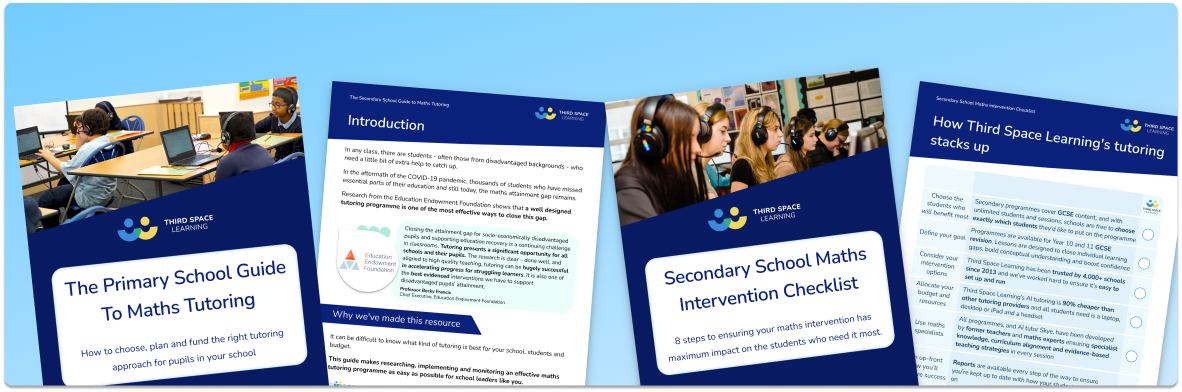
The Ultimate Guide to Maths Tutoring
Learn how to choose, plan and fund the right tutoring approach for your students for maximum impact. Includes individual primary and secondary guides.
Download Free Now!What is online tutoring?
Online tutoring is real-time, internet-based instruction between a tutor, human or AI, and one or more students. Sessions take place via a dedicated platform, typically using video, audio, and an interactive digital workspace, and are scheduled around the school day or a student’s wider timetable.
The term covers a wide range of provisions. Online tuition is available from primary school through to A level, spanning subjects from maths and English to science and modern languages. Schools use online tutoring as a targeted intervention, by families supporting learning at home, and sometimes by parents of children in homeschooling settings.
What has changed is the nature of the platforms themselves. Online tutoring now describes very different products depending on which you are looking at, and that distinction matters when making a procurement decision for your school.
What online tutoring is not
The online tutoring category is frequently confused with other forms of digital education. Online tutoring is not asynchronous. Pre-recorded video lessons, revision apps, and worksheets have their place, but they are not tutoring. Tutoring requires real-time interaction – a tutor responding to a student’s answers, misconceptions, and pace in the moment.
It is also not the same as online teaching. When a session involves more than five or six students, the responsiveness that underpins the evidence base begins to disappear. Large group sessions can still be valuable, but they are better understood as online lessons than tutoring.
Finally, not all online tutoring platforms are the same product. A human tutoring marketplace and purpose-built AI tutoring have different cost structures, different safeguarding requirements, and different use cases. The rest of this guide will help you understand which is which.
What the evidence says about tutoring
One to one online tuition vs small group tutoring
The Education Endowment Foundation’s Teaching and Learning Toolkit rates one-to-one tuition as one of the highest-impact interventions available in UK education, with students making an average of five months’ additional progress. Few other interventions in the toolkit come close to that effect size, and for schools looking to close attainment gaps, that is a compelling starting point.
One to one tuition delivers the strongest outcomes because the tutor can adapt in real time to each person’s pace, errors, and confidence. Small group tutoring – typically up to five or six students – retains some of the personalisation benefits at a lower cost per pupil and can work well for addressing shared gaps across a cohort or supporting structured revision. It is a pragmatic option where budget is the primary constraint, and when the group has sufficiently similar learning needs that targeted lessons remain relevant to everyone in the session.
Beyond six students, the dynamic shifts. The real-time responsiveness that drives progress in one to one and small group settings begins to disappear, and the session becomes closer to online teaching than tutoring. Schools should be clear about which they are commissioning, and not expect tutoring-level outcomes from a larger group model.
Is online tutoring as effective as face-to-face?
The evidence is reassuring that there are many benefits to online tutoring. The EEF indicates that online provision is broadly as effective as in-person tuition when implemented well. A 2024 UK randomised controlled trial of 165 British secondary students found that supervised AI tutoring slightly outperformed human tutors on transfer tasks, with students scoring 66.2% compared to 60.7% for those receiving human tuition.
Effectiveness of AI tutoring
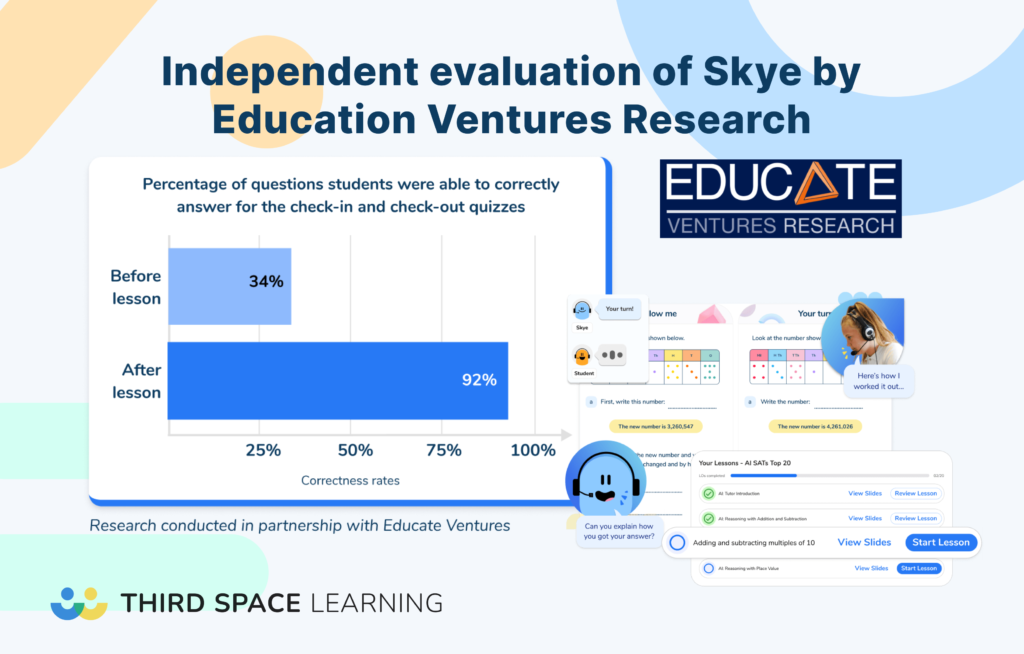
Independent research from Educate Ventures Research, led by Professor Rose Luckin of UCL, evaluated Third Space Learning’s AI maths tutor Skye and found that students improved from 34% accuracy at diagnostic check-in to 92% at check-out within sessions.
59.4% of students ended sessions with higher confidence, and 66% showed session-on-session confidence increases – strong evidence that well-designed AI tutoring can support attainment and confidence in parallel.
See how the Fairfax Multi-Academy Trust is using pupil premium funding for AI maths tutoring across four schools.
Why implementation quality matters more than modality
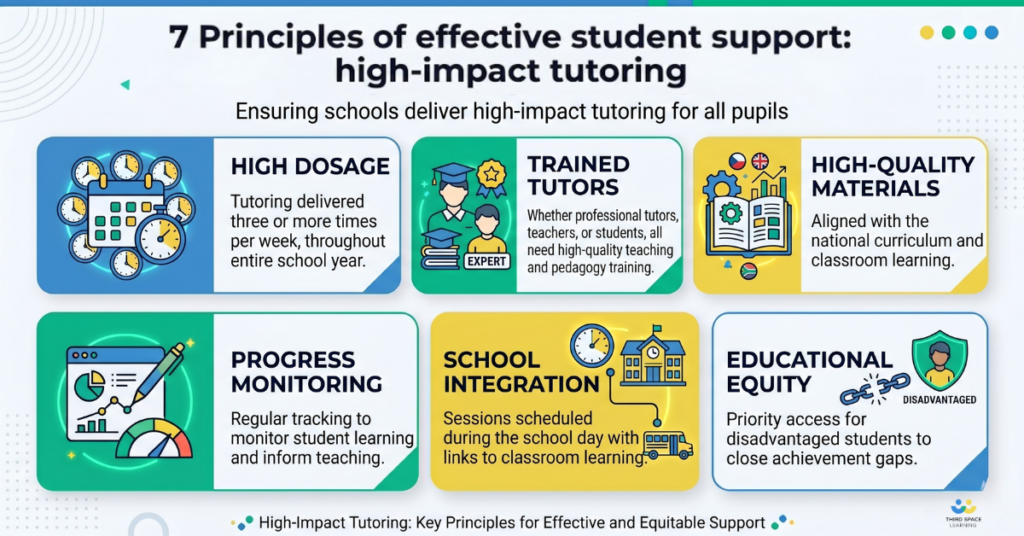
The EEF is clear that not all tutoring strategies deliver equally strong outcomes. What the research consistently shows is that modality, online versus face-to-face, matters far less than how tutoring is implemented. Whether you are working with experienced tutors online or a purpose-built AI tutor, what drives progress is whether tutoring is high-dosage, well-matched, consistently delivered, and connected to what students are learning in the classroom.

Online tutoring experts
Since 2013, Third Space Learning has provided high-impact online tutoring to 170,000+ children in primary and secondary schools across the UK as part of a maths intervention programme.
Drawing on more than 10 years of experience and over 2.1 million hours of online tutoring insights, our qualified teachers and maths experts have developed spoken AI maths tutor Skye.
This article acts as a guide covering all the aspects of online tutoring in the UK that you need to know about, including AI tutoring, including primary AI tutoring and GCSE AI tutoring.
School leaders and teachers should consider this guidance to ensure they choose the most effective maths interventions for their school.
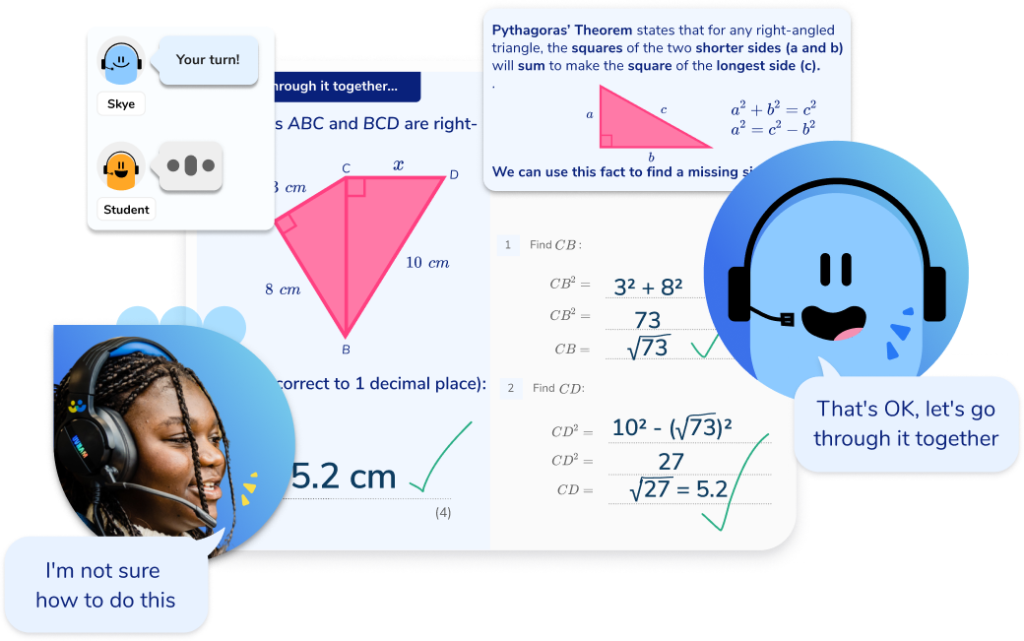
Human tutoring platforms vs AI tutoring: what schools need to know
The online tutoring market now operates across two distinct types of provision, and understanding which you are buying is one of the most important decisions.
Human tutoring platforms and websites operate as marketplaces. Often, you can filter tutors to find the perfect tutor for each student. Schools and parents search tutors, browse tutor profiles, filter by subject and availability, and book individual sessions. Many platforms let you take a first lesson before committing. Tutors range from university students to qualified teachers, and the quality of lessons depends heavily on the individual tutor selected.
Purpose-built AI tutoring operates on a different delivery model. These are not general chatbots – they are structured platforms built on established teaching pedagogy and real tutoring data, with curriculum-aligned content and diagnostic tools that deliver consistent one-to-one support to more students at scale.
Understanding which type of provision is right for your context matters for several practical reasons:
- cost per student
- scalability across a cohort
- consistency of lesson quality
- safeguarding
- administrative burden
Human tutoring platforms place the matching and scheduling work on the school; AI tutoring platforms handle that centrally.
Human tutoring
Human tutoring platforms are well-suited to situations where subject breadth matters. If you need an English tutor, a French tutor, support across sciences, or preparation for A level subjects and university entrance, human platforms give you access to many tutors with the right specialism. They also work well for older or higher-attaining students who benefit from building a relationship with an experienced tutor over time, and for short-term GCSE or A level exam preparation where a tutor needs to adapt flexibly to a student’s specific syllabus.
Most platforms allow you to search tutors, review tutor profiles, and filter by subject and availability. For schools, the key questions are:
- Have all tutors been DBS-checked before they teach students?
- What oversight exists once lessons start?
- How is lesson quality monitored?
AI tutoring
AI tutoring addresses a different problem: scale. If you need to provide one-to-one support to more students than your budget or timetable allows through human tutoring, a purpose-built AI tutoring platform makes that possible at a fraction of the per-session cost.
AI tutoring is particularly well-suited to core subjects like maths, where large numbers of students may need targeted support – at primary level for KS2 tutoring and SATs preparation, and at secondary level for GCSE intervention.
Third Space Learning’s AI tutor Skye is among some of the best tutoring for maths. Skye delivers structured, curriculum-aligned maths lessons written by qualified teachers and maths experts, with sessions available every five minutes before, during, or after school. All sessions are recorded, with built-in safeguarding. As the Educate Ventures Research evaluation shows, the outcomes for students – in both accuracy and confidence – are strong.
Research also suggests that anxious or quieter pupils can find the non-judgemental nature of AI interaction more accessible, making it a particularly useful tool for students who disengage in more traditional settings.
It is also worth noting that AI tutoring and intelligent tutoring systems currently have the strongest evidence base in maths at KS2 and GCSE. Here’s how schools like yours are using online AI tutoring across KS2 and GCSE maths.
What to look for in an online tutoring platform
The right fit depends on your subject need, age range, budget, and whether you are looking for human or AI provision. For a detailed comparison of the major UK platforms currently available, see this guide to the best online tutoring websites in the UK.
This section focuses on the evaluation principles that apply regardless of which type of platform you are considering.
1. Tutor quality and qualifications
For human tutoring platforms, “qualified” should mean at minimum a degree in the relevant subject, ideally alongside teaching experience or QTS, a current DBS check, and evidence of ongoing professional development. Most platforms state that all their tutors are vetted before they can teach students. School leaders should verify what that vetting actually involves rather than take it on trust. Expert tutors with a track record of teaching at GCSE or A level are not the same as university students offering their first lessons, and the platform’s transparency about this distinction matters.
For AI platforms, the equivalent question is about content authorship. Who writes the lessons? Are they created by qualified teachers and subject specialists, or generated by AI without meaningful oversight? Red flags include a lack of transparency about how content is produced and no evidence of teacher involvement in lesson design.
2. Safeguarding
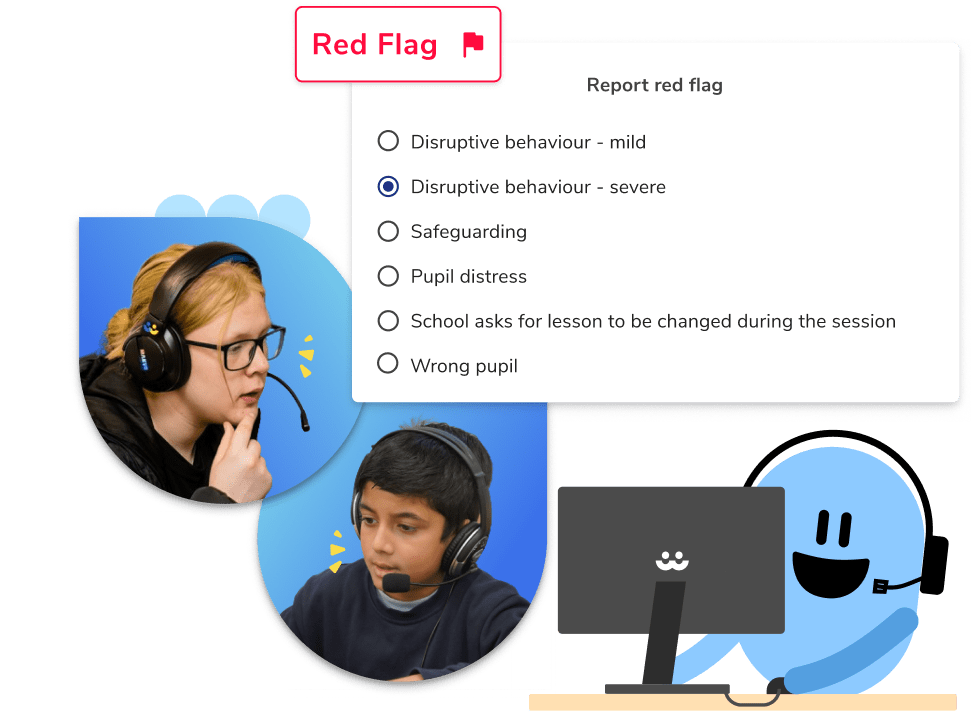
Safeguarding is non-negotiable for school procurement and should be one of the first questions you ask of any platform. For human tutoring platforms, check whether all tutors are DBS-checked, whether sessions take place on a secure platform rather than via personal video calls, and whether there is a clear process for raising concerns. On-platform messaging and recorded sessions are both strong indicators of a platform that takes its responsibilities seriously.
For AI platforms, question whether sessions are recorded and transcribed, how content is controlled, and what happens if a student raises a concern during a session.
Schools should also ensure any tutoring platform, human or AI, fits within their existing safeguarding and AI policies. Students learn safely when the platform has clear, verifiable protocols in place, not just a policy page on a website.
3. Curriculum alignment
Lessons should map explicitly to the national curriculum, not loosely adapted generic or international content. Good platforms use diagnostic assessment to identify gaps before tutoring starts, so that students receive support targeted at what they actually need rather than a generic programme.
When evaluating a platform, ask how lessons are sequenced, how the tutoring adapts to each student’s responses, and how progress is reported back to the school. A platform that cannot give clear answers to these questions is unlikely to deliver the grade-level improvements and targeted support that justify the investment.

4. Pricing and value
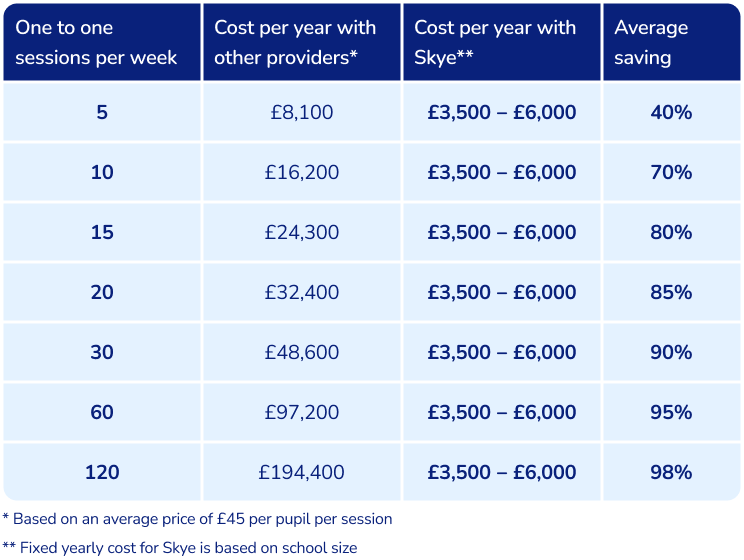
Online tutoring is significantly cheaper than in-person provision. For human tutoring platforms, expect to pay on average £15–£35 per hour, with GCSE and A level specialists typically even higher.
The hourly rate varies by subject, tutor experience, and platform. Most human platforms operate on a per-session payment system, which gives flexibility but makes costs harder to predict at scale.
AI tutoring is typically more affordable tutoring and operates on a fixed annual subscription rather than a per-session model – a fundamentally different cost structure that makes it considerably more cost-effective when you are supporting a large cohort.
Third Space Learning’s unlimited model, for example, starts from £3,500 per year for primary schools, and £5,000 for secondary schools, with no cap on the number of sessions or students. When evaluating cost, it is worth looking at the total cost per student across a full year, not just the headline price per hour or per week.
Getting the most from online tutoring: implementation principles
Buying tutoring and expecting it to run itself is where many schools go wrong. The evidence for one-to-one tuition is strong, but it is not unconditional – outcomes depend heavily on how well the provision is embedded into school life. These principles apply whether you are using a human tutoring platform or an AI system.
Before committing to a specific platform, it is worth stepping back and considering what tutoring for schools model best fits your context.
1. Link tutoring to classroom teaching
Tutoring delivers the most value when it reinforces what students are already learning, not when it runs as a parallel programme disconnected from the curriculum. Share what your class teachers are covering so that tutors can sequence their lessons accordingly.
2. Use diagnostic data to select the right students
Not every student benefits equally from tutoring. Use assessment data to identify those with specific, addressable gaps rather than allocating places based on availability alone. Targeted support is more likely to produce measurable progress than a broad, undifferentiated approach.
3. Commit to a regular schedule
Weekly sessions consistently outperform ad hoc ones. Students who attend regularly develop confidence over time and build on each lesson rather than starting from scratch. A stable schedule also makes it easier to monitor whether tutoring is working and to adjust if it is not.
4. Brief the student
Students who understand why they are receiving tutoring, what success looks like, and how it connects to their learning in school are more engaged and more likely to succeed. A short conversation before the first lesson makes a meaningful difference.
5. Communicate with parents
Informing families about the purpose of tutoring and the progress their son or daughter is making consistently improves outcomes. Research shows that parental engagement meaningfully increases the impact of tutoring, and keeping families informed helps build the wider support that students need to develop.
6. Monitor and adjust
The National Tutoring Programme – which ended in 2024 but established many of the good practice norms that still apply – was clear that schools should treat tutoring as a dynamic intervention, not a set-and-forget one. Review progress at regular intervals, check in with tutors and students, and be willing to change approach if the evidence suggests it is not working.
Choosing the right online tutoring provision for your school
Online tutoring is one of the most evidence-backed interventions available to schools – but the provision you choose, and how you implement it, determines whether that evidence translates into real outcomes for your students. The decision is not simply which platform to use, but which type of online tutoring fits your school’s context, budget, and needs.
Whichever path you decide to go down, the starting point is the same: be clear about what you need, check the evidence behind any platform you are considering, and treat implementation as seriously as procurement.
Frequently asked questions
The Education Endowment Foundation rates one-to-one tuition as delivering an average of five months’ additional progress. Online tutoring is broadly as effective as face-to-face when implemented well. What drives outcomes is not the modality but the quality and consistency of delivery.
Human tutoring platforms typically charge £15–£35 per hour, with GCSE and A level specialists at the higher end. Most operate on a per-session payment system. AI tutoring platforms use a fixed annual subscription – Third Space Learning’s unlimited model starts from £3,500 for primary schools.
Provided the platform meets school safeguarding standards, online tutoring should be safe. For human tutoring, check tutors are DBS-checked, and sessions are recorded. For AI platforms, verify how content is controlled. Any platform should fit within your school’s existing safeguarding and AI policies.
Virtually any subject: maths, English, science, modern languages, and primary through to A level. Third Space Learning specialises in maths – Skye covers primary (KS2 and SATs) and secondary (GCSE). For broader subject coverage, including French and sciences, human tutoring platforms offer more choice.
Online tutoring with Third Space Learning can double a child’s progress over a period of 14 weeks. We ran a trial using a standardised assessment test and children who received our one to one online maths tuition achieved double their expected progress. They made 28 weeks progress in 14 weeks. Find out more in our case studies from schools who’ve seen excellent success with our online tutoring.

DO YOU HAVE STUDENTS WHO NEED MORE SUPPORT IN MATHS?
Skye – our AI maths tutor built by teachers – gives students personalised one-to-one lessons that address learning gaps and build confidence.
Since 2013 we’ve taught over 2 million hours of maths lessons to more than 170,000 students to help them become fluent, able mathematicians.
Explore our AI maths tutoring or find out about online maths tuition for your school.