
Safe and effective use of generative AI in education: what the DfE guidance means for your school

AI has moved from the early-adopter margins into everyday school work. Official DfE data for 2024–25 shows 44% of teachers using generative AI in education, mainly for planning and preparation. Twinkl’s 2025 survey puts that closer to 60%, and Teacher Tapp polling from April 2026 found one in five teachers had planned their most recent lesson with AI. Interestingly, the governance situation has barely shifted: most teachers report no meaningful training, half say their school has no AI policy at all, and two-thirds say there is nothing specific to pupil use.
This article is designed as a leadership-level guide to the current DfE landscape on generative AI in education: what’s been published, what’s changed and evolved in the updates, and how to act on it safely in your setting.

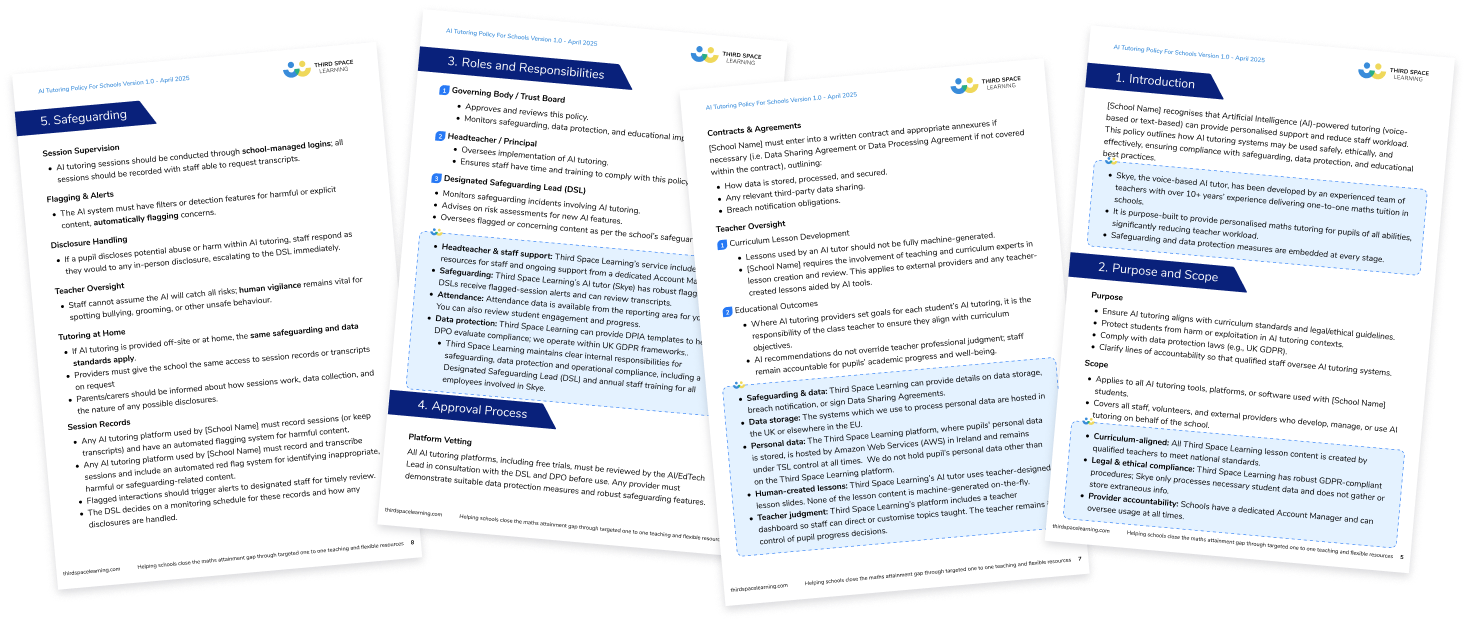
AI Tutoring Policy for Schools
A practical framework to help you integrate AI tutoring in your school and meet data protection and safeguarding requirements – includes an editable policy template
Download Free Now!What the DfE has published: the latest picture
The DfE’s generative AI guidance for schools now rests on three main pillars:
1: The Generative AI product safety standards
The product safety document has been renamed and expanded to Generative AI: product safety standards, updated on 19 January 2026 and launched at the UK AI for Education Summit. It was first published in January 2025 as Generative AI: product safety expectations.
2: The Using AI in education settings: support materials collection
The Using AI in education settings: support materials collection was refreshed on 19 May 2026 for the 2026–27 academic year, with four modules plus a leaders’ support pack and Chartered College of Teaching assessment and webinars. This includes operational aspects and SEND-focused materials.
3: The core policy paper Generative artificial intelligence (AI) in education.
The core policy paper Generative artificial intelligence (AI) in education remains the narrative backdrop. It was first published on 29 March 2023 and last updated on 12 August 2025, when links to Ofsted’s AI inspection guidance and research were added.
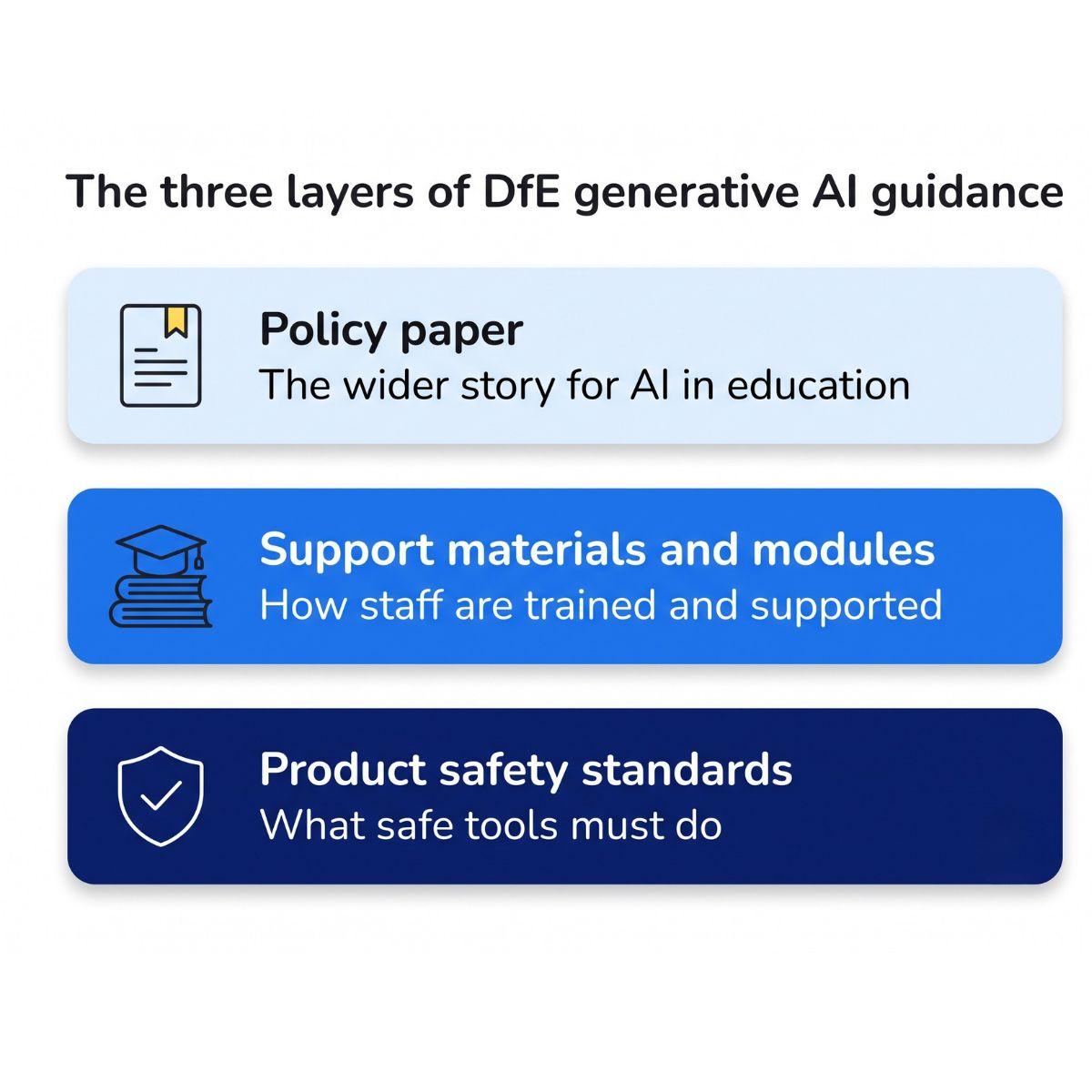
You can think of these as three layers: what safe AI tools must do, how staff should be trained and supported, and the broader policy story for generative AI in education.
Generative AI tools: product safety standards
The DfE product safety standards are now the clearest statement of what “safe and effective” means for AI tools used with pupils.
They require AI tools to:
- State their purpose and evidence claims honestly, picking from defined educational use cases.
- Provide filtering and monitoring of learner-facing content, with logging, DSL alerting and clear safeguarding-disclosure routing.
- Meet security and privacy expectations: UK GDPR, Data Protection Act 2018, ICO Children’s code, and no use of pupil or teacher data or IP for commercial purposes or model training without a lawful basis or consent.
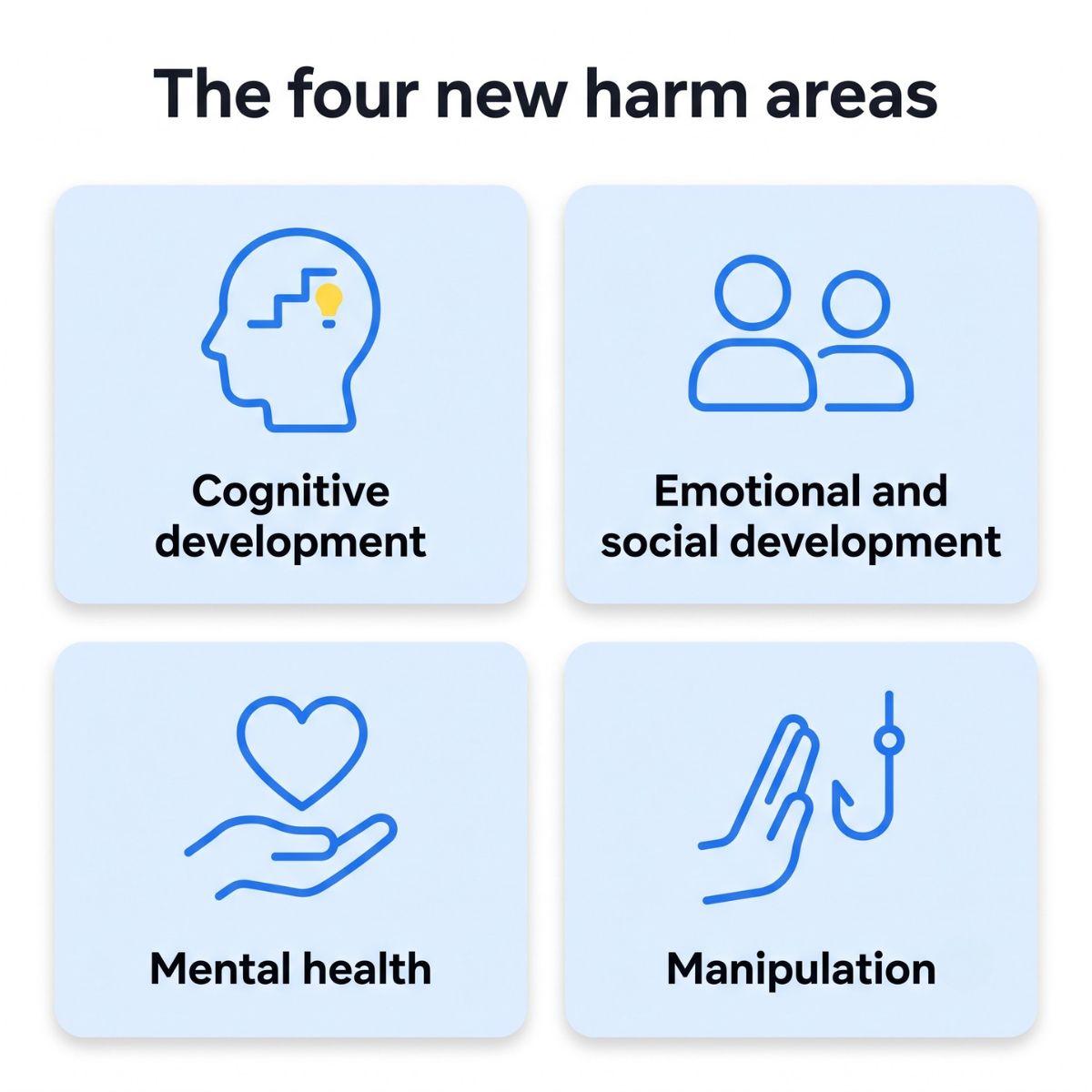
The January 2026 update added four new harm areas:
- Cognitive development: AI tools should not encourage cognitive offloading by giving final answers, full solutions or complete worked examples by default. The standards expect progressive disclosure – starting with hints or partial steps, and only showing a full solution after a genuine learner attempt – to guard against cognitive deskilling.
- Emotional and social development: AI tools should avoid anthropomorphism and “I” statements, avoid isolating language, and set time limits.
- Mental health: AI tools must detect distress signals and route concerns to human help via the DSL.
- Manipulation: no sycophancy, no deceptive or dark-pattern UX, and no engagement-maximising design intended to keep pupils in the AI tool.
For school leaders, this standard is now the checklist to use when you assess any AI product: if a vendor cannot show how they meet these requirements, the risk is likely too high. It’s worth noting that many ‘out of the box’ consumer AI tools like ChatGPT and Claude do not align with these standards, simply because they lack school-specific logging, cognitive development controls, and DSL-linked safeguarding flows.
The support materials collection for staff and leaders
The refreshed support-materials collection is structured as four modules plus a separate leaders’ pack:
- Module 1 – Understanding AI in education
- Module 2 – Interacting with generative AI in education
- Module 3 – Safe use of generative AI in education (the DfE explicitly says this should be used regardless of experience level)
- Module 4 – Use cases of generative AI in education
Alongside these sits Using AI in education: support for school and college leaders, and the Chartered College adds a certificated multiple-choice assessment and webinars mapped to the modules.
This gives you a ready-made structure: staff literacy, safe use, and practical use-cases, underpinned by a leader-specific pack you can use to help staff explore different generative AI tools and their practical applications in educational settings as part of your whole-school approach. All at no cost!
Safeguarding context: KCSIE and Ofsted
The standards explicitly cite Keeping children safe in education (KCSIE), particularly parts 1, 2 and 5. KCSIE 2025 is in force until 31 August 2026 and addresses generative AI within online safety. KCSIE 2026 was published on 7 July 2026 for information and comes into force on 1 September 2026, so write your AI policy against the 2026 wording now, while the 2025 version still governs anything you do before then.
Ofsted does have AI-specific material. Its approach to AI collection page dates from April 2024, and How Ofsted looks at AI during inspection and regulation was published on 27 June 2025 and updated on 21 October 2025. The position it sets out is that Ofsted does not look at AI as a stand-alone part of inspection and does not directly evaluate any AI tool, but inspectors can consider the impact that the use of AI has on the outcomes and experiences of children and learners. The school inspection toolkit itself makes no mention of AI, in either the version published in September 2025 or the version re-issued for September 2026. Ofsted’s Annual Report 2024/25, published in December 2025, does address AI directly, in a chapter on navigating its opportunities and challenges.
Why the guidance matters now
The guidance has evolved at an important moment, where AI is becoming more present in day-to-day school life for many staff and pupils. Here’s a round-up of how schools are using AI:
On the staff side:
- In the DfE Technology in schools survey 2024–25, 44% of teachers reported using generative AI for school activities, most commonly for lesson planning (35%), with much lower use for delivering live lessons (7%) and marking (5%).
- Independent surveys suggest the trend is sharper still: a 2025 Twinkl survey found 60% of UK educators using generative AI in education, up from the 31% the National Literacy Trust recorded in 2023, and an NEU 2026 survey found 76% of teachers now using AI day-to-day, up from 53% the year before.
On the pupil side:
The pupil picture is of AI-native learners whose habits are ahead of many schools’ policies.
- Ofcom’s Children and Parents: Media Use, and Attitudes report, published in May 2026, found that 56% of children aged 8–17 had used generative AI in 2025, up from 50% the year before and 46% two years before that. Use for schoolwork and homework is the fastest-rising category, climbing from 34% in 2023 to 45% in 2024 and 51% in 2025.
- Oxford University Press’s Teaching the AI-Native Generation study, published in October 2025, found that 80% of UK students aged 13–18 used AI in their schoolwork, yet only 47% felt confident identifying accurate AI-generated information, and 51% worried resources may be biased or reinforce untrue stereotypes.
- National Literacy Trust research with more than 60,000 young people found two-thirds (66.5%) of 13–18s using generative AI in 2025, with homework help among the top uses. That is a fall from 77.1% in 2024, but the proportion admitting to “just copying” AI outputs for homework rose from 20.9% to 25.1%.
Parents and teachers are alive to the risks. Oxford University Press found that 60% of 13–18s worry AI encourages copying over original work, and NEU data shows 66% of secondary teachers think pupils’ critical thinking has declined because of AI – though that is teacher perception rather than measured decline, and the primary figure is only 28%. The government’s plan for piloting AI tutors for disadvantaged pupils has also been met with a fairly muted reception.
Against this backdrop, the DfE’s standards and support-materials are not optional extras; they are the baseline for any school that wants to meet its safeguarding, curriculum and equity responsibilities while adopting AI safely.
Five themes: our reading of the guidance
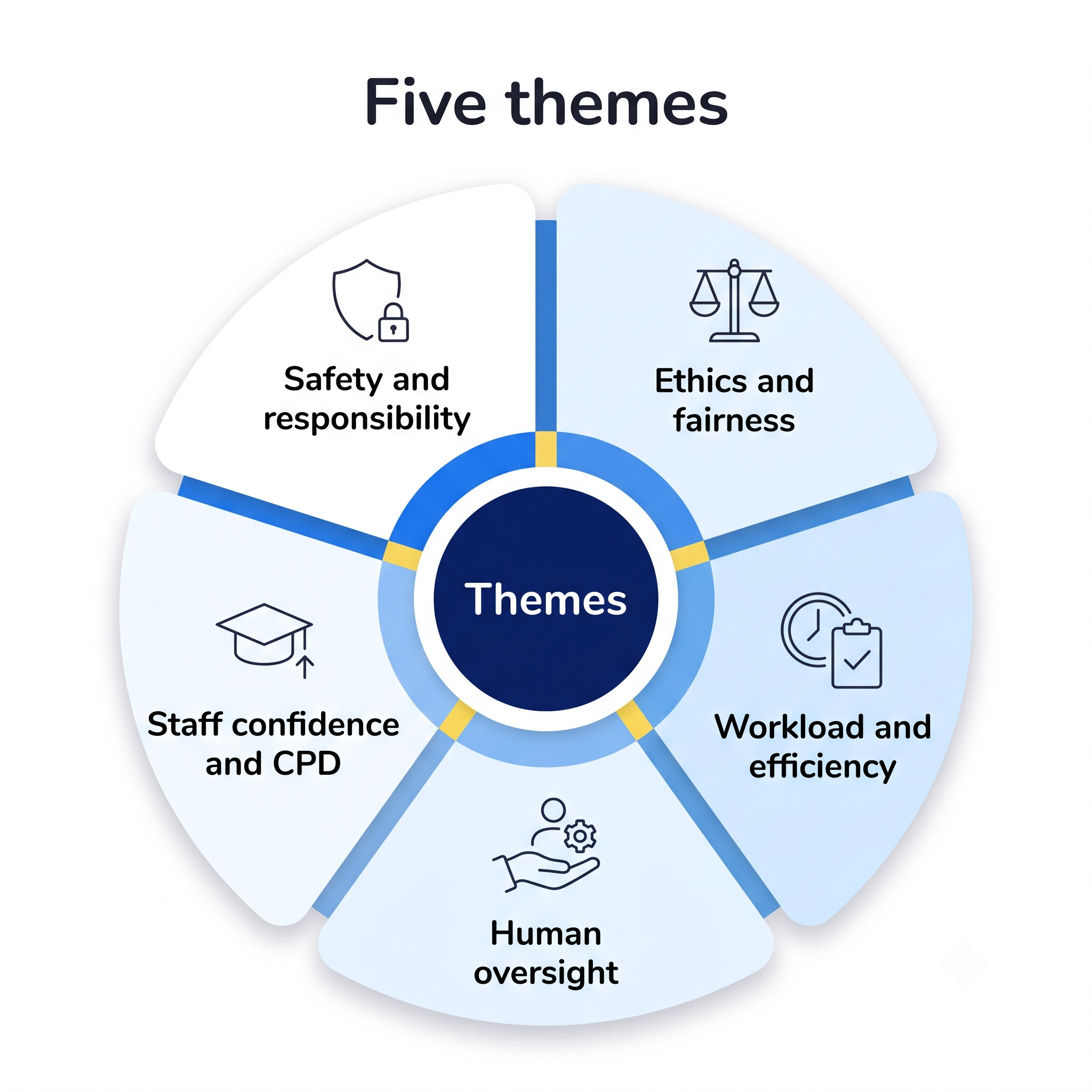
The original article organised the early guidance into five themes and a 10-step leadership guide. Those themes and steps were our editorial synthesis, not the DfE’s own structure. In this refresh, we keep the synthesis because it helps leaders act, but we are explicit that it is Third Space Learning’s reading of the guidance, sitting alongside the formal modules and standards.
1. Safety, data privacy, and responsibility
Safety now means more than filters. It means matching generative AI technologies and generative AI tools to clearly defined educational purposes, meeting data-protection obligations, addressing data privacy and intellectual property concerns, and aligning with KCSIE and the four harm areas in the product safety standards.
This is also where the sharpest new risks sit: the rapid rise of AI-generated child sexual abuse material online, and evidence from schools of pupils creating sexually explicit deepfakes.
2. Ethics and fairness
Ethical use of generative AI in education means confronting bias, hallucination and equity head-on, not assuming the technology is neutral.
- Many young people worry AI tools and resources may be biased or reinforce untrue stereotypes.
- Data on children’s AI use shows a digital divide by socio-economic group: Ofcom found 67% of children in ABC1 households had used generative AI in 2025, against 46% in C2DE households. The picture is not settled, though – the National Literacy Trust found almost no gap by free school meal eligibility (66.7% against 67.0%), while pupils eligible for free school meals were more likely to copy AI outputs (30.0% against 24.0%).
The government’s equity framing matters here: the Every Child Achieving and Thriving white paper is explicit that access to tutoring is deeply unequal, and that AI tutoring policy is partly about bringing one-to-one support, often reserved for the privileged, to scale.
3. Workload and efficiency
The evidence on workload is still emerging, but there are clear signals that well-scaffolded use can reduce administrative burdens for teachers without harming quality.
- An EEF/NFER trial published in December 2024 found that teachers using ChatGPT alongside a support guide cut weekly lesson and resource planning time by around 31% – 56.2 minutes a week against 81.5 for the control group – with no noticeable difference in lesson quality. Keep the scope in mind: it covered Year 7 and 8 science across 68 English secondary schools, and the EEF itself says the quality finding rests on a limited sample and should be treated with caution.
- Some things generative AI tools can do for you or your teachers:
- Automate grading and provide personalised feedback, especially for time-consuming tasks tied to reviewing student work.
- AI can also generate quizzes and exercises for courses.
- Generative AI can provide instant, personalised feedback to students.
- Developer-reported data cited by government suggests larger potential savings in specific AI tools, but these should be treated as pilots, not independent trials.
The guidance is clear that workload gains must not come at the expense of cognitive development or safeguarding; the standards explicitly guard against AI tools that give final answers, full solutions or complete worked examples by default, even where some systems use data analysis of student performance to tailor content.
4. Human-in-the-loop
Across the guidance and the white paper, one line is consistent: generative AI should complement high-quality teaching, not replace it.
- The direction of travel is that general-purpose generative AI is a poor substitute for teaching, because it tends to hand over answers rather than build understanding, while tools built specifically for education and rooted in good pedagogy show more promise. The product safety standards put the same principle in enforceable terms, requiring products to support rather than replace learners’ own cognitive effort.
- The DSIT announcement of 26 January 2026 committed that AI tutoring tools will be co-created with teachers and industry, available to schools by the end of 2027, and will complement high-quality face-to-face teaching, not replace it. Up to 450,000 pupils a year in Years 9–11 on free school meals could benefit if the programme is rolled out and expanded but the initial programme supports up to 4 schools with eight partners (roughly 32 schools).
For leaders, this is the frame to use in your own policies: AI should sit under teacher oversight, within curriculum and assessment design, and within safeguarding systems – not as a standalone “assistant” pupils are left to navigate alone.
5. Staff confidence and CPD
The data shows a sharp training gap:
- In 2025, most teachers reported not having had adequate training on AI, despite large numbers already using it in their work, and only a small minority felt AI was well-regulated.
- By 2026, half of teachers said their school still had no AI policy for staff or students, and two-thirds said there was no policy specific to pupil use.
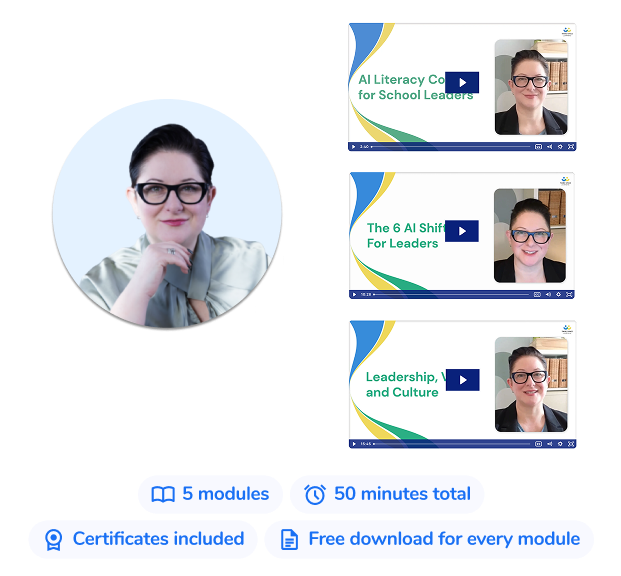
The DfE’s modules and leaders’ pack, plus Chartered College assessment, give you ready-made content for closing this gap; the challenge is prioritising time and helping staff develop understanding of AI tools, stay informed, and build confidence through a whole-school plan that supports stronger educational practices across the school and wider education sector. Third Space Learning’s free AI literacy course for school leaders is a good starting point for building this into your CPD plan.
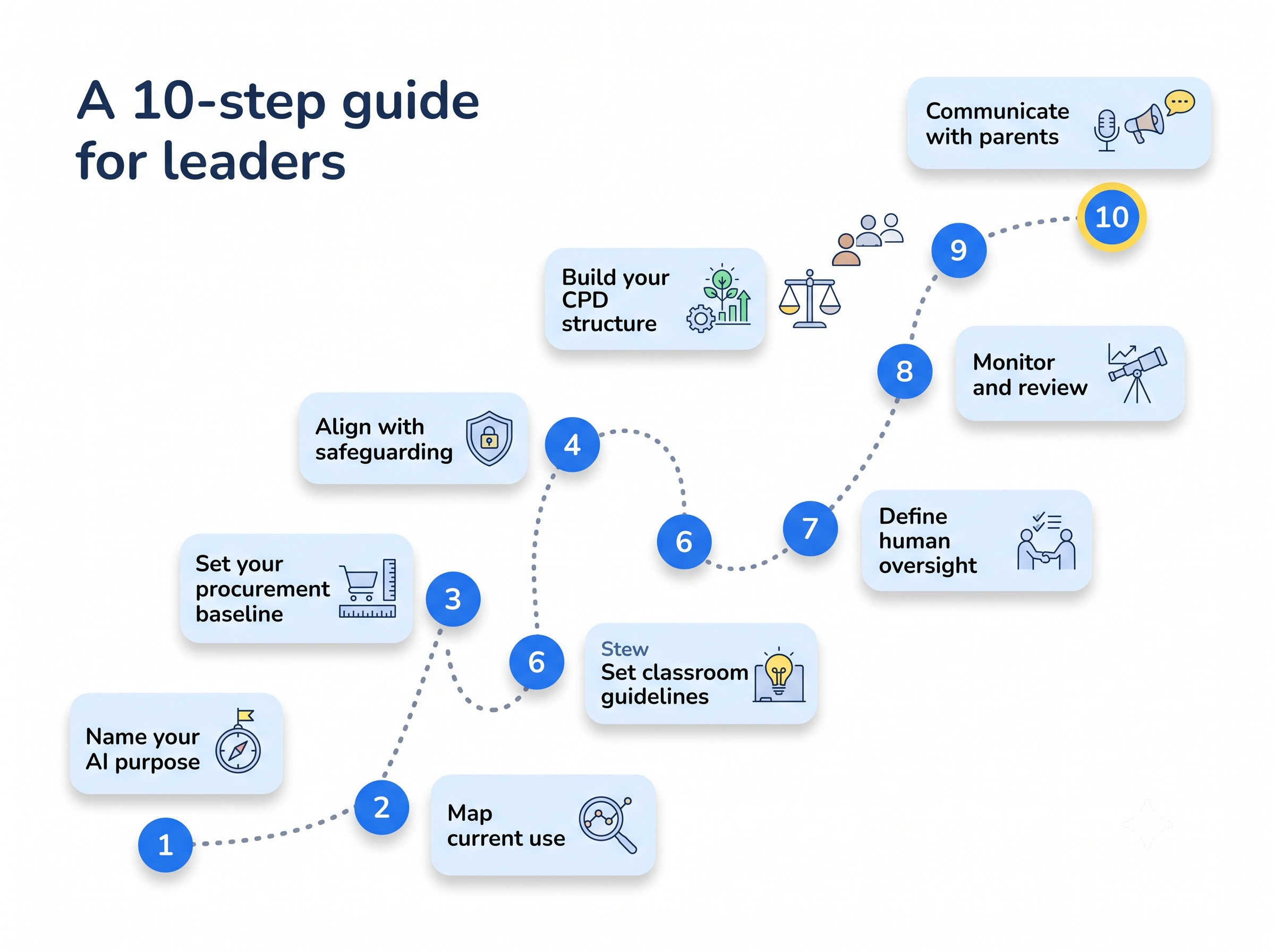
Taking the lead: a 10-step leadership guide
You can adapt this to your context, but as a starting point:
- Name your AI purpose: Decide where AI can genuinely help (planning, admin, specific tutoring, accessibility), including creating lesson plans or personalised materials where they can enhance engagement and motivation, and where it must not be used without a teacher in the loop. Note that the DfE’s standards list assessment and analytics as a defined educational use case, so the question is not whether AI can touch assessment at all, but whether a teacher stays accountable for the judgement. Link each use to a clear educational purpose and evidence base.
- Map current use: Use staff surveys and pupil voice to understand which AI tools are already in use, for what, and with what safeguards; expect reality to be ahead of AI policy.
- Make the product safety standards your procurement baseline: Require vendors to show how they meet each point, including the four harm areas and data-protection obligations.
- Align with KCSIE 2026 and safeguarding: Ensure your AI policy and any AI tool deployment routes concerns through DSL structures and sits visibly within online-safety and safeguarding policies, using the 2026 wording that takes effect on 1 September 2026.
- Use the DfE support materials as your CPD structure: Plan staff training across Modules 1–4, with Module 3 as non-negotiable, and integrate the leaders’ pack and Chartered College assessment where appropriate, including curriculum design as a practical use case.
- Set clear classroom guidelines for pupil use: Decide how far pupils can use AI for drafting or homework, how you will guard against cognitive offloading, and how you will teach students to interrogate AI-generated content for bias and accuracy in ways that preserve their own understanding and critical thinking skills.
- Define your human-in-the-loop rules: Make explicit that teachers remain responsible for curriculum, assessment and pastoral care; AI tools are supports, not decision-makers, echoing the white paper’s “complement not replace” line.
- Plan for equity and the digital divide: Use data on disadvantage gaps, tutoring impact and AI access to ensure your AI strategy closes gaps rather than widening them, for example by focusing AI investments on structured support for disadvantaged pupils and using AI to enable personalised learning that adapts to student needs and different learning styles.
- Monitor, review and retire tools: Build in processes for reviewing tools against the standards and your own outcomes, and for retiring tools that prove too risky or ineffective; track learning outcomes, whether tools support learning, and whether use is building deeper understanding rather than just speeding up task completion.
- Communicate with parents and pupils: Share your approach transparently, acknowledging both benefits and risks, and invite questions. Use evidence from parent and pupil surveys to show you take concerns seriously.
What’s new in this refresh
Since the original guidance was published, several things have evolved.
The headline changes are:
- The product safety expectations have become a full Generative AI: product safety standards document, renamed and expanded in January 2026 with explicit cognitive, emotional/social, mental-health and manipulation harm areas. It’s worth noting that these standards are guidance and are not legally binding but we do believe they act as a strong compass around what you should expect from products – ultimately they are the DfE’s expected safety baseline for generative AI products used in education.
- The support-materials collection has been refreshed for 2026–27, with a sharpened module structure and leaders’ pack, plus Chartered College assessment and webinars.
- The government’s Every child achieving and thriving schools white paper, published on 23 February 2026, has pivoted decisively towards AI tutoring as a scalable route to equity, confirming and extending the product-safety focus on mental, social and cognitive development across the wider education sector.
- KCSIE 2025 is in force until 31 August 2026, with generative AI explicitly addressed within online safety, and KCSIE 2026 was published on 7 July 2026 and comes into force on 1 September 2026.
Limitations and what to watch next
The data and policy picture is still moving, and there are things you should be cautious about claiming, with future research still needed on long-term impacts across the educational system.
- The core Generative artificial intelligence (AI) in education policy paper has not been substantively rewritten since 12 August 2025, despite everything that has moved around it; check the GOV.UK page directly before describing its current status.
- Some evidence is flagged as developer-reported and should be used as indicative, not as proof; independent trials like the EEF ChatGPT study carry more weight because they are grounded more clearly in science, but still require nuance.
- There are genuine data gaps, for example on pupils using AI specifically for maths homework in 2025–26; resist the temptation to manufacture numbers to fill these gaps.
Looking ahead, key things to watch include:
- The EEF/NFER trial of Oak’s Aila lesson-planning assistant, with a report due in autumn 2026.
- The Curriculum and Assessment Review recommendations on AI and assessment, including replacing the computer science GCSE with a broader computing GCSE that folds in AI and digital literacy, and leaning towards exams over coursework. The revised curriculum is due to be published by spring 2027, for first teaching from September 2028.
- Any further Ofsted guidance that addresses AI more directly, and how KCSIE 2026 beds in from 1 September 2026.
AI tutor Skye: an example worth noting
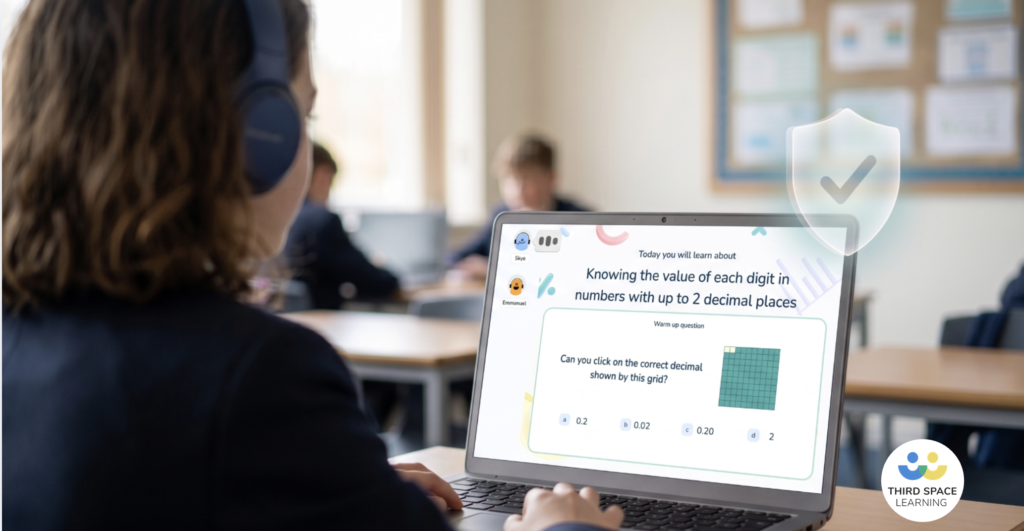
Within this policy landscape, AI maths tutor Skye is one example of generative AI in education with real-life practical applications, designed to meet the DfE’s product safety standards.
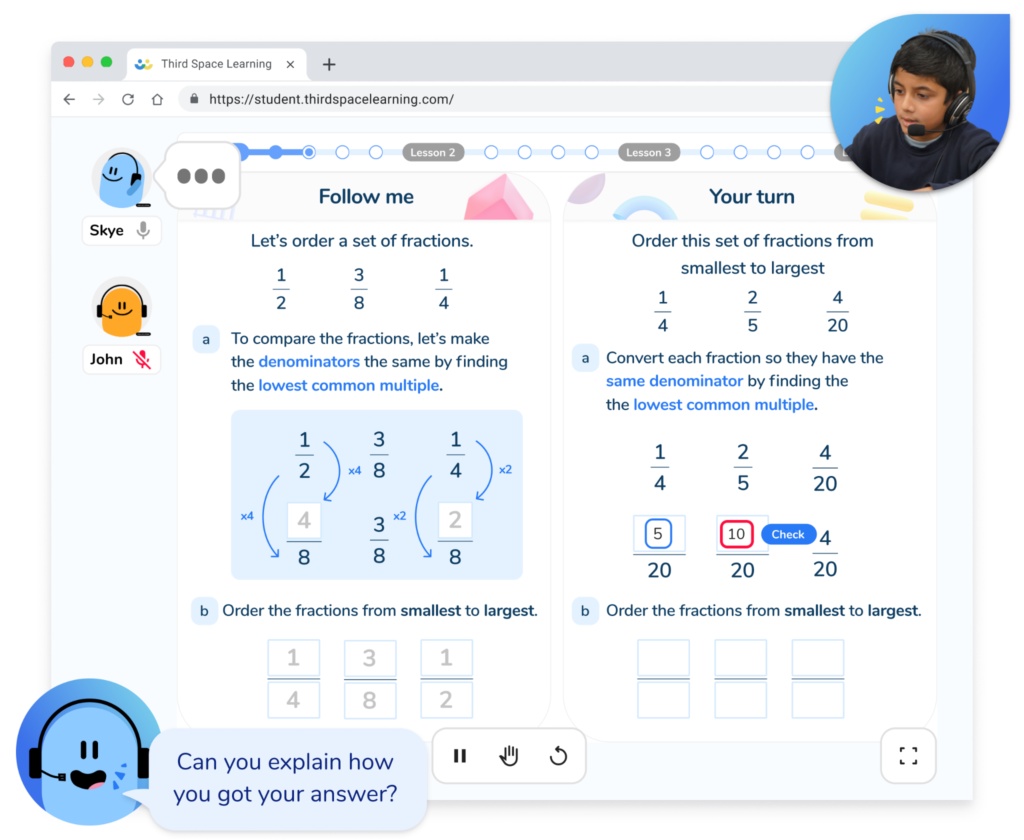
Skye’s design starts from two non-negotiable distinctions:
- Skye delivers lessons designed by expert teachers; AI is simply the delivery mechanism, not the curriculum creator.
- Skye does not give final answers by default: it follows the progressive-disclosure principle the product safety standards now expect for cognitive development, offering hints and partial steps first, and modelling or revealing a full solution only after a genuine attempt and where that is pedagogically appropriate. The aim is to help students build knowledge and skills in maths while keeping their ability to reason independently.
From a safety standpoint:
- Sessions are audio-only, with a shared whiteboard of pre-approved, teacher-made lessons; Skye has no access to the wider internet and cannot generate anything beyond the lessons.
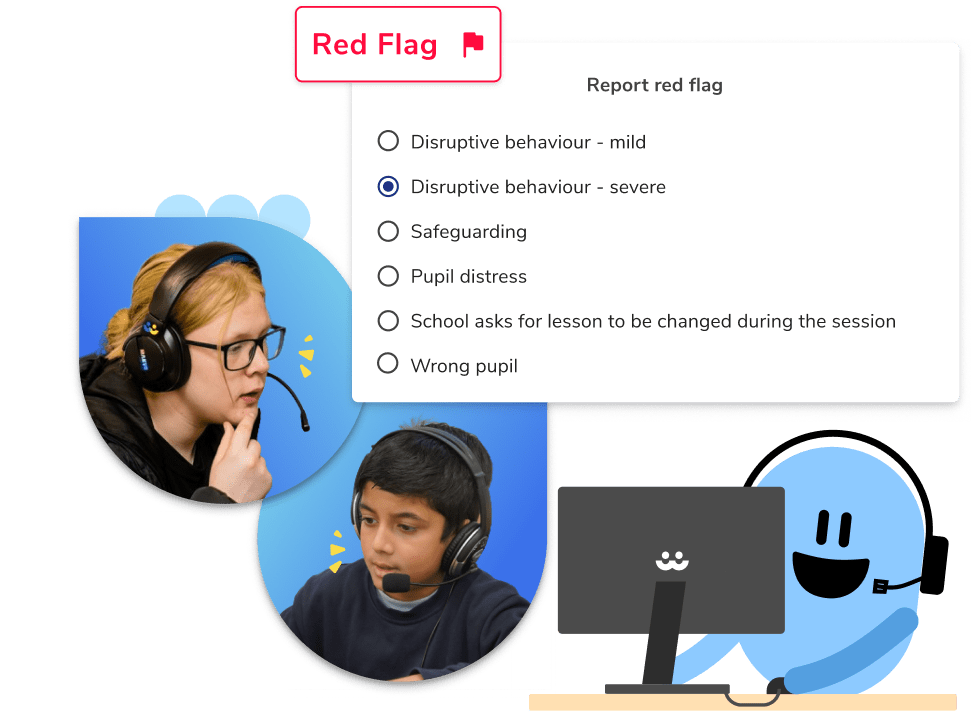
- All sessions are recorded and transcribed, with school staff supervising; concerns are flagged, not “detected”, and escalated to the school’s DSL, aligning with KCSIE and the mental-health and safeguarding expectations in the standards.
- Skye is hosted on AWS in the UK or EU, aligned with UK GDPR and the Data Protection Act 2018. Third Space Learning acts as an independent data controller rather than a processor, because it exercises pedagogical judgement when delivering tutoring and can act independently where a safeguarding concern arises. Your school remains the controller of the decision to use Skye and of which pupils take part.
On the emotional/social and manipulation fronts:
- Skye’s conversational design avoids anthropomorphism and “I” statements and is time-bound, with finite lessons rather than engagement-maximising loops.
- There are no dark-pattern or attention-extending UX features; the aim is to help pupils work through a maths lesson, not to keep them inside the programme.
In terms of impact and credibility:
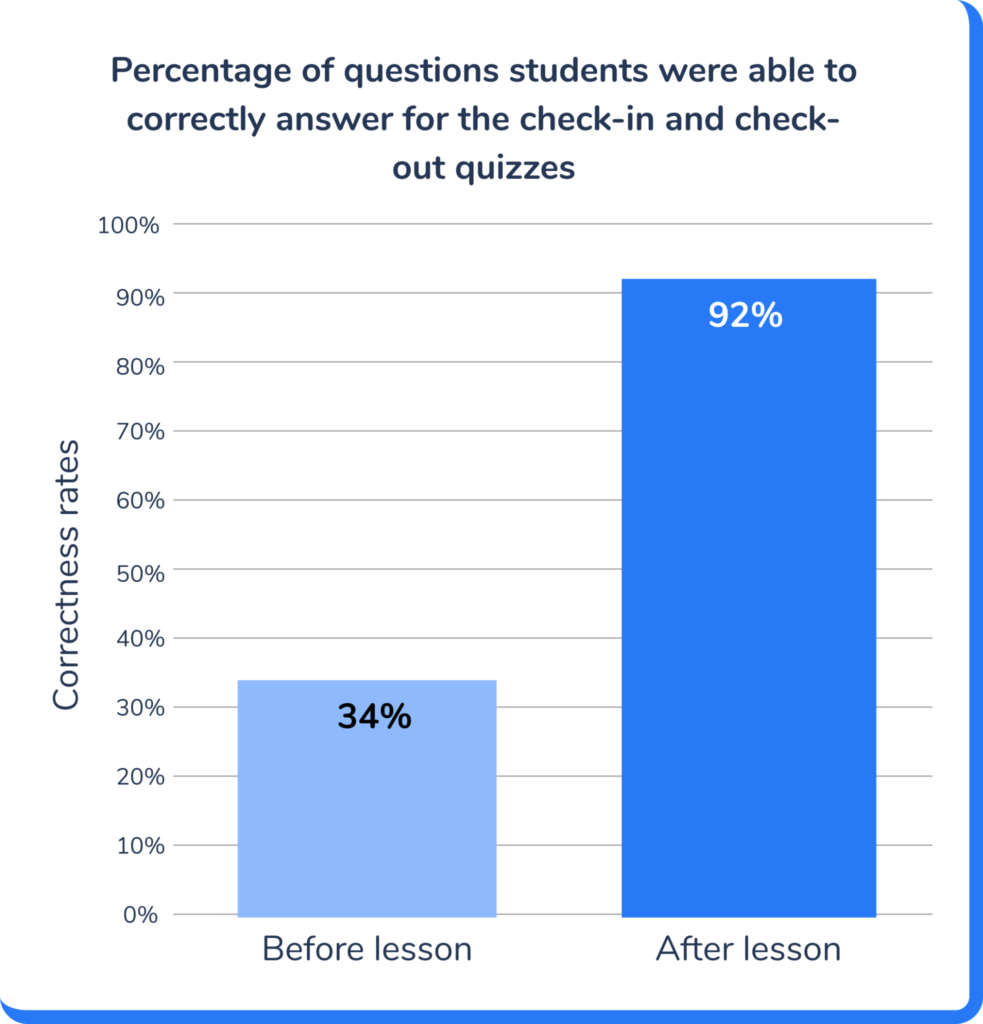
- In its first year (2024/25), Skye supported 747 pupils across 89 schools, delivering more than 6,500 one-to-one tutoring sessions. Within those sessions, quiz correctness rose from 34% at check-in to 92% at check-out, and 63.8% of pupils reported an increase in confidence by the end of a session.
- An independent case study of Skye by Educate Ventures looks at this evidence in more depth, across 9,320 sessions, six teacher interviews and a pupil survey. Educate is clear that it is not yet estimating standardised attainment impact, which would require a controlled design, so treat these as within-session learning signals rather than proof of attainment gains.
Where to begin
If you are at the beginning of your school’s AI journey, or trying to move from ad-hoc use to something more deliberate, the most practical place to start is with:
- The Generative AI: product safety standards as your procurement and AI tool-assessment checklist, including how you evaluate different generative AI tools and whether large language models are being used appropriately.
- The Using AI in education settings: support materials modules and leaders’ pack as your CPD structure, particularly Module 3 on safe use, with practical examples of how staff can create resources and how Generative AI can analyse student performance data for tailored content.
- A simple, honest map of where AI is already being used in your school, and how that lines up against the standards, safeguarding and your curriculum priorities, so you can explore create-focused use cases while keeping human oversight in place.
Third Space Learning’s free AI literacy course and wider resources on AI policy for schools, AI training for teachers and AI tutoring evidence can help you use this guidance in practice, rather than starting from a blank page.