

New Ofsted Framework: Report Cards, Grades and the 2026 Updates Explained

The new Ofsted framework has been in use in schools since 10 November 2025. It replaced the 2019 framework and single-word judgements with report cards, a five-point grading scale and a new school inspection toolkit. From September 2026, Ofsted has also made its first annual updates to those toolkits.
This guide explains what changed under the renewed education inspection framework, how report cards and monitoring inspections work, and what the updates mean for your school. It covers state-funded schools, non-association independent schools, early years settings and further education and skills providers in England.
Key takeaways
- The new Ofsted framework has applied to inspections of state-funded schools, early years and FE and skills providers since 10 November 2025.
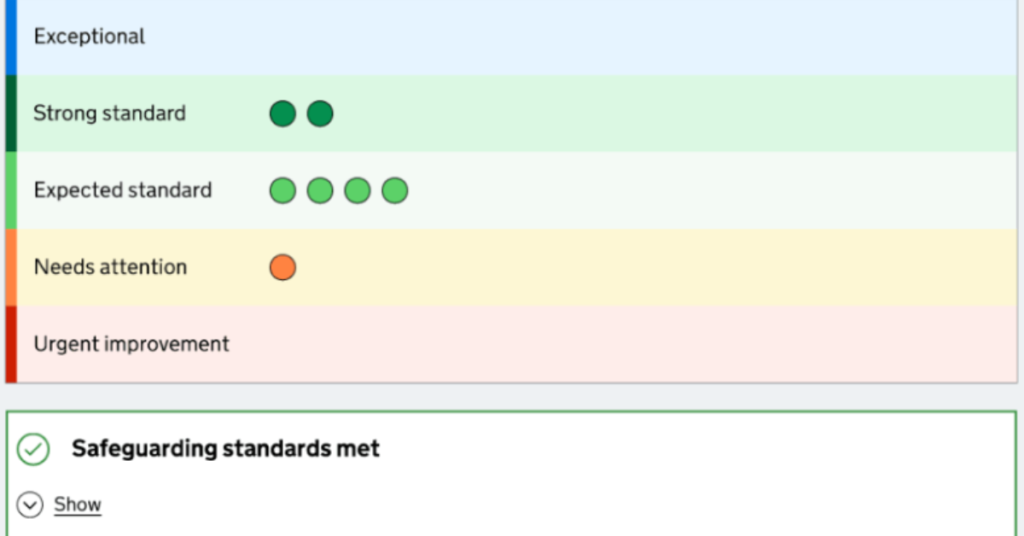
- Report cards replaced single-word judgements, with a grade for each evaluation area on a five-point scale from exceptional to urgent improvement.
- Safeguarding is judged separately as ‘met’ or ‘not met’.
- All routine inspections are now full, graded inspections on a four-year cycle, and ungraded inspections have ended.
- Inspectors use a toolkit and a planning call with leaders instead of deep dives.
- Schools with areas graded ‘needs attention’ or ‘urgent improvement’ receive monitoring inspections.
- Since September 2026, Ofsted updates its toolkits every year. The 2026 updates cover achievement against similar schools, a wider view of inclusion and changes to learning walks.

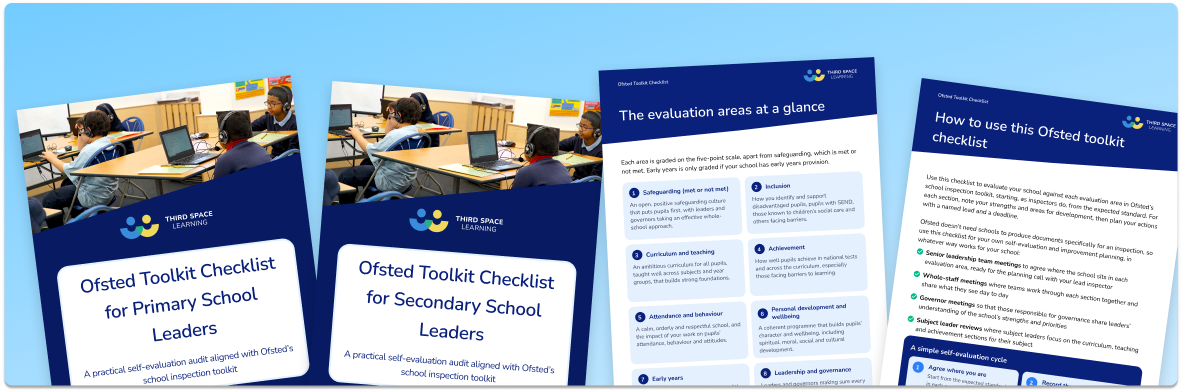
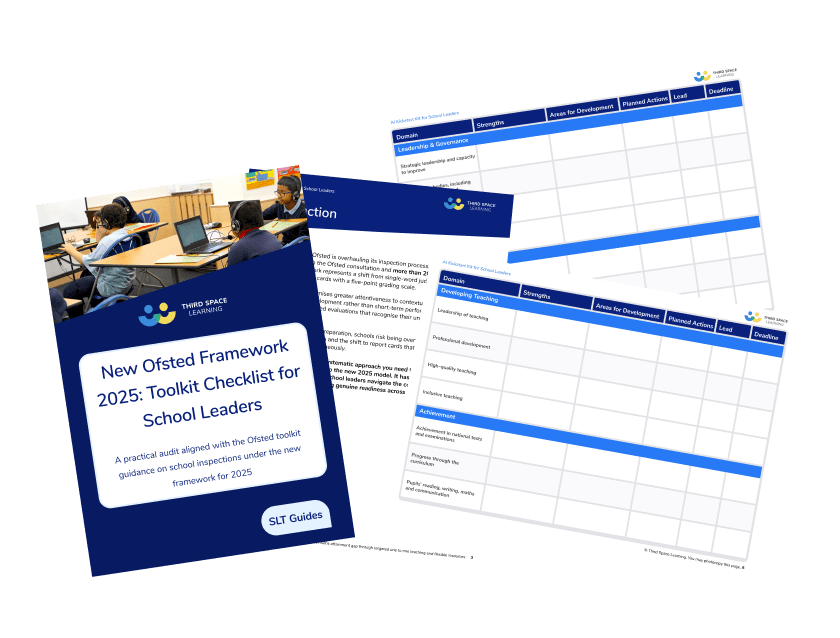
Ofsted Toolkit Checklists: Primary and Secondary
A practical audit aligned with the Ofsted toolkit guidance on school inspections under the new framework. Separate checklists for primary and secondary, with actions to assign so you're ready when the call comes.
Download Free Now!What is the new Ofsted framework?
The new Ofsted framework replaced the 2019 inspection framework. It grew out of two rounds of feedback. In 2024, Ofsted ran the ‘Big Listen’, a public consultation that gathered views from parents, carers, pupils and education professionals. Between February and April 2025, it then consulted on its proposals for report cards and a new inspection toolkit, before publishing the final framework in September 2025.
Ofsted noted that parents and carers valued separate judgements for each inspection area as their most favourable change to the previous Ofsted inspection framework, while professionals wanted bullet point summaries of the findings. The new Ofsted report cards aim to merge these two preferences.
The new inspection framework responds to concerns many educators raised about the previous inspection model, including the use of ungraded inspections and the impact on school leaders and staff. Inspections also place less emphasis on attainment data and compliance, and more on teaching quality, staff wellbeing and pupil support.
New Ofsted framework timeline
Date | What happened |
|---|---|
2024 | Ofsted ran the Big Listen public consultation |
February to April 2025 | Ofsted consulted on report cards and a new inspection toolkit |
September 2025 | Ofsted published the final renewed framework |
10 November 2025 | Routine inspections started for state-funded schools, early years, and FE and skills providers |
January 2026 | Inspections started for initial teacher education (ITE) and non-association independent schools |
September 2026 | Ofsted’s first annual updates to its toolkits and operating guides came into effect |
Between 10 November and Christmas 2025, Ofsted prioritised state-funded schools that had volunteered for inspection under the new system. You can find more information under ‘Next steps’ in the ‘Starting inspections’ section of Ofsted’s consultation outcome.
Who the new framework applies to
The new framework applies to all education settings Ofsted inspects in England. This includes maintained schools, academies, non-association independent schools, registered early years settings, and further education and skills providers.
Each type of provider has its own inspection toolkit and operating guide. This guide focuses on state-funded schools.
Ofsted report cards and the five-point grading scale
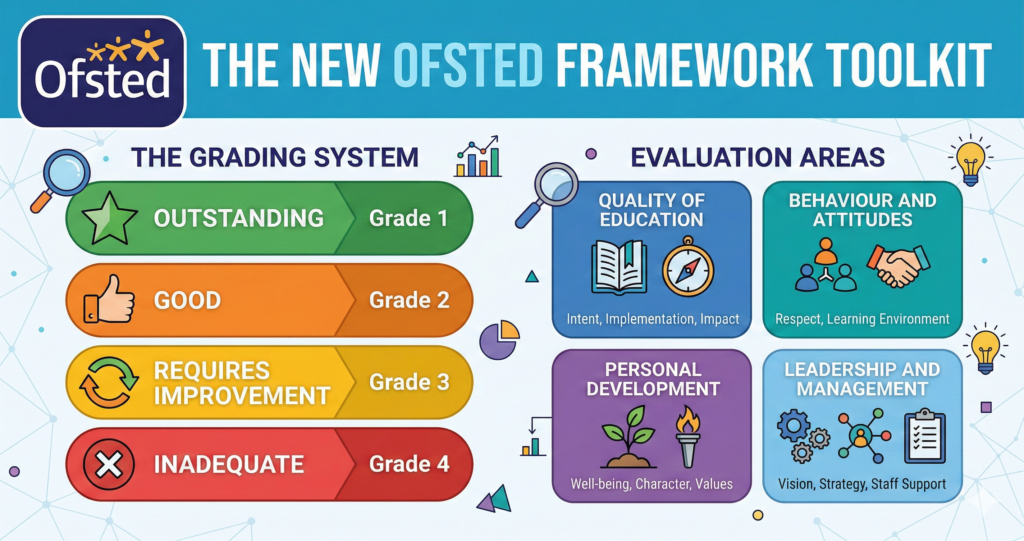
The report card replaced the single-word Ofsted grade descriptors of the old system: Outstanding, Good, Requires improvement and Inadequate. It also removed the overall effectiveness grade used in the Ofsted rating system entirely.
Instead, a report card includes:
- a grade for each evaluation area
- a written explanation of each grade
- a ‘met’ or ‘not met’ judgement for safeguarding
- published data alongside the inspection outcome
With a grade and written report for each evaluation area, leaders and parents get a clearer picture of the school’s strengths and areas for improvement.
The five Ofsted grades
Ofsted renamed the grades after the consultation. The final five grades are:
- Exceptional
- Strong standard
- Expected standard
- Needs attention
- Urgent improvement
Evaluation areas for schools
Report cards for state-funded schools cover six core evaluation areas, plus safeguarding. Early years and sixth form provision are added where a school has them:
- safeguarding (met or not met)
- inclusion
- curriculum and teaching
- achievement
- attendance and behaviour
- personal development and wellbeing
- leadership and governance
- early years (where applicable)
- sixth form provision (where applicable)
Inspections start by discussing and observing the school’s work against the ‘expected standard’ criteria for each evaluation area, before exploring the other grades.
Safeguarding evaluation
Safeguarding is assessed on a binary scale: ‘met’ or ‘not met’. Schools either meet statutory requirements and have an open and positive safeguarding culture or they do not, and Ofsted safeguarding evaluations reflect this.
A ‘not met’ judgement in safeguarding automatically places the school in a category of concern.
How inspections work under the new framework
The new inspection methodology takes a more collaborative approach, with inspectors working closely with school leaders and educators to understand the school and identify areas for improvement.
The planning call and self-evaluation
Ofsted’s new inspection process includes a planning call before the inspection to discuss the school’s context and agree the areas of focus. This conversation is also designed to create productive working relationships between inspectors and leaders.
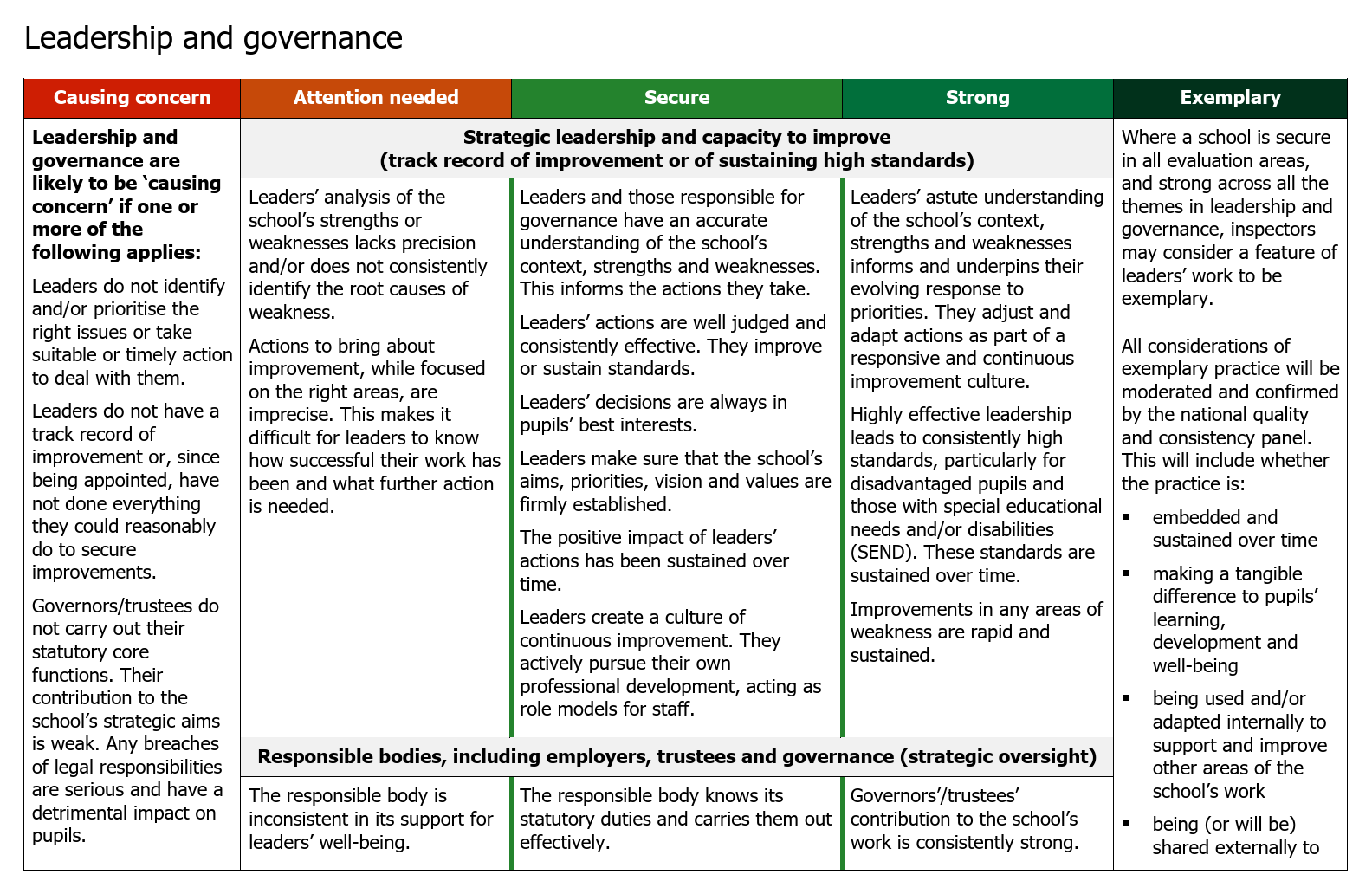
During the call, the lead inspector asks for your evaluation of the school’s strengths and priorities for improvement. This includes where you think the school sits on the five-point scale for each evaluation area.
The Ofsted inspection toolkit
The new Ofsted toolkit replaced the School Inspection Handbook as the core reference for inspections. It sets out Ofsted’s expectations in each evaluation area and what schools need to demonstrate for each grade.
The toolkit aims to give leaders and governors an accurate understanding of their school’s strengths and areas for improvement, without asking schools to create extra paperwork. If leaders have already identified their areas for development, they should come as no surprise during an inspection. Ofsted’s toolkit guides the evaluation, but inspectors do not use it as a checklist.
Ofsted has published a toolkit for each type of provider, and it now updates them every September.
No deep dives or graded lesson observations
School inspections no longer use the deep-dive methodology, which Ofsted removed partly to reduce the workload on middle leaders. Instead of deep dives, inspectors work with leaders to agree areas of focus, which typically mirror school leaders’ improvement priorities.
Ofsted has also stated that it will not return to formal lesson observations of teaching practice, including graded lesson observations.
School context and inclusion
Under the renewed framework, Ofsted aims to give a more accurate picture of the school and the local area. Inspectors take into account the challenges each setting faces when they interpret evidence.
Considerations for the school’s context include:
- the characteristics of learners
- outcomes, including performance data for groups of children
- attendance data
Ofsted also shares local area data with parents and other stakeholders through its Explore an Area tool. This includes:
- deprivation and relevant characteristics of the local community
- availability and quality of other educational and care provision in the area
- any provision or service a learner may move on to next
The renewed framework recognises the importance of inclusive education. Ofsted inspections aim to focus on ‘getting it right for all children and learners’, with particular attention on the experiences and outcomes of disadvantaged children and learners. Ofsted’s view is that if providers are supporting disadvantaged children and students, they are also supporting everyone else.
Inspectors evaluate the school’s inclusive practices for supporting disadvantaged pupils and vulnerable children, including pupils with SEND. They also consider the school’s approach to children’s welfare, including establishing routines and promoting wellbeing. Reports aim to answer the question ‘What is it like to be a child or learner in this provider?’
Ofsted and AI
Ofsted does not inspect the use of AI as a stand-alone area, but inspectors can consider its impact where it is relevant to what they are evaluating.
Wellbeing and the inspector code of conduct
Ofsted has stated that it wants to work collaboratively with schools:
“We will go about our work with professionalism, empathy, courtesy and respect. Our inspections must feel ‘done with’, not ‘done to’.”
Ofsted has added wellbeing measures for leaders and staff. These include an additional inspector on inspections, mental health training for inspectors, and inspectors leaving the school by 5pm each day. The operating guide for inspectors also includes a code of conduct, which sets out clear expectations for how inspectors work, with a focus on wellbeing and transparent, evidence-led evaluation.
Types of inspection and monitoring
The new framework uses two types of inspection: graded inspections and monitoring inspections.
Graded inspections
All routine inspections are full, graded inspections on a four-year cycle. Graded inspections (previously section 5 inspections) evaluate the school’s performance across all evaluation areas.
Since November 2025, Ofsted no longer conducts ungraded inspections. Removing ungraded inspections aims to simplify the inspection process, so every school knows what kind of inspection it will have and how often. However, the move to full graded inspections may increase pressure and workload for leaders and staff.
Monitoring inspections
Monitoring inspections provide targeted support and challenge for schools causing concern. They focus on the specific areas of concern.
If a school is below an acceptable standard of education and/or leaders do not have the capacity to improve, it receives monitoring inspections. Schools with one or more evaluation areas graded ‘needs attention’ or ‘urgent improvement’ also receive monitoring.
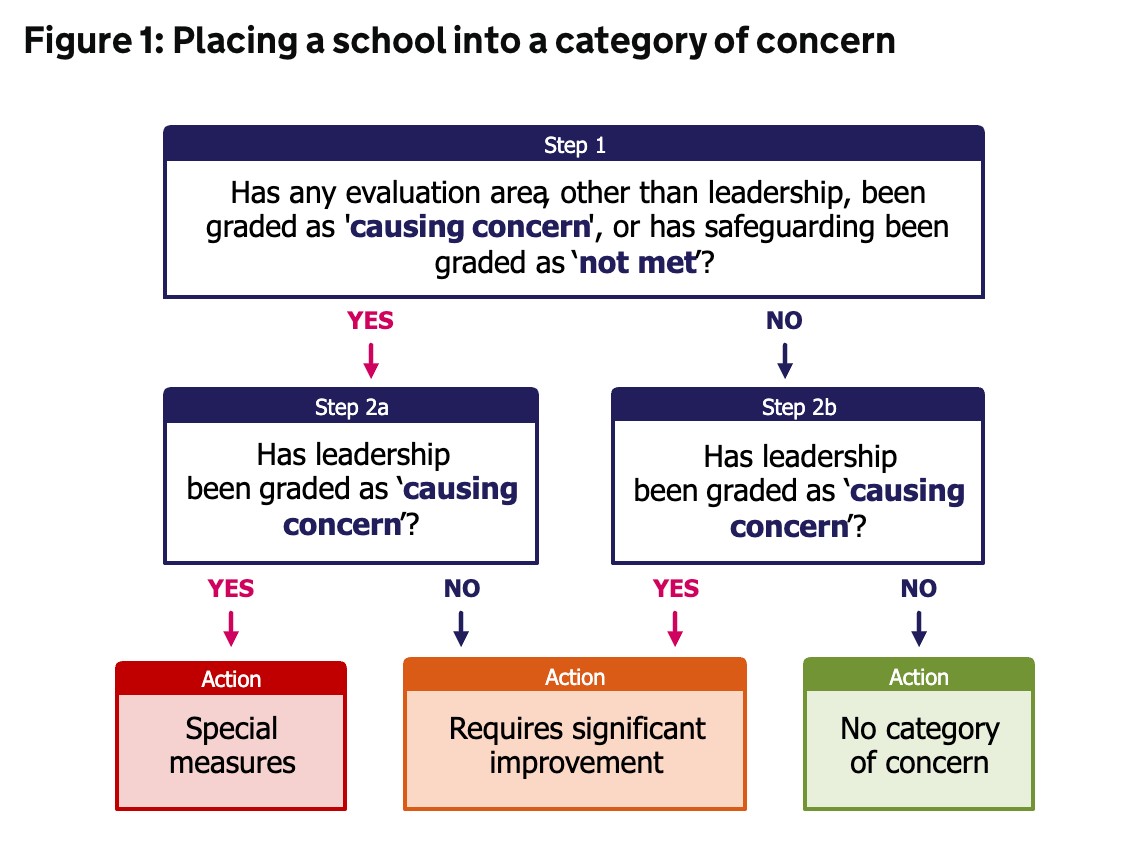
Inspection teams focus on the areas that required improvement at the previous inspection.
If a struggling school requires significant improvement, it will have 5 monitoring inspections over 18 months. For schools that require special measures, there will be 6 monitoring inspections within 24 months. If there are still concerns after the set number of monitoring inspections, Ofsted carries out a full reinspection.
What’s changed in the Ofsted framework from September 2026
In June 2026, Ofsted published its first annual updates to the education inspection toolkits, operating guides and inspection information documents. These Ofsted framework 2026 updates apply to inspections from September 2026, so they shape any inspection your school has this academic year.
Ofsted now plans to update these materials once a year. It will publish the changes in advance, and they will come into effect each September.
Updated guidance on achievement and similar schools
Ofsted and the Department for Education have built a new statistical model that groups similar schools together. It shows leaders and inspectors how well pupils in your school are achieving compared with pupils in schools with a similar context.
The updated school inspection toolkit reflects this model. It sets out what published data shows about achievement over time, including against similar schools, and how inspectors gather evidence on disadvantaged pupils’ attainment and progress.
Context helps inspectors interpret evidence fairly, but Ofsted says it never pre-determines the grades they give.
For early years, the toolkit now refers to Early Years Foundation Stage Profile data and the proportion of children reaching a good level of development compared with the national average.
A wider view of inclusion
Inclusion still covers pupils who are disadvantaged, have SEND or are known to children’s social care. Ofsted also uses a fourth ‘contextualised’ group: pupils facing other barriers to their learning or wellbeing.
The updated materials introduce the term ‘leaders who have an inclusion role’. Ofsted sees inclusion as the responsibility of all leaders and staff, so inspectors may speak to your designated teacher or inclusion lead as well as your SENCo.
Changes to learning walks
Joint learning walks between leaders and inspectors are a key part of the renewed methodology. In small schools, leaders told Ofsted that matching the number of leaders to inspectors added pressure and workload.
The updated operating guides now set out the range of leaders who can accompany inspectors on learning walks. Inspectors also use regular reflection meetings to keep you up to date with what they have seen and heard.
Learning walks focus mainly on the ‘curriculum and teaching’ and ‘achievement’ evaluation areas, shaped by your planning call. Inspectors still gather evidence on the other evaluation areas.
Data alongside report cards
Under the new Ofsted framework, report cards include published data alongside inspection outcomes for the first time. Ofsted has said it will publish guidance on where this data comes from, so parents and others can read it more easily. It has also started removing national data comparisons from report cards for special schools.
Inspector accreditation
From September 2026, Ofsted has also introduced accreditation for its inspectors. All eligible employed inspectors are already accredited, and the scheme will extend to contracted inspectors later. Accreditation checks that inspectors have the knowledge, skills and behaviours Ofsted expects of them. The British Standards Institution has certified the arrangements.
What the 2026 updates mean for your school
Ofsted has said it will not expect a perfect policy, perfectly in place, as soon as guidance changes. It will not hold schools to account for reforms that have not happened yet either.
If you have already self-evaluated against the toolkit, check your evidence on achievement, inclusion and learning walks against the updated version.
How to prepare your school for inspection under the new Ofsted framework
Preparing for an inspection under the new framework starts with knowing where your school sits against the toolkit. Ofsted wants leaders to understand their school’s strengths and priorities, and the planning call gives you the chance to share that view.
Self-evaluate against each evaluation area
Use the school inspection toolkit to review your provision against each evaluation area. Decide where you think the school sits on the five-point scale, and note the evidence behind each judgement. Start with the ‘expected standard’ criteria, as inspectors do, and then look at the grades either side.
Pay particular attention to inclusion. It is now an evaluation area in its own right and runs through the others, so think about how you identify and support each group of pupils, including those facing other barriers to their learning.
Link your self-evaluation to your improvement plan
Record your priorities in your school improvement plan and track your progress against them. If your areas for development are already in the plan, inspectors can see that leaders know the school well.
Brief staff and governors
Make sure staff and governors understand the new evaluation areas, the five grades and what happens during an inspection. Talk through the planning call, learning walks and reflection meetings, so everyone knows what to expect.
Governors and trustees also need to understand the grading structure, as Ofsted expects those responsible for governance to share leaders’ understanding of the school.
Plan how you will talk to parents
Report cards give parents more detail than a single-word grade, but the format may be new to them. Plan how you will explain the grades and the data alongside them once your report card is published.
Review your evidence each September
Ofsted now updates its toolkits every September. Check the summary of changes each year and update your self-evaluation where Ofsted’s expectations have moved.

New Ofsted framework FAQs
Since November 2025, all routine inspections have been ‘full’ inspections. Ofsted no longer carries out ungraded inspections, so every school knows what kind of inspection it will have and how often. Ofsted has also changed its monitoring programmes for state-funded schools.
Ofsted has removed its single-word judgements. Schools now receive a report card with a grade for each evaluation area, plus a ‘met’ or ‘not met’ judgement for safeguarding.
Ofsted now uses a five-point scale, ranging from ‘exceptional’ at the highest end, to ‘strong standard’, ‘expected standard’, ‘needs attention’, and ‘urgent improvement’ at the lowest end.

DO YOU HAVE STUDENTS WHO NEED MORE SUPPORT IN MATHS?
Skye – our AI maths tutor built by teachers – gives students personalised one-to-one lessons that address learning gaps and build confidence.
Since 2013 we’ve taught over 2 million hours of maths lessons to more than 170,000 students to help them become fluent, able mathematicians.
Explore our AI maths tutoring or find out about school tutors for your school.