

All Your AI Tutoring Questions Answered: How Does It Work, How Effective Is It, And How Safe Is It?

Every school has more pupils who need one-to-one maths support than the budget or the timetable can stretch to. AI tutoring can help close that gap, but it’s still relatively new to the tutoring space, and it can be hard to tell what it is and how effective it is. So here are honest answers to the questions school leaders and teachers like you actually ask us: what the evidence says, what AI tutoring can and cannot do, and what to check before you invest.
Where there is solid research, we point to it; where the honest answer is “it depends”, we say so. The questions below come in groups: does it work, is it as good as a human, is it good for learning, can we trust it, is it safe, who it is for, and what it costs. Skip to whichever one is on your mind.

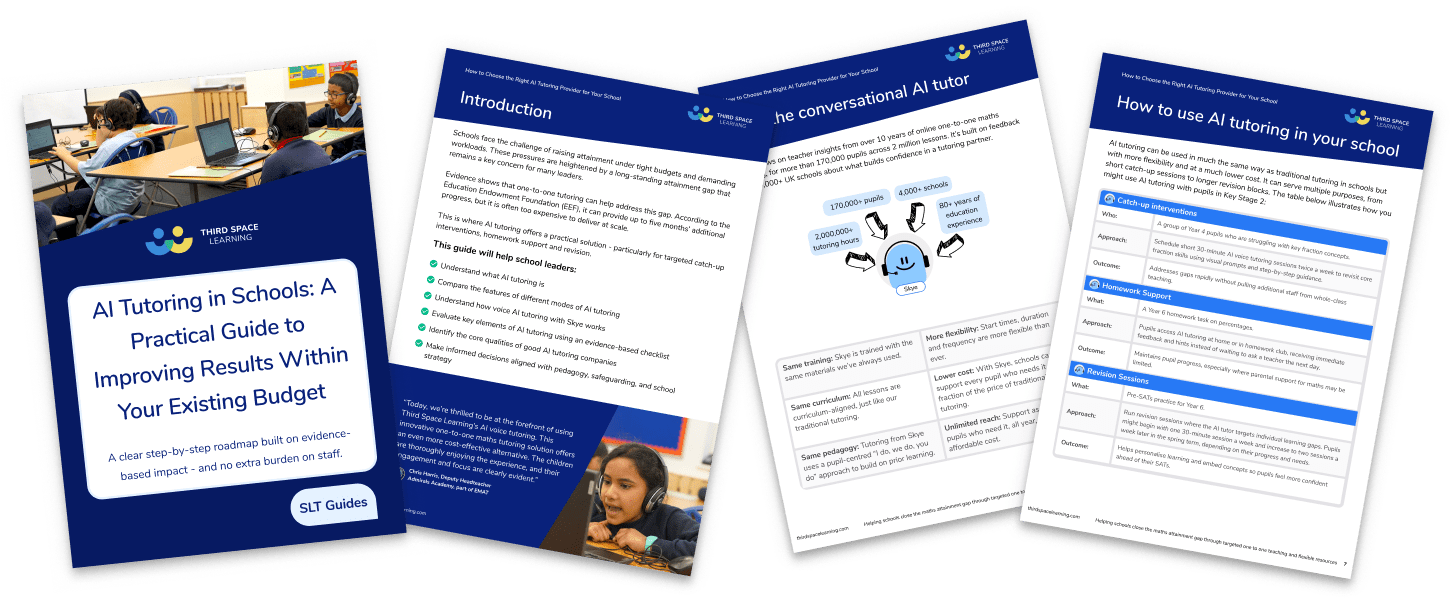
AI Tutoring in Schools: A Practical Guide to Improving Results Within Your Existing Budget
Thinking about AI tutoring but not sure where to start? This free guide answers the big questions and includes a ready-to-use evaluation checklist to weigh up any tool, all within your existing budget.
Download Free Now!The evidence on AI tutoring
Does AI tutoring actually work, and what does the evidence say?
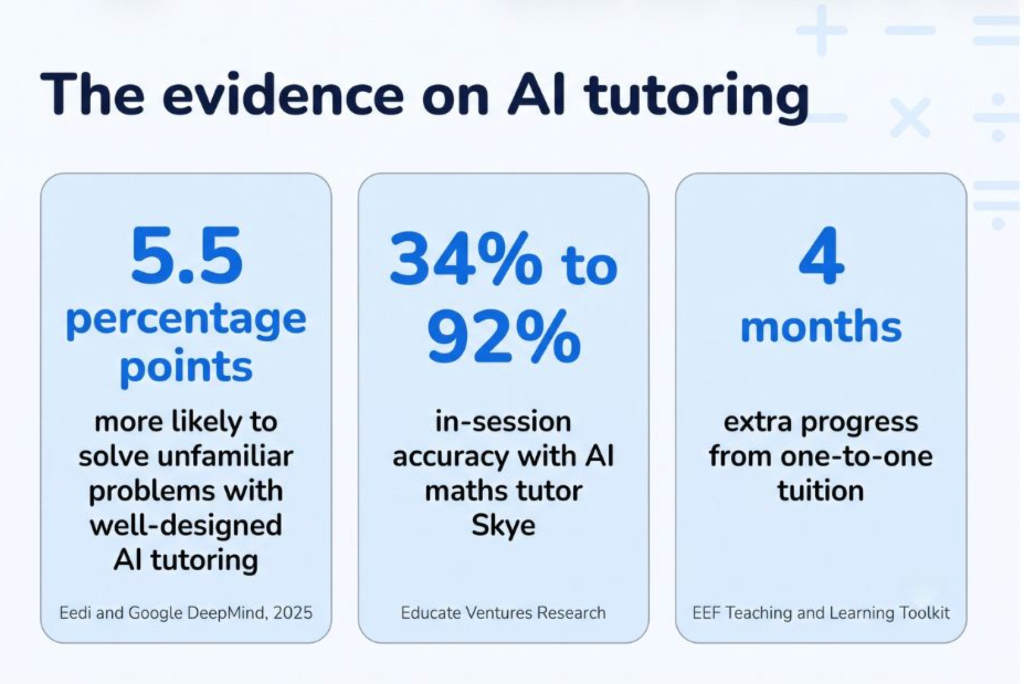
One-to-one tuition is one of the most effective things a school can do, worth around four months’ extra progress on the EEF’s toolkit, and AI is starting to make far more of it affordable and accessible. However, the gains come when AI tutoring is structured and supervised, not left to run itself.
Promising, and increasingly backed by real trials, but the results of AI tutoring hinge on how it is used. In a 2025 randomised trial by Eedi and Google DeepMind, pupils using carefully designed, human-in-the-loop AI tutoring were 5.5 percentage points more likely to solve unfamiliar problems than those with human tutoring alone, and the AI got things wrong on only 0.1% of turns. Used the wrong way it can backfire: when Wharton gave pupils an unrestricted chatbot to revise with, they did around 17% worse once it was taken away, and a Stanford review of 20 studies found the same pattern.
Additionally, an independent evaluation by Educate Ventures Research of AI maths tutor Skye found pupils’ in-session accuracy rose from 34% to 92%.
What subjects and age groups is AI tutoring for, and can it help with SATs and GCSEs?
Maths is a great subject for AI tutoring, which is no surprise: it is a subject with clear right answers and well-mapped misconceptions, so it suits the technology. AI tutoring is also available for languages, science and literacy.
Age and stage vary by product; some are built for Key Stage 2, others for GCSE and exam years. Plenty are mapped to the curriculum and can support SATs or GCSE revision, but “can it help with exams?” really comes down to whether a given AI tutor covers your curriculum and your year groups. Check before you commit.
AI tutors and teachers
Is an AI tutor as good as a human tutor, and could it replace teachers?
AI tutors cannot replace teachers. Think of it as another pair of hands, not a replacement pair. An AI tutor can give a pupil patient, one-to-one practice on demand, at a scale no school could ever staff by hand.
What AI tutors cannot do that teachers can is know a child: spot that the wobble in fractions is really a wobble in confidence, notice when something is off at home, or be the person a reluctant learner turns up for. So, it’s not AI versus teachers, but which parts of tutoring AI should take on so teachers get their time back for the parts only a human can do.
In the conversations we have with schools, the ones getting the most from AI tutoring never asked it to replace anyone; they use it for the one-to-one practice and keep teachers for the parts only a teacher can do.
AI tutoring and learning
Will relying on AI make learners lazy or stop them thinking for themselves?
Relying on AI in the wrong way can make learners lazy, and pretending otherwise would be dishonest. If AI simply hands over the answer, pupils quickly default to cognitive offloading instead of thinking for themselves.
But that is a design choice, not a law of nature. Ask a general chatbot to “do question 4” and it will. A well-built AI tutor does the opposite: it withholds the answer, offers a hint, and makes the pupil take the next step themselves, so the effort stays where it belongs, with the learner. Which is exactly why supervision and the right tool matter far more than whether AI is “allowed” at all.
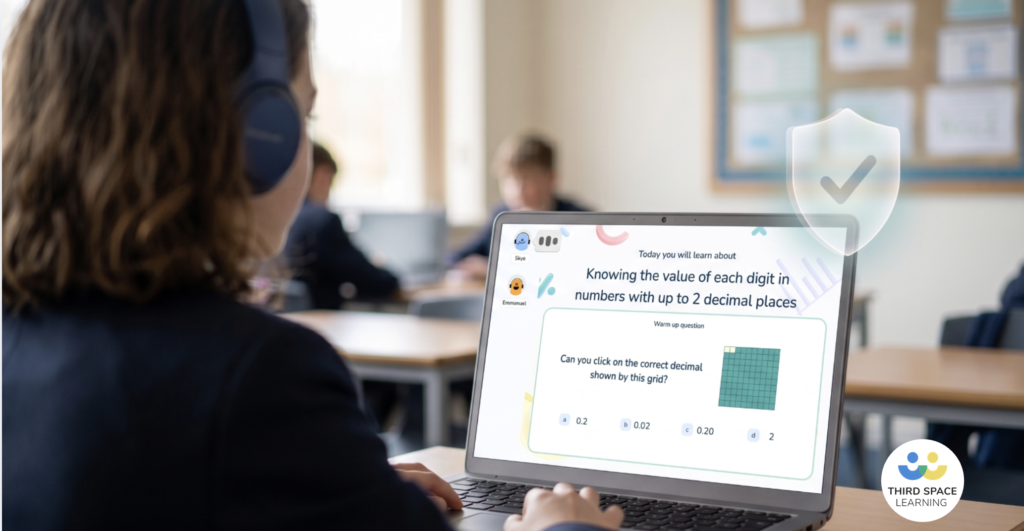
With Third Space Learning, when a pupil demonstrates an incorrect answer or misconception, AI tutor Skye provides a verbal hint. If the pupil answers incorrectly again, Skye provides another hint. If the pupil answers a third time incorrectly, Skye scaffolds the learning and models the correct steps the learner needs to take.
Is using an AI tutor cheating?
No, using an AI tutor is not cheating. Using an AI tutor to understand a method, practise, or get feedback is learning; this is no different from sitting with a tutor. However, a student using generative AI to produce a piece of work and pass it off as their own is cheating.
The line is simple: is the pupil doing the thinking, or outsourcing it? That is why a flat AI ban tends to backfire – it pushes the tool underground instead of teaching pupils to use it well. Most schools are getting further by naming that line clearly, setting work that rewards reasoning over a tidy final answer, and writing it into a school AI policy everyone understands.
Trustworthiness of AI tutoring
How do we know an AI tutor is teaching pupils the right things?
This is the question that should decide which tool you pick, because not all AI is built the same. A general chatbot generates every answer on the spot, which means it can sound completely confident and still be wrong; a pupil often will not know the difference.
A purpose-built AI tutor works differently: it teaches from lessons written and checked by teachers, so what a pupil sees has been vetted before it ever reaches them, not improvised mid-session.
Third Space Learning’s AI tutor Skye, for instance, only teaches lessons written and checked by qualified teachers, so nothing is made up on the spot. The question to put to any provider is a blunt one: where does your content come from, and who has checked it?
AI tutoring and safeguarding
Is AI tutoring safe for pupils, and what happens to their data?
Safety is not a given; it is something to check, because “AI tutor” is a broad term that can cover everything from a locked-down, curriculum-only tool to a general chatbot. Responsible companies limit what the tool can say and do, record sessions, and are clear about pupils’ data: where it is stored, who can see it, and whether it is used to train the model.
Two things to insist on before you sign anything: UK GDPR compliance, and a straight answer on data use. Third Space Learning’s AI tutor Skye, for example, records every session and is UK GDPR compliant, with no pupil data used to train the model. Your school stays the data controller, so those answers are your responsibility too – fold this into your wider approach to AI in schools rather than treating it as a box to tick.
Choosing the right pupils for AI tutoring
Can AI tutoring help pupils with SEND?
For some pupils AI tutoring is a real help; for others it is not the right tool. A calm, low-stakes, one-to-one setting, especially a spoken one, can suit pupils who freeze when asked to speak up in class, or who need the same concept explained again without any sense of judgement.
What it is not is a replacement for specialist SEND provision, and tools vary a lot in how well they adapt to different needs. So treat it as one option to trial with specific pupils in mind, watch how it works for the pupils in front of you, and build from there rather than rolling it out blind.
How can AI tutoring be used to support inclusion?
AI tutoring works best as part of inclusive teaching rather than instead of it – but used well, it helps far more pupils get the support that used to reach only a few.
For the schools we work with, the biggest inclusion advantage is reach. One-to-one support is normally rationed to a handful of pupils, and AI tutoring can offer it to everyone who needs it at once – so support is not limited to a chosen few. At classroom level that opens up a lot: every pupil can work at their own level and pace, so a mixed-attainment group each gets the right challenge or support without feeling singled out.
A one-to-one setting can also give pupils learning English as an additional language, or those working well below age-related expectations, the space to have a concept revisited as many times as they need, without stigma.
Cost and choosing the right AI tutor
How much does AI tutoring cost, and are free tools good enough?
AI tutoring runs from free to a few thousand pounds a year, and the price usually tells you what you are getting. Free tools like Khan Academy can be useful for self-directed pupils; paid platforms tend to add curriculum-aligned content, reporting, safeguarding and teacher oversight – the things a school needs to run it.
For a school, though, free-versus-paid is the wrong comparison. The one that matters is cost per pupil reached against the alternatives, a human tutor at roughly £45 a session, or a TA-led group, where an unlimited AI model can work out far cheaper per pupil. Skye’s unlimited model is one example: a fixed yearly price based on school size for unlimited learners and sessions. Some of the schools we work with fund it from their pupil premium.
How do we choose an AI tutor, and can we just use ChatGPT?
You can use ChatGPT as a study aid, but know what you are getting: it is a general model and it can be wrong; it does not follow your curriculum, and it will hand over answers unless a pupil knows exactly how to stop it. A purpose-built tutor is designed to teach rather than answer.
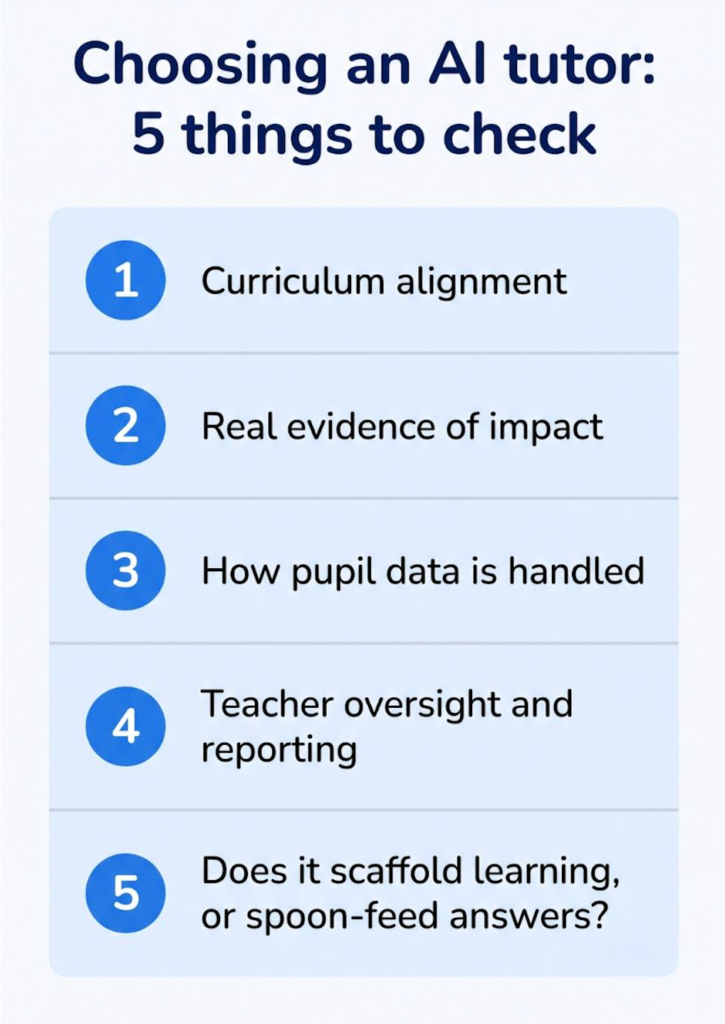
When you compare tools, five things separate the serious ones from the rest:
- curriculum alignment
- real evidence of impact
- how pupil data is handled
- the level of teacher oversight and reporting
- whether it scaffolds learning or simply spoon-feeds answers
If a provider cannot give you a straight answer on all five, that tells you something.
Where Skye fits in AI tutoring
If one thread runs through all of these answers, it is that the outcomes depend far less on the idea of AI and far more on how a particular tool is built and how a school chooses to use it. The strong ones scaffold rather than spoon-feed, teach from content that real teachers have written and checked, are clear about pupils’ data, and work best with a member of staff in the room. The weak ones are a general chatbot with a login.
So the more useful question is not “is AI tutoring any good?” but “is this AI tutor well-built, and will we use it well?” The evidence is encouraging where those two things line up, and thin where they do not. In practice, that means trialling a tool with specific pupils in mind, asking providers the blunt questions: where the content comes from, what happens to the data, whether it teaches or just answers, and keeping teachers in the loop rather than handing the job over.
Skye, Third Space Learning’s spoken AI maths tutor, is built around the answers above: one-to-one lessons written and vetted by qualified teachers, designed to give hints rather than hand over answers, with every session recorded and UK GDPR compliance built in. To see how one purpose-built tutor holds up against these questions, take a look at our Skye-specific FAQs.

DO YOU HAVE STUDENTS WHO NEED MORE SUPPORT IN MATHS?
Skye – our AI maths tutor built by teachers – gives students personalised one-to-one lessons that address learning gaps and build confidence.
Since 2013 we’ve taught over 2 million hours of maths lessons to more than 170,000 students to help them become fluent, able mathematicians.
Explore our AI maths tutoring or find out about the AI tutor for your school.