

Pupil Premium Maths Tutoring: How One MAT Scaled AI Tutoring to Close the Attainment Gap [Webinar]

The attainment gap in secondary maths has barely shifted in a decade, and not for want of knowing the answer. As stated by the EEF, one-to-one tutoring is one of the most effective interventions there is. Yet, most schools can only afford it for a handful of pupils, so it gets rationed long before it reaches everyone who needs it.
In this webinar, Fairfax multi-academy trust shares how it broke that pattern, and what happened when every disadvantaged pupil in maths, not just a chosen few, got one-to-one support.
Why hasn’t the secondary attainment gap closed?
By the end of secondary school, the divide is stark. In 2025, just 25.8% of disadvantaged pupils achieved a grade 5 in English and maths, against 53.1% of their peers. The gap is already wide on arrival, too: only 47% of disadvantaged pupils met the expected standard at the end of Key Stage 2, compared with 69% of everyone else. Left alone, those gaps tend to widen across Years 7 to 11 rather than narrow.
What makes this so frustrating is that the evidence is settled. The Education Endowment Foundation (EEF) rates one-to-one tutoring, layered on top of high-quality teaching, as one of the highest-impact interventions available, worth around five months of additional progress. So the puzzle is not what works. This is why a proven intervention still reaches so few of the pupils it was meant for.
This post answers that question through one multi-academy trust’s experience, and how AI maths tutoring lets it offer one-to-one support to every pupil who needs it across four secondary schools. (For the primary phase, see how two primary schools tackled the same challenge.)
Joining me, Paul Coffey, Secondary Curriculum Lead at Third Space Learning and a former maths teacher, is Natalie, Academy Improvement Advisor for Maths and Numeracy at Fairfax MAT, which includes Bournville School, where around 65% of pupils are disadvantaged. She has led the AI tutoring rollout across the trust’s four secondary schools.

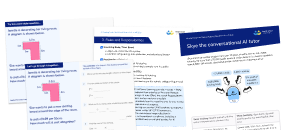
AI Maths Tutoring Pack
This free AI Maths Tutoring Pack is designed to help you introduce AI maths tutoring confidently and safely, choose the right approach for your pupils, and make sure every maths intervention has the biggest possible impact. Includes: AI Tutoring Policy and Template, AI Tutoring Guide, AI Tutoring Lessons: GCSE Programme and a Maths Intervention Checklist
Download Free Now!Key takeaways
- The secondary attainment gap has stuck not because the solution is unknown, but because one-to-one tutoring has always cost too much to offer at scale.
- When tutoring is billed per pupil, per session, the budget – not the pupil’s need – ends up deciding who is supported.
- A fixed annual price changes that calculation, letting a school support a whole year group for what used to cover a handful of pupils.
- ‘AI tutoring’ spans everything from answer-giving chatbots to structured, spoken tutoring, so the questions you ask before buying really matter. • At Bournville, the model is 15 Year 11 pupils in one form-time session, each on a different lesson matched to their target grade.
- The early signs are strong: 80% of pupils who fail the diagnostic pass the check-out question in the same session, and half the cohort rose a grade between the November and March mocks.
- Bringing tutoring into Years 7 and below tackles foundational gaps while they are still small and cheap to close.
The challenge at Bournville and Fairfax MAT
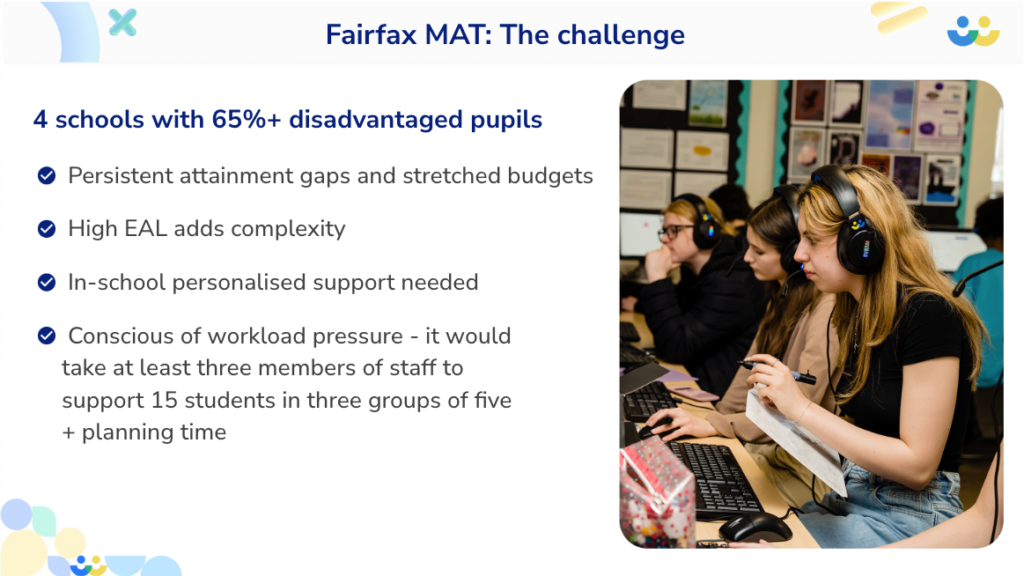
Bournville is a relatively small school with 65% disadvantaged pupils, high numbers of pupils with English as an additional language (EAL), and starting points significantly below the national average. The average prior attainment score sits around 98 to 99, depending on the year group, so pupils arrive already behind.
For a maths lead, that creates an impossible sum. “The difficulty is always working out which pupils to target for intervention, because there are simply too many,” Natalie explains. “Do I have the staff skilled enough to deliver it? And whatever I put in place feels like a small drop in the ocean compared with the actual need.”
It is not an isolated problem. Three of Fairfax’s four schools have 65% or more pupil premium pupils, so this is a trust-wide challenge rather than a single-school one. When the trust priced up genuinely personalised intervention for just 15 pupils across three target groups, it worked out at a minimum of three staff members plus planning time, before anyone had taught a single timetabled lesson. The workload maths simply did not add up.
The rationing trap
In more than ten years of supporting secondary schools with one-to-one tutoring, we have seen the same trade-off play out again and again. Because tutoring is costly, departments concentrate it on a small, fixed cohort, often just 8 to 10 places a term, almost always in Year 11, while everyone else waits, despite the long list of competing demands on a school’s pupil premium spending. The catch is that the number of pupils who need that support keeps climbing year on year.
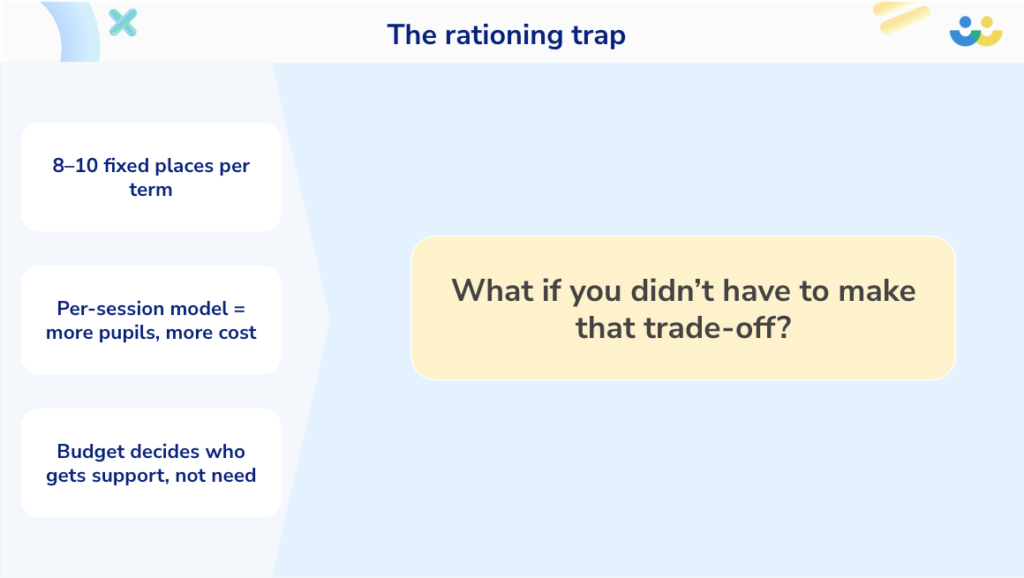
The reason is structural; the more pupils you support, the more it costs. Most external providers charge per session, per pupil. In the end, the budget decides who gets help, not the need. We call this the rationing trap.
The obvious question is: what if you did not have to make that trade-off?
Fairfax looked at traditional one-to-one tutoring first. “We had looked at Third Space Learning’s human tutoring the year before,” Natalie says. “It was excellent, but at the numbers we needed, paying per session was simply too expensive. We couldn’t give it to everyone who needed it.”
The AI tutoring option changed the calculation. “For the first time, we thought: we can actually support lots of pupils at once. We can move pupils between year groups if needed, as it’s one cost rather than a cost per child. And we weren’t piling work onto teachers to do it.” Quality was the other deciding factor. “Anyone who’s used Third Space Learning’s resources knows how much thought goes into them. I knew experienced maths teachers had planned this content and that it would pick up misconceptions properly. That gave us the confidence to bring it into all four schools. Many of the pupils on our plan now would have had nothing under the old model.”
What to look for in AI tutoring
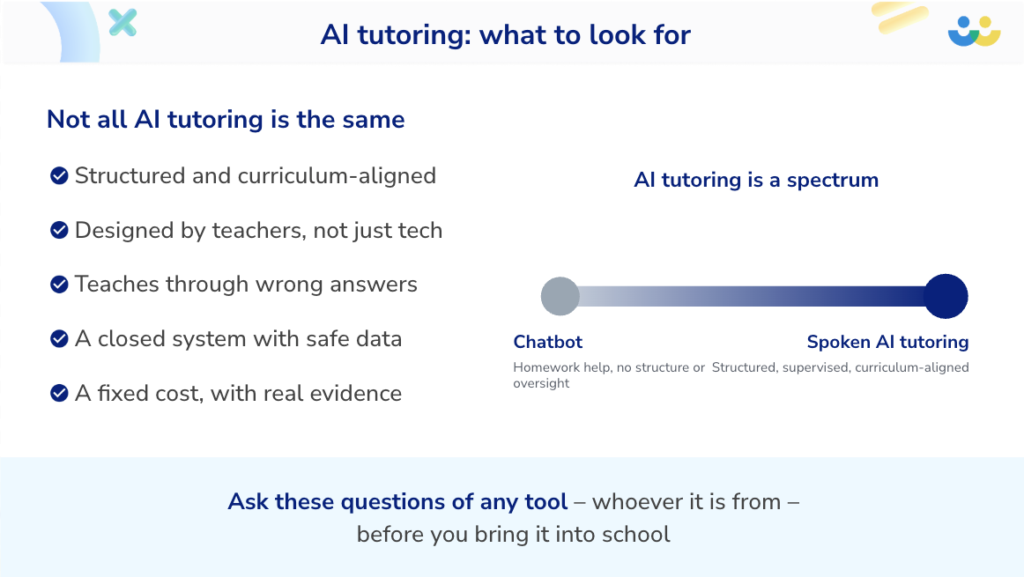
Before getting into how Fairfax uses it, it is worth being clear about what AI tutoring actually is, and what to look for if you are investigating it for your own school. The most important thing is that the tool has been designed by educators, is not just a chatbot, and actively challenges pupils to engage in the productive struggle that produces learning.
If you are weighing it up for your pupil premium pupils, these are the questions worth asking:
- Is the teaching structured and aligned to your curriculum, or is it open-ended?
- Who designed the lessons: teachers or technologists?
- When a pupil gets something wrong, does the tool teach them through it, or just mark it and move on?
- Is it a closed system or an open one? Where does pupil data go, and is anyone monitoring sessions?
- Is the cost per pupil and per session, or a fixed price? That single point decides whether you can ever escape the rationing trap.
- And what is the evidence of impact so far?
AI tutoring is not a replacement for a good maths teacher. It works best as a supervised intervention alongside the classroom.
Introducing Skye
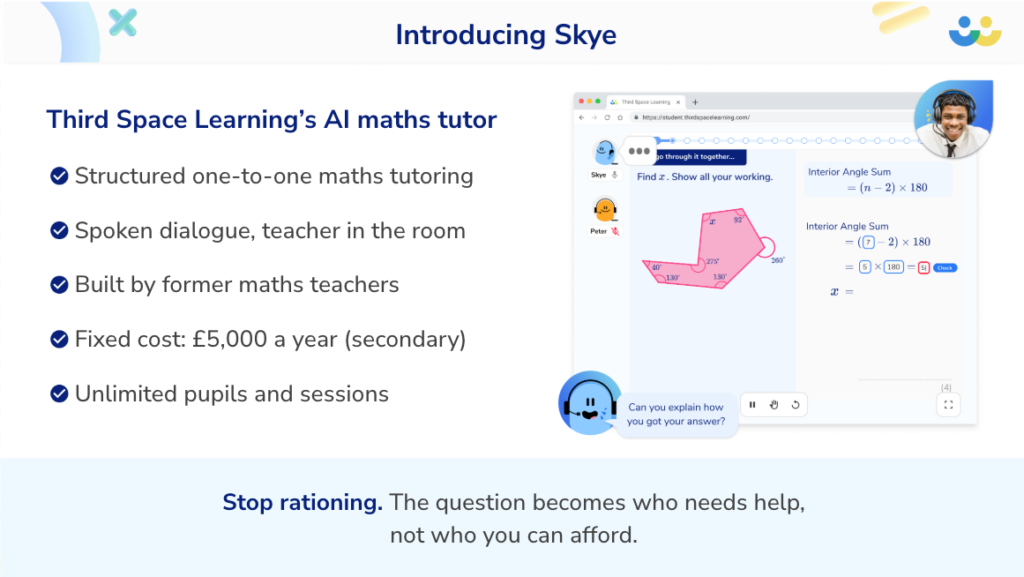
Skye is Third Space Learning’s AI maths tutor, built for one-to-one support. It delivers structured, in-school maths tutoring through spoken dialogue, with a teacher in the room. It is not a homework chatbot.
Skye was built by former maths teachers alongside our engineering team. Lessons follow a clear structure, with spoken dialogue, frequent feedback, careful scaffolding and close curriculum alignment, and every pupil gets a session pitched to them rather than to the group. Crucially, it is a fixed annual cost covering unlimited pupils and unlimited sessions, so the rationing decision falls away, and you can support well beyond the eight or ten pupils a fixed budget usually stretches to.
The trust started with Year 11 at Bournville, to get the model right before scaling. For Chrissy, the Head of Maths at Bournville, the first reaction was disbelief. “It honestly felt like Christmas,” she remembers. “I got 15 Year 11 pupils in and ran it myself. I had five just below a grade 4, five who needed a push to a grade 5, and five who needed a push to a grade 7, and I could target all three groups straight away.”
The contrast with a normal classroom is what stands out. “Even within a single topic, some pupils can do the diagnostic and jump straight to independent practice. Others have a misconception that, realistically, might be 20 minutes before I get to them. With Skye, the second a pupil gets something wrong, the teaching input is right there.”
Setup was quick: an email to Third Space Learning to add the Year 11 pupils, then selecting the cohort and setting a target grade for each one based on mock data.
How the timetable works
Bournville runs four 30-minute sessions a week, in form time. Grade 4, grade 5 and grade 7-plus pupils sit in the same room, all working on completely different content, with one staff member supervising 15 pupils. The cohorts rotate based on need, something a fixed-place model could never allow. Year 11 has run from day one, Year 10 is next, and a Year 7 programme is being set up to close primary maths gaps before they widen.
“They all come into the room in the morning, and they are all doing completely different things depending on what their pathway needs. The alternative is me running interventions every morning, trying to work out what 15 pupils know and what to teach. I like to think I am a good teacher, but I cannot get anywhere near the impact this has on my own.”
Something unexpected has started to emerge, too: around one in ten Year 10 pupils have begun self-launching their own lessons at home, off their own back. Natalie says, “A lot of it comes down to motivation to work independently at home, which any teacher will recognise. These are disadvantaged pupils choosing to log on and do extra maths in their own time, with nobody standing over them. Even a handful doing that is something we would not have seen before.” Because the cost is fixed, there is no barrier to a pupil launching as many extra sessions as they like.
Two personalised pathways
That picture of 15 pupils in one room, all doing something different, is the heart of how the gap closes. In a normal classroom, one teacher cannot teach 15 lessons at once, so some pupils wait and others coast. AI tutoring is built precisely for that problem.
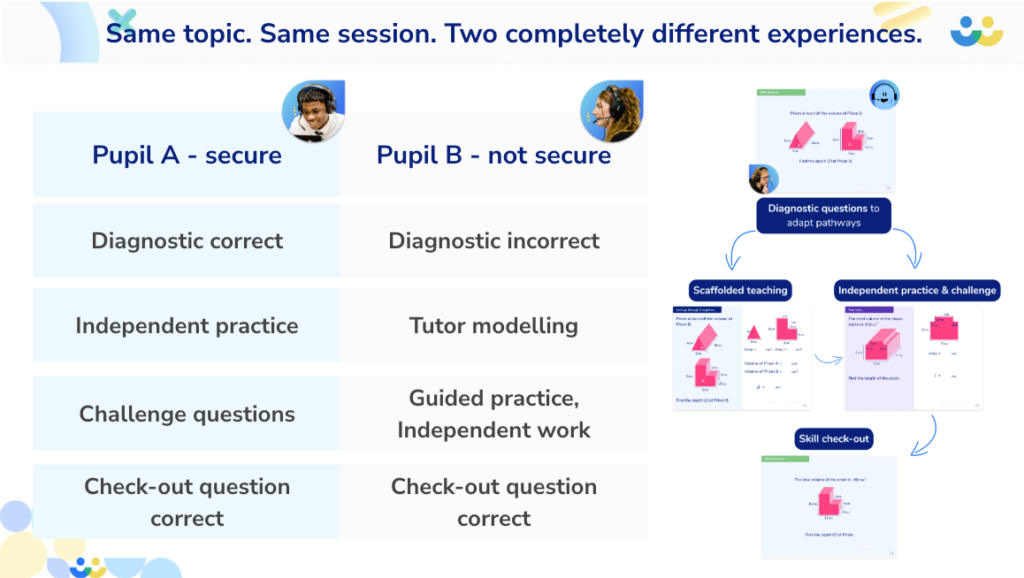
Every Skye session opens with a diagnostic check-in question, and from there the lesson branches. A pupil who gets the diagnostic right is not made to sit through content they already know; they move down a pathway towards independent practice, with Skye probing their reasoning and modelling only if they slip up later, before a challenge question and a check-out question.
A pupil in the same room who is less secure gets the diagnostic wrong, and that is exactly the pupil the intervention is built to reach. They follow a scaffolding pathway instead: Skye models the question, uses a “follow me, your turn” approach for guided practice, asks careful questions, and builds confidence step by step before moving on to independent practice and the check-out question. The result is bookended data for every pupil, a check-in score and a check-out score on every skill, every day, and a lesson built around what each pupil actually needed.
How Skye scaffolds when pupils get it wrong
The moment a pupil gets something wrong is where a gap either closes or quietly widens, and it is where many digital tools fall down: they mark the answer wrong and move on. Skye was built for that moment.
“It never just says ‘that’s wrong’ or ‘try again’,” Natalie says. “It starts by acknowledging what the pupil has got right, and builds from there. I’ve heard it say things like, ‘You’ve correctly identified the tens column in the place value chart, lovely, now let’s look at writing your answer as a decimal.’ That patient, step-by-step input is exactly what I cannot give 15 pupils at once, and here it is happening for every one of them at the same time.”
That patience is why the trust was keen to test Skye with SEND pupils, and Natalie is careful not to overclaim. “This is an area we are still actively testing. For some pupils, the step-by-step approach really suits them; for others, it has been more of a mixed picture, and we are learning which pupils it works best for. ” To explore it properly, the trust has deliberately built a Year 10 group with four SEND pupils in a cohort of 15, and we are putting the work in to get the best out of it.”
The same consistency helps EAL pupils. Skye uses the same mathematical vocabulary every time and gives pupils the chance to hear it, repeat it back and use it themselves. “That exposure to consistent maths talk is genuinely valuable,” Natalie notes, “and it is hard to replicate in a busy classroom.”
Is the gap actually closing? The early evidence
This is the question that matters most. It is worth remembering who these pupils are: the cohort is drawn from disadvantaged pupils, the very pupils the attainment gap is about. So when their grades move, it is the gap itself narrowing, not simply a cohort improving. The evidence so far sits in three layers, and they all point in the same direction.
First data layer
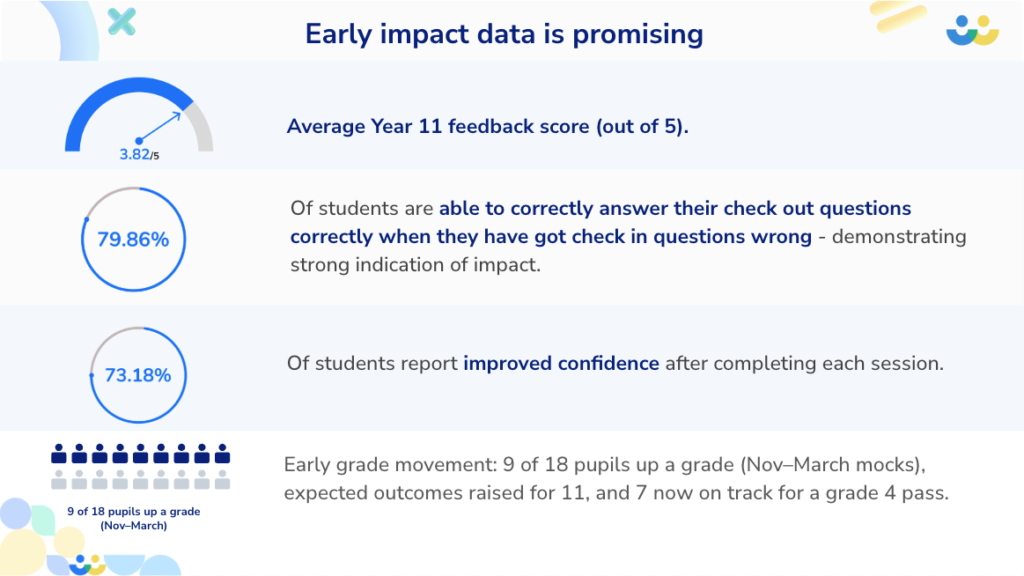
Pupil satisfaction. Pupils rate each session at the end, and Year 11 is averaging 3.8 out of 5. “If pupils were rating us daily, I’m not sure we’d always get 3.8.”
Second data layer
In-session impact. Of the pupils who get their diagnostic question wrong, meaning they cannot do that skill at the start of the lesson, 80% correctly answer the check-out question by the end of the same 30-minute session. They move from “I can’t do this” to “I can” in half an hour, which is a strong, repeatable signal.
Third data layer
Longer-term grade movement. Of the 18 pupils on the programme for more than 10 weeks, 9 improved their grade from the November mock to the March mock, half the cohort moving up a grade in roughly four months. Expected outcomes have been raised by a grade for 11 of those pupils, and one pupil has moved up two grades. Most significantly of all, seven pupils previously expected to achieve a grade 3 are now on track for a grade 4. Because the trust keeps its predictions deliberately conservative, Natalie expects that to rise rather than fall.
That grade 4 line is the one that matters most for the gap. It is the standard pass, the threshold that decides whether a pupil leaves school with a pass in maths, and disadvantaged pupils are far less likely to reach it than their peers. Moving them across that line closes the gap at exactly the point it bites hardest.
There is also a softer signal that no graph captures: confidence. “Pupils are coming in every morning, learning something new, and going on with their day with that confidence built up,” Natalie says. “Or they come to me in period three and say, ‘I did this this morning, I know what to do now.’”
Less workload, not more
A point that matters enormously when you run this across a trust: all of that data, the check-in and check-out scores, the satisfaction ratings, the grade movement, is captured and assessed by Third Space Learning, not by teachers. “We are not asking our staff to build tracking spreadsheets or work out the impact themselves,” Natalie says. “It’s all done in one place.”
Under old intervention models, knowing whether an intervention was working meant someone, usually a head of maths, who is already stretched, pulling it all together by hand. Here, the impact assessment arrives pupil by pupil and session by session, viewable at the school level or across the whole trust. “Sitting above four schools, that is the part that makes it work at scale. It frees our maths leads to spend their time teaching and responding to the data, rather than compiling it.”
Safeguarding and earning parental trust
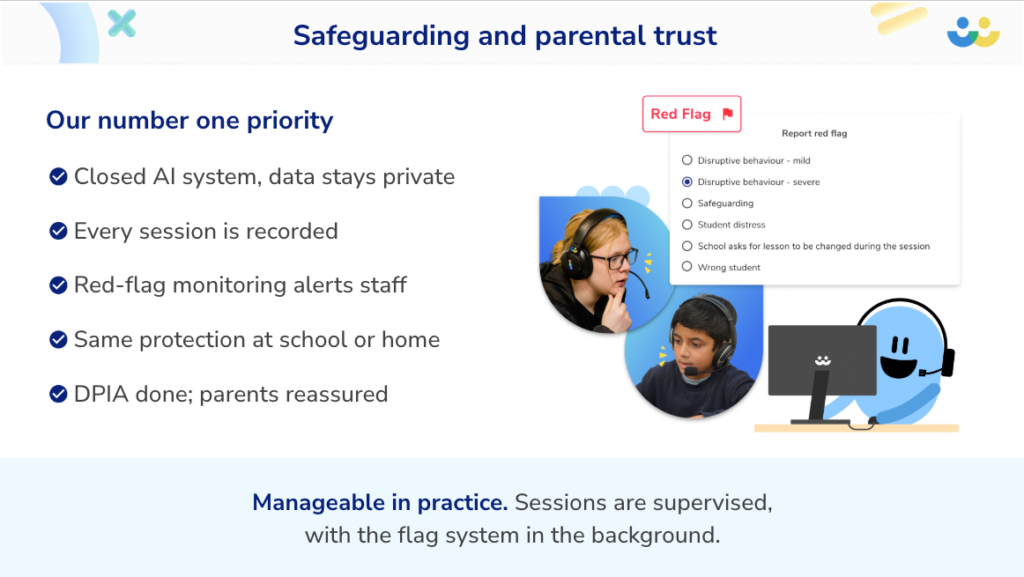
Safeguarding is the question we are asked every single time, and as an AI product, it is our number one priority. Every session is recorded, and a red flag monitoring system picks up anything of concern, whether the session happens in school or at home; the safeguarding follows the pupil.
From the school side, Fairfax completed a Data Impact Assessment as part of its GDPR obligations and looked closely at safeguarding before rollout. The fact that Skye is a closed AI system mattered to the trust and its Data Protection Officer: pupils’ voices, data and information are not floating around the wider internet.
One moment reassured Natalie more than any policy document. “When I was introducing it, I told pupils, ‘It’s a closed AI, you can’t talk to it the way you talk to ChatGPT.’ One pupil said, ‘Watch me,’ put on the headset and asked, ‘What’s your favourite film?’ A few seconds later: ‘Miss, Skye’s not responding to me.’ It just looped back to the task.” That, she says, helped reassure parents too. “Once I could explain how it works, it gave them the reassurance that the more worrying aspects of AI simply aren’t present in this system.”
Closing gaps across a whole trust
Closing the gap for one classroom is one thing; doing it for hundreds of disadvantaged pupils across a trust is another, and the honest picture is that rollout has been uneven.
Two schools got going quickly. Bournville is the most established site, and Smithwood Academy in Solihull was the other; the biggest factor in both was early buy-in from the heads of maths, in schools with a high proportion of disadvantaged pupils where the benefit was obvious. Smithwood has already scaled to a Year 10 morning session alongside Year 11, helped by having a free computer room and spare classrooms.
The other schools have had more difficulty, largely logistical: computer rooms already used by tutor groups, laptops already allocated to a literacy package, and the challenge of rearranging that mid-year. “Had we started in September rather than mid-year, we could probably have secured them,” Natalie says.
So if you are thinking about rolling AI tutoring out at scale, the practical questions are straightforward. Do you have a staff member who can supervise? It helps if they teach maths, but it is not essential. Do you have support staff free in the morning? And do you have access to the technology and a quiet space? Where the technology is the barrier, Fairfax is rolling Skye out for at-home use instead, supported by stronger parental buy-in at that school.
Getting ahead of the gap: Years 7 and 6
The most effective way to close a gap is to stop it from opening in the first place. “It was quite easy to get Skye rolling at the start,” Natalie says, “but now I’m thinking about how we double, triple or quadruple the impact.” With a couple of teaching assistants in the morning and a bank of 15 laptops per room, Bournville plans at least three blocks of sessions from September: Year 11, Year 10 and Year 7.
Year 7 is the one she is most excited about. “If I can start making an impact in Year 7 using something we’ve already paid for, I’m not fighting fires further down the line in Year 10 and Year 11.” It is a timely direction, too: when Smithwood was recently inspected, Ofsted asked specifically about closing gaps in foundational knowledge.
The trust has even extended Skye to incoming Year 6 pupils as an all-through school, and the early signs are warm. “They logged on once and came out buzzing. They love putting the headsets on and doing maths on a screen, and at that age, that excitement is half the battle.” From this week, 10 Year 6 pupils begin a structured intervention, an hour every day, run partly by a teaching assistant. “If we can close those primary maths gaps before these pupils even arrive in secondary, we are not firefighting later on.”
The cost model that unlocks it all
The pricing is the part that makes everything else possible. Skye is a fixed annual cost of £5,000 a year for a secondary school. That cost does not change with the number of pupils, the number of sessions or the year groups you choose to support. Unlimited pupils, unlimited sessions, one annual price. For leaders weighing up cost-effective pupil premium strategies, that is exactly the kind of fixed, scalable spend that stretches further.
For pupil premium funding, that removes the per-pupil rationing decision entirely. You are no longer choosing between eight Year 11 pupils or eight Year 10 pupils; you can do both, plus Year 7, plus any pupil who needs an ad-hoc lesson, all within the same investment. “We looked at what we were already spending on small-group intervention, planning time and additional adult support,” Natalie says, “and the maths simply worked out better with a fixed annual cost. The deciding factor was reach. For roughly the same budget, we could move from a small fixed cohort to every pupil on our intervention list across four schools. If your bottleneck is ‘we cannot afford to scale’, this is the model worth looking at.”
Why the gap closes
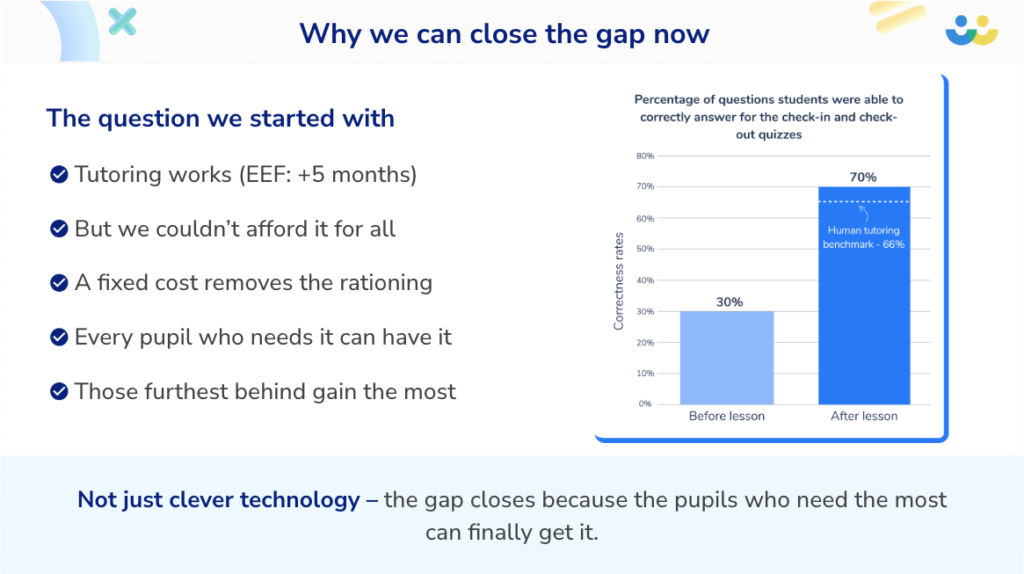
It is worth coming back to where we started. If one-to-one tutoring has worked for years, why has it not closed the gap? Not because the support did not exist, but because schools could only ever afford it for a handful of pupils.
What changes with AI tutoring is the cost model. Once the price is fixed rather than per pupil, the question stops being “which children can we afford to help?” and becomes “which children need it?” The gap does not close because of clever technology alone. It closes because, for the first time, the children who need the most can actually get it.

Further reading on pupil premium
- Pupil premium: a guide for school leaders on closing the attainment gap
- The attainment gap: what it is and 7 strategies that work
- A guide to pupil premium funding and allocations
- 45 cost-effective pupil premium strategies for schools
- What can pupil premium be spent on? Intervention ideas
- Closing the disadvantage gap in primary maths: two schools, two approaches

DO YOU HAVE STUDENTS WHO NEED MORE SUPPORT IN MATHS?
Skye – our AI maths tutor built by teachers – gives students personalised one-to-one lessons that address learning gaps and build confidence.
Since 2013 we’ve taught over 2 million hours of maths lessons to more than 170,000 students to help them become fluent, able mathematicians.
Explore our AI maths tutoring or find out about one to one tuition for your school.