
Closing the Disadvantage Gap in Primary Maths: Two Schools, Two Approaches [Webinar]

We know one-to-one tutoring works. So why isn’t the maths attainment gap closing? For most schools, the honest answer is that high-quality one-to-one support has always been too expensive to give to every pupil who needs it, so it gets rationed to a chosen few. Here, two primary leaders explain how they removed that rationing decision and what changed when one-to-one maths support reached every disadvantaged pupil, not just a handful.
We know what works, so why isn’t the gap closing?
The disadvantage gap in primary maths is not closing fast enough. At the end of Key Stage 2 in 2025, 47% of disadvantaged pupils met the expected standard in reading, writing and maths combined, compared with 69% of other pupils, keeping the gap at 22 percentage points. The disadvantage gap index rose slightly, from 3.13 in 2024 to 3.14 in 2025.
The good news is that we know what works. The Education Endowment Foundation is clear that, once high-quality teaching is in place, one-to-one tutoring is one of the most effective interventions there is, adding around five months of progress. So if schools have known for years that personalised, one-to-one support is the answer, why aren’t they closing the gap?
This post looks at that question through the experience of two very different primary schools, and how each of them has used AI maths tutoring to give one-to-one support to every child who needs it, not just a chosen few.
Here, Charlotte Grubecki, Senior Content Editor at Third Space Learning and a former Year 6 teacher, is joined by two primary leaders tackling the attainment gap head-on:
- Connor, Assistant Head and Maths Lead at De Lacy Primary School, part of Pontefract Academies Trust, where around 52% of children are disadvantaged.
- Simrat, Deputy Headteacher and SEND Lead at St Giles Primary School, a highly disadvantaged school where she has been scaling tutoring across Years 4 to 6.
Between them, they show two different routes to the same goal: closing the maths attainment gap for disadvantaged pupils.
Key takeaways
- The attainment gap persists not because we don’t know what works, but because one-to-one tutoring has always been too expensive to give to every pupil who needs it.
- Most tutoring is charged per pupil, per session, which forces schools into a ‘rationing trap’: the budget decides who gets help, not the need.
- A fixed-cost AI maths tutor removes the rationing decision, so schools can move from supporting a handful of pupils to a whole cohort within the same spend.
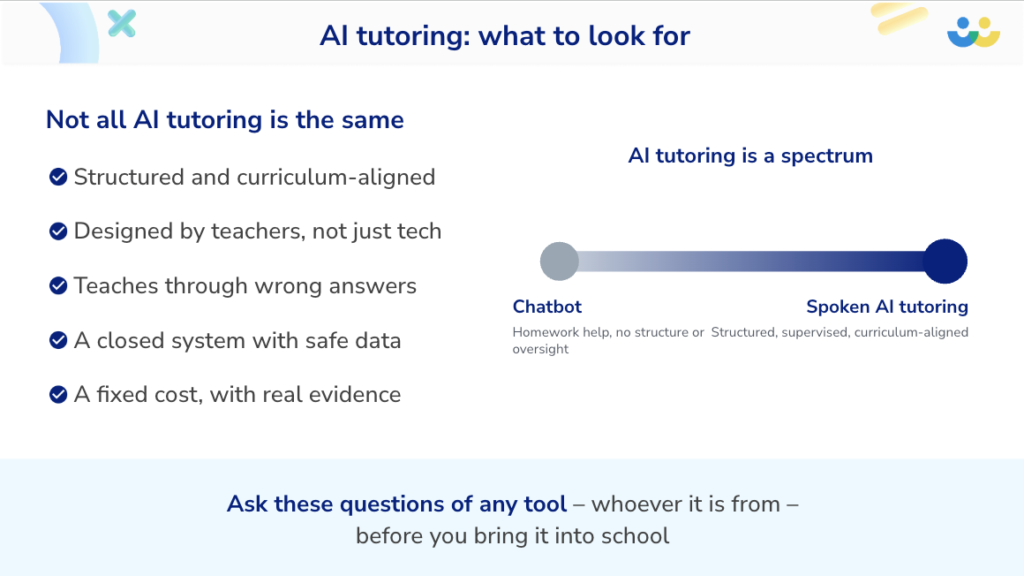
- AI tutoring covers a huge range of tools, from homework chatbots to structured, spoken, high-dosage tutoring. They are not equal, and the questions you ask before you buy matter.
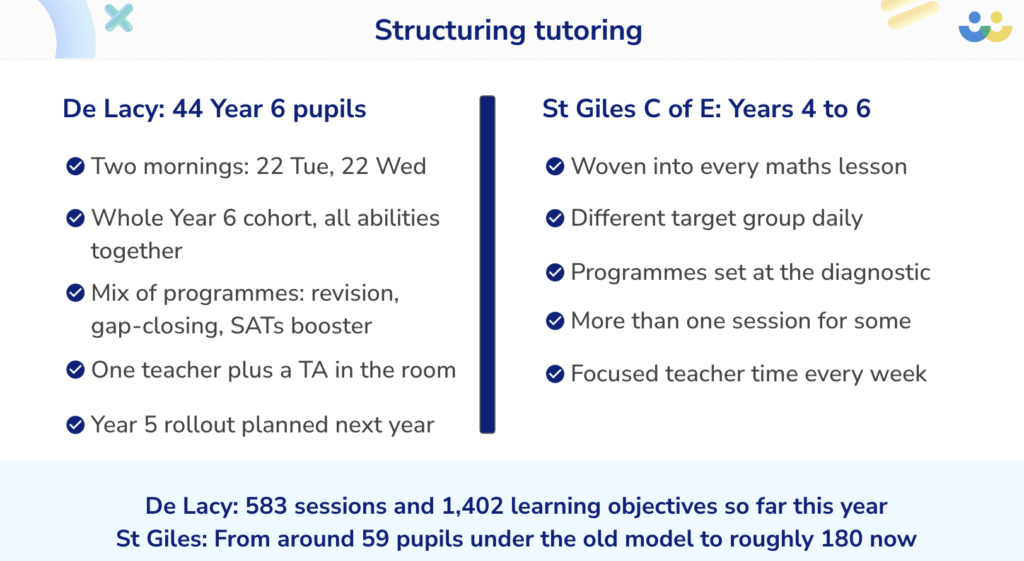
- The two schools here run the same tool in completely different ways: De Lacy as a whole-cohort morning session, St Giles woven into every maths lesson from Year 4 upwards.
- Starting earlier, before Year 6, closes foundational gaps while they are still small and easy to close.

![Closing the Disadvantage Gap in Primary Maths: Two Schools, Two Approaches [Webinar]](https://thirdspacelearning.com/wp-content/uploads/2025/04/AI-tutoring-in-schools-guide.png)
AI Tutoring in Schools: A Practical Guide to Improving Results Within Your Existing Budget
A practical guide to using one-to-one AI maths tutoring, including how to avoid the rationing trap, what to look for in an AI tutor, and how to build it into the school day.
Download Free Now!The maths attainment gap isn’t closing fast enough
The honest answer to why schools haven’t closed the gap is that one-to-one support has always been expensive and difficult to organise. When there is only so much pupil premium funding to go round, and so many areas of need, schools end up rationing it to a small handful of pupils, even when the potential impact is huge.
Rather than talk in the abstract, it helps to see how two schools gave the one-to-one maths support their pupils needed to every child who needed it, and how each built it into the school day in its own way.
Two schools, the same trap
At De Lacy, the challenge was a significantly deprived intake with a heavy overlap between pupil premium and SEND.
“We’re a two-form, effectively 1.5-form entry primary, and around 52% of our children are disadvantaged. It’s a significantly deprived intake, and there’s a big overlap between pupil premium and SEND – for some of our children that’s a double barrier.
Under the old pricing model, our funding only stretched to around 15 ‘cuspy’ Year 6 pupils we were targeting for SATs. So every year I faced the same decision: which 15? Too many children needed it, and whatever we put in place felt like a drop in the ocean against the actual need. And there was always the staffing question – who delivers it, and what does that cost us in teacher time?”
Connor McMahon, Assistant Head and Maths Lead, De Lacy Primary School
At St Giles, the context was different, but the trap was the same.
“We’re at around 36% pupil premium at the moment, and up to 40% of our children have been in receipt of the grant. We’ve got a similar heavy overlap between pupil premium and SEND, and closing the in-school attainment gap has been a core focus in our development plan for years.
Third Space Learning’s human tutoring was an expensive route when you took into account how many pupils needed it, so we had to carefully target pupil premium pupils from Year 4 to Year 6, plus a few SEND pupils. Over time, we’d invested up to £60,000 with Third Space – our biggest tutoring spend. We were an NTP flagship school and used all three routes when the 60% subsidy was available. But even with that spend, we could only reach a fraction of our children, and every live session had to be pre-booked around a single tutor.”
Simrat Mavi, Deputy Headteacher and SEND Lead, St Giles Primary School
The rationing trap
After more than 10 years supporting schools with one-to-one tutoring, we hear this pattern almost every day. Tutoring is expensive, so schools focus on a small, fixed cohort, often just the cuspy pupils, often just one year group, and everyone else gets left behind. Meanwhile, the number of children who need that support keeps growing.
However you resource it, the more pupils you support, the more it costs, because most providers charge per pupil, per session. So in the end, the budget decides who gets help, not the need.
For Connor, the move to AI tutoring with Skye removed that trade-off.
“The human tutoring worked really well, but it was limited to about 15 pupils because we paid per pupil, per session. The lightbulb moment with Skye was that it’s one cost, not a cost per child – so the rationing decision just falls away. We could go from 15 pupils to a whole cohort. That’s why we’ve been able to support 44 Year 6 pupils this year. And I trusted the content straight away, because I’d already seen Third Space’s human tutoring and resources first-hand.”
Connor McMahon, Assistant Head and Maths Lead, De Lacy Primary School
Simrat felt the trade-off even more sharply, given the numbers she was working with.
“We’ve gone from supporting around 59 pupils under the old model to roughly 180 now, for about a tenth of the price we used to pay. It means the tutoring is now accessible to all the children we want to reach, pitched to where each child actually is, rather than rationed to the ones we could afford. It’s a real saving I can justify to my governors, and in a school like ours every penny counts. And there’s no more variable tutor quality, or language and connection barriers – it’s the same AI tutor for every child, every session.”
Simrat Mavi, Deputy Headteacher and SEND Lead, St Giles Primary School
What to look for in AI tutoring
Before looking at how these two schools use AI tutoring, it is worth being clear about what ‘AI tutoring’ actually means, because it covers a huge range of things, and they are not equal.
It helps to think of it as a sliding scale. At one end are chatbots, think ChatGPT, or the free homework-help tools pupils use at home. They’ll answer a question, but with no structure, no curriculum and no oversight, and they usually just hand over the answer. For a pupil with a maths gap, that does the thinking for them.
At the other end is structured, spoken, high-dosage tutoring, closer to what a good human tutor does. It talks with the pupil, follows a planned curriculum, and when they get something wrong it teaches them through it rather than handing over the answer, the productive struggle that actually builds understanding.
Both of these get called ‘AI tutoring’, but they are worlds apart. If you are weighing up a tool for your own pupil premium pupils, here is what to ask to work out where on that scale it sits:
- Is the teaching structured and aligned to your curriculum, or open-ended?
- Who designed the lessons – teachers, or technologists?
- When a pupil gets something wrong, does the tool teach them through it, or just mark it and move on?
- Is it a closed system or an open one? Where does pupil data go, and is anyone monitoring sessions?
- Is the cost per pupil and per session, or a fixed price? That single question decides whether you can ever get out of the rationing trap.
- And what is the evidence of impact so far?
This is a new and fast-moving field, and the evidence is still building. AI tutoring isn’t a replacement for a good maths teacher. It works best as a supervised intervention alongside the classroom, which is exactly how both Connor and Simrat run it.
Introducing Skye
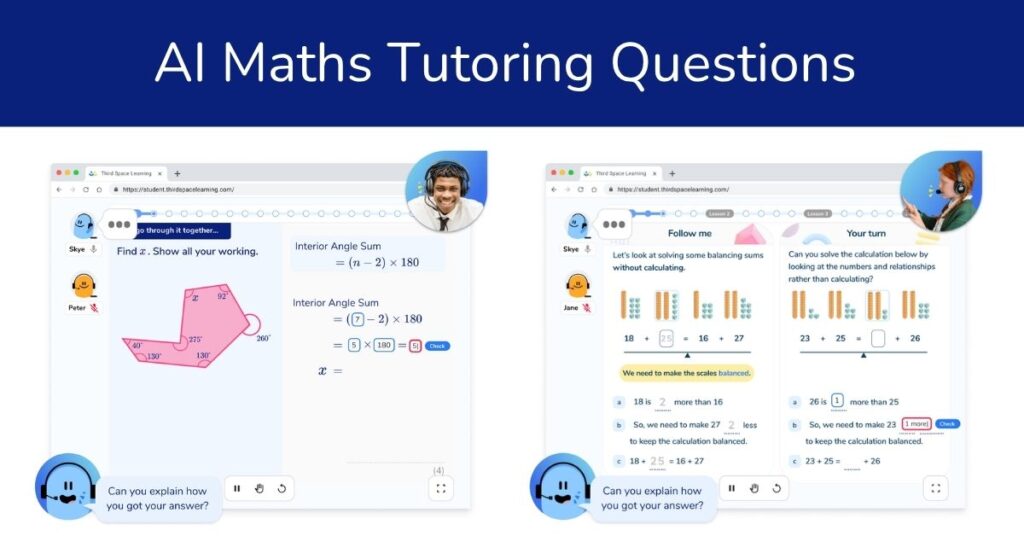
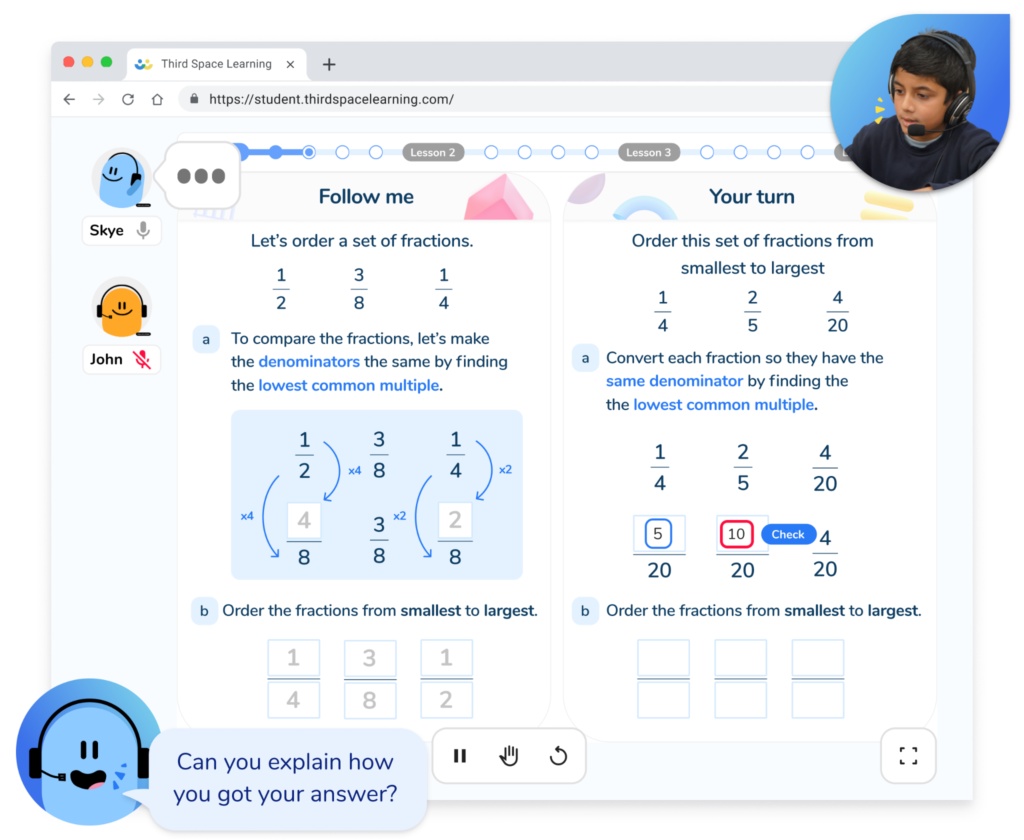
Skye is Third Space Learning’s AI maths tutor, built for one-to-one support. It is structured, in-school maths tutoring delivered through spoken dialogue, with a teacher in the room. It isn’t a homework chatbot.
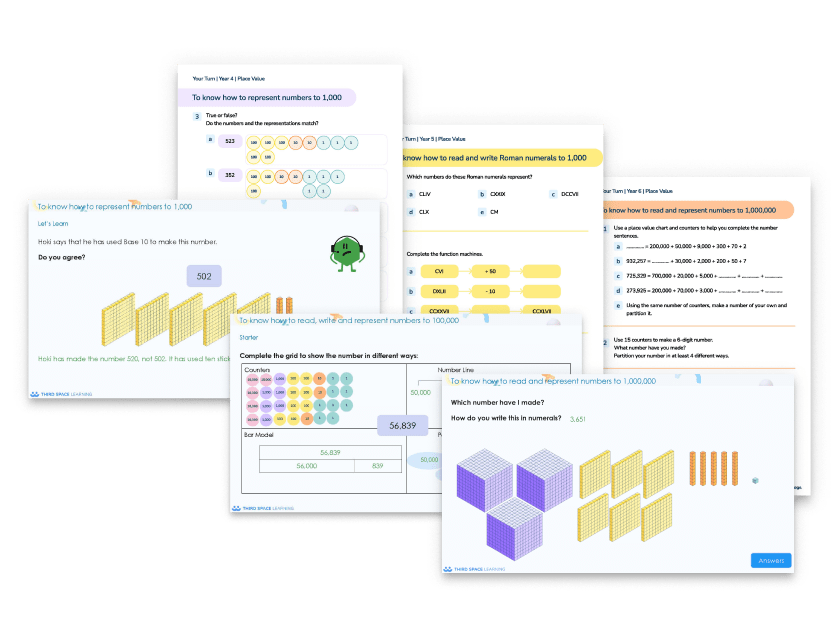
Skye was built by former maths teachers alongside our engineering team. The lessons have a clear structure: spoken dialogue, frequent feedback, careful scaffolding, and close curriculum alignment. Every pupil gets a session pitched to them, not to the group.
And it is a fixed annual cost. For a primary school that is £3,500 a year for one-form entry, £5,000 for two-form and £6,000 for three-form, and it doesn’t change with the number of pupils, sessions or year groups you put on it. Unlimited pupils, unlimited sessions, one price. So the rationing decision falls away, and you can support well beyond the handful of pupils a fixed budget usually stretches to.
To put that in context, the 583 sessions De Lacy ran this year would have cost around £26,235 with agency tutors. Skye cost them a fraction of that, just over 2% of their pupil premium budget. For pupil premium specifically, that is what removes the rationing decision: you are not choosing between 15 Year 6 pupils or 15 Year 5 pupils, you can support both, and any child who needs an extra session, within the same investment.
What is striking about these two schools is that they have built Skye into the day in completely different ways.
De Lacy: a whole-cohort morning session
“We’ve gone from those 15 cuspy pupils to the whole Year 6 cohort – 44 children. I split them across two mornings: 22 on Tuesdays and 22 on Wednesdays. We start about 15 minutes early and it runs straight into the normal maths lesson.
They’re on different programmes depending on what they need – some on revision, some on baseline-identified gap programmes, and the higher attainers on the SATs booster. Across the year that’s added up to 583 sessions and 1,402 learning objectives taught. And honestly, setting it up was quick.”
Connor McMahon, Assistant Head and Maths Lead, De Lacy Primary School
St Giles: woven into every maths lesson
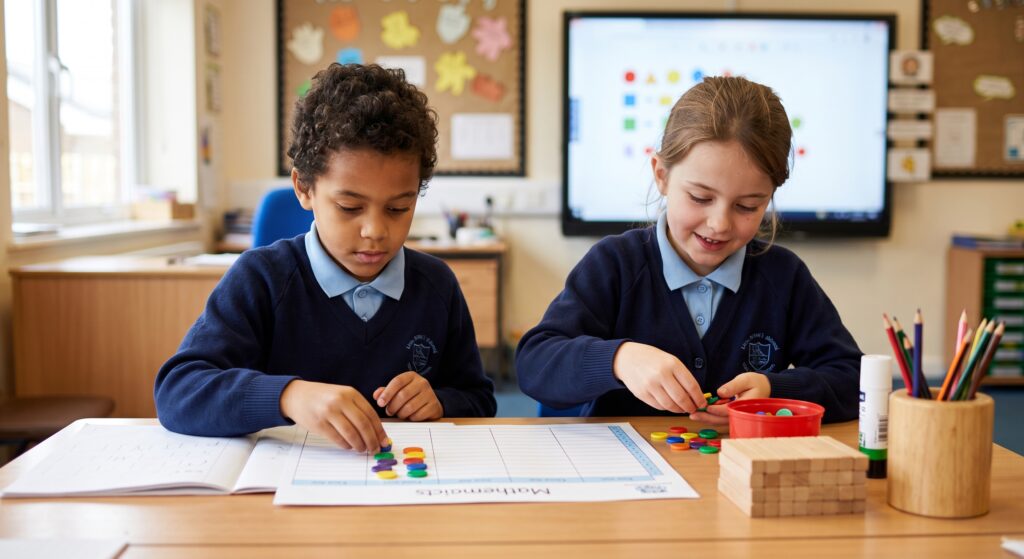
“We’ve done it differently – Skye is woven into every maths lesson across Years 4 to 6, not a separate slot before school. Classes are split into groups that rotate: one group is directly with the teacher in a focused, fairly homogeneous group; one group works with Skye; and one group completes other maths work.
The whole class is never on Skye at once, and this also means teachers are focused on smaller groups of pupils. Every pupil gets that focus time with them every week, from those working towards the expected standard through to greater depth. Some children have more than one session a week, depending on need. We choose each child’s programme at the diagnostic stage so they’re pitched correctly – right now that’s fractions, calculations and place value, with newer programmes coming on stream.”
Simrat Mavi, Deputy Headteacher and SEND Lead, St Giles Primary School
How the room actually works
This is the part teachers always want to picture.
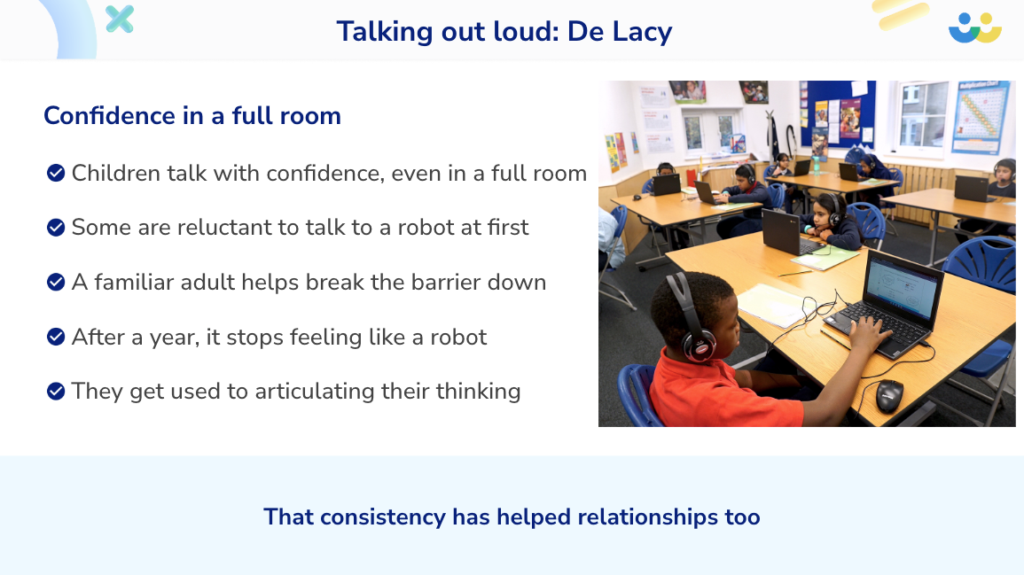
“All the pupils are in one room, laptops set up ready. It’s me plus a TA. The TA handles the headsets and logistics for the first ten minutes, then we both circulate. I’m walking round constantly, checking over shoulders, gauging confidence. Every child has a dedicated Third Space Learning maths book for working out and annotations.
I stay in the room myself because a maths teacher in the room – not a passive TA – makes the difference. I step in if Skye misreads a child. It doesn’t work if the adult treats it as time to do their own work; the children pick up on that energy.”
Connor McMahon, Assistant Head and Maths Lead, De Lacy Primary School
In Simrat’s model, the class teacher is teaching another group at the same time, so the question is how the Skye group stays well supported.
“In our model, the class teacher is in the room throughout but not directly delivering to the Skye group. We can glance across and see very quickly how each child is doing. The rotation frees the teacher up to do really targeted teaching with a small group while Skye supports another, so the quality of every group goes up.
A learning walk with Tom, the CEO of Third Space Learning, helped me refine how the room runs. My younger, tech-confident teachers manage the platform comfortably as part of the normal lesson.”
Simrat Mavi, Deputy Headteacher and SEND Lead, St Giles Primary School
Talking out loud: the oracy point
One thing that surprises a lot of primary teachers is the spoken element, the idea of a room of pupils talking out loud to an AI maths tutor.
“Yes – the children can and do talk with confidence, even in a full room. Some are reluctant at first to ‘talk to a robot’, especially in a community like ours where children may not see many positive relationships outside school. But the back-and-forth on screen, and having a familiar adult in the room, breaks that barrier down quickly. After a year of weekly sessions, it stops feeling like speaking to a robot, and that consistency has helped relationships in a way the old online human tutors couldn’t.”
Connor McMahon, Assistant Head and Maths Lead, De Lacy Primary School
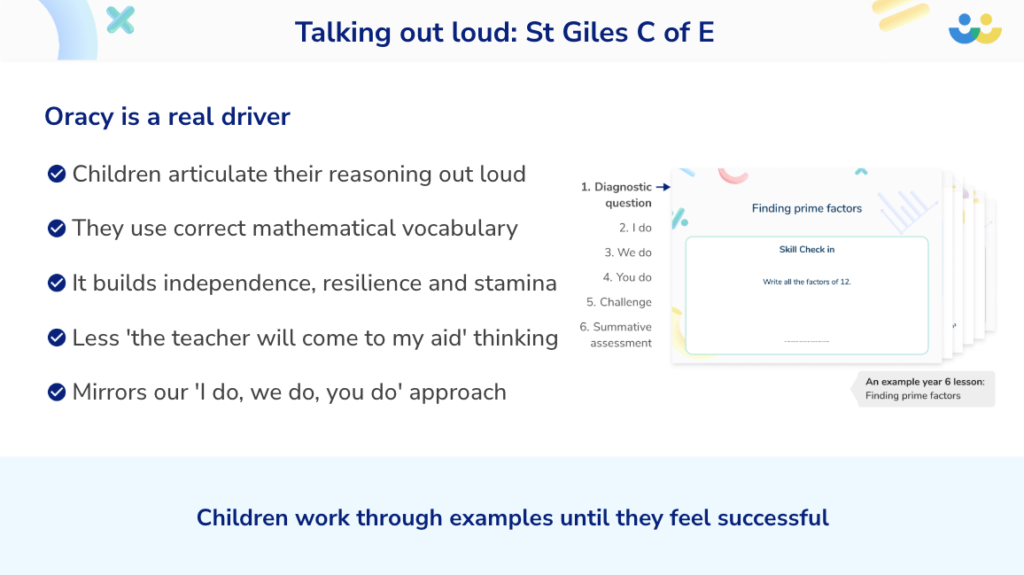
For Simrat, oracy is a real driver.
“Talking to Skye makes the children articulate their reasoning out loud and use the correct mathematical vocabulary, rather than waiting for me to step in. It builds independence, resilience and stamina, and moves them away from the ‘the teacher will come to my aid’ mindset. The way lessons with Skye are built mirrors our ‘I do, we do, you do‘ pedagogy, and my own ‘extended redo’ approach, where the children work through a couple of examples until they feel successful.”
Simrat Mavi, Deputy Headteacher and SEND Lead, St Giles Primary School
How Skye works: two personalised pathways
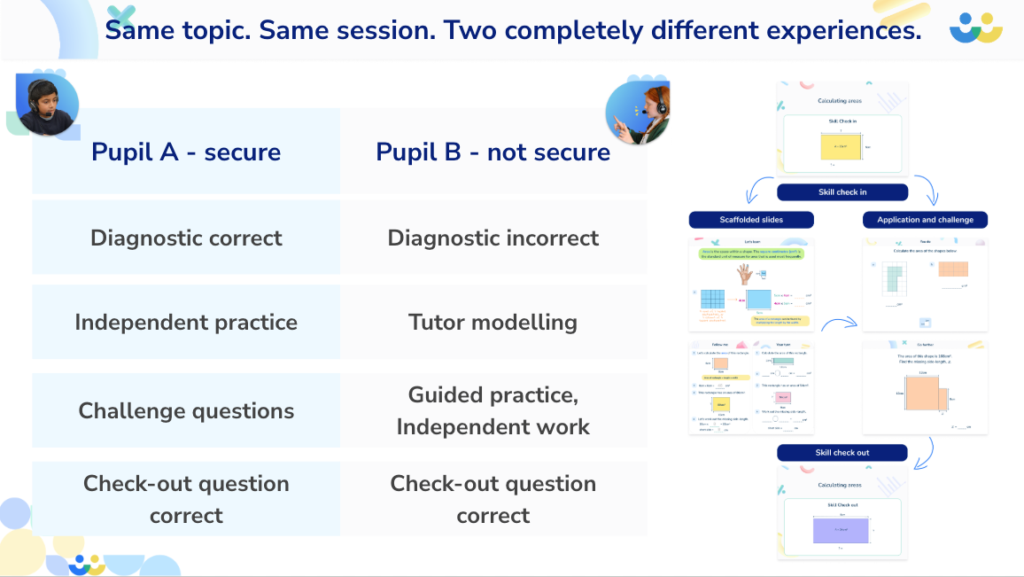
Both Connor and Simrat describe rooms where pupils are all working on something different. That personalisation is central to closing the gap. In a normal classroom, one teacher can’t teach thirty different lessons at once, so some pupils wait and others coast. AI tutoring is built precisely for that problem.
Every Skye session starts with a diagnostic check-in question, and from there the lesson branches. Take two pupils in the same room.
The first gets the diagnostic right, so rather than re-teach what they know, Skye moves them straight to independent practice, still probing their reasoning throughout, then on to a challenge question and a check-out question.
The second is less secure and gets it wrong, and that is the pupil we are really trying to reach. Skye takes them down a scaffolding pathway: it models the question, guides them through with a ‘follow me, your turn’ approach, and builds confidence step by step before they move on to independent practice and the check-out question.
So you end up with bookended data for every pupil: a check-in score and a check-out score, on every skill, every session. And every pupil in the room has had a lesson built around what they actually needed.
The moment that matters most is when a pupil gets something wrong, because that is where a gap either closes or quietly widens. A lot of digital tools just mark it wrong and move on, when what a pupil really needs is to be taught through it.
“It’s one of the things that struck me most when I’m walking round during a session. Skye never just says ‘that’s wrong, try again.’ It starts by recognising what the child has got right, then builds from there. I’ve heard it say something like, ‘you’ve correctly identified the tens column, lovely – now let’s go a step further and write your answer as a decimal.’ It picks up on the misconception, then guides and encourages until the child gets there. That patient, step-by-step input is exactly what I can’t give a whole room at once on my own, and with Skye it’s happening for every child at the same time.”
Connor McMahon, Assistant Head and Maths Lead, De Lacy Primary School
Getting ahead of the gap: starting earlier
The most effective way to close a gap is to stop it from opening in the first place. This is where the two schools are at different points on the same journey, and they can learn a lot from each other. Connor is planning to use AI tutoring earlier; Simrat is already there.
“Next year I’m planning to roll Skye out to all of Year 5, not just a target group, and I’m looking at Year 4 too. I want to start Year 5 this year, so the teething problems – reluctance to speak, tech issues – are ironed out before September, and the programme rolls from Year 5 into Year 6 rather than starting cold in the autumn.
I’ll sit down with the Year 5 teachers to decide which programme each child goes on. Greater-depth children don’t need to sit through number if it’s already embedded, and I’ve seen children get frustrated on a programme that’s too easy. I’ll support the Year 5 teachers to run sessions independently, so I don’t have to be in the room myself. What’s held me back from going earlier is that it’s always been seen as ‘a Year 6 thing’, the curriculum squeeze, and the practical question of overseeing Year 5 while I’m with Year 6.”
Connor McMahon, Assistant Head and Maths Lead, De Lacy Primary School
Simrat is further down this road, running Skye across Years 4 to 6 already.
“Year 4 is the entry to our upper school and a natural place to introduce Skye, and starting earlier means we catch gaps well before Year 6. We fit it in without asking the younger children to come in early – the rotation model inside the daily maths lesson is what makes that possible. I use the diagnostic to place every child on the right programme, including SEND pupils.”
Simrat Mavi, Deputy Headteacher and SEND Lead, St Giles Primary School
This is where it gets really interesting, because the gaps we see in Year 6 very rarely start in Year 6. Take rounding: a conceptual gap that can be traced right back to Year 3 or Year 4. If a school can use something it has already paid for to close those foundational gaps in Year 4 or Year 5, it is not firefighting in Year 6.
Is the gap actually closing? The evidence
This is the question that matters most.
“This year Skye has supported 44 Year 6 pupils at De Lacy. We’ve delivered 583 sessions and 1,402 learning objectives so far. 86% of our pupils demonstrated a secure understanding by the end of each session – so they’re not just sitting the session, they’re leaving it more secure than they came in. 91% of lessons ended with pupils reporting maintained or improved confidence. For a primary audience, that confidence point matters as much as the maths. And our average pupil survey score was 3.7 out of 5.”
Connor McMahon, Assistant Head and Maths Lead, De Lacy Primary School
St Giles has a slightly different evidence picture, early but encouraging.
“In our end-of-term NFER tests, Year 5 maths attainment was around 73%, with our pupil premium group at around 70% – a narrow in-school gap. But I’d be the first to say quality-first adaptive teaching is the number-one driver. Skye is one spoke in a much bigger wheel, a solid supplement to our quality-first teaching. Our pupil voice is strong, though – the children talk about enjoying the skill check-ins, getting positive feedback, and being helped when they get stuck.”
Simrat Mavi, Deputy Headteacher and SEND Lead, St Giles Primary School
Confidence matters more than a graph can show. When 91% of lessons at De Lacy end with a pupil feeling as confident or more confident than when they started, that is a lot of small wins stacking up every single morning.
There is one more thing worth flagging for any leader thinking about workload. All of that data, the check-in and check-out scores, the confidence ratings, the session detail, Third Space captures and assesses for you.
“We get fantastic, detailed reports, and the key thing is we’re not the ones having to produce them. Under the old way, if you wanted to know whether an intervention was working, someone – usually a maths lead who’s already stretched – had to pull it all together by hand. Here it’s done for us, pupil by pupil and session by session, and it lands in one place. That frees my teachers up to act on what the data is telling them rather than spend their evenings compiling it, and for teacher wellbeing that’s a real saving.
Simrat Mavi, Deputy Headteacher and SEND Lead, St Giles Primary School
Attendance: the equity advantage
There is one more thing that matters enormously for disadvantaged pupils specifically, and that is attendance. The pupils most likely to miss sessions are exactly the ones the gap is about.
“The cuspy and disadvantaged children often had attendance problems – sometimes we’d be doing home visits to get them in for an early human-tutor session. Under the old model, a missed scheduled session was simply gone, and it was costly. With Skye’s self-launch sessions, the children can log on whenever – if someone misses Tuesday, they still get their session. That builds ownership and responsibility for their own learning.”
Connor McMahon, Assistant Head and Maths Lead, De Lacy Primary School
The flexibility point landed with Simrat too.
“A live tutor session used to have to be pre-booked, and if a child was away or the connection failed, it was lost. Now the groups are flexible – we move children between groups as they make progress, so the delivery follows the child rather than a fixed booking. And the children work at their own pace, which takes away the frustration of being timed out or left behind.”
Simrat Mavi, Deputy Headteacher and SEND Lead, St Giles Primary School
Safeguarding and earning parental trust
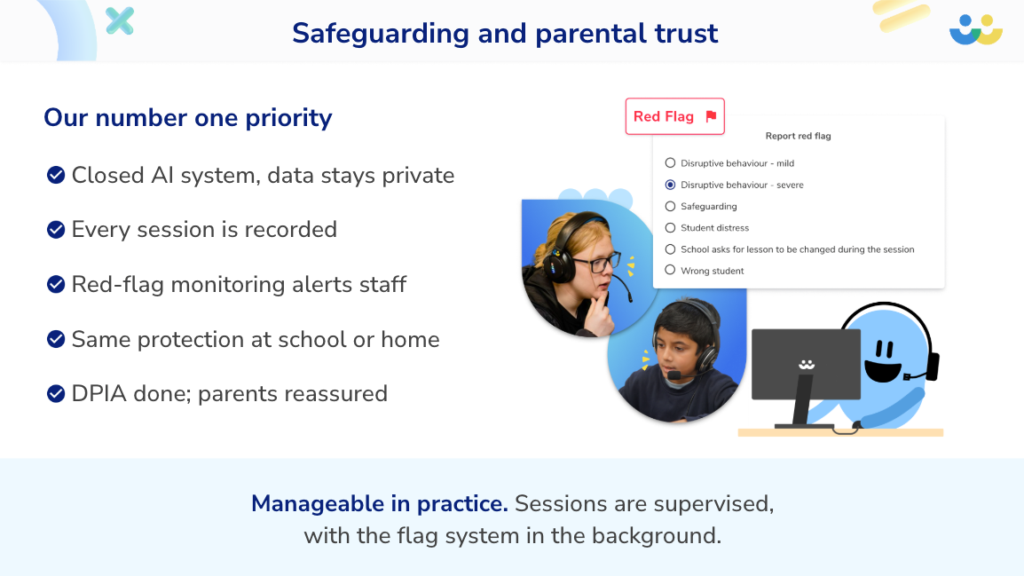
Safeguarding is the question we get asked every single time, because it is top of mind for anyone bringing AI into a primary setting. Skye is an AI product, so safeguarding is our number one priority. Every session is recorded, and we have a red-flag monitoring system that picks up anything of concern, in school or at home. Skye is also a closed AI system, so pupils’ voices and data aren’t floating around the wider internet.
“We went through the DPIA and GDPR process, and the fact that it’s a closed system was really reassuring. For us, having a maths teacher in the room throughout matters – it’s never just the child and Skye.”
Connor McMahon, Assistant Head and Maths Lead, De Lacy Primary School
“We’ve uploaded privacy notices to our website as a statutory duty, so parents are informed. We’ve added an AI section to our computing policy, reviewed by our computing lead and the safeguarding team. The session transcripts are really valuable – if anything is ever misinterpreted, we can check the record.”
Simrat Mavi, Deputy Headteacher and SEND Lead, St Giles Primary School
What changes when you take the rationing away
Let’s come back to the question we started with. If we know one-to-one tutoring works, why haven’t we been closing the gap? The honest answer is that schools could never afford to give it to enough pupils. The support existed, but it was rationed to a handful, so for most disadvantaged pupils, it may as well not have.
What Connor and Simrat show is what changes when you take that rationing away, and that there is more than one way to do it. At De Lacy, that is a whole Year 6 cohort in a morning session; at St Giles, it is woven through every maths lesson from Year 4 upwards. Two very different models, same principle: support that, under the old model, would have reached a fraction of these pupils now reaches all of them, each at their own level. And increasingly, that support is starting before Year 6, when those gaps are easier to close. The pupils furthest behind are the ones who gain the most.
The gap doesn’t close because of a clever piece of technology. It closes because, for the first time, the pupils who need the most can actually get it. Leading a secondary or all-through trust? See how one MAT scaled one-to-one tutoring to close the maths attainment gap at GCSE.