


GCSE Results Day 2027: Key Dates, Deadlines And What Schools Need To Plan For

GCSE results day 2027 is Thursday 19 August. If you lead a maths department, though, your working day starts on the Wednesday, when results reach your exams officer and nobody else.
This guide sets out every confirmed date in the 2027 series, the post-results deadlines worth diarising now, and what to do with your maths results in the 24 hours before students arrive.
Stay updated for the 2027 GCSE season
Join our email list to be alerted to any new changes to GCSE maths exams in 2027.
We’ve got all the GCSE dates 2027 and we will be reviewing the contents of each of the GCSE maths papers in 2027 and taking a good look at the GCSE results 2027 in August.

Edexcel, AQA and OCR Foundation and Higher Papers: Set 5 (2026)
Download these 2026 GCSE maths practice paper packs for students following the Edexcel, AQA and OCR exam boards. Each exam board contains 3 foundation and 3 higher tier papers.
Download Free Now!Key takeaways
- GCSE results day 2027: Thursday 19 August 2027, results slips from 8.00am
- Restricted release to centres: Wednesday 18 August 2027, from 12.01am
- A level results day 2027: Thursday 12 August 2027
- Scotland: Tuesday 10 August 2027
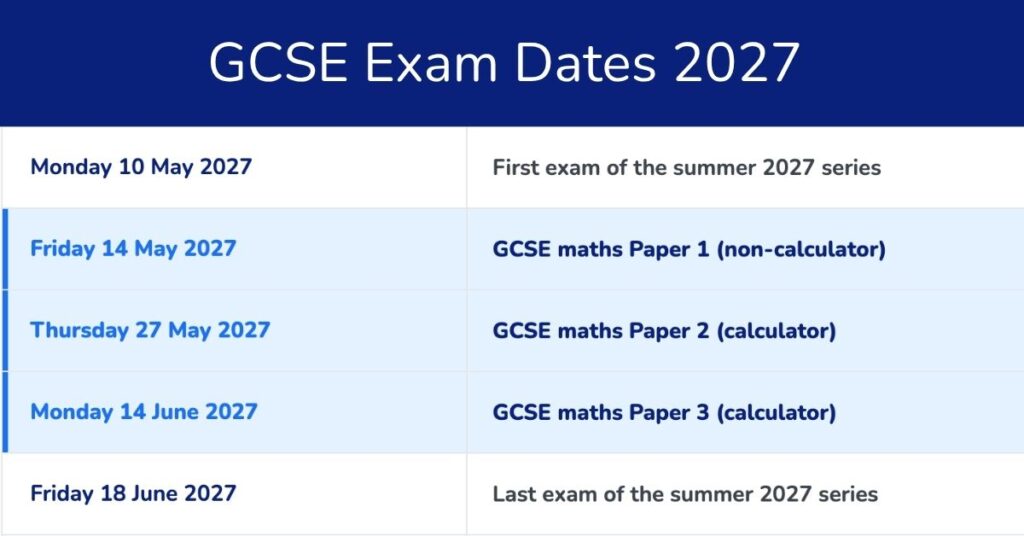
- GCSE exam dates 2027: Monday 10 May to Friday 18 June 2027, with a contingency day on Wednesday 23 June
When is GCSE results day 2027?
GCSE results day 2027 is Thursday 19 August 2027. JCQ gives the date in its key dates document for the June 2027 exam series, which every JCQ awarding body works to, and AQA’s results days page confirms it.
The exact date and time
Schools can give students their results slips from 8.00am on Thursday 19 August 2027. Most schools set their own collection window from there, so a student asking what time results come out, or where to collect results, should be pointed at your school website rather than a national time. Provisional national statistics follow at 9.30am, and that release is where the national picture comes from if your head is briefing governors or the local press.
Wednesday 18 August: restricted release to centres
Results reach centres a working day early. From 12.01am on Wednesday 18 August 2027, exams officers and the head of centre can see results slips on their awarding body’s secure site and through the JCQ Data Transport Application, and AQA keeps those slips available for 28 days. Nobody else in school sees a grade until Thursday morning, and that includes heads of maths, form tutors and Year 11 themselves.
The key dates around GCSE results 2027
Results day sits at the end of a run of fixed dates. These are the ones to put in the department calendar now.
The June 2027 exam series at a glance
Date | What happens |
|---|---|
Monday 10 May 2027 | First exam on the common timetable, GCSE and GCE |
Friday 18 June 2027 | Final GCSE exam on the common timetable |
Tuesday 22 June 2027 | Final GCE exam on the common timetable |
Wednesday 23 June 2027 | Contingency day for national or significant local disruption |
Wednesday 11 August 2027 | Restricted release of A level and Level 3 results to centres |
Thursday 12 August 2027 | A level, AS and Level 3 results released to students |
Wednesday 18 August 2027 | Restricted release of GCSE results to centres, from 12.01am |
Thursday 19 August 2027 | GCSE results day, results slips from 8.00am |
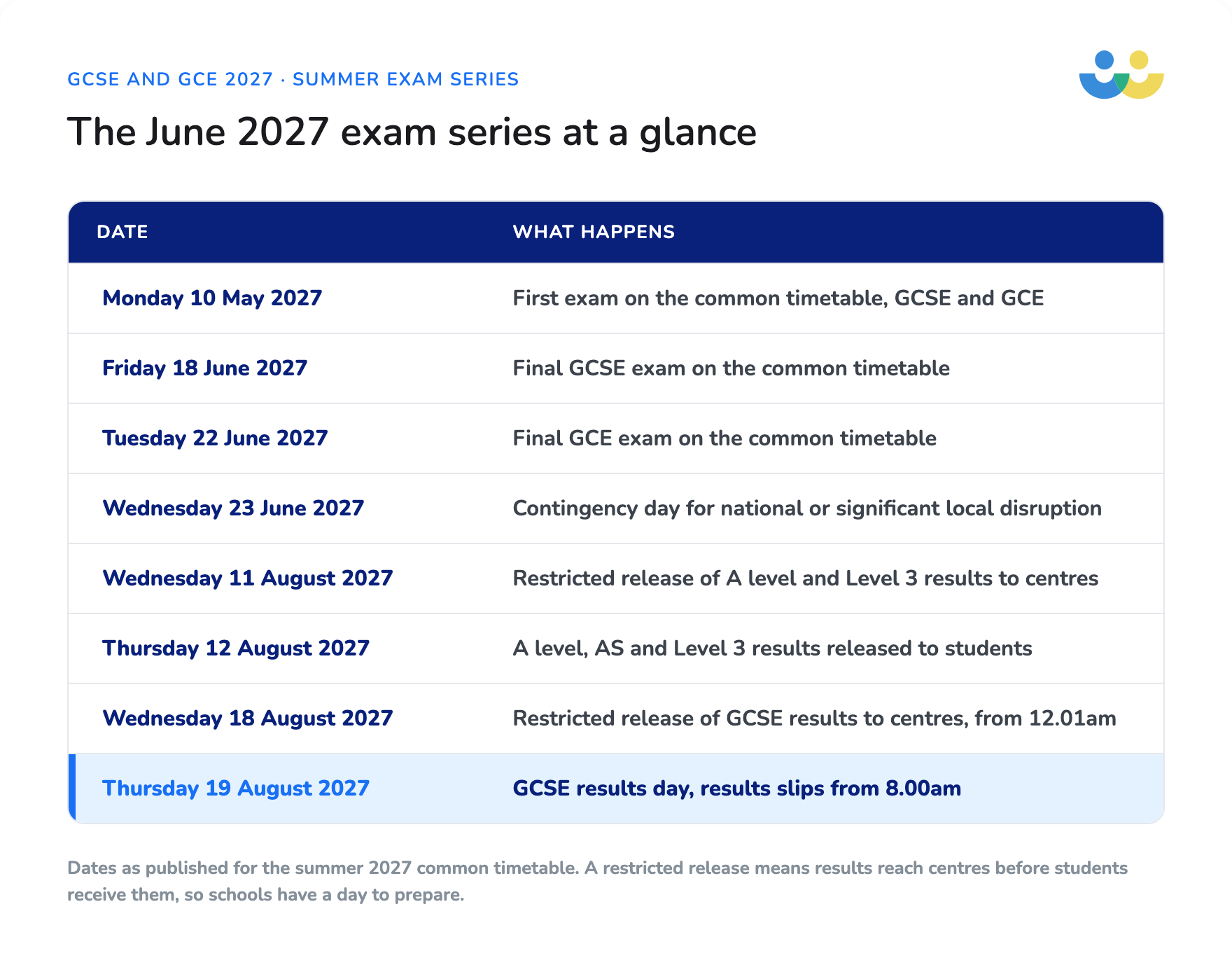
The exam season runs from Monday 10 May 2027 to Friday 18 June 2027 for GCSE, with the GCE timetable closing on Tuesday 22 June. Core subjects are spread across those six weeks: GCSE mathematics sits as a non-calculator paper and two calculator papers, the English language and English literature papers run alongside them, and the biology, chemistry and physics papers fill the middle weeks.
Keep the contingency day clear whatever your own timetable looks like. Every candidate has to stay available until Wednesday 23 June, even where their GCSE exam dates 2027 finish a week earlier.
Why results day falls on the third Thursday in August
Results day moves each year because awarding bodies set it by working days, not by a calendar date. They need a consistent gap between the final exam on the common timetable and release, which has put results on the third Thursday in August in most recent years. In 2027 that is 19 August, a day earlier in the month than 2026 and just under nine weeks after the final exam on 18 June.
When is A level results day 2027?
A level results day 2027 is Thursday 12 August 2027, with restricted release to centres on Wednesday 11 August. GCSE results follow a week later.
The gap between the two results days is busier than the calendar suggests. Your Year 13 outcomes from A levels, and any priority reviews of marking that come out of them, land while your Year 11 results are still sealed.
Results day 2027 across the UK
England, Wales and Northern Ireland
Every JCQ awarding body releases results on the same day: AQA, Pearson Edexcel, OCR, WJEC and Eduqas, and CCEA. Exam board timetables differ across the series itself, but 19 August 2027 is common to all of them.
Northern Ireland centres entering CCEA specifications should still check CCEA’s own administration documents, because some deadlines around the release sit outside the JCQ common dates. Edexcel, AQA and OCR centres in England work to the JCQ dates throughout.
Scotland: results day is Tuesday 10 August 2027
Qualifications Scotland, formerly the SQA, confirms that the 2027 exams start on Monday 26 April and finish on Thursday 3 June, with results day on Tuesday 10 August 2027. Scottish results land nine days ahead of the GCSE release, so a trust with sites either side of the border sees National 5 and Higher outcomes first.
What to do with your maths results on the Wednesday
The Wednesday is the only quiet day you get before results day. Use it and you arrive on Thursday with a plan instead of a reaction.
What centres can see, and when
Your exams officer holds every candidate’s marks, across every subject, from 12.01am. Nothing is broken down by boundary yet, because boundaries are not published until Thursday morning.
Agree in advance who sees the maths results and when. A head of maths who gets the data at 8.00am on Thursday, alongside Year 11 itself, has lost the useful day.
Three checks to run before students arrive
- Missing and incomplete results. Check every entered candidate has a grade for every paper. A missing result means you contact your awarding body, and it is far easier to raise on the Wednesday.
- Candidates close to a threshold. You cannot see boundaries yet, but you can see every total. Flag the candidates whose totals cluster in the range where a 3, a 4 or a 5 will be decided.
- Anything that contradicts what you know. A student who worked at grade 6 all year and came out with a 3 is worth a second look at paper level before Thursday.
Where grade boundaries fit
Grade boundaries are published on results day morning, not before. Until then you have marks and grades, with no way of knowing how close a candidate sat to a threshold.
Once they are out, the grade boundaries for your own specification show you who missed a 4 or a 5 by a mark or two. Those are the students to consider for a review of marking.
Reading your 2027 maths results
Grade 4 and grade 5 in maths
A 4 is a standard pass and a 5 a strong pass. For a student, a 4 in maths means they no longer have to keep studying it post-16 under the condition of funding. For your figures, a 5 is what appears in the basics measure alongside English language.
Read both. A cohort with plenty of 4s and few 5s usually points at secure procedural work and thin reasoning.
Foundation and higher tier decisions
Your tier split is a record of decisions made in Year 10. Foundation tier caps a candidate at 5, and higher tier starts at 4 with a safety net at 3.
So on the Wednesday, count two things: how many higher tier students came out at 4 or below, and how many foundation tier students topped out at 5. The headline number of 5s tells you less. If more than $frac{1}{4}$ of your higher entry landed below a 4, look at the tiering decision before you look at the teaching.
Comparing your results with the national picture
The provisional national figures released at 9.30am cover all UK candidates of all ages. Your own results are England-only and mostly 16-year-olds, so setting the two side by side will flatter or punish your department for no good reason.
The fairer comparison is your own department, year on year, read against the GCSE results 2026 figures on the same basis.
Post-results services 2027: reviews, scripts and appeals
Every post-results service runs to a deadline within weeks of results day, and two of them fall while your department is still on holiday. This is a section to diarise in September 2026, not August 2027.
Clerical re-checks and reviews of marking
A clerical re-check confirms the total on the slip is correct and every mark was recorded. A review of marking puts the script back in front of a senior examiner to check the mark scheme was applied as intended. Neither is a re-mark against a different standard, and the outcome can lower a grade as well as raise it, so you need the student’s consent in writing before you submit.
The priority service, and who it covers
Priority reviews cover A levels, T levels and Level 3 VTQs only, because those grades hold up university places. There is no priority route for GCSE.
In summer 2026 the priority deadline fell on 20 August, the same day GCSE results were issued. You get one day to decide on A level priority reviews, and GCSE results arrive on the same morning.
Access to scripts and what to do with them
Copies of scripts do two jobs. They tell you whether an enquiry is worth submitting, and they show your department exactly where the drops happened.
A set of returned higher tier scripts shows where marks were dropped on the non-calculator paper, question by question. For planning your next Year 11, question-level evidence from your own scripts beats a general examiner’s report.
Appeals
An appeal comes after a review outcome, not instead of one. Edexcel, OCR and AQA all require appeals within 30 days, and the head of centre normally submits on the student’s behalf.
Deadlines to diarise
JCQ publishes its summer 2027 post-results deadlines nearer the time. The summer 2026 dates give you the shape.
Service | Summer 2026 deadline | Expected 2027 equivalent |
|---|---|---|
Priority reviews of marking (A levels, T levels, Level 3 VTQ) | 20 August 2026 | Thursday 19 August 2027 |
Reviews of results, including every GCSE | 24 September 2026 | Week beginning 20 September 2027 |
Copies of scripts to support teaching and learning | 24 September 2026 | Week beginning 20 September 2027 |
The 2027 column is expected, not confirmed. Check it against JCQ’s summer 2027 post-results guidance once that is published.
GCSE maths resits after results day 2027
The autumn 2027 resit series
Maths and English language GCSE resits are sat in November, and entries open once results are out. JCQ confirms the autumn series dates during the autumn term.
The November 2026 series is the pattern to plan around: a final entry date of 4 October, with exams running from 2 to 11 November.
When do GCSE resit results come out?
Resit results arrive in mid-January, around nine weeks after the November exams. For the November 2026 series, results reach centres under restriction on Wednesday 13 January 2027 and go to candidates on Thursday 14 January 2027. Both AQA and Pearson give those dates, and the same Wednesday to Thursday pattern applies to the autumn 2027 series a year later.
Deciding who resits maths
Not every 3 should sit in November. Two things decide it: how far off the student really was, and where they are in September.
A student four marks short of a 4 with a clear gap in one strand is a strong November candidate. Someone 30 marks short needs a year of teaching, not eleven weeks. Students who move on to colleges will often be entered anyway, because the condition of funding applies wherever they study, and colleges enter large numbers each autumn.
Turning results day into a Year 11 plan
The first fortnight of September
Your 2027 results are at their most useful in the two weeks after you get them, while the exams are still fresh in everyone’s mind.
Pull the question-level data for maths and read it against your current Year 11’s mock results. The topics your last cohort struggled with are usually the ones your next cohort is heading towards, and September is when there is still time to change the plan. A cohort that slipped on converting between fractions and decimals, or reading 0.5 ÷ 2 as 1, needs that fixed in the autumn term rather than revisited in May. A short set of diagnostic questions in the first week tells you whether your current Year 11 carries the same gap.
Then work the same detail into how the department uses past papers. Teachers who know which questions their own students found hardest can pick past papers that target those gaps, and prepare Year 11 for the next series far more precisely than a generic revision plan allows.
Where one-to-one tutoring fits
In most maths departments, there are more students who need one-to-one support than the timetable or the budget will stretch to. Schools end up choosing who gets it.
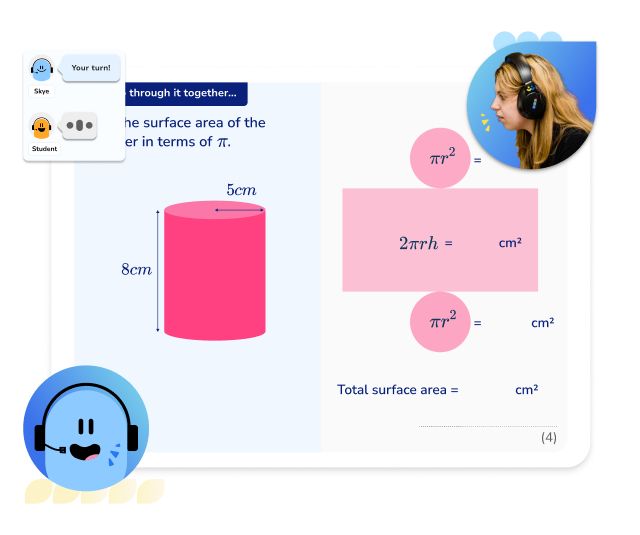
Skye, our spoken AI maths tutor, was built for that gap. Tutoring is unlimited for one fixed yearly price, so the number of students and the number of sessions do not change the cost. GCSE programmes align with the grade each student is aiming for.
Sessions start every five minutes before, during or after school, and are supervised in school. Skye was built by former teachers and technologists using insight from 2 million one-to-one lessons taught to 170,000 students across 4,000 schools, and is available for Years 10 and 11.

Free GCSE maths revision resources for schools
As part of the Third Space Learning offer to schools, the personalised online GCSE maths tutoring can be supplemented by hundreds of free GCSE maths revision resources from the secondary maths resources library including:
– GCSE maths past papers
– GCSE maths predicted papers
– GCSE maths worksheets
– GCSE maths questions
– GCSE maths topic list
Final note on GCSE results 2027
The dates are settled. Results day 2027 is Thursday 19 August, slips go out from 8.00am, and boundaries are published the same morning.
The part worth planning is the Wednesday, and the four weeks that follow it. Agree the checks now, put the post-results deadlines in the calendar and book the question-level analysis into the first fortnight of September. Do that and results day 2027 is a working day rather than one you brace for.
Results day 2027 FAQs
The first exam on the common timetable is on Monday 10 May 2027. GCSE exams finish on Friday 18 June 2027, with a contingency day on Wednesday 23 June that every candidate must stay available for.
GCSE results day 2027 is Thursday 19 August 2027. Results go to centres under restriction the day before, from 12.01am on Wednesday 18 August.
Schools can give students their results slips from 8.00am on Thursday 19 August 2027. Individual schools set their own collection times, so check your school’s arrangements.
Results for the November series are released in mid-January. For the November 2026 series, results go to candidates on Thursday 14 January 2027, with restricted release to centres the day before.
A 4 is a standard pass and a 5 is a strong pass. A student with a 4 in maths no longer has to keep studying it post-16 under the condition of funding.
Boundaries are set after marking and published on results day morning, 19 August 2027. Exam boards set them to keep standards comparable year on year, so they cannot be fixed in advance.
Yes. Following its consultation, Ofqual will continue to require exam boards to provide formulae and equations sheets for GCSE mathematics, physics and combined science. That runs for the remaining lifetime of the current specifications, so the formulae and equations sheets your students use in mocks will be there in the 2027 exams.
Not in a way that changes the 2027 series. Assessment arrangements stay as they are for the current specifications, and the reforms coming out of the Curriculum and Assessment Review are aimed at later cohorts.

DO YOU HAVE STUDENTS WHO NEED MORE SUPPORT IN MATHS?
Skye – our AI maths tutor built by teachers – gives students personalised one-to-one lessons that address learning gaps and build confidence.
Since 2013 we’ve taught over 2 million hours of maths lessons to more than 170,000 students to help them become fluent, able mathematicians.
Explore our AI maths tutoring or find out how a GCSE maths tutor could support students in your school.