


What Is The Lowest Common Multiple: Explained For Primary School

In this post we will be answering the question “what is the lowest common multiple?” and providing you with all of the information you need to help your students understand this area of maths. We’ve also got some questions based around the lowest common multiple that your child can complete, all to help them (and you) master maths fast!
What is a multiple in maths?
What is a multiple? A multiple is a number that can be divided without any remainder.
Sometimes it helps children to think of it as a number in another number’s times table – for example, 24 is a multiple of 12; it is also a multiple of 1, 2, 3, 4, 6, 8, and 24. The first five multiples of 6 are 6, 12, 18, 24 and 30.
Multiples and factors link together – for example, 4 is a factor of 12 and 12 is a multiple of 4.
Children often confuse multiples with factors, so it is important they learn about the difference between factors and multiples.
See also: Divisibility rules
What is a common multiple in maths?
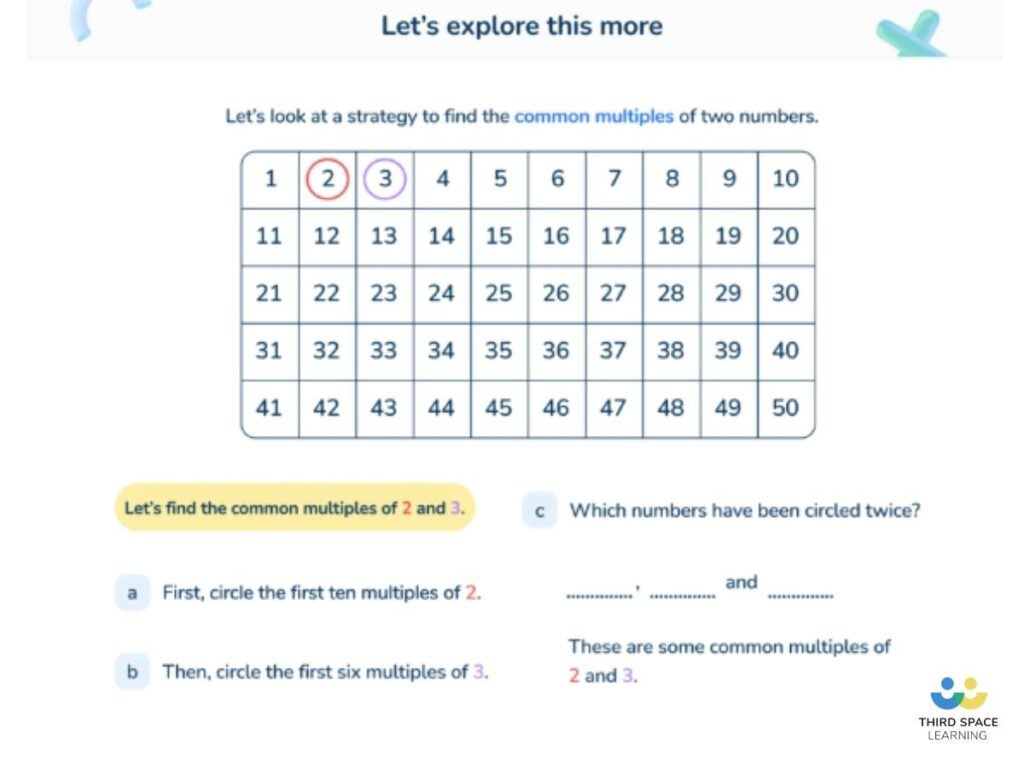
A common multiple is a multiple that is shared by two or more numbers.
12 is a common multiple of 6 and 4 as it’s in both the 6 and 4 times tables.
Three common multiples of 6 and 9 are 18, 36 and 54.
In the slide below, students are asked to identify common multiples in Third Space Learning’s online tutoring with Skye, the AI maths tutor. Each tutoring programme is specially designed to meet the needs of the individual student, plugging learning gaps and building confidence in maths through conversation-based intervention.
Third Space Learning offers a wide range of free maths resources, including our collection of multiplication worksheets.
What is the lowest common multiple?
The lowest common multiple is the lowest multiple shared by two or more numbers.
For example, common multiples of 4 and 6 are 12, 24 and 36, but the lowest of those is 12; therefore, the lowest common multiple of 4 and 6 is 12.

Unlimited primary maths tutoring with Skye, the voice-based AI maths tutor.
Built on the same principles, pedagogy and curriculum as our traditional tutoring, but with more flexibility, reach and lower cost.
Join the schools already helping hundreds of primary pupils nationwide with Skye’s one to one maths tutoring.
Watch Skye in actionHow to find the lowest common multiple
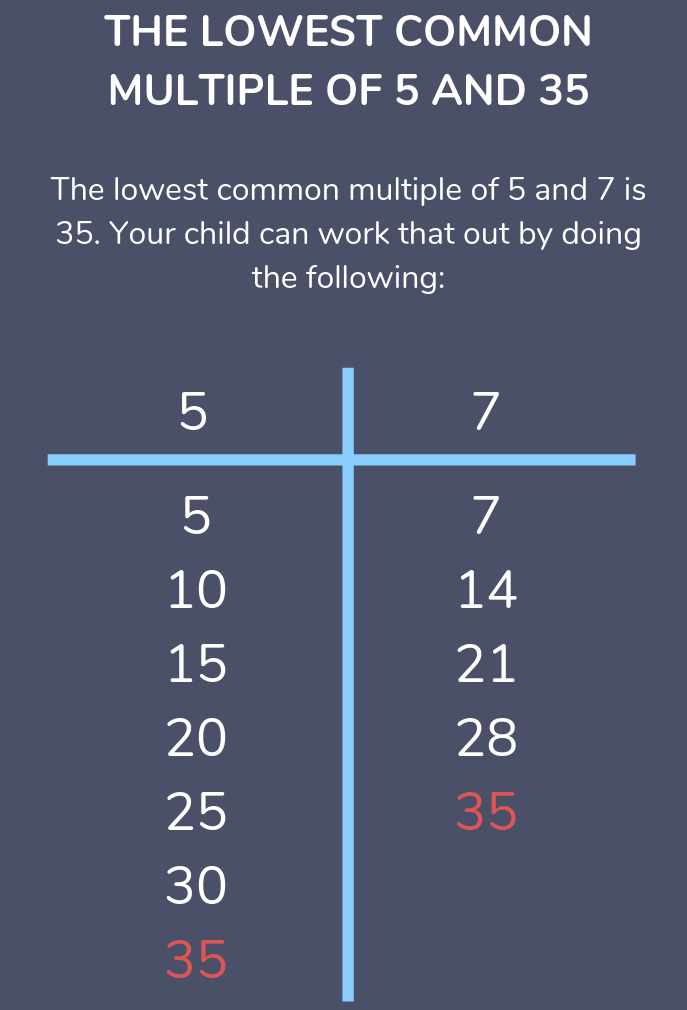
One way of helping children to find the lowest common multiple is to ask them to list the multiples of each number until they come across the first one each number shares.
For example, the LCM of 5 and 7 is 35:

FREE Factors, Multiples, Square & Cube Numbers Pack
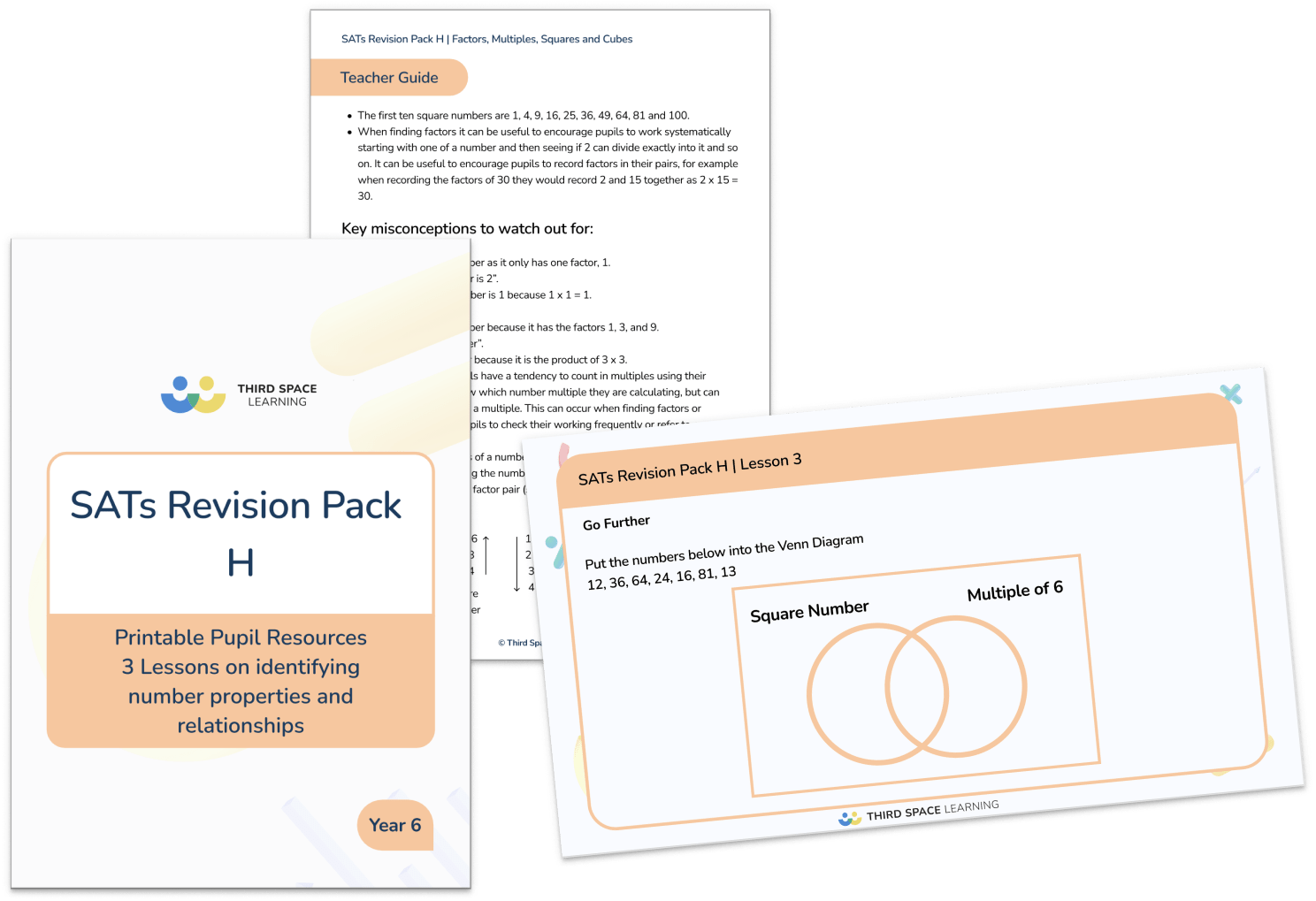
Download this resource pack aimed at helping pupils identify number properties and relationships in advance of SATs. It includes teaching guidance, pupil practice sheets and activity slides.
Download Free Now!When will my child learn about lowest common multiples?
Children are introduced to multiples in Year 1 (perhaps without knowing the actual term) when they will count in multiples of twos, fives and tens, as part of their learning of number bonds. In Year 2, the non-statutory guidance suggests that children count in multiples of three to support their later understanding of a third.
In Year 3, children count from 0 in multiples of 4, 8, 50 and 100. The non-statutory guidance suggests that children use multiples of 2, 3, 4, 5, 8, 10, 50 and 100.
In Year 4, children count in multiples of 6, 7, 9, 25 and 1000. The non-statutory guidance suggests that pupils use factors and multiples to recognise equivalent fractions and simplify where appropriate (for example, 6/9 = 2/3 or 1/4 = 2/8).
The National Curriculum states that Year 5 pupils should be taught to identify multiples and solve problems involving multiplication and division including using their knowledge of multiples.
Common multiples are not introduced until Year 6. Year 6 pupils are expected to use common multiples to express fractions in the same denomination and to solve problems involving unequal sharing and grouping using knowledge of fractions and multiples.
How do lowest common multiples relate to other areas of maths?
Lowest common multiples are useful when needing to express fractions in the same denomination (required when going through the process of how to add fractions and how to subtract fractions, ordering or comparing fractions). For example, to calculate 3/5 + 1/6, we’d need to find the common denominator by calculating the lowest common multiple of 5 and 6 (30). We can then convert the fractions to 18/30 + 5/30 = 23/30.
Wondering about how to explain other key maths vocabulary to your children? Check out our Primary Maths Dictionary, or try these primary maths terms:
- Long Multiplication
- Long Multiplication Method
- What Is A Cube Number
- What Is A Square Number
- Highest Common Factor
Lowest common multiple practice questions
1) What is the lowest common multiple of 8 and 10?
2) Write all the common multiples of 3 and 8 that are less than 50.
3) What is the lowest common multiple of 100 and 50?
4) Write all the common multiples of 4 and 6 that are less than 60.
5) What is the lowest common multiple of 1000 and 650?

DO YOU HAVE STUDENTS WHO NEED MORE SUPPORT IN MATHS?
Skye – our AI maths tutor built by teachers – gives students personalised one-to-one lessons that address learning gaps and build confidence.
Since 2013 we’ve taught over 2 million hours of maths lessons to more than 170,000 students to help them become fluent, able mathematicians.
Explore our AI maths tutoring or find out about online maths tuition for your school.