

13 Effective Learning Strategies: A Guide to Using them in your Maths Classroom 2026

Imagine one of your learners staring at a complex maths problem, completely stuck. Now picture that same student confidently breaking down the problem using the researched learning strategies you’ve taught them. The difference? Your approach to learning strategies. When educators understand and implement diverse approaches to learning, they provide students with the tools to deepen their understanding. The science of learning shows that diverse learning strategies can turn struggling students into confident learners who actively engage in learning.
This article explores 13 effective learning strategies and how to use them in your maths classroom as a natural part of the learning process to improve student attainment.
What are learning strategies?
Learning strategies are evidence-based methods that help pupils organise, remember and apply new information. They include cognitive techniques like dual coding and concept mapping, retrieval-based techniques like spaced repetition and flashcards, and active techniques like elaboration and reciprocal teaching. Each works by moving information from short-term to long-term memory.
There is more to learning strategies than memorisation. Students must retain and apply information and develop independent thinking skills.
Learning strategies can be thought of as tools in a toolbox. Students have different learning styles and preferences so teachers need to provide students with a toolbox of different teaching strategies and students need access to a toolbox of various learning strategies and learning processes to suit their needs.

Adaptive Teaching CPD Guide For Schools
Discover the key strategies for implementing adaptive teaching across your school to help meet students’ learning strategies and needs to improve attainment.
Download Free Now!What are some popular learning strategies?
Maths places unique demands on working memory. Pupils have to hold multiple steps in their head, switch between concrete and abstract representations, and apply prior knowledge to unfamiliar problems. When any of those processes overload, learning stalls. This is the core insight of cognitive load theory: working memory is finite, and effective teaching keeps load manageable so long-term memory can do the heavy lifting.
Effective learning strategies reduce that load. They help pupils chunk information, transfer it from short-term to long-term memory, and surface gaps before they compound. Maths is uniquely cumulative: a wobble in early fractions work shows up two years later in algebra. So the strategies that teach students how to learn maths – retrieval practice, spaced repetition, dual coding – matter more in this subject than in those with looser sequencing.
The 13 strategies in this guide are drawn from cognitive science and education research, chosen for how well they translate into a maths classroom. Some work best for whole-class teaching; others sit naturally inside an effective maths intervention, particularly during high-impact tutoring. A few are most powerful with older pupils who can manage independent learning autonomously.
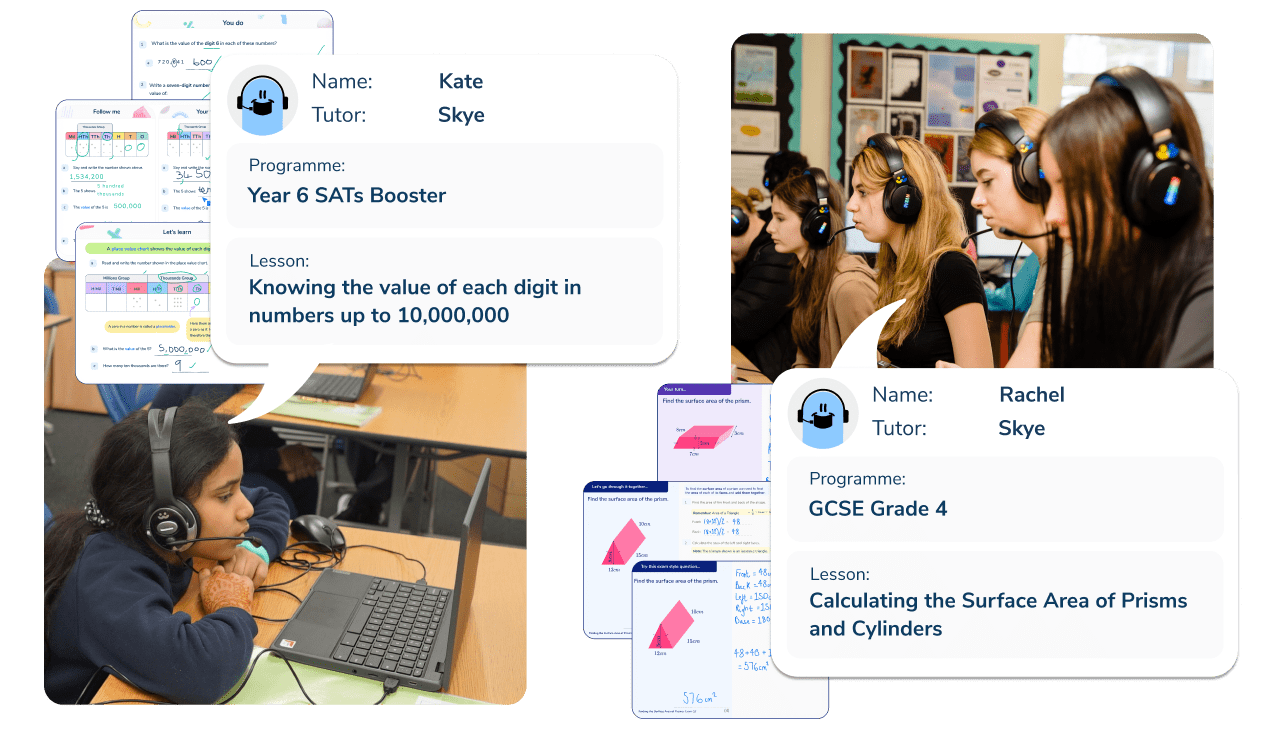
Meet Skye, the spoken AI tutor making maths success possible for every student.
Teachers and math experts built Skye on the same principles that make human tutoring effective. Its pedagogy, curriculum and lesson structure draw on more than 2.2 million tutoring sessions.
But with more flexibility and a lower cost, schools can scale online maths tutoring to support every student who needs it.
Watch Skye in action13 learning strategies: A guide to using them in the classroom
1. Concrete examples
What it is
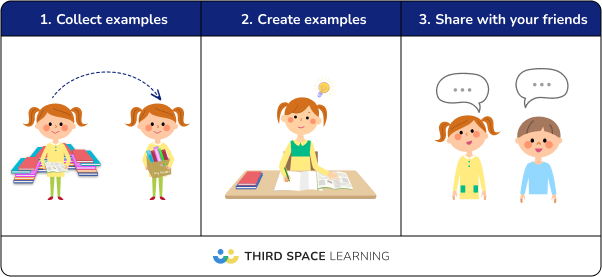
Teachers provide clear examples of a concept or skill and students create concrete examples to help them understand material. As one of Rosenshine’s principles states, explicit instruction that uses concrete examples helps students understand and learn abstract concepts such as time.
Learners can apply learned concrete examples to their studying and come up with their own examples to reference.
Why it works
Human memories are better at working with concrete examples than abstract information. Students who practise with concrete examples are more likely to learn and retain foundational concepts.
Dunlosky et al. (2013) classify worked examples and concrete representations as moderate-utility strategies; Rosenshine’s Principles of Instruction also place worked examples among the most consistent classroom moves.
Example
A teacher has students brainstorm examples of how fractions are used in real life so that students can develop a firm conceptual understanding of fractions using concrete examples.
2. Group work
What it is
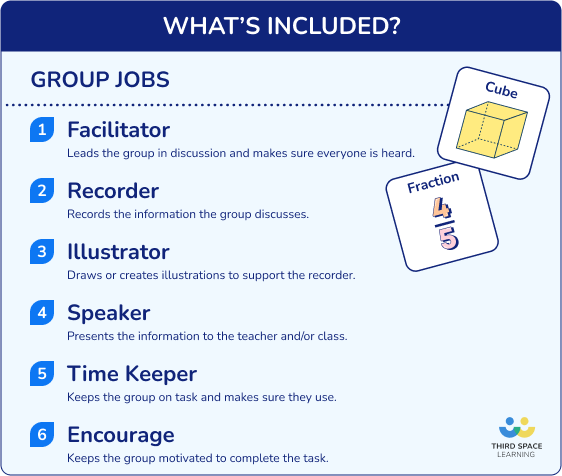
Students work in groups where they each have a separate role, such as reader, note-taking, or artist. Each learner is required to access and work with the same content but in a different way.
Why it works
Group work helps students engage with content using their own learning processes and preferences rather than each student learning in the same way. It is advisable to use mixed ability groups for this learning strategy to help all learners; however, you can also use differentiation for group work if students have access to adult support.
The EEF Teaching and Learning Toolkit reports an average +5 months progress for collaborative learning, with strongest effects when each pupil has a defined role and the task requires interdependence.
Example
A teacher assigns students to work in small groups to solve problems. Each student has a role and must contribute to the problem-solving through their role:
One student reads each problem.
Another student draws a model to represent the problem.
A third may write an explanation of the steps the group took to solve it.
3. Concept mapping or visual examples
what it is
Concept mapping requires students to create a visual representation of information. This may take the form of a chart, graphic organiser, flow chart, Venn diagram, or another visual representation.
Why it works
Students must think through how they use and organise information when they use concept mapping, which involves metacognition. A review of visual information helps students remember and organise information.
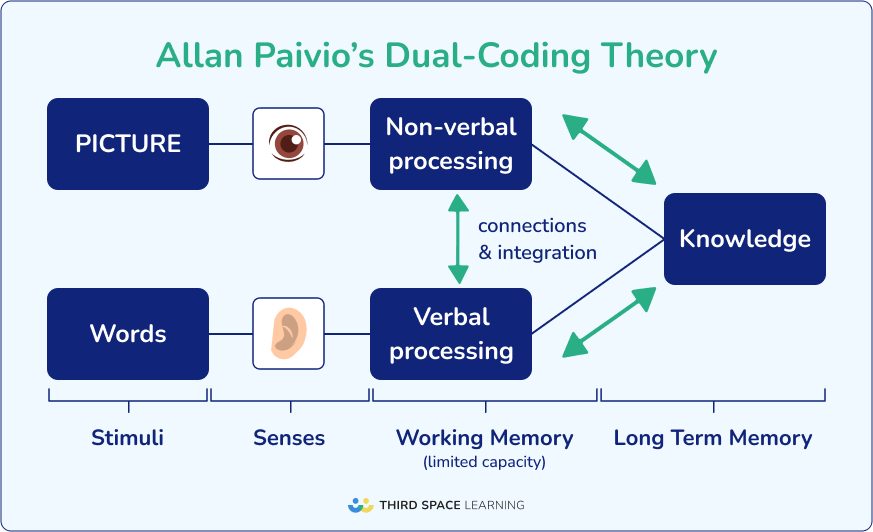
Concept mapping draws on dual coding theory (Paivio), which holds that information processed through both visual and verbal channels is more durable than information processed through either alone.
Example
When students study fractions they are provided with visuals of what fractions look like and how they work together. For example, a visual of how to add and subtract fractions using an image of pizza.
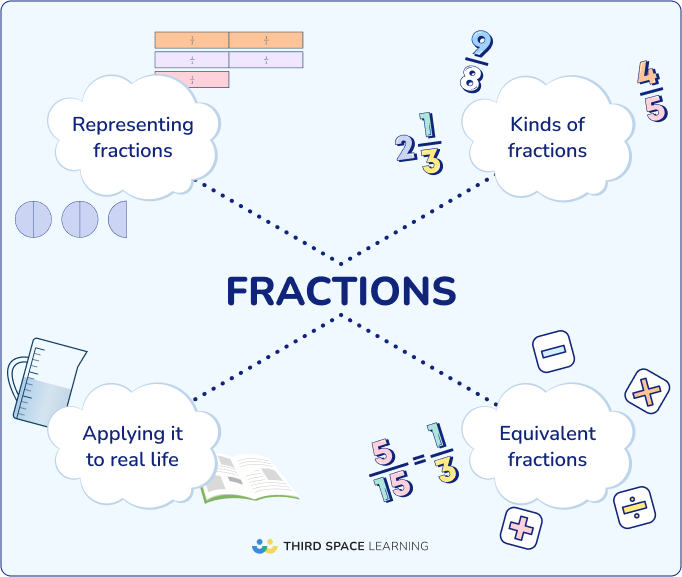
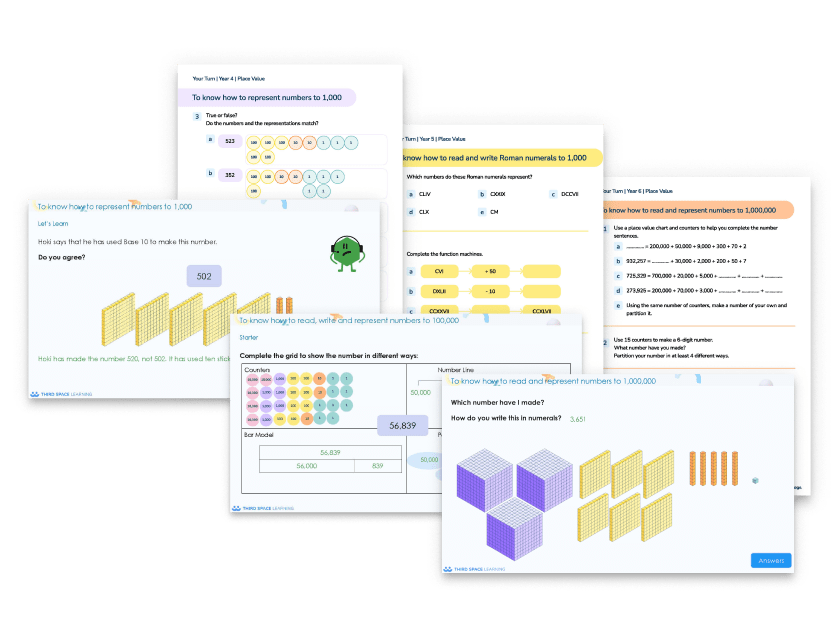
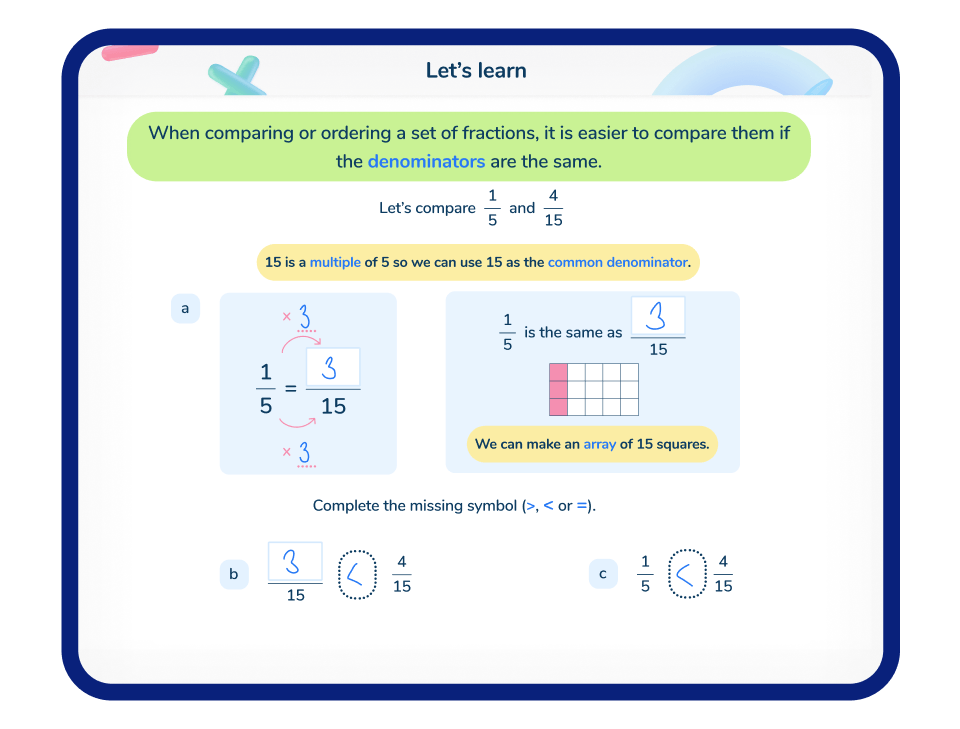
Third Space Learning’s one to one online maths tutoring sessions use visual examples in every primary and secondary programme. Skye, the AI maths tutor, can refer students to the visuals to help scaffold learning and build a conceptual understanding of the maths concept.
4. Interleaving
What it is
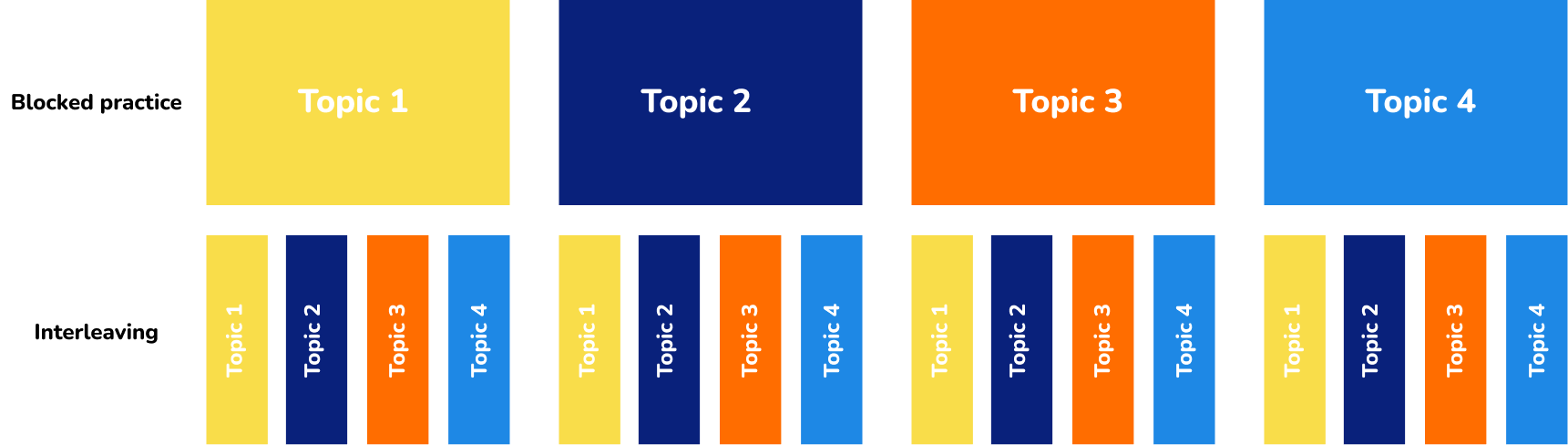
Interleaving involves practising related skills or topics simultaneously. It can be used across the curriculum but works particularly well when learning or revising for maths.
Why it works
When students interleave their studies, they are required to think about how to approach each problem rather than rely on what they just completed.
Although interleaving can prove harder to learn information in the short term, it helps students with long-term learning of information.
Dunlosky et al. (2013) rate interleaved practice as moderate utility; Rohrer and Taylor’s research on maths problem types shows interleaving slows initial performance but improves long-term retention.
Example
Students practise finding the area of shapes. Instead of having students complete 10 problems in a row using the area of a square, they switch between problems that use triangles, squares, and circles. This means they must pay attention to which processes they need to solve each type of problem.
5. Spaced repetition
What it is
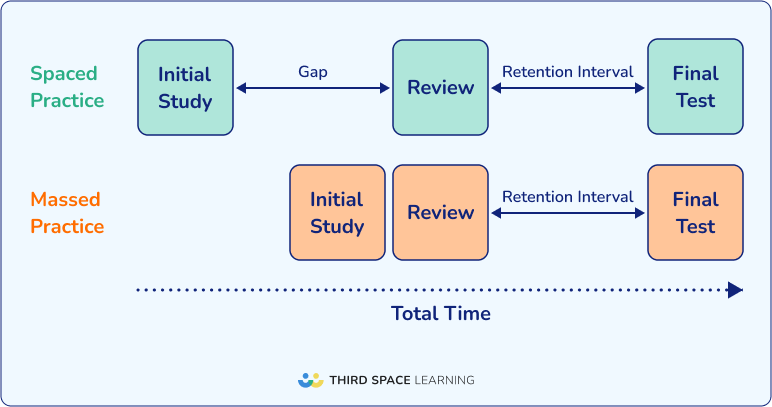
Spaced repetition requires students to break down review into small chunks over time, rather than spending a larger time reviewing and cramming the night before an exam.
Why it works
Students need time to move new concepts from short to long-term memory. Spaced repetition extends the learning experience over time which incorporates the information over time.
As students repeatedly review content, they strengthen their memory by forgetting a little and then relearning content again. Using a spiral curriculum across year groups is a good way to incorporate spaced repetition throughout the school in both primary and secondary settings.
Spaced (or distributed) practice is one of only two strategies Dunlosky et al. (2013) classify as high utility, supported by Cepeda et al.’s meta-analysis of over 250 studies.
Example
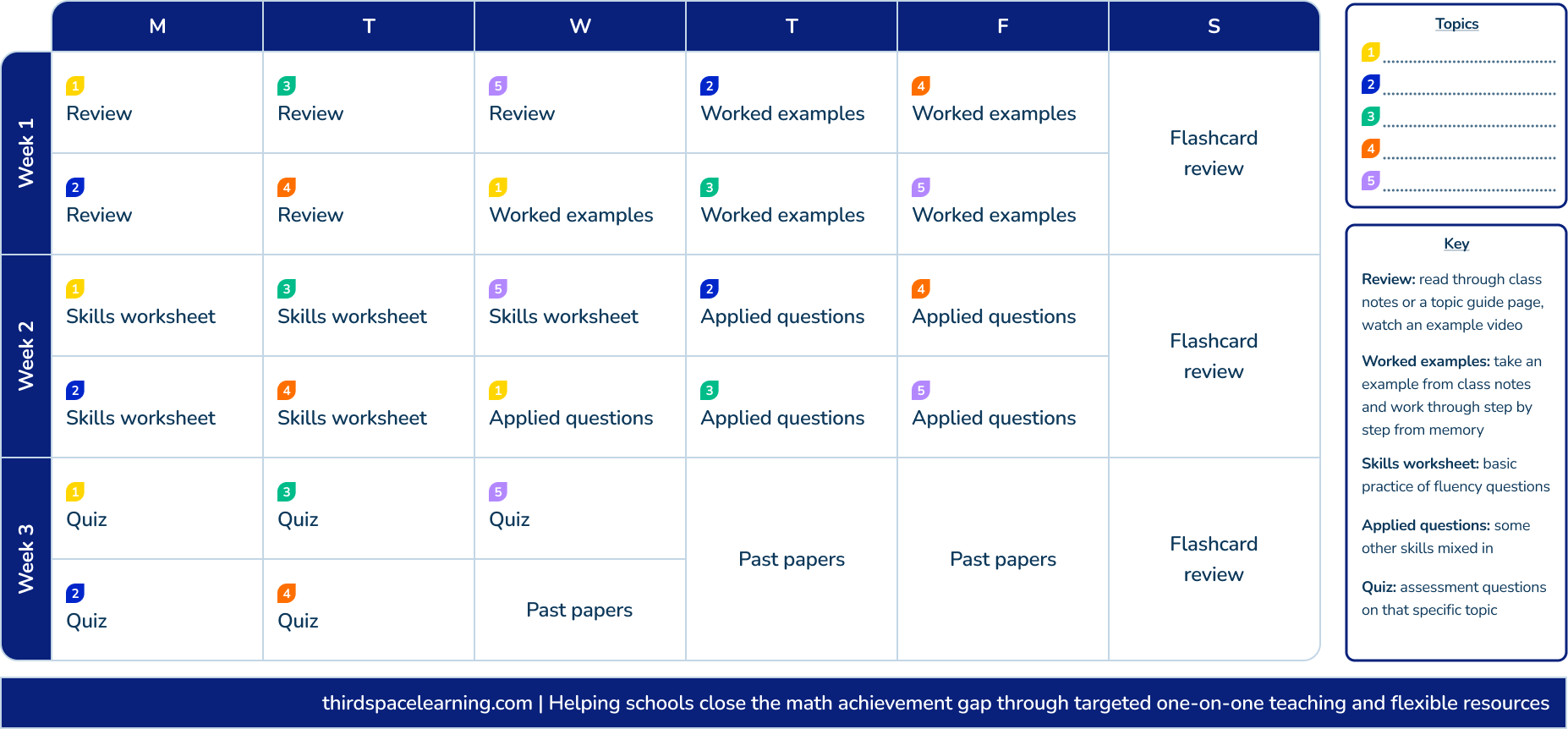
Help students create a revision timetable, or set up a class timetable to review small chunks of information before an exam. Revision timetables should include current concepts and previously taught skills in the review.
Spaced repetition can help reduce student’s exam anxiety by revisiting older content frequently before exams.
6. Mnemonic devices
What it is
Mnemonic devices are physical or visual memory devices that help learners remember larger pieces of information. These are particularly helpful for remembering maths sequences or lists.
Why it works
Mnemonic devices put large amounts of information into shorter lists or phrases that students can remember more easily. This information helps them remember the longer, more complex information they apply.
Dunlosky et al. (2013) rate mnemonics as moderate utility for memorising specific facts and sequences, but caution they don’t build the conceptual understanding maths requires alongside fluency.
Example
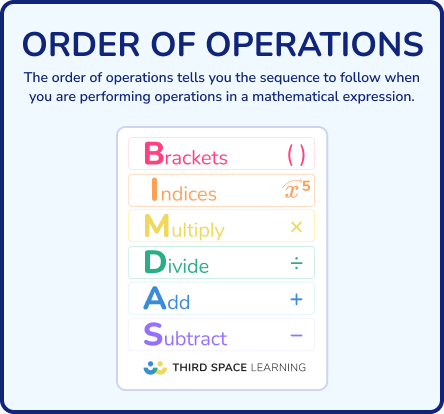
A student uses the mnemonic device BIDMAS (Brackets, Indices, Division, Multiplication, Addition, Subtraction) to remember the order of operations for maths equations.
7. Retrieval practice
What it is
Retrieval practice is the process of recalling facts, concepts and information from memory or without prompts or visuals to enhance learning.
Why it works
Learners’ memories have to work harder to recall information. Retrieval practice helps with summarising information they have learned. Retrieval practice (also called the testing effect) is the second strategy Dunlosky et al. (2013) classify as high utility, with foundational research from Roediger and Karpicke (2006) showing repeated retrieval produces more durable learning than repeated study.
Example
Students put their study materials away and write or speak everything they know about the topic of quadratic equations. Once they have retrieved all the information they know from memory, they can return to their notes and textbooks to check for accuracy.
Third Space Learning lessons begin with an assessment question to help learners access the key information and skills they need in the forthcoming lesson. This also gives Skye an idea of their starting point and how to adapt the teaching.
Terri Higgins, Learning Content Lead, Third Space Learning
8. Reciprocal teaching
What it is
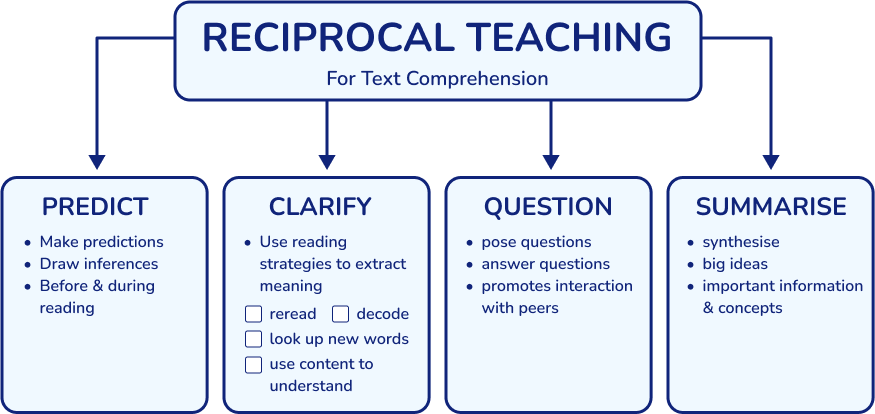
Reciprocal teaching is a strategy with four parts to help students work through maths problem-solving:
Predicting
Clarifying
Solving
Summarising
Why it works
Reciprocal teaching uses students’ knowledge to engage them in planning and working through maths problems. The four steps are effective at helping students apply higher-order thinking skills to solve more complex maths problems.
Reciprocal teaching originates in Palincsar and Brown’s 1984 research and aligns with the EEF Toolkit’s metacognition and self-regulation findings, which show an average +7 months progress.
Example
Students are given a multi-step word problem. They predict:
The type of question asked
Mathematical operations needed
Answer
After these predictions, they clarify the information they do not yet know.
During the solving stage, students solve the problem and in the summarising stage they reflect on the process and how they got their answer.
9. Dual coding
What it is
Learners use a combination of words and visuals to present, learn, understand, and work with information.
Why it works
Students work with smaller chunks of information rather than the entire concept or problem at once and make connections between the content as they progress.
Dual coding is grounded in Paivio’s theory that the brain processes visual and verbal information through separate channels; Mayer’s multimedia learning research extends this into classroom practice.
Example
A student graphs inequalities before working with them in a larger problem. The visual representation of inequalities helps the student manage the amount of information they are working with.
10. Elaboration
What it is
Elaboration is a student-centred learning and instructional strategy. Students describe concepts in their own words when using elaboration. They ask questions about what they are learning, make connections between material and dig deeper into a topic.
Why it works
Elaboration helps students to identify:
What they have learned
What they still need to learn
How the ideas connect
Dunlosky et al. (2013) classify elaborative interrogation (asking pupils to explain why a fact is true) and self-explanation as moderate-utility strategies that build deeper conceptual understanding.
Example
Students work in pairs to review the concept of ratios. They record what they have learned, and jot down things they are not completely confident with yet.
All Third Space Learning lessons are designed with student-centred teaching in mind. Learners are frequently encouraged to rephrase questions or explanations in their own words, and reflect on how they are finding aspects of the topic.
Terri Higgins, Learning Content Lead, Third Space Learning
11. Active learning
What it is
Active learning involves discussing, investigating, writing, thinking, and creating. In maths, explaining thinking and discussing solutions is a form of active student-centred learning.
Why it works
The combination of talking through explanations and receiving feedback through questioning helps students retain information. Receiving feedback helps catch and correct misconceptions in real-time.
Active learning draws on Freeman et al.’s 2014 meta-analysis showing pupils in active learning environments outperform peers in passive lecture-style instruction across STEM subjects.
Example
Students are working on solving equations. In small groups, students must present and explain their thinking as they model how to solve an equation. The other students must provide feedback and ask additional questions.

Alongside effective learning strategies, high-quality maths intervention strategies determine how quickly students progress.
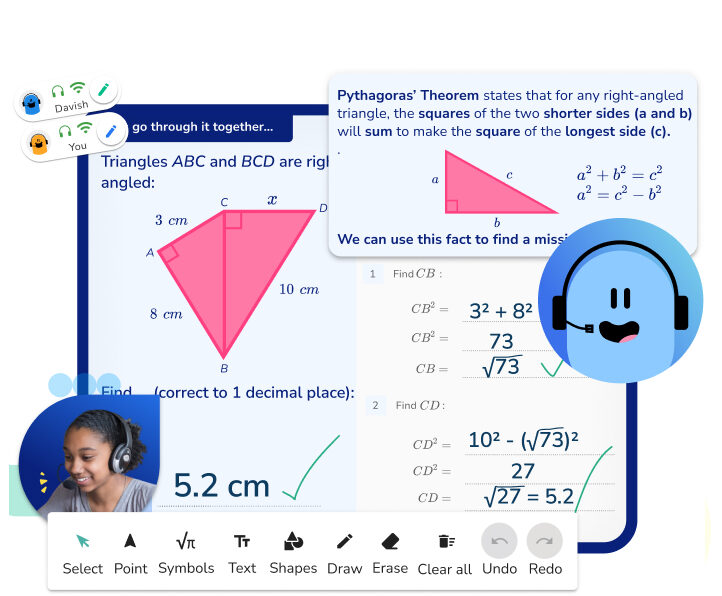
Maths intervention lessons with Third Space Learning take place in an interactive online classroom and use strategies that strengthen students’ maths skills.
Students can draw, type and circle the relevant information to help them solve maths problems.
Skye, the AI maths tutor, is trained to use effective tutoring strategies and to encourage students to use various interactive tools to embed learning in long-term memory.
12. Flashcards
What it is
Flashcards are pieces of paper with facts written on them. Students read the facts to help them ingest the information. Although they may be an old learning strategy, using flashcards to memorise maths facts and maths vocabulary is an effective learning strategy.
Why it works
Repeated exposure to information and deliberate practice of skills multiple times helps the brain recall information. Flashcards are an applied form of retrieval practice, which Dunlosky et al. (2013) classify as high utility; their effectiveness depends on active recall rather than passive recognition.
Example
Two students practise maths fluency facts. Each has a set of flashcards and reads the information before they test each other. They then put the maths facts they have mastered in one pile and review the facts they have not yet mastered until they can quickly recognise each maths fact.
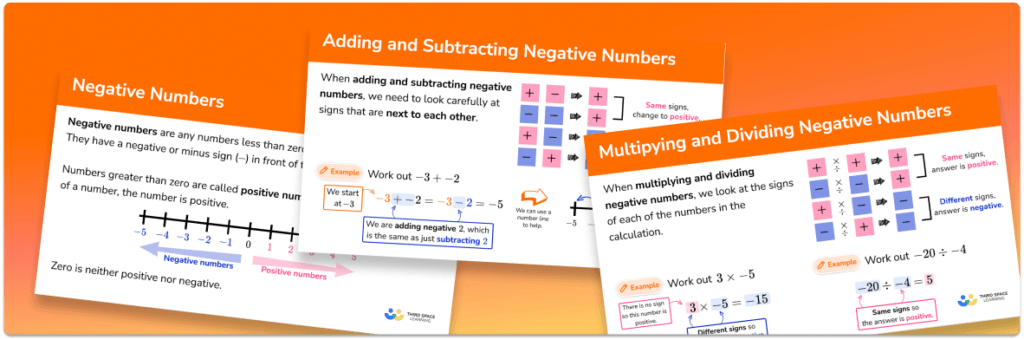
Third Space Learning’s GCSE maths experts created a series of 60 revision flashcards covering Algebra and Number topics to help students learn and recap key concepts.
Students can use these cards to support their learning by referring to them while they tackle a question or to help them remember key information on a given topic.
Paul Coffey, Secondary Education Lead, Third Space Learning
13. Technology
What it is
Technology such as interactive whiteboards, virtual classrooms and technology programmes or apps can be used as a learning strategy to increase engagement and allow teachers to collect and monitor student progress through concepts.
Why it works
Technology encourages active learning. It helps students engage with content through active learning strategies to retain information such as:
Practice opportunities
Visual examples
The EEF Toolkit reports an average +4 months progress for digital technology when used to supplement rather than replace high-quality teaching.
Example
Students learn about graphing and work through a rotation of stations that allow them to practice different types of graphing. Stations could include:
- An online app
- Interactive whiteboard activity
- Online games
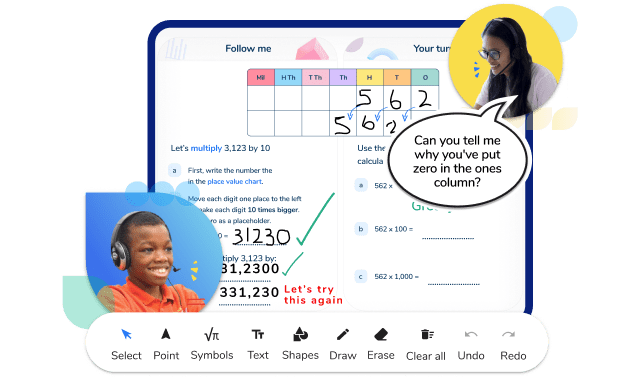
All one to one maths tutoring with Third Space Learning takes place online in a virtual classroom. Learners interact with Skye, the AI maths tutor, through the interactive tools and headsets provided.
Learners engage in practice problems with Skye using visual examples and an I Do We Do You Do pedagogy. Students write, draw, type and speak their way through each guided interactive tutoring session helping them to progress.
In fact, an independent study found that learners enrolled in Third Space Learning’s one to one online tutoring made as much as 7 months’ progress in just 14 sessions.
Learning strategies takeaways
Learning strategies help students learn processes and remember and apply information. When students apply learning strategies effectively they retain information long into the future. Learning strategies must be incorporated into every learning environment if students are to succeed in assessments, exams, and projects. Embedding these strategies works best within a wider school culture of educational excellence.

FAQs
Six learning strategies include:
Spaced learning, spreading practice out over time,
Retrieval practice, practising accessing and recalling information without looking at notes,
Elaboration or putting content into your own words,
Concrete examples or putting information into examples that are tangible and easy to understand,
Interleaving, switching between different concepts to study, and
Dual coding or combining words and visuals to learn information.
Four learning strategies that are effective are active learning, dual coding, reciprocal questioning, and retrieval practice.
Five strategies that can help you remember what you learn and recall it for exams and later use are elaboration, retrieval practice, interleaving, dual coding, and spaced repetition.

DO YOU HAVE STUDENTS WHO NEED MORE SUPPORT IN MATHS?
Skye – our AI maths tutor built by teachers – gives students personalised one-to-one lessons that address learning gaps and build confidence.
Since 2013 we’ve taught over 2 million hours of maths lessons to more than 170,000 students to help them become fluent, able mathematicians.
Explore our AI maths tutoring or find out about school tutors for your school.