

Free Year 6 Maths Test And Free Downloadable Year 6 Quizzes
Standard Year 6 maths tests often cover too much ground, leaving little time to focus on the key, challenging concepts pupils actually need for SATs success. Endless practice doesn’t help if it’s not targeted, leaving gaps in essential knowledge just before the SATs.
As math specialists, we understand that focused revision is the key to success. We’ve created this unique resource drawing on our years of experience pinpointing the exact topics where Year 6 pupils need the most practice.
This resource focuses exclusively on crucial Year 5 and 6 topics and includes both printable student papers and a complete mark scheme for easy assessment – ideal for an end of term or unit test.
If you just want the Year 6 maths test straightaway, download it now.

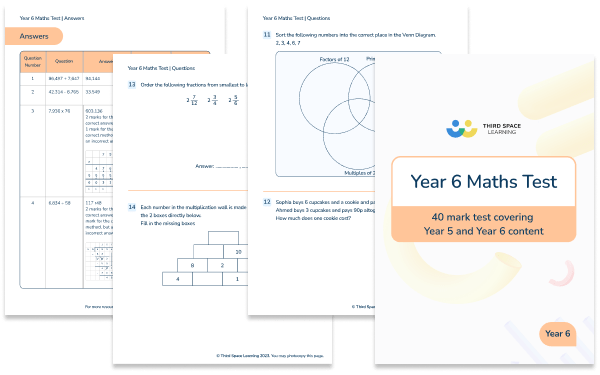
Year 6 Maths Test
Download this free Year 6 maths test composed of 25 questions covering a wide array of Year 6 maths topics. Includes answers and explanations.
Download Free Now!About the Year 6 maths test
This Year 6 maths test is based on topics from the national curriculum programme of study for Years 5 and 6.
The 25 questions test children on a number of content domains and also a variety of maths skills that they’re likely to need for their SATs exam in May. Answer sheets are provided and, while this isn’t an actual diagnostic assessment, it will give you and your pupils a chance to see where they need to improve before they sit their official Key Stage 2 SATs test papers in May.
In this Year 6 maths test, we’ve included:
- 8 arithmetic and 17 reasoning questions to roughly mimic the percentage split between arithmetic and reasoning in the 3 SATs papers.
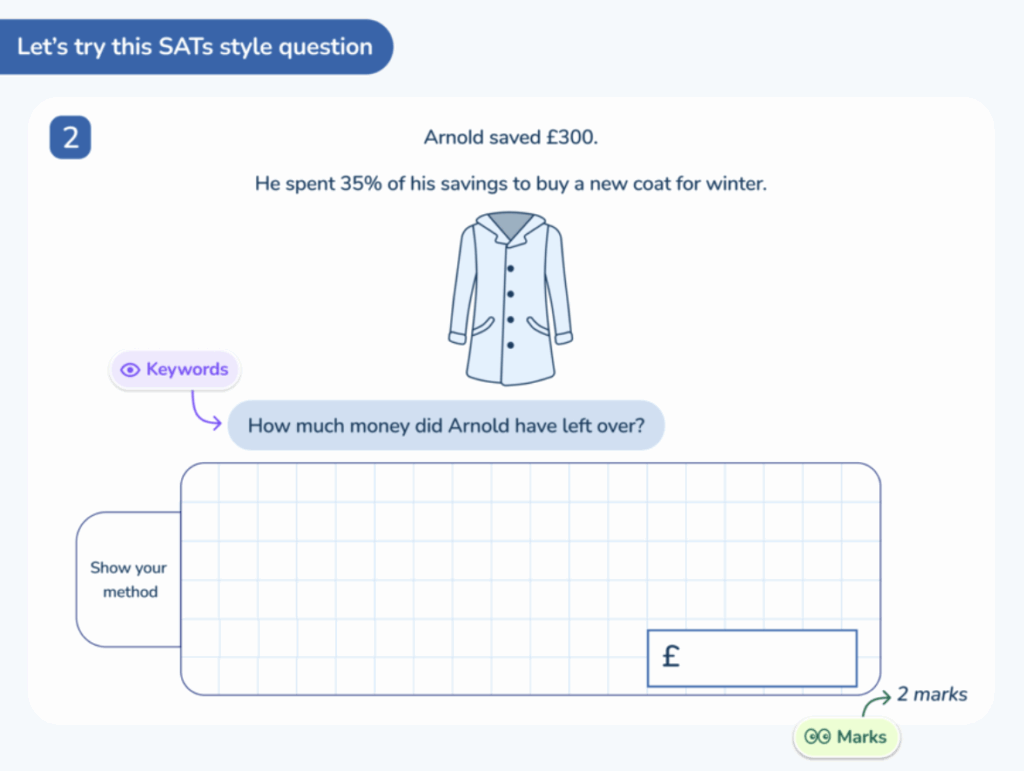
- A mix of 1, 2 and 3 mark questions so children get used to looking at the marks allocated.
It is important to encourage children to show all their workings out, as they can score marks for using the correct method, even if the final answer is calculated incorrectly.
Showing workings is an important skill for students to learn. Especially when it comes to the maths SATs exams, students receive extra marks for showing their methods. Third Space Learning’s online, one-to-one primary AI maths tutoring and SATs revision programmes encourage students to practice showing their problem solving methods.
How to use this Year 6 maths test
This test is useful for assessing your pupils’ understanding of the Year 5 maths and Year 6 maths curriculum and identifying any knowledge gaps they may still have. Unlike the standard Key Stage 2 SATs papers, which test mathematical content taught across the entire key stage, this assessment deliberately focuses only on the upper KS2 (Years 5 and 6) curriculum.
This focus is crucial because in an analysis of 8 years of SATs papers (2016–2019, 2022–2025), we found that the majority of questions continue to assess upper KS2 content. Focusing on upper KS2 ensures that revision efforts are strategically concentrated on the Year 5 and 6 strands that carry the highest weighting.
Read more about our analysis of past SATs papers and the top 20 Year 6 maths revision topics to help your pupils meet age-related expectations and achieve 100 in SATs here.
We recommend using this test towards the end of the Spring term, once children have learnt most of the Year 6 content, but with still sufficient time to work on any areas highlighted as being a challenge for any individuals or groups of students.
If you’re looking for a test earlier in the school year, our back to school maths quiz for Year 6 assesses Year 5 content to help you benchmark and tailor your teaching.
You might choose to use self-marking, peer-marking, or teacher-marking depending on your purpose and the time available, ensuring consistent and useful feedback is delivered.
Consider how you will use the data/outcomes of the test and how you might share feedback with your students. You may wish to provide individual comments and targets or opt for whole class feedback.
25 question Year 6 maths test (with answers)
1. 86,497 + 7,647
Answer: 94,153
1 mark
2. 42.314 - 8.765
Answer: 33.549
1 mark
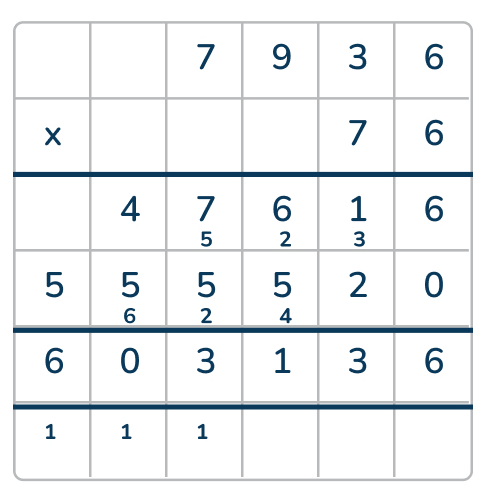
3. 7936 × 76
Answer: 603,136
2 marks
2 marks for the correct answer, 1 mark for the correct method, but an incorrect answer
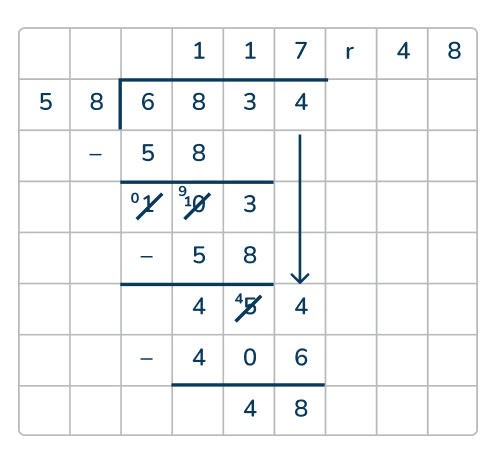
4. 6834 ÷ 58
Answer: 117 r48
2 marks
2 marks for the correct answer, 1 mark for the correct method, but an incorrect answer
5. 35% of 7480
Answer: 2618
1 mark
6. \frac{2}{5}✕\frac{3}{4}
Answer: \frac{6}{20}=\frac{3}{5}
1 mark
7. 17.36 × 1000
Answer: 17,360
1 mark
8. \frac{3}{7} of 84
Answer: 36
1 mark
9. Round 76,385 to the nearest:
10,
100,
1,000,
10,000
Answer: Rounded to 10: 76,390, Rounded to 100: 76,400, Rounded to 1,000: 76,000, Rounded to 10,000: 80,000
2 marks for all correct
1 mark for 2 or 3 correct
10. Write the following capacities in order from smallest to largest: 2.673l, 2.635l, 2.605l, 2.61l
Answer: 2.605l, 2.61l, 2.635l, 2.673l
1 mark
11. Sort the following numbers into the correct place in the Venn Diagram.
2, 3, 4, 6, 7
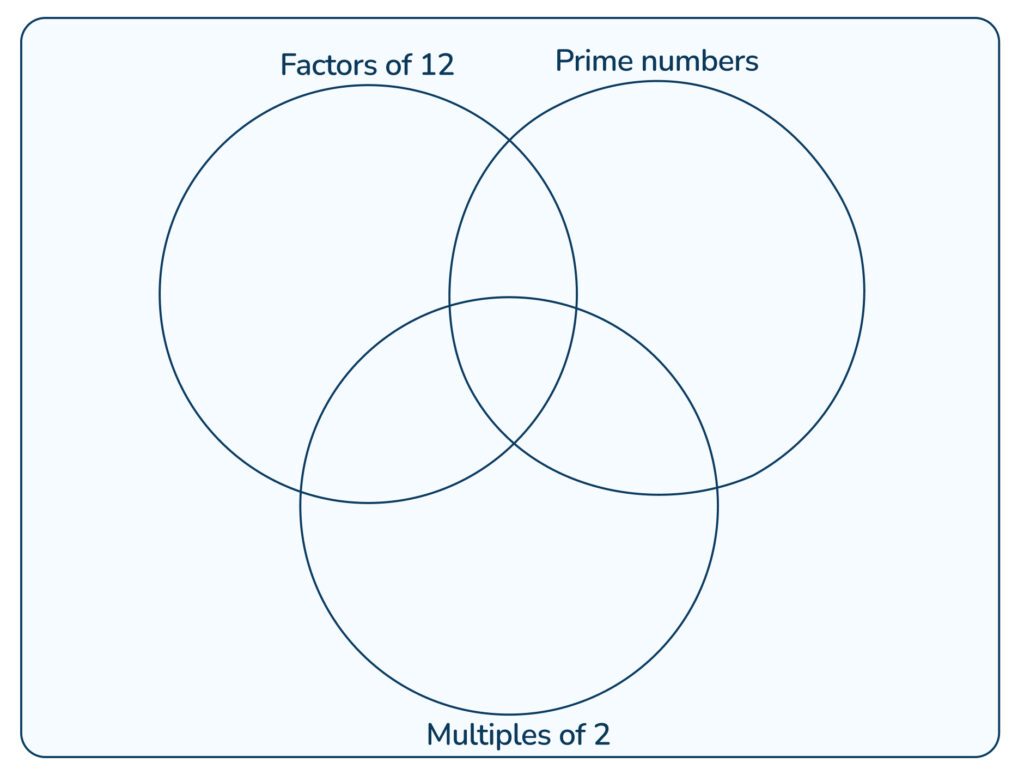
Answer:
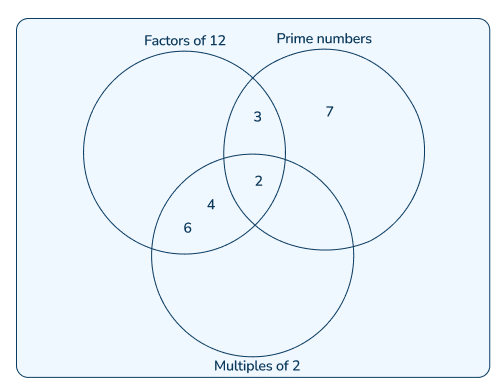
2 marks for all correct, 1 mark for 3 or 4 correct.
12. Sophia buys 6 cupcakes and a cookie and pays £2.05 altogether.
Ahmed buys 3 cupcakes and pays 90p altogether. How much does one cookie cost?
Answer: 25p
3 cupcakes cost 90p
6 cupcakes cost 90p × 2 = £1.80.
£2.05 - £1.80 = £0.25 or 25p
Or
£2.05 - £0.90 = £1.15
£1.15 - £0.90 = £0.25 or 25p
2 marks for correct answer of 25p or £0.25. 1 mark for the correct method, but incorrect answer.
13. Order the following fractions from smallest to largest: 2\frac{7}{12}, 2 \frac{3}{4}, 2 \frac{5}{6}, 2 \frac{2}{3}
Answer: 2\frac{7}{12}, 2 \frac{2}{3}, 2 \frac{3}{4}, 2 \frac{5}{6}
1 mark
14. Each number in the multiplication wall is made by multiplying the numbers in the 2 boxes directly below. Fill in the missing boxes:
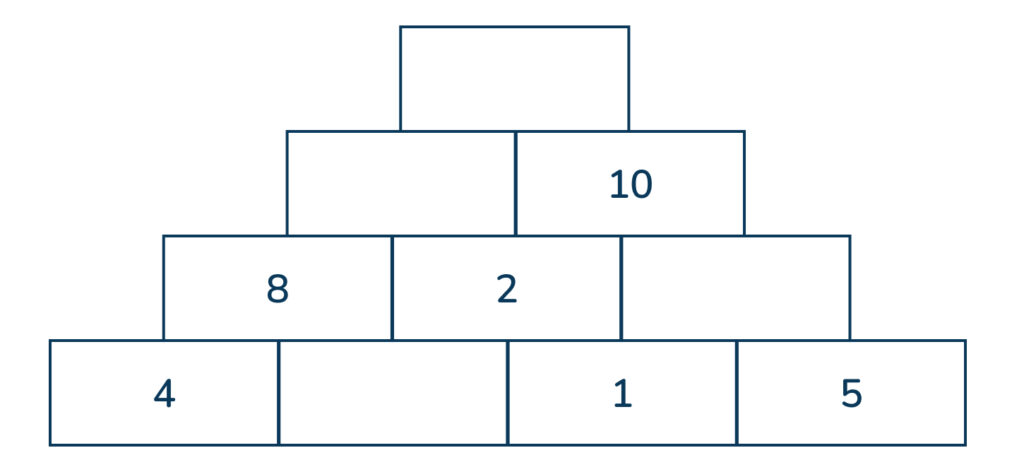
Answer:
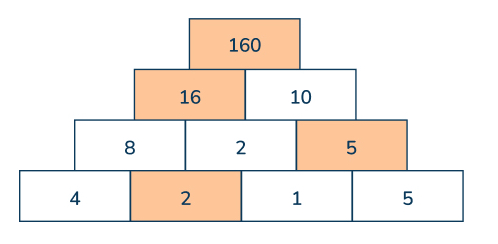
2 marks if all boxes are completed correctly.
1 mark if 2 or 3 boxes are completed correctly.
15. Arlo chose a number. He multiplied the number by 8. Then he subtracted 47. His answer was 1049. What was his original number?
Answer: 137
2 marks for correct answer of 137.
1 mark for correct method, but incorrect answer:
16. Tom had £40 in his pocket, but lost some. What expression shows how much Tom has now?
- 40 + x
- x x 40
- 40 ÷ x
- 40 - x
Answer: 40 - x
1 mark
17. Write the following improper fractions as mixed numbers. Write the answer in its simplest form:
\frac{34}{12}
\frac{17}{8}
\frac{35}{11}
\frac{19}{7}
Answer:
\frac{34}{12} = 2\frac{10}{12} = 2\frac{5}{6}
\frac{17}{8} = 2\frac{1}{8}
\frac{35}{11} = 3\frac{2}{11}
\frac{19}{7} = 2\frac{5}{7}
2 marks for all correct
1 mark for 2 or 3 correct
18. a) Jamal flew 3243.7 miles from London to Doha. He then flew an additional 431.6 miles to Dubai. How far did he fly in total?
b) He then flew on to Sri Lanka, making his journey a total of 5737 miles. How far was the journey from Dubai to Sri Lanka?
Answer: a) 3675.3miles b) 2061.7 miles
2 marks for both correct, 1 mark for 1 correct.
19. Amber had a bag containing 360 jelly beans. She gave \frac{4}{9} of the jelly beans to her friend, Erin . How many did she have left?
Answers: 200 jelly beans
2 marks for the correct answer: 200 jelly beans.
1 mark for the correct method, but incorrect answer:
\frac{1}{9} of 360 = 40
\frac{4}{9} of 360 = 160
Therefore Amber has 200 jelly beans left.
Or
\frac{5}{9} of 360 = 200 jelly beans
20. A class of 28 pupils go on a school trip to Alton Towers. The total price for their tickets is £504. How much does it cost per child?
Answer: £18
2 marks for the correct answer of £18.
1 mark for the correct method, but incorrect answer:
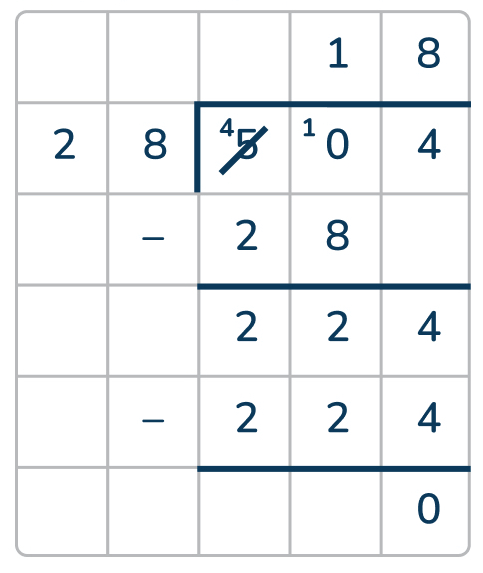
21. What is the value of angle x?
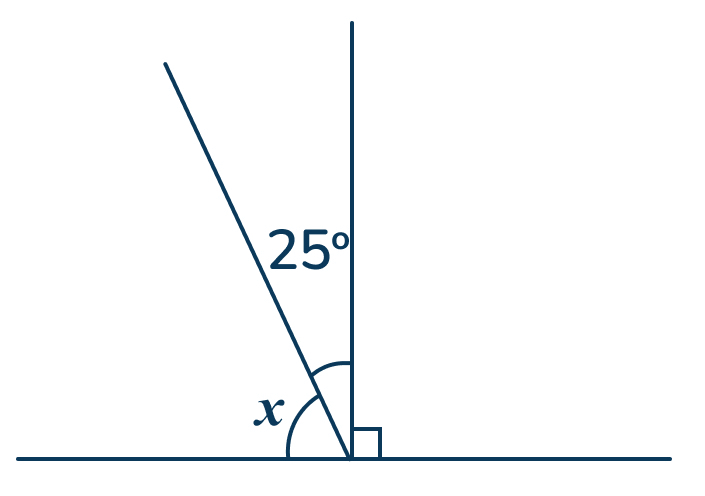
Answer: 65°
1 mark
22. Write one symbol in each box, to make the following statements correct:
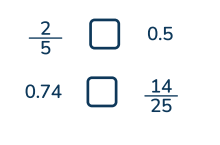
Answer: \frac{2}{5} < 0.5 , 0.74 > \frac{14}{25}
1 mark
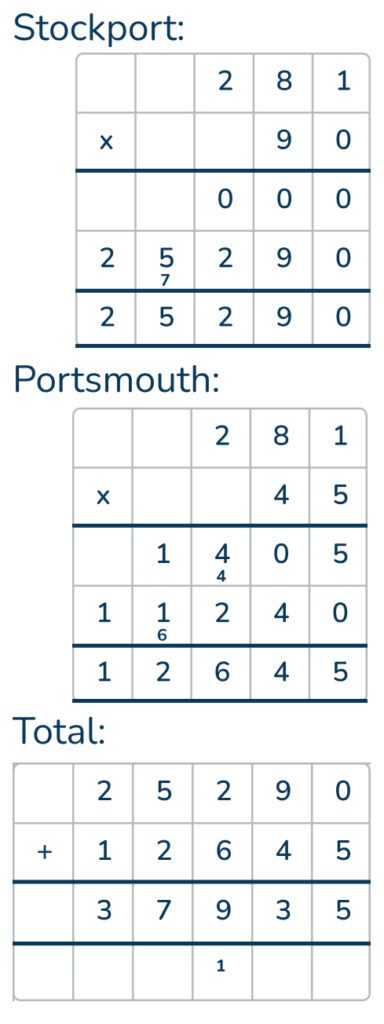
23. The town of Stockport has 90 primary schools and the City of Portsmouth has 45 primary schools. Schools in the UK have an average of 281 pupils. Approximately how many pupils are there in Stockport and Portsmouth altogether?
Answer: 37,935.
3 marks for the correct answer of 37,935.
2 marks if evidence of the correct method, with only 1 arithmetic error.
1 mark if evidence of appropriate method, with more than 1 arithmetic error.
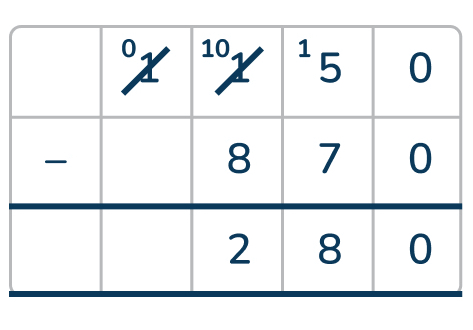
24. Chloe has a bag of vegetables that weighs 1.15kg. She takes out some peppers. The bag now weighs 870g. How much did the peppers weigh?
Answer: 280g
2 marks for the correct answer: 280g
1 mark for the correct method, but the incorrect answer.
25. Apples cost £1.20 per kg. Bananas cost £1.45 per kg. Abdullah buys 1\frac{1}{2}kg of apples and 2kg of bananas. How much change does he get from £10?
Answer: £5.30
2 marks for the correct answer: £5.30.
1 mark for the correct method but incorrect answer.
Turning Year 6 maths test scores into action: intervention strategies for weak spots
The key to ensuring this Year 6 maths test is effective in helping to support your learners is how you then use the results. Raw scores are only the starting point; the real value is in diagnosing common errors and misconceptions to plan targeted intervention.
Here are some simple, practical tips for tackling frequent SATs weak spots:
| Misconception Area | Example SATs Error | Practical Intervention Tip |
| Fractions | When adding or subtracting fractions, pupils add or subtract both the numerator and the denominator (e.g., 1/2 + 1/4 = 2/4). | Use maths manipulatives (like fraction circles or Cuisenaire rods) to physically demonstrate that the ‘whole’ must be the same size, visually establishing the need for a common denominator. |
| Algebra KS2 | Students struggle to understand that a letter represents a variable number, not a specific object (e.g., in a + a + a = 3a, a is not apples). | Use a ‘Function Machine’ diagram or create simple ‘What’s the Rule?’ input/output tables to show how a variable changes based on the rule applied. This reinforces the concept of a rule or relationship. |
| Ratio KS2 & Proportion | Students fail to maintain the multiplicative relationship when scaling up or down. | Use double number lines or concrete examples (like recipe scaling) to show the ‘paired’ values and ensure the same factor is applied to both sides of the ratio. |
| KS2 Area & Perimeter | Students confuse the two concepts, often calculating the area when asked for the perimeter, or vice versa. | Always use coloured tape or string to physically outline the perimeter (the distance around) and squared paper to shade the area (the space inside). Constant emphasis on the correct units (cm vs cm2) helps cement the difference. |
Once you’ve identified the topics and areas your pupils need to revisit (whether for SATs preparation or not), we’ve got several Year 6 maths worksheets available for free download organised by topic. For schools following White Rose maths year 6, we also have White Rose aligned resources.

RELATED RESOURCES:
- Maths Worksheets | Angles In Polygons | Year 6
- Maths Worksheets | Angles In Quadrilaterals | Year 6
- Maths Worksheets | Angles In Triangles | Year 6
- Maths Worksheets | Area Of A Parallelogram | Year 6
- Maths Worksheets | Area Of A Triangle | Year 6
- Maths Worksheets | Converting Between Miles And Kilometres | Year 6
- Maths Worksheets | Equivalent Fractions, Decimals And Percentages | Year 6
- Maths Worksheets | Finding Pairs Of Values | Year 6
- Maths Worksheets | Finding The Whole | Year 6
- Maths Worksheets | Fractions To Percentages | Year 6
- Maths Worksheets | Identifying 3-D Shapes From 2-D Nets | Year 6
- Maths Worksheets | Nets Of 3-D Shapes | Year 6
- Maths Worksheets | Ordering Fractions, Decimals And Percentages | Year 6
- Maths Worksheets | Parts Of A Circle | Year 6
- Maths Worksheets | Percentages Of Amounts | Year 6
While topic-focused intervention may be beneficial, most primary schools we talk to tell us that it’s Year 6 maths questions involving reasoning and problem solving skills that children tend to struggle most with. You’ll find several examples of maths word problems and multi-step problems on our blog, as well as Year 6 maths reasoning questions and strategies on answering SATs questions, providing pupils with all-important SATs practice.

Analysing test results for 30+ pupils with varying gaps is time-consuming, making it difficult to give Year 6 pupils the targeted support they need in such an important year.
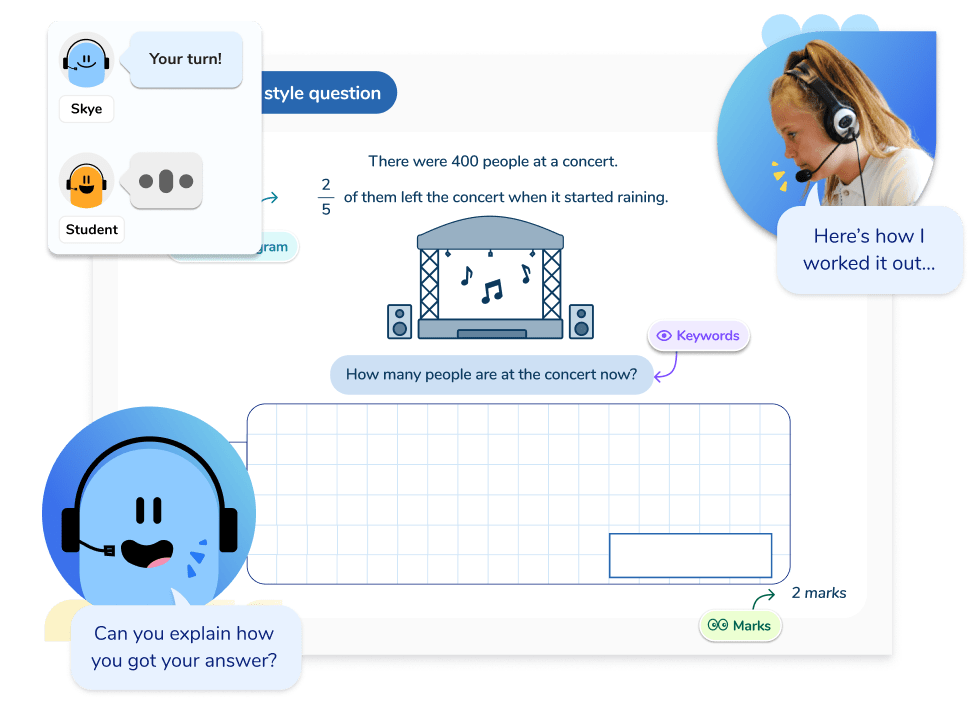
With Skye, the AI maths tutor, the analysis and reporting is done for you. Schools can now easily provide targeted, one-to-one interventions to address these challenges.
- Dedicated SATs Programme: Skye works one-to-one with Year 6 pupils on a dedicated SATs revision programme, addressing gaps identified in the Skills Check In diagnostic and moving on to SATs-style question practice when required to build confidence and familiarity with fluency and reasoning questions.
- Teacher Control: The order of lessons has been developed by our academic team to build on pupils’ developing skills, and every lesson is personalised to individual pupils through an initial diagnostic assessment and ongoing formative assessment. Teachers retain control and can re-order lessons at any time to target specific topics, such as addressing gaps identified through tests and practice papers or aligning with classroom teaching.
- Proven Results: In a survey of our schools, Year 6 Third Space Learners did better on their maths SATs than the national average, and 9 out of 10 teachers felt the tutoring helped their pupils achieve higher maths SATs scores.
100% of our Year 6 Third Space Learners met the expected standard in their maths SATs. It helped them consolidate learning and addressed misconceptions. The sessions help those children who are unsure and need to go back over concepts from earlier year groups.
Barbara Yeo, Deputy Headteacher at King’s Cliffe Endowed Primary School
SATs and other resources for Year 6
In addition to our AI tutoring, we offer other free resources and revision packs for Year 6 and upper KS2 maths to help you support your class this year.
SATS 2026: STAY UP TO DATE
Join our email list to stay up to date with the latest news and free resources for SATs 2026. As usual our expert teachers will be on hand to provide one to one tuition support, revision resources, expert paper analysis, SATs teacher survey results and the SATs results 2026.
SATs practice test
If you’re clear that what your students need are ‘real’ Year 6 SATs practice papers, then we have 6 free SATs practice tests to give away – two sets, each of which have 2 reasoning and an arithmetic paper just like the real thing.
RELATED RESOURCE: KS2 Maths SATs Practice Papers | Packs 1 And 2
SATs maths papers
Find out about the pedagogy behind our maths SATs papers and why they’re so popular. You’ll also find links to other KS2 SATs papers including our collection of topic based SATs questions and several past SATs papers.
Year 6 SATs revision
If all that wasn’t enough, the best SATs revision resources we haven’t mentioned above plus several other SATs practice papers are available to you from our regularly updated SATs revision article.
More SATs papers
Finally this is where you’ll find links to all the government’s practice SATs papers and mark schemes: National Curriculum Assessments Practice Materials. There are both free SATs papers and paid for ones for maths, English (reading and SPaG), all with answers and mark schemes.
More maths tests and quizzes
As well as this Year 6 maths test and other Year 6 maths resources, if you are looking for secondary resources, you can also use our extensive secondary resource library where you’ll find other maths tests more focused towards KS3 teaching.
RELATED RESOURCES:
Year 6 maths FAQs
Many of the concepts children cover in Year 6 are a progression on topics taught lower down the school across Number, Measurement and Geometry. There are some concepts children are introduced to in Year 6 for the first time, such as:
∙Long division, dividing by 2-digit numbers
∙Order of operations
∙Multiplication and division of fractions
∙Converting between miles and km
∙Area of triangles and parallelograms
∙Ratio
∙Algebra
∙Scale factors
∙Parts of circles, including radius, diameter and circumference
∙Finding missing angles
∙Translating shapes
∙Pie charts
The 3 SATS papers sat by children in Year 6 are
Paper 1 – Arithmetic
Paper 2 – Reasoning
Paper 3 – Reasoning
For the SAT paper in the summer, children need to achieve a scaled score of 100. The raw score needed to achieve a scaled score varies slightly each year, but children generally need to score between 58 and 61 out of 110 (53% and 55%) to pass.
We have set the pass mark for this Year 6 test as 50%, as the children are only exposed to content from the Year 5 and Year 6 curriculum. In the SAT test the children sit in the summer, they will also be exposed to content from the Year 3 and Year 4 curriculum.

DO YOU HAVE STUDENTS WHO NEED MORE SUPPORT IN MATHS?
Skye – our AI maths tutor built by teachers – gives students personalised one-to-one lessons that address learning gaps and build confidence.
Since 2013 we’ve taught over 2 million hours of maths lessons to more than 170,000 students to help them become fluent, able mathematicians.
Explore our AI maths tutoring or find out about primary school tuition for your school.