

Essential Guide to SATs 2026 For School Leaders And Teachers: Key Dates And How Best To Prepare

KS2 SATs 2026 will take place from Monday 11 May to Thursday 14 May 2026. As in previous years, the SATs will assess reading, writing and maths for Year 6 pupils in England.
This guide provides you with all of the key dates and information you need for primary school SATs and is regularly updated with new information about the 2026 SATs as it becomes available.
SATS 2026: STAY UP TO DATE
Join our email list to stay up to date with the latest news and free resources for SATs 2026. As usual our expert teachers will be on hand to provide one to one tuition support, revision resources, expert paper analysis, SATs teacher survey results and the SATs results 2026.
Key dates for KS2 SATs 2026
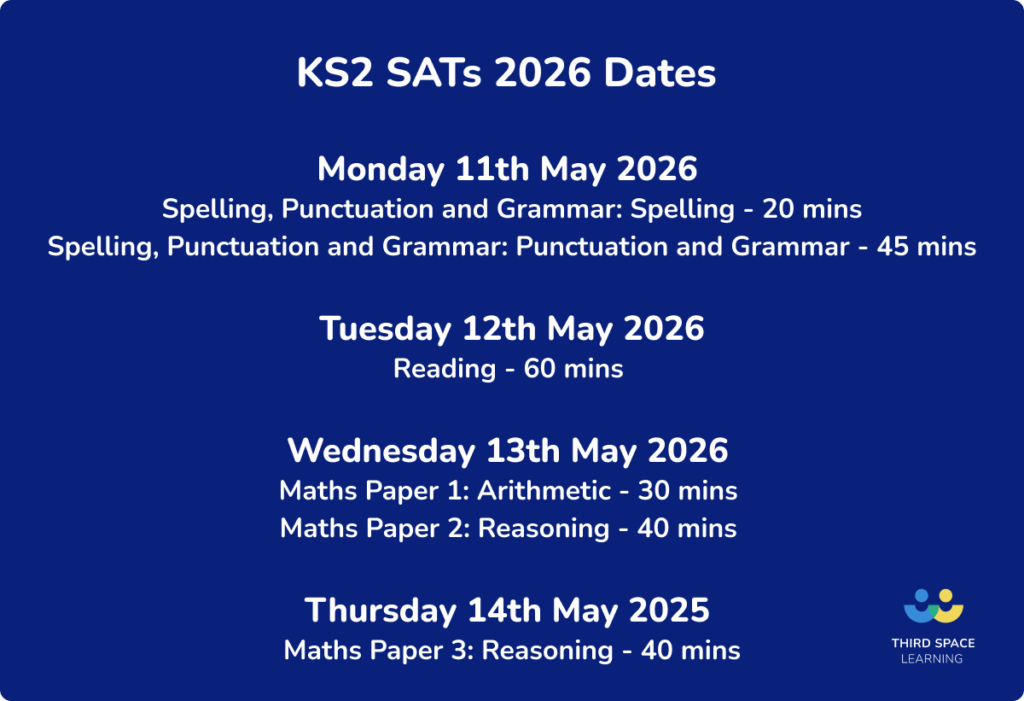
The statutory key stage 2 SATs dates run from 11 to 14 May 2026. These tests cover English grammar, punctuation and spelling, reading, and mathematics.
- Monday 11 May 2026: English Grammar, Punctuation and Spelling: Paper 1: Grammar and Punctuation, 45 minutes
- Monday 11 May 2026: English Grammar, Punctuation and Spelling: Paper 2: Spelling, 20 minutes
- Tuesday 12 May 2026: English Reading, 60 minutes
- Wednesday 13 May 2026: Mathematics Paper 1: Arithmetic, 30 minutes
- Wednesday 13 May 2026: Mathematics Paper 2: Reasoning, 40 minutes
- Thursday 14 May 2026: Mathematics Paper 3: Reasoning, 40 minutes

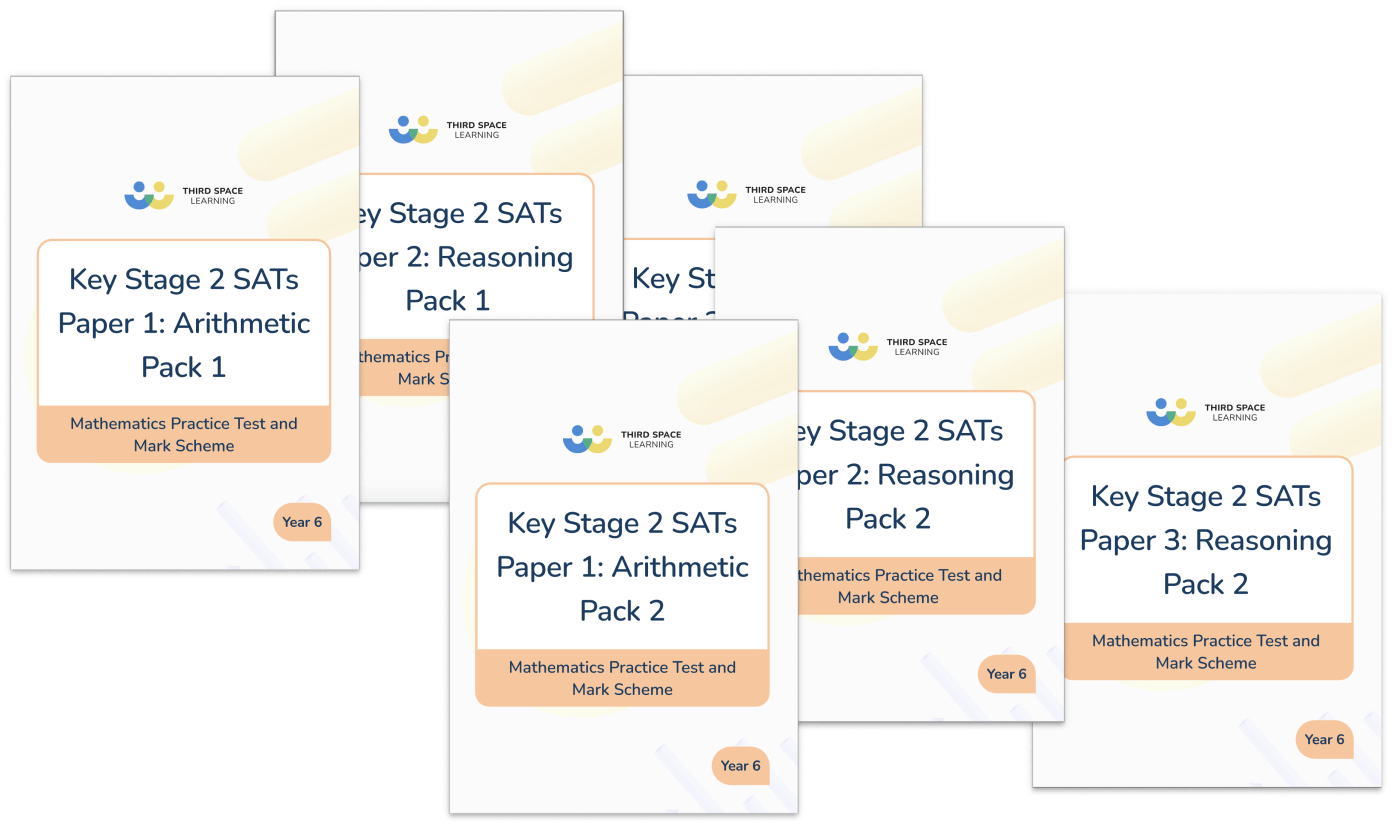
6 FREE KS2 SATs Papers Maths
2 sets of free KS2 SATs papers ie 2 Arithmetic, 4 Reasoning Papers in line with National Assessment, including mark scheme, content domains and thresholds
Download Free Now!SATs dates for the next three years
If you are a school leader planning ahead, here are the key dates for SATs over the next three academic years:
Academic Year | KS2 SATs Week |
2025–2026 | Monday 11 May to Thursday 14 May 2026 |
2026–2027 | Monday 10 May to Thursday 13 May 2027 |
2027–2028 | Monday 8 May to Thursday 11 May 2028 |
Purpose of SATs
SATs (Statutory Assessment Tests) are national assessments that children in English primary schools sit at the end of each key stage. They measure attainment in English and maths and form part of the school accountability system.
Key stage 2 SATs remain statutory, including tests in grammar, punctuation and spelling, reading and maths.
KS2 SATs papers 2026 at a glance
Year 6 pupils sit the following compulsory KS2 SATs papers in 2026.
KS2 English reading SATs in 2026
- There will be one English reading paper with questions based on approximately 3 different passages. Children have 1 hour to complete the reading exam in a specially provided answer booklet.
KS2 SPaG SATs in 2026
- There will be a 20-word aural spelling test, which lasts around 20 minutes. Pupils write the spellings in the provided booklet.
- Additionally, there will be a 45-minute grammar and punctuation paper. Questions vary in format, including some multiple-choice questions, but usually require short answer questions.
KS2 maths SATs in 2025
There will be 3 mathematics papers:
- Paper 1 is an arithmetic paper, lasting for 30 minutes.
- Papers 2 and 3 are reasoning papers, lasting for 40 minutes each.
There is no test during SATs week for writing, but pupils must submit writing from throughout the year as part of their teacher-assessed Writing SATs. Some schools are moderated for the writing assessment, which usually happens after SATs week.
Additionally, primary schools will determine whether pupils are working at the expected standard in science.
Optional KS1 SATs tests
While no longer statutory, optional key stage 1 SATs in reading, grammar, punctuation and spelling, and maths are still available to use for internal moderation or to support teacher assessment. But schools no longer submit results to the Department for Education.
When are the KS1 SATs 2026?
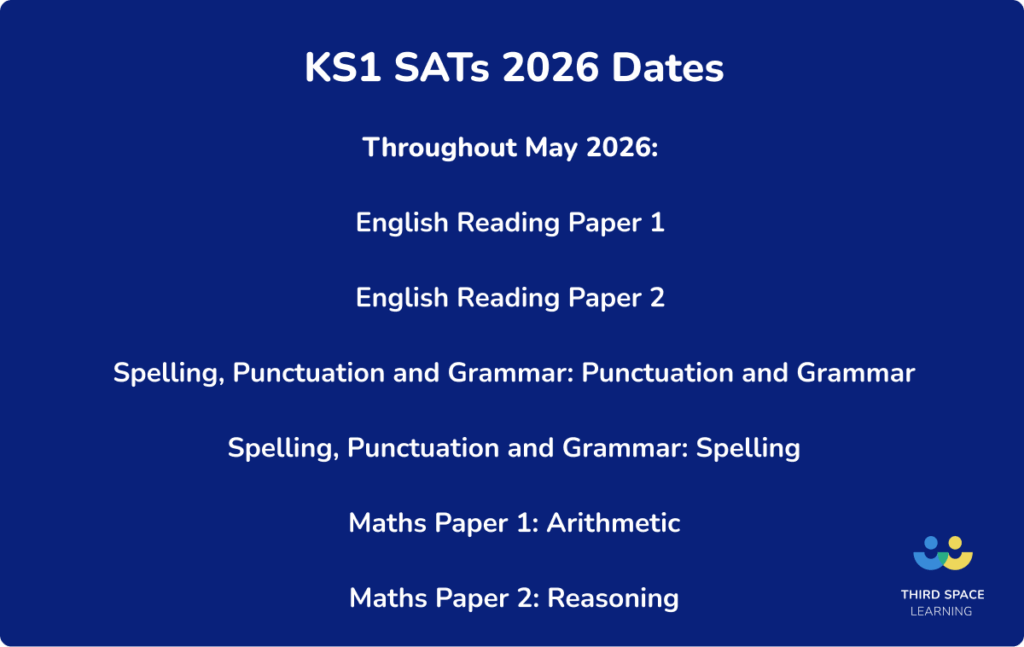
Schools may administer these optional tests during May 2026, depending on what works best for pupils and staff.
Detailed breakdown of Year 2 national tests: KS1 SATs papers 2025
The KS1 SATs papers that schools can choose to give 6 and 7-year-olds in Year 2 in May 2025 take the following format:
KS1 maths SATs
- There are 2 papers.
- Paper 1 is a 25-mark arithmetic test which should take around 15 minutes.
- Paper 2 involves reasoning, problem-solving and mathematical fluency. This paper has 35 marks available, will last for roughly 35 minutes, and contains a variety of question types .
KS1 SPaG SATs
- There are 2 papers.
- Paper 1 is a 20-word spelling paper, comprising 20 marks. The spelling test should take around 15 minutes.
- Paper 2 consists of grammar and punctuation, with two sections taking around 10 minutes per section.
KS1 reading SATs
- There are 2 papers.
- Paper 1 consists of a variety of texts totalling between 400-700 words. There will be a number of questions for pupils to answer dotted throughout.
- Paper 2 consists of a reading booklet containing different passages of text. This will average out at roughly 900 words.
2026 SATs preparation for Key Stage 2
Effective preparation starts with identifying gaps early and building confidence gradually. Proper preparation for KS2 SATs makes a difference. In our 10+ years of SATs revision maths tutoring, we’ve found the best approach tends to be a blend of the following:
- Analysis of past papers and topics to see the sorts of questions that come up.
- SATs strategies practice.
- A solid KS2 SATs revision programme that addresses any remaining knowledge gaps based on assessment data.
- Good quality SATs revision and teaching resources; you’ll find hundreds available from the free Third Space Learning online maths hub.
- SATs practice papers. When the time is right, children will benefit from regular exposure to the kinds of papers they’ll face in their national curriculum tests.
- Bespoke maths interventions as needed.
GET THE ANALYSIS ON PREVIOUS SATS
SATs have been running in their current incarnation for 7 years; there were no government standardised assessments in 2020 and 2021 as a result of the Covid-19 pandemic. Get all the analysis and results from previous national assessments below.
And find out which are the top 20 year 6 maths revision topics to focus on this year.
– SATs papers 2025
– SATs results 2025
– SATs papers 2024
– SATs results 2024
– SATs papers 2023
– SATs results 2023
– SATs papers 2022
– SATs results 2022
– SATs papers 2019
– SATs results 2019
– SATs papers 2018
– SATs results 2018
– SATs papers 2017
– SATs results 2017
– SATs results 2016
Best revision resources for the 2026 SATs
- Visit our SATs papers hub which includes links to every SATs practice paper you could need from all suppliers (not just us)
- Download these 6 free SATs maths papers
- Choose from hundreds of SATs questions here, including these 35 exemplar year 6 maths questions focused on the reasoning skills required for mathematics paper 2 and mathematics paper 3.
- Here are the best SATs revision resources that other teachers have recommended.

One-to-one SATs support with Skye
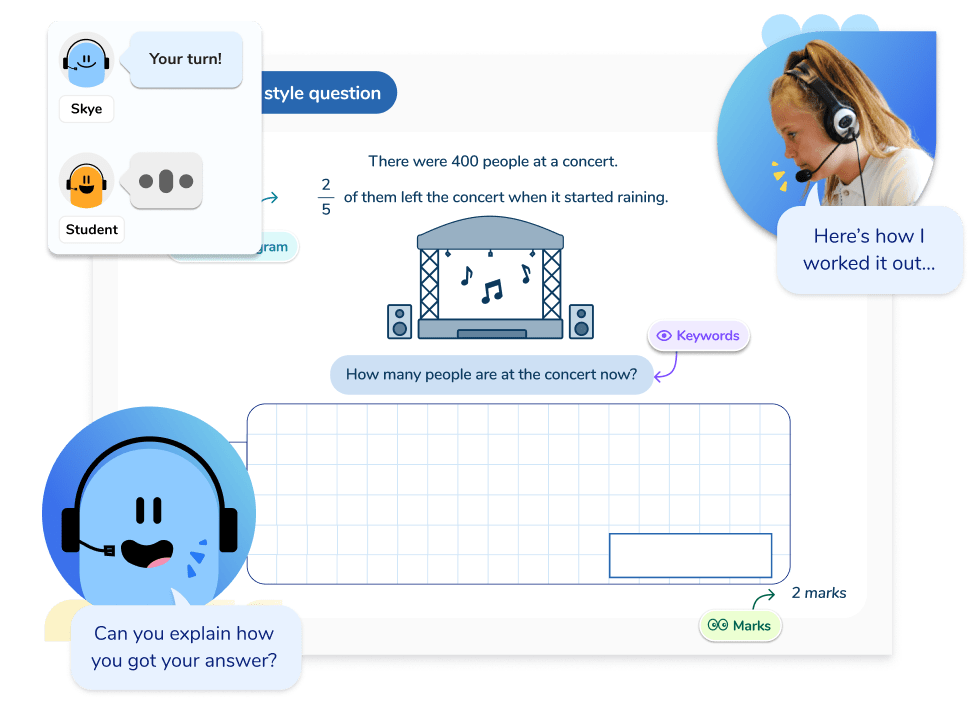
For children who need targeted support in maths spoken AI tutor, Skye, built by teachers, provides flexible one-to-one practice at scale. Skye supports the same lesson structure as traditional tutoring, but with greater flexibility; sessions can be scheduled every 5 minutes, before, during or after school.
Schools using Skye report improved confidence in pupils and greater consistency in delivery. Skye adapts to individual pupil responses, scaffolding each session using the I do, we do, you do approach.
With a fixed cost and no session limits, Skye makes it easier to provide SATs preparation for every pupil who needs it, without increasing teacher workload.
Find out more about our primary AI maths tutoring programme.
We used AI tutor Skye this year. 93% of our Third Space Learning pupils reached the expected level. One child, who had been struggling with maths, attained at greater depth (scaled score 110).
Deb Harris, Assistant Head and Maths Lead,
Wormley CofE Primary School
SATs timetable planning for 2026
When will the KS1 SATs papers be released?
The Standards and Testing Agency will likely release the KS1 SATs papers from embargo by early in June 2026. At this point, you can expect to receive the mark scheme and the scaled score conversion tables.
When do the KS1 SATs results 2026 come out?
Teachers mark the KS1 SATs internally following the Standards and Testing Agency mark scheme. Therefore, it is up to schools to decide when and if they share the results.
There is no obligation for schools to share the results of these optional tests with parents, but many include a summary of them in the end-of-year report.
When will the KS2 SATs 2026 papers be released?
Generally, based on previous years, the Standards and Testing Agency release the Key Stage 2 SATs papers and mark scheme at the end of May. This is usually around 2 weeks after children complete the KS2 SATs tests.
When do the KS2 SATs results 2026 come out?
While this date is not yet available, KS2 SATs results are usually released in the second week of July.
Schools will then receive both the raw score and the scaled score for every child, and whether or not they have reached ‘expected standard’ ie a scaled score of 100 or above.
When will the KS2 SATs results 2026 be made public?
The next key date for KS2 SATs results is the publishing of the league tables. Each school’s performance is subject to wider scrutiny with its Ofsted report. During the pandemic years, this data wasn’t published but returned to public publishing in 2023 on the compare performance website. These usually appear in April of the following year, so we can expect to see the KS2 SATs results 2026 made public in April 2027.
Test timing in your school
Schools can vary the test time between 7am and 7pm on the day of a SATs exam. Individual children or part of the cohort can take a test on the scheduled date, but at a different time from the rest. Schools no longer need to submit a notification to the STA as was previously the case.
For further guidance on this from the STA, see how to apply for a timetable variation.
SATs: special considerations
If they have had some impact on the child, the following circumstances are all eligible for Special Consideration, adding 3 points to each child’s scaled scores (if the application is accepted).
Note that the 3 scaled score addition won’t show on your results on NCA tools, but the pupils are marked with a symbol to show it was granted, so you can add the 3 scaled score points.
- Bereavement of a family member or close friend within 12 months of the SATs.
- The pupil, or a close family member, has a diagnosed terminal illness at the time as the SATs.
- The child or a close family member has suffered a severe or permanent injury or illness or has undergone major surgery, in the 6 months before the tests.
- A serious domestic incident occurred within 2 weeks of the start of the SATs.
- A longer-term major incident that occurred in the 6 months before the tests is still having an impact on the pupil at the time of the test.
Schools can usually apply for special consideration from the Thursday of SATs week, and you have one week to do it.
Helpful GOV.UK links for KS1 and KS2 SATs 2026
Much of the key documentation is available from the Department for Education (DfE) on GOV.UK and updated for every academic year.
KS1: National Curriculum Assessments KS1 tests page. This includes:
- Key stage 1 assessment and reporting arrangements
- Key stage 1 calendar of SATs dates
- Access arrangements
- Test administration
- Maladministration
KS2: National Curriculum Assessments KS2 tests page. This includes:
- Key stage 2 assessment and reporting arrangements
- Key stage 2 planner
- Planning
- Access arrangements
- Test administration
- Monitoring visits
- Maladministration
- Results
In addition, you may need the following:
- Key Stage 1 Teacher Assessment Guidance and the
- Key Stage 2 Teacher Assessment Guidance
- Future dates for primary assessment
Other statutory primary assessments in 2025/26
Statutory assessments are still required in other year groups at primary school, particularly in reception, Year 1 and Year 4.
Reception baseline assessment
All reception baseline assessment schools must administer the RBA to children in the first six weeks of the autumn term. This establishes a starting point for measuring progress to the end of key stage 2.
The assessment is carried out one-to-one and includes early maths, literacy and language tasks appropriate for the reception year. Schools must complete the assessment for all eligible children who enter reception in September.
Phonics screening check
The phonics screening check must be completed during the week commencing 8 June 2026. It applies to:
- All Year 1 pupils
- Any Year 2 pupils who did not meet the expected standard in Year 1 or did not take the check previously
Phonics screening check schools must administer the same test to all children and mark it using DfE guidance.
Multiplication tables check
The multiplication tables check window opens in June 2026. Schools can choose the date but must complete the check within the two-week national window from Monday 1 June 2026.
The check is statutory for all Year 4 pupils in multiplication tables check schools. Children answer 25 timed questions online, focusing on recall of multiplication tables up to 12 × 12.
FAQs: SATs 2026
Year 6 SATs take place from Monday 11 May to Thursday 14 May 2026. These include tests in grammar, punctuation and spelling, reading, and three mathematics papers.
Yes. SATs will continue in 2026 for Year 6 children as part of the statutory key stage 2 assessments in English and maths. Key stage 1 SATs remain optional tests.
No. There are no current plans to remove statutory key stage 2 SATs. They continue to form part of the national primary accountability measures.
No. Wales no longer uses SATs. Instead, pupils complete personalised online assessments in reading and numeracy as part of the Curriculum for Wales.

DO YOU HAVE STUDENTS WHO NEED MORE SUPPORT IN MATHS?
Skye – our AI maths tutor built by teachers – gives students personalised one-to-one lessons that address learning gaps and build confidence.
Since 2013 we’ve taught over 2 million hours of maths lessons to more than 170,000 students to help them become fluent, able mathematicians.
Explore our AI maths tutoring or find out about year 6 SATs for your school.


![The Top 20 SATs Revision Topics For 2026 [Video]](https://thirdspacelearning.com/wp-content/uploads/2026/01/SATs-webinar-2025-social-image-6-180x160.png)