
GCSE Maths Marking: How To Agree Your Department’s Approach Before Mocks [Webinar]

GCSE maths marking can feel complex, especially when two teachers mark the same Year 11 mock differently. Here, Edexcel examiner Martin Noon and Third Space Learning’s Secondary Curriculum Lead Paul Coffey, a former maths teacher, talk through GCSE maths mark schemes and decode the marking codes that cause the most disagreement. They explain how heads of maths can train their department to mark consistently before mocks, and how to make sure students gain as many marks as possible in their GCSE maths exams.
When marking doesn’t match, a student can be predicted a 4 in one class and a 5 next door, and those marks then feed predicted grades, tier entry, intervention lists and parents’ evenings. In this 30-minute webinar, Martin and Paul share how maths departments can agree one approach to marking before the scripts arrive.
Key takeaways
- Mock marks feed predicted grades, tier entry, intervention lists and parents’ evenings, so inconsistent marking affects every decision that follows.
- Teachers who haven’t marked for an exam board tend to under-credit method marks and over-credit final answers.
- Six marking codes cause most disagreements: follow-through, dependent marks, ignore subsequent working, special cases, inverted commas and square brackets.
- A calibration session takes 15 to 20 minutes and works best before mocks are marked, not after.
- Agree four decisions as a department: answer-only responses, follow-through, special cases and misreads. Write them down and tell students.
- After the mocks, record method and accuracy marks in separate columns to see whether students are losing marks through content gaps or exam technique.
- Last year, in GCSE Maths Marking Decoded, we explained how GCSE mark schemes work. This article and webinar are about timing: what to agree as a department before marking the first mock paper.
Stay updated for the 2027 GCSE season
Join our email list to be alerted to any new changes to GCSE maths exams in 2027.
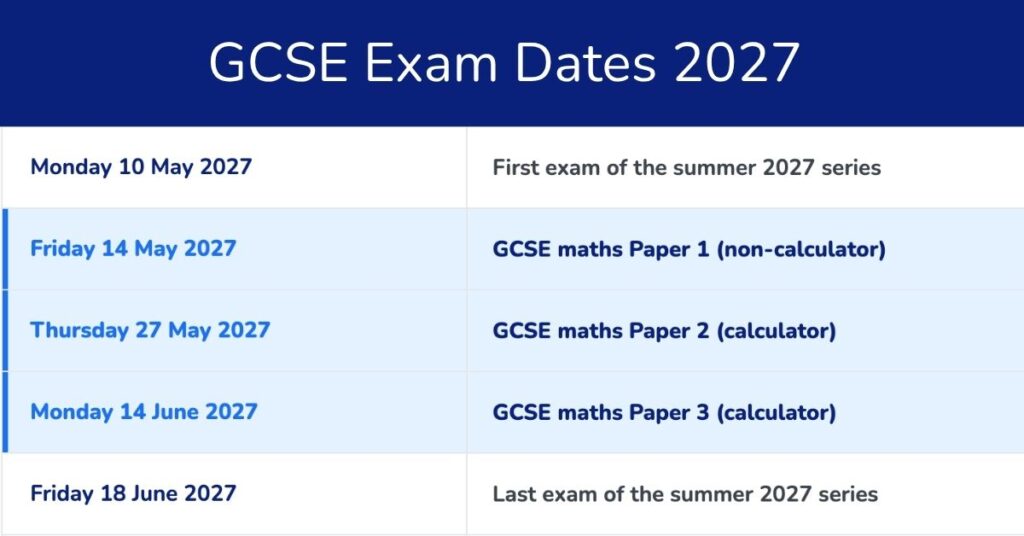
We’ve got all the GCSE dates 2027 and we will be reviewing the contents of each of the GCSE maths papers in 2027 and taking a good look at the GCSE results 2027 in August.
Why GCSE maths marking needs to match before mocks
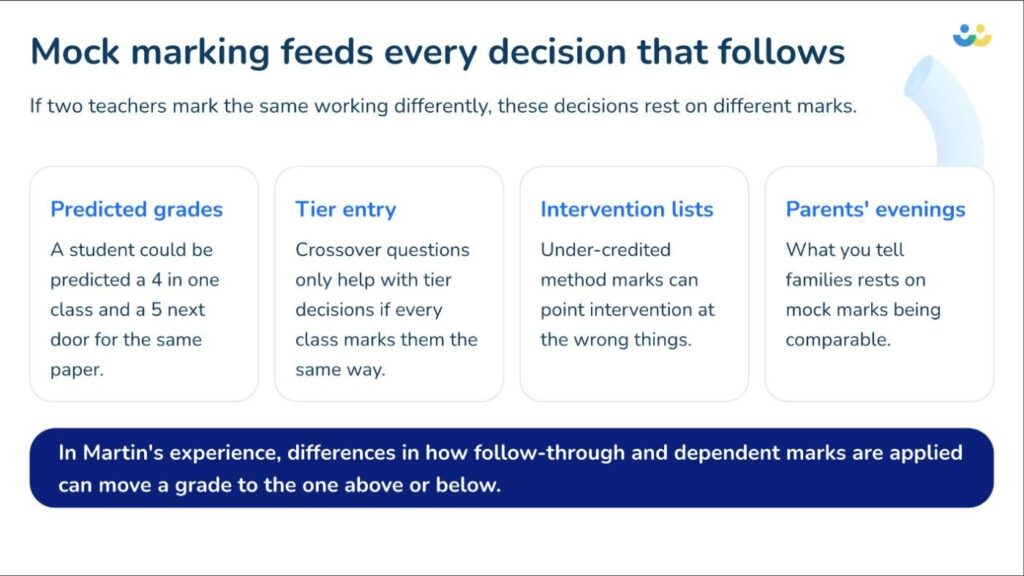
Mock results shape almost everything in Year 11. They decide predicted grades, which students sit Higher or Foundation, who goes on an intervention list and what teachers tell parents at consultation evenings. If two teachers mark the same working differently, each of those decisions rests on marks that mean different things in different classes.
In Martin’s experience as an examiner, differences in how teachers apply follow-through and dependent marks alone could move a student up or down a grade. Tier entry is a clear example. When Martin led Key Stage 4, his team looked at the crossover questions at the end of the Foundation paper and the start of the Higher paper. A student picking up most of those marks was considered for Higher, and a student losing most of them was usually safer on Foundation. That only works if those questions are marked the same way in every class.
Most of the marks are for method
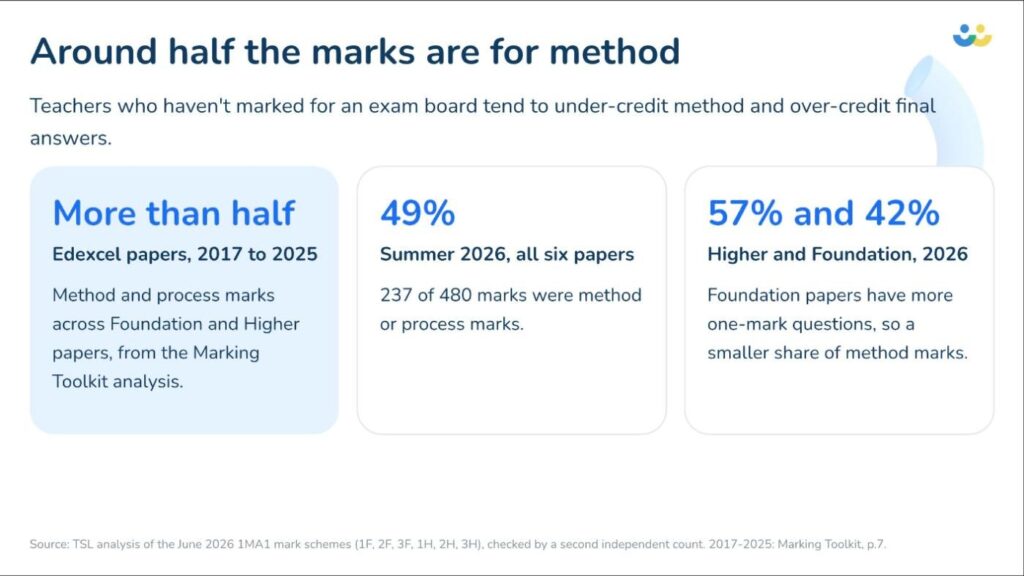
The variation between teachers isn’t random. Teachers who haven’t formally marked for an exam board tend to under-credit method marks and over-credit final answers. This can have a real cost. Across Edexcel papers from 2017 to 2025, more than half of all marks were method or process marks. In summer 2026, the share dipped just under half overall, but it was still 57% on the Higher papers.
A department that under-credits method underestimates what its students can do, and may aim intervention at the wrong things. Agreeing an approach before 200 scripts land on everyone’s desks is far easier than fixing inconsistent marks afterwards.
The GCSE maths marking codes that cause arguments
Most maths teachers are confident with M marks (method) and A marks (accuracy). Disagreements tend to come from six less common codes. They’re worth going through with ECTs, non-specialists and anyone who has taught a different exam board.
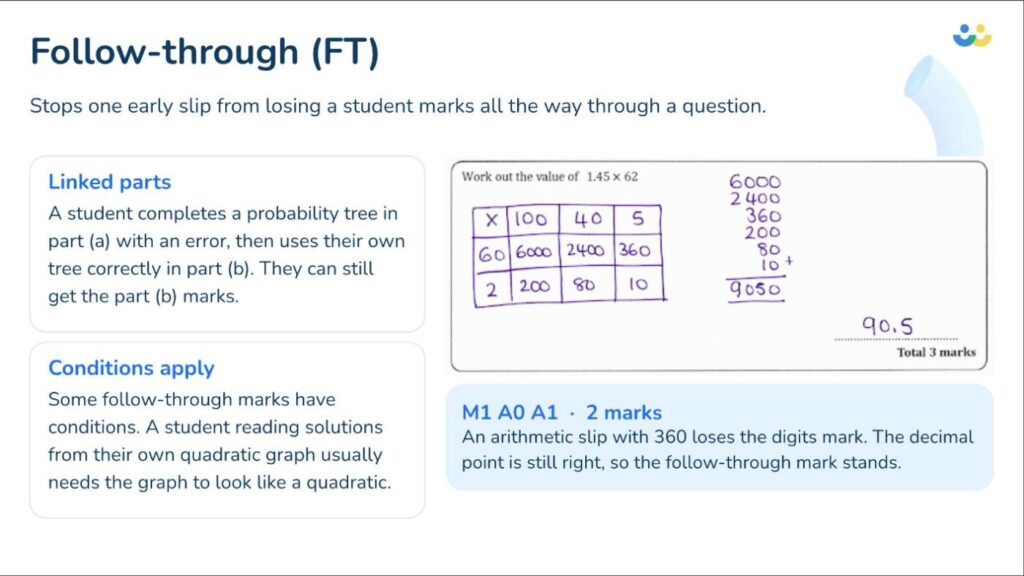
Follow-through (FT)
Follow-through stops one early slip from costing a student marks all the way through a question. It appears in questions with linked parts. For example, a student who makes an error completing a probability tree in part (a) can still earn the marks in part (b) if they use their own tree correctly and the mark scheme includes FT.
Some follow-through marks come with conditions. If a student reads solutions from their own sketch of a quadratic graph, the graph has to look like a parabola, and they have to read from it accurately.
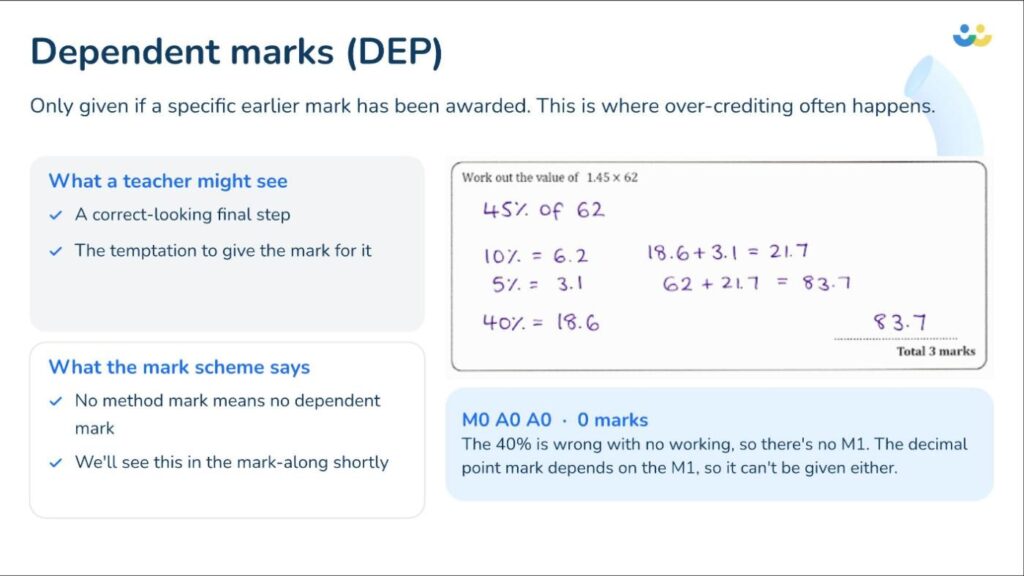
Dependent marks (DEP)
A dependent mark can only be given if a specific earlier mark has been awarded. This is where over-crediting often happens. A teacher sees a correct-looking final step and gives the mark, but if the method mark it depends on isn’t there, the dependent mark can’t be given either.
Ignore subsequent working (ISW)
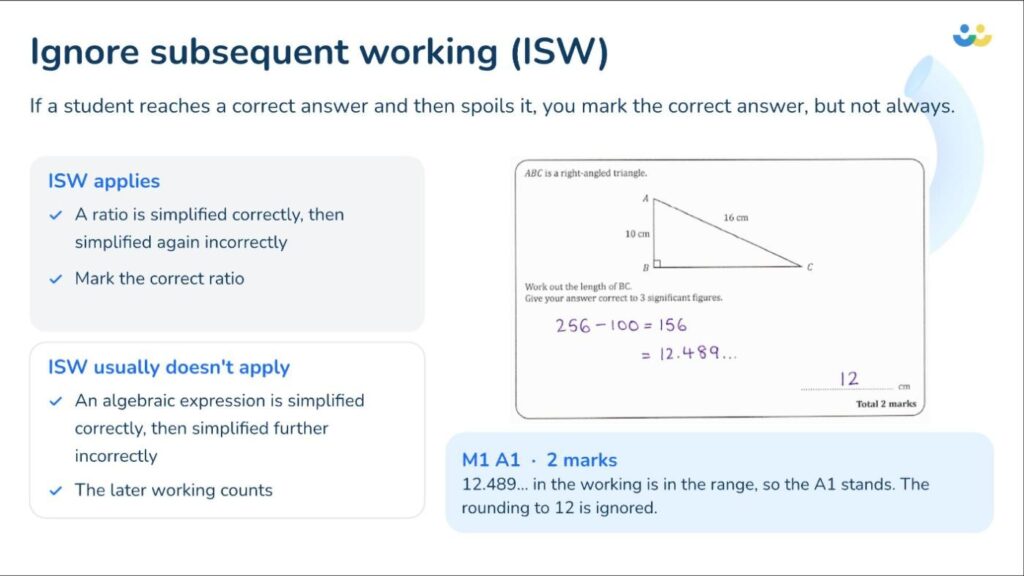
If a student reaches a correct answer and then carries on and spoils it, you mark the correct answer. A common example is a ratio simplified correctly and then simplified again incorrectly.
ISW doesn’t always apply. If an algebraic expression is simplified correctly and then simplified further incorrectly, the later working usually isn’t ignored.
Special cases (SC)
Special cases, usually written SC1 or SC2, give credit for one specific, common incorrect response that would otherwise score zero. They’re often added after examiners have seen real student responses, which makes them unpredictable. A special case on one question one year doesn’t mean a similar question will have one next time.
In summer 2026 there were 12 special case marks across the six Edexcel papers, each worth between 1 and 4 marks.
Inverted commas
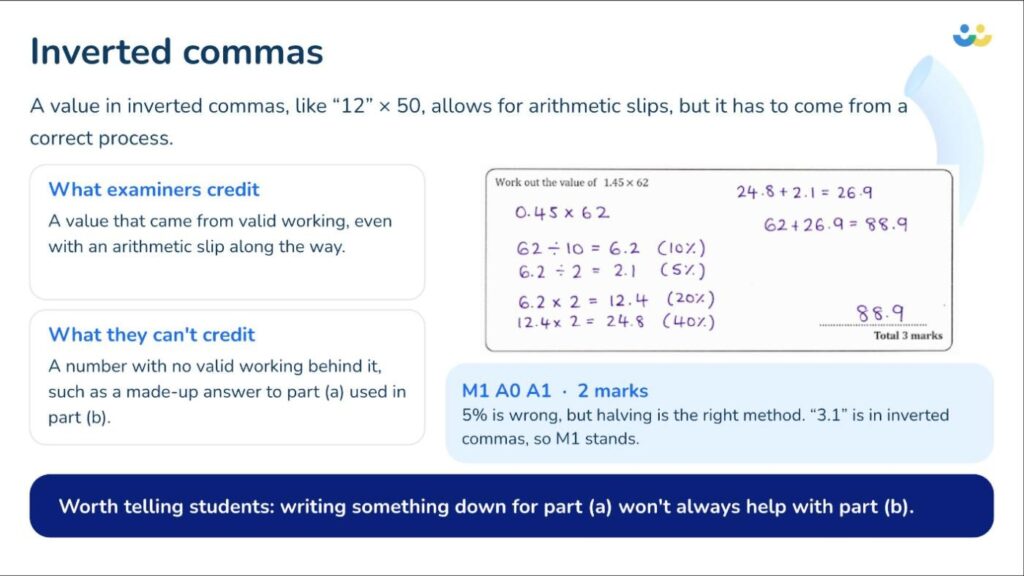
A value in inverted commas on a mark scheme allows for arithmetic slips, but it has to come from a correct process. Examiners can’t credit a number a student has made up for part (a) just so they can attempt part (b).
This one is worth sharing with students, because many of them believe writing anything down for part (a) will help them with part (b).
Square brackets
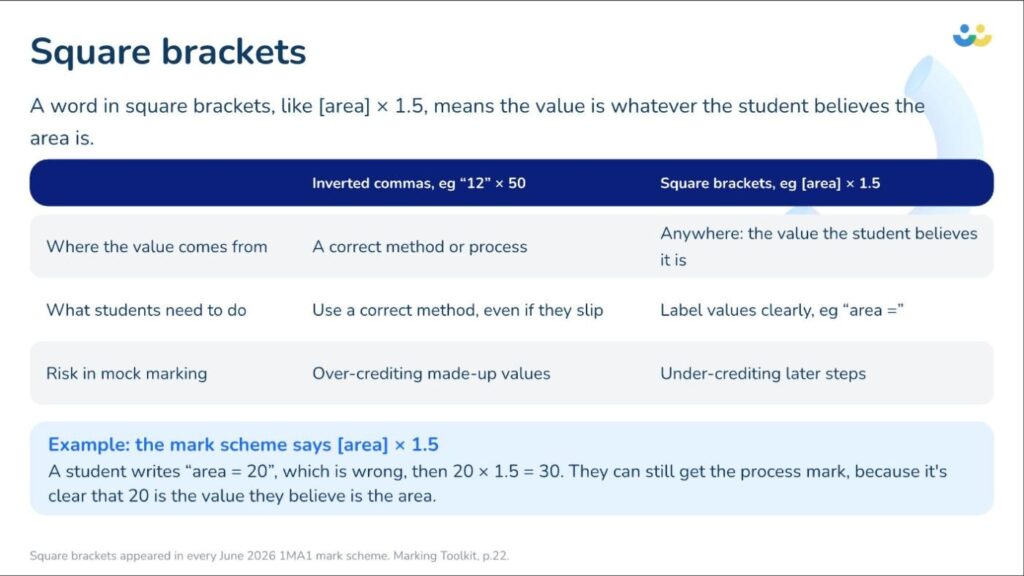
Square brackets are less well known and more generous. If a mark scheme says [area] × 1.5, the value is whatever the student believes the area is, even if it didn’t come from a correct method. Square brackets appeared in every Edexcel mark scheme in summer 2026, and a teacher who treats them like inverted commas will under-credit students.
All six codes, with worked illustrations, are in the Ultimate Edexcel GCSE Maths Marking Toolkit, updated for 2026. For a refresher on the more common codes, see this breakdown of GCSE maths mark schemes.
Mark along with an examiner: a calibration session in practice
In the webinar, attendees marked student responses in the chat before seeing what an examiner would award. We wrote the questions and responses ourselves to match real Edexcel questions and mark schemes.
Question 1: multiplying decimals
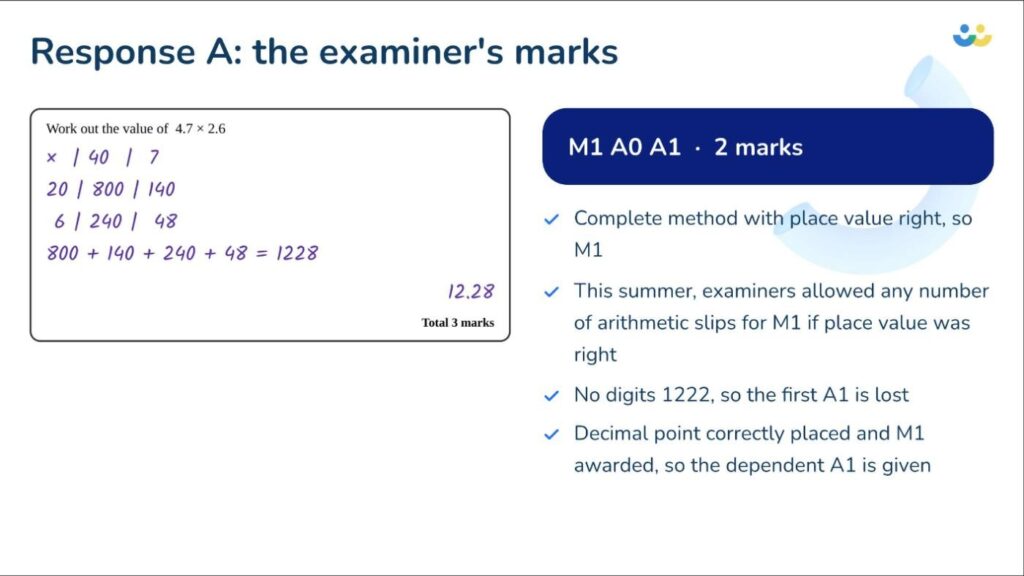
The first question was modelled on one that appeared on both the Foundation and Higher non-calculator papers in summer 2026: work out the value of 4.7 × 2.6, for 3 marks.
The mark scheme gives:
- M1 for a complete method with the place value correct
- A1 for the digits 1222
- A1 for the decimal point in the right place, dependent on the M1
The correct answer is 12.22.
Response A used the grid method but wrote 48 where 7 × 6 should be 42, giving 12.28. This scores 2 marks (M1 A0 A1). The method is complete, and the place value is right, and examiners in summer 2026 allowed any number of arithmetic slips for that method mark. The digits are wrong, so the first A1 goes. The decimal point is in the right place for their working, and they have the M1, so the dependent mark is awarded.
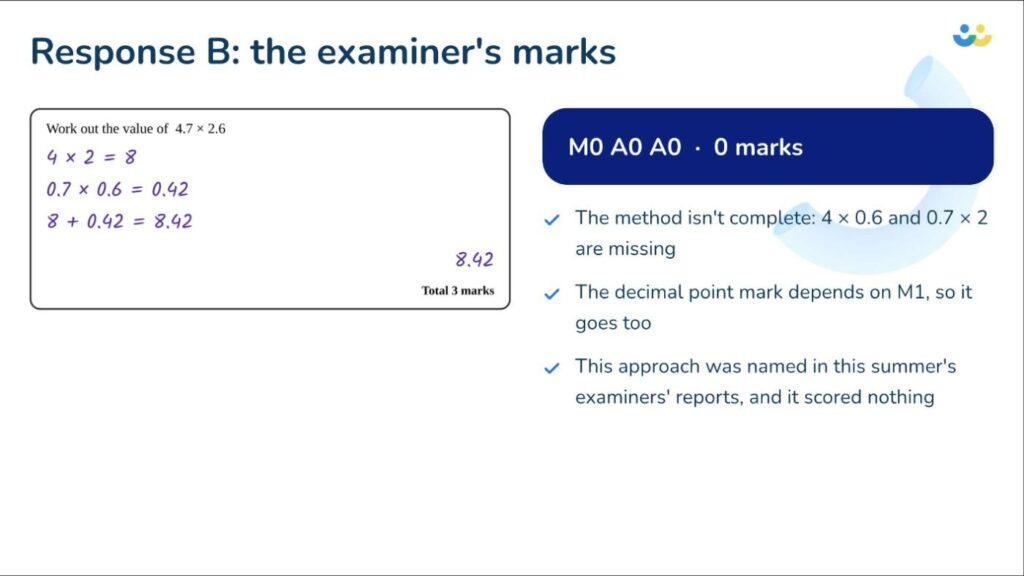
Response B split the numbers up: 4 × 2 \= 8 and 0.7 × 0.6 \= 0.42, giving 8.42. This scores 0 marks. The method is incomplete because it misses 4 × 0.6 and 0.7 × 2, and the decimal point mark depends on the method mark, so that goes too. This exact approach came up in the summer 2026 examiners’ reports.
For teaching this method with Year 11, use this guide to multiplying decimals.
Question 2: a special case in probability
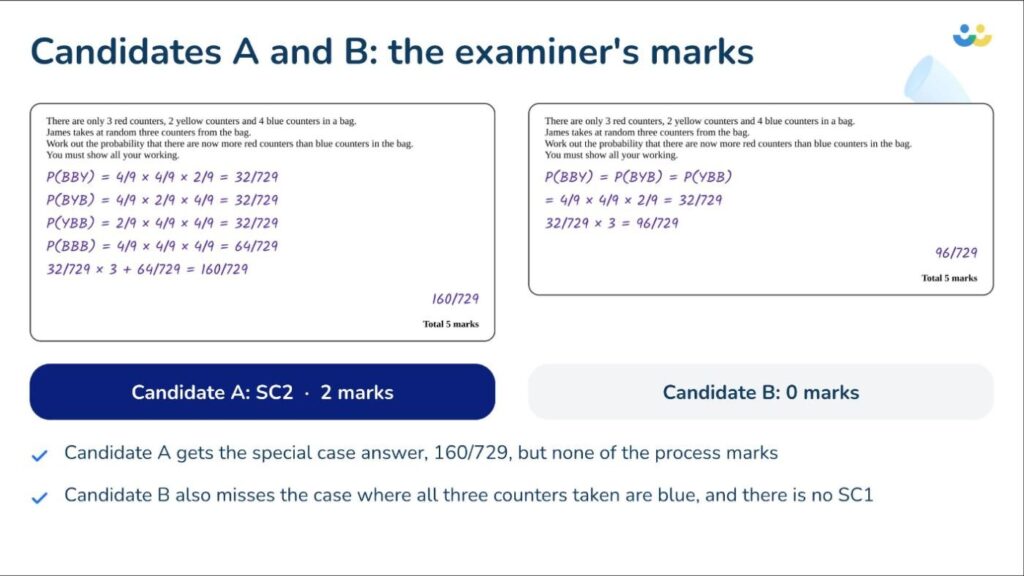
The second question was modelled on a June 2024 Higher calculator question. A bag has 3 red, 2 yellow and 4 blue counters. James takes three counters at random. Work out the probability that there are now more red counters than blue counters in the bag. It’s worth 5 marks, and the answer is 4/21.
The detail to look out for is that this is without replacement. The mark scheme includes SC2 for the answer 160/729, which is what a student gets by working it out as if the counters were replaced.
Candidate A worked with replacement and got 160/729. This scores 2 marks for the special case, but none of the process marks.
Candidate B made the same mistake and also missed the case where all three counters taken are blue, giving 96/729. This scores 0 marks.
There’s no SC1 on this mark scheme, so two very similar responses end up 2 marks apart.
How to run a calibration session in your department
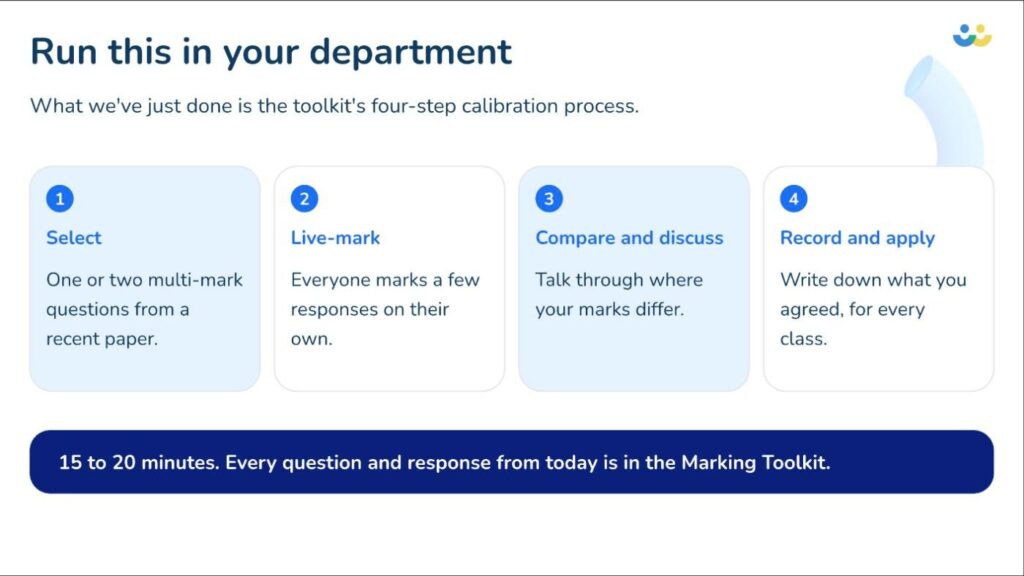
If the chat was divided on those answers, a department meeting could be too, and across 200 mock papers the differences add up. The toolkit sets out a four-step calibration process:
- Select one or two multi-mark questions.
- Have everyone mark a few responses on their own.
- Compare marks and discuss the differences.
- Write down what you agreed.
It takes 15 to 20 minutes, and the best time to do it is before mocks are marked. Every question, mark scheme and response from the webinar is in the toolkit, so you can run the same activity with your own team.
Four decisions to agree before marking GCSE maths mocks
Once a team marks consistently, the next step is to agree where mocks will follow the official mark scheme and where they won’t.
Why would a department choose to mark differently from Edexcel? A mock has a different job from the real exam: as well as measuring students, it trains habits for the summer. Small, deliberate changes to the mark scheme can reinforce the behaviours that earn marks. Making those changes once, at department level, means every class gets the same message, rather than one teacher being generous and another strict without anyone having agreed it.
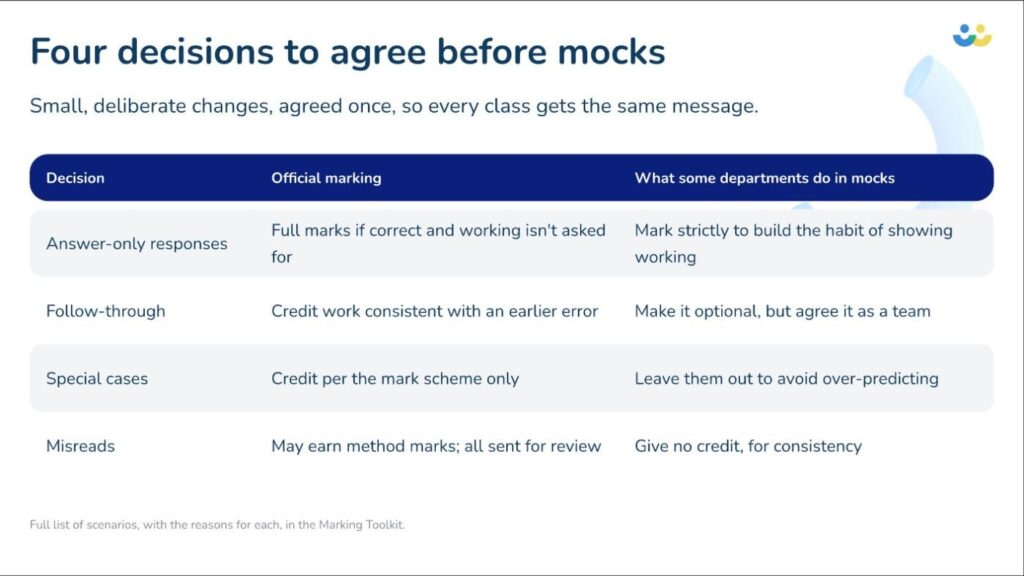
1. Answer-only responses on multi-mark questions
Officially, if a question doesn’t ask for working, a correct answer with nothing contradicting it gets full marks. Some departments mark these strictly in mocks. Students aren’t reliable at spotting which questions say “show your working”, so it’s safer to build the habit of always showing it.
2. Follow-through marks
Officially, later work that’s consistent with an earlier error is credited. Checking every follow-through across a full set of mocks takes a long time, so some departments make it optional depending on the assessment. Whatever the decision, everyone needs to apply it the same way, because follow-through alone can move a grade.
3. Special cases
Special case marks aren’t guaranteed. There were 12 in summer 2026 and no way of predicting which questions would carry them. Some departments leave them out of internal mocks to avoid over-predicting. There’s also a risk that a teacher treats a special case as “any alternative method”, when it’s a very narrow exception.
4. Misreads
On the real exam, a genuine misread can still earn method marks, for example, a student who copies 241 instead of 214, as long as it doesn’t make the question easier. In practice, Edexcel examiners send every possible misread to a senior examiner. Non-examiners can find that judgement hard, so some departments give no credit for misreads in mocks. It’s more consistent, and it reminds students to copy numbers carefully.
Whatever you decide
Once you’ve agreed your approach, do three things:
- Write it down, so new staff and supply teachers can follow it.
- Tell students before the mock, so a lower mark doesn’t come as a shock.
- Remember it when you set predicted grades. If you’ve marked more strictly than Edexcel would, the mock score may sit slightly below what the student would get in the summer, and that’s fine as long as you know it.
The full list of marking scenarios, with the official rule, a suggested department approach and the reasoning for each, is in the toolkit.
Show students what full-mark working looks like
The marks discussed so far are earned by students, and the mock is a chance for them to practise showing their working in a way an examiner can credit. Most students know they should “show their working”, but very few know which lines earn the marks. The toolkit makes the case that helping students show what they already know, in a way examiners can credit, is often more effective than re-teaching content.
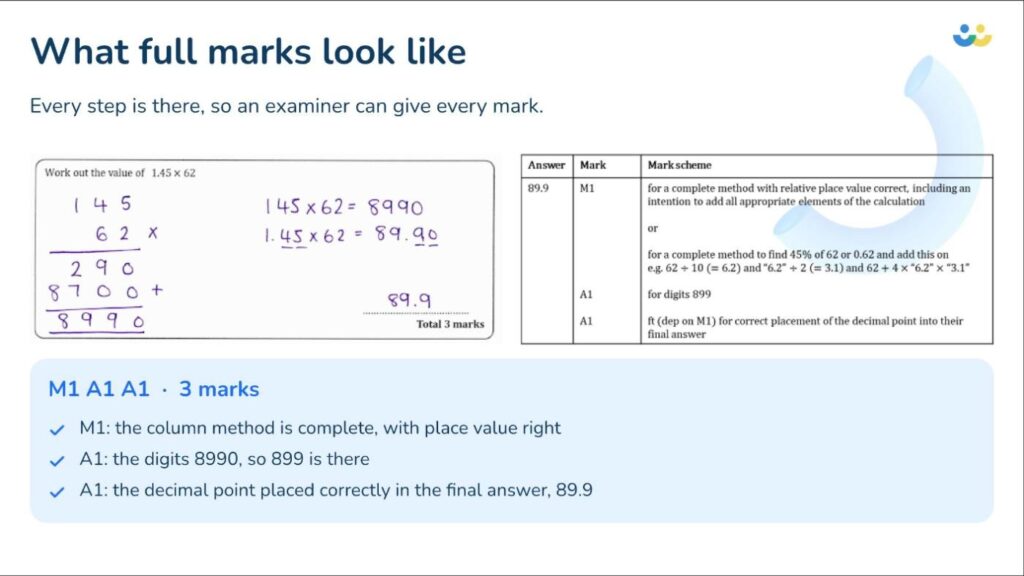
That’s why we created a free GCSE maths marking pack for this webinar, with Edexcel-style worked examples: calculator and non-calculator papers for Higher and Foundation, each with its own mark scheme. Each paper has been completed by a student. Some answers are correct and some contain mistakes, so your students mark them as if they were the examiner.
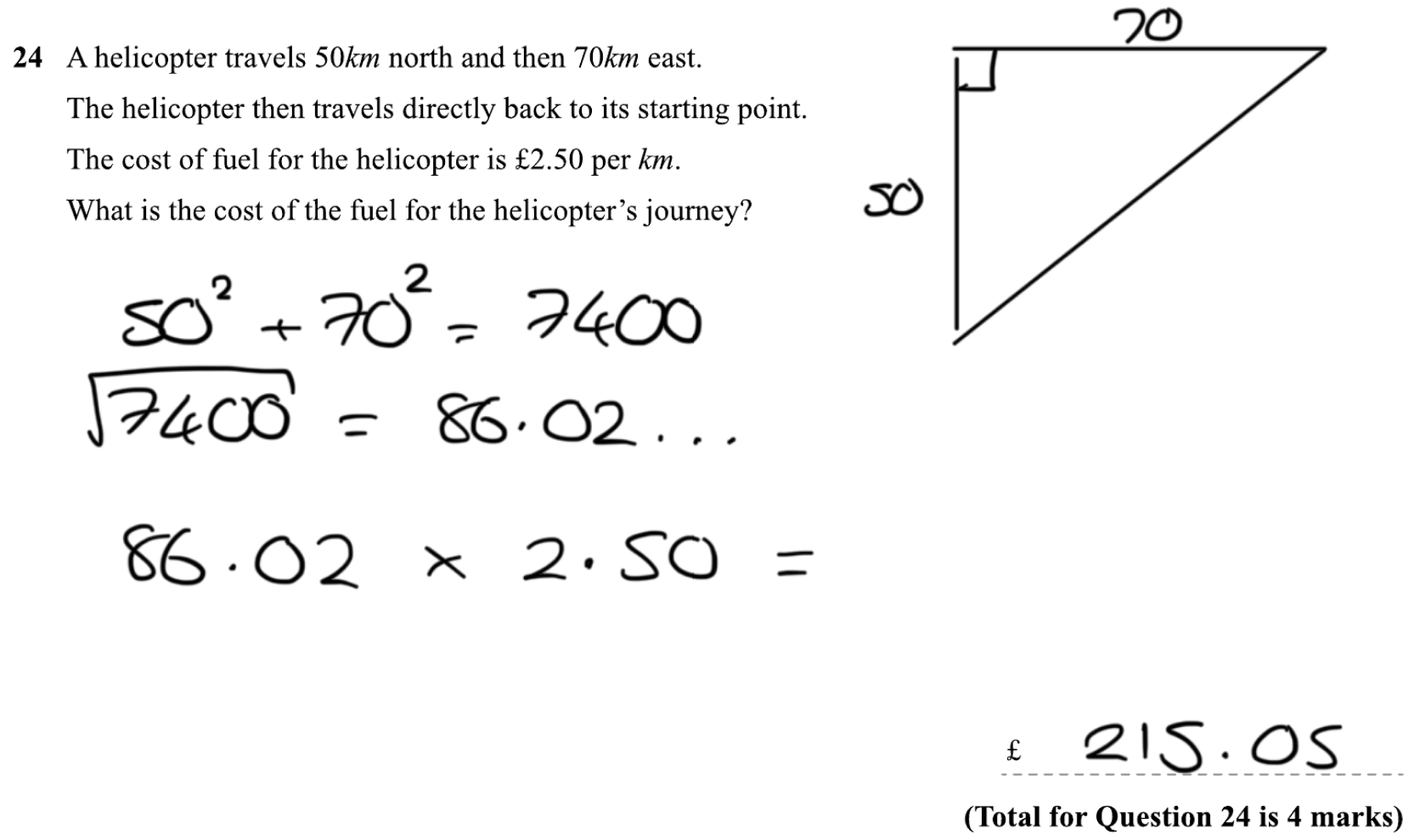
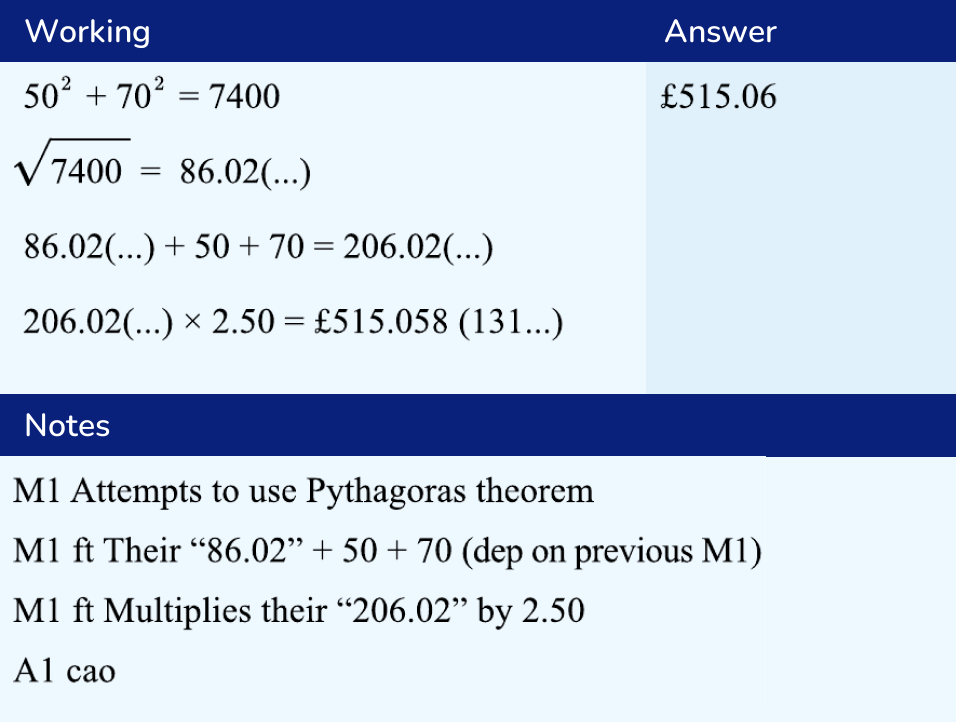
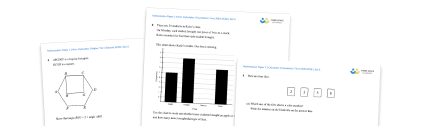
Here’s Foundation Paper 2, Question 24 from the pack. To use it with a class, put the worked example and the mark scheme side by side and ask students to find where each mark is earned. Which line gets the M1? Which marks are missing, and which line would have earned them? Here, the student uses Pythagoras’ theorem correctly but never adds the 50 and the 70, so they get £215.05 rather than £515.06. Once students see that a mark comes from one specific step, showing that step stops feeling optional.
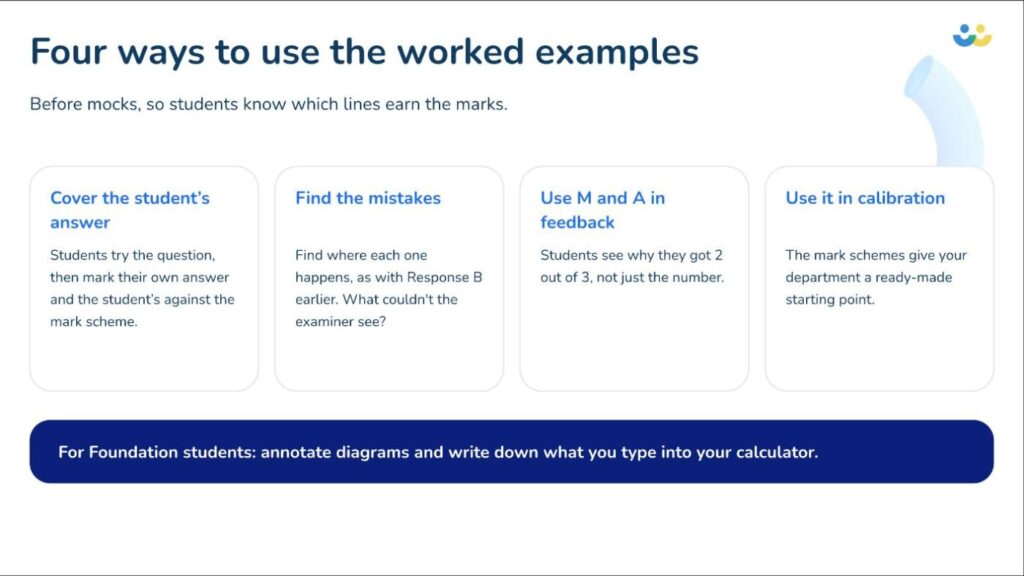
Four ways to use the worked examples before mocks
- Cover the student’s answer. Students try the question, then uncover the worked answer and mark both against the mark scheme. They get used to thinking like an examiner.
- Find the mistakes. Students find where each mistake happens, explain what went wrong and write out the correct working.
- Use student versions of the codes. When students see M for method and A for accuracy in their feedback, they understand why they got 2 out of 3, rather than just seeing the number.
- Use them in your calibration session. The mark schemes give the department a ready-made starting point.
For Foundation students in particular, annotating diagrams and writing down what they type into their calculator are easy ways to pick up method marks. The worked examples show what happens when that working is missing, so they’re useful even for students who are confident with the maths. These exam techniques help students make the most of their marks.
After the mocks: content gap or exam technique?
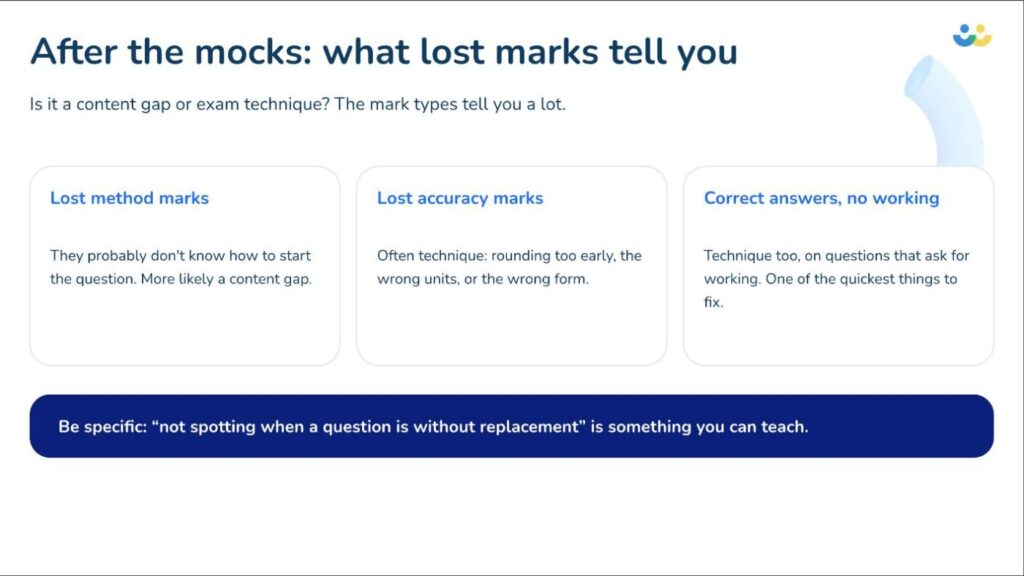
Once mocks are marked consistently and results are in, the first question is whether students are losing marks because of content gaps or exam technique.
The mark types tell you a lot:
- Losing method marks usually means the student doesn’t know how to start the question, so it’s more likely a content gap.
- Getting method marks but losing accuracy marks is often technique: rounding too early, the wrong units, or not giving the answer in the form the question asked for.
- Correct answers with no working on questions that ask for it is technique too, and one of the quickest things to fix.
Split method and accuracy in your question-level analysis
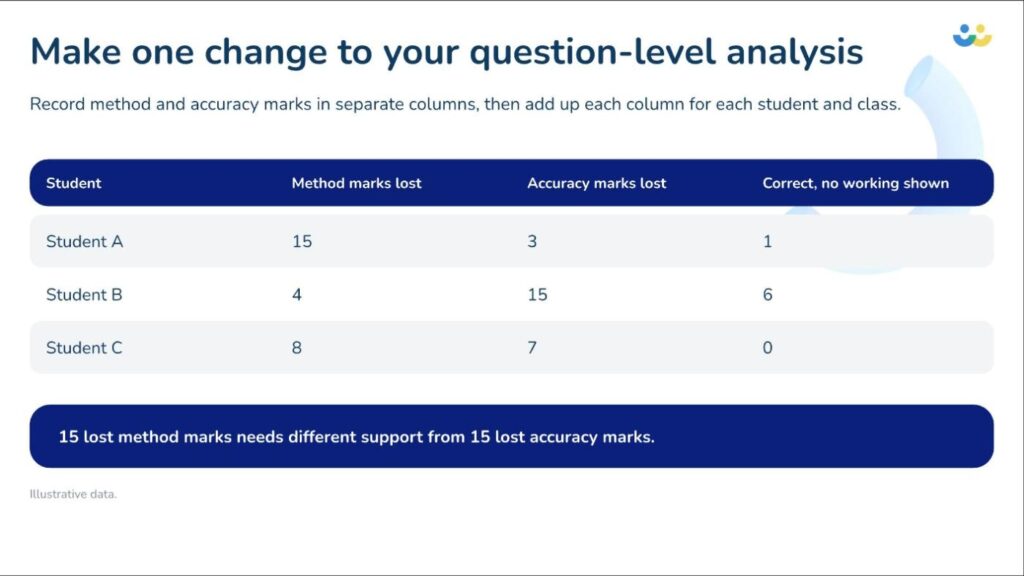
If your department already uses a question-level analysis spreadsheet, make one change. Instead of one total per question, record method or process marks and accuracy marks in separate columns, then total each column for each student and each class. A student who has lost 15 method marks needs different support from one who has lost 15 accuracy marks. You could also add a column for correct answers with no working on questions that asked for it, to see how many marks that habit is costing.
Look past the overall score to the questions that consistently lose marks across a class or year group, and be specific. “Students are weak at probability” is hard to act on. “Students aren’t spotting when a question is without replacement” gives you something to teach. Focus GCSE intervention on high-value question types, where a small change in what students write down can pick up several marks. The same approach works with real exam scripts in the summer: see how to use GCSE maths exam scripts and results data to plan teaching.
Keep calibrating through the year
The toolkit suggests repeating the calibration process three or four times a year, after each round of assessments, and holding one formal moderation session after the Year 10 and Year 11 mocks. Keep the examples you discuss, because they make good training material for new staff.
What examiners said about summer 2026
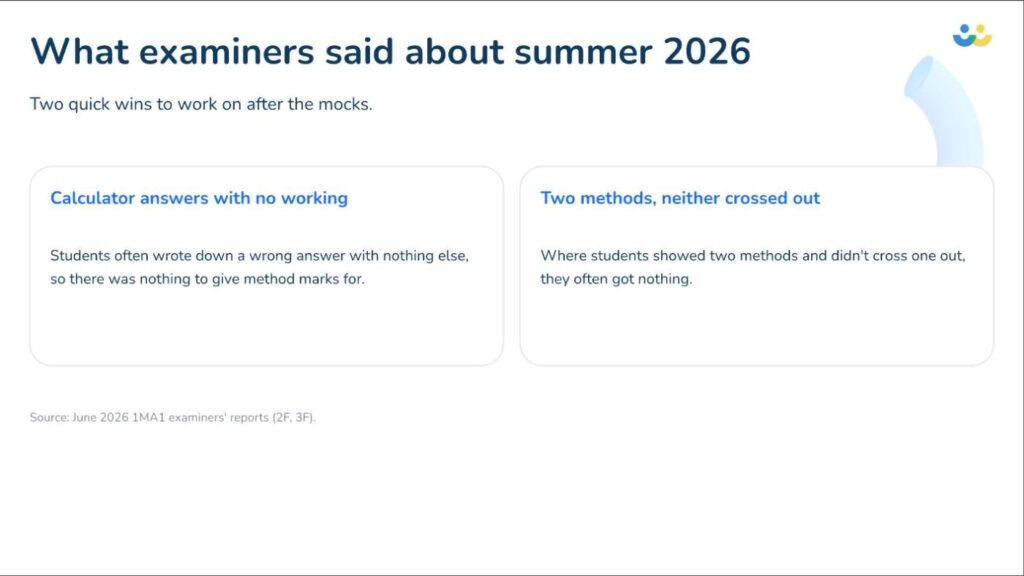
Two issues stood out in the summer 2026 papers:
- Students using their calculator and writing down a wrong answer with no working, leaving nothing to award method marks for.
- Students showing two methods without crossing one out, which often scored nothing.
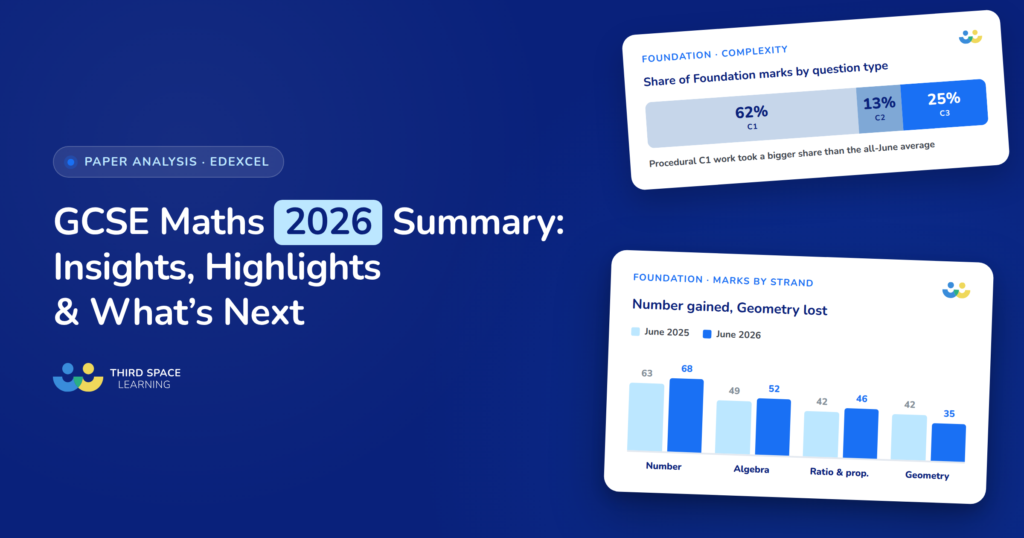
Both are quick to fix after the mocks. For a full paper-by-paper review, see the GCSE maths 2026 summary.
GCSE maths marking resources from the webinar
Everything covered in the webinar is free to download:
- Free GCSE Maths Marking Pack: Edexcel Worked Examples and Mark Scheme Decoder – created exclusively for this webinar, with calculator and non-calculator worked examples for Higher and Foundation and a mark scheme for each.
- The Ultimate Edexcel GCSE Maths Marking Toolkit – updated with the summer 2026 papers, including the marking scenarios and calibration format.
For full mock papers to use with Year 11, the Edexcel Foundation and Higher practice papers (Set 5) come with mark schemes.
Extra support for Year 11
If you’d like extra support for Year 11 between now and the summer, Skye, our AI maths tutor, delivers one-to-one GCSE maths tutoring for grades 3–7. Students talk Skye through their reasoning out loud, so they practise explaining their working in every session, the same habit that earns method marks in the exam.
GCSE maths mock marking FAQs
Before the mocks are marked. A calibration session takes 15 to 20 minutes: choose one or two multi-mark questions, have everyone mark a few responses on their own, compare and discuss, then write down what you agreed. Repeat it three or four times a year after each round of assessments.
A dependent mark (DEP) can only be awarded if a specific earlier mark, usually a method mark, has been given. If the method mark is missing, the dependent mark can’t be given either, even if the final step looks correct.
Not always. Some departments deliberately mark answer-only responses, follow-through, special cases and misreads differently in mocks to build good exam habits. Whatever you decide, agree it as a department, write it down, tell students in advance and allow for it when setting predicted grades.