



GCSE Maths Lessons: How to Deliver Targeted, Confidence-Building Revision Sessions

Most teachers know the feeling: you’ve taught a topic three times, and students are still dropping marks on it in the exam. GCSE maths revision should move students forward – but too often, it doesn’t.
This post walks through a four-stage lesson structure for GCSE maths revision, applicable to every exam board. This structure diagnoses student understanding first, then adapts support to what students actually need to help them achieve their target grade. It applies to GCSE maths lessons across any topic where students are making consistent errors that cost them marks, including algebra, geometry, statistics, and probability.
It’s the same structure used by Skye, Third Space Learning’s AI maths tutor, refined across thousands of online GCSE maths tutoring sessions with real students preparing for their GCSE exams.
Here, Paul Coffey, Secondary Curriculum Lead at Third Space Learning, and former maths teacher and GCSE examiner, explains how to apply it to a whole class setting.
Key takeaways
- Traditional GCSE maths revision lessons often fail because they teach before diagnosing, wasting time on explanations some students don’t need and leaving gaps unaddressed for others
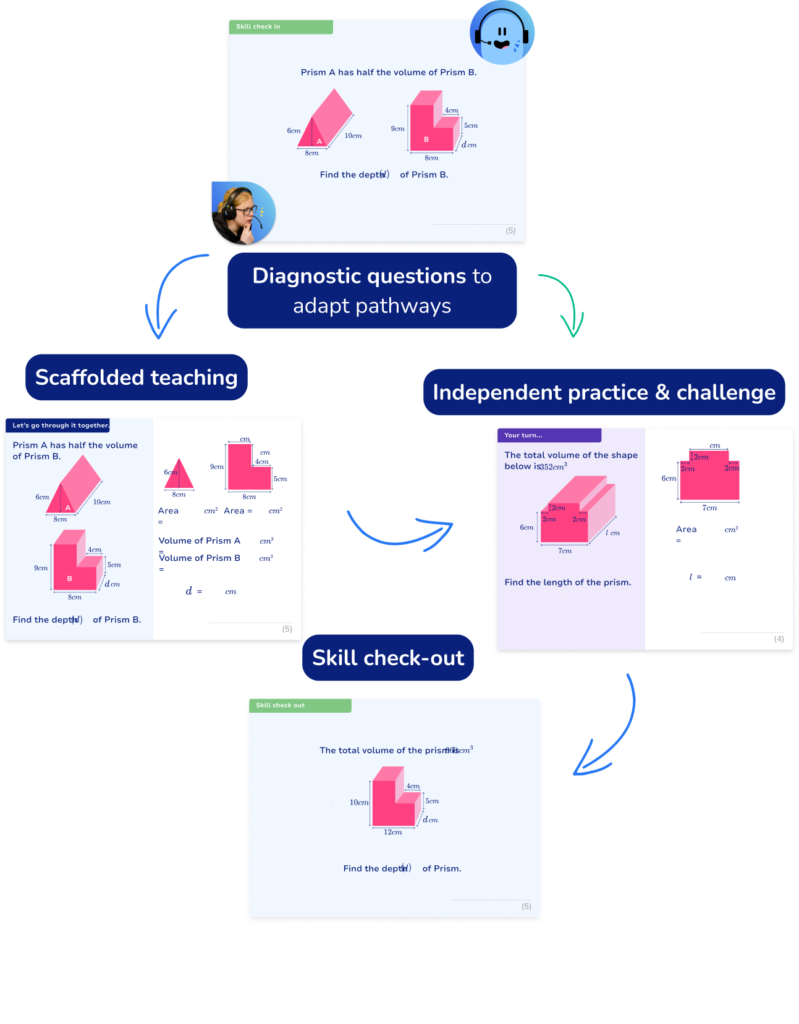
- A four-stage GCSE maths lesson structure – skill check-in, targeted support, guided practice, skill checkout – flips this by diagnosing first
- The check-in question must be carefully designed to surface specific misconceptions, not just right or wrong answers
- Confidence checks alongside the checkout give you richer data than results alone
- The tracking data is useful beyond a single lesson, at class, year group, and department level
- Five complete GCSE revision lessons following this structure are available to download free from the Third Space Learning secondary maths resource library

5 GCSE Maths Revision Lessons: Targeted, Confidence-Building Sessions for Grades 3–7
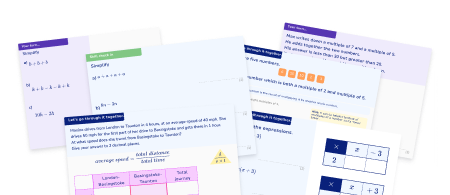
Download these five ready-to-use GCSE maths revision lessons, each built around the four-stage diagnostic structure: skill check-in, targeted support, guided practice, and skill checkout. The lessons span grades 3 to 7 and cover a range of key topics across number, algebra, and statistics.
Download Free Now!Why traditional GCSE maths revision lessons fall short
It all comes down to one thing: teaching before diagnosing. In a traditional revision lesson, you might start with a brief recap, work through an example, and then hand out a practice sheet. Some students will fly through it; others will get stuck on question one. You’re left trying to support 30 different needs at once with no clear picture of who needs what.
The deeper problem is that students who already understand the topic sit through explanations they don’t need, while students with a specific gap – a sign error, or a misconception about like terms – get a general explanation that doesn’t address their actual problem. Neither group makes the progress they should.
In GCSE maths revision, every lesson counts. You can’t afford to spend 15 minutes re-explaining something half the room already knows. And you can’t afford to let students practise a method they’ve only half understood, because that just reinforces the error. Students also need to show all working to earn method marks, even if their final answer is wrong – which means they need to truly understand the method, not just follow a remembered procedure.
The solution: a four-stage structure that diagnoses first
The GCSE maths lesson structure covered here essentially inverts the traditional approach. It diagnoses what students know at the start, adapts the support based on that diagnosis, and measures progress by the end. Every student benefits from the right level of challenge, and you get clear data on who has made progress and who needs a little more time.
This aligns with the ‘I do, we do, you do‘ model: modelling the method first, then practising it jointly, then students working independently. When students receive targeted help and then demonstrate they can do it independently, that’s where they see visible progress – and it’s a powerful motivator, especially for students who’ve convinced themselves they just can’t do maths.
By the end of a maths revision lesson using this structure, you’ll have a clear framework for knowing at a glance which students are securing topics and which need more time, not just in one lesson but across your entire revision programme.
The four stages of a GCSE maths revision lesson
The four stages are: the skill check-in, targeted support, guided practice, and the skill checkout. Here’s what each one involves.
Stage 1: The skill check-in
Students answer one question independently – no hints, no scaffolding. This is your diagnostic. You’re not looking for right or wrong answers at this stage; you’re looking at what each student does and where they go wrong. That will tell you everything you need to know about what to teach next.
A good check-in question needs to be carefully chosen. It should be pitched at the level you’re revising – for a class targeting grade 4, something like expanding and simplifying 3(2x + 1) − 2(x − 4) works well. It needs to be complex enough to surface common errors, but not so multi-step that you can’t pinpoint where the breakdown is.
The diagnostic power comes from choosing the right question, not just observing whether students are getting it right or wrong.
Stage 2: Targeted support
This is where you respond to what the check-in revealed. The keyword here is targeted – you’re not re-teaching the whole topic, you’re addressing the specific gap. A student who drops a sign when expanding the second bracket just needs two minutes on negative numbers. They don’t need a full explanation of how expanding works. Whereas, a student who only multiplies the first term inside the bracket has a more fundamental gap and needs a different response entirely. Same topic, same question, completely different support.
Stage 3: Guided practice
Students work on similar questions with some limited support. The keyword here is sequenced – questions start simple and increase in complexity gradually. Students build fluency step by step rather than leaping to the hardest version immediately. This is also where misconceptions that didn’t show up in the check-in will surface. A student might handle one bracket confidently, then show a gap when you introduce a coefficient outside the bracket.
Stage 4: The skill checkout
Students answer a question independently at the same level as the check-in. This gives you a direct comparison. Alongside the answer, ask students to give a thumbs up or thumbs down on their confidence – and that confidence signal is almost as important as the answer itself.
A student who gets the checkout right but gives a thumbs down is telling you something important: they followed the steps for that specific question, but they don’t yet feel secure applying the method more broadly. That’s a student who needs more varied practice before the exam, because exam conditions, the pressure of timing, and a question that looks slightly different from what they’ve practised, are exactly where the difficulty will hit.
A thumbs down means: don’t move on just yet. They need more practice, more varied examples, or more reassurance that they understand the underlying principle, not just the procedure.
Why this lesson structure works well for GCSE maths
There are four reasons this approach works where traditional revision often doesn’t:
- It’s adaptive
- It’s efficient
- It builds confidence
- It provides usable data
1. Adaptive
The check-in tells you exactly what each student needs, so you’re not wasting time re-teaching students who already understand or pitching content above students who aren’t quite ready.
2. Efficient
In a traditional lesson, you might spend 15 minutes explaining a concept that half the room already understands. With this structure, students who get the check-in right move straight to consolidation practice while you focus your time on the students who need extra support.
3. Confidence
Students answer a question independently at the start, get targeted help, and then prove to themselves and to you that they can do it at the end. That’s a complete learning cycle in a single lesson – and it’s particularly powerful for students who’ve convinced themselves they’re not good enough at maths. Now there’s concrete evidence you can point to.
4. Data.
Not just a sense of how the lesson went, but a specific record of which students closed the gap and which still need more time. More on that when we look at tracking.
This structure is well-suited to the breadth of the GCSE maths curriculum, which covers algebra, geometry, statistics, and probability, as well as number topics including fractions, decimals, and percentages.
Whether you’re revising linear or simultaneous equations, graphs, angles, compound shapes, surface area calculations, problem solving tasks, or converting units, the same four-stage approach applies.
A full GCSE lesson walkthrough: expanding and simplifying expressions
Here’s a complete GCSE maths lesson on expanding and simplifying expressions with brackets. This topic appears consistently across papers for all major GCSE exam boards and generates a wide range of misconceptions. Students can make consistent errors here that cost them marks, so understanding what those errors look like and how to respond to each one is the real skill.
The check-in question
The session opens with the skill check-in. No hints, no scaffolding – you’re simply observing who can do it, who’s attempting a method, and who doesn’t know where to start.
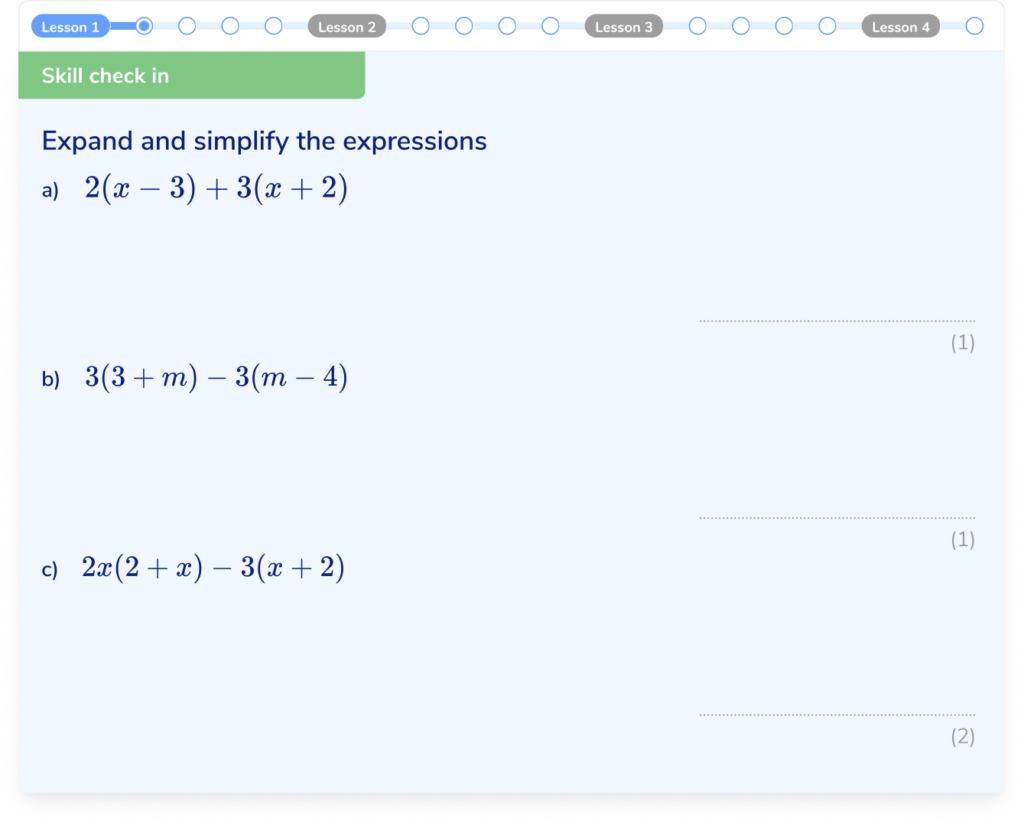
An example question: expand and simplify 3(2x + 1) − 2(x − 4). You’re looking at students working out here, not just the final answer.
Why this question specifically?
A simpler question – say, expand 2(x + 3) – wouldn’t surface the most common and costly errors. Choosing the two-bracket structure with a negative multiplier exposes the misconceptions most likely to cost students marks. This is the same principle that should guide your check-in question design for any algebra topic – the question needs to be rich enough to generate meaningful diagnostic information, whether you’re working on expanding brackets, solving equations, or simplifying algebraic expressions.
What students’ responses tell you
Here’s what you might see in the room, and what each response tells you:
- Response A: correct answer. This student understands the method fully. They’ve handled the negative multiplier correctly and collected like terms correctly. They don’t need your time during stage two.
- Response B: sign error in the second bracket. Probably the most common error you’ll see. The student multiplied -2 by x correctly, but treated -2 × -4 as -8 instead of +8 – they’ve forgotten that a negative times a negative gives a positive. This is a specific, fixable gap, not a fundamental misunderstanding of expanding brackets.
- Response C: partial expansion. Only the first bracket has been expanded; the second has just been rewritten. The student may not have read the question carefully, or may not have understood that the minus sign applies to the entire second bracket.
- Response D: incorrect distribution. The student has only multiplied the first term inside each bracket. They understand the need to multiply the term outside the bracket by something inside, but they’re only applying it to the first term. This is a more foundational gap in what expanding brackets actually means.
- Response E: correct expansion, but collecting unlike terms. The student has merged x terms and constant terms incorrectly, writing 11x instead of 11. The expansion was fine – this is a like terms error, separate from the expansion itself.
- Response F: no working, or a blank. This student doesn’t know where to start. They may need to go back to basics on single brackets before attempting this question.
Just a few minutes into the lesson – before any teaching has happened – you already have a clear picture of where everyone in the room is. That’s the power of a well-designed diagnostic check-in question.
Responding to different errors: targeted group support
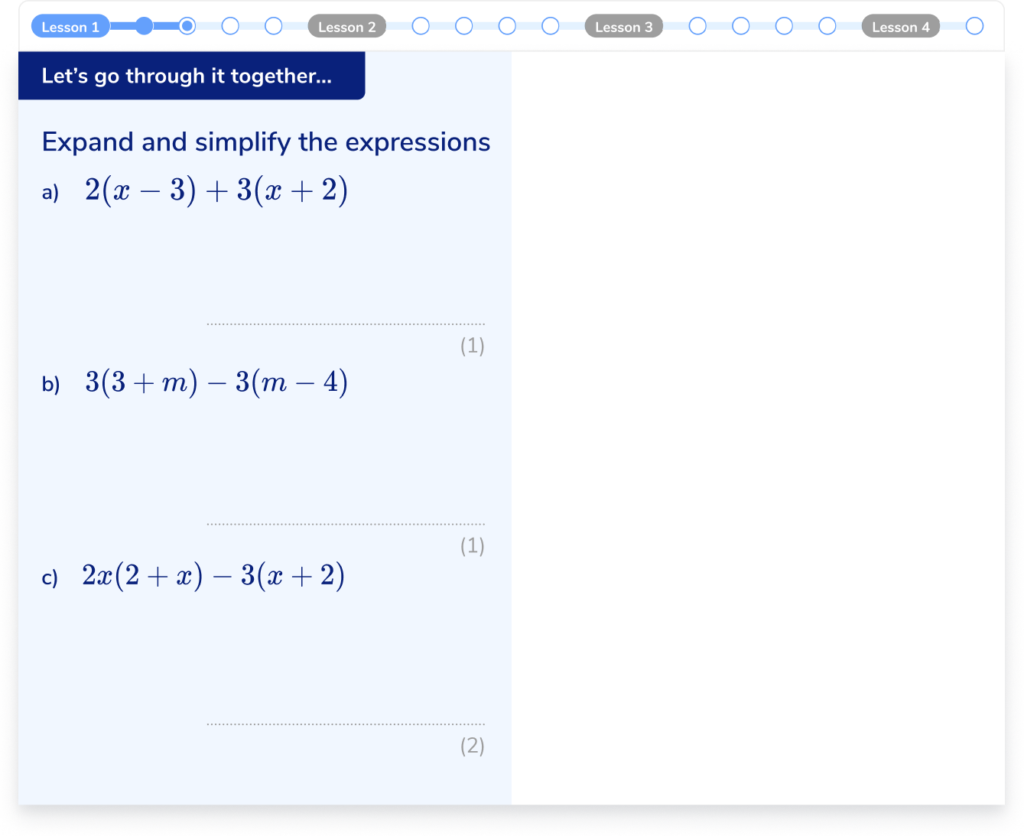
You’re not going to deliver six different explanations to six different students simultaneously. The practical strategy is to group students by error type and address each group efficiently.
- Group A (correct answer) move straight to independent practice with more complex questions. You don’t need to spend time with this group yet.
- Group B (sign error) are probably your largest group. Bring them together. The correction is specific: when you expand -2(x[/katex</span>[katex]x − 4), you multiply the -2 by every term inside. Write it out explicitly. Ask students: what is -2 × -4? Why? That's where the misconception lives - many students have learned a rule without understanding it. If you have a visualiser, show one student's working and correct it together. Three minutes for the whole group.
- Group C (partial expansion) - ask them to read the question again. Get them to explain what "expand and simplify" means. They probably know; they've just applied it inconsistently. Model what it means to treat the minus sign as belonging to the multiplier: -2(x − 4) means multiplying -2 by every term. Once they see that, they can often correct it themselves.
- Group D (only multiplied the first term) has a more foundational gap. Use a visual if you can - an area model or a grid showing what it means to multiply a term by everything inside the bracket. You want them to see that 3(2x + 1) means 3 lots of 2x plus 3 lots of 1. This group may need more time; flag them for follow-up.
- Group E (like terms error) need a quick correction. Ask them to circle all the x terms and all the constant terms separately before they start collecting. The expansion itself was fine - this is a procedural slip, not a conceptual gap.
- Group F (blank) needs one-to-one support. Work with them directly, starting with a single bracket: 3(2x + 1). If they can do that, move on to single brackets with a negative. Get them secure on each step before combining.
What does this look like for a class of 30+ on your own?
The realistic strategy is: get Group A working independently, address Group B as a group using the visualiser (since that's likely your biggest group), then do a round of the room for Groups C, D, and E. For Group F, flag those students for one-to-one support during the guided practice phase. You can't do everything at once - but you can make sure every student knows what their specific next step is.
This is also where prepared resources make all the difference. If you've got a targeted practice sheet ready for Group B students - say, five questions specifically on negative multipliers - they can work on that while you work with another group. You're not creating these from scratch every lesson; make them once and reuse them every time you revisit the topic.
The guided practice sequence
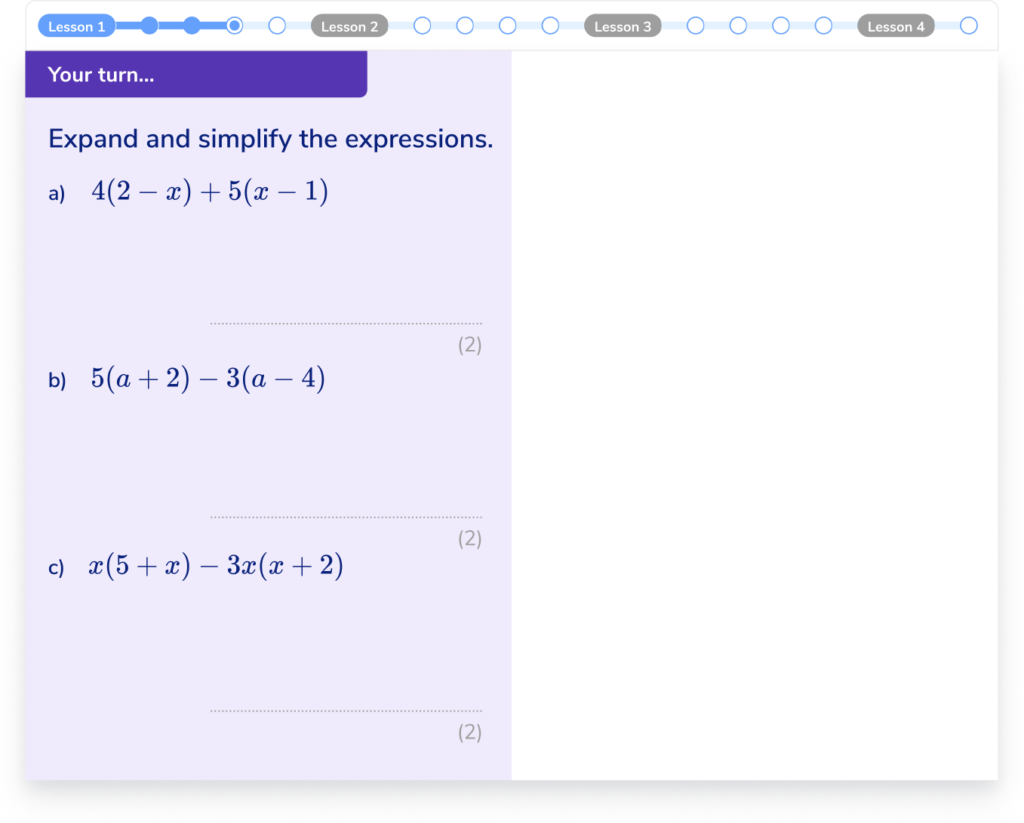
The practice questions need to be carefully sequenced. Here's what that could look like for this topic.
- Question 1: Expand and simplify 4(2x − 1) + 5(x − 1). This mirrors the check-in: two brackets, one negative multiplier.
- Question 2: Expand and simplify 5(a + 2) − 3(a − 4). Both brackets have a subtraction inside, increasing the chance of sign errors surfacing for students still uncertain about negative multipliers.
- Question 3: A more complex version with variables outside the brackets. Students who are secure on the two-bracket version now get an opportunity to apply it with greater complexity.
The sequencing matters. Students who made errors in the check-in could be overwhelmed if they jump straight to question 3 before consolidating the correction. Starting with question 1 lets them experience success, then increasing the difficulty builds the confidence that should show up in the checkout. Students who got the check-in correct can start on question 2 or 3; students who didn't should start at question 1.
Rounding off with the skill checkout
The checkout question mirrors the check-in in structure but uses different numbers. Students answer it independently.
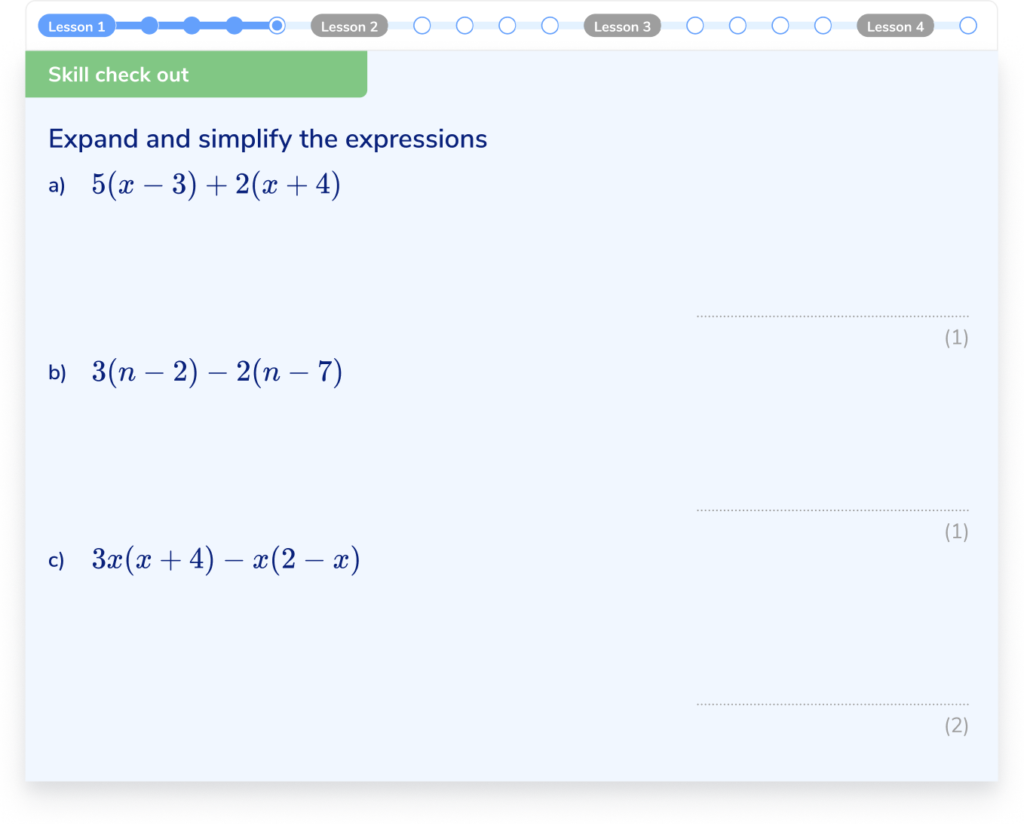
Then comes the confidence check. Ask students to rate how they're feeling now compared to the start of the lesson.
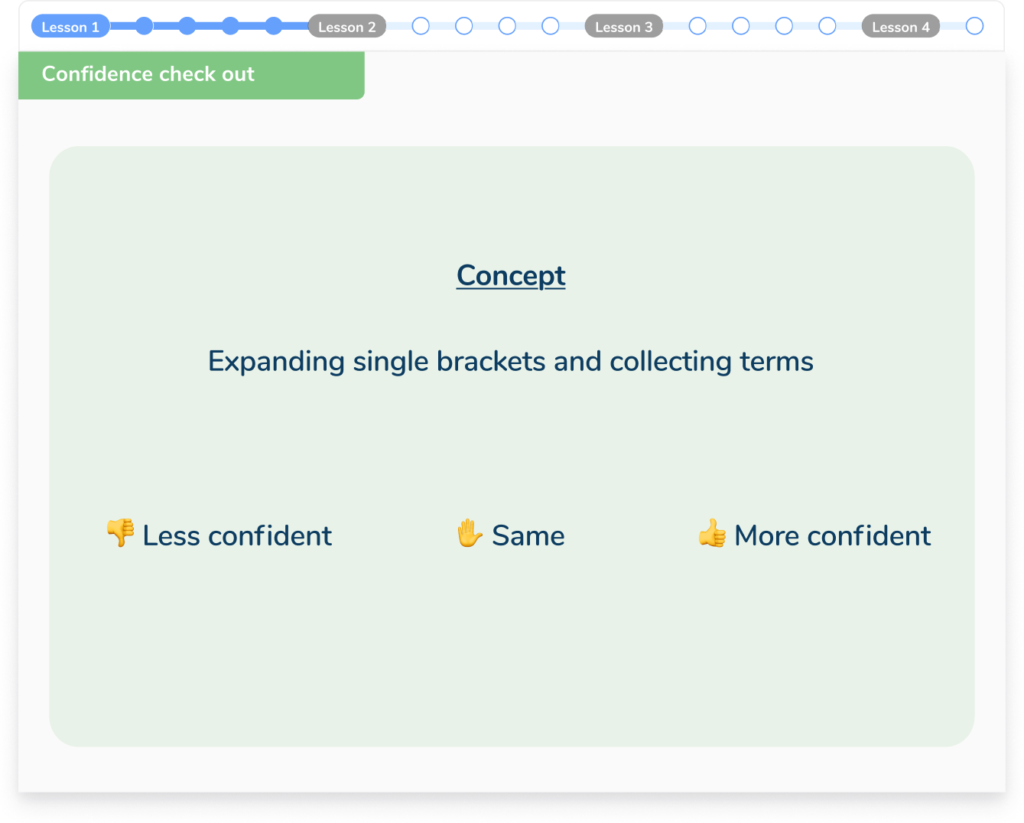
Here's how to read the results:
- Wrong → right: a potentially closed gap; good progress
- Wrong → wrong: a priority - this student needs more time before moving on
- Right → right: potentially secure; possibly ready to move on to the next topic
- Right → thumbs down: the student understood this specific question type, but doesn't feel confident applying the method more broadly - they need more varied practice questions before the exam
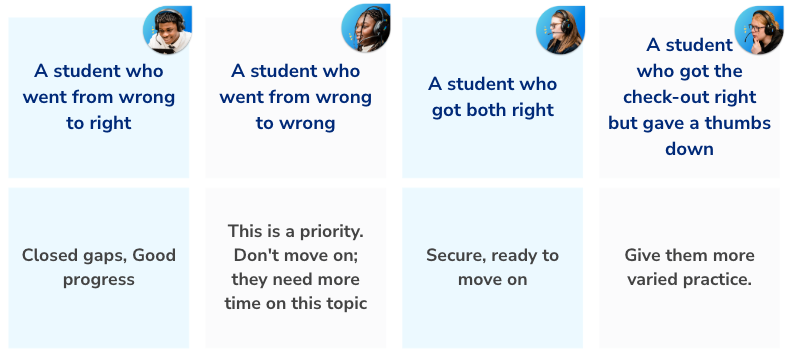
That last category is the one most likely to struggle under exam conditions when a question looks slightly different from what they've practised.
Making this manageable for a whole class
Three things make this approach practical at scale.
1. Prepare your resources in advance.
For any topic you're revising, prepare four things before the lesson: a check-in question, a targeted practice sheet for each of the two or three most common errors, a sequenced set of guided practice questions, and a checkout question. For algebraic simplification, that means a sheet on negative multipliers, something on like terms errors, and something for students who need to step back to single brackets. Once made, you can reuse them every time you revisit that topic. The prep time is front-loaded, not repeated.
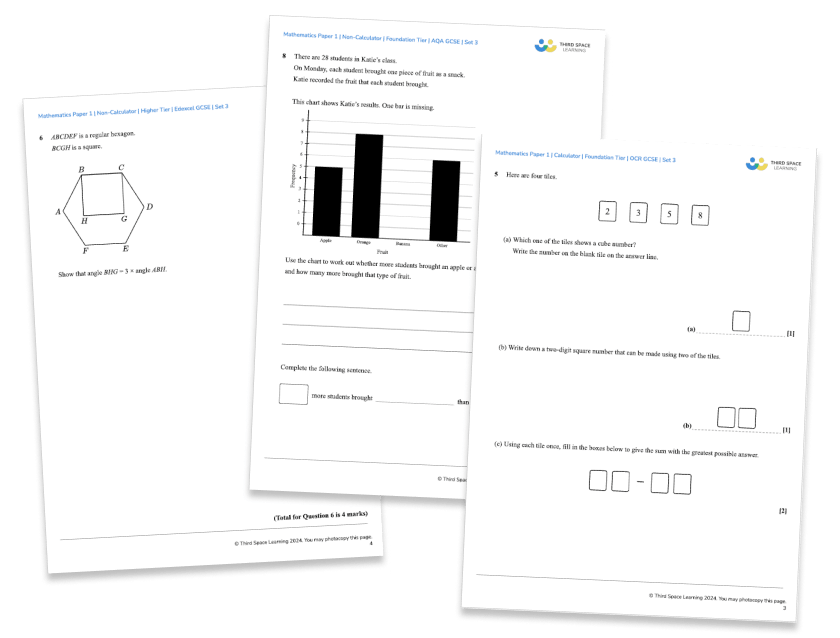
Third Space Learning's secondary maths resource library has hundreds of free GCSE revision resources, including a GCSE maths starter kit, practice questions, and GCSE past papers with mark schemes for Higher tier and Foundation tier across Edexcel, AQA, and OCR.
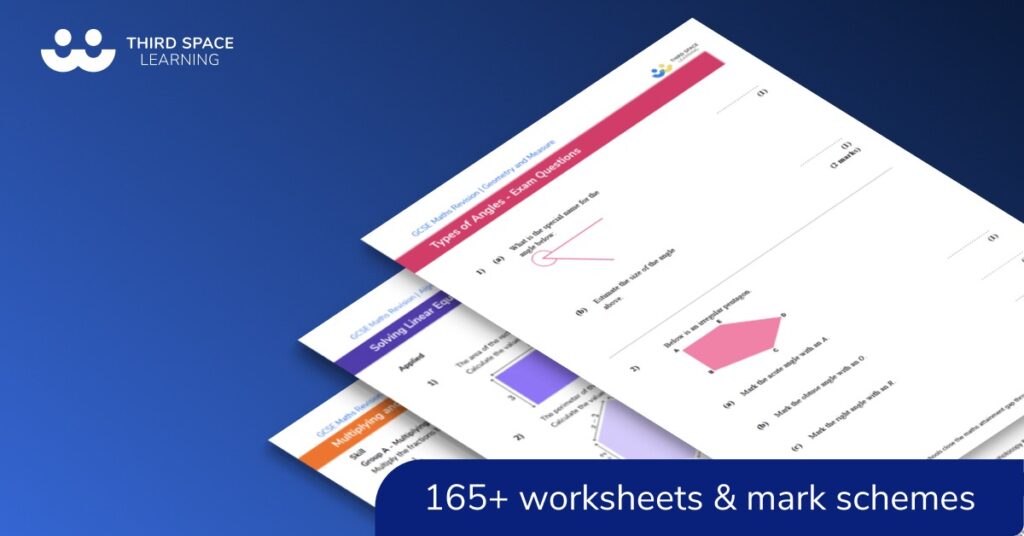
There's also guidance on using AI tools to support resource creation, such as ChatGPT for maths, though it's always worth checking anything AI-generated carefully before using it with students.
2. Use a visualiser or mini whiteboards.
If five students have made the same sign error, bring them together and work through the correction once with one student on the visualiser. That's far more efficient than explaining the same thing five times individually. Meanwhile, the rest of the class are working independently on consolidation or targeted practice.
3. Use a tracking sheet.
At the end of the lesson, you'll have three data points for every student: a check-in result, a checkout result, and a confidence check. A simple tracking sheet - with space for all three - takes around 30 seconds to fill in after the lesson, and gives you a clear record to draw on across your whole revision programme.
You're not recording anything complicated. Over five or six topics, patterns will emerge quickly. You'll spot students who consistently give a thumbs down even when they're getting the right answer - they need more reassurance and more varied practice. You'll also spot students who've got the check-in wrong across multiple topics, who may need more intensive support or a different approach to revision altogether. The data isn't complicated, but it's specific - and it's much more useful than mock exam scores alone.
Using this data at a department level
This is where the approach becomes a genuinely powerful tool for heads of maths and maths leads. If every teacher in your department is running this structure, you can aggregate check-in and checkout data across multiple classes to identify topics where students across year 11 need more support.
Maybe it's algebraic simplification, solving simultaneous equations, working with quadratic equations, or applying the quadratic formula. Maybe it's interpreting quadratic graphs or straight line graphs, a statistics topic like representing data, a probability question, or a geometry problem on surface area or compound shapes in the Higher tier paper.
The data tells you two things:
- Which topics need more time in your revision schedule.
- Which topics might need a different teaching approach altogether.
This is particularly useful for Higher tier classes, where the algebra and problem solving demands are more complex and gaps can be harder to spot without structured diagnostic data. It's also relevant for Foundation tier, where building fluency and confidence in core equations and number skills is the priority.
Additionally, it gives you a basis for peer-to-peer observation. A teacher whose students are consistently closing the gap in a particular topic might be doing something worth sharing with the whole department. Paired with your mock exam data, you get a full picture - not just overall scores, but which skills have been secured and which are still open gaps going into the exams.
AI maths tutors for GCSE revision lessons
This is also where Skye, Third Space Learning's AI maths tutor, is particularly effective for GCSE revision. Every AI maths tutoring session follows the exact four-stage structure described here and collects this data automatically. Sessions are delivered one-to-one, so every student gets personalised support at their own pace –without adding to your workload.
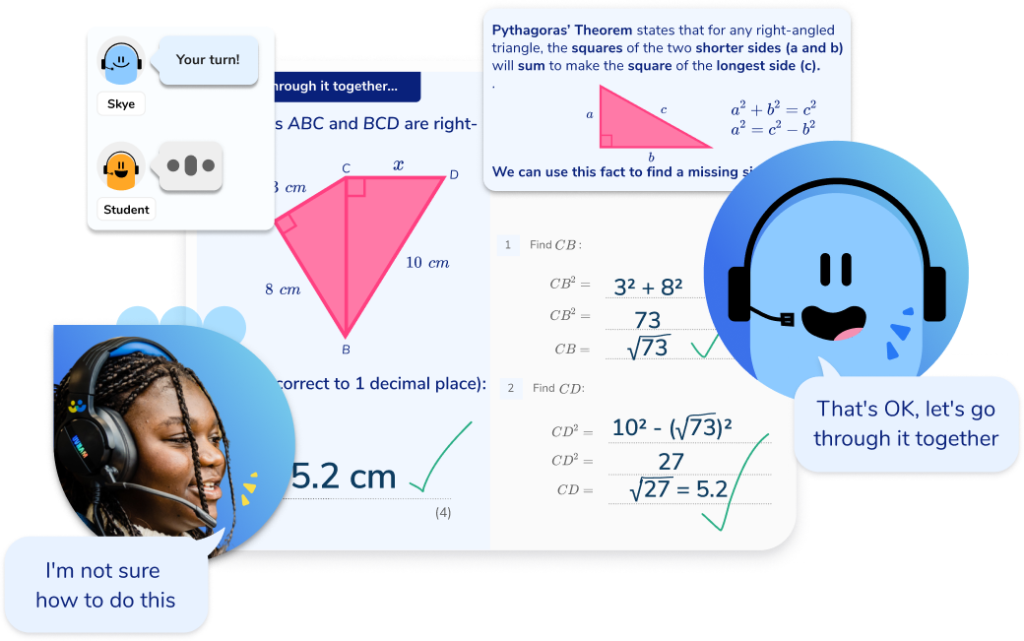
The five free GCSE mathematics lessons available to download are the same lessons Skye delivers, so you can see exactly how the structure works and adapt them for your own classroom.
If you want to implement this across your department, those five lessons are a great ready-made starting point for departmental CPD sessions in your school. You can run through the structure together, assign topics, agree on shared check-in and checkout questions across classes, and make your data comparable across the whole cohort.
How to get started this week
Don't try to overhaul your entire revision programme overnight. Start with one of the five lessons. Pick a topic your class has struggled with, run the lesson as written, and fill in the tracking sheet at the end. That's it - one lesson, then see what the data tells you.
If you want to build your own check-in questions, the key design rule is: choose a question complex enough to surface the most common errors for that topic, but not so multi-step that you can't identify where the breakdown happened. For:
- Algebraic simplification, that's a two-bracket expression with a negative multiplier.
- Solving equations, it might be a two-step equation with unknowns on both sides.
- Straight line graphs, a question involving gradient and intercept, will quickly expose whether students can correctly identify the slope and y-intercept.
- Quadratic equations or the quadratic formula, design the check-in to expose whether students are applying the method correctly or making a consistent procedural slip.
- Simultaneous equations, a pair of equations with integer coefficients, will surface the most common errors quickly.
The same logic applies right across the GCSE maths curriculum, for every exam board.
When considering geometry topics like angles, surface area, and compound shapes, choose exam questions that require students to identify the right formula before applying it - that's often where the breakdown happens. For number topics like fractions, decimals, percentages, and converting units, find the question that exposes the most common calculation error.
For statistics and probability topics, algebra topics including straight line graphs, quadratic graphs, Venn diagrams, and the nth term, and problem solving questions that combine multiple skills - think about what the most costly errors are and design your check-in to expose them.
In Higher tier papers, especially, problem solving and multi-step exam questions are where even well-prepared students lose marks, so these are worth building check-ins for early in your revision programme.
A useful complement is the Red-Amber-Green (RAG) system, which lets students categorise topics by confidence level at the start of a revision block, giving you a broader picture of where to focus alongside the lesson-by-lesson data.
Resources to support maths GCSE exams
All the free resources mentioned - GCSE maths topic lists, topic-specific practice questions, revision mats, GCSE revision guides, and past papers for Edexcel, AQA and OCR exam boards, including brand new 2026 papers for Edexcel - are available in the Third Space Learning secondary maths resource library.
Online GCSE maths support
If you'd like to see how this structure scales with AI tutoring, find out more at thirdspacelearning.com or get in touch at hello@thirdspacelearning.com.


![GCSE Maths Marking Decoded: How to Train Your Department and Boost Student Exam Performance [Video]](https://thirdspacelearning.com/wp-content/uploads/2026/02/Youtube-thumbnail_-GCSE-maths-marking-decoded-1-180x160.png)