
Socratic Questioning In Maths: What It Is, With Examples For Primary And Secondary

When a pupil tells you that \frac{1}{2}+\frac{1}{3}=\frac{2}{5}, what do you do next? You can see they’ve added the numerators and then the denominators, so the answer is wrong. You could tell them the correct answer, move them on to another question, or ask them something about the answer they’ve just given. That third option is what we call Socratic questioning: responding to what a pupil has just said or done with a question or prompt that helps them reason their way to the right answer for themselves.
It’s a moment we think about a lot at Third Space Learning, because Skye, our spoken AI maths tutor, has to handle it in every lesson. You might not call it Socratic questioning, but if you teach maths you’re almost certainly doing some of it already. The national curriculum asks teachers to use “discussion to probe and remedy their misconceptions”. And when we analysed recent Ofsted report cards, we found inspectors asking schools to act on misconceptions far more often than they asked for more questioning. Socratic questioning does both, because each question you ask responds to the mistake the pupil has just made.
Questioning isn’t always the right call, though. If a pupil is completely stuck, another “why?” won’t get them unstuck. Good teaching means knowing when to switch to a hint, a fraction wall or a worked model, and when to step back again.
In this guide, I’ll explain what Socratic questioning is and where it comes from, go through the six types of Socratic questions, and work through examples from Year 5 fractions to expanding brackets at KS3 and GCSE. I’ll also share what our analysis of Ofsted report cards shows, how to tell when to stop asking questions, and how to use the same approach in feedback and interventions.


Assessment for Learning Examples
A quick guide to the 10 most effective Assessment for Learning strategies, including questioning and feedback, with examples in context to show how and where to use them. Includes advice on next steps for adapting your teaching.
Download Free Now!Key takeaways
- Socratic questioning means responding to what a pupil has just said or done with a question or prompt that helps them reason their way to the right answer.
- After a wrong answer, you can tell the pupil the answer, move on to another question, or respond to the specific mistake. All three have their place, and the third is the one that deals with the mistake while the pupil does the thinking.
- The same test applies to any tutor, human or AI: after a wrong answer, does the response deal with the mistake, or just mark it and move on?
- In our analysis of Ofsted report cards, “misconception” appears in the Next steps of 11% of report cards and “questioning” in under 1%. Ofsted asks schools to act on misconceptions far more often than it asks for more questioning.
- If a pupil is completely stuck, another “why?” won’t help. Give them more support, such as a fraction wall or a model of the method, and then less as they start to succeed.
- You can use the same approach in feedback, by asking a question about the mistake that the pupil answers in their next lesson.
What is Socratic questioning?
Socratic questioning is a way of teaching through open-ended, probing questions. In a maths lesson, it means responding to a pupil’s answer with a question or prompt, based on what they’ve just said or done, that gets them to reason their way to the right answer.
So if a pupil tells you that 7 \times 8 = 54, “No, it’s 56” gives them the answer. “What’s 7 \times 7? So what would one more 7 be?” is Socratic questioning, because the pupil still has to work it out.
The idea goes back to Socrates, the Greek philosopher we know about mainly through Plato’s dialogues. Socrates taught by asking his students questions, listening to their answers and asking another question based on what they’d said, until they could see for themselves where their thinking had gone wrong. Socrates compared himself to a midwife who helps other people bring out their own ideas.
Richard Paul, who wrote widely about Socratic questioning, gives teachers a simple rule: “Base each of your questions on the answer given by the last student” (Paul and Elder, 2006). I think that’s the most useful rule for a maths teacher, because it means you can’t script the whole conversation in advance. Your next question depends on the mistake the pupil has just made.
In this guide I’m using the term more broadly than its classical meaning. If you respond to a pupil’s specific mistake with a hint that makes them think again, I’d still count that as a form of Socratic questioning. The test is whether your response builds on what the pupil has just said or done.
Socratic questioning vs the Socratic method
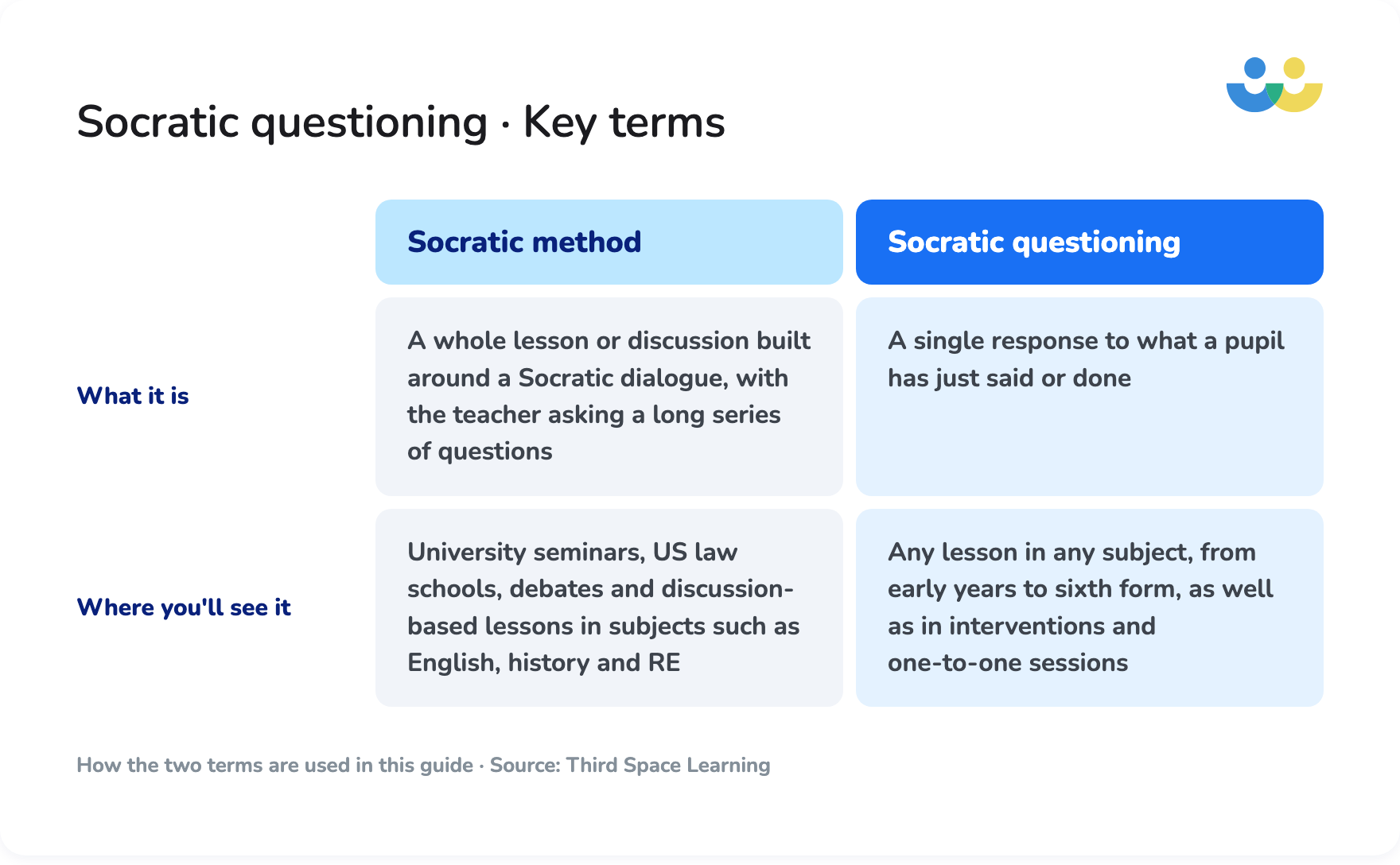
People often use Socratic questioning and the Socratic method interchangeably, but I find it helpful to separate them.
Socratic method
- What it is: a whole lesson or discussion built around a Socratic dialogue, with the teacher asking a long series of questions
- Where you’ll see it: university seminars, US law schools, debates and discussion-based lessons in subjects such as English, history and RE
Socratic questioning
- What it is: a single response to what a pupil has just said or done
- Where you’ll see it: any lesson in any subject, from early years to sixth form, as well as in interventions and one-to-one sessions
You don’t need to run a whole Socratic dialogue to use Socratic questioning in your teaching. One question after a wrong answer, based on what the pupil has just told you, is a good place to start.
The six types of Socratic questions
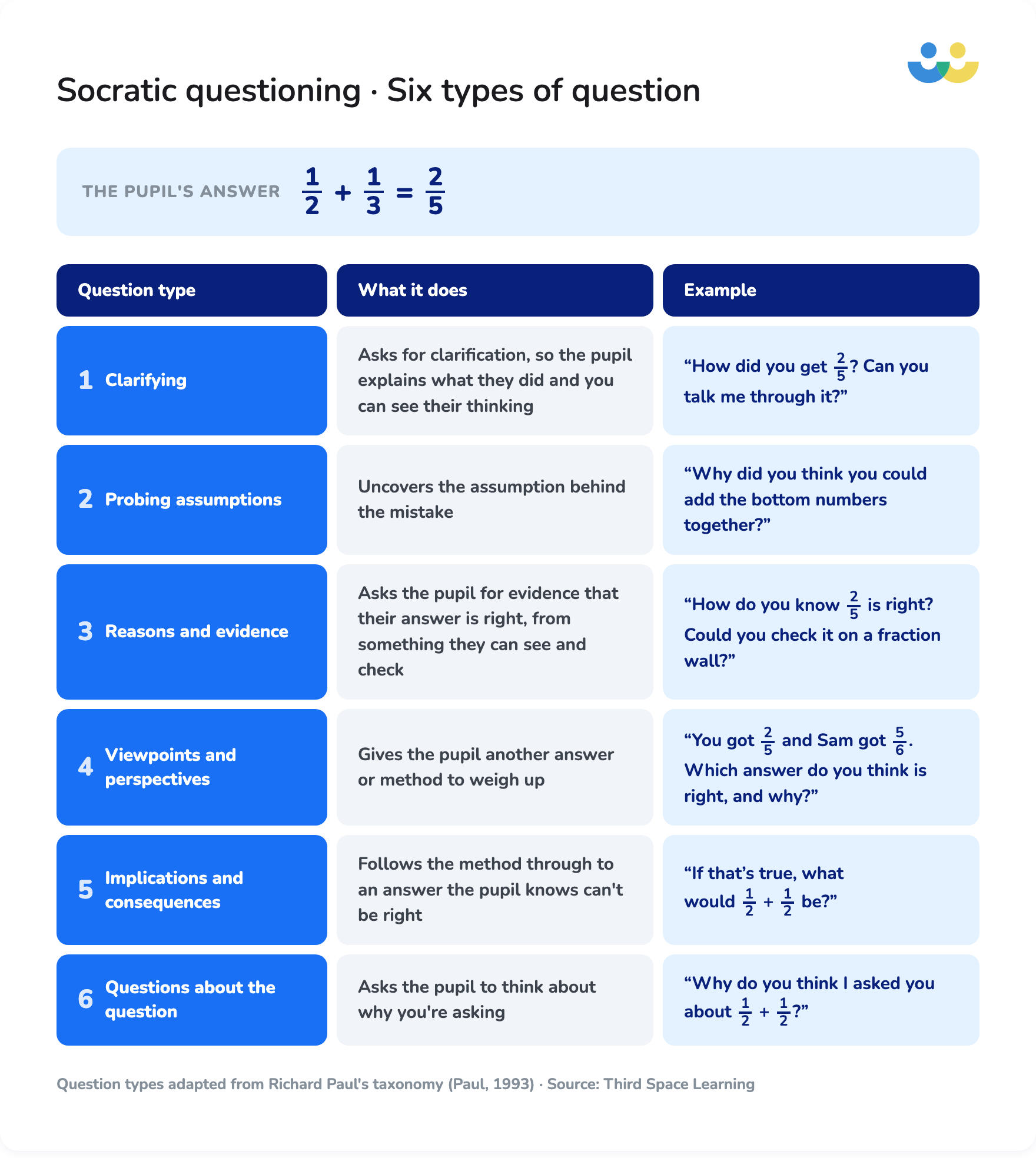
Most guides to Socratic questioning use six types of questions, adapted from Richard Paul’s taxonomy (Paul, 1993). I find them most useful when you see all six asked about the same wrong answer, so here’s how each one might sound with the pupil who told you that \frac{1}{2}+\frac{1}{3}=\frac{2}{5}.
1. Clarifying questions
- What it does: asks for clarification, so the pupil explains what they did and you can see their thinking
- Example: “How did you get \frac{2}{5}? Can you talk me through it?”
2. Questions that probe assumptions
- What it does: uncovers the assumption behind the mistake
- Example: “Why did you think you could add the bottom numbers together?”
3. Questions about reasons and evidence
- What it does: asks the pupil for evidence that their answer is right, from something they can see and check
- Example: “How do you know \frac{2}{5} is right? Could you check it on a fraction wall?”
4. Questions about viewpoints and perspectives
- What it does: gives the pupil another answer or method to weigh up against their own
- Example: “You got \frac{2}{5} and Sam got \frac{5}{6}. Which answer do you think is right, and why?”
5. Questions about implications and consequences
- What it does: follows the pupil’s method through until it gives an answer they know can’t be right
- Example: “If that’s true, what would \frac{1}{2}+\frac{1}{2} be?” Their method gives \frac{2}{4}, which is a half, and most pupils know that a half plus a half makes one.
6. Questions about the question
- What it does: asks the pupil to think about why you’re asking, which often shows them where to look
- Example: “Why do you think I asked you about \frac{1}{2}+\frac{1}{2}?”
A seventh prompt for maths: the next step
There’s one more kind of prompt worth adding, even though it isn’t one of Paul’s six. The EEF suggests exploring the “partial truth” a misconception is built on (EEF, Improving Mathematics in Key Stages 2 and 3). The pupil’s assumption that you can add the numerators is right when the denominators match, so you can build on that:
- “Adding the top numbers does work sometimes. When does it work?”
- “So what has to be true before you can add the top numbers?”
That gives the pupil their next step without telling them the method.
Socratic questioning examples in maths
It’s easiest to see what Socratic questioning adds when you put it next to the other options. Here are two worked examples, one primary and one secondary, and more examples of Socratic questions you can use with any topic.
Worked example: one wrong answer, three responses (Year 5)
A Year 5 pupil is adding fractions and writes \frac{1}{2}+\frac{1}{3}=\frac{2}{5}. The EEF names this exact mistake, “the common error of adding fractions by adding the numerators and then adding the denominators”, and says that “misconceptions are uncovered and addressed rather than side-stepped or ignored” (EEF, Improving Mathematics in Key Stages 2 and 3).
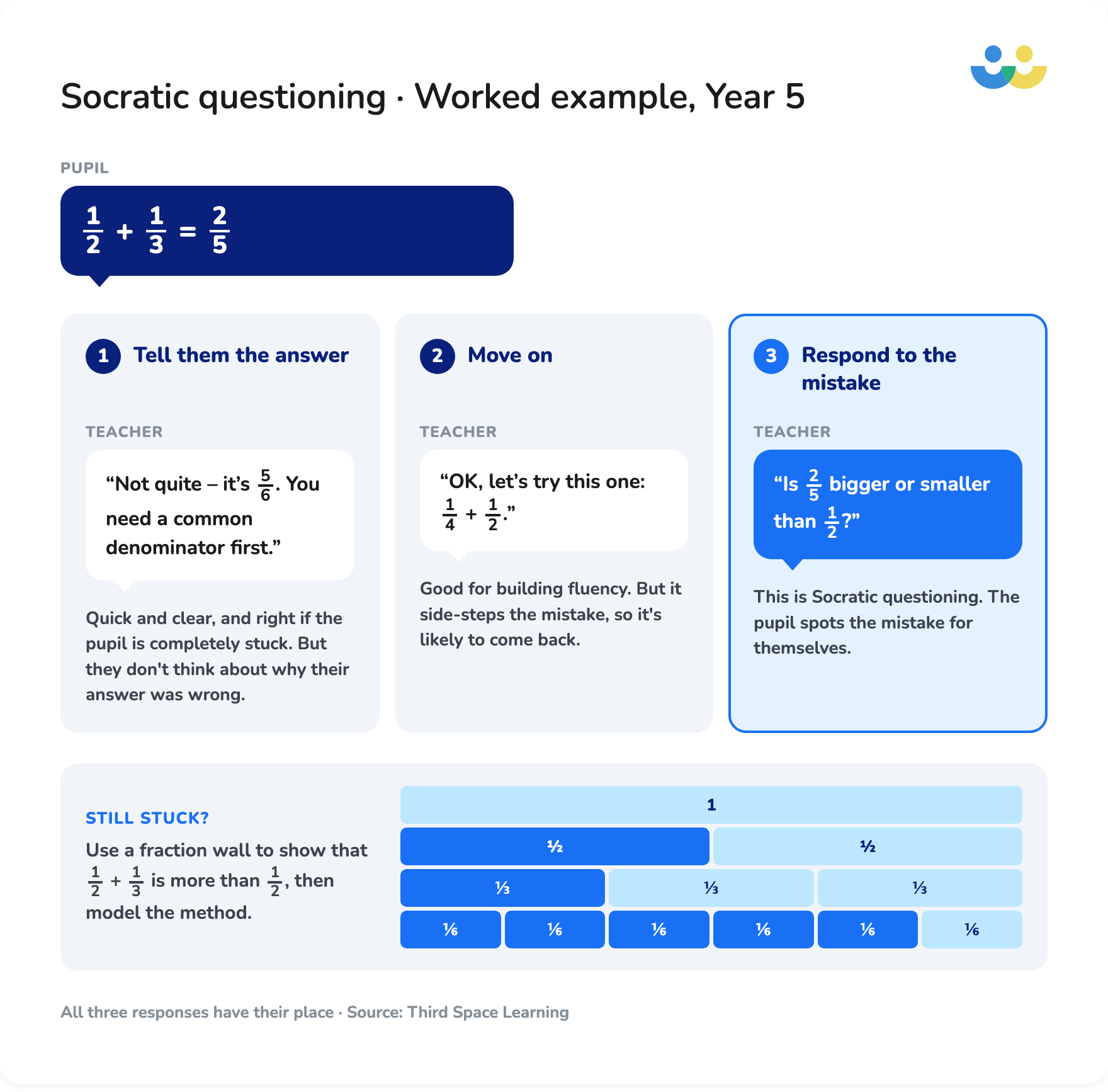
Here are the three things you could do next.
Response 1: tell the pupil the correct answer
Teacher: “Not quite – it’s \frac{5}{6}. You need a common denominator first.”
This is quick and clear, and it’s the right call if the pupil is completely stuck. But the pupil hasn’t had to think about why their answer was wrong, so the same mistake may well come back next week.
Response 2: move on to another question
Teacher: “OK, let’s try this one: \frac{1}{4}+\frac{1}{2}.”
This is adaptive practice, and it’s good for building fluency, reasoning and problem solving. But it side-steps the mistake, so there’s a good chance the pupil adds the tops and the bottoms again.
Response 3: respond to the mistake with a question
Teacher: “Is \frac{2}{5} bigger or smaller than \frac{1}{2}?”
Pupil: “Smaller.”
Teacher: “So if you start with \frac{1}{2} and add something to it, can you end up with less than \frac{1}{2}?”
Pupil: “No… so \frac{2}{5} can’t be right.”
Teacher: “So what do you think has gone wrong?”
This is Socratic questioning. The pupil has spotted the mistake for themselves, and you can now help them build a deeper understanding of why the denominators need to match. The EEF backs this kind of estimating too: being able to estimate the result of adding two fractions helps pupils “recognise, and address” this error.
Pupils don’t tend to estimate like this without a prompt. In a US national maths assessment, when 13-year-olds were asked whether \frac{12}{13}+\frac{7}{8} was closest to 1, 2, 19 or 21, only 24% chose 2 (Siegler et al.).
All three responses have their place. If you want more ideas for the third, there’s a whole set of effective questioning strategies you can draw on.
If the pupil is still stuck
If the pupil still can’t see it after a question or two, stop asking. Get out a fraction wall, or draw two bars the same length split into halves and thirds, so they can see that \frac{1}{2}+\frac{1}{3} is more than \frac{1}{2}. Then model the method: change both fractions to sixths, and add. A Year 5 pupil who has hit a wall needs this more than another “why?”.
Secondary example: expanding brackets (KS3 and GCSE)
A pupil expands (x+3)^2 and gets x^2+9. They’ve assumed they can square each term inside the bracket, which works when the terms are multiplied, as in (3x)^2=9x^2, but not when they’re added.
Teacher: “Let’s test your method with numbers. What’s (2+3)^2?”
Pupil: “25.”
Teacher: “And what do you get if you use your method, 2^2+3^2?”
Pupil: “13. They’re not the same.”
Teacher: “So what’s missing?”
From there, you can write (x+3)^2 as (x+3)(x+3) and expand it to get x^2+6x+9. If the pupil is still stuck, draw it as an area model: a square with sides of x+3, split into an x^2 square, two 3x rectangles and a 9 square. Seeing the two rectangles usually shows the pupil where the 6x comes from.
Testing a method with simple numbers is one of the problem solving skills pupils can use again and again, including in multi-step problem solving.
What Ofsted looks for after a wrong answer
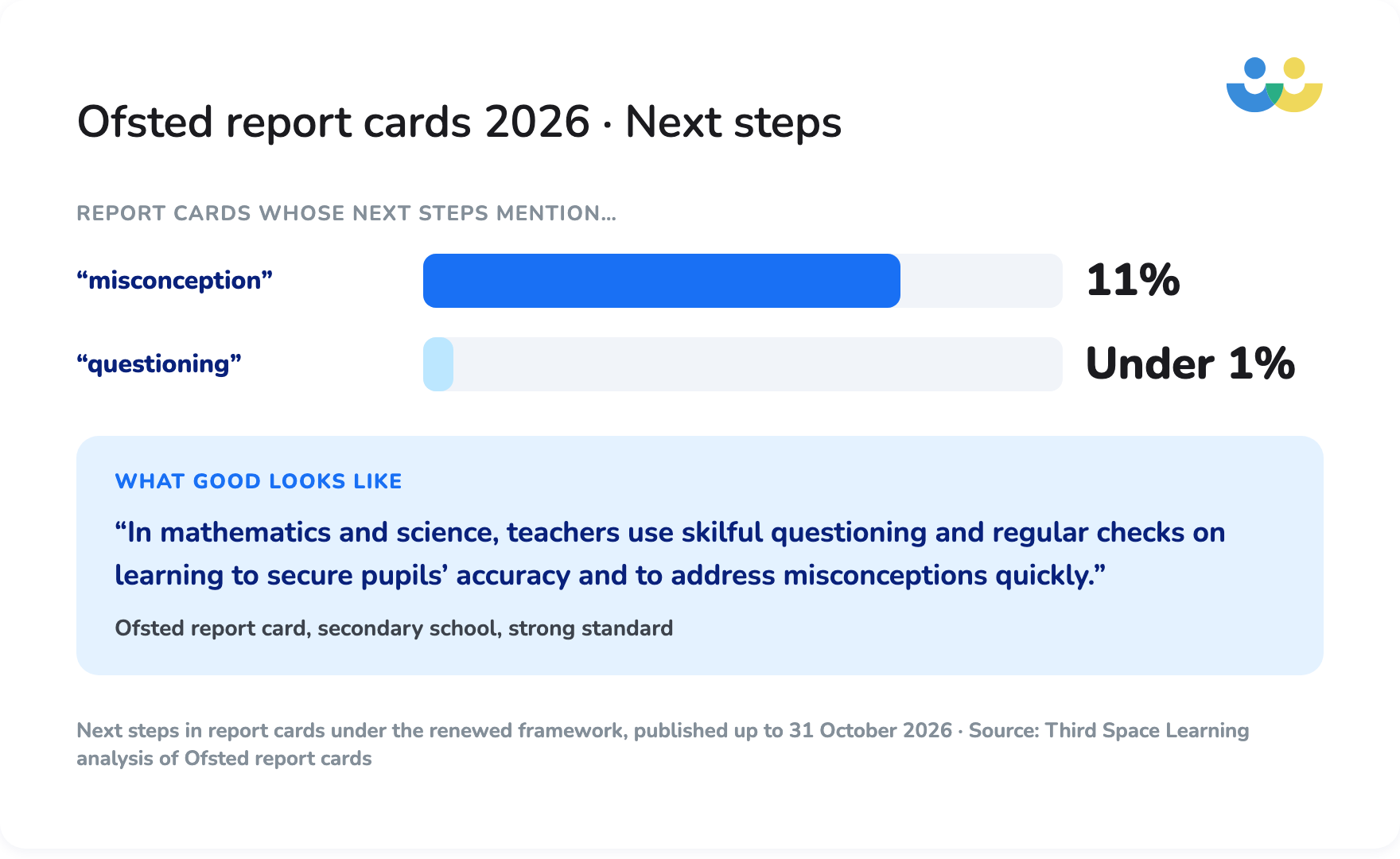
We analysed Ofsted report cards under the renewed framework (those published up to 31 October 2026). In their Next steps, 11% of report cards mention misconceptions, and fewer than 1% mention questioning.
The inspection toolkit doesn’t use the word “questioning” in its curriculum and teaching criteria either. It asks whether teachers “check pupils’ understanding systematically, identify misunderstandings and adapt teaching as necessary to correct these” (Ofsted, School inspection toolkit).
When inspectors praise maths teaching, they tend to pair questioning with dealing with mistakes straight away:
- “In mathematics and science, teachers use skilful questioning and regular checks on learning to secure pupils’ accuracy and to address misconceptions quickly.” (secondary school, strong standard)
- “For example, in mathematics, pupils use practical resources, talk through their thinking and correct mistakes quickly.” (primary school, expected standard)
And when they set Next steps, this is the kind of thing they ask for:
- “Leaders should ensure that teachers use assessment consistently and effectively in mathematics to identify and address misconceptions and gaps in learning before pupils move on to new content…” (primary school)
Ofsted wants teachers to deal with a mistake before pupils move on, and Socratic questioning is one practical way to do that.
Socratic questions to keep to hand
These open-ended questions work with almost any topic. Keep them by your desk, or on a card for TAs running interventions.
- Clarifying: “How did you get that?”
- Probing assumptions: “Why did you choose that method?” “Does that always work?” “What did you assume?”
- Reasons and evidence: “How could you check your answer?” “Can you show me on a diagram?”
- Viewpoints: “How might someone else have done it?”
- Implications: “If that’s true, what would happen with…?” “Does your answer make sense?”
- Next step: “What do you need to do first?” “What do you already know that could help?”
Two things to avoid:
- A chain of “why?” questions when a pupil is completely stuck. Questions they can’t answer will only frustrate them. Switch to a hint, a picture or a model instead.
- Asking the next question on your list, whatever the pupil has just said. Paul’s own check is “Did the questioner respond to all answers with a further question?” (Paul and Elder, 2006). Each question or hint should build on the pupil’s last answer.
How to use Socratic questioning in the classroom
If you’re adding Socratic questioning to your lessons, start with these five steps. They work for whole-class teaching and for small groups.
1. Plan for the misconceptions you expect
You don’t have to improvise every question. Before the lesson, think about the mistakes pupils are most likely to make and the probing questions you’ll ask for each one. If you’re teaching how to add fractions, you can be fairly sure someone will add the numerators and the denominators, so have “Is \frac{2}{5} bigger or smaller than \frac{1}{2}?” ready.
2. Choose the moment
Socratic questioning works best during guided practice, the “we do” part of a lesson, when pupils have just enough prior knowledge to reason with. When you’re introducing a brand-new idea, explain and model it first.
3. Respond to the mistake with one question or hint, then wait
Ask one question about the specific mistake, then give the pupil time to think before you say anything else. If you ask three questions at once, or answer your own question, the pupil doesn’t get the chance to do the reasoning.
4. Know when to stop
If the pupil is still stuck after a couple of tries, give them more support: a concrete or pictorial step, such as a fraction wall or a bar model, and then model the method. You can always come back to questions once they’re on firmer ground.
5. Check the pupil has understood
Finish with a fresh question, such as \frac{1}{3}+\frac{1}{4}, so you know the pupil can do it independently. With a whole class, hinge questions are a quick way to check who has understood before you move on.
When to question, when to hint and when to model
Socratic questioning stops working at a fairly predictable point: when a pupil doesn’t have enough knowledge to reason with. If a pupil has never met equivalent fractions, no question about \frac{2}{5} will get them there. They need you to show them.
How much help to give
The most useful idea I know for this moment comes from the psychologist David Wood, who studied how adults tutor children. He called it contingent tutoring. If a pupil fails, give more help straight away. And “when the learner succeeds with help, offer less help if you intervene again” (Wood, 2003).
In a maths lesson, that gives you four levels of support:
- A question about the mistake
- A hint that points to the part that went wrong
- A concrete or pictorial step, such as a fraction wall or a bar model
- A model of the whole method
There’s research behind this. In a review of tutoring research, Kurt VanLehn found that across a range of tutoring systems, those that responded to each step of a pupil’s working were “nearly as effective as human tutoring”, with an average effect size of 0.76 against 0.79 for human tutors. Systems that responded only to the final answer averaged 0.31 (VanLehn, 2011). Those averages come from separate sets of studies rather than a head-to-head trial, and none of the systems was a spoken tutor. But they point the same way: responding to each step of a pupil’s working does more than marking the final answer.
You move to more support when the pupil is stuck, and back to less as soon as they start to succeed. Wood also describes what usually goes wrong: tutors “insist on repeating what they’ve already said, often adding more detail, thus increasingly obscuring the message”. It’s one of the things I look out for when I watch our one-to-one tutoring sessions. If a question hasn’t worked twice, asking it a third time with more words won’t help.
In 2025, researchers repeated Wood’s original study with three-year-olds and didn’t get the same result. They didn’t find that being taught this way helped the children do the task on their own afterwards (Smit et al., 2025). I wouldn’t call Wood’s rule strictly proven. But I do still use it as a rule of thumb, because giving more help when a pupil is stuck and less as they start to succeed is what most experienced teachers do anyway.
Socratic questioning needs explicit teaching alongside it
Questioning doesn’t replace explicit teaching. Kirschner, Sweller and Clark reviewed the research and concluded that “minimally guided instruction is less effective and less efficient than instructional approaches that place a strong emphasis on guidance” (Kirschner, Sweller and Clark, 2006).
So if you use guided discovery, where pupils work an idea out through a sequence of questions, keep the guidance strong: plan the questions carefully, and step in with a model as soon as pupils need one.
Rosenshine’s principles of instruction point the same way. Rosenshine found that “less successful teachers ask fewer questions and almost no process questions”, and that checking for understanding helps teachers know “if students were developing misconceptions” (Rosenshine, 2012). But the same principles also include providing models and guided practice. So you’ll usually question pupils and show them how to do something in the same lesson. In I do, we do, you do, the modelling comes in the “I do” stage, and most Socratic questioning belongs in the “we do” stage.
The EEF’s guidance on metacognition lists “Socratic talk” as one way to structure classroom dialogue, with conditions attached. Strategies for metacognition in the classroom should “build on firm pupil subject knowledge” and be “suitably guided and supported by the teacher” (EEF, 2018).
As for questioning on its own, the EEF’s Dialogic Teaching trial, which trained teachers in 38 schools to make more use of classroom talk, found pupils made “one additional month’s progress in maths” compared with 38 control schools. But the maths result wasn’t statistically significant, so we can’t be sure the approach made the difference (EEF evaluation report, 2017).
So my view is that you should use Socratic questioning once pupils have enough knowledge to reason with, and be ready to switch to a hint or a model as soon as they don’t.
Applying Socratic questioning in feedback
A lot of feedback is a response to a mistake, so everything above applies here too.
Feedback in the moment
The EEF’s guidance on feedback describes pupils who are “struggling unproductively” and “may require a hint or a steer in the right direction” (EEF, 2021). If that hint responds to the specific mistake, it’s Socratic feedback. If a pupil writes (x+3)^2=x^2+9, try “What does the little 2 mean? Can you write it out as two brackets?” instead of “wrong, it’s x^2+6x+9“.
Written feedback
A marking comment can be a question about the mistake, which the pupil answers at the start of the next lesson. For a Year 5 pupil who has written \frac{1}{2}+\frac{1}{3}=\frac{2}{5}, that might be “Is \frac{2}{5} bigger or smaller than \frac{1}{2}?” For the brackets mistake, it might be “Put x=1 into both sides. Do you get the same answer?” The pupil does the thinking, and their answer shows you whether they’ve understood.
Whole-class feedback
When you’re marking a set of books, you’ll often see the same mistake again and again. Put one example on the board, without a name, and use open-ended questions from the six types to work through it with the class: “Who agrees with this answer? How could we check it? Is there another way to get there?”
Socratic questioning in one-to-one and small-group interventions
Most advice on Socratic questioning is written for whole-class discussion. I think it’s at its most useful in interventions, where you can hear exactly how one pupil is thinking and respond to that. It’s adaptive teaching on a small scale: each question responds to what that pupil has just said.
Give two kinds of wait time
There are two moments when it pays to wait. The first is after you ask a question, so the pupil has time to think before anyone answers. The second is after the pupil answers, before you say anything back.
The second pause is the one I’d focus on in maths, because it’s the moment straight after a wrong answer. If a pupil says \frac{1}{2}+\frac{1}{3}=\frac{2}{5}, count to three in your head before you respond. Sometimes that’s all it takes for them to spot the mistake themselves. And if they don’t, you’ve had a few seconds to choose the right question.
When a pupil says “I don’t know”
“I don’t know” doesn’t have to end the conversation. You can:
- Make the question smaller: “Which is bigger, \frac{1}{2} or \frac{2}{5}?”
- Offer a choice: “Do you think the answer is more or less than \frac{1}{2}?”
- Ask for the first step only: “What would you do first?”
- Take the pressure off: “If you had to guess, what would you say?”
In a small group, “I don’t know” can also mean the pupil doesn’t want to be wrong in front of the others. Giving everyone a moment to talk to a partner first helps. And if the pupil still can’t answer, move up to a hint or a model, as in the four levels above.
Ask pupils to talk through their working
“Talk me through what you did” is one of the most useful questions you can ask in an intervention. Once a pupil says their working out loud, you can hear where it went wrong, and they often hear it too. It takes active listening, so let the pupil finish their explanation before you step in. Over time, this self-reflection becomes a habit, and pupils start checking their own answers before you ask. It’s also a good way to build mathematical reasoning.
A practical tip: give pupils scrap paper beside the desk or screen, so they have somewhere to try things out while they think.
Asking pupils to explain their thinking and giving them processing time before a hint are both techniques we’ve built into Skye, our AI maths tutor.
What AI tutor Skye does after a wrong answer
At Third Space Learning, we’ve spent a lot of time thinking about the moment straight after a wrong answer, because it’s just as important in AI tutoring as it is in a classroom. A tool that just says “incorrect, try again” leaves the pupil exactly where they were.
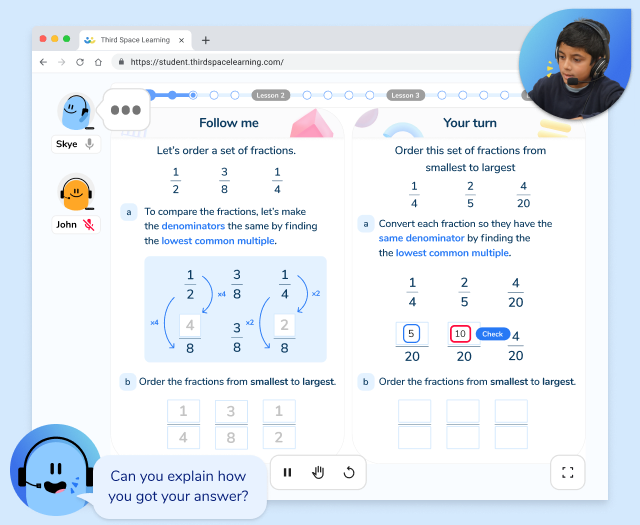
Skye, our spoken AI maths tutor, works through three steps after a wrong answer, with more support at each one:
- When a pupil gives a wrong answer, Skye gives a spoken hint based on the type of mistake they’ve made, such as a conceptual or a procedural one.
- If they get it wrong again, Skye gives another hint.
- If they’re still wrong a third time, Skye models the correct steps.
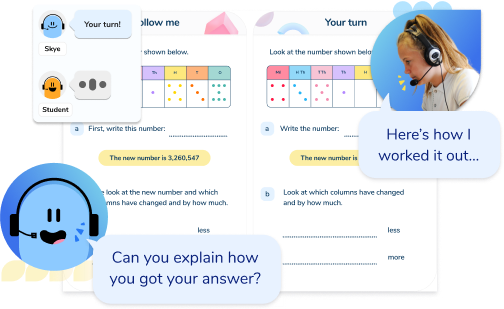
Throughout, pupils talk through problems out loud while Skye listens and responds. Skye also gives them processing time before it offers a hint, and rephrases ideas in a different way when the first explanation hasn’t helped. In every lesson, Skye works like a pedagogically trained maths tutor. It asks questions and identifies misconceptions, then adapts its responses so each pupil gets the support they need.
That’s more help when a pupil is stuck and less when they’re succeeding, which is the same principle I described earlier. All of Skye’s lesson content is written, edited, and approved by qualified maths teachers, and Skye has specific training and prompts for every question in every lesson. By design, Skye can’t generate its own content, because AI tutors need human expertise behind them.
One limit: Skye can’t see a pupil’s working. It relies on what the pupil says or types as their answer. So asking them to explain their thinking out loud does a lot of the work.
We know there’s still work for us to do to make Skye’s feedback and next steps even better, so we are running research on how different kinds of questions and hints affect pupils’ learning, in partnership with the Gates Foundation, Stanford and Cornell. It compares Skye’s hints with questions after a wrong answer, to see which helps pupils learn more and which keeps them working through the lesson.
Discover how AI tutor, Skye, can improve your students’ confidence and maths results.
Get in touch to arrange a free AI maths tutoring session.
Try a free sessionTry one Socratic question tomorrow
You can start without changing a whole lesson. Next time a pupil gets a fractions question wrong, ask them one question about their answer before you correct it. “Is \frac{2}{5} bigger or smaller than \frac{1}{2}?” works for a lot of fraction mistakes. Then wait, and listen to what they say.
If they spot the mistake, you’ve learned that they had the knowledge and just needed a nudge. If they don’t, you’ve learned something about how they’re thinking, and you can move to a hint or a model. Either way, you know more than you would if you’d told them the answer.
Socratic questioning FAQs
Socratic questioning means responding to what a pupil has just said or done with a question or prompt that helps them reason their way to the right answer. In maths, it usually happens straight after a wrong answer: you ask about the pupil’s answer, so they do the thinking. The name comes from Socrates, who taught by questioning his students.
A pupil says that \frac{1}{2}+\frac{1}{3}=\frac{2}{5}. Instead of telling them the correct answer, you ask, “Is \frac{2}{5} bigger or smaller than \frac{1}{2}?” The pupil realises that adding \frac{1}{3} to \frac{1}{2} can’t give an answer smaller than \frac{1}{2}, so \frac{2}{5} must be wrong.
Telling a pupil the answer does the thinking for them. A general hint, such as “remember the method”, points them in a direction. A hint or question that responds to the specific mistake they’ve made, and gets them to think again, is Socratic questioning.
Not by name, but it does look at whether teachers check pupils’ understanding, spot misconceptions and adapt their teaching to deal with them. Socratic questioning is one practical way to do that, because each question responds to the mistake the pupil has just made.
Yes. Keep the questions short and concrete, and use pictures or objects, such as a fraction wall or a bar model, when a pupil is stuck.
Yes, if it responds to what the pupil has just said or done, instead of just giving the answer or moving on. Kurt VanLehn’s review of tutoring research found that systems which respond to each step of a pupil’s working are far more effective than those that only mark the final answer (VanLehn, 2011). There’s more on this above.