




Primary Maths Intervention: How To Plan It In 5 Decisions [Webinar]

Most primary maths intervention plans lose two or three weeks of Autumn 2 before the first session runs. In this webinar, Terri Higgins, Primary Curriculum Lead and former teacher, and Charlotte Grubecki, Senior Content Editor at Third Space Learning and former teacher, explain the five decisions to take before October half term so your intervention starts in week one.
This webinar was recorded before October half term; however, the information can be applied to any point in the school year.
Terri leads the team that writes and reviews every primary lesson and programme that AI maths tutor Skye delivers. Skye teaches thousands of one-to-one primary maths sessions every week, and most of them run as a school’s maths intervention. Much of the advice in this webinar comes from our academic team watching those sessions back and seeing what works for pupils.

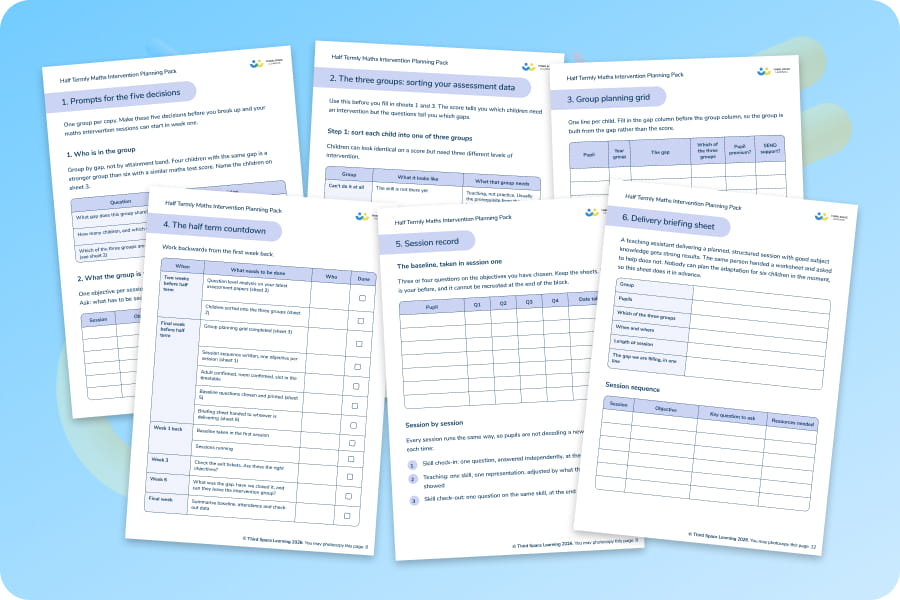
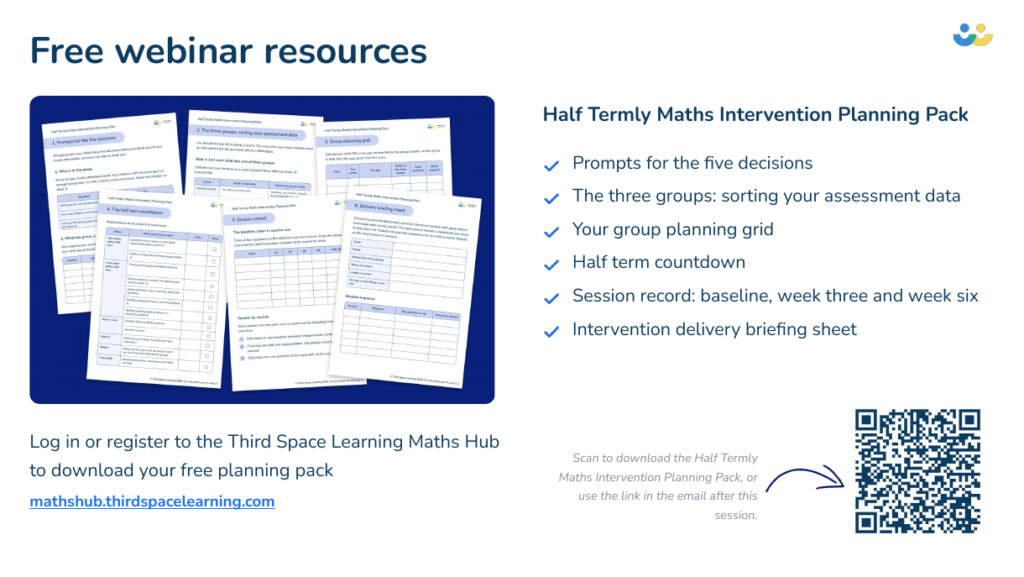
Half Termly Maths Intervention Planning Pack
Plan your primary maths intervention before half term. The pack includes a group planning grid, a half term countdown, a baseline and six-week check sheet, and a briefing sheet for whoever delivers your sessions.
Download Free Now!In this webinar, you’ll find out:
- how to read your early autumn data so it points you to the right gap as well as the right children
- the three groups your pupils fall into, and why each one needs a different intervention
- the five decisions that make or break a primary maths intervention, and how to take them before half term
- what a strong intervention session looks like, using a Year 5 worked example
- how to set up after half term so you know within six weeks whether the intervention is working
The right time to start a primary maths intervention
Most primary schools start their interventions properly in Autumn 2. Autumn 1 is extremely busy, while Autumn 2 gives you one of the longest uninterrupted runs of the school year. The catch is that sessions need to start in week one to make the most of it.
I remember how easily that time slipped away when I was teaching. We would come back after half term with a rough list of children who needed support. The first week went on firming up the list, and the second on finding an adult and a room. Sessions started in week three, and the seven-week block was suddenly much shorter, even before Christmas events took their share.
Nothing had gone wrong. The decisions simply hadn’t been made before the holiday.
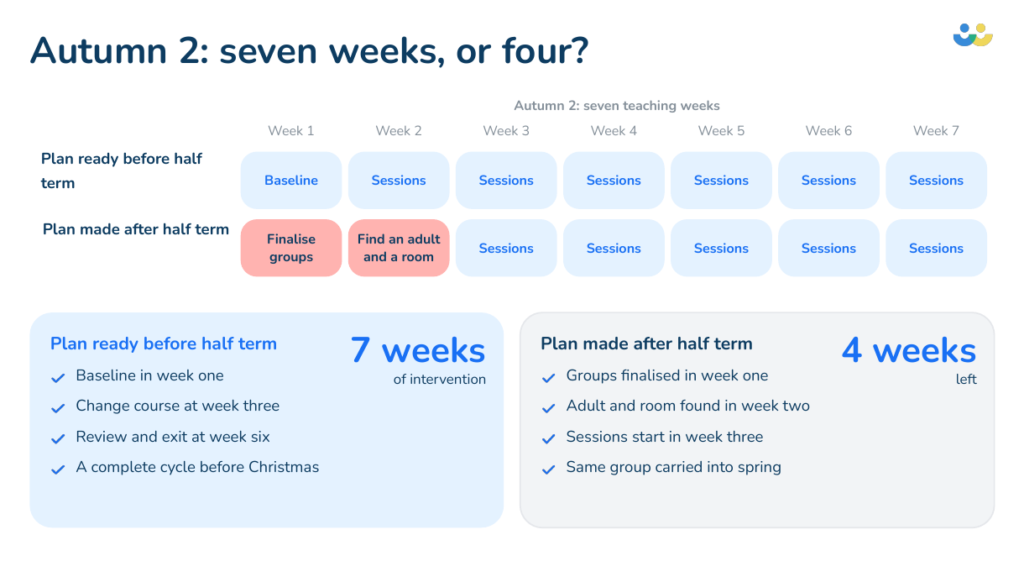
So the aim is to have three things settled by the time you break up for half term:
- who is in the group
- what the group is working on
- who is delivering it
Everything else can wait.
Why the seven-week block is worth protecting
Interventions work best when they are sustained, and most of the evidence points the same way. The Education Endowment Foundation’s tutoring guidance is built around short, regular sessions of about 30 minutes, around three times a week, kept going for six to twelve weeks.
A seven-week Autumn 2 block gives you a complete intervention cycle before Christmas. You can baseline the group, run the intervention and check the progress pupils are making. Four weeks doesn’t give you that. Schools then carry the same group into the spring term, sometimes longer, without ever knowing whether the intervention had the right impact.
How to read your data for a primary maths intervention
Some schools will have just finished their early autumn assessments, and others will be about to start. When you look at that data with an intervention in mind, there are two separate questions to ask:
- Which children need the support?
- Which gap does the intervention need to close?
Quite often, only the first question gets a proper answer. The assessment score tells you which pupils haven’t scored where you want them to, but it doesn’t tell you what they need.
Take two children who both scored 42%. One calculates fluently but falls apart as soon as a calculation sits inside a word problem. The other reasons well and picks the right operation, but still counts on their fingers to multiply. The first child has an application or conceptual gap. The second has a fluency or procedural gap. Those are very different interventions.
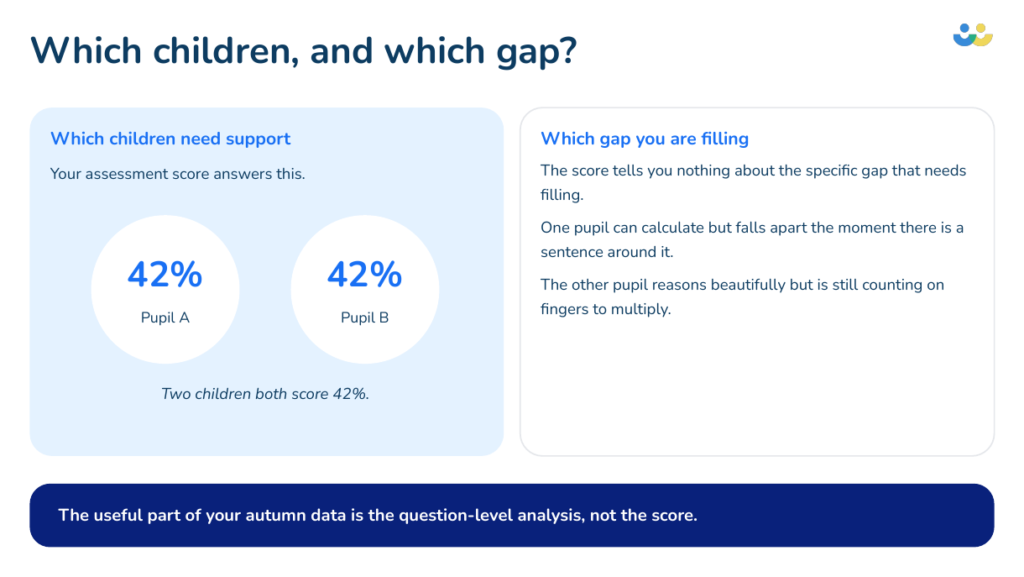
The useful part of your autumn data is the question-level analysis. Sit with the papers of the children who scored lower than you hoped, and look for the questions that group got wrong together. The similarities in their gaps should lead you to your intervention focus.
The three groups your pupils fall into
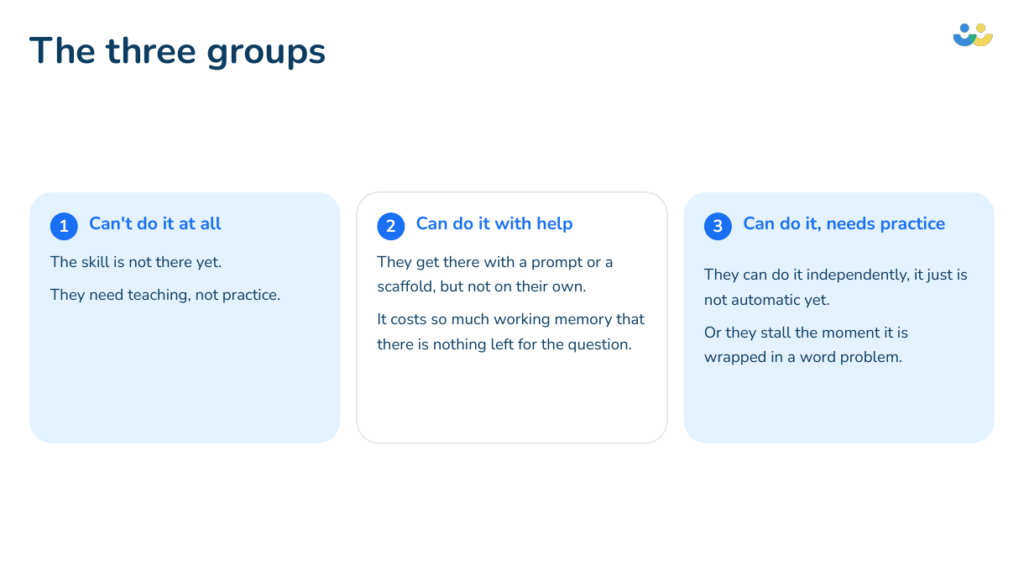
Once the questions the group lost marks on are side by side, every child falls into one of three groups:
- They can’t do it at all. The skill isn’t there yet, often because important prerequisite knowledge is missing. These pupils need focused teaching, not just practice.
- They can do it with help. They get there with prompting or scaffolding from an adult, but can’t do it on their own yet. Working independently costs them so much working memory that there’s nothing left to answer the question. (Our blog on cognitive load theory explains why.)
- They can do it and just need practice. They work independently, but the skill isn’t automatic yet. They may use inefficient methods, or struggle as soon as they have to apply it to a word problem.
Pupils in all three groups can look identical on a score, but they need three different interventions.
For example, one pupil can find \frac{1}{4} of 20 but doesn’t recognise that a word problem is asking them to do exactly that. Practising finding quarters won’t help. They need familiarity with word problems and application. Another pupil can’t find a quarter because 20 \div 4 is the sticking point, and that calls for a very different intervention.
Group 1: going back a year without getting stuck there
For pupils who can’t do it at all, you may want to go back to the previous year group’s content. Look for the prerequisite lesson underneath whatever came up in the autumn data.
Go carefully here, because our own programme had to work through this exact issue. Our old diagnostic programme would identify a place value gap and put the pupil on place value. Pupils would then plug every place value gap, going back two or more years. Some spent most of a year there and never got back to their year group content.
We changed the programme to a much more formative approach, based on real-time assessment. Skye now checks where each pupil is at the start of every lesson, then decides what support they need from there.
So how far back is too far? The test is to remember what going back is for. In most cases, you go back to bring pupils forward, not to leave them in Year 4. Hone in on the misconception that unlocks the year group content flagged in your data. Secure that, then bring them back up to what their year group is covering.
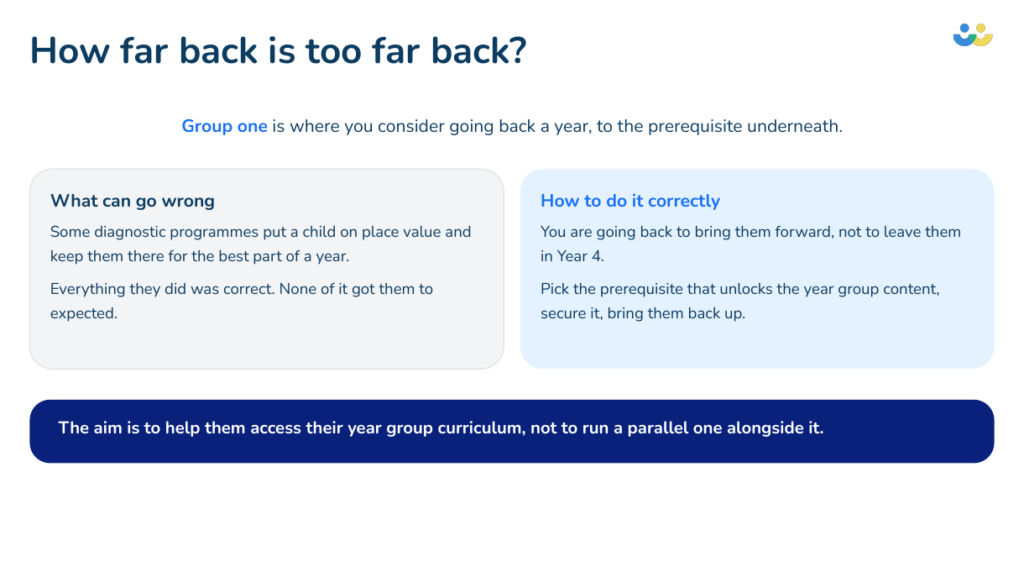
The aim, most of the time, is to help pupils access their own curriculum. A parallel curriculum running alongside the class rarely gets them back on track. It isn’t productive for the teacher either, who already has one curriculum to deliver.
Group 2: removing the help
Pupils who can do it with help can usually stay on their year group content. You don’t need to reteach from scratch. The intervention focuses on removing the help, so they can do it without an adult beside them or heavy scaffolding on the page.
This is often the biggest group in a class, and the one where timing the intervention session makes the biggest difference. It’s also the group in the Year 5 worked example further down.
Group 3: short and frequent practice
Pupils who just need practice don’t need a block of focused teaching. They need short, frequent repetitions close together.
This group is often left out of intervention planning, because they can already do it. Where possible, it’s worth setting up an intervention for them too, because they tend to move very quickly with a small amount of support.
The gap is rarely in the topic your data flags
By Year 6, the gap you’re looking at is rarely in the topic itself. I once put a group on fractions for a whole half term, because that’s where they’d lost marks. They knew the fractions process. What they couldn’t do was divide. Faced with \frac{3}{4} of 48, they were stuck on 48 \div 4, and I spent six weeks teaching the wrong thing.
Autumn data flags the symptom very well, but the gap that needs closing often sits a year or two underneath. A Year 5 child who can’t do column subtraction is rarely stuck on the steps themselves. More often, they’re stuck on exchanging, which signals a weakness in place value.
When you pick what an intervention group will work on, keep asking: what needs to be secure before this makes sense? That question takes you to the thing worth teaching.
The five decisions to make
Taking these five decisions before you break up means your primary maths intervention can start in week one. The Half Termly Maths Intervention Planning Pack has resources to support these decisions, so you can fill them in as you go. These five choices also shape whether an effective maths intervention gets going on time.
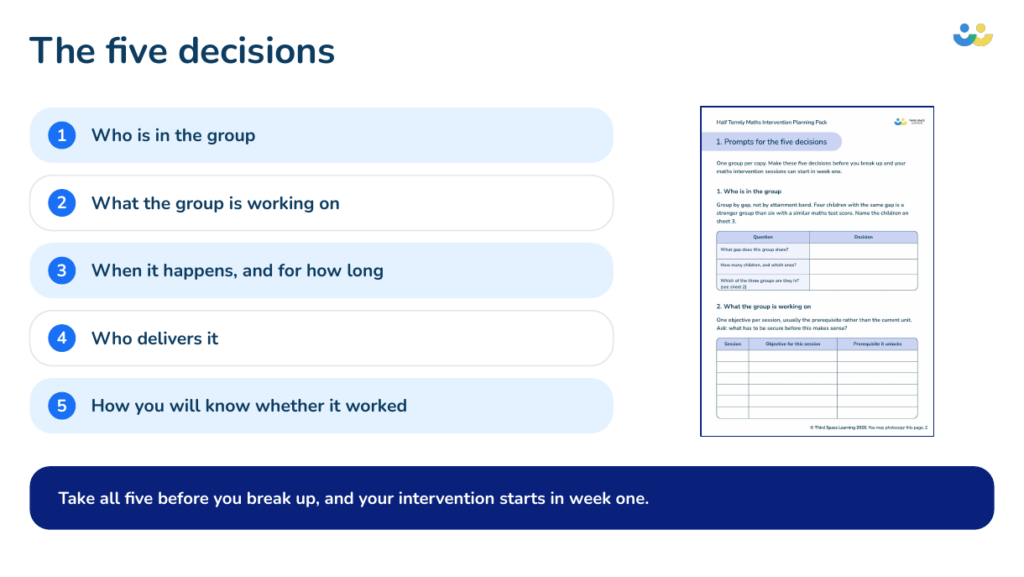
Decision 1: Who is in the group?
Where possible, group pupils by gap, not just by attainment band. The temptation is to take the six lowest scores and put them together to bring those scores up. If those six pupils have different gaps, though, the adult ends up running six interventions at once, and nobody gets what they need.
Four children with the same gap make a far stronger group than six children with similar scores. It’s fine for an intervention group to be small, and it’s fine for it to be temporary.
Grouping by score also creates a longer-term problem. When Terri was teaching, her school’s booster groups always held the same children, because the criteria was simply who had performed worst again. Nothing about the group was designed to close a particular gap, so those pupils drifted further behind and stayed in the group all year.
I had the same experience with a Year 6 maths club for pupils on scaled scores of 97 or 98. Once I dug into the data, those cusp pupils had completely different gaps. Pupils notice, too, and staying in the same group all year can be demoralising. The goal is for pupils to close the gap and move back to their class.
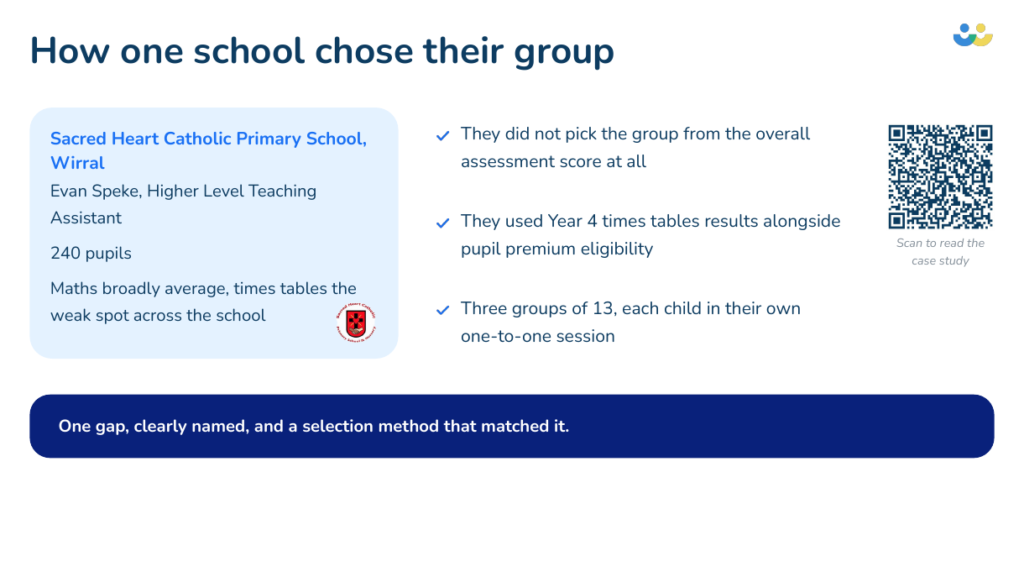
Sacred Heart Catholic Primary School in the Wirral set up its Skye groups in exactly this way. Evan Speke, Higher Level Teaching Assistant, selected pupils using their Year 4 times tables results and Pupil Premium eligibility. That gave the group one clearly named gap, and the selection method matched the intervention. Evan now runs three groups of 13 pupils on Skye for half an hour each, and says it’s “like having 13 teachers in the room”.
Decision 2: What is the group working on?
Plan one objective per session. That objective should be the misconception or knowledge gap you found, not just the current unit.
Write the sequence of objectives down before you break up, ordered so each session builds understanding for the next. That way, whoever is delivering the intervention isn’t deciding on the morning what to teach.
Keep it narrow. Securing three things properly is better than briefly touching nine and securing none of them. Narrow objectives are easier to manage in one-to-one sessions.
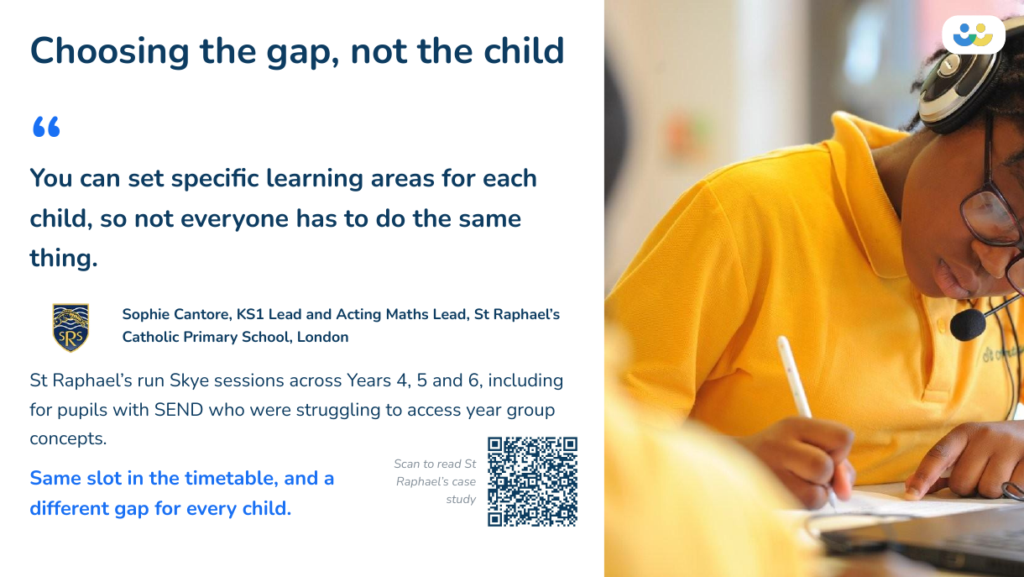
At St Raphael’s Catholic Primary School in London, Sophie Cantore, KS1 Lead and Acting Maths Lead, ran Skye sessions from Year 4 to Year 6. In Years 4 and 5, class teachers used assessment data to set up small interventions and chose the area each child worked on. Compared with group interventions, Sophie says, “you can set specific learning areas for each child, so not everyone has to do the same thing.” The school uses the same timetable slot, with a different gap for every child.
Decision 3: When does it happen, and for how long?
This one causes plenty of debate in primary schools, because the timetable is already so full. There are two things to think about.
First, short and regular beats long and occasional. Three sessions of 20 to 30 minutes will do more than one hour-long session a week, and they’re much kinder on attention and cognitive load for Key Stage 2 pupils.
Second, think carefully about what pupils miss while they’re at the intervention. Pulling a child out of their maths lesson for a maths intervention means they miss the very teaching the intervention is meant to help them access. Afternoon sessions raise a different question. Is the same child always missing history, or always missing art?
It’s easy for pupils to develop a negative relationship with maths. Missing a subject they love for extra maths only adds to that, but with a packed timetable it’s a tough decision.
Pre-teaching or catch-up?
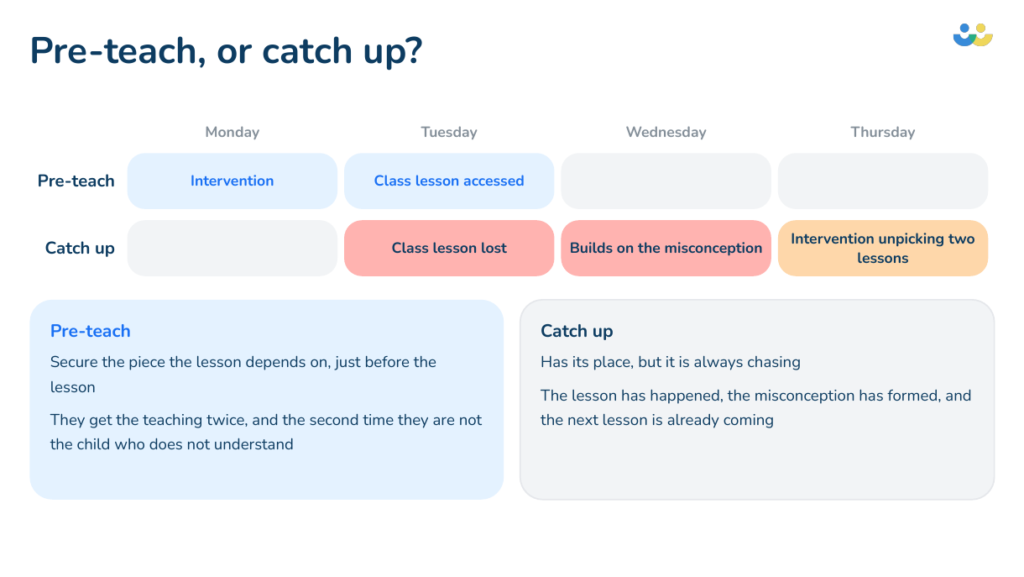
Where possible, choose pre-teaching, especially in primary. Ideally, the group meets just before the class lesson. The intervention secures the piece pupils need to unlock that lesson, and they walk into class able to take part.
Pupils get the teaching twice. The second time, they aren’t sitting there lost. Pre-teaching also keeps pupils on their year group curriculum, helping them into the lesson everyone else is in.
Catch-up has its place when you’re closing something specific that isn’t linked to current lessons. If the goal is to help pupils access their maths lessons, though, catch-up is always chasing. The lesson has already happened, a misconception may have formed, and the next lesson is already coming.
Decision 4: Who delivers it?
Whoever delivers the intervention needs a plan they can follow. Schools often ask a lot of teaching assistants and other adults to run intervention groups.
A TA taking a group of six can’t reasonably plan the adaptation for all six pupils in the moment. That is adaptive teaching in real time, and it’s one of the hardest things a teacher does. Handing it over without a plan isn’t fair on the adult or the pupils.
Give the adult delivering the sessions:
- the sequence of objectives
- the objective for each session
- the key questions to ask
- a clear picture of the end goal
With those, they can deliver a genuinely targeted session. The briefing sheet in the pack is designed to help you put this together.
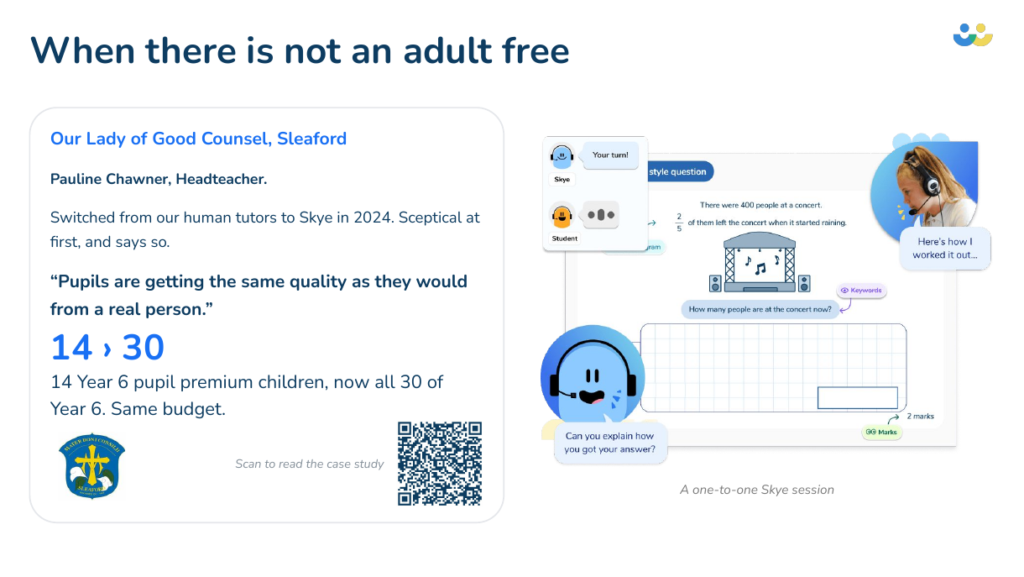
For many schools, finding a free adult is half the battle, because staff are stretched so thin. That’s one reason some schools turn to Skye. At Our Lady of Good Counsel Catholic Primary School in Sleaford, Headteacher Pauline Chawner first used our human tutoring for booster sessions with around 14 Year 6 Pupil Premium pupils. The school switched to Skye in 2024 and, because it cost less, put the whole of Year 6 on it. All 30 pupils now have three 30-minute sessions a week, in groups of ten with an adult in the room to help with logins.
Pauline was a little sceptical about AI at first. Comparing Skye with the school’s previous human tutors, she says pupils are “getting the same quality as they would from a real person”, and the lower cost meant the school could reach more than twice as many pupils.
Decision 5: How will you know whether the intervention has worked?
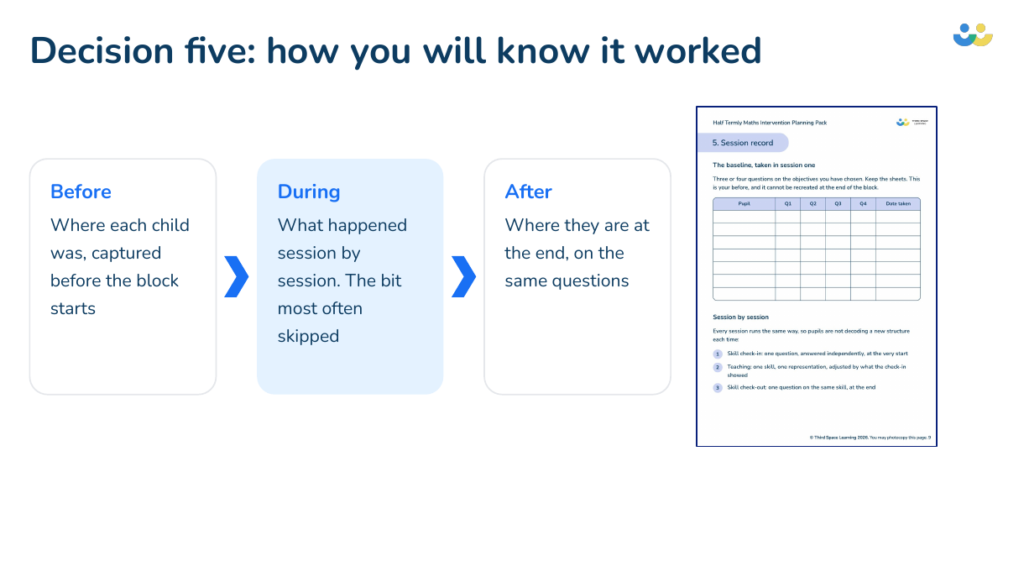
Decide this before you start, because you can’t baseline retrospectively. You need to know three things:
- where each child was before the intervention block started
- what happens session by session
- where each child is at the end of the block
The session-by-session evidence is the part that often gets skipped. It tells you whether to change course in week three, if the objectives aren’t quite right. Without it, you find out in week seven that the intervention needed to change halfway through.
Worked example: a Year 5 intervention on column subtraction with decimals
This example is for the second group: pupils who can do it, but still need help.
Four Year 5 pupils have lost marks across column subtraction questions in their autumn assessment. The easy conclusion is that they need a subtraction intervention because they don’t know how to do column subtraction.
Their working tells a different story. All four can follow the steps of column subtraction. They come unstuck when one of the numbers has nothing in the hundredths column, in a calculation such as 3.7 - 1.35.
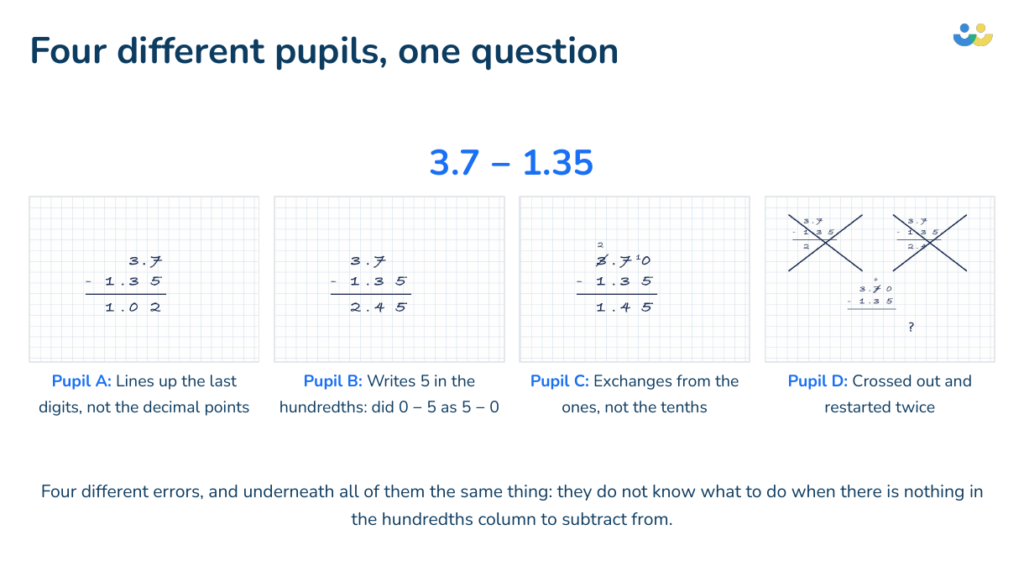
That one gap shows up as four different errors:
- The first pupil lined up the last digits instead of the decimal points.
- The second lined the numbers up correctly, but didn’t know what to do with the empty hundredths column. They swapped the digits round and calculated 5 hundredths subtract 0 hundredths.
- The third made an exchange in the wrong place, going to the ones instead of the tenths.
- The fourth knew to line the numbers up and knew they needed an exchange, but the effort cost so much working memory that they couldn’t finish.
On the surface, these are four quite different errors. Underneath, they all point to the same thing: the pupils don’t know what happens when there’s nothing in the hundredths column.
The steps they’re following are procedural. They’ve learned the method for column subtraction, but their decimal place value knowledge isn’t secure enough to fall back on when the procedure hits an empty column. A general subtraction intervention could spend weeks practising something these pupils can already do.
What the intervention session looks like
The session objective is to use column subtraction when one of the numbers has nothing in the hundredths.
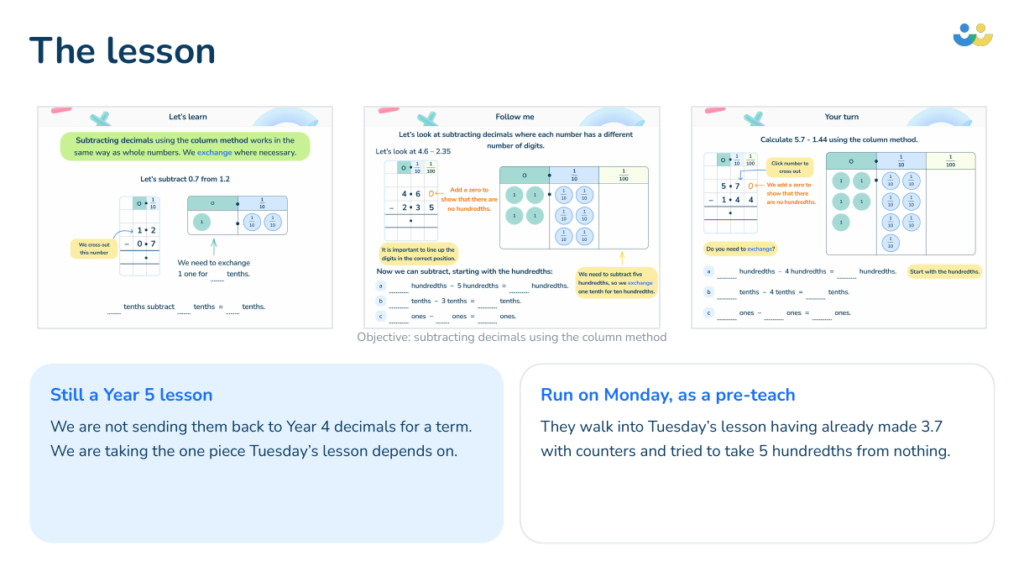
Place value counters give pupils a visual scaffold, so they can see what is happening conceptually at each step of the subtraction. There are no word problems, because pupils aren’t ready for that step yet. The session covers one skill, with one representation.
Sentence stems help pupils think through each step, for example: “0 hundredths subtract 5 hundredths.”
This is still a Year 5 lesson. The pupils don’t need sending back to Year 4 place value for a term. The intervention takes the one piece of knowledge that unlocks the next maths lesson and secures it. Pupils fill their decimal place value gap while staying on their year group objective.
The timing decision
Say the class lesson on Tuesday is column subtraction with decimals. If you run this intervention on Monday as a pre-teach, the four pupils walk into Tuesday’s lesson having already made 3.7 with counters. They’ve seen what happens when they try to take hundredths away from 0, and they aren’t learning it for the first time in front of 30 classmates.
If you run it on Thursday as catch-up, the picture changes. The pupils sat through Tuesday’s lesson, probably got lost and may have formed a misconception. On Wednesday, they built on that misconception and may have grown frustrated. By Thursday, the intervention has to unpick the misconception before it can teach anything.
Using the same lesson for a different group
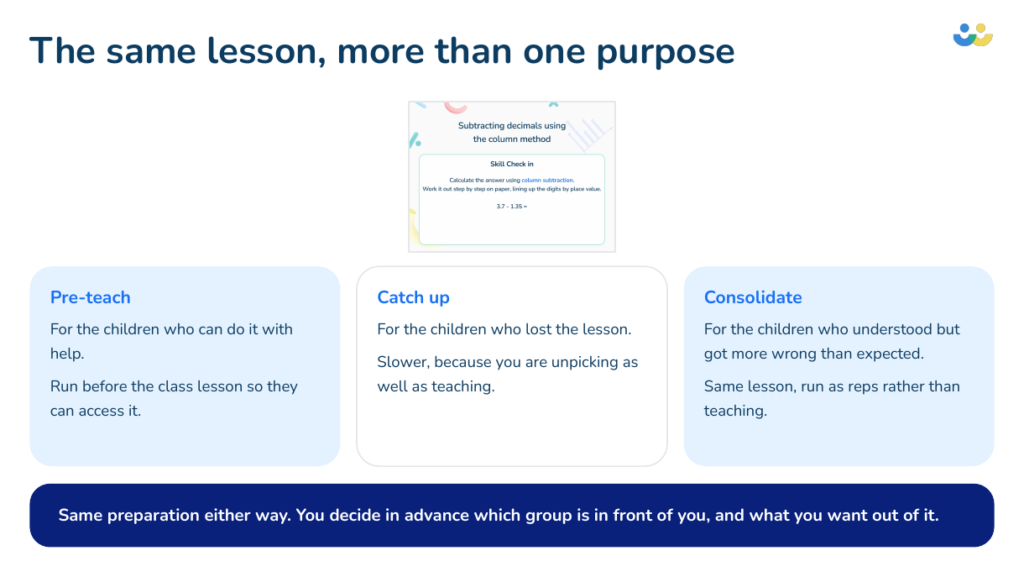
The same lesson works for the third group, too: pupils who can do it and just need practice. They may have worked through the assessment independently but dropped more of these questions than expected. You can run the same lesson as consolidation, giving them the repetition they need.
Plan this deliberately. It’s the same preparation either way, but you decide in advance which group the lesson is for and what you want the session to achieve.
What a 25-minute primary maths intervention session looks like
Every primary lesson Skye teaches follows the same four-part pattern. Terri’s team landed on it by watching thousands of sessions, then changing lessons wherever they could see something wasn’t working for pupils.
The first principle is that the structure stays the same every time. If the structure changes from session to session, pupils spend the first few minutes working out what’s expected of them. That uses working memory they need for the maths.
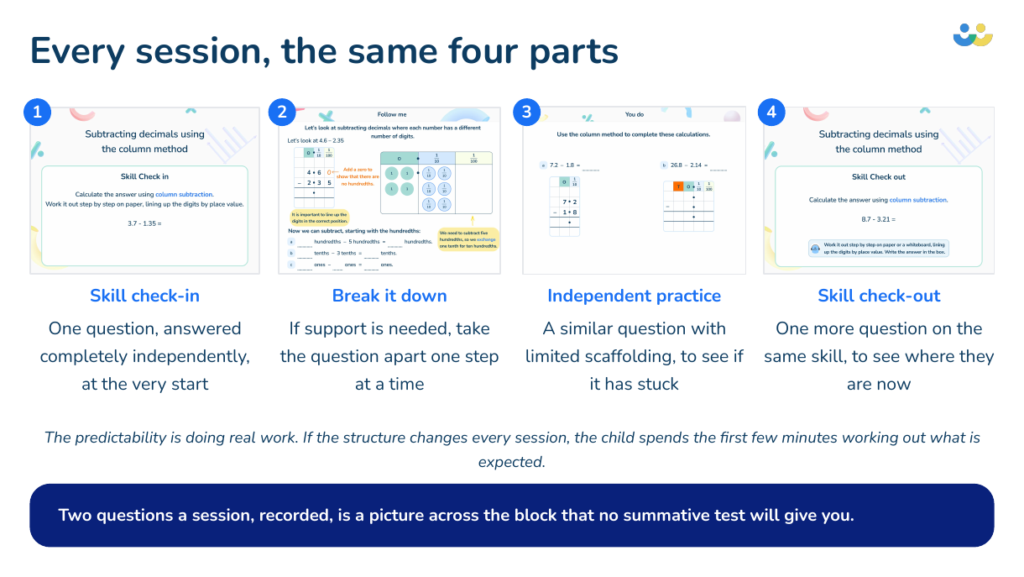
- Skill check-in. Pupils answer one question independently at the very start. Their answer shows where they are and how much input they need.
- Breaking it down. Pupils who get the check-in wrong move to a section that breaks the concept down, with more teaching and a chance to unpick misconceptions.
- Independent practice. Pupils who get the check-in right skip straight here. They try a few more questions and apply the skill to a harder problem, which shows the first answer wasn’t luck.
- Skill checkout. Pupils answer a question that mirrors the check-in, with different numbers. It gives concrete evidence of where they were at the start compared with the end.
The faster route came out of our own session reviews. Terri’s team kept hearing pupils who had got the check-in right sitting through teaching they didn’t need. They’d get frustrated, and you could hear them saying, “I know the answer, it’s 12.”
Recording two questions per session builds a picture across the block that a single test at the end of the cycle can’t give you. You can see the exact session where something clicked, and how it affected progress through the rest of the intervention. That evidence also supports your own planning and pupil progress meetings.
Making a group session adaptive
Teachers and TAs running a group of four, rather than one-to-one sessions, can still build in the same adaptivity. The key is to plan both branches in advance.
The check-in has two outcomes, so have both ready. Prepare the broken-down section for pupils who aren’t secure, and something for the pupils who are. It’s much easier to plan two paths before the session than to invent one in the moment.
It also helps to check confidence as well as accuracy where possible. Some pupils get the answer right but still don’t feel confident, or don’t believe they can do it. It’s worth knowing that before you sign the skill off, because something is holding them back.
What to record after each session
Record everything a pupil does against the session objective. When the session ends, you should be able to see:
- which skill was checked
- what the pupil answered at the start
- what support they needed
- what they answered at the end
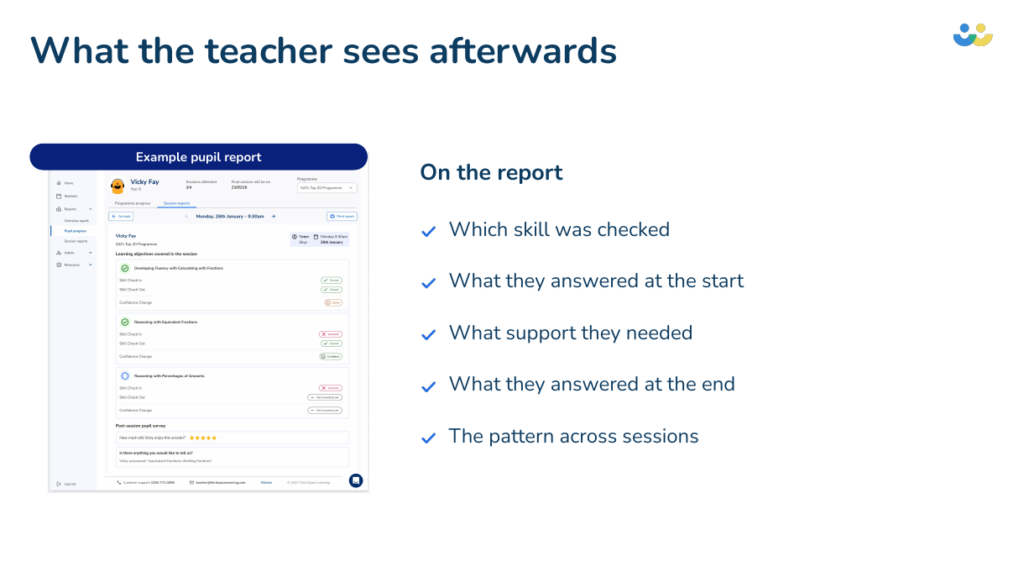
After a Skye session, teachers see a report showing whether each pupil got the check-in and checkout right or wrong. Across several sessions, patterns start to show. If a pupil keeps getting checkouts wrong on a particular topic, that points to your next intervention objective, without any heavy marking.
This is where the planning and the reporting meet. You use the same structure and the same evidence, whether you deliver the intervention yourself, a TA delivers it, or Skye does.
Setting up your primary maths intervention
Set the baseline
If you do one thing over half term, set the baseline. Groups and rooms are often easier to sort out than people expect, but you can’t recreate in December a baseline you didn’t take in October.
It doesn’t need to be elaborate. Three or four questions on your chosen objectives, answered in the first session, are enough. Keep pupils’ responses in a folder, and you have a clear before picture.
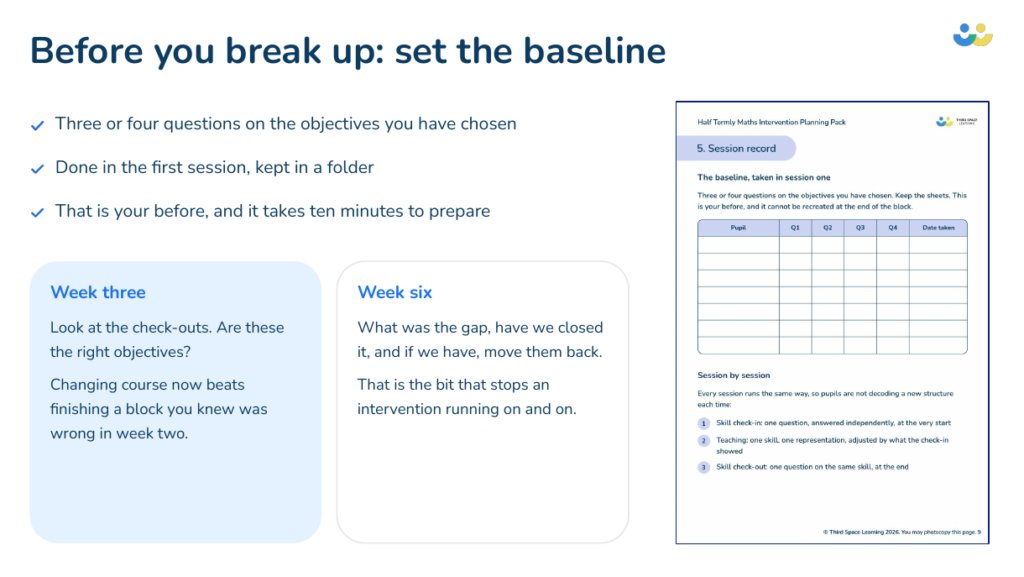
Check in at week three and week six
Around week three, look at the checkouts and ask whether these are the right objectives. Changing course at this point is completely fine, and much better than powering through a block you know isn’t working.
Around week six, ask the baseline questions again as an end-of-block progress measure. What was the gap at the start, and has the group closed it? If it has, pupils can move back and access their year group maths lessons.
Testing the gap at the start and the end stops an intervention from running on indefinitely. Without it, schools can reach July still running the intervention set up in October, with the same children. Meanwhile, other pupils who need an intervention can’t get one.
Report the impact to SLT and governors
When you report upwards, whether to pupil progress meetings, SLT or governors, the strongest evidence comes from three things:
- your baseline
- attendance across the intervention block
- your checkout data
All three are easy to gather while the intervention runs.
Half Termly Maths Intervention Planning Pack
Everything covered in this webinar is in the Half Termly Maths Intervention Planning Pack. It includes a group planning grid, a half term countdown, a baseline and six-week check sheet, and a briefing sheet for whoever delivers your sessions. You’ll need a free Third Space Maths Hub account to download it, which also gives you access to hundreds more primary maths resources.
To see Skye, our AI maths tutor, delivering one-to-one primary maths intervention sessions, email hello@thirdspacelearning.com or book a demo with our team. You can also watch clips of Skye in action in real sessions.

DO YOU HAVE STUDENTS WHO NEED MORE SUPPORT IN MATHS?
Skye – our AI maths tutor built by teachers – gives students personalised one-to-one lessons that address learning gaps and build confidence.
Since 2013 we’ve taught over 2 million hours of maths lessons to more than 170,000 students to help them become fluent, able mathematicians.
Explore our AI maths tutoring or find out about maths intervention programmes for your school.