

Teaching Place Value: A Guide for K-6 Math Teachers

If you ask a class of 4th graders what the 3 in 435 is worth, a fair number of them will tell you it is 3. They can find the tens place and name it correctly and still not read the digit sitting in it as thirty, which tells you they have picked up the labels for the places without the understanding of place value that gives those labels any meaning.
That gap is easy to miss, because most place value worksheets never ask a student what a digit is worth. You are more likely to meet it much later, when regrouping goes wrong, or when a student compares two decimals by counting the digits after the point, or in rounding, where a student writes down an answer and cannot tell you why.
This guide sets out how to teach place value from kindergarten through 6th grade. It covers what each grade is responsible for under the standards, the vocabulary to be careful about, what strong core instruction looks like, the misconceptions you will meet every year, and what to do for the students who need more than Tier 1 can give them.
Key takeaways
- Place value runs from kindergarten to 6th grade and each grade has a specific job under the standards, so a gap in one year does not surface until two or three years later.
- Two things to check if you are using free lessons written for another country’s curriculum: 3rd grade rounds to the nearest 10 or 100 and no further, and negative numbers are a 6th grade topic under The Number System rather than an elementary place value one.
- The most common misconception is reading the digit as its value, so the 3 in 435 is read as 3 rather than thirty. If you ask a student what a digit is worth, their answer will tell you whether they are reading the 3 as thirty or as 3.
- Stay on the blocks longer than the class looks like it needs. A student who can rebuild 235 as 1 flat, 13 rods and 5 small cubes and still call it 235 has understood the equivalent groupings that regrouping depends on.
- Diagnose before you intervene, because a student who cannot decompose a number at all needs something different from one who decomposes it fine and then loses track halfway through a calculation.
Why place value matters across the grades
Place value is the idea that the position of a digit tells you what it is worth, so that the 5 in 52 and the 5 in 205 are the same symbol doing two different jobs. If you want the full explanation to hand to a student teacher or a paraprofessional, we have one in our guide to place value.
The clearest account of why it carries so much weight is in the K-5 Progression on Number and Operations in Base Ten, written by the Common Core Standards Writing Team, which describes the power of the base ten number system as lying in repeated bundling by ten. Ten ones compose a new place value unit called a ten, 10 tens make a hundred, and the same process keeps going upward into multi-digit numbers and downward into decimals, so that every base ten unit can be understood in terms of any other.
That is why so much of what comes later rests on this one idea. Adding within 1,000 with regrouping makes sense only to a student who knows that 10 ones can be exchanged for 1 ten. The standard algorithm in 4th grade is a shorthand for those same exchanges between adjacent places. Rounding, from 3rd grade onward, is a judgment about which place you are rounding to and what the digit to its right is doing. By 5th grade, a student who cannot compare decimals is almost always a student who never secured the places to begin with.
As teachers, we often treat the place value unit as something to get through in the first few weeks of the year so that we can start on the operations, and I would push back on that, because the weeks spent here make the operations teachable at all. A class that finishes the unit able to name the places but unable to say what a digit is worth will cost you time in every unit that comes after it.

FREE PLACE VALUE ACTIVITIES
Place value expectations by grade
Place value runs from kindergarten through 6th grade, and each grade has a specific job to do with it. These are the Common Core expectations, and most state standards follow the same sequence even where the codes differ.
| Grade | Standard | What it means in the classroom |
|---|---|---|
| Kindergarten | K.NBT.A.1 | Compose and decompose the numbers 11 to 19 into 10 ones and some further ones, recorded as a drawing or an equation such as 18 = 10 + 8. Two ten frames are the usual way students represent numbers at this stage |
| 1st grade | 1.NBT.B.2, 1.NBT.B.3 | Ten becomes a place value unit of its own: 10 is a bundle of 10 ones called “a ten”, and 10 through 90 are that many tens and 0 ones. Students compare two two-digit numbers with >, = and < |
| 2nd grade | 2.NBT.A.1 to 2.NBT.A.4 | Hundreds, tens and ones, where 706 is 7 hundreds, 0 tens and 6 ones. Students skip count within 1,000, read and write numbers to 1,000 in standard form, word form and expanded form, and compare two three-digit numbers |
| 3rd grade | 3.NBT.A.1 | Use place value understanding to round whole numbers to the nearest 10 or 100 |
| 4th grade | 4.NBT.A.1 to 4.NBT.A.3 | A digit in one place represents 10 times what it represents in the place to its right. Multi-digit numbers up to 1,000,000, and rounding to any place |
| 5th grade | 5.NBT.A.1 to 5.NBT.A.4 | The other half of the relationship, where a digit is also one tenth of the place to its left. Powers of 10 written with exponents, decimals to thousandths, and rounding decimals |
| 6th grade | 6.NS.B.3, 6.EE.A.1 | Fluent addition, subtraction, multiplication and division of multi-digit decimals using the standard algorithm, and numerical expressions with whole-number exponents |
Two points are worth checking if you are working from free place value lessons found online, some of which are written for other countries’ curricula. 3rd grade rounds to the nearest 10 or 100 and no further, so rounding to the nearest 1,000 belongs in 4th grade where the standard says “any place”. And negative numbers are not an elementary place value topic in the US at all, because they arrive in 6th grade under The Number System.
The grade-level charts that go with this sequence are in our place value charts collection, and each grade has its own math curriculum guide.
Place value vocabulary
Three habits are worth getting right as a team, and they cost nothing to fix. Recommendation 2 of the 2021 What Works Clearinghouse practice guide, Assisting Students Struggling with Mathematics: Intervention in the Elementary Grades, is to teach clear and concise mathematical language and to support students in using it themselves. I would put place value near the top of the topics where that advice is worth following.
The first is the word units, which older programs still use where the standards say ones. If your materials still say units, it is worth agreeing as a team to change them, because a student who meets both words in the same year has to figure out on their own that they mean the same thing.
There is also the difference between a digit, a number and a numeral. A digit is one of the 10 symbols from 0 to 9, a numeral is the written form of a number, and a number is the quantity itself. Students do not need those definitions recited at them, but they do need you to use the three words consistently. “What number is in the tens place” asks for something different from “what is the value of the digit in the tens place”, and the second question is the one that tells you whether a student understands place value or has learned to point at a column.
The last is how we say multi-digit numbers out loud, and here the Progression is blunt about a difficulty English creates and East Asian number words do not. The number words from 13 to 19 give the number of ones before the number of tens, so a student hears “fourteen” and writes 41. “Fourteen” and “forty” sound very similar, as do “fifteen” and “fifty”, and so on up to “nineteen” and “ninety”.
This is a difficulty with the words themselves, and it is worth saying so to the class rather than letting it go down as a comprehension gap. Say the decade words deliberately when you write numbers on the board, and ask students to say them the same way when they read them back to you. Our elementary math vocabulary list is a useful starting point if you want the whole team using the same words.
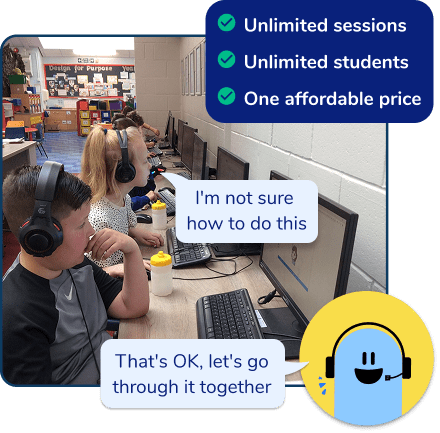
Meet Skye, the spoken AI math tutor making math success possible for every student.
Teachers and math experts built Skye on the same principles that make human tutoring effective. Its pedagogy, curriculum and lesson structure draw on more than 2.2 million tutoring sessions.
But with more flexibility and at a low cost, schools can scale online math tutoring to support every student who needs it.
Find out moreTier 1: teaching place value in core instruction
Tier 1 is the instruction every student in the room gets, and most place value problems are far cheaper to prevent here than to repair in an intervention group in March. Recommendation 1 of the same practice guide is systematic instruction, and while the guide is written for intervention, the principle holds in core teaching: I would secure one place at a time before students work across several at once.
Start with concrete resources
Base ten blocks, bundles of straws and ten frames all do the same job, which is to let a student see that 10 of one thing can be exchanged for 1 of the next thing. Recommendation 3 of that guide is to use a well-chosen set of concrete and semi-concrete representations, and the phrase to attend to is well-chosen, because a class set of four different manipulatives used interchangeably tends to confuse rather than help. Our guide to base ten blocks covers the manipulative itself, and the concrete representational abstract sequence explains why the order matters.
The mistake I see most often is moving off the blocks too quickly, usually because the class looks confident with them, and I would not rush that stage even when they do. A student who can represent numbers such as 235 with 2 flats, 3 rods and 5 small cubes, and who can then rebuild the same number as 1 flat, 13 rods and 5 small cubes and still call it 235, has understood equivalent groupings in a way no worksheet will give you. Insist on that second representation, because regrouping depends on it.
The same test works in the lower grades: a student who is secure in tens and ones can build 47 as 4 tens and 7 ones, then rebuild it as 3 tens and 17 ones and still call it 47.
Place value counters are the step I would take next, before the written number. A counter marked 100 is the same size as a counter marked 1, so the student cannot read the value off the size of the counter and has to take it from the label. That is a real step up in difficulty, so introduce the counters in a lesson of their own.

Connect the blocks to the written number
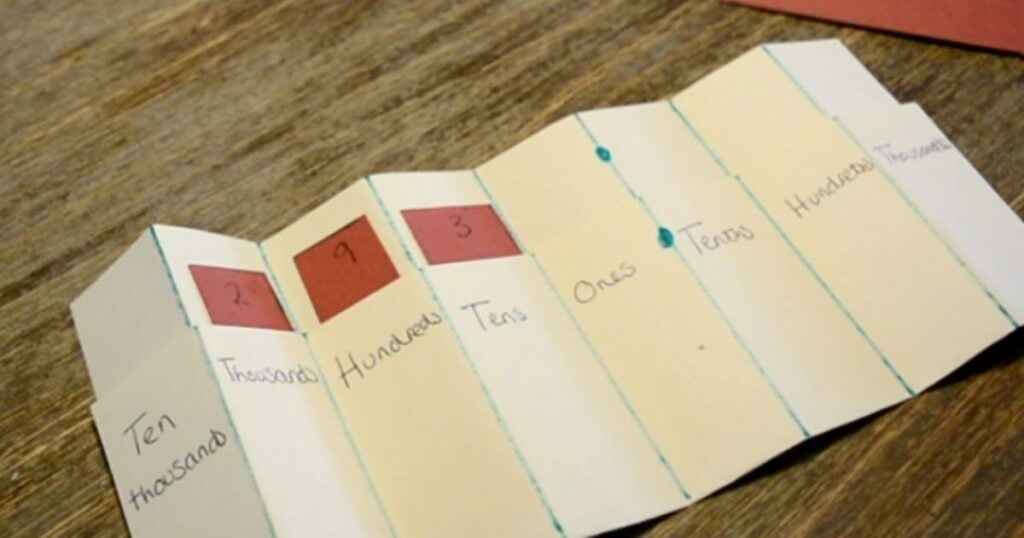
Once students can represent numbers with base ten blocks and counters, the place value chart ties the quantity to the numeral. Ask them to build a number, place it in the chart, write it in standard form, word form and expanded form, and say it out loud. Our printable place value accordion works well here, because students make it themselves and can slide the places past each other.
An I do, we do, you do sequence works well here. Model one number completely, work through a second with the whole class supplying each step, then set two more for independent practice and watch who hesitates at which column. Students hesitate first when you ask them to write the same number in more than one form, so a few activities of this kind early in the unit will tell you more than a test at the end of it.

Teaching zero as a placeholder
Teach zero deliberately, because the standard gives you the example itself: 706 is 7 hundreds, 0 tens and 6 ones. A student who reads zero as “nothing is here” will write 76 while apparently understanding everything else in the lesson.
Build a three-digit number with base ten blocks and then remove all the rods, so there is a visibly empty tens column with the hundreds still to its left. Students need to see that the zero keeps the tens column open, because without it the 7 slides into the tens place and 706 becomes 76.
Comparing numbers using place value
Comparing numbers appears in the standards from 1st grade, and asking students to compare numbers is the quickest check on whether their understanding of place value is real. Some students compare by counting how many digits each number has. That settles it whenever one number is longer, which happens often enough for the habit to survive, and it tells them nothing at all when both numbers are the same length, which is what the standards actually ask them to compare.
Teach the habit of working from the left, one place at a time, and saying the reason out loud: 5,240 is greater than 5,204 because the thousands and hundreds are equal and the tens digit is 4 against 0. The habit matters more as the numbers get longer, because with a five-digit number a student who takes in all the digits at once will usually compare the wrong pair. A hundreds chart is useful alongside this for place value patterns, because what changes when you move one square down is a different thing from what changes when you move one square across. A number line does similar work for rounding numbers later on.
Place value activities
Here are three that need almost no preparation and work as a warm-up or at the end of a lesson.
What number am I?
You describe a number by its places, for example 5 tens, 3 ones and 2 hundreds, deliberately out of order, and students figure out which number you mean. Giving the places out of order stops students from writing the words down in the order they hear them.
Greatest number wins
Students roll a die three or four times and choose which column to place each digit in as they go, and the math happens at the moment a student commits a digit to a column without knowing what is coming next. The conversation afterward about why someone put a 6 in the hundreds place will tell you more about their number sense than the score does.
Missing numbers on a hundreds chart
Blank out a scatter of squares and have students reason their way to the missing numbers from the number patterns instead of counting up from 1.
You’ll find more fun place value activities in this free set of whole class math games.
Place value problem solving and reasoning
Place value gives you fewer natural word problem contexts than the four operations do, and money is the one worth using: how many $10 bills you can make from $235 is the same question as how many tens are in 235. Reasoning tasks are more useful here, and the two below sit squarely in two of the Standards for Mathematical Practice: constructing an argument, and looking for and making use of structure. Both ask students to explain their reasoning.
The first task is about equivalence. Show students two representations of the same number, where one uses 10 ones and the other uses 1 ten in their place, and ask which of them shows 222 and how they know. Both are 222, and a student who says only one is correct has not yet accepted that ten ones and one ten are the same quantity, and they will need that before regrouping makes sense.
The second task asks students to compare two numbers when one digit is missing. Write 4,_18 and 4,298 on the board and ask which digits could go in the gap to make the first number larger than 4,298, and which could not. Counting digits will not settle it, because both numbers have four, so a student has to work from the left one place at a time. Wait for someone to try 2, because then the hundreds are equal and the comparison comes down to the tens. Ask two students who disagree to explain their reasoning to each other before you say anything.
Neither task takes long, and I would use them as the assessment, because what you are listening for is the explanation.
Common place value misconceptions
If you teach a place value unit every year, the same misconceptions will come around with it. Our guide to math misconceptions covers the wider ground; what follows is specific to this topic.
The digit is the value
The student reads the 3 in 435 as 3 rather than thirty. This is the one you will meet most, because naming the tens place correctly looks like understanding.
Ask what the 3 is worth. Then have them build both 3 and 30 with base ten blocks and put the two side by side. The follow-up worth asking is how many tens are in 235: the answer is 23, and a student who says 3 has read the digit in the tens place instead of working out how many tens the whole number holds.
Zero means nothing is there
An empty column does not read as a column at all, so a student writes 706 as 76, or reads 405 as forty-five.
Ask for 7 hundreds, no tens and 6 ones written as a numeral, and watch what happens at the tens column. Then build it with blocks and take the rods away, so the empty column is visibly holding a space rather than being absent.
More digits means a bigger number
The student compares by counting how many digits each number has. It gives the right answer whenever one number is longer, so students go on using it for years without anyone noticing.
Have them compare 0.45 and 0.5 and explain the reasoning. Teach comparison from the left, one place at a time, saying the reason out loud.
A longer decimal is a bigger decimal
This is the same habit one step further on, and whole number work will never expose it, so students carry it with them until they start comparing decimals, which begins in 4th grade under fractions and moves into place value proper in 5th grade.
Ask them to put 0.7, 0.68 and 0.09 in order, with a reason for each. A student who leads with 0.68 is reading the digits after the decimal point as a whole number, and has told you so in one answer.
The number is a string of separate digits
The student reads 435 as “four three five”, treating the numeral as three symbols that happen to sit together.
Have them say the number and then write it in expanded form as 400 + 30 + 5. Most students hear the difference between the two answers right away.
A short diagnostic assessment at the start of the unit will tell you which of these are live in your class before you write a single lesson plan, so you can aim the intervention at the gap you have actually found.
Tier 2 and Tier 3 place value intervention
Some students will need more than Tier 1, and place value is a topic to act on quickly, because the gap widens with every unit that assumes it. Our guides to MTSS interventions and math intervention strategies cover the framework itself; what follows is how it works for this topic.
Find the gap before you plan
I would not recommend reteaching the whole unit more slowly, because the student has already had that unit twice and a third pass over the same material rarely changes anything. A short diagnostic that separates the three things that go wrong is more useful. Can the student decompose a number into its places? Can they hold on to that while they are carrying out a calculation? And does any of it survive once the number has a decimal point in it?
What a Tier 2 intervention looks like
Tier 2 is small group work, targeted at the specific place value concepts the student has not secured and running alongside core instruction rather than in place of it. For a student who cannot reliably decompose a three-digit number, that means going back to base ten blocks without embarrassment and spending several sessions on equivalent groupings, until 235 as 1 flat, 13 rods and 5 small cubes is as comfortable as the standard version. Our guide to Tier 2 interventions sets out the structure in more detail.
Some students can decompose a number perfectly well and then lose track of it once they are halfway through a calculation. They need something different. Set the calculations they are meeting in class out on a place value chart, and keep going until the exchange in the algorithm and the exchange in the blocks are the same move to them.
What changes at Tier 3
Tier 3 interventions are more intensive and usually one-on-one, and for place value they nearly always mean working on below grade level content for a period, which feels uncomfortable to plan and is almost always the right decision, because the student cannot access the grade level work until the gap is closed. A 5th grader who cannot decompose a three-digit number will not be helped by 5th grade decimal work, however carefully it is scaffolded.
By the time a school reaches Tier 3, it usually knows exactly which students need one-on-one time and does not have the staff to give it to them. Our AI math tutor delivers one-on-one sessions to those students and shows the teacher afterward which step each one got stuck on, so a school can run Tier 3 for more than the handful the schedule allows. The sequence it works through is built on insights from 2,295,000 one-on-one tutoring sessions across 4,200 schools since 2013, which is where we learned which wrong answers are worth stopping on.
Place value in 5th and 6th grade: decimals and powers of 10
In 5.NBT.A.1, students learn that a digit is 10 times the place to its right and one tenth of the place to its left, and 6th grade builds on that second half.
Students explain patterns in the number of zeros when multiplying by powers of 10, and write those powers using whole-number exponents, so that 10 x 10 x 10 becomes 10 cubed. In 6th grade that consolidates into fluent decimal arithmetic with the standard algorithm for each operation, and into numerical expressions involving exponents. Negative numbers also arrive in 6th grade, under The Number System rather than base ten, and if place value has been taught well in elementary school then extending the number line below zero is a smaller step than it looks, because students already understand that position carries meaning. Our guide to decimals in elementary school covers the ground immediately before this.
I would not overstate how neatly this progresses. Plenty of students arrive in 6th grade fluent with whole numbers and unsure what the digits after a decimal point are worth, and the honest position is that the diagnosis and the intervention are the ones described above, applied to a different set of places.
Frequently asked questions
A student can learn the labels without ever understanding the idea underneath them. They can name the tens place correctly and complete most of a worksheet without once reading the digit in it as a quantity, and you often do not see the gap until regrouping or comparing decimals. English number words add to it, because 13 to 19 say the ones before the tens, and “fourteen” and “forty” sound very similar.
Place value is taught from kindergarten through 6th grade. Kindergarten covers 11 to 19 as 10 ones and some more, 1st and 2nd grade build two-digit and three-digit numbers, 3rd grade rounds to the nearest 10 or 100, 4th grade establishes the 10 times relationship between places, 5th grade extends place value to decimals, and 6th grade moves into fluent decimal arithmetic and exponents.
Base ten blocks, ten frames and bundles of straws do the most work, because each one lets students physically exchange 10 of something for 1 of the next unit. Place value counters and place value charts are useful once students are moving between the quantity and the written numeral. The practice guide’s advice is to choose a small set and use them consistently, rather than introducing a new representation every week.
The activities that work best ask a student to make a decision they then have to justify. Greatest number wins is the clearest example of a fun game of this kind, because students pick which column each rolled digit goes in before they know what is coming next, and they then have to defend the choice.

FREE Place Value Math Enrichment Activities Pack For Grades 2 to 5
Use these place value enrichment activities to stretch your 2nd to 5th grade students, whatever level they are working at
Download Free Now!Do you have students who need extra support in math?
Skye – our AI math tutor built by experienced teachers – provides students with personalized one-on-one, spoken instruction that helps them master concepts, close skill gaps, and gain confidence.
Since 2013, we’ve delivered 2,295,000 math tutoring sessions to 196,000 students, guiding them toward higher math achievement.
Discover how our AI math tutoring can boost student success, or see how our math programs can support your school’s goals:
– 3rd grade tutoring
– 4th grade tutoring
– 5th grade tutoring
– 6th grade tutoring
– 7th grade tutoring
– 8th grade tutoring