

I Do, We Do, You Do: How To Introduce New Learning Effectively

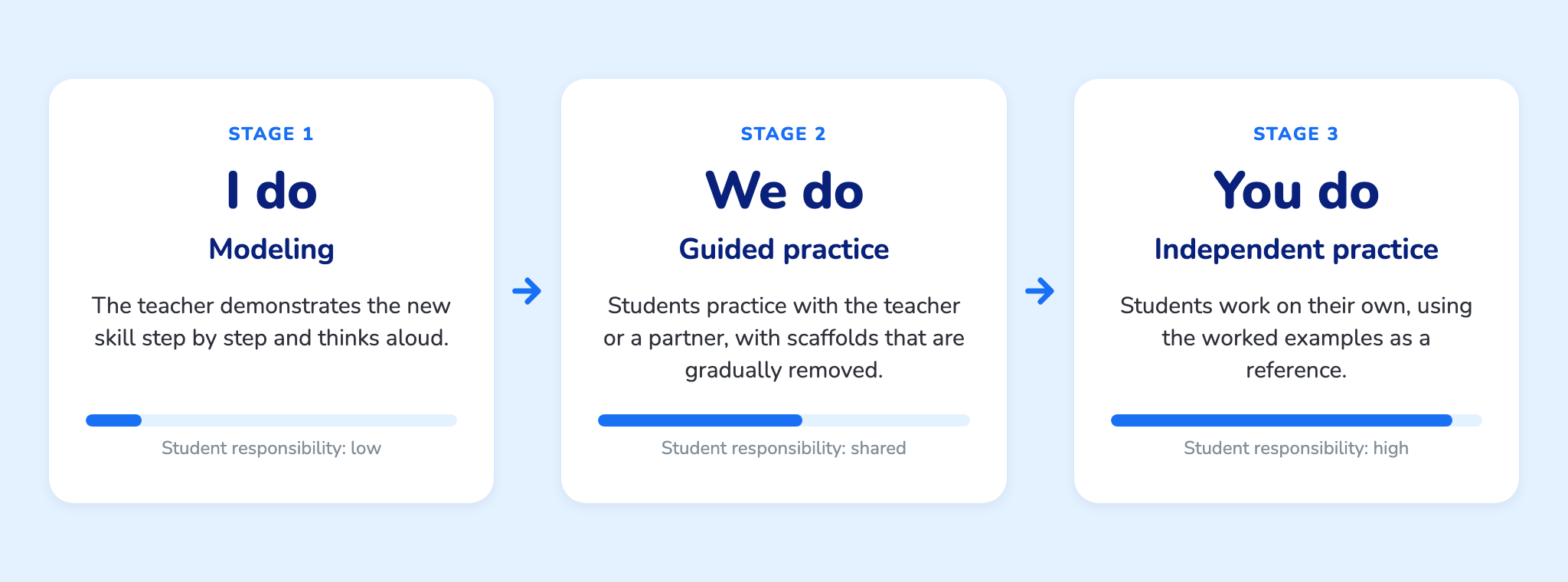
I do, we do, you do is a teaching method for introducing new skills and concepts, also known as the gradual release of responsibility model. The teacher models, the class practices together, then students work alone. It suits any subject, and teachers find it especially useful in math.
Our expert author Zoe Benjamin explains why the approach works and how to plan each phase, using lesson examples from the Third Space Learning math curriculum.
What is I do, we do, you do?
This teaching strategy takes students from no prior knowledge of a topic to working on their own in three planned phases. Each phase hands a little more responsibility to the learner, which is where the name gradual release model comes from.
The idea comes from reading comprehension research. P. David Pearson and Margaret Gallagher described the gradual release of responsibility in 1983. Many teachers first came across it in their own training as one of the standard learning strategies, and it suits math well because most new procedures break naturally into small steps that students can learn one at a time.
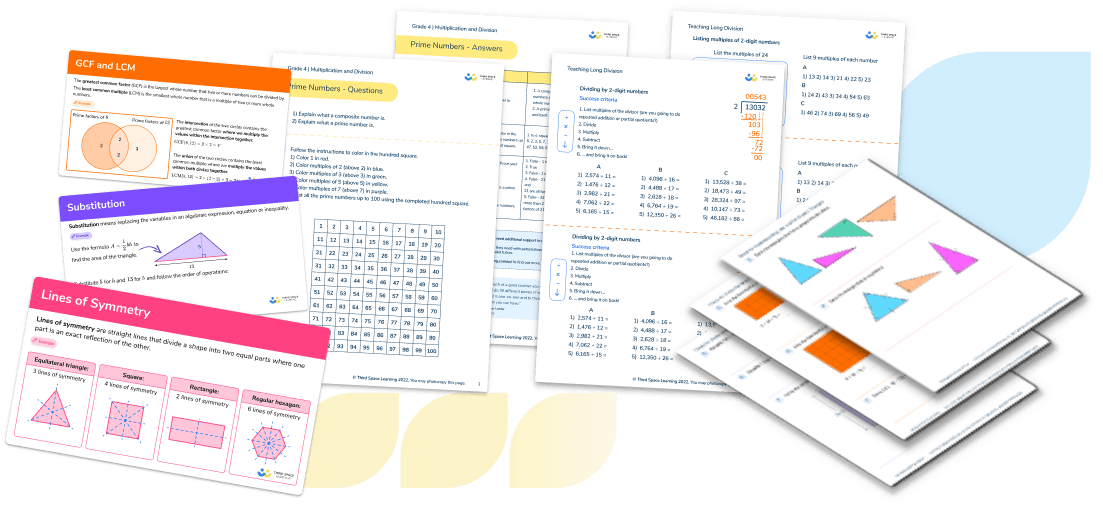
Every lesson in Third Space Learning’s elementary and middle school math tutoring follows this structure. Here is how each phase works, with ideas from our elementary and middle school lessons.
Download our free 13 Teaching Strategies Poster to share proven classroom techniques, including I do, we do, you do, with your teachers.

13 Teaching Strategies Poster
13 tried and tested strategies to help teachers maximise student progress. Print off and hand out at the beginning of the school year or a during staff meeting or use each tried and tested teaching strategy as the basis for staff meetings.
Download Free Now!I do: the modeling stage
In the first phase, the teacher models the new skill, demonstrating it step by step, working through problems and thinking aloud so students can follow the reasoning behind each step. Because the material is new and unfamiliar at this point, this is the place for clear, teacher-led direct instruction.
The aim is to keep the load on working memory low. Try a silent demonstration of one worked example first, so students watch the process without also processing an explanation, then talk it through. Leave time for students to say what they notice and to ask questions.
When introducing long division (the standard algorithm students are expected to use fluently by 6th grade), you might demonstrate two or three problems on the board without speaking, then go back and explain each step aloud.

Our AI math tutor, Skye, follows the same teaching pattern in every session. In the “Follow me” step, Skye talks the student through a problem in small steps, explaining each one before the student is asked to try anything alone.
We do: the guided practice stage
In the “we do” phase, students practice the new skill with the teacher, in small groups or with a partner. Guided work is most effective when the problems closely mirror the ones you modeled, so every student can participate.
Scaffolding matters most in this phase. A writing frame, a partially completed task or a set of prompts gives students enough support to succeed, and you take that support away as they become more confident. Keep checking understanding throughout, and if several students are stuck on the same step, stop and model it again. Catching a shared mistake now takes far less time than reteaching it later.
With long division, you might solve the next problem as a class, with students talking through each step. Pairs or groups could take turns explaining each step, or finish a partly solved problem. Group work here surfaces misconceptions while they are still easy to fix.
In a Third Space Learning lesson, this is the “Your turn” step. The worked example stays on screen while the student solves a similar problem with Skye’s help. Skye frequently asks questions to check understanding. When an answer is wrong, the student gets two targeted hints before Skye reteaches the step, so each student moves at their own pace.
“With Skye, students have to take the time. They have to listen, work with Skye, and understand what was wrong, why it was wrong, and how to fix it before moving on.”
Kathy Garcia, Principal, Moffat PK-12, Colorado. Read more school stories
You do: the independent practice stage
In the last phase, students practice on their own. A few will still need light assistance, such as sentence stems or concrete manipulatives, but most should be ready to complete problems alone, using the earlier worked examples as a reference.
Set this work in short chunks so that no one repeats the same mistake ten times. Students who are struggling can move back to guided practice for extra time with you.
For long division, the task might be four or five problems to complete and check against an answer key. Students then reflect on whether to keep going, ask for help or look back at the worked problems. A quick exit ticket on a sticky note at the end of the lesson tells you who is ready to move on.

In Third Space Learning lessons, Skye removes the scaffolding gradually as students become more independent learners. Each student gets the support they need, whether that is a planned prompt or a visual model. Our middle school math tutoring follows the same instruction model, and longer multi-step problems are broken into smaller steps.

The benefits of I do, we do, you do
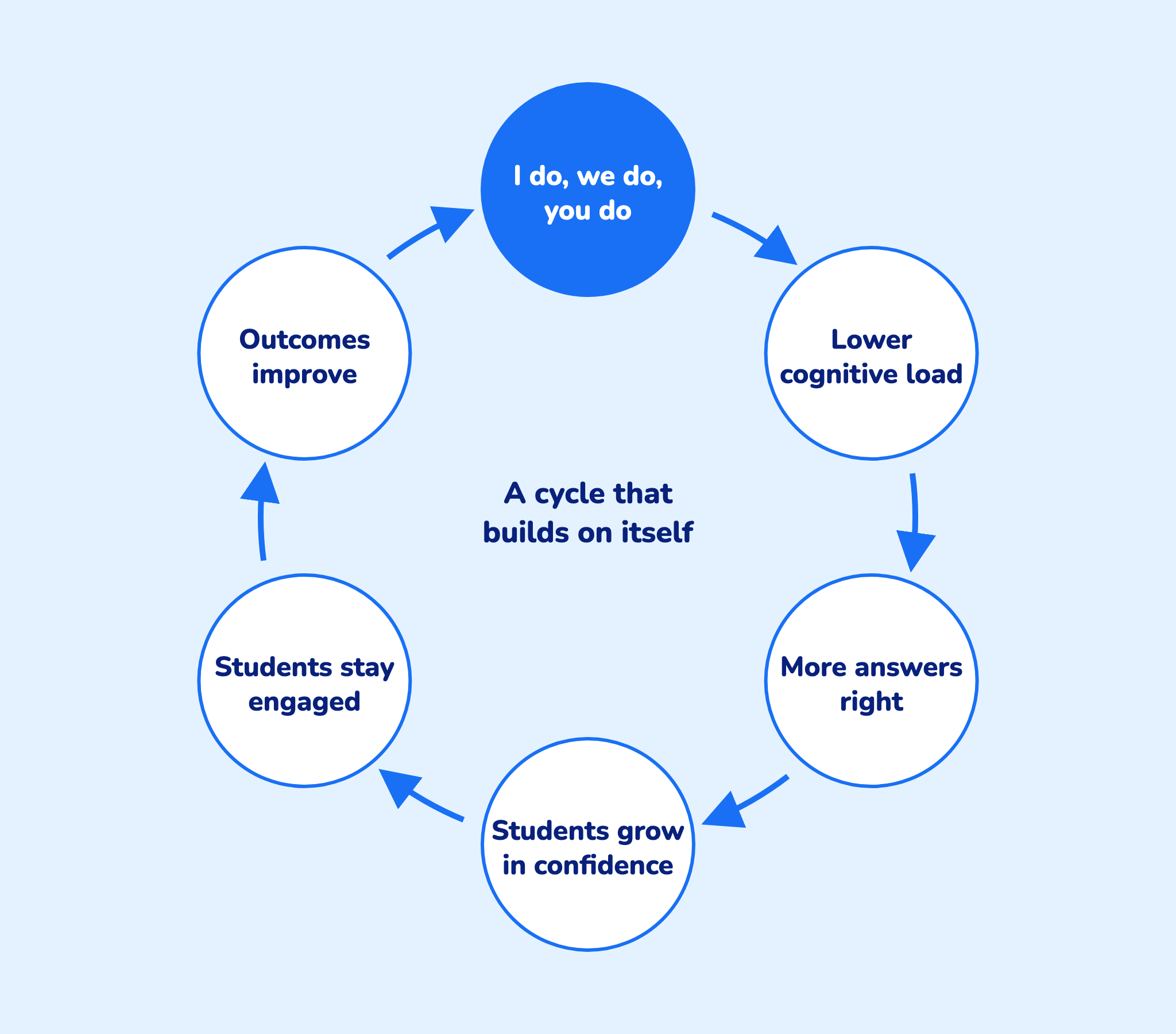
The three phases build on each other. Small steps keep cognitive load low, so students get more questions right early on, and that early success makes them more willing to keep going when the work gets harder.
1. Reduced cognitive load
Modeling and scaffolding take pressure off working memory, so students have more capacity left to learn the new step. The worked example on the board holds the steps, so students do not have to keep them all in their heads. Students master one step of the method before moving on to the next, so they never have to take in the whole procedure at once.

2. Gradual release of responsibility
Responsibility for the learning moves from the teacher to the student in planned steps. Students get support while the method is new, and you take it away once they can manage without it, so they end up as independent learners.
3. A point of reference
The worked problems from the “I do” phase become a resource students can return to in future lessons, written on paper or saved on screen. That means they can get unstuck without waiting for you.
4. Immediate feedback
Guided work gives students feedback while the skill is still fresh, which helps them develop the habit of monitoring their own progress, an important part of metacognition. It works as formative assessment for you too: you can see who understands and adjust the lesson as it happens.
Our math tutoring for schools uses the same structure during the school day, and in one-on-one sessions the pace and scaffolding can respond to every answer.
How to use I do, we do, you do in your classroom
The method depends on careful planning and on breaking new material into small pieces. Teachers who plan the three phases together, rather than one at a time, usually find the lesson flows better.
Planning tips
- Plan your examples and questions in advance, ordered from easiest to hardest.
- Present new material in small steps, creating a clear sequence from one step to the next.
- List the common misconceptions for the topic and use them to choose your examples and questions.
Delivery tips
- Model in silence first so students can give each step their full attention.
- Then think aloud, explaining your reasoning as you write each step.
- Give students time to process the worked examples before they practice.
- Use scaffolded problems during guided practice and encourage students to explain their thinking to each other.
- Check understanding in every phase, and move on only when students are secure.
- Save real-life contexts and problem solving for the “you do” phase.

Former teachers and math experts design every Third Space Learning lesson. Each comes with notes on the best prompts and questions for every stage, built into the guidance Skye follows. In one-on-one sessions, our online math tutor, Skye, can see exactly which step a student gets stuck on during guided practice and go back to the modeling step before a misconception sets in. Students also get extra time to practice the new skill out loud, with Skye listening and responding. Once students are secure, the “Go further” step asks them to use the skill in a new or problem-solving context, so every student is stretched.
I do, we do, you do and Rosenshine’s principles of instruction
This approach lines up closely with Rosenshine’s principles of instruction, which Barak Rosenshine published for teachers in American Educator in 2012. In his 2019 book Rosenshine’s Principles in Action, Tom Sherrington grouped the ten principles into four strands, which make the links easy to see:
- Sequencing concepts and modeling: present new material in small steps, with models and scaffolds.
- Questioning: ask lots of questions and check every student’s understanding.
- Stages of practice: use guided and independent practice to reach a high success rate.
- Reviewing material: review prior learning regularly.
1. Sequencing concepts and modeling
This strand matches the first two phases most closely. Rosenshine recommends presenting new material in small steps and giving students worked models and scaffolds for difficult tasks, and that is what the “I do” and “we do” phases are for.
2. Questioning
Asking lots of questions shows teachers what students have understood. In this approach most of that questioning happens during guided practice, where you can respond to an answer straight away as part of ongoing assessment.
3. Stages of practice
Rosenshine argues for guided practice, then independent practice, with tasks designed so students get most questions right on the first try. He suggested a success rate of around 80%. Gradual release keeps students succeeding as they move from “we do” to “you do”.
4. Reviewing material
The final strand is regular review of earlier learning, daily, weekly and monthly. Rosenshine recommends starting each lesson with a short review, and returning to earlier learning weekly and monthly helps students remember today’s lesson weeks later.
If you choose the examples and questions for all three phases before the lesson starts, it becomes much easier to judge when to hand the work over to students, whatever the grade or subject.
I do, we do, you do FAQs
It is a teaching approach that begins with the teacher modeling a new skill (I do). This is followed by scaffolding, collaboration and guided practice (we do), and then independent practice (you do).
The new skill is broken into small steps, and students take on more responsibility for it gradually. That keeps the demand on working memory low from one example to the next as students become more confident.
It lines up with several of Rosenshine’s recommendations: present new material in small steps, provide models and worked examples, scaffold difficult tasks, ask lots of questions, check for student understanding, use guided practice and give independent practice.
Do you have students who need extra support in math?
Skye – our AI math tutor built by experienced teachers – provides students with personalized one-on-one, spoken instruction that helps them master concepts, close skill gaps, and gain confidence.
Since 2013, we’ve delivered 2,295,000 math tutoring sessions to 196,000 students, guiding them toward higher math achievement.
Discover how our AI math tutoring can boost student success, or see how our math programs can support your school’s goals:
– 3rd grade tutoring
– 4th grade tutoring
– 5th grade tutoring
– 6th grade tutoring
– 7th grade tutoring
– 8th grade tutoring