Help 7th graders build confidence and master grade-level math
7th grade math introduces proportional relationships, two step equations and rational numbers – and word problems demand more problem solving than ever.
Without a strong foundation from earlier grades, many students struggle to keep pace. Gaps widen, confidence drops, and grades slip.
AI math tutor Skye delivers personalized one-on-one 7th grade math tutoring online, working through each child’s gaps at their own pace – every child gets their own AI tutor, at the exact level of that student, all at the same time.
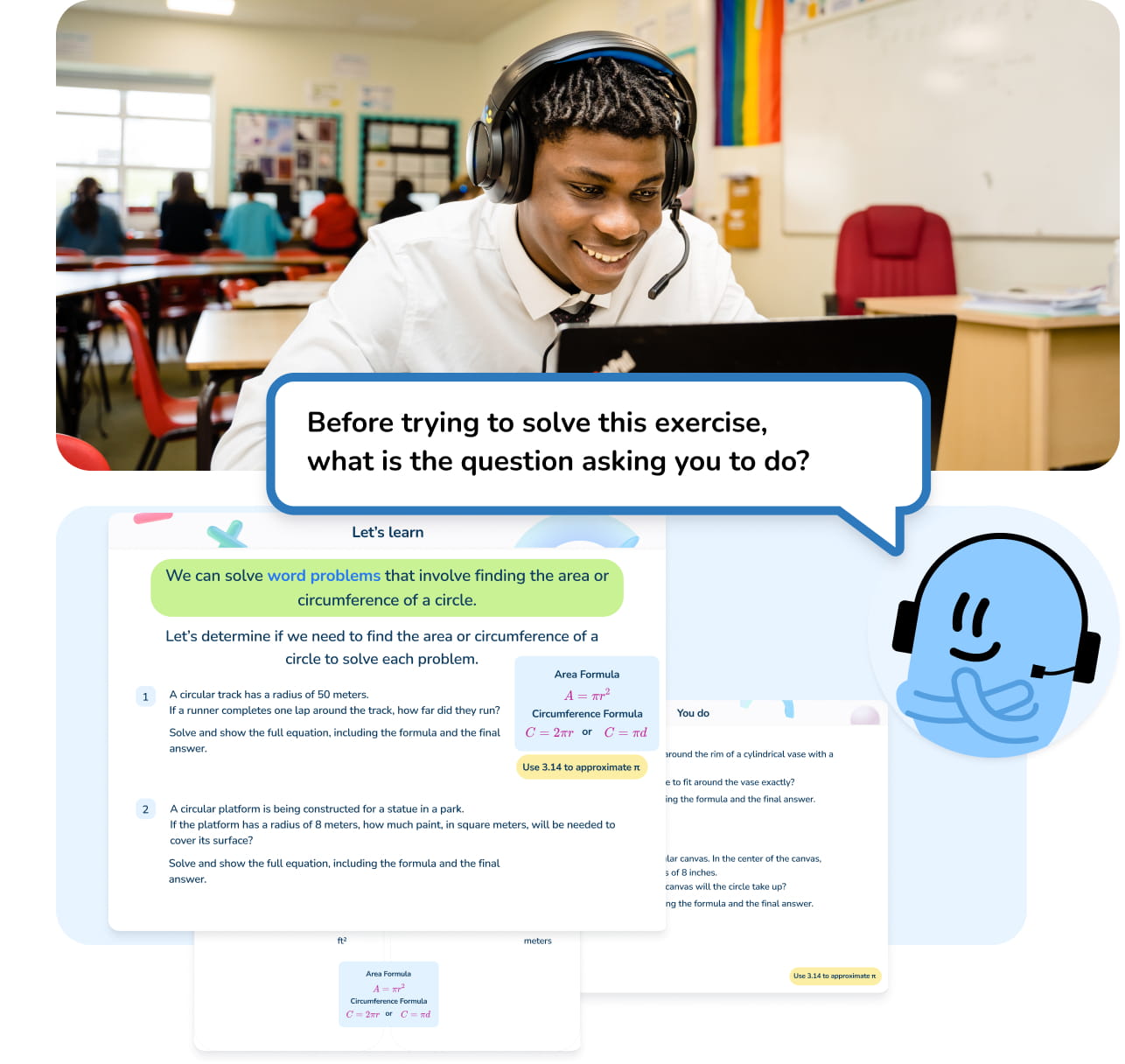
“With Skye, students have to take the time. They have to understand what was wrong, why it was wrong, and how to fix it. Coming from a program where kids are just clicking through to get to the end, to one where they’re monitored, directed, assisted, and held accountable for their learning – that’s amazing.”
Kathy Garcia, Principal
Moffat PK-12, Colorado
Structured 7th grade math lessons designed by teachers
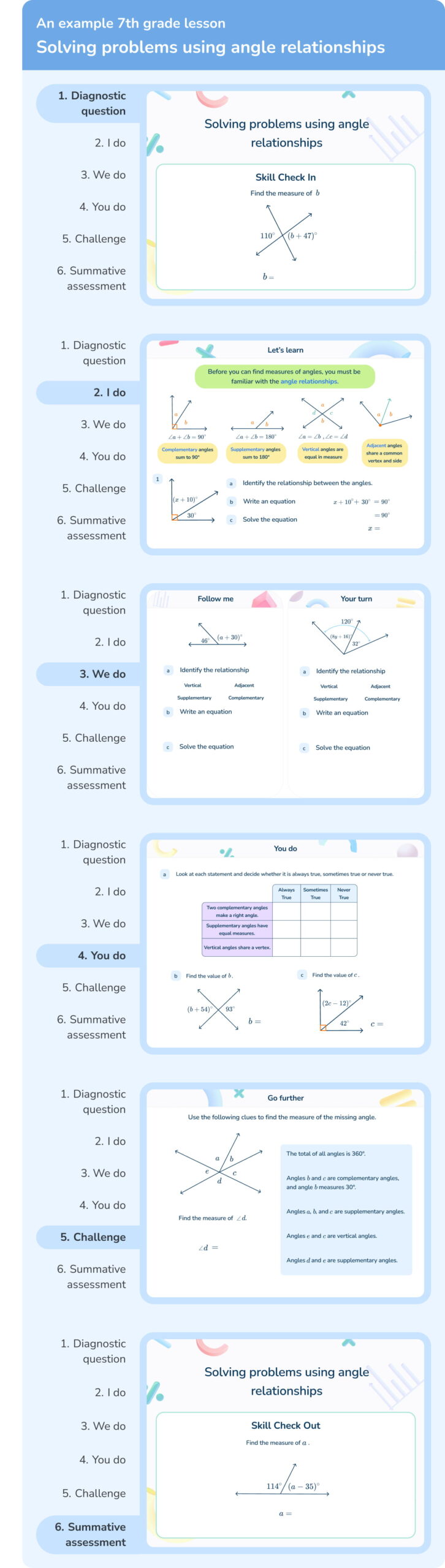
Every 7th grade math lesson follows an “I do, we do, you do” structure built by certified teachers to develop understanding of grade-level math concepts and skills.
Trained on every lesson in the curriculum, Skye adapts teaching to individual learning needs, addressing misconceptions, building confidence and securing the knowledge required for 7th grade success.
Every math tutoring session:
Starts with a short diagnostic assessment
Moves straight to independent practice if secure
Provides guided support where needed
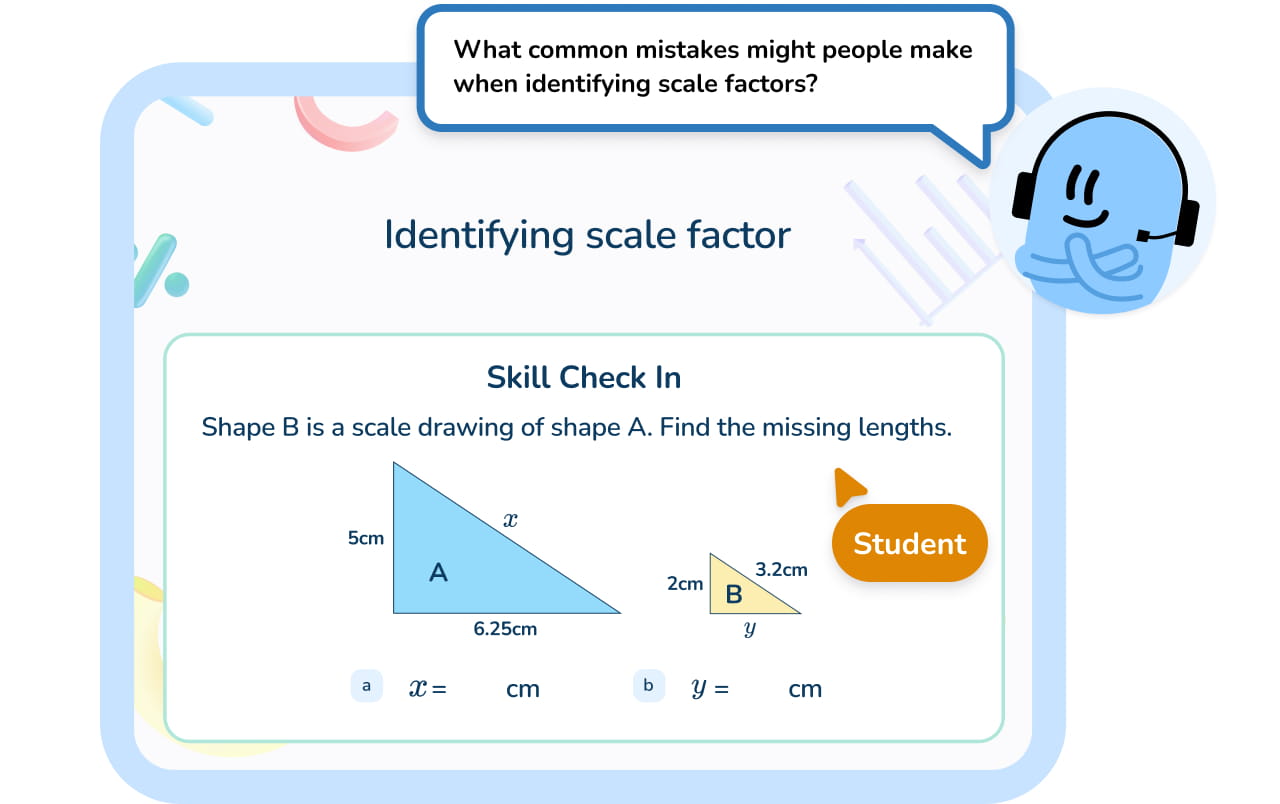
Uses formative assessment throughout to identify misconceptions and provide targeted hints
Ends with a summative assessment to confirm understanding
7th graders are not limited to 7th grade content. A child who has mastered the 7th grade math curriculum can move ahead.
See a 7th grade tutoring session in action
 Press play to see and hear this session
7th grade math tutoring programs, aligned to your curriculum
Skye’s lessons are aligned to the curriculum your school follows, so tutoring
reinforces exactly what students are learning in class
Common Core & State Standards
Domain-based programs for grade 7, aligned to Common Core and all state standards.
View Common Core programsIllustrative Mathematics
Unit-by-unit programs that follow the IM sequence for grade 7, mapped to the unit your class is working through.
View IM programsCommon Core aligned 7th grade math programs
These programs are aligned to Common Core and your state standards. Whether students need more practice with 7th grade standards or have learning gaps from earlier grades, there is a program to match. AI math tutor Skye works through each program one-on-one with every student, adapting to their level as they go.
Click on the program name to view the full scope and sequence.
7th Grade: The Number System
View lessons

7th Grade: The Number System
Learning objectives in this program
Third Space Learning lessons are available for all state standards and for Common Core.
Interpreting quantities that combine to zero
Estimating sums and differences
Adding integers using visual models with counters
Adding integers using number lines
Subtracting integers using integer addition understanding
Applying addition and subtraction integer rules
Applying the rules for adding integers with the same signs
Adding rational numbers
Subtracting rational numbers
Adding and subtracting rational numbers with word problems
Estimating products and quotients
Understanding multiplying by a negative integer using a number line
Applying integer multiplication rules
Understanding integer division by using visual models with counters
Applying integer division rules
Multiplying rational numbers
Dividing rational numbers
Multiplying and dividing rational numbers with word problems
Converting fractions to decimals
Solving multi-step word problems with rational numbers
About this program
The program features 19 high-impact topics, each thoughtfully designed to address the key concepts and skills crucial for mastering The Number System
How are lessons ordered?
The default order has been set by our academic team to align with your state standards. Schools can pick one of our alternative sequences to re-prioritize domains, or send us their assessment data for us to pick the most appropriate sequence.
Want to speak to our friendly team? Book a call.
7th Grade: Ratio & Proportional Relationships
View lessons
7th Grade: Ratio & Proportional Relationships
Learning objectives in this program
Third Space Learning lessons are available for all state standards and for Common Core.
Simplifying fraction ratios
Calculating unit rates with fractions
Working with equivalent ratios
Understanding proportional relationships
Determining proportional relationships from tables
Determining proportional relationships from graphs
Understanding the unit rate as the constant of proportionality
Representing proportional relationships with equations
Understanding graphs of proportional relationships
Understanding graphs of proportional relationships with fractions
Solving multi-step proportion problems
Solving percent problems: Tax, markups/markdowns, fees
Solving percent problems: Percent change
Solving percent problems: Simple interest
Solving percent problems: Multistep word problems
About this program
The program features 15 high-impact topics, each thoughtfully designed to address the key concepts and skills crucial for mastering Ratios and Proportional Relationships.
How are lessons ordered?
The default order has been set by our academic team to align with your state standards. Schools can pick one of our alternative sequences to re-prioritize domains, or send us their assessment data for us to pick the most appropriate sequence.
Want to speak to our friendly team? Book a call.
7th Grade: Statistics & Probability
View lessons
7th Grade: Statistics & Probability
Learning objectives in this program
Third Space Learning lessons are available for all state standards and for Common Core.
Understanding random sampling
Drawing inferences from sample distributions
Comparing two populations with dot plots
Comparing two populations with box plots and histograms
Understanding probability of a chance event
Calculating the theoretical probability of a simple event
Understanding experimental probability
Using simulation to estimate probabilities
Creating sample spaces of compound events
About this program
The program features 9 high-impact topics, each thoughtfully designed to address the key concepts and skills crucial for mastering Statistics and Probability.
How are lessons ordered?
The default order has been set by our academic team to align with your state standards. Schools can pick one of our alternative sequences to re-prioritize domains, or send us their assessment data for us to pick the most appropriate sequence.
Want to speak to our friendly team? Book a call.
7th Grade: Geometry
View lessons
7th Grade: Geometry
Learning objectives in this program
Third Space Learning lessons are available for all state standards and for Common Core.
Using scale factor to solve problems
Identifying scale factor
Evaluating changes in perimeter and area related to scale factor
Constructing triangles
Describing parallel and perpendicular cross sections of 3-dimensional solids
Understanding measurements of a circle
Calculating the circumference of a circle
Calculating the area of a circle
Solving word problems with circles
Solving problems using angle relationships
Evaluating areas of composite shapes
Solving real world problems with areas of polgyons
Calculating volume of right prisms and pyramids
Solving real world problems with volume
Solving real world problems with surface area
About this program
The program features 15 high-impact topics, each thoughtfully designed to address the key concepts and skills crucial for mastering Geometry.
How are lessons ordered?
The default order has been set by our academic team to align with your state standards. Schools can pick one of our alternative sequences to re-prioritize domains, or send us their assessment data for us to pick the most appropriate sequence.
Want to speak to our friendly team? Book a call.
7th Grade: Expressions & Equations
View lessons
7th Grade: Expressions & Equations
Learning objectives in this program
Third Space Learning lessons are available for all state standards and for Common Core.
Adding and subtracting linear expressions
Factoring linear expressions
Expanding linear expressions
Identifying equivalent linear expressions
Rewriting linear expressions to reveal relationships
Evaluating numerical expressions involving positive and negative rational numbers
Solving two-step equations
Writing and solving two-step equations to solve real-world problems
Comparing solution methods
Solving and graphing two-step inequalities
Solving inequalities with negative coefficients
Solving word problems with two-step inequalities
About this program
The program features 12 high-impact topics, each thoughtfully designed to address the key concepts and skills crucial for mastering Expressions & Equations.
How are lessons ordered?
The default order has been set by our academic team to align with your state standards. Schools can pick one of our alternative sequences to re-prioritize domains, or send us their assessment data for us to pick the most appropriate sequence.
Want to speak to our friendly team? Book a call.
Illustrative Mathematics aligned 7th grade math programs
Programs aligned to the Illustrative Mathematics scope and sequence for grade 7. Unit 1 is available now, with the remaining units coming soon.
Grade 7, Unit 1: Scale Drawings
View lessons
Grade 7, Unit 1: Scale Drawings
Learning objectives in this program
Each learning objective includes concept review, guided practice, independent practice and challenge problems.
Identifying scaled figures and their corresponding parts
Using scale factor to solve problems
Identifying scale factor
Comparing scale factors and their reciprocals
Evaluating changes in perimeter and area related to scale factor
Converting scale factors
About this program
The program features 6 high-impact topics, each thoughtfully designed to address the key concepts and skills crucial for mastering Unit 1: Scale Drawings.
How are lessons ordered?
The default order has been set by our academic team to align with your state standards. Schools can pick one of our alternative sequences to re-prioritize domains, or send us their assessment data for us to pick the most appropriate sequence.
Want to speak to our friendly team? Book a call.
Grade 7, Units 2 to 9
Coming soon
Grade 7, Units 2 to 9
Learning objectives in this programme
All programmes begin with a diagnostic assessment to identify gaps
Why choose online 7th grade math tutoring with Skye
7th grade is where gaps from earlier grades catch up. Students face proportional relationships, negative numbers, inequalities and equations that build directly on what came before.
Online math tutoring with Skye helps students close those gaps before they widen. With 4,000+ schools already using Third Space Learning, students consistently build confidence and accelerate their math growth – closing gaps that would otherwise follow them into 8th grade and beyond.
Personalized support at every child’s level
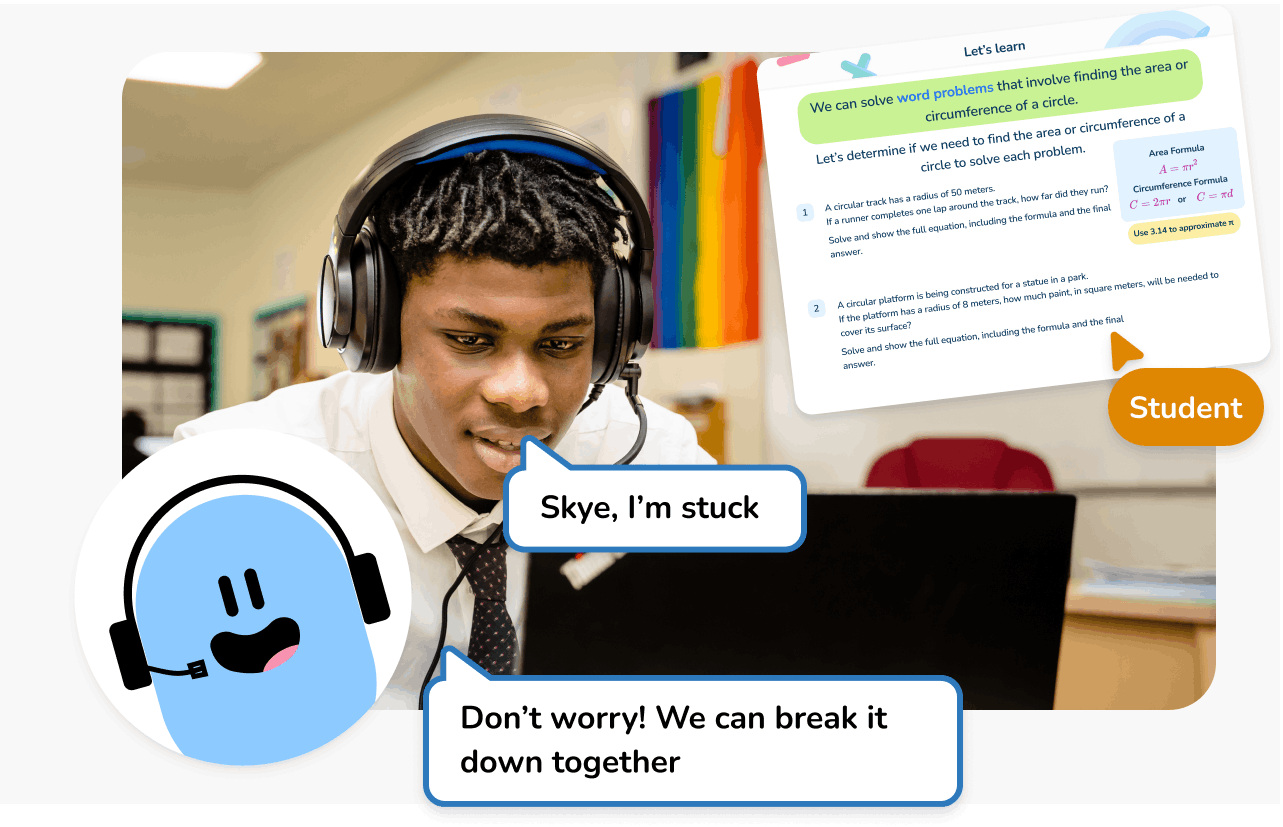
Every child learns differently. Skye creates a customized learning plan based on a diagnostic, then adapts in real time – giving hints when students struggle with new concepts and moving ahead when they’re ready.
That’s personalized support that would be impossible in a class of 30, but Skye makes it available to every student, every week.
Try for free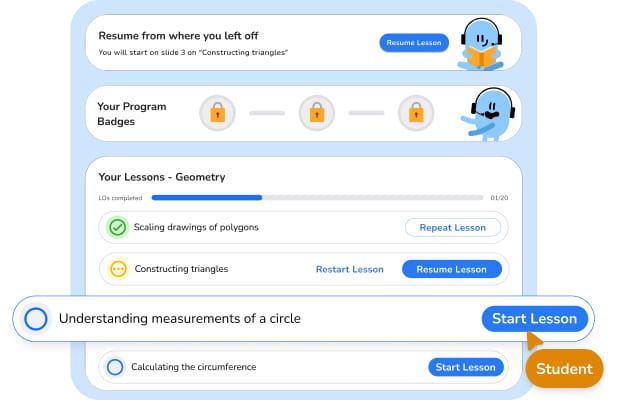
Homework help and test taking strategies
Students can connect with Skye for math homework help and practice problems outside scheduled sessions. Parents and families appreciate that their child has access to one-on-one support with homework and assignments whenever they need it.
Skye also helps students prepare for tests and quizzes with test taking strategies that build confidence and help grades improve across subjects.
One fixed cost
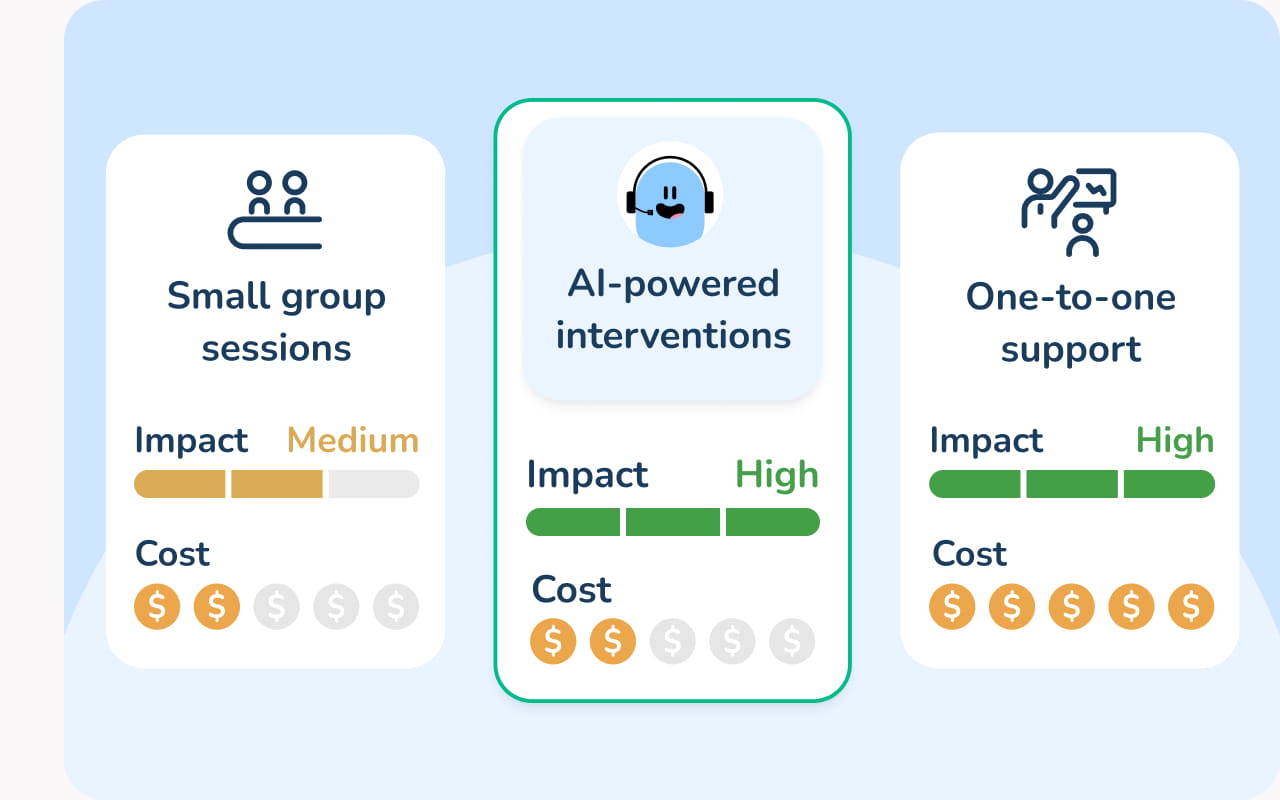
Hiring a math tutor in person typically costs $40 to $69 an hour per student. For most parents, that adds up fast across a whole grade.
Skye is one fixed yearly cost (from $5,000) for unlimited one-on-one online math tutoring – every student, every week. Save up to 97% compared to other providers and fund it through Title 1 or ESSER.
View pricing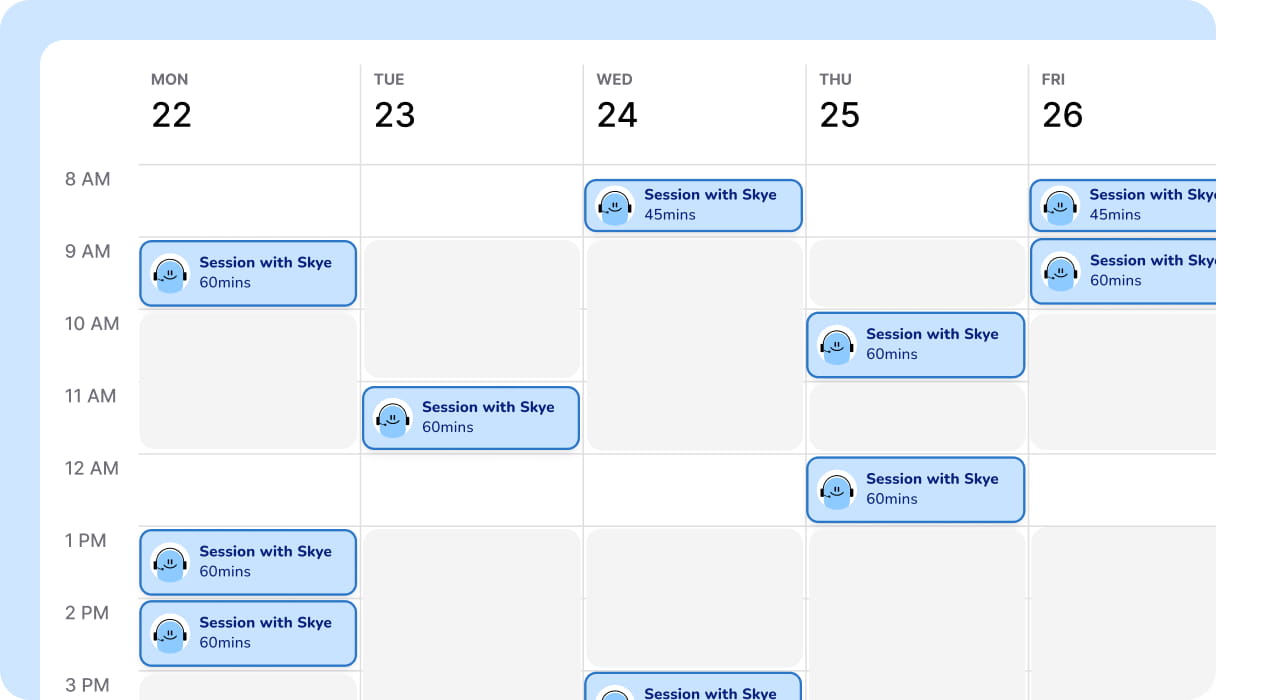
How 7th grade math tutoring works in your education setting
Personalized one-on-one online tutoring for every student at once, delivered by AI math tutor Skye at a day and time that works for you. Students connect with Skye for short sessions before, during or after the day – with progress reports sent to teachers each week so they can focus on what every child needs next. Whether you run 20 or 200 sessions a week, the cost stays the same.
Book a free 7th grade math tutoring pilot for your school or district
See Skye in action – explore the online classroom, preview 7th grade math lessons aligned to your state’s standards and find out why 4,000+ schools have chosen high impact one-on-one tutoring from Third Space Learning:
Proven to accelerate growth in half the time
Save up to 97% compared to hiring a tutor in person
Scalable and easy to set up across multiple grades and buildings
Flexible scheduling to fit your needs
You can learn more about how we keep your data safe and secure in our privacy policy.
Frequently asked questions
What type of math do you learn in 7th grade?
7th grade math covers two step equations, proportional relationships, rational numbers, negative numbers, fractions, decimals, geometry and inequalities. Problem solving and word problems get harder, and students build the math skills they need for 8th grade and algebra.
How can I help my 7th grader with math?
The best way to support a struggling 7th grader is consistent one-on-one tutoring that fills gaps from earlier grades while keeping pace with new concepts. AI math tutor Skye works through personalized 7th grade math lessons at each child’s own pace, building confidence and closing misconceptions before they grow. Many parents find that regular online tutoring makes a bigger difference than homework help alone.
Is $40 an hour for tutoring a lot?
In person tutoring typically costs $40 to $69 an hour per student – over a year, that adds up fast. Third Space Learning offers unlimited one-on-one tutoring with Skye for one fixed yearly cost (from $5,000 per year), which works out far less per child.
How much does a math tutor cost?
Costs vary. In person tutoring ranges from $40 to $69 per hour. Online tutoring platforms can be cheaper but may not offer genuine one-on-one support. AI math tutor Skye provides unlimited personalized tutoring for a fixed yearly fee (from $5,000), making it affordable for districts looking to give every student the education support they need.
Is math tutoring worth it?
For students struggling with 7th grade math, tutoring makes a measurable difference. The key is consistency – regular sessions that target each student’s specific gaps through math intervention, not generic practice. Schools using Third Space Learning have seen students accelerate growth and build lasting confidence. Skye delivers exactly that, adapting to what each child needs.
What is an algebra tutor?
An algebra tutor focuses on helping students solve algebraic problems and prepare for algebra 1 and algebra 2 in high school. Skye covers algebra topics as part of 7th grade math tutoring – solving equations, working with inequalities and building the problem solving skills students need to succeed.
What does 7th grade math tutoring cover?
Tutoring with Skye covers all key areas of the 7th grade math curriculum, aligned to Common Core and state standards. Topics include proportional relationships, rational numbers, fractions, decimals, geometry (area, circumference, volume), equations, inequalities and statistics. Students also solve word problems and practice problems that develop reading comprehension and problem solving across subjects like science.
Can I pay someone to take a class for my child?
Rather than paying someone to take a class, students learn more by getting the right support to succeed themselves. AI math tutor Skye provides one-on-one 7th grade math tutoring that adapts to each student’s level, helping them build a strong foundation and the confidence to keep up. Sessions fit during the day so students get consistent support without missing other subjects like science and reading.