

29 SATs Preparation & Revision Tips For Year 6 Teachers

As we approach the KS2 SATs, the pressure isn’t just felt in the classroom – it’s felt at the kitchen table. Effective SATs preparation relies on a strong partnership between school and home. To help you bridge that gap, we’ve drawn on our decade of experience preparing pupils for KS2 SATs to compile 29 actionable tips for parents and pupils to support home learning and revision.
These tips have been designed to be ready to share in parent newsletters, workshops, or home-learning packs to ensure Year 6 pupils (and their parents!) stay confident and calm both at school and home ahead of the KS2 SATs.
Key takeaways for SATs success
- Partnership is priority: Success comes from alignment between teachers and parents; use consistent language (e.g., ‘not yet’ instead of ‘can’t’).
- Focus on gaps, not just volume: Use diagnostic tests to identify specific weaknesses rather than doing endless, repetitive practice papers.
- Mindset over marks: Prioritise confidence and stress reduction; avoid words like ‘pass’ or ‘fail.’
- Master exam technique: Teach active strategies like underlining keywords, eliminating wrong answers, and using mnemonics.
- Practical preparation: Small changes like a hearty breakfast, a quiet study space, and a clear revision calendar make a massive difference.

Year 6 SATs Presentation for Parents
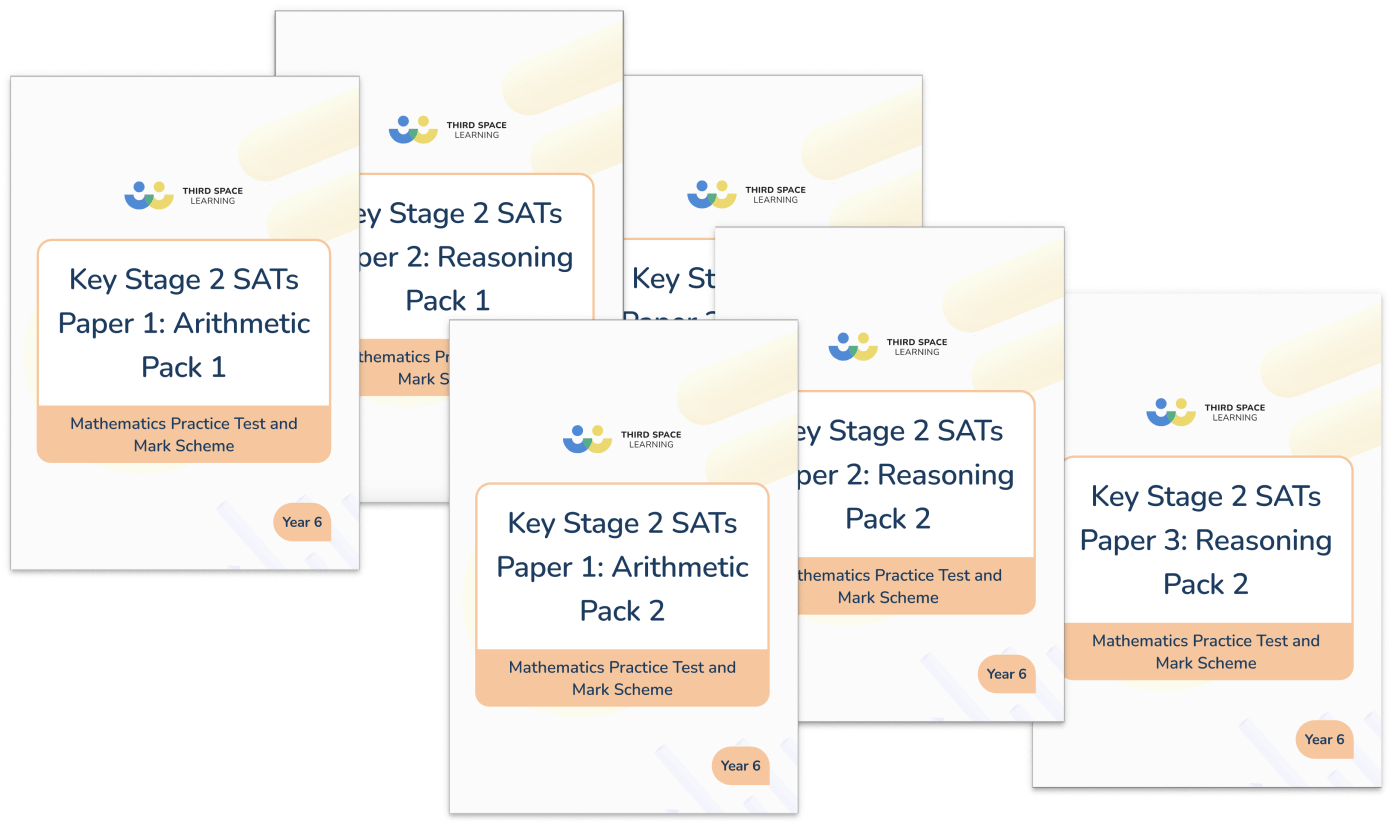
Download a free PowerPoint you can share with parents at your school to help them understand everything about SATs!
Download Free Now!What are the KS2 SATs?
In England, the Year 6 SATs are a series of national assessments taken by children at the end of Key Stage 2, typically when they reach the age of 11. Standard Assessment Tests (SATs) are compulsory at state primary schools in England, while private prep schools can choose whether pupils take them.
The results of Year 6 SATs help teachers understand which pupils need extra support as they prepare to transition to secondary school. Year 6 SATs results are also used by some secondary schools to help group students into sets or streams.
SATs are designed to assess children’s knowledge of the Key Stage 2 national curriculum. Children in Year 6 will sit the Year 6 SATs test papers in English and Maths, covering:
- English reading
- English SPaG (spelling, grammar and punctuation)
- mathematics (arithmetic and reasoning)
Year 6 SATs are held in the month of May each year when children are 10 or 11 years old. Students will sit the following exams:
- KS2 reading SATs: One paper (1 hour)
- KS2 English grammar, punctuation and spelling SATs: a grammar and punctuation paper (45 minutes) and a 20-word aural spelling test (around 15-20 minutes).
- KS2 maths SATs:
- Paper 1 is the arithmetic paper (30 minutes)
- Papers 2 and 3 will involve a wider range of question types including multiple choice, true or false and reasoning based (40 minutes each).
The results of Year 6 SATs are shared with parents before children leave primary school in July. Each child receives a scaled score which ranges from 80 to 120, with a score of 100 being average or the expected standard. You can learn more about the standardised scores and scaled scores used in the KS2 SATs on our blog.

How to help parents support key stage 2 SATs revision at home
The following tips focus on Year 6 SATs revision at home and encourage parents to not only use SATs practice papers, but also spend time addressing gaps and building pupils’ confidence. Remember that effective SATs preparation involves gradual skill building starting at least 3–6 months before the test date.
SATs Tip 1: Help your child understand their mistakes
There is nothing wrong with making a mistake, as long as it is learned from.
By using any mistakes your child makes in their revision as a learning exercise, not only are you helping them to better their knowledge of the topic they are revising, but you are also helping to lessen the panic and stress that can come with “not knowing how to do something.”
Remember, mistakes are great as they can help you to learn!
SATs Tip 2: Focus on the gaps in your child’s knowledge
It might sound obvious, but the most important thing to help your child revise is the topic(s) that they struggle the most with.
Your child can revise as many questions as they like, but if the core understanding of a topic isn’t there they will be unable to tackle them and will find their stress levels increasing. Equally, time spent reviewing subject areas where pupils are already secure may be better spent working on higher priority areas.
Teachers, use a diagnostic test to identify pupils’ weaker areas. Then, bridge the gap between school and home by sharing information with parents and providing resources for parents to target the specific topics where their child needs the most support. The Third Space Learning resource hub has a range of worksheets and intervention packs, including free SATs revision lesson packs, available for free, covering KS1 and KS2 maths topics.

Unlimited primary maths tutoring with Skye, the voice-based AI maths tutor.
Built on the same principles, pedagogy and curriculum as our traditional tutoring, but with more flexibility, reach and lower cost.
Join the schools already helping hundreds of primary pupils nationwide with Skye’s one to one maths tutoring.
Watch Skye in actionSATs Tip 3: Put most of your efforts into boosting your child’s confidence
Here at Third Space Learning, we put a huge amount of our focus on improving children’s confidence in maths as we know that by doing this it builds the foundations for future success.
Often children think, especially with maths, that they are bad at a certain subject or topic.
Pupils working on maths they find challenging might say:
“I can’t do fractions” or “Times tables are too hard”.
Don’t worry. We have a simple solution.
One of our best Key Stage 2 SATs tips is to sit with your child and change this perception.
Work with them on the areas they lack confidence in, and change:
“I can’t do fractions” to “I don’t know the answer to this fractions question yet, but I am going to figure it out.”
Confidence is key when it comes to SATs and learning in general in primary school.
SATs Tip 4: Take revision online to keep things fresh and exciting
As well as playing host to a number of games and other ways to waste time, the internet can provide a plethora of revision resources for your child.
The online world is one that children love, so why not make the most of this and get them to practise their maths and English online?
Third Space Learning provides primary AI maths tutoring delivered by Skye, the AI maths tutor, with programmes specially targeted at the KS2 maths SATs. Also take a look at this list of the best free maths homework sites including sites like BBC Bitesize.
SATs Tip 5: Make sure you’re both aware of what’s coming up
Preparation is everything here. Look at practice papers, find out what sorts of questions come up, and know which SATs papers your Year 6 will be sitting on which days.Use these free sats papers for maths practice as they’ve been designed to match the real thing as closely as possible. Remember that practice tests should be taken in quiet spaces without distractions to build stamina.
How to help parents to support pupils’ exam technique
Something that is crucial but often forgotten about is exam technique.
The KS2 SATs will likely be the first time pupils will sit an official test/exam. Ahead of the test, share these simple exam technique strategies (like mnemonics) with parents so they are using the same language at home that you use in the classroom.
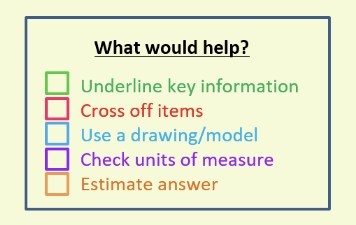
SATs Tip 6: Teach your child to eliminate any wrong answers
For any questions that have multiple answers in the SATs paper, only one of them is going to be correct and this is why you should remind your child to eliminate any answers they know to be wrong.
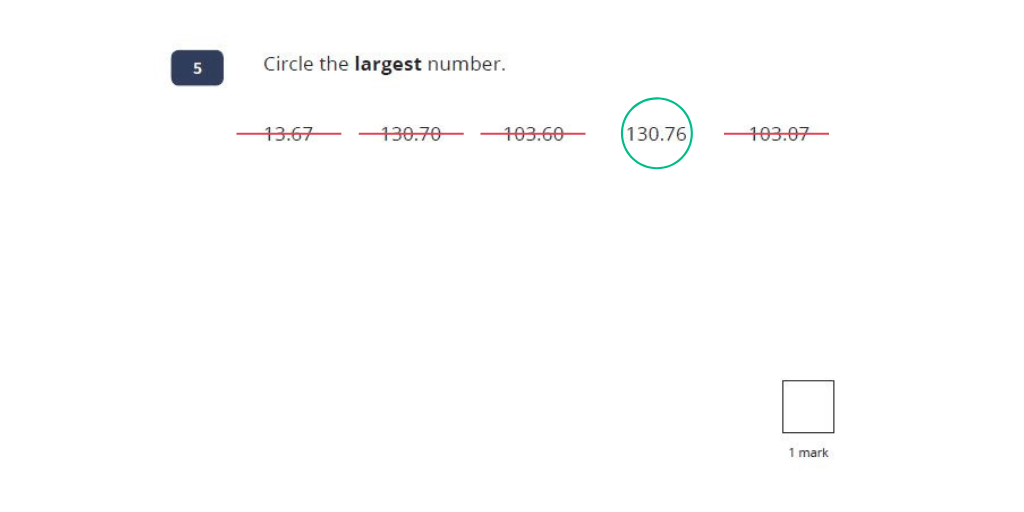
By doing this they are removing any doubt they may have had about the question and it can be a good way to focus during an exam.
Download past SATs papers and work through them with your child, verbalising your approach and strategies.
SATs Tip 7: Make sure they pay attention to the connotations and context of the questions
Sometimes the questions in KS2 SATs papers use words that can help to indicate certain actions that your child will need to take, so it is worth keeping an eye out for these.
For example, if “Johnny has four more apples than Ben” the question is likely to be about addition.
Whereas if “Ben has 15 fewer apples than Johnny”, the question is likely to be about subtraction.
Run through some examples of these types of questions with your child, helping them to identify the words that may help them answer the question as you go.
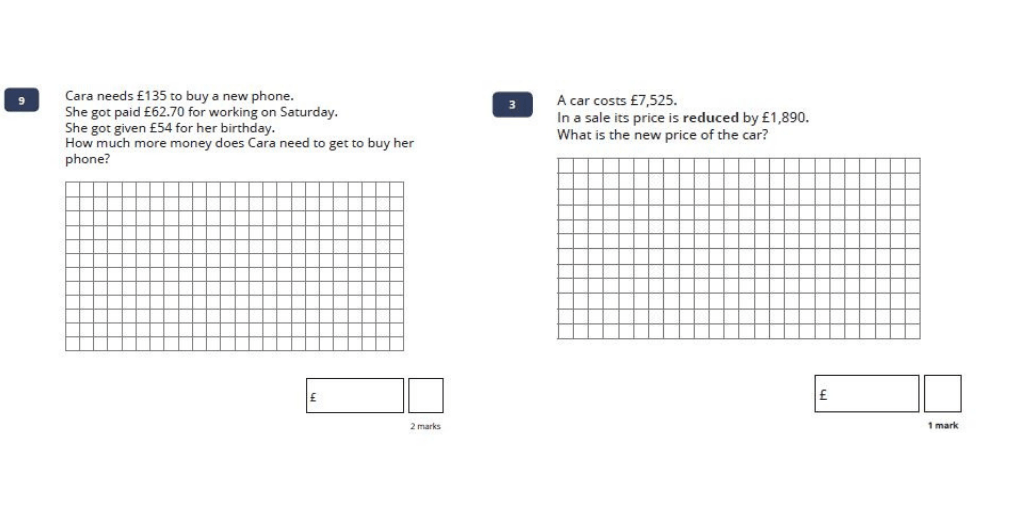
SATs Tip 8: Remind them to underline key parts of the question
This is another simple tip, but if children are not reminded to do it they can often forget when they are immersed in their SATs test.
By simply underlining key parts of the question they are working on, it will help them to focus on specific calculations or problems that need to be solved.
This tip is especially relevant as a KS2 SATs preparation tip for the maths tests.
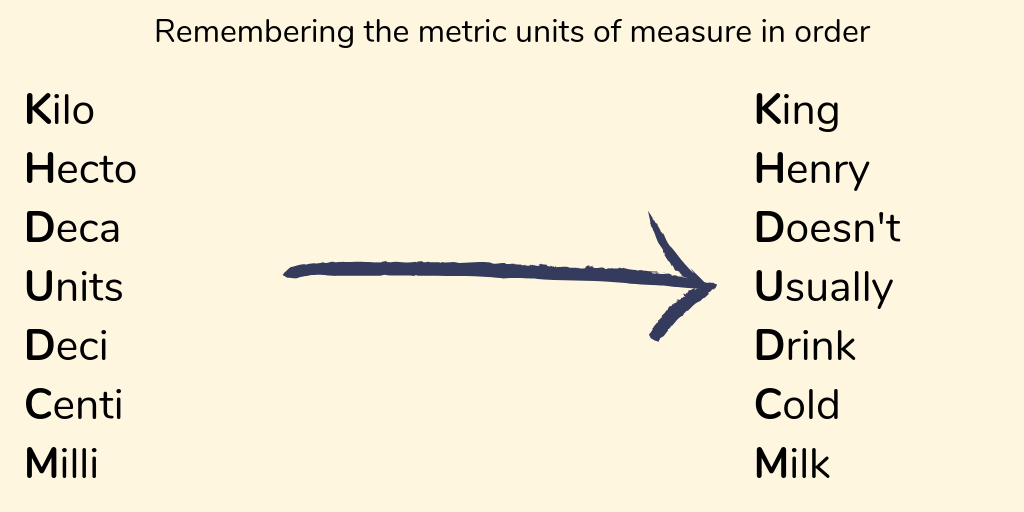
SATs Tip 9: Make up and make use of mnemonic devices
Whether its:
I View X-Rays to remember the order of the Roman Numerals for 1,5 and 10;
KFC to remember the way to divide fractions (Keep the first fraction. Change the sign from divide to multiply. Flip the last fraction)
or simply
Going across the hallway and then up the steps when plotting ordered pairs on a coordinate grid,
mnemonic devices are a great way to help your child remember everything they need for their SATs.
SATs Tip 10: Remind them to take their time in the tests
Rushing equals mistakes, so one of our most important SATs tips is to remind your child to take their time and start with the harder questions on the paper.
It can be easy for children to try and go through the paper as quickly as possible in an attempt to make sure it is completed, but this is not best practice when it comes to any type of exams!
How to keep children calm during SATs preparation
SATs Tip 11: Reduce stress over the weekends in the run up to the SATs
The weekends before SATs should play host to a minimum of schoolwork and the revision that is being done should be done with a light touch.
The rest of the time should be spent doing something that your child finds relaxing, and that could be anything from having a kick around outside to visiting a petting zoo. The key is to remove as much stress as possible from your child’s weekend routine!
SATs Tip 12: Put the tests into perspective for them
When you are a 10 or 11-year-old, SATs can seem like a much bigger deal than they should do.
At that age, you see these tests as something that you have been working towards for a long period of time, and whilst they are important, SATs are not the be-all and end-all.
Remind your child that whilst they should always try their hardest, you’ll still be proud of them whatever happens in the tests.
SATs Tip 13: Talk to your child about their stress and listen
It is very important that you speak to your child throughout the entire SATs period and discuss with them anything they may be finding stressful.
Your child trusts you, and by just lending your ear to their worries and fears you will find that they are a lot less stressed than they otherwise might be.
SATs Tip 14: Use the right language around the home
There should be no mentions of “passing” or “failing” in the run up to, or during the SATs. It is up to you to set the right tone around your home.
You should also look to replace negative phrases that your child may say with positive ones with examples being:
“I can’t do this, I think it’s too hard” becomes “I am going to work hard to get better at this.”
and“I feel stupid” becomes “I only feel like this right now because I’m nervous about the tests.”
SATs Tip 15: Discuss the concepts of anxiety and stress with them
With your child being such a young age when they sit the SATs, this could be the first time they experience anxiety or stress so they may not know how to describe what they are feeling.
The best thing to do is to simply sit with your child and discuss both the physical and mental effects stress and anxiety can have to help them articulate anything they may be feeling.
SATs Tip 16: Keep calm and carry on – It’s only the SATs
As a parent, panicking during the SATs is the worst thing you can do. Children will pick up on this so try not to create worry in the run up to SATs week, and keep things cool, calm and collected! If they don’t feel like tidying their room this week, now isn’t the time to have a battle over it.
SATs Tip 17: Remain positive throughout the SATs
Similar to the above point, it is crucial that you remain positive in the run up to, and during SATs week. If you are anything other than positive about the KS2 tests, then this can trickle down to your child and affect their attitude about the SATs.
SATs Tip 18: Remember that SATs are not the be-all and end-all
Whilst we’ve already made sure that you remind your child that the SATs are not the most important thing they will ever do, it is also important for you to remember this fact!
This will help to prevent confusion for both you and your child, and should ensure that you are both prepared when SATs week rolls around.
SATs Tip 19: Celebrate your child’s success in getting here
Your child has done exceptionally well to get here, and you should be celebrating this fact.
Having gone through six years of primary school education to get to this point, it is about time for a celebration or two for the years spent building up to this moment.
Year 6 SATs preparation: Practical steps to take at home
Things are already busy in most households, but these five quick KS2 SATs preparation tips can easily be implemented by families to give Year 6 pupils the best opportunity to focus without distractions.
SATs Tip 20: Get the correct test dates in your calendar early
The Year 6 SATs take place over the course of 1-week, so to avoid confusion in the mornings we recommend writing each of the dates of the exams in your calendar so you know what is coming up and when!
Stay up to date with announcements and dates on our SATs page.
SATs Tip 21: Make your home conducive to studying
This doesn’t mean you’ll need a complete remodel of your home, merely that you should do your best to make your home the best possible study environment for your child.
This means doing simple things such as:
- Ensuring that the TV is off during study time
- Creating an area dedicated to study (a desk will do, as long as it is in a quiet room)
- Make sure that all siblings are on board with study time to avoid them disrupting proceedings
SATs Tip 22: Create a revision calendar for your child
If your child knows that on Mondays they will be working on their English, Wednesday for maths and Thursday for everything else, they will be much more likely to get on with their revision as there is no confusion as to what they should be doing.
A calendar or action plan is key to your SATs preparation.
This is one of the most simple SATs tips and tricks for Year 6 children, but it is a highly effective one.
SATs Tip 23: Put aside ten minutes each evening to discuss how their day was
A ten minute conversation about what they learned that day, and how they are feeling about it is a great way to find out if your child is struggling or needs any help with their work.
SATs Tip 24: For SATs week itself, swap the rice crispies for something more substantial
A good breakfast before a day of tests can be the difference between a child thinking about what’s coming for lunch and about the answer to the questions in the test.
Make sure your child has a hearty breakfast before they begin their day and this won’t be an issue.
SATs Tip 25: Put a stop to the morning rush
Set your alarm 10 minutes earlier to make sure you’re ready on the day of the tests. You can also make sure that lunch is prepared and bags are packed the evening before the tests to ensure that your family can be up and out of the door with plenty of time to spare.
By arriving early, it gives your child time to relax and prepare for the coming day, and this is much better than rushing through the gates at 8.44am for an 8.45am start!

Third Space Learning’s KS2 Maths teachers SATs advice
With over 10 years’ experience of bringing our maths tutoring into schools, we’ve gathered some top SATs tips from both our teaching experts here at Third Space Learning and some of our colleagues who are working in schools.
Here’s what they had to say:
SATs Tip 26: Know your strategies for approaching SATs reasoning questions
From Ed, former teacher and member of the Third Space Learning team.
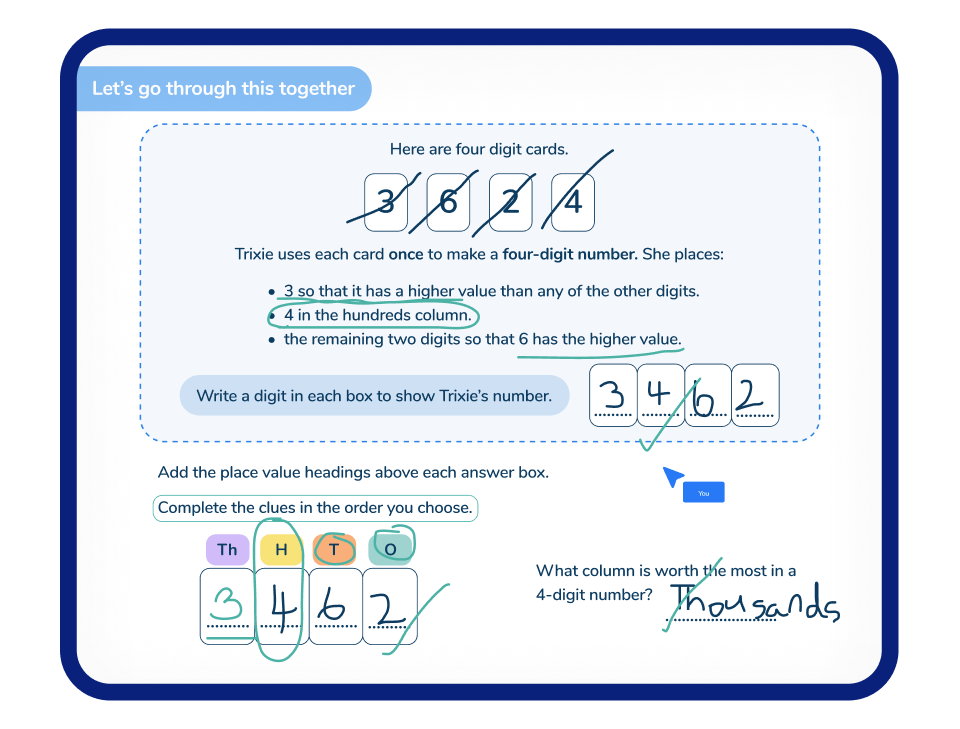
Take inspiration from one of the slides we use in our SATs lessons here. This is an annotated SATs practice question, and it gives children strategies and techniques to help them approach any SATs questions they may come up against.
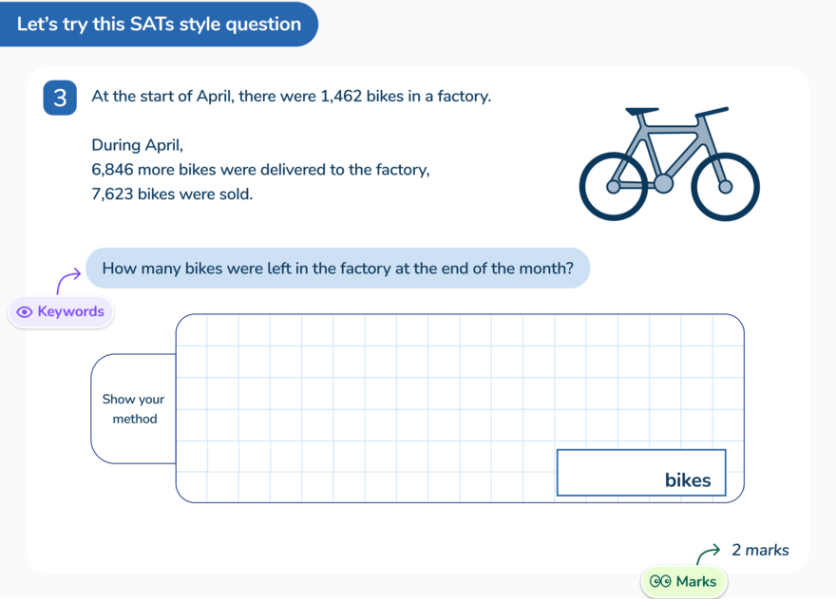
This strategy is a good way to ensure that your child is working through each question in enough detail, and it helps to get them thinking about the maths in the question at greater depth.
SATs Tip 27: Get used to timing yourself on questions
From Sam Adams, former primary school teacher, SLT and now educational consultant.
Sam’s first piece of advice is:
“Get children into a rhythm and help them to understand that halfway through the time means that they should be halfway through the paper.”
This is a very important thing for children to remember as if they don’t keep time during the tests, it is very easy to end up rushing questions and therefore make mistakes. Children should be working towards spending roughly 2 minutes on each question.
It’s also a good idea to get used to looking at the mark schemes – the more marks allocated to a question the more time you can take on it.
SATs Tip 28: Practise explaining your reasoning when you do any maths problem
Sam’s second piece of advice is:
“The word because is key for me. I’d like to see the children make a statement and use the word because and explain what they are thinking and why they are thinking it.”
When working through SATs practice questions with your child before the SATs, make sure you are always asking them to explain their reasoning behind their answer.
This is the only way that you’ll understand whether or not they understand the question in enough depth rather than just repeating an answer they have memorised.
SATs Tip 29: Practise getting it wrong
From Aidan Severs, Deputy Headteacher and maths leader. His advice comes in the form of an activity you can do with your child:
“What A Bad One Looks Like’ is always a great choice. Children love to find the mistakes of others and are very good at it, even when they are blind to their own!”
When at home, get hold of a past paper, take it in turns answering questions with your child and intentionally get your answers wrong.
They can then work out where you have gone wrong and teach you how to get to the correct answer.
As Aidan says, children love to find mistakes in other people’s work, and even more so if it is their parents!
SATs are a milestone, not a mountain. By providing parents with these clear, actionable strategies, you can reduce anxiety across your school community and ensure your pupils have the best possible environment to showcase what they’ve learned.
We’ve got lots more guidance and advice around SATs revision for teachers on our blog. Follow the links below for the most suitable Key Stage 2 SATs revision help for parents, designed for schools to print and send home as targeted revision or optional practice.
SATs preparation support and resources for parents and children in Year 6
Looking for high-quality resources that provide pupils (and parents!) in your class with Year 6 SATs practice in both arithmetic and reasoning?
Download our free Year 6 Maths SATs revision packs and Arithmetic and Reasoning SATs Questions. These are designed for schools to print and are a brilliant option to send home as targeted revision or optional practice.
The blogs below collect these worksheets all in one place, organised by topic area:
SATs preparation FAQs
Preparation should begin with a diagnostic test to establish a baseline and identify specific gaps in knowledge. Because Year 6 SATs are conducted in a formal, timed environment, it is essential for students to build exam stamina. You can download past SATs papers for Maths, English, and Science to simulate the real test experience; students who complete multiple full-length practice tests under timed conditions often see the most significant score improvements.
Beyond practice papers, consistency is key. A routine of 30–60 minutes of daily study focused on identified weak areas is far more effective than last-minute cramming. This approach allows for gradual skill-building in arithmetic, reasoning, and spelling, ensuring the child feels confident and calm when the actual test week arrives.
No. GCSEs are significantly more difficult than SATs.
These exams are taken at very different stages of a child’s education in the UK. KS2 SATs (Key Stage 2) are national assessments taken by Year 6 pupils (aged 10–11) at the end of primary school. They focus on the fundamentals of English and Maths. GCSEs are formal qualifications taken by Year 11 students (aged 15–16) at the end of secondary school. They cover a much wider range of subjects and involve more complex analysis, advanced mathematics, and extensive essay writing.
While SATs can feel stressful because they are often a child’s first experience with formal testing, the academic content of GCSEs is far more advanced and carries more weight for future college or career paths.
In the United States, the SAT is a completely different assessment from the UK’s Key Stage 2 tests. While the UK version focuses on 11-year-olds, the US version is a high-stakes college admissions test.
No, 95 is not a pass – nor is it a fail! In the SATs tests, scores are converted into a scaled score. Scaled scores in each Key Stage 2 test range from 80 to 120, with a scaled score of 100 being average. 100 represents the expected standard. A score of 95 therefore indicates that the student is working below the expected standard for their age.

DO YOU HAVE STUDENTS WHO NEED MORE SUPPORT IN MATHS?
Skye – our AI maths tutor built by teachers – gives students personalised one-to-one lessons that address learning gaps and build confidence.
Since 2013 we’ve taught over 2 million hours of maths lessons to more than 170,000 students to help them become fluent, able mathematicians.
Explore our AI maths tutoring or find out about year 6 SATs for your school.


![The Top 20 SATs Revision Topics For 2026 [Video]](https://thirdspacelearning.com/wp-content/uploads/2026/01/SATs-webinar-2025-social-image-6-180x160.png)