

Socratic Questioning In Math: What It Is, With Examples For Elementary And High School

When a student tells you that \frac{1}{2}+\frac{1}{3}=\frac{2}{5}, what do you do next? You can see they’ve added the numerators and then the denominators. You could tell them the correct answer, move them on to another question, or ask them something about the answer they’ve just given. That third option is Socratic questioning: responding to what a student has just said or done with a question or prompt that helps them reason their way to the right answer for themselves.
It’s a moment we think about a lot at Third Space Learning, because our spoken AI math tutor, Skye, has to handle it in every lesson. If you teach math, you’re almost certainly doing some of it already. NCTM lists “pose purposeful questions” among its eight effective mathematics teaching practices, and asking about the mistake a student has just made is one practical way to do it.
Questioning isn’t always the right call, though. If a student is completely stuck, another “why?” won’t get them unstuck. Below I cover the six types of Socratic questions, worked examples from 5th grade fractions to Algebra 1, what US math frameworks say, and how to tell when to switch to a hint or a model.

School Leaders Guide To Math Assessment
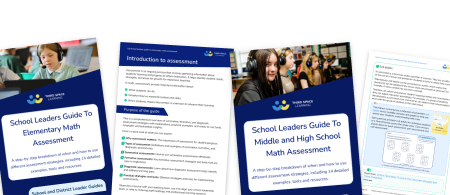
Download this free guide to the main types of elementary, middle and high school math assessment and how they differ. Includes classroom strategies, example assessments and an assessment tool picker to help you choose the right assessment at the right time.
Download Free Now!Key takeaways
- Socratic questioning means responding to what a student has just said or done with a question or prompt that helps them reason their way to the right answer.
- After a wrong answer, you can tell the student the answer, move on, or respond to the specific mistake. All three have their place, and only the third deals with the mistake while the student does the thinking.
- Asking about a student’s answer builds critical thinking in math: students check their own method and reasoning instead of waiting to be told.
- US frameworks point the same way: NCTM asks teachers to pose purposeful questions, and the Danielson Framework for Teaching gives questioning its own component.
- If a student is completely stuck, another “why?” won’t help. Give more support, such as fraction strips or a model of the method, then less as they start to succeed.
- The same test applies to any tutor, human or AI: after a wrong answer, does the response deal with the mistake, or just mark it and move on?
What is Socratic questioning?
Socratic questioning is a way of teaching through open-ended, probing questions. In a math lesson, it means responding to a student’s answer with a question or prompt, based on what they’ve just said or done, that gets them to reason their way to the right answer.
So if a student tells you that 7 \times 8 = 54, “No, it’s 56” gives them the answer. “What’s 7 \times 7? So what would one more 7 be?” is a Socratic question, because the student still has to work it out.
The idea goes back to the ancient Greek philosopher Socrates, who taught through dialogue. He’d ask a question, listen to the answer and ask another based on what he’d heard, until the person he was talking to could examine their own beliefs and assumptions and see for themselves where their thinking had gone wrong. His best-known line, usually quoted as “the unexamined life is not worth living”, comes from Plato’s account of his trial (Plato, Apology). Richard Paul, who wrote widely about Socratic questioning, turns Socrates’ approach into a simple rule for teachers: “Base each of your questions on the answer given by the last student” (Paul and Elder, 2006).
That rule is the useful one for a math teacher, because it means you can’t script the conversation in advance. I’m also using the term a little more broadly than its classical meaning: if you respond to a student’s specific mistake with a hint that makes them think again, I’d count that too.
How Socratic questioning builds critical thinking
Critical thinking is a phrase you’ll hear in a lot of US district goals, and in math it has a fairly concrete meaning: can a student examine their own method, spot the assumption behind it and decide whether their answer makes sense? A good question asks them to do exactly that. Instead of accepting your correction, they have to challenge their assumptions and test the idea against something they already know.
That’s why a question usually does more than a correction. When students propose a method and then check it, they’re doing the same problem solving they’ll need on an unfamiliar question, and over time checking becomes a habit. An open-ended question such as “How do you know?” asks the student to justify their answer. “Not quite, try again” only asks them to guess again.
Socratic questioning vs the Socratic method
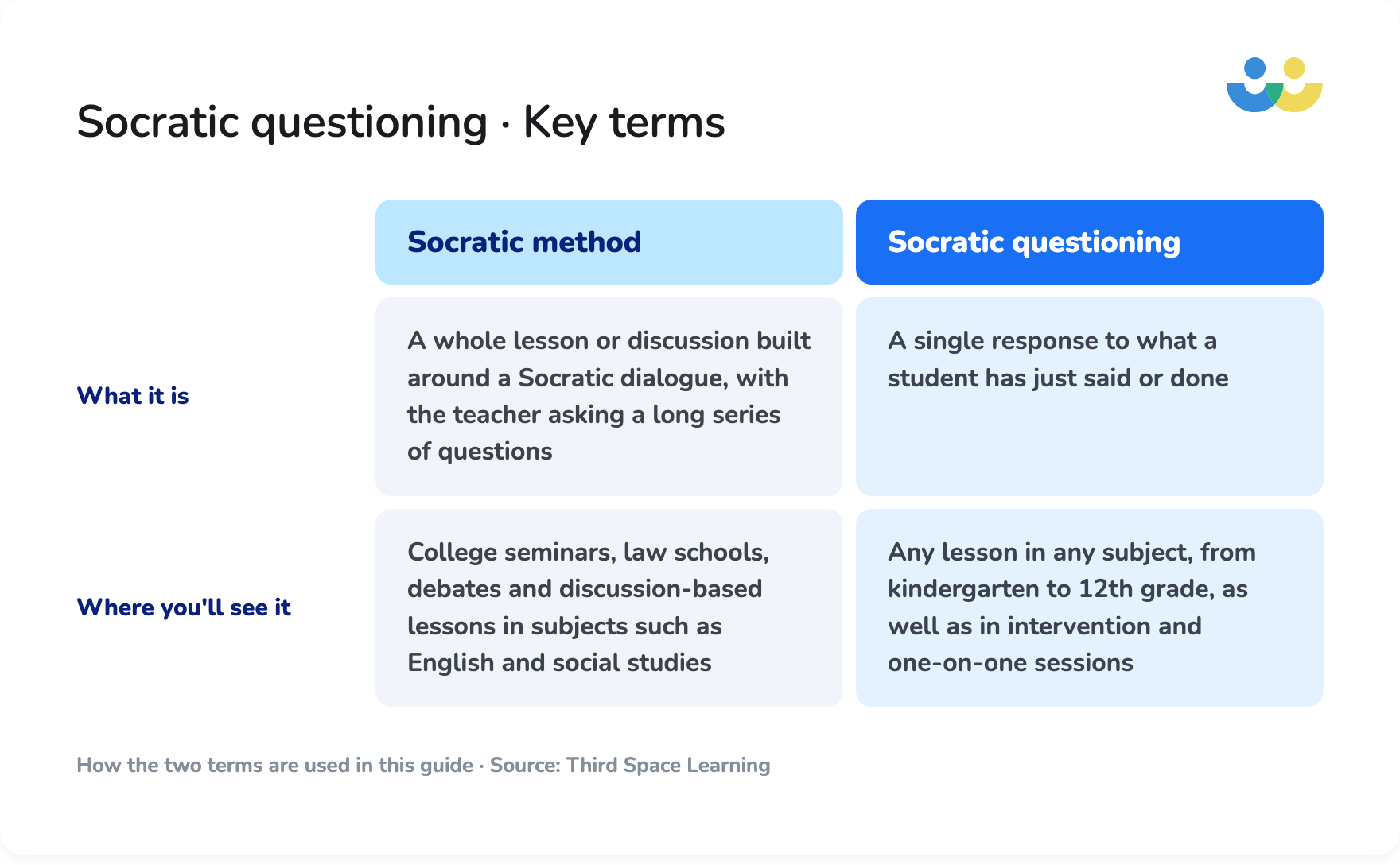
People often use the two terms interchangeably, but it helps to separate them.
- The Socratic method is a whole lesson or discussion built around a long series of questions, a dialogue in which the teacher keeps probing the students’ arguments. You’ll see it in college seminars, law schools and discussion-based lessons in English or social studies.
- Socratic questioning is a single response to what a student has just said or done. You’ll see it in any subject, from kindergarten to 12th grade, and in intervention and one-on-one sessions.
The Socratic method is a back-and-forth, sometimes described as cooperative argumentative dialogue: people ask and answer questions to test each other’s ideas until they reach a conclusion they can defend. In a law school, that usually means a professor questioning one student about a case in front of the class. In a Socratic seminar, students discuss a text and respond to each other’s arguments while the teacher mostly listens.
One question after a wrong answer, based on what the student has just told you, is enough to start with.
The six types of Socratic questions
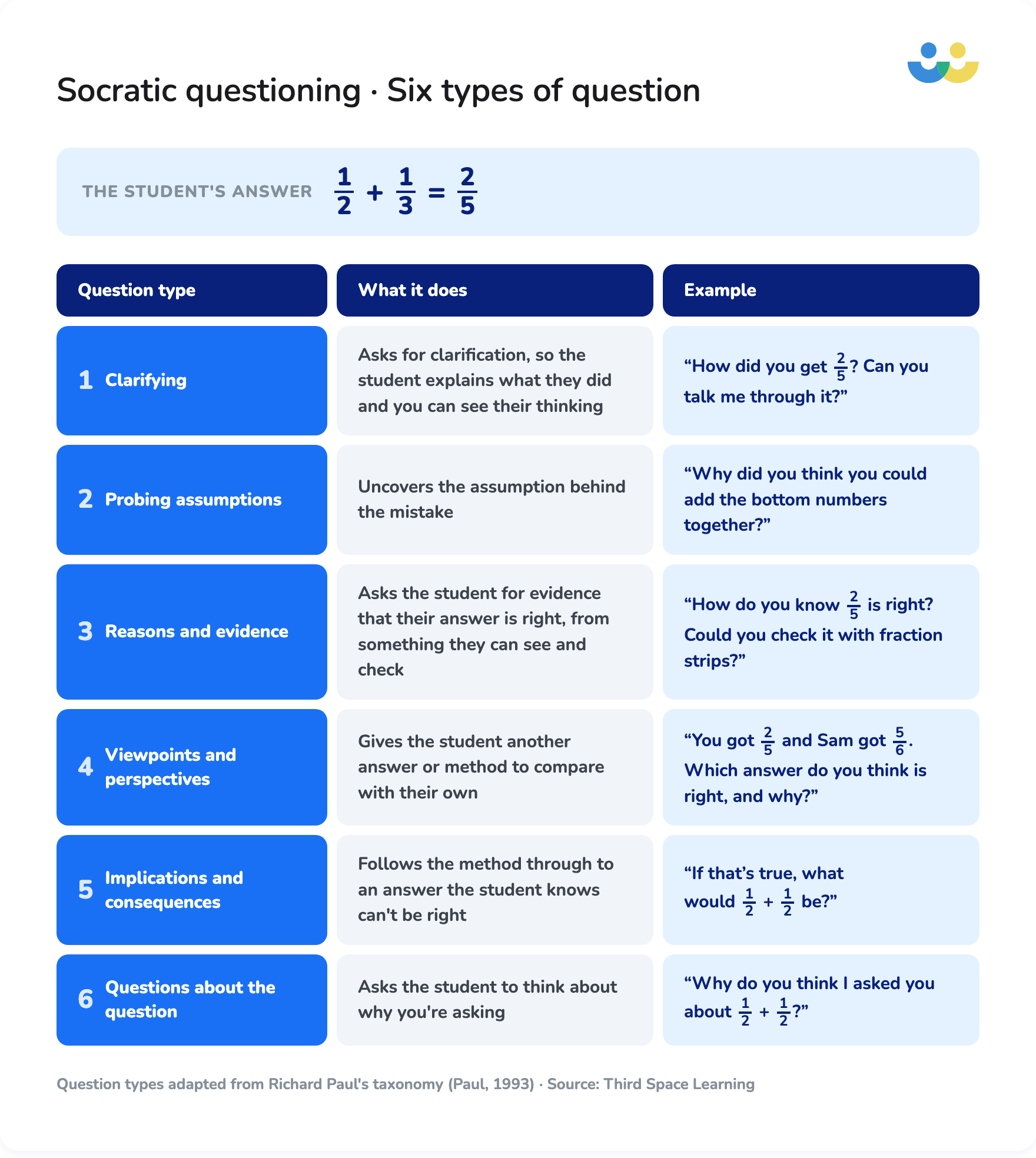
Most writing on the topic uses six types of questions, adapted from Richard Paul’s taxonomy (Paul, 1993). They make most sense when you see all six asked about the same wrong answer, \frac{1}{2}+\frac{1}{3}=\frac{2}{5}.
1. Clarifying questions
These ask the student to explain what they did, so you can see their thinking: “How did you get \frac{2}{5}? Can you talk me through it?”
2. Questions that probe assumptions
These challenge the assumptions behind the mistake: “Why did you think you could add the bottom numbers together?”
3. Questions about reasons and evidence
These ask for evidence the student can see and check: “How do you know \frac{2}{5} is right? Could you check it with fraction strips?”
4. Questions about viewpoints and perspectives
These give the student another perspective to compare with their own: “You got \frac{2}{5} and Sam got \frac{5}{6}. Which answer do you think is right, and why?”
5. Questions about implications and consequences
These follow the method through to an answer the student knows can’t be right: “If that’s true, what would \frac{1}{2}+\frac{1}{2} be?” Their method gives \frac{2}{4}, a half, and most students know a half plus a half makes one.
6. Questions about the question
These ask the student why you’re asking, which often shows them where to look: “Why do you think I asked you about \frac{1}{2}+\frac{1}{2}?”
A seventh prompt for math: the next step
Adding the numerators does work when the denominators match, so you can build on that partial truth: “Adding the top numbers works sometimes. When does it work?” That gives the student their next step without telling them the method.
Socratic questioning examples in math
It’s easiest to see what a question adds when you put it next to the other options.
Worked example: one wrong answer, three responses (5th grade)
A 5th grader adding fractions with unlike denominators writes \frac{1}{2}+\frac{1}{3}=\frac{2}{5}. The What Works Clearinghouse fractions practice guide names this exact mistake: “A common mistake students make when faced with fractions that have unlike denominators is to add both numerators and denominators” (Siegler et al., 2010).
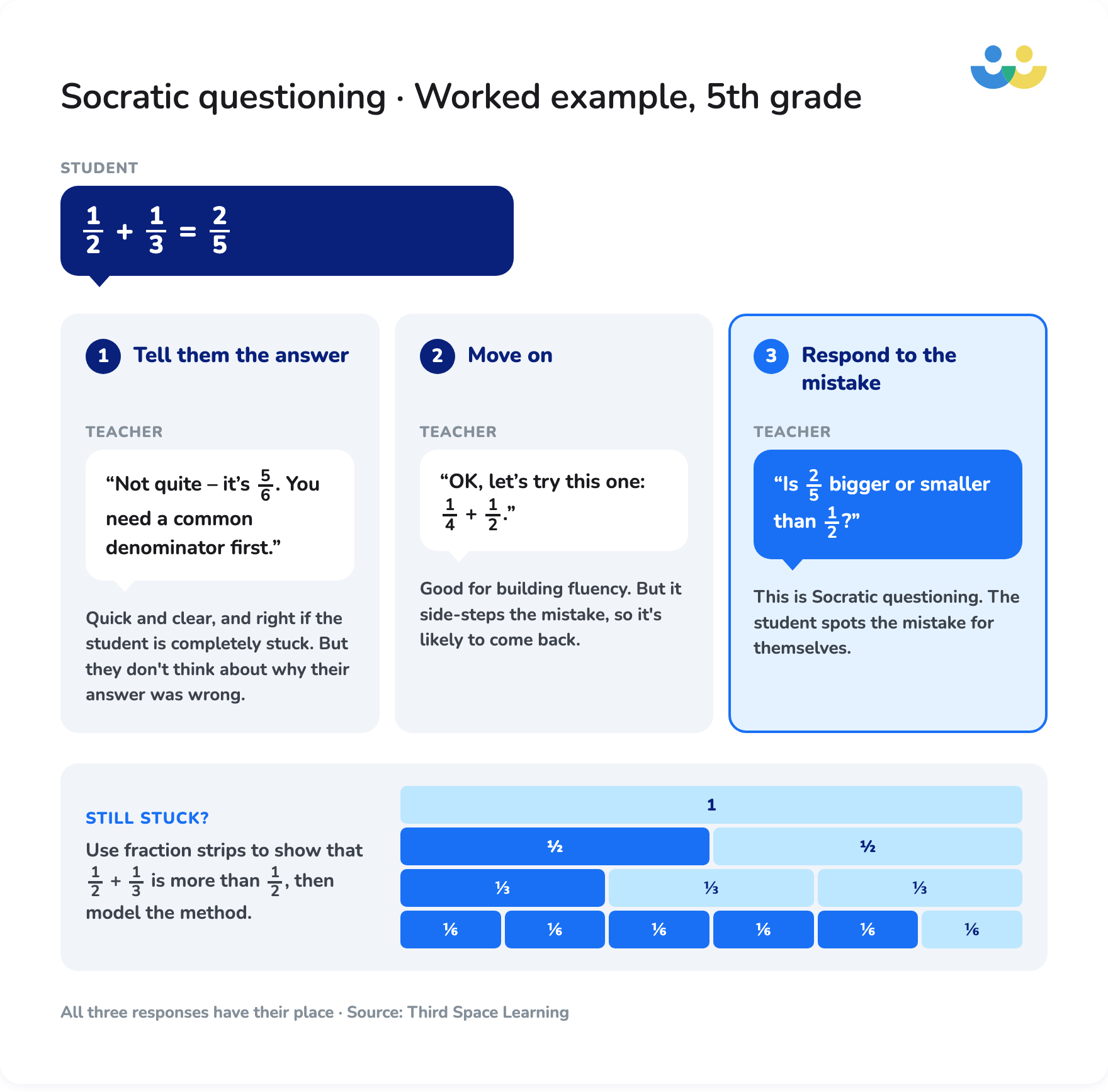
Response 1: tell the student the answer. “Not quite, it’s \frac{5}{6}. You need a common denominator first.” Quick and clear, and right if the student is completely stuck. But they haven’t had to think about why their answer was wrong, so the mistake may come back next week.
Response 2: move on. “OK, let’s try this one: \frac{1}{4}+\frac{1}{2}.” Good for fluency and problem solving and reasoning, but it sidesteps the mistake.
Response 3: respond to the mistake with a question.
Teacher: “Is \frac{2}{5} bigger or smaller than \frac{1}{2}?”
Student: “Smaller.”
Teacher: “So if you start with \frac{1}{2} and add something to it, can you end up with less than \frac{1}{2}?”
Student: “No… so \frac{2}{5} can’t be right.”
Teacher: “So what do you think has gone wrong?”
The student has spotted the mistake for themselves, and you can now help them build a deeper understanding of why the denominators need to match. The guide recommends this kind of estimate: a teacher “can note that this answer cannot be right” because it’s smaller than one of the fractions being added.
Students rarely estimate like this without a prompt. When 8th graders on the 1978 National Assessment of Educational Progress (NAEP) were asked whether \frac{12}{13}+\frac{7}{8} was closest to 1, 2, 19 or 21, only 24% chose 2. When the same problem was given in 2014, it was still only 27% (Siegler et al.).
For more ideas for the third response, there’s a whole set of effective questioning strategies you can draw on. And if the student is still stuck after a question or two, stop asking. Get out fraction strips so they can see that \frac{1}{2}+\frac{1}{3} is more than \frac{1}{2}, then model the method: change both fractions to sixths, and add.
High school example: squaring a binomial (Algebra 1)
A student expands (x+3)^2 and gets x^2+9. They’ve assumed they can square each term inside the parentheses, which works when the terms are multiplied, as in (3x)^2=9x^2, but not when they’re added.
Teacher: “Let’s test your method with numbers. What’s (2+3)^2?”
Student: “25.”
Teacher: “And what do you get with your method, 2^2+3^2?”
Student: “13. They’re not the same.”
Teacher: “So what’s missing?”
From there, write (x+3)^2 as (x+3)(x+3) and expand it to get x^2+6x+9. If the student is still stuck, draw an area model: a square with sides of x+3, split into an x^2 square, two 3x rectangles and a 9 square. The two rectangles show where the 6x comes from. Testing a method with simple numbers is one of the math strategies for problem solving students can use again and again.
Socratic questions to keep on hand
These open-ended questions and follow-up questions work with almost any topic. Keep them by your desk, or on a card for paraprofessionals running intervention groups.
- Clarifying: “How did you get that?”
- Probing assumptions: “Why did you choose that method?” “Does that always work?”
- Reasons and evidence: “How could you check your answer?”
- Viewpoints: “How might someone else have done it?”
- Implications: “Does your answer make sense?”
- Next step: “What do you already know that could help?”
Whichever you use, base any further questions on the student’s last answer. Paul’s own check is “Did the questioner respond to all answers with a further question?” (Paul and Elder, 2006).
What US math frameworks say about questioning
Most US frameworks don’t name Socratic questioning or the Socratic method, but the idea runs through them, and through what an observer looks for in your classroom.
NCTM’s Principles to Actions lists eight mathematics teaching practices. Two describe it almost exactly: “Pose purposeful questions”, which “assess and advance students’ reasoning and sense making”, and “Elicit and use evidence of student thinking”, to “adjust instruction continually” (NCTM, 2014).
The Common Core’s Standard for Mathematical Practice 3 asks the same of students: they “justify their conclusions, communicate them to others, and respond to the arguments of others” (Common Core State Standards for Mathematics). When a student talks you through how they got \frac{2}{5}, they’re practicing MP3.
If your district uses the Danielson Framework for Teaching, questioning has its own component, 3b, “Using Questioning and Discussion Techniques”. The 2013 edition notes that questioning and discussion “are the only instructional strategies specifically referred to” in the framework (Danielson, 2013).
How to use Socratic questioning in the classroom
These five steps work for whole-class teaching and for small groups.
1. Plan for the misconceptions you expect
Before the lesson, think about the mistakes students are most likely to make and the question you’ll ask for each. If you’re teaching adding fractions, have “Is \frac{2}{5} bigger or smaller than \frac{1}{2}?” ready. There’s a fuller process for addressing misconceptions in math if you want one.
2. Choose the moment
Questioning works best during guided practice, the “we do” part of I do, we do, you do, when students have just enough prior knowledge to reason with. With a brand-new idea, explain and model it first.
3. Ask one question, then wait
Ask one question about the specific mistake, then give the student time to think. If you ask three questions at once, or answer your own, the student doesn’t get to do the reasoning.
4. Know when to stop
If the student is still stuck after a couple of tries, give them a concrete or pictorial step, such as fraction strips or a bar model, then model the method.
5. Check the student has understood
Finish with a fresh question, such as \frac{1}{3}+\frac{1}{4}. With a whole class, a quick formative assessment such as an exit ticket shows who has understood before you move on.
When to question, when to hint and when to model
Questioning stops working when a student doesn’t have enough knowledge or understanding to reason with. If they’ve never learned equivalent fractions, no question about \frac{2}{5} will get them there. They need you to show them.
How much help to give
The most useful idea I know here comes from the psychologist David Wood, who studied how adults tutor children. He called it contingent tutoring: if a student fails, give more help right away, and “when the learner succeeds with help, offer less help if you intervene again” (Wood, 2003). In math, that gives you four levels of support:
- A question about the mistake
- A hint that points to the part that went wrong
- A concrete or pictorial step, such as fraction strips or a bar model
- A model of the whole method
Kurt VanLehn’s review of tutoring research found that systems which responded to each step of a student’s work were “nearly as effective as human tutoring”, with an average effect size of 0.76 against 0.79 for human tutors. Systems that responded only to the final answer averaged 0.31 (VanLehn, 2011). Those averages come from separate sets of studies, and none of the systems was a spoken tutor, but they point the same way.
A 2025 replication of Wood’s original study didn’t find the same benefit for three-year-olds (Smit et al., 2025), so I’d treat contingent tutoring as a rule of thumb rather than a proven law. It’s still a sensible way to decide how much help to give.
Socratic questioning works alongside explicit instruction
Questioning doesn’t replace explicit teaching. Kirschner, Sweller and Clark concluded that “minimally guided instruction is less effective and less efficient than instructional approaches that place a strong emphasis on guidance” (Kirschner, Sweller and Clark, 2006). Rosenshine found that “less successful teachers ask fewer questions and almost no process questions”, but his principles also include models and guided practice (Rosenshine, 2012). So you’ll usually question students and show them how in the same lesson.
Using Socratic questioning in feedback
A lot of feedback is a response to a mistake, so the same approach works. In the moment, if a student writes (x+3)^2=x^2+9, try “What does the little 2 mean? Can you write it out as two sets of parentheses?” instead of “Wrong, it’s x^2+6x+9.” In written feedback, leave a question the student answers at the start of the next lesson, such as “Put x=1 into both sides. Do you get the same answer?” Their answer shows you whether they’ve understood, and the student gets a minute to think back before the new work starts.
Socratic questioning in one-on-one and small-group intervention
I think it’s at its most useful in intervention, where the conversation is a real dialogue: you can hear exactly how one student is thinking and respond to exactly that. It’s differentiated instruction on a small scale.
Wait after a wrong answer
Most advice on wait time is about the pause after you ask a question. In math, the pause after the student answers is just as important. Count to three in your head before you respond to a wrong answer. Sometimes that’s all it takes for the student to spot the mistake, and if they don’t, you’ve had time to choose the right question.
When a student says “I don’t know”
“I don’t know” doesn’t have to end the conversation. Make the question smaller (“Which is bigger, \frac{1}{2} or \frac{2}{5}?”), offer a choice (“More or less than \frac{1}{2}?”), or take the pressure off (“If you had to guess, what would you say?”). If they still can’t answer, more questions won’t help, so move up to a hint or a model.
Ask students to talk through their work
“Talk me through what you did” is one of the best questions to ask in intervention. Once a student says their work out loud, you can hear where it went wrong, and they often hear it too. Over time, students start to analyze their own answers before you ask, which is a big part of mathematical reasoning and metacognition.
What AI tutor Skye does after a wrong answer
The moment right after a wrong answer is just as important in AI tutoring as in a classroom, maybe more so. A tool that just says “incorrect, try again” leaves the student exactly where they were.
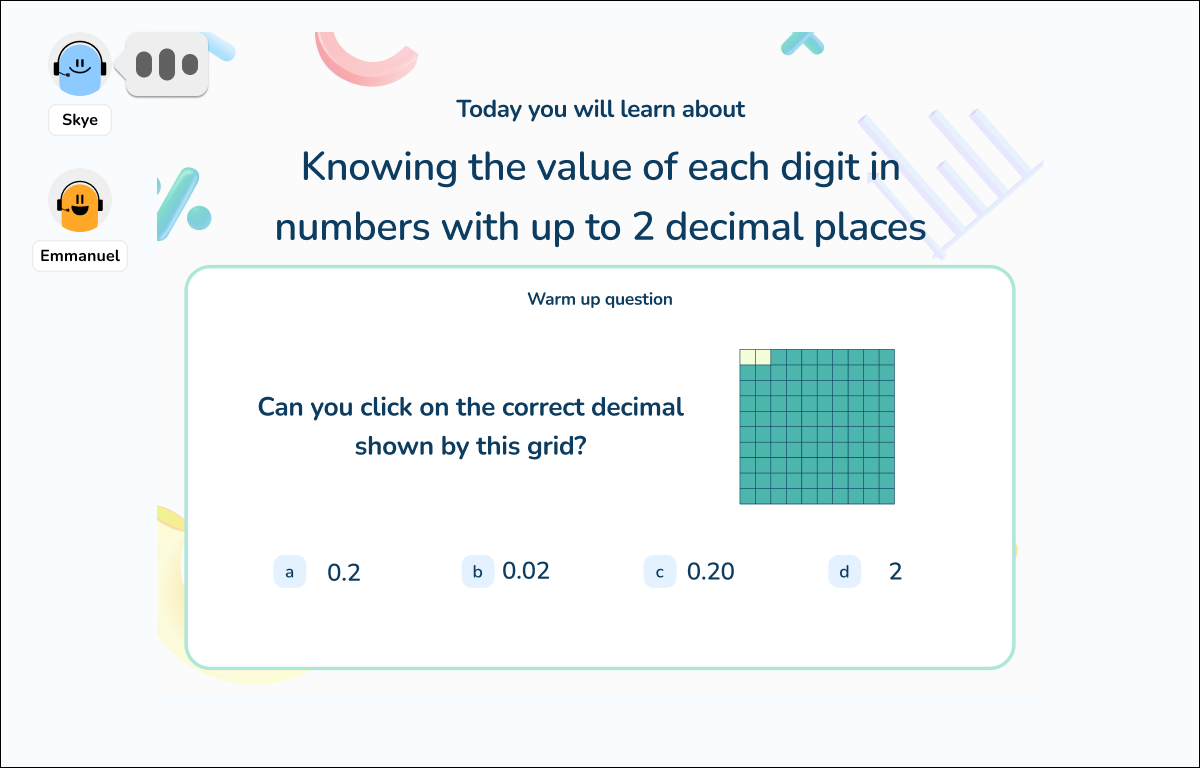
Our AI math tutor, Skye, works through three steps after a wrong answer, with more support at each one:
- When a student gives a wrong answer, Skye gives a spoken hint based on the type of mistake they’ve made, such as a conceptual or a procedural one.
- If they get it wrong again, Skye gives another hint.
- If they’re still wrong a third time, Skye models the correct steps.
Throughout, students talk through problems out loud while Skye listens and responds. Skye gives them processing time before it offers a hint, and rephrases ideas when the first explanation hasn’t helped. That’s more help when a student is stuck and less when they’re succeeding, the same principle as Wood’s.
“It’s not just practice, it’s targeted to exactly what each student needs, at every level. Unlike other online tools, it’s genuinely responsive to the specific answer a student gives.”
Madeline Loeb, Director of Curriculum and Instruction, Primary Hall Charter School, New York (Third Space Learning impact)
All of Skye’s lesson content is written, edited and approved by qualified math teachers, and Skye can’t generate its own content, because AI tutors need human expertise behind them. One limit: Skye can’t see a student’s work on paper, so asking them to explain their thinking out loud does a lot of the work.
We’re also running research with the Gates Foundation, Stanford and Cornell that compares Skye’s hints with questions after a wrong answer, to see which helps students learn more and which keeps them working through the lesson.
Try one Socratic question tomorrow
Next time a student gets a fractions question wrong, ask them one question about their answer before you correct it. “Is \frac{2}{5} bigger or smaller than \frac{1}{2}?” works for a lot of fraction mistakes. Then give them time to answer, and listen to what they say.
If they spot the mistake, they had the knowledge and just needed a nudge. If they don’t, you’ve learned something about how they’re thinking, and you can move to a hint or a model. Either way, you know more than you would if you’d told them the answer.
Socratic questioning FAQs
Socratic questioning means responding to what a student has just said or done with a question or prompt that helps them reason their way to the right answer. In math, it usually happens right after a wrong answer: you ask about the student’s answer, so they do the thinking. The name comes from the ancient Greek philosopher Socrates, who taught by questioning the people he talked with.
A student says that 1/2 + 1/3 = 2/5. Instead of telling them the correct answer, you ask, “Is 2/5 bigger or smaller than 1/2?” The student realizes that adding 1/3 to 1/2 can’t give an answer smaller than 1/2, so 2/5 must be wrong.
The Socratic method is a whole lesson or discussion built around a long series of questions, as in college seminars or law schools. Socratic questioning is a single response to what a student has just said or done, and you can use it in any lesson, including one-on-one and small-group intervention.
Not by name. But Standard for Mathematical Practice 3 asks students to justify their conclusions and respond to the arguments of others, and NCTM lists posing purposeful questions as one of its eight effective teaching practices. Asking about a student’s answer is a practical way to do both.
Yes, if it responds to what the student has just said or done, instead of just giving the answer or moving on. Kurt VanLehn’s review of tutoring research found that systems which respond to each step of a student’s work had much larger average effects than those that only mark the final answer, 0.76 against 0.31 (VanLehn, 2011).
Do you have students who need extra support in math?
Skye – our AI math tutor built by experienced teachers – provides students with personalized one-on-one, spoken instruction that helps them master concepts, close skill gaps, and gain confidence.
Since 2013, we’ve delivered 2,295,000 math tutoring sessions to 196,000 students, guiding them toward higher math achievement.
Discover how our AI math tutoring can boost student success, or see how our math programs can support your school’s goals:
– 3rd grade tutoring
– 4th grade tutoring
– 5th grade tutoring
– 6th grade tutoring
– 7th grade tutoring
– 8th grade tutoring