



Pupil Premium: What It Is, Who Gets It and Why It Still Matters in 2026

Pupil premium is extra funding for schools in England, paid to raise the attainment of disadvantaged pupils. It has existed since 2011, and at £3 billion a year it now reaches more than a quarter of all pupils.
While the numbers have held steady for years, the rules behind them are changing. Free school meals eligibility expands in September 2026, but the government has said it intends to stop using free school meals as the trigger for the grant. The disadvantage gap has just been measured at its widest in over a decade.
This guide covers what pupil premium funding is, who qualifies, the current funding rates per pupil, and how pupil premium eligibility is about to diverge from FSM.

The Senior Leader’s Guide to Pupil Premium
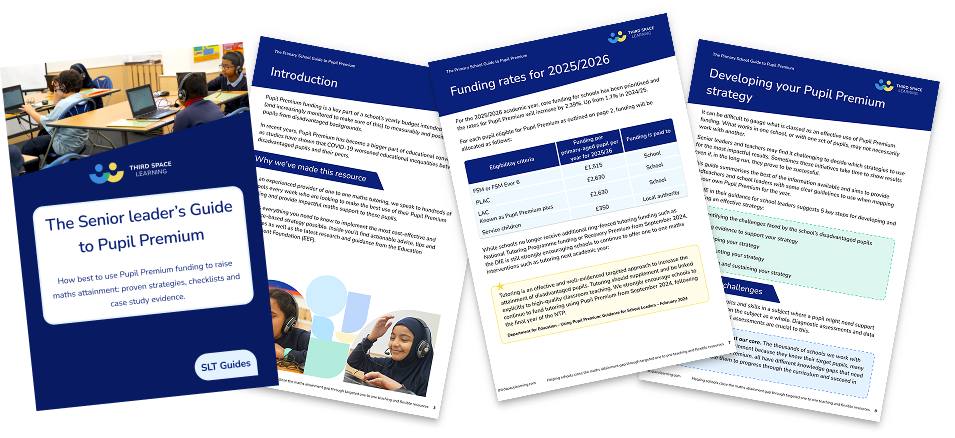
A free primary and secondary pupil premium guide for headteachers and senior leaders setting out which interventions the evidence supports, and how real schools have spent their allocation on budget decisions, reporting and accountability.
Download Free Now!What is pupil premium?
Pupil premium is targeted additional funding for disadvantaged pupils in state funded schools in England, and every school with eligible pupils on roll receives it. Its purpose is to improve educational outcomes for those pupils and narrow the gap in educational attainment between them and their peers.
Schools receive the funding for each eligible pupil, each year. It sits on top of the core budget and comes with conditions: a published strategy statement, and every funded activity must fall within the government’s menu of approaches.
In 2025 to 2026 pupil premium funding was worth £3 billion in total, and around 2.3 million pupils qualified. Of those, roughly 1.99 million were pupils aged 5 to 16, which is 27% of all pupils.
What does it mean if a child is pupil premium?
If a child is pupil premium, their school receives extra funding because of their circumstances, usually low household income. That funding is the school’s, not the child’s to spend.
Pupil premium is not a personal budget, and it is not ring fenced to named individuals. Each school decides how to spend its own allocation. That spending can benefit non disadvantaged pupils too, as long as it is also designed to improve outcomes for the eligible pupils the funding was allocated for.
Schools do not report how much individual children attract, and there is no per pupil pot for families to ask about.
What is the difference between disadvantaged and pupil premium?
Disadvantaged is the wider term used in school performance measures. The pupil premium grant is narrower, with defined eligibility criteria attached.
The two overlap heavily without being the same. A pupil can face real disadvantage and still not meet the pupil premium eligibility criteria, and the distance between them is about to widen (see the free school meals change below).
Three common misconceptions about pupil premium
1. Schools do not have to spend pupil premium only on eligible pupils. It is judged on whether it improves outcomes for the pupils it was allocated for, so spending pupil premium funding on activities that also reaches other pupils is fine.
2. Pupil premium is separate from the deprivation funding in the national funding formula. The two streams are calculated differently, and schools receive both.
3. Pupil premium does not follow individual pupils mid-year. Pupils eligible on the October census generate the funding for that year. Pupils arriving afterwards generate nothing until the next census.
When was pupil premium introduced?
The Department for Education introduced pupil premium in 2011, after research showed that children from low income families did less well at school than their peers.
Wales introduced a similar scheme the following year. Originally the Pupil Deprivation Grant, it was renamed the Pupil Development Grant in April 2017.
Who is eligible for the pupil premium in 2026?
Three groups of pupils are eligible for the grant:
- Pupils eligible for free school meals (FSM), now or in the last six years. This is the Ever 6 cohort, and it accounts for the large majority of eligible pupils. FSM eligibility rests on a household income threshold of £7,400 a year for families receiving Universal Credit.
- Looked-after children and children who have left care. A child in care for at least one day qualifies, and for children and young people the entitlement continues after they leave care. So do children who left local authority care or other state care through an adoption order, a special guardianship order or a child arrangements order. Funding for looked-after children goes to the local authority, and the virtual school head manages it alongside the child’s school and social worker.
- Service children. Pupils with a parent in the armed forces, as recorded on the school census.
Pupil referral units, general hospital schools and special schools receive funding for their eligible pupils on the same basis as mainstream schools. Pupils with special educational needs attract the grant under the same criteria as everyone else, with no separate rate.
How free school meals eligibility works
Free school meals (FSM) is the route most eligible pupils take. A family qualifies if they receive Universal Credit and their household income is below £7,400 a year after tax, not counting benefits. Families apply through the local authority or the school office, and the school then records eligibility on the census.
Once a pupil is recorded, they stay in the Ever 6 cohort for six years, even if circumstances improve. Pupil premium eligibility therefore lags behind current FSM eligibility, and the funding received in any academic year reflects a census taken months earlier.
Registering for free school meals is worth doing even where meals are already free. Every child in year groups Reception to Year 2 gets a universal infant free meal, so families at that stage often never apply for free school meals (FSM), and the school in England loses the funding.
How much is pupil premium funding per pupil?
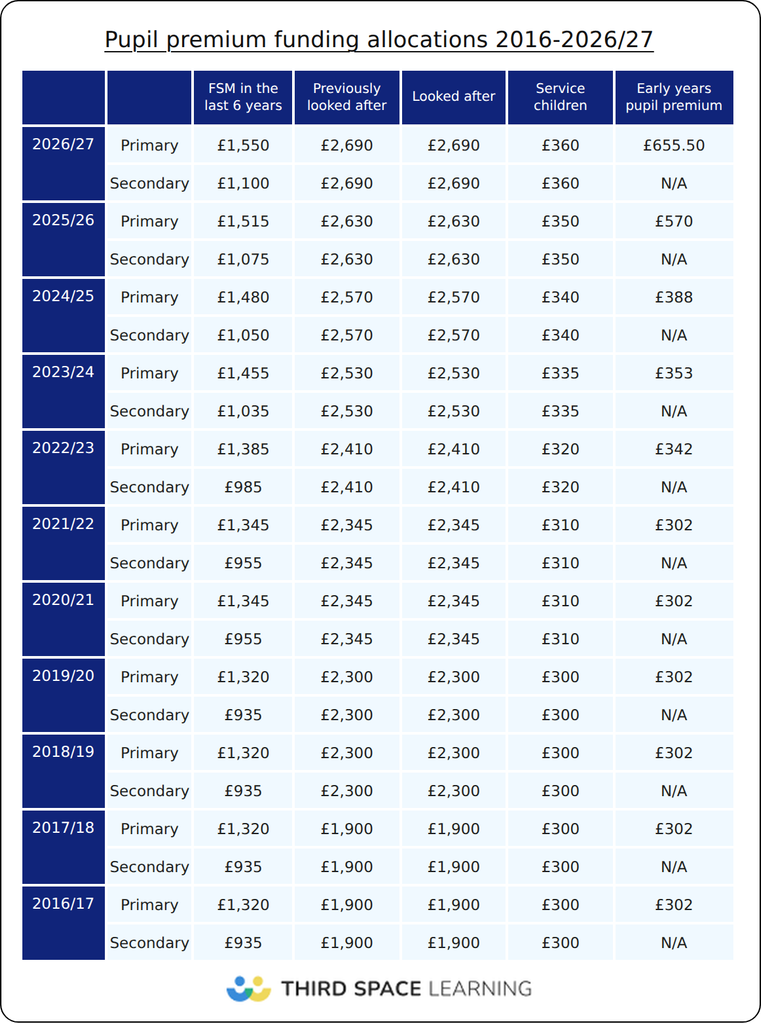
For 2026 to 2027 the pupil premium funding rates are £1,550 for each eligible primary aged pupil and £1,100 for each eligible secondary aged pupil. Looked-after and previously looked-after children attract £2,690, and service pupil premium is £360.
Funding rates are set per financial year, running April to March, and paid in four instalments. A school’s allocation depends on how many eligible pupils appeared on the October census, not on how many are on roll today.
Early years pupil premium
Early years funding works differently, and is much smaller. For 2026 to 2027, local authorities must fund providers at a rate of at least £1.15 per hour for each eligible child, for the first 15 hours a week only, up to 570 hours a year.
The rate is a minimum and the hours are a maximum. Together they give at least £655 a child per year, and a local authority can choose to pay above that.
Why do schools still need pupil premium in 2026?
The disadvantage gap the grant was created to close is still widening.
The Education Policy Institute’s 2026 annual report puts the disadvantage gap at 4.9 months by the end of Reception, 10.0 months by the end of Year 6 and 19.0 months by the end of Year 11. The early years gap is the widest recorded for over a decade, back to the level last seen in 2014.
Most of the attainment gap is set before Year 7
Research published by the Education Endowment Foundation and EPI in June 2026 found that 44% of the GCSE disadvantage gap already exists by age 11. Low prior attainment at 11 accounts for 6.8 months of the GCSE gap on its own.
School leaders deciding where the funding does most good can plan around that finding. Waiting until Year 10 means working against a gap that was largely fixed years earlier.
Some groups are much further behind
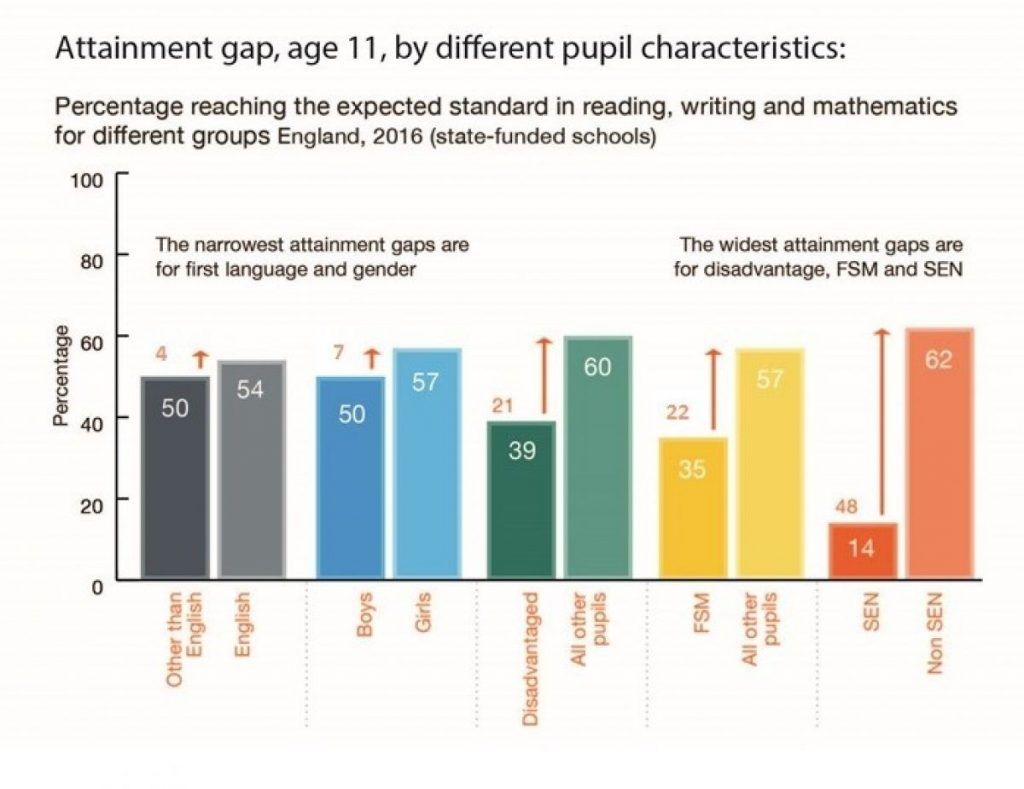
Children in care are the clearest example. In 2024/25, 35% of children looked after for at least 12 months met the expected standard in reading, writing and maths at the end of key stage 2, against 62% of all pupils. By GCSE their average Attainment 8 score was 17.3, less than half the figure for all pupils nationally.
Why maths gaps show first
Maths gaps compound. A pupil who has not secured place value will struggle with fractions, and then with every topic that rests on fractions, and the distance grows with each year group.
Early, targeted support therefore changes a pupil’s trajectory instead of managing it, and it can enable schools to close a gap rather than report one. The years before Year 7 carry more weight in maths than in almost any other subject.
What is changing for pupil premium funding
Two changes are worth planning around.
Free school meals eligibility expands in September 2026. Every child in a household on Universal Credit becomes entitled to a free meal. The government estimates that this will reach over half a million more children. FSM then splits in two: targeted FSM keeps the £7,400 threshold, while expanded FSM covers every family above it and applies to meals only. Only targeted FSM counts towards Ever 6.
More children will eat a free meal under expanded FSM, but no extra pupil premium funding follows them. Pupils already in the Ever 6 cohort keep their place for six years.
The eligibility trigger itself may change. In December 2025 the government said it intends to design a new model for targeting disadvantage funding. That model would use household income data to allocate pupil premium directly, rather than free school meals eligibility. No implementation date has been published.
What can schools spend pupil premium on?
The pupil premium grant can be spent on anything within the government’s three categories:
- high quality teaching,
- targeted academic support, and
- tackling non-academic barriers to academic success such as attendance and social and emotional wellbeing.
Every approach or strategy has to be evidence-informed, and schools have to show what evidence sits behind each one in the published strategy.
What the evidence says works
The Education Endowment Foundation rates approaches by cost and by the months of additional progress they deliver. High quality teaching comes first. Improving what happens in every lesson helps disadvantaged children and their classmates alike, and money spent on CPD for school staff reaches every pupil those teachers go on to teach.
Targeted support comes next, and one-to-one and small group tuition are among the best evidenced approaches available to schools. Wider strategies covering attendance, behaviour and wellbeing deal with the barriers that sit outside lessons.
How schools account for the funding
Every school with eligible pupils must publish a pupil premium strategy statement on its website by 31st December each academic year, using the DfE template. In a multi-academy trust, each academy publishes its own.
The statement sets out the challenges disadvantaged pupils face, the approaches the school has chosen and the evidence behind them. It also sets out how the school will measure whether outcomes for disadvantaged pupils actually improved. Schools review it annually rather than rewriting it from scratch.
What Ofsted looks for
Ofsted inspectors consider how schools spend the pupil premium grant and what it achieves for the pupils it funds. Separately, the Department for Education reviews a sample of published strategies each year.
Using pupil premium for one-to-one maths tutoring
One-to-one tuition is one of the targeted approaches in that second category, and the evidence behind it is strong. Cost stops schools offering it to every pupil who needs support. At around £45 a session, ten pupils a week costs more than £16,000 a year, so the budget decides who gets tutored.
Third Space Learning has worked on that cost problem since 2013, and more than 50% of Third Space Learners have been eligible for the grant. Skye, our AI maths tutor built by teachers, gives pupils personalised one-to-one lessons and adapts as each pupil works.
Schools pay one fixed annual fee for unlimited sessions, from £3,500 a year for primary schools and £5,000 for secondary. The number of pupils taught no longer depends on the price of a session. Pupils who need weekly support get it, including those who would previously have waited without seeing the benefit.
Fixed cost tutoring funded by pupil premium changes who gets picked.
“We tend to target the children who are just below age-related expectations: the ones who’d otherwise get missed. They’re not low enough to be getting daily interventions, but they need that little boost to get them up, and from there, some go on to greater depth.”
Laura Bolton, Pupil Premium Lead and Year 6 Teacher at Giles Brook Primary School

In secondary the same problem arrives on a larger scale.
“If you’re like me, you’ve got a school with 65% disadvantage, there are just too many students for us to intervene with every single student individually.”
Natalie, Academy Improvement Advisor for Maths and Numeracy at Fairfax MAT

With a fixed fee, the number of pupils who benefit stops being a budget decision.
Pupil premium FAQs
A pupil is eligible through free school meals now or in the last six years, being in care or having left care, or having a parent in the armed forces. FSM eligibility depends on household income below £7,400 a year for families on Universal Credit.
No. Schools decide how to spend the pupil premium grant, though every funded activity must sit within the government’s menu of approaches and appear in the published strategy.
Not individually. Schools publish a strategy statement covering the whole cohort, and that statement must be on the school website.
Not within the financial year. Allocations are fixed to a census snapshot, so the next census picks up a mid-year arrival.
Pupil premium has been running for fifteen years, and the disadvantage gap it was built to close is wider now than at any point in the last decade. The rules are about to change again, so it is worth knowing what your school is working with before the next strategy statement is due.

DO YOU HAVE STUDENTS WHO NEED MORE SUPPORT IN MATHS?
Skye – our AI maths tutor built by teachers – gives students personalised one-to-one lessons that address learning gaps and build confidence.
Since 2013 we’ve taught over 2 million hours of maths lessons to more than 170,000 students to help them become fluent, able mathematicians.
Explore our AI maths tutoring or find out about one to one tuition for your school.


![Pupil Premium Maths Tutoring: How One MAT Scaled AI Tutoring to Close the Attainment Gap [Webinar]](https://thirdspacelearning.com/wp-content/uploads/2026/06/Screenshot-2026-06-24-at-17.24.57-1024x574.png)