

How Schools Are Using AI In 2026: 7 Practical Use Cases From School Leaders

How schools are using AI in 2026 is changing. AI in education is no longer about experimenting with AI tools. School leaders need to make practical decisions that genuinely save time, protect budgets and improve learning.
AI is supporting schools and saving hours of lesson planning, resource creation and administrative tasks each week. Others, however, are unsure how much they can trust what it produces or how to talk about it with pupils and parents. AI in education in 2026 is not clear-cut.
In this guide, digital education and AI specialist Laura Knight brings together what she learnt in the last year from visiting over 20 schools across the country to provide them with a practical AI strategy and support. Although the schools are all in very different contexts with different challenges when it comes to their digital setup, there are certain commonalities in the AI usage and implementation that have been most successful, and the AI initiatives that end up causing more problems than they resolve.
Here she shares the most recommended and proven practical uses for AI in schools that are likely to have the most impact in your own school in 2026.
Key takeaways
- AI in education in 2026 is shifting from experimentation to practical implementation. Educational leaders are focusing on AI tools that save teachers time, protect budgets and improve student learning.
- Seven practical AI uses are transforming schools. AI assessment and marking, supported planning, AI tutoring, consistency across non-specialists, AI to reduce cognitive load, AI literacy and governance, and AI for equity and early intervention.
- Safe use of AI requires clear boundaries and human oversight. Successful schools define where AI is expected and off-limits. This ensures professional judgement remains central whilst generative AI handles administrative tasks and routine planning.
- AI literacy is essential. Schools must integrate AI literacy into the curriculum and provide AI training for educators. This helps everyone understand what artificial intelligence can and cannot do, when to question it, and how to use it responsibly, whilst protecting data protection and academic integrity.

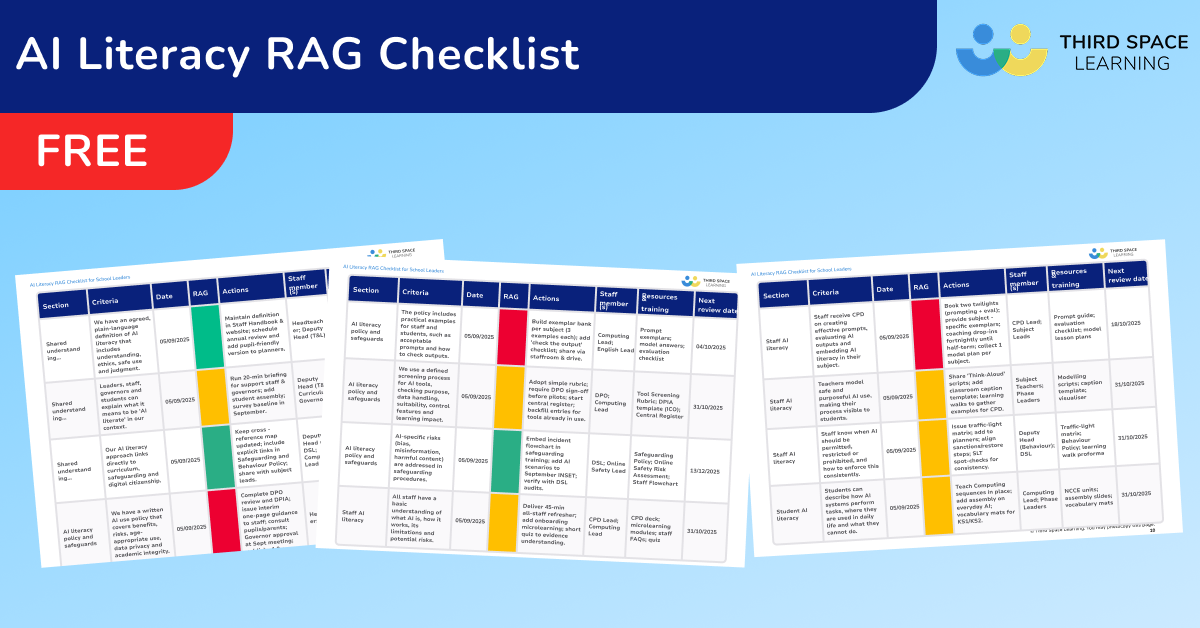
AI Literacy RAG Checklist
Download this practical AI audit, aligned with the DfE’s guidance on AI use in schools, to assess your school's AI literacy readiness. Includes a completed example and blank AI literacy RAG checklist for primary and secondary school leaders.
Download Free Now!How schools are using AI
Teachers need confidence that if they lean on AI for marking, planning or administration, it will support their expertise rather than undermine it. The schools that stand to benefit most are not the ones chasing every new innovation, but the ones making careful choices about where AI can reliably save time and build trust. Leaders in the education sector must ask themselves:
- Can I rely on what this gives me?
- Does this help my pupils learn better?
- If a parent or inspector asked about this, would I feel comfortable explaining it?
7 practical AI uses in 2026
Here are seven practical uses AI in schools. For each use, you’ll learn:
- What this practical use of AI means
- Why it matters for schools
- How schools can start integrating AI
1. AI‑powered assessment and marking
For most educational settings, assessment is where AI can make a quick, clear difference to workload and impact. AI assessment tools can take on the heavy lifting of marking and gap analysis so teachers can focus on what only they can do: interpret the data, adapt teaching and work directly with pupils.
What this practical use of AI means for schools
- Some AI tools can mark low‑stakes quizzes, short answers and some extended responses, and pull out patterns by pupil, class and cohort.
- Automating administrative tasks means teachers receive an immediate picture of secure objectives and which misconceptions are common, instead of spending hours entering scores into spreadsheets.
- The technology is already embedded in many assessment platforms.
Why it matters for schools
- Marking and analysis are time‑consuming and unsustainable parts of a teacher’s week. Reducing this is one of the fastest ways to give staff time back.
- Better, faster assessment data underpins everything else: grouping, intervention, curriculum tweaks and conversations with parents and governors.
- When assessment becomes more responsive, pupils get feedback closer to the point of learning, which is when it is most likely to change future academic performance.
- However, AI marking can be inconsistent if questions are complex or context‑dependent; teacher moderation is non‑negotiable.
How schools can start integrating AI
- Start with one or two low‑stakes assessment types (for example, weekly retrieval quizzes or end‑of‑unit checks) and switch to an AI‑assisted format, while keeping teacher moderation in place.
- Choose approved AI tools that align with your existing curriculum and present insights teachers can act on quickly.
- Agree on a simple process across year groups and subjects: which questions are auto‑marked, when teachers can override AI judgements, and how often subject leads review the quality of AI marking.
- Use time‑saving wins for teachers to do more responsive reteaching and targeted small‑group work following each assessment cycle.
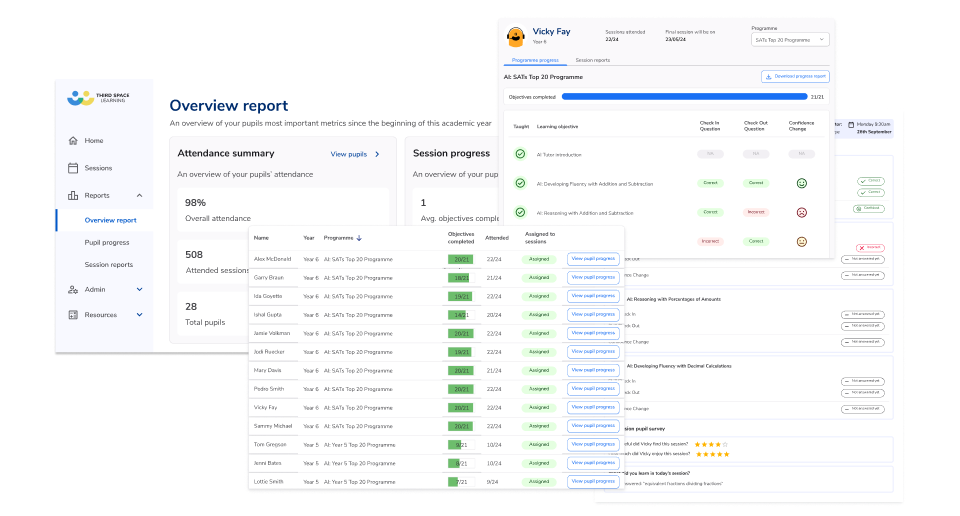
Example
A Year 8 class completes a Friday afternoon fractions topic test. 30 pupils, 15 questions, including some multi-step problems.
Traditional way: You mark all 30 papers over the weekend, enter scores into a spreadsheet, manually tally which questions caused problems, and plan Monday’s lesson based on gut feel about what went wrong.
With AI: Pupils complete the test on an AI-enabled platform that marks and shows which questions they struggled with. For example, Question 7 (adding fractions with different denominators): 23/30 got it wrong.
The teacher element: Deciding why those 23 pupils are adding denominators: do they lack denominator understanding, or are they rushing? Choosing the right representation to address it.
2. AI‑supported planning and resource creation
Artificial intelligence now offers a way to keep teachers firmly in charge of curriculum and pedagogy while taking away the repetitive drafting. This is where most teachers are already using AI in the classroom in practice: lesson content, planning and resource creation are consistently the top reported use cases in UK and international surveys. As one Deputy Head put it:
What changed planning for us was agreeing that AI was a useful starting point or critical friend, not an endpoint. Once that was clear, staff felt less uneasy about using it.
What this practical use of AI means for schools
- Teachers use AI tools to generate worked examples, success criteria, question sets, model answers and retrieval quizzes mapped to existing schemes.
- Subject and phase leaders provide the spine: the objectives, key representations and non‑negotiables. AI fills in the routine variations and examples.
- These outputs are checked, edited and saved into shared repositories so that quality improves over time.
Why it matters for schools
- Planning is often squeezed into evenings and weekends. Reducing this load is central to staff wellbeing and retention.
- Non‑specialists, early career teachers and supply staff benefit from clear, consistent models and questions for complex concepts.
- When planning is more consistent, pupils across different classes and groups are more likely to encounter the same high‑quality explanations and practice.
How schools can start integrating AI
- Identify two planning tasks to target first, such as generating retrieval quizzes and model answers for key exam‑style questions. Create shared prompts staff can reuse.
- Ask subject leads to define and share “guardrails”: specialist content, methods, and approaches that AI‑generated content must respect, so that curriculum integrity is preserved.
- Check before anything reaches pupils: factual accuracy, age‑appropriateness, alignment with your agreed methods and representations.
- Save the strongest AI‑adapted resources into departmental or phase folders so next year’s planning load is even lighter.
Example
Teaching the quadratic formula to Year 10. You need worked examples showing the formula applied to equations with different coefficient patterns.
Traditional way: You create 3-4 worked examples from scratch, or adapt textbook examples that don’t quite fit the progression. Takes 30-40 minutes to type up, check algebra, and ensure examples build appropriately.
With AI prompt: AI produces examples in 90 seconds. You review them, spot that example 3 has an arithmetic error in the discriminant calculation, fix it, reorder examples 4 and 5 because the difficulty jump is too steep, and add a note about ensuring pupils write the ± symbol clearly.
The teacher element that still matters: Sequencing the difficulty, spotting the arithmetic error, knowing that this class will need extra emphasis on the ± symbol because they rushed through prior learning on equations.
3. AI for consistency and non‑specialists
Pupils’ experience can vary dramatically depending on who is teaching. Using artificial intelligence in education offers a way to raise the bar for all classes by giving non‑specialists and support staff access to strong, shared materials.
What this practical use of AI means for schools
- Schools can use AI to produce lesson packs: clear explanations, model responses, key vocabulary and typical misconceptions for each topic.
- Teachers can share these packs with teaching assistants, cover supervisors and non‑specialists so they can deliver or support lessons with more confidence.
- Over time, departments refine these AI‑generated materials into stable, high‑quality sequences.
Why it matters for schools
- Staffing shortages, especially in subjects like maths and science, raises concerns that more pupils are taught by teachers working outside their main specialism or by supply staff.
- Without support, these colleagues often spend disproportionate time planning and may unintentionally use conflicting explanations or methods.
- More consistent explanations help pupils form secure mental models and reduce confusion when they move between classes or year groups.
One school I worked closely with said:
AI is becoming a lifeline for non-specialists. It has given them language, examples and confidence – and a way to sense-check incomplete information, rather than a folder of slides with no explanation.
How schools can start integrating AI
- Start with one year group or subject where staffing is stretched. Use an AI tool to build model lesson packs for the most important units.
- Ask subject leads to annotate these packs with essential phrases, diagrams and methods so teaching assistants and non‑specialist teachers understand what to emphasise.
- Provide short, focused training for TAs and cover staff on how to adapt the materials for particular pupils, rather than reading them verbatim.
- Encourage feedback from non‑specialists about where explanations or tasks were too complex or unclear, and update the AI‑generated resources accordingly.
Example
Year 9, solving quadratic equations by factorising. Two maths teachers, one science specialist covering a group, one day of supply.
Without AI: Science teacher uses trial-and-error method for finding factors. Supply teacher teaches “the grid method” they remember from their own schooling. Neither matches your department’s agreed approach (factor pairs → brackets → check). Pupils experience three different methods in one week.
With AI: HoD uses AI to generate 6 worked examples of factorising quadratics using the department’s method and common errors.
Result: All four teachers use the same method and check. No confusion when pupils move between classes or return to a specialist teacher.
The teacher element: HoD defines the non-negotiable method and common errors, ensuring all adults teach the agreed approach.
4. AI to reduce cognitive load and improve learning design
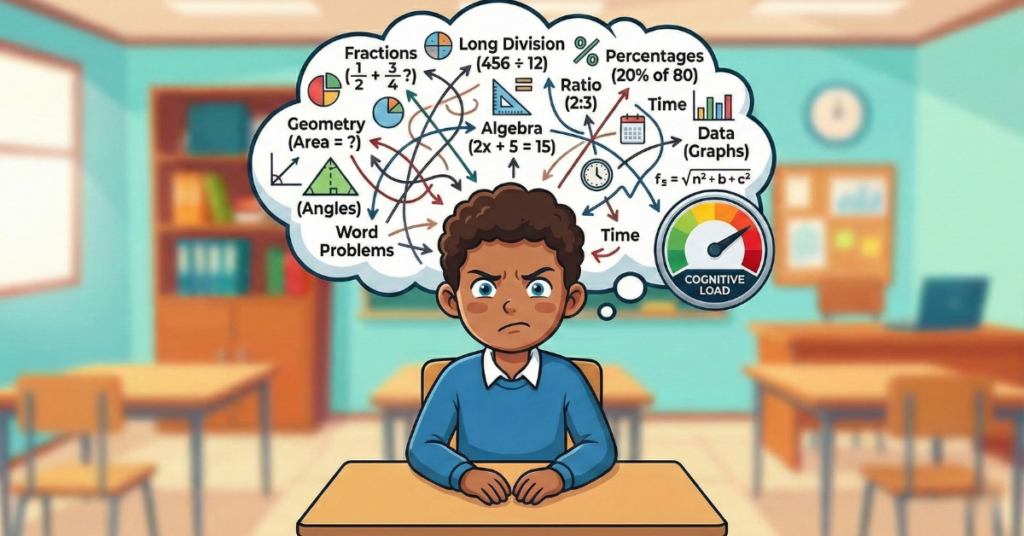
Artificial intelligence can help teachers simplify, scaffold and sequence content so pupils can focus on the ideas that matter.
What this practical use of AI means for schools
- AI helps to rewrite dense questions, simplify language, and strip away distracting elements in lesson slides or learning materials.
- Teachers generate step‑by‑step worked examples, scaffolded questions and metacognitive prompts that guide pupils through strategies, not just answers.
- AI can support pre‑teaching: short, targeted activities providing prerequisite vocabulary and knowledge before a lesson.
Why it matters for schools
- Cognitive overload is a real barrier for many pupils, especially those with SEND or those who lack prior knowledge.
- When explanations are simpler and practice is better sequenced, more pupils can access the main teaching and make tangible progress.
- In subjects like maths, carefully staged worked examples and talk‑throughs are central to building deep understanding.
How schools can start integrating AI
- Choose one upcoming unit and ask AI to generate three things: simplified versions of key questions, fully worked examples, and a short pre‑teaching activity.
- Use your professional judgement to cut or adapt anything that adds unnecessary complexity, keeping only what directly supports the learning objective.
- Build routines where pupils regularly explain each step of a worked example, helping them internalise strategies and reducing the need for constant teacher repetition.
- Monitor whether more pupils are able to access independent practice after pre‑teaching and simplified input, and refine the approach over time.
Example
Year 6 SATs prep. You’re teaching ratio problems. The textbook question reads:
“The ratio of cats to dogs in a pet shop is 3:5. There are 24 cats. The pet shop owner buys some more dogs so that the ratio becomes 1:2. How many dogs did the owner buy?”
Problem: This question has multiple steps buried in complex language. Some pupils can’t access it because they’re overwhelmed by the wording before they even start the maths.
With AI: You paste the question into an AI tool and prompt: “Simplify the language and break this into three sequential questions that build to the same endpoint.”
AI produces:
- “There are 3 cats for every 5 dogs. There are 24 cats. How many dogs are there?”
- “Now the ratio changes to 1 cat for every 2 dogs. There are still 24 cats. How many dogs are there now?”
- “How many more dogs did the owner buy?”
You review this, decide question 2 needs one more scaffold step, and add:
- 2a. “If the ratio is 1:2, what does that mean for the number of dogs compared to cats?”
- 2b. “There are 24 cats. How many dogs are there now?”
The teacher element that still matters: Knowing that this class needs question 2 split further, deciding which pupils get the scaffolded version vs. the original.
5. AI‑scaled one‑to‑one and small‑group support
One‑to‑one and small‑group tuition remain some of the most effective ways to accelerate progress, but they can also be the most expensive. The most exciting use of AI in 2026 is not generic chatbots; it is structured, high‑frequency extra practice for the young people who need it most, delivered without adding another intervention group to a teacher’s timetable.
Compared with planning and admin, this is still at an early stage, but it is where AI could have genuine long‑term impact on attainment if it is done well.
What this practical use of AI means for schools
- AI tutors can provide structured, curriculum-aligned practice and feedback for individual pupils or pairs, guided by teacher‑set objectives.
- Spoken AI tutors are emerging as particularly powerful in Maths, encouraging pupils to talk through their reasoning, using speech recognition, not just click through multiple‑choice questions.
- Verbal reasoning is a key mathematical skill, with one to one AI tutoring, every pupil can practice their reasoning skills.
Why it matters for schools
- Many schools have used recovery funding or short‑term grants for tutoring that is now difficult to sustain as budgets tighten.
- In maths, teachers report having a persistent group of pupils who sit just below the expected standard and need structured, regular support that teachers struggle to provide alone.
- AI tutoring offers an opportunity to extend high‑quality practice and explanation to all pupils who need it, not only those who can be scheduled for a small‑group slot.
How schools can start integrating AI
- Decide which pupil groups are priorities for AI‑supported tutoring, such as those below expected standard, pupils with specific gaps, or those transitioning between key stages.
- Ring‑fence time and space in the timetable for sessions, whether during the school day, breakfast clubs or after school, with clear attendance expectations.
- Ask teachers to set the focus for each session and to review a simple summary afterwards so AI tutoring remains tightly connected to classroom teaching.
- Collect a small set of metrics: attendance, pupil confidence, and a few curriculum‑aligned assessments over a term, to judge whether the approach is delivering value.
Example
You’ve got 12 Year 6 pupils working towards expected standard in maths. They’re stuck on fractions, ratio, and percentage problems that require multi-step thinking.
Old way: You run a 30-minute intervention group 3x per week. You see 6 pupils per session maximum, meaning the other 6 get intervention once every other week.
With AI tutoring: All 12 pupils get a 20-minute AI tutoring session 3x per week.
Monday’s session log shows:
- 8 pupils completed the fraction work and moved to percentages
- 4 pupils are still struggling with the underlying “division” concept in fractions
- Pupil M asked the AI to re-explain the same step 4 times and eventually got it
- Pupil J finished everything in 12 minutes but made errors, suggesting over-confidence
Wednesday morning: you pull those 4 struggling pupils for a 15-minute teacher-led session with concrete resources to build the division concept. The other 8 continue with AI.
The teacher element that still matters: Interpreting why those 4 are stuck, providing the concrete/pictorial bridge that AI can’t, deciding that Pupil J needs challenge not more practice.

Skye, Third Space Learning’s spoken AI maths tutor, helps schools scale one-to-one support without expanding staffing or per-pupil costs. Using speech recognition technology, pupils talk through their mathematical reasoning whilst Skye provides structured, teacher-designed practice aligned to your curriculum.
The fixed annual cost means you can extend this support to every learner who needs it – for pre-teaching, catch-up or reasoning practice – not just a small, targeted group. Teachers can reorder lesson objectives and receive clear post-session reports, keeping AI tutoring tightly connected to classroom teaching whilst saving time on intervention coordination.
If you’re looking to make personalised support genuinely scalable, find out more about how AI maths tutoring with Skye works in practice.

6. AI for equity, inclusion and early intervention
Many AI conversations in schools centre on saving teacher time. In 2026, an important question is whether AI is helping you reach the pupils who are underserved by the current system – or quietly making gaps worse.
What this practical use of AI means for schools
- AI‑enhanced analytics can flag patterns in attendance, student engagement and assessment that suggest a pupil or group is beginning to slip, long before this shows up in headline data. Early noticing in the learning process enables early intervention.
- Build inclusion by design with AI, not as an afterthought: auto‑generated read‑aloud, simpler parallel texts, visual supports and translated key vocabulary let pupils with SEND, EAL learners and those with weaker literacy access the curriculum with dignity and agency.
- Select AI tools with care so they align with diverse contexts and are mapped to the right curriculum.
Why it matters for schools
- Budget and staffing constraints mean you cannot give intensive human support to everyone; using data more intelligently is one of the few levers left for earlier, more targeted help.
- Equity in education is now central in international AI guidance: UNESCO and OECD are explicit that AI in education should reduce gaps in educational outcomes, not widen them, and should respect learners’ rights and autonomy.
- Parents and pupils are increasingly alert to questions of fairness, bias and privacy; schools that use AI for monitoring or prediction without a clear ethical stance risk losing trust.
How schools can start integrating AI
- Start with one or two well‑defined early warning indicators. For example, a combination of attendance patterns, missed homework and quiz results; use AI to surface pupils or classes that may need a closer look, not an automatic label.
- Pair any analytics with human review and pastoral knowledge, so that flags lead to conversations, not assumptions. Make it explicit that no high‑stakes decision will ever be made by an AI algorithm alone.
- Use AI’s accessibility features deliberately: translated explanations, simplified language, audio support and pre‑teaching sequences for key vocabulary, so pupils are better prepared to access whole‑class teaching.
Example
Teaching column multiplication to Year 5 in October.
Without AI: You notice a pupil struggling in timed assessments but getting class work correct.
The AI-specific value: System analyses patterns across time and task type that a teacher can’t easily spot while teaching 30 pupils.
AI flags performance tracking over 3 weeks shows sudden drop (85% → 78% → 68%) specifically on timed assessments. Accuracy unchanged on untimed practice. AI cross-references with engagement data: high help-button use after wrong answers, suggesting she knows the method but second-guesses herself. AI synthesis: anxiety pattern emerging.
AI tracks micro-patterns across dozens of data points per pupil (click behaviour, time-on-task by question type, performance trajectories) that reveal why pupils struggle, not just that they do.
The teacher element: Acting on insights, having conversations with the pupil about exam anxiety.
7. AI literacy, ethics and governance for staff and students
However educational institutions choose to use AI in 2026, one thing is clear: ignoring it or banning AI adoption does not stop pupils or staff from using it. It just means they are doing so without guidance. Schools must prepare pupils and staff with the knowledge, skills and guardrails to use AI safely and well.
What this practical use of AI means for schools
- AI literacy becomes part of what it means to be ready for life and work: understanding what AI’s potential is, what it can and cannot do, how it can mislead, and how to use it responsibly.
- Schools should develop clear, living guidance on AI that covers teaching, learning, assessment, admin and communication.
- Pupils learn how to get help from AI, and how to question it, check sources and declare its use in their work.
Why it matters for schools
- Staff need clarity on what is allowed and encouraged, and what is off‑limits to create confidence experimenting within safe boundaries.
- Effective AI training for educators needs to be hands-on, allowing teachers to experience the tools while solving real problems from their practice.
- Clear governance helps school leaders answer legitimate questions from parents, governors and inspectors about fairness, privacy and academic integrity.
How schools can start integrating AI
- Draft or update a short, practical AI policy or statement for staff and families: what the school is aiming to achieve with AI, and how it will protect pupils. Review this at least once a year.
- Integrate simple AI literacy content into existing subjects. For example, checking AI‑generated claims in English, discussing bias in PSHE, and exploring how AI algorithms work in computing.
- Provide staff with a small menu of approved AI uses (such as lesson planning, administrative tasks, quizzes and feedback) and a few red lines (such as ethical considerations, data protection or using AI to fabricate assessment data).
Example
January INSET day, your school/trust discusses AI. The conversation is chaotic – some staff are using ChatGPT for everything, others refuse to touch it, no one’s sure what’s allowed.
With clear governance, you produce a one-page guidance document:
- Where AI is expected
- Where AI is optional
- Where AI is not allowed
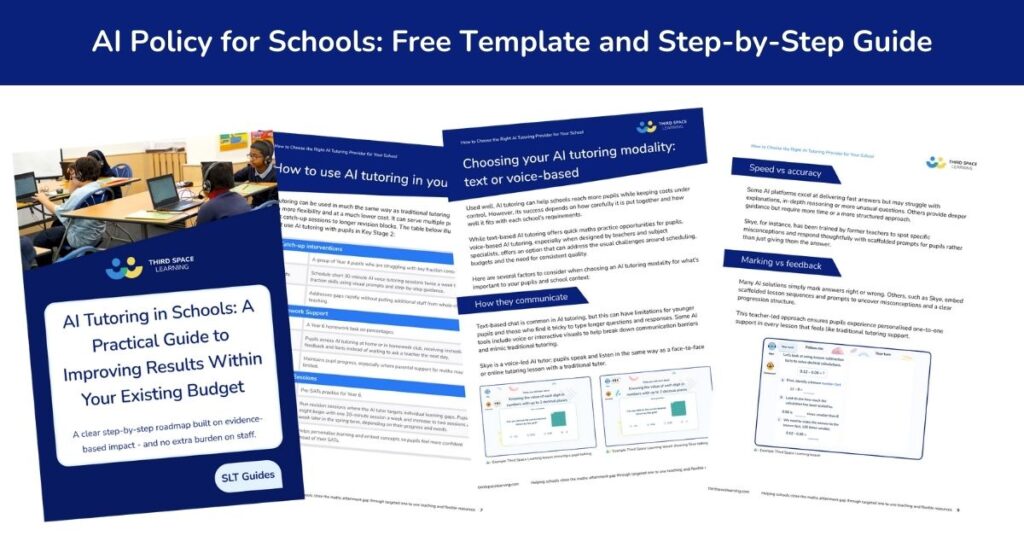
Schools implementing AI tutoring can use the Third Space Learning AI tutoring policy and template as a starting place to create their own.
At this point, it is worth saying plainly that very few schools are doing all of this. Most are in a phase of controlled experimentation.. Surveys and conversations with schools show that time‑saving is real, but so are the concerns about training, ethics and impact on learning.
AI uses you should pay less attention to
Here are three AI technology trends that are not worth paying attention to (yet, at least) for most schools in 2026.
1. “AI‑powered creativity” tools that promise to replace teachers’ professional judgement
There’s a wave of artificial intelligence tools claiming to generate “fully adaptive interactive lessons” or “AI‑driven creative projects” from scratch. In practice, these systems still produce generic, context‑blind content that often contradicts a school’s curriculum or pedagogical approach.
Why it isn’t worth your time:
- They produce glossy but shallow outputs that require heavy editing.
- They blur intellectual ownership and raise plagiarism or copyright questions.
- They risk pushing teachers into editing AI drafts rather than designing learning experiences.
2. Over‑engineered analytics dashboards that don’t lead to action
Generative artificial intelligence platforms now offer “360‑degree insights” on pupils’ attendance, mood, engagement, and learning data all rolled into one. It sounds powerful, but many schools find these systems generate impressive‑looking dashboards full of noise rather than insight.
Why it isn’t worth your time:
- Staff spend more time creating and interpreting graphs than teaching.
- Predictions can easily over‑label pupils, risking bias or data fatigue.
- Few of these dashboards integrate cleanly with MIS or align meaningfully with classroom practice.
3. Generic chatbots as “AI teaching assistants”
Some schools are tempted by free‑form chatbots marketed as classroom aids or pupil mentors. However, generic conversational AI still struggles with accuracy, context, and safeguarding, and pupils tend to use them transactionally to get quick answers without thinking. Without strict configuration and oversight, they can offer wrong or inappropriate feedback.
Why it isn’t worth your time:
- Safety, bias and data privacy remain major concerns.
- Pupils can quickly push the bot off track or receive unhelpful or out-of-context advice.
- Teachers then spend extra time correcting misconceptions.
Three AI principles before you begin
1. Follow the official guidance
The Department for Education has a host of official publications for using generative artificial intelligence in educational settings. Ensure you read these before making any informed decisions about which AI tools to use in your setting.
- AI in schools and colleges: what you need to know
- Generative artificial intelligence (AI) in education
2. Define AI boundaries
Refine your AI guidance so it’s clear where AI is expected (e.g. planning, retrieval, diagnostics), where it is optional, and where it is not appropriate, with an emphasis on enhancing teacher judgement.
3. Evaluate ruthlessly
Review which AI tools are genuinely saving time or improving educational outcomes, retire overlapping products, and reinvest that money and staff energy into the few approaches that are demonstrably working.
A practical AI checklist for your next term
Many school leaders across the education sector are finding that successful AI adoption isn’t about rushing to implement every new generative AI tool at once. Instead, it’s about taking deliberate, measured steps that support teaching and learning whilst building staff confidence.
Whether you’re just beginning to explore using AI or you’re looking to expand existing initiatives, this practical checklist will help you move forward thoughtfully. It’s designed to support teachers in integrating AI safely whilst maintaining the professional judgement that remains central to excellent teaching.
- Decide your top AI priorities: what matters most in your context right now?
- Name where AI is expected, optional and off‑limits: clarity with boundaries helps everyone.
- Run one well‑designed pilot per term: define success measures up front, run it for a half‑term, and then decide: expand, adapt or stop.
- Be clear about the role of the human in the loop, and where professional judgement matters most.
- Invest time in AI literacy for staff
- Talk openly with pupils and parents, and build community awareness and understanding
The future of AI in education
AI in education in 2026 is neither a miracle cure nor a disaster waiting to happen. It is a set of imperfect tools landing in very human systems, with all the complexity (and messiness!) that implies.
School leaders aren’t looking for a debate about generative AI replacing teachers. They want to know about using AI safely and sensibly, whether it’s worth the effort, and which AI tools and practices are best left alone for now. The schools that are getting the most out of AI technology are not the ones doing the most, but the ones that are clear about why they are using it:
- Giving teachers back time,
- Strengthening what already works,
- Extending support to pupils who would otherwise miss out.
Remember, schools should start with focused pilot programs when implementing AI tools to evaluate their effectiveness before scaling up.

AI in schools FAQs
Schools are using AI to personalise learning, automate administrative tasks, and support teaching. Common applications include adaptive learning platforms that tailor content to individual students, AI tutors providing one-to-one support, and tools that help teachers with lesson planning, marking, and data analysis.
AI in UK education supports personalised learning through adaptive platforms and AI tutoring systems. Schools use it for assessment, tracking progress, and identifying learning gaps.
Yes, schools can use AI, but they must follow DfE guidance on data protection, safeguarding, and responsible implementation.

DO YOU HAVE STUDENTS WHO NEED MORE SUPPORT IN MATHS?
Skye – our AI maths tutor built by teachers – gives students personalised one-to-one lessons that address learning gaps and build confidence.
Since 2013 we’ve taught over 2 million hours of maths lessons to more than 170,000 students to help them become fluent, able mathematicians.
Explore our AI maths tutoring or find out about the AI tutor for your school.