


GCSE Maths Marking Decoded: How to Train Your Department and Boost Student Exam Performance [Video]

GCSE maths marking can feel complex. Here, Paul Coffey and Martin Noon talk through GCSE maths mark schemes, decoding the marking codes, training your maths department to mark consistently, and how to ensure students gain as many marks as possible in their GCSE maths exams.
Welcome, everyone, and thank you for joining us today for GCSE Maths Marking Decoded.
Everyone here today will receive the webinar recording along with exclusive resources, including a topic frequency guide, along with a topic revision list, marking scenario guidance and departmental CPD templates. We’ll share links to these resources at the end.
Along the way, we will also mention some of our free GCSE maths resources that you can download from the Secondary Maths Resource Library.
For those of you who aren’t familiar with Third Space Learning, we provide one-to-one AI maths tutoring for schools. We’ve supported thousands of students through their GCSE maths journey, and that experience, combined with our team’s expertise in exam marking, has shaped today’s session.
In the next 30 minutes, we’ll cover:
- How GCSE mark schemes really work and common marking codes that can be misinterpreted
- Higher versus foundation marking expectations and how that affects tier decisions
- How to train your maths department to spot critical marking scenarios
- Practical exam techniques you can teach students to maximise their marks
- Topic frequency data to help you allocate revision time effectively


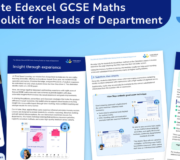
The Ultimate Edexcel GCSE Maths Marking Toolkit
A practical Edexcel marking toolkit to help your department build examiner-aligned marking, improve consistency and strengthen students’ exam technique.
Download Free Now!Before we start, let me introduce myself. I’m Paul, Secondary Curriculum Lead at Third Space Learning. I’m a former maths teacher and GCSE examiner, and I now oversee all of our secondary maths programmes.
Joining me today is Martin, who brings invaluable expertise to this session.
Hello, I’ve been working with Third Space Learning for five years. Currently, I help write the GCSE tutoring lessons delivered by AI tutor Skye. I’ve also been an Edexcel specialist since 2017. My experience as both a teacher and examiner gives me insight into both sides of the marking process, which I’m looking forward to sharing with you today.
What’s in a GCSE mark scheme?
Let’s start with the fundamentals of GCSE mark schemes. GCSE mark schemes include different types of marks: method marks or process marks, accuracy marks, communication marks, alternative methods, and special marking codes.
Martin, can you talk us through what teachers really need to understand about these different mark types?
Absolutely. There are similarities across all GCSE exam boards; I’ll focus mainly on Pearson Edexcel as that’s my specialism, but much of this advice applies across boards.
The important thing about GCSE mark schemes is understanding the special codes. You’ll have method marks, which may be dependent on previous method marks. There are codes like CAO, correct answer only, where students must get the exact answer with no room for method marks. There are voluntary marks, special cases; it’s important that everyone in your department marking mock exams or tests understands these codes, so there isn’t any inconsistency.
We’ve all had those chats in the staff room where someone says, “Oh, should I give this mark or not?” If we formalise that through proper departmental standards, it saves everyone time. It also helps students understand why they did or didn’t get marks, rather than arguing their case with their teacher, and better prepares them for the exam.
Making sure we understand those marking codes and how method marks and accuracy marks work is absolutely essential.
I completely agree, and I also think that distinction can be quite confusing. Martin, would you be able to explain the difference between a process mark and a method mark?
A method mark wants to see something very specific. If the question doesn’t say “you must show your working” and students get the answer right, they can get all the marks. But if they don’t get it right, method marks are more structured; we want to see this particular calculation or this particular number being used in a formula.
Process marks are a bit looser. They’re used when there could be lots of different ways to approach a problem. Instead of listing every possible alternative method, the mark scheme just wants to see that students are starting a process to find the answer. If that’s obvious from their working, they can get that mark.
That’s really helpful. We have a mark scheme example on screen here that shows some of these codes in action. You can see how method marks, process marks, and accuracy marks all work together. This visual guide is included in the GCSE maths marking toolkit.
Foundation vs Higher tier
Now let’s look at Foundation versus Higher-tier mark scheme expectations, because this is crucial for deciding which tier suits your students best.
Foundation-tier exam papers cover grades 1 to 5 and reward partial method marks quite generously, making them more forgiving for incomplete working. Higher-tier exam papers cover grades 4 to 9 and require more complex, structured solutions.
There are 240 marks across all three exam papers, and that converts to the final grade. Understanding how marks convert differently across tiers can help you make strategic decisions about borderline students.
Martin, do you have any top tips on how teachers can decide whether to put borderline students on Foundation or Higher?
From my experience leading Key Stage 4, we would always analyse what we called the crossover questions – those questions that appear at the end of the foundation paper and the start of the higher paper.
If a student was able to get the majority of those crossover questions correct – say they were scoring 20 to 25 marks out of 30, we’d say, “OK, let’s give the higher paper a go and see how you perform.”
If they were losing most of those crossover marks, we’d always say the foundation paper was the safer option. If you’re losing these marks, you’re unlikely to pick up many marks later on the harder content. You might end up not getting the grade 4 and potentially even getting a grade 3.
Generally, the guidance is: if the student is not aiming for a grade 6, the foundation paper is the best paper for them. I believe that myself. If a student is aiming for a grade 5 or trying to secure a grade 4, the foundation paper should be what they sit.
But it will depend on the individual student. Sometimes, they might just be better at picking up those few marks on the higher paper. If they sit the foundation paper, they might make more mistakes on the really basic questions and miss out. That’s why you need to do lots of practice papers, and this is where consistent marking across your department becomes really important.
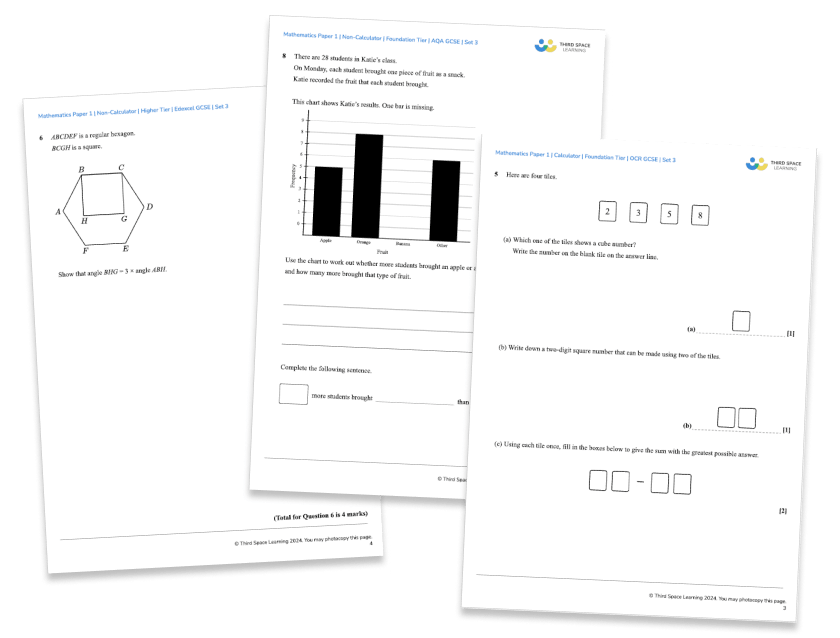
Absolutely, practice papers are key to GCSE maths success. We have a whole host of GCSE maths practice papers in the Secondary Resource Library for both Higher and Foundation Tiers across Edexcel, AQA and OCR. In fact, we are releasing a brand new set of papers in February.
Training your department
Thinking about the mark scheme application, you’re absolutely right. Even experienced teachers can apply mark schemes quite differently. Some under-credit method marks, some over-credit answers. These inconsistencies across your department can really skew your data and affect what students may or may not need to focus on.
So, aligning marking standards across the department is vital. In your experience leading this work, what would you say are the best techniques that department heads can use to standardise marking across busy teams?
If you’ve got any exam markers who’ve had official training in your department, they should always be available to offer advice to less experienced teachers. Those conversations you’re having in staff rooms need to be made more formal, perhaps in department meetings.
What you don’t want is one teacher giving a mark to a student in one class, and another teacher having a student with the exact same working and wrong answer but giving different marks. Students will start to complain, they’ll argue their point, teachers won’t know what to do, and it creates unnecessary friction.
We need to make sure we’re collaborating. If teachers have had marking training, they should lead departmental sessions and say, “This is what we need to do if we see this.” Come up with scenarios for questions that could be awkward to mark.
When you’re doing it properly for the exam board, you’ll still have heated debates with your team leader about why they didn’t accept your mark on a particular question. It still happens, even with really experienced people. Throughout the marking process, there could be an email to all markers saying, “We’ve seen a lot of inconsistency on this question, so everyone needs to stop, read this information, and if you see this, you give that mark.”
It must happen on that smaller departmental scale as well.
One practical way to do this is to get your team together and look at some past questions. Go through them together and make sure everybody’s on the same page. You’ll find some examples of these in the GCSE maths marking toolkit, both blank and completed examples to use with your team.
Critical marking scenarios
Speaking of using examples with your team, let’s discuss training your team to spot particular scenarios that often trip students up. Martin, can you walk us through these?
Certainly. There are several key areas where students commonly lose marks that examiners see repeatedly.
First, rounding too early in calculations. When questions carry accuracy marks, students need to keep full accuracy throughout their working. If they round too early, they can lose those accuracy marks even if their method was correct. Encourage students to keep all decimal places in their calculator until the final answer.
Second, contradictory working. If students show two different methods that give two different answers, you have to mark the one that gives the least number of marks; you can’t give them the benefit of the doubt for the better working. If there’s an answer line and they’ve written an answer there, that’s the answer you must mark, regardless of what working is shown.
Misreading numbers is another big one. If a student reads 814 as 841, they may still get method marks if their working is correct based on what they read, but they’ll lose the accuracy mark. For GCSE marking, genuine misreads are usually passed to a team leader to confirm.
And finally, crossed-out work. If work is crossed out and not replaced, you still mark it. If you can read it and there’s something there worth a mark, you must give it. So tell your students: don’t go mad crossing things out. Put a few lines through it, but keep it legible so that if there’s something worth marking, the examiner can still see it.
Those are brilliant, practical points. Let’s look at a real example to see how this works in practice.
On screen, we have a typical simplifying algebraic expression question and three different student responses. Let’s walk through how we’d apply the mark scheme to each of these three students.
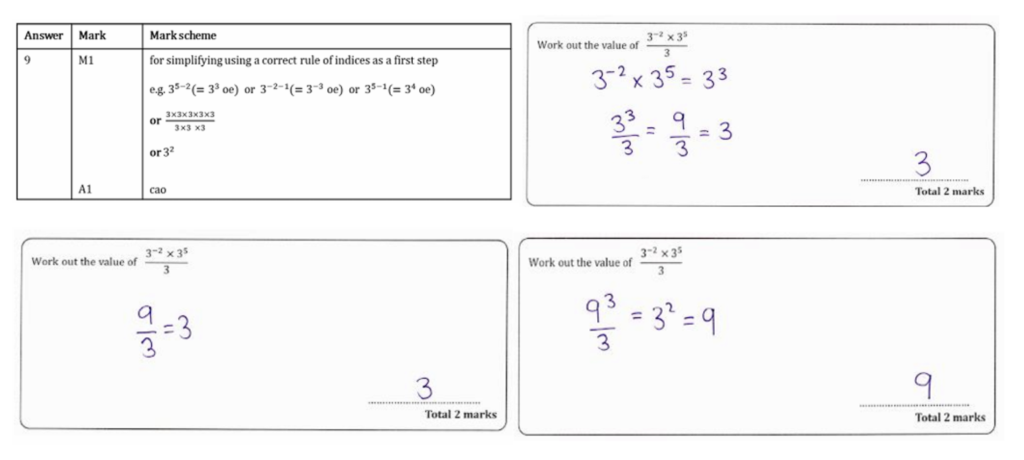
Looking at Student A, they’ve shown clear working, expanded the brackets correctly, collected like terms, and reached the correct simplified answer. That’s full marks.
Student B has made an error in expanding the brackets, but they’ve then collected like terms correctly based on their expansion. So they’d get the method mark for collecting like terms, but lose the accuracy mark for the final answer.
Student C has the correct final answer written in the answer box, but their working is contradictory; they’ve shown two different methods with different intermediate steps. In this case, if the working doesn’t clearly support the final answer, we can’t award method marks. They might only get the accuracy mark if “correct answer only” applies, or they might lose marks entirely depending on the specific mark scheme requirements.
This is exactly why showing clear, structured working is so important.
And this is exactly the kind of scenario teachers should be discussing in department meetings to ensure consistency.
Student strategies: building structured exam technique
So, we’ve looked at training your department for marking consistency to improve GCSE grades. Let’s move on to strategies teachers should be explicitly teaching students. These aren’t just good practice, they’re mark-winning techniques.
Strategy one
Show your full working. This builds structured, logical thinking and promotes clarity. I always used to say to students: show the examiner what you know. Make it very clear, very ordered. Make it easy for them to give you marks. Don’t keep calculations in your head, if you know something, write it down. There may be method marks available even if your final answer is wrong.
Strategy two
Set up equations or diagrams. For Edexcel, those process marks could come from showing a diagram or showing rectangles that represent something. If it’s clear what they represent, that could give them a process mark. Make sure students are writing equations or showing diagrams to help secure those method marks and process marks.
Strategy three
Highlight key information in questions. This strengthens critical reading skills and helps students filter out noise and focus only on the key information needed. It encourages attention to detail and improves task prioritisation.
Strategy four
Ensure the final answer is in the required form. Some papers, like Pearson, will specifically ask for answers rounded to three significant figures or in surd form. Students need to read questions carefully. Sometimes the rounding isn’t that important—it’s just to save students writing out ten decimal places. But there are questions where it’s specifically about rounding, and if they don’t follow the instructions, they lose marks.
Strategy five
Annotate diagrams, graphs, and charts. If a student knows something, write it on the diagram. This is crucial for angle questions, geometry problems, circle theorems. The information on the diagram is available to mark, so even if a student hasn’t included something in their calculation but they’ve written it on the diagram, we can award marks for it.
I always found that when teaching angle questions, whether parallel lines or circle theorems, I’d tell students to do everything on the diagram. Point arrows at angles, write labels, and note any reasons near the angle. I found it much easier for students to communicate that way rather than trying to write everything at the bottom away from the diagram. If they’re not very good at using angle notation like angle AOB, just put an arrow pointing to it—that’s perfectly acceptable.
For angle questions, especially, students should just fill in what they know on the diagram first. Don’t even worry too much about the question initially. Straight lines, alternate angles, if you know something, put it on the diagram. Mark right angles with a square. Get that information down.
Strategy six
Last one, check units and conversions. If the question has units in it and students haven’t written them down, that’s normally worth an extra mark. Make sure they use the correct unit and that it makes sense. If it’s a question about centimetres and they’ve worked out 0.0000084, or if it’s the length of a pencil and they’ve worked out 20 miles, it’s not going to be right. Logical thinking matters.
These strategies are so important that we’ve created a GCSE Exam Strategies Poster that covers all these points, and it’s perfect for displaying in your classroom. When students get stuck, you can direct them to it as a quick reference guide.

And actually, one of the challenges teachers often mention is finding time to teach these strategies explicitly to every student who needs them, especially when you’ve got 30 students in a class all at different stages.
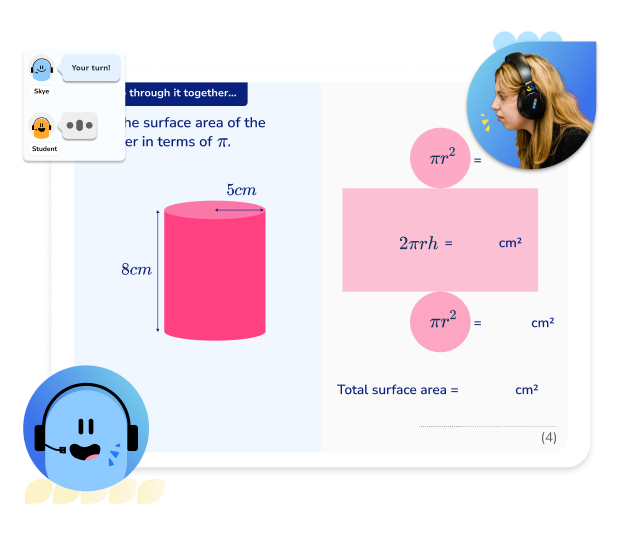
That’s one of the reasons many schools use AI maths tutoring with Skye, our AI maths tutor, for targeted GCSE revision. Every Skye session explicitly models these exam techniques, showing working, checking answers, using efficient methods, and because it’s one-to-one, each student gets personalised support on exactly which techniques they need most.
For example, if a student consistently forgets to include units or rounds too early, Skye picks up on that pattern and addresses it directly in future sessions. It means these exam habits get reinforced regularly without adding to your workload.
Exam technique training: practical skills
Beyond those core strategies, there are some specific exam technique skills worth training explicitly.
First exam technique
Strategic pacing. This is crucial. Part of the exam skill is getting through it within the time limit. As a rough guide, students should aim for around one mark per minute. That gives them a bit of time at the end for checking.
But here’s the key: don’t panic if you’re still on a one-marker or two-marker after a few minutes. Move on. You can always come back. If you’re on a three- or four-marker and really struggling, write down what you know, then move on. You might pick up one or two method marks, and you can always return to them later. Keep calm, do a couple more questions, then come back with fresh eyes.
Second exam technique
Decoding command words. Every exam board uses roughly the same command words throughout papers. Make sure your students know what they mean.
“Write down,” “state” these are normally one-mark questions, quick and straightforward. “Work out” normally involves working out with method marks, then an accuracy mark. Students need to be aware: is this a quick question or something that needs more detail? Make sure they’re writing enough for the number of marks available.
Third exam technique
Sense-checking answers. Is my answer sensible? Areas and volumes must be positive; if your answer is negative, something’s gone wrong. A recipe won’t call for 700,000kg of flour. The distance between the two cities won’t be 10cm.
Students should look at their answer and ask: is this relevant? Is this sensible? If not, take another look. It’s possible a conversion has gone wrong, or there’s been a calculation error. That simple check can be the difference between getting the accuracy mark and losing it.
Fourth exam technique
Never leave blanks. Examiners are overjoyed when they see a blank question because they can just write zero and move on. Make them work for it. Make them actually look for something, check something. Write something down—there might be a method mark available even if the final answer is wrong.
Fifth exam technique
Use your calculator. This sounds obvious, but for calculator papers, students should actually use it. Make sure your students are really familiar with their calculator, ideally they should have their own calculator that they use throughout Year 10 and 11, not borrowing different ones.
Write down what the calculation is, then type it into the calculator. Don’t try to do long multiplication on a calculator paper; it wastes time and creates opportunities for errors. Write the calculation, use the calculator, and write the answer.
Sixth exam technique
Substitute correctly into formulae. If students need to use a formula from the formula sheet, they should write down the formula first, then substitute the values in the correct places.
If they’re putting the correct values in the correct places in the formula, that’s normally worth a method mark, even if they make a calculation error later. If it’s a formula they’ve had to learn, writing down the formula first could be worth a method mark. Then, substituting correctly or just writing down the values substituted in the correct format, that will show the method mark can be given. Show that working.
We do have a GCSE maths formula sheet that students can use.
Departmental implementation: making it sustainable
So we’ve covered a lot of ground, understanding mark schemes, training techniques, and student strategies. How do we actually embed this across a busy department in a sustainable way?
Spend time in departmental CPD sessions looking at multi-mark questions from past papers. Think about whether they’d be worth different numbers of marks. Get teams to come up with different answers that may or may not be worth something. Get them to think about different marking situations.
Use the mark schemes to create example questions that could be tricky to mark. Get teachers to do some live marking—you can even have staff mark each other’s work, try seeing what students might come up with. Discuss these scenarios in meetings and write down any situations that come up.
Then, and this is crucial, agree on a departmental marking stance and document it.
That’s a really important point. Departments can formalise their stance on key marking scenarios. Some departments apply stricter approaches for mock assessments to reinforce key exam habits.
Exactly. You might decide, “OK, we’re going to require our students to show working, and if they don’t, we’re not giving full marks. We want them to get used to doing this.” But make sure it’s consistent across the department. And make sure it’s communicated with students and parents so everyone understands. You could even say, “For this particular exam, all working must be shown to gain the marks.”
You might even edit the exam papers so every question says “all working must be shown.” If that’s consistent, you’ll have more consistent marking throughout those tests rather than some teachers giving full marks for correct answers with no working. But be consistent, that’s the keyword.
In the GCSE maths marking guide, you’ll find these Departmental Marking Scenarios and examples. It covers different scenarios you might want to create policies around, such as requiring full working, how to handle misreads, dealing with contradictory methods, and all the tricky situations that come up.
Using data to guide revision: topic frequency analysis
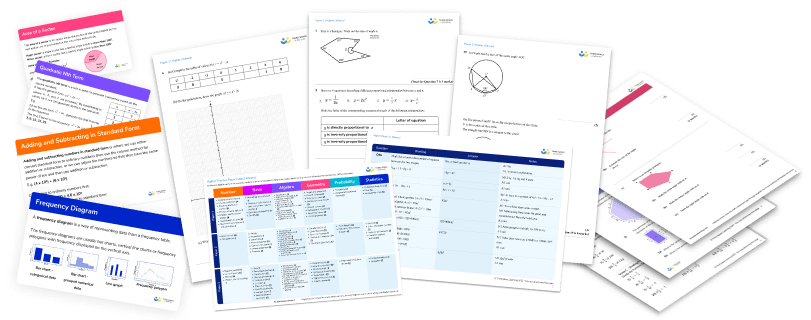
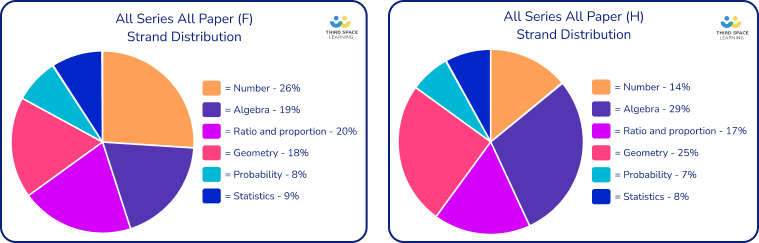
Finally, before we wrap up, let’s talk about using data strategically. We’ve analysed topic frequency from 2017 to the 2025 summer series maths GCSE papers, and this can really help you allocate revision time effectively.
We’ve looked inside the main content strands to show what sort of topics actually come up. You can use this as part of your revision planning. When I used to start revision, I’d go in with loads of questions on addition and subtraction, loads on multiplication and division, but the questions within each topic can be so different that it’s more beneficial to group questions by specific skill.
The key message here is: don’t use frequency data as a guarantee that something will or won’t come up. Just because something came up one year doesn’t mean it’ll come up the next. But it does help you see patterns and make informed decisions about where to focus limited revision time.
Exactly. Combine the insights from your marking analysis with this multi-year topic frequency data to direct students to particular areas of weakness. But none of it should be taken as gospel; it’s all about giving your students the best possible opportunity.
This frequency data, along with our analysis methodology, is included in the full resource pack you’ll receive. You can use it to inform your revision planning without it taking hours of your own time to compile.
Resources and next steps
Martin, thank you so much for joining us today to help demystify GCSE maths mark scheme, we hope you’ve found this useful and can apply the strategies we’ve discussed today across your department.
All the resources we’ve mentioned today are available through the QR code on screen:
- Mark scheme code examples and explanations
- Departmental CPD templates for standardising marking
- Marking scenarios guide with suggested policies
- GCSE exam strategies poster for students
- Free GCSE practice papers following the exact exam formula
- Topic frequency analysis data
We also have extensive free resources available through the Secondary Resource Library, including hundreds of GCSE revision resources, practice papers, and GCSE revision guides.
And if you’re interested in learning more about Skye, our AI maths tutor that delivers personalised one-to-one GCSE revision sessions, please get in touch at hello@thirdspacelearning.com or register your interest online at thirdspacelearning.com. Our team will be happy to arrange a free demo session so you can see Skye in action.
Thanks, everyone. We know how busy you are, especially at this time of year, so we really appreciate you taking the time to join us.
Good luck with your GCSE preparation. We hope these strategies and resources help both your department and your students feel confident and prepared. Thank you.

DO YOU HAVE STUDENTS WHO NEED MORE SUPPORT IN MATHS?
Skye – our AI maths tutor built by teachers – gives students personalised one-to-one lessons that address learning gaps and build confidence.
Since 2013 we’ve taught over 2 million hours of maths lessons to more than 170,000 students to help them become fluent, able mathematicians.
Explore our AI maths tutoring or find out how a GCSE maths tutor could support students in your school.