

DFE Backs AI Tutoring To Close The Attainment Gap – What Does That Look Like For Schools?

The government’s new AI tutoring programme won’t reach schools until 2027. But with trials starting this year, schools need to know what separates effective, safe AI tutoring from the hype – and what’s already available now.
Key takeaways:
- The DfE has announced plans to develop AI tutoring tools for up to 450,000 disadvantaged Year 9–11 pupils, with AI tutoring trials starting autumn 2026 and rollout by end of 2027.
- The government’s priorities for AI tutoring – teacher-led design, curriculum alignment, robust safeguarding, and complementing (not replacing) classroom teaching – are the right ones.
- Schools don’t need to wait for the results of the pilot: AI tutoring tools meeting these criteria already exist, including Skye from Third Space Learning.
- This article explains what the announcement means, what to look for in any AI tutoring tool, and the questions to ask providers.
Government has announced pilot into eAI tutoring
The Department for Education has announced plans to develop AI tutoring tools that could support up to 450,000 disadvantaged children in Years 9–11 – a clear signal that government sees AI as part of the solution to closing the attainment gap.
The announcement sits within a broader edtech strategy, including a £23 million expansion of their AI in education EdTech Testbeds pilot recruiting over 1,000 schools to trial AI tools and assistive technology. For tutoring specifically, the DfE will run a tender for industry to co-create AI tutoring tools with teachers, working alongside AI labs and leading tech companies. Teacher-led co-creation begins this summer term, with trials of AI tutoring in secondary schools from autumn 2026 and tools available to schools by the end of 2027.
Education Secretary Bridget Phillipson was clear on priorities: “AI tools are only helpful in education if they are safe and support learning – and that is a non-negotiable. We will ensure tutoring tools are designed with teachers and rigorously tested, so they enhance pupils’ learning and keep our children safe online, never replacing the human connection that only great teachers can provide.”
The government has committed to developing robust benchmarks for quality and safety, practical training for teachers, and ensuring the tools complement face-to-face teaching rather than replace it. The stated goal is “taking tutoring from a privilege of the lucky few, to every child who needs it.”
These are the right priorities. But schools don’t need to wait two years to act on them.
Declaration of interest: AI tutor Skye
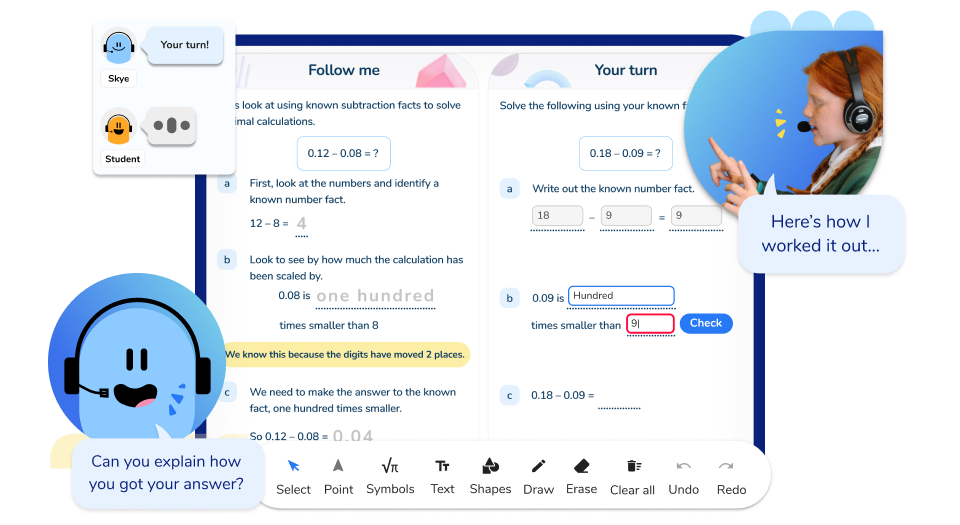
At Third Space Learning, we’ve spent over a decade delivering one-to-one maths tutoring to primary schools and secondary schools across the UK – more than 2.1 million sessions to over 170,000 pupils. For the past two years, we’ve been building Skye, our spoken AI maths tutor, which is now supporting pupils in over 200 schools.
So we have a clear interest in this announcement. But we also have hard-won experience of what works in online tutoring – and what doesn’t. This article aims to share that perspective: what the government has announced, why it matters, and what schools should look for in any AI tutoring tools they consider, whether ours or anyone else’s.
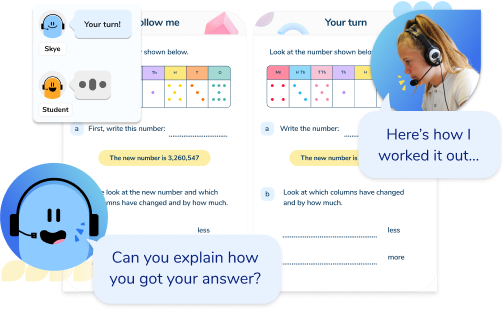
Discover how AI tutor, Skye, can improve your students’ confidence and maths results.
Get in touch to arrange a free AI maths tutoring session.
Try a free sessionWhy one-to-one tutoring works
The evidence for one-to-one tutoring is strong. The Education Endowment Foundation estimates it can accelerate a pupil’s learning by approximately five months – a figure the government cites in its own announcement. Small group tuition also shows positive impact, though typically smaller than individual tutoring.
Why does it work? One-to-one tutoring allows for genuinely personalised pace and pitch, adapting to individual pupils’ needs in real time. It provides immediate feedback on misconceptions before they become embedded. It creates a safe space for pupils to make mistakes and verbalise their reasoning – something that’s difficult to achieve in a busy classroom. And for pupils who’ve lost confidence, it offers tailored support without the anxiety of speaking up in front of peers.
The challenge is access. The government’s announcement acknowledges this directly: tutoring is “deeply unequal, with children from wealthier families far more likely to benefit.” Private tutors typically charge £45 or more per session – unaffordable at scale for most schools, even with Pupil Premium or other targeted funding.
This is why the National Tutoring Programme was established – and why, even after NTP funding ended, schools have continued seeking cost-effective ways to deliver tutoring. The question now is whether AI tutoring tools can provide the same quality of support at a price that allows schools to reach every pupil who needs it.
For more on what research tells us about effective tutoring approaches, see our guides to online tutoring including the best online maths tutoring platforms and also our guide to AI tutoring.
The maths attainment gap: where we are now
The scale of the challenge that AI tutoring seeks to solve is significant.
At Key Stage 2, the 2025 results show that 47% of disadvantaged pupils met the expected standard in reading, writing and maths combined, compared with 69% of their peers – a 22 percentage point gap. In maths specifically, the gap is 20 percentage points, the largest of any subject.
The DfE’s disadvantage gap index rose slightly from 3.13 in 2024 to 3.16 in 2025. It remains substantially wider than pre-pandemic levels of 2.91 in 2019.
At GCSE, the picture is similarly stark. The government’s own announcement notes that “just one in four” pupils eligible for free school meals achieve a grade 5 or above in English and maths, “compared to over half of their peers.” That’s a 27.2 percentage point gap.
Research from the Education Policy Institute puts this in terms of learning time: by the end of primary school, disadvantaged pupils are approximately 10 months behind their more affluent peers.
This isn’t a problem that classroom teaching alone can solve, no matter how skilled the teachers. With 30 pupils in a class and a packed national curriculum to deliver, there simply isn’t time to provide the individualised attention that struggling pupils need. Teachers need tools to support pupils who are falling behind – and AI tutoring, done well, could help transform access to that support.
What best practice in AI tutoring looks like
The government is right to emphasise safety and quality in AI tutoring. Not all AI tutoring tools are equal, and schools need to know what to look for.
The DfE’s recently updated Generative AI Product Safety Standards set a high bar, specifically addressing cognitive development (ensuring AI doesn’t substitute for pupils’ own thinking), emotional and social development, mental health safeguards, and restrictions on persuasive or exploitative design.
Based on these standards, the research evidence, and what we’ve learned from delivering tutoring, here’s what schools should look for:
Content built by teachers, not generated by AI
AI tutors need human expertise. Effective AI tutoring needs content created by qualified teachers who understand the curriculum, know common misconceptions, and can design lessons that build conceptual understanding. The AI should deliver expert-designed teaching – not generate its own content on the fly. Ask any provider: who wrote the lessons?
Structured, scaffolded learning
Look for tools that follow evidence-based approaches like “I do, we do, you do” – where concepts are modelled, then practised with support, then applied independently. Look for genuine teaching sequences, not random question generators.
Humans in the loop
AI tutoring is not replacing teachers, it depends on teachers. Not only should teachers create lessons but teachers should remain in control of any AI tutoring: selecting which pupils receive support, choosing programmes, reordering lessons to align with classroom teaching, and monitoring progress. AI that operates in isolation from the classroom – or from teacher oversight – is far less likely to have a positive impact on children’s learning.
No cognitive offloading
The DfE’s new standards are clear: AI must not act as a substitute for cognitive development. Effective tutoring provides hints and scaffolding that guide pupils towards understanding – not answers that bypass the thinking process. Pupils should do more practice, not less. The goal is building mathematical reasoning, not dependency.
Active recall and error correction
Good AI tutoring should diagnose gaps through assessment, then address specific misconceptions directly. It should encourage reflection: what went wrong, and why? This metacognitive element is often what separates tutoring that has lasting impact from tutoring that’s quickly forgotten.
Safeguarding by design
Keeping children safe online is non-negotiable. In terms of safeguarding AI tutoring look for tools where all content is controlled and pre-approved, where sessions are recorded and monitored, and where the AI cannot access external content or generate inappropriate material.
For a deeper dive into the research on effective AI tutoring, see our article on intelligent tutoring systems.
Making AI tutoring accessible: the cost question
The government’s goal for AI tutoring is to support learning for disadvantaged children who currently cannot afford private tutors. But achieving this requires more than building good tutoring tools – it requires making tutoring affordable.
Traditional per-session pricing creates a rationing problem. At £45 per session, schools have to choose who gets tuition support based on budget rather than need. Even with targeted funding, most schools can only support a handful of pupils – often far fewer than actually need help. This was one of the challenges with elements of the National Tutoring Programme work, where tuition partners and academic mentors could only reach a fraction of eligible pupils.
The potential for scalable potentially unlimited access to AI tutoring changes this equation. For example with Third Space Learning schools pay a fixed annual fee regardless of how many pupils they support so the rationing problem disappears. 50% of pupils using Skye are from disadvantaged backgrounds but it’s also available to any pupil who needs it, all for a fixed cost that works out vastly cheaper than private tutoring. (Tutoring with Skye starts from a flat fee of £3,500 per year per school.)
If AI tutoring is going to close the attainment gap, it needs to be affordable enough that schools can reach every pupil who needs it.
Schools don’t need to wait until 2027
AI tutoring tools that meet the government’s stated criteria – teacher-created content, robust safeguarding, curriculum alignment, and a model that complements classroom teaching – already exist.
Skye, our spoken AI maths tutor, has been operational since early 2025 using insights from 2.1 million tutoring sessions delivered to over 4,000 schools since 2013.
Early evidence is promising. Within sessions, 92% of pupils successfully complete their post-session assessment questions, compared with 34% on the pre-session diagnostic – suggesting genuine learning during the session itself. And 63.8% of pupils report increased confidence afterwards, important given how much maths anxiety holds disadvantaged pupils back.
Schools are already using Skye flexibly – for regular intervention, SATs and GCSE revision, pre-teaching new topics, homework support, and even emergency cover. For more on how this works in practice, see our article on AI maths tutoring use cases.
Questions for school leaders
We welcome the government’s focus on AI tutoring as part of the solution to the attainment gap. The priorities they’ve outlined – working hand in hand with teachers, ensuring tutoring tools are designed with safety at their core, aligning with the national curriculum, and complementing great teachers rather than replacing them – are exactly right.
For schools ready to explore AI tutoring now, or preparing for the government’s 2027 rollout, here are the questions to ask any provider:
- Who created the content? Is it written by qualified teachers, or generated by AI?
- What safeguarding measures are in place? Can the AI access external content? Are sessions recorded and monitored?
- What control do teachers have? Can school staff select programmes, reorder lessons, and monitor progress?
- Does it support learning or substitute for it? Does the tool help pupils think, or think for them?
- What’s the evidence base? And what are the honest caveats?
- What’s the pricing model? Per session, or unlimited? How many pupils can you realistically support?
- How does it complement classroom teaching? Is it designed to work alongside what teachers are doing?
Message from the founder of Third Space Learning, Tom Hooper
The DfE’s announcement on AI tutoring is a welcome and strong message of intent for the future role of AI tutoring in schools.
We know that AI can transform access to effective tutoring, because we are working with hundreds of schools in the UK and US to deliver this, and so we welcome the DfE’s ambitious goal of testing and scaling effective AI tutoring to transform access and close the attainment gap.
The evidence is very clear on what effective tutoring is – spoken, one-to-one, curriculum based programmes, integrated into the school timetable, led by teachers to reinforce class teaching. The EEF’s research shows this. We must ensure that AI tutoring is built upon this evidence base.
We also know what doesn’t work – On-demand chat tutoring. We must avoid thin veneers on large language models, offering easy solutions, and focus on what the research shows. This is hard work, but with transformative potential.
We have provided evidence-based spoken tutoring programs to over 4000 schools since 2013. We are now the leading provider of spoken, one-to-one AI Maths tutoring in UK and US schools, working with researchers to build the evidence base to help Third Space, and the wider sector, maximise the potential of AI in tutoring, and so help close the attainment gap.
The DfE doesn’t need to wait until 2027, that future is here now. We are building it, and welcome the DfE’s support in doing so.

DfE AI tutoring programme FAQs
The DfE’s AI tutoring programme targets disadvantaged pupils in Years 9–11. The focus on upper KS3/KS4 makes sense – the disadvantage gap at GCSE is stark (just one in four pupils eligible for free school meals achieve grade 5+ in English and maths, compared to over half of their peers), and outcomes are straightforward to measure. Trials begin autumn 2026, with tools available to schools by end of 2027.
Online tutoring traditionally means a human tutor delivering lessons via video call – effective, but limited by tutor availability and typically charged per session. AI tutoring uses artificial intelligence to deliver structured lessons, which means it can scale to support every pupil who needs it rather than just a handful. The best AI tutoring tools (like Skye) are spoken and conversational, replicating the dialogue of human tutoring, but with unlimited access pricing that removes the rationing problem. Both happen online, but AI tutoring doesn’t require scheduling around human availability.
No. The government’s programme won’t reach schools until late 2027, but AI tutoring tools that meet the DfE’s stated criteria – teacher-created content, curriculum alignment, robust safeguarding, and integration with classroom teaching – already exist. Schools can start supporting pupils now while the government develops its own tools. The key is choosing a provider that meets the quality and safety standards outlined in this article

DO YOU HAVE STUDENTS WHO NEED MORE SUPPORT IN MATHS?
Skye – our AI maths tutor built by teachers – gives students personalised one-to-one lessons that address learning gaps and build confidence.
Since 2013 we’ve taught over 2 million hours of maths lessons to more than 170,000 students to help them become fluent, able mathematicians.
Explore our AI maths tutoring or find out about the AI tutor for your school.