

AI Training for Teachers and School Leaders: the Best Courses for 2026

Most schools have now reached the same conclusion: staff need AI training. The question that follows is harder. Which training? And for whom?
Because the answer is different for a classroom teacher who wants to save time on lesson planning and a headteacher being asked to write an AI policy before they’ve had any structured professional development in AI themselves. The education workforce needs both, and the courses that serve one group rarely serve the other.
We’ve reviewed the most credible AI training for teachers and school leaders, as well as the AI literacy courses for school leaders available in the UK in 2026. Below, you’ll find what each course covers, what it costs, and where the gaps still are.
Key takeaways
- Teachers need practical skills: using generative AI tools for lesson planning, assessment, feedback and resource creation, while spotting inaccurate AI generated content and using AI safely
- Leaders need strategic AI literacy: how to evaluate AI tools, write policy, manage safeguarding and data protection, build school culture around AI, and prepare for Ofsted
- The DfE/Chartered College modules are the strongest free starting point for all staff
- The National College offers good paid options for both teachers and leaders
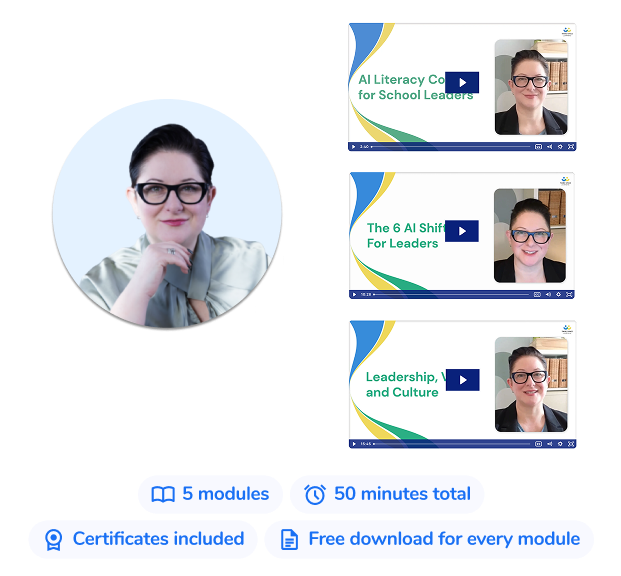
- Very little structured, free CPD exists specifically for school leaders – which is why we developed our own: the free AI Literacy Course for School Leaders

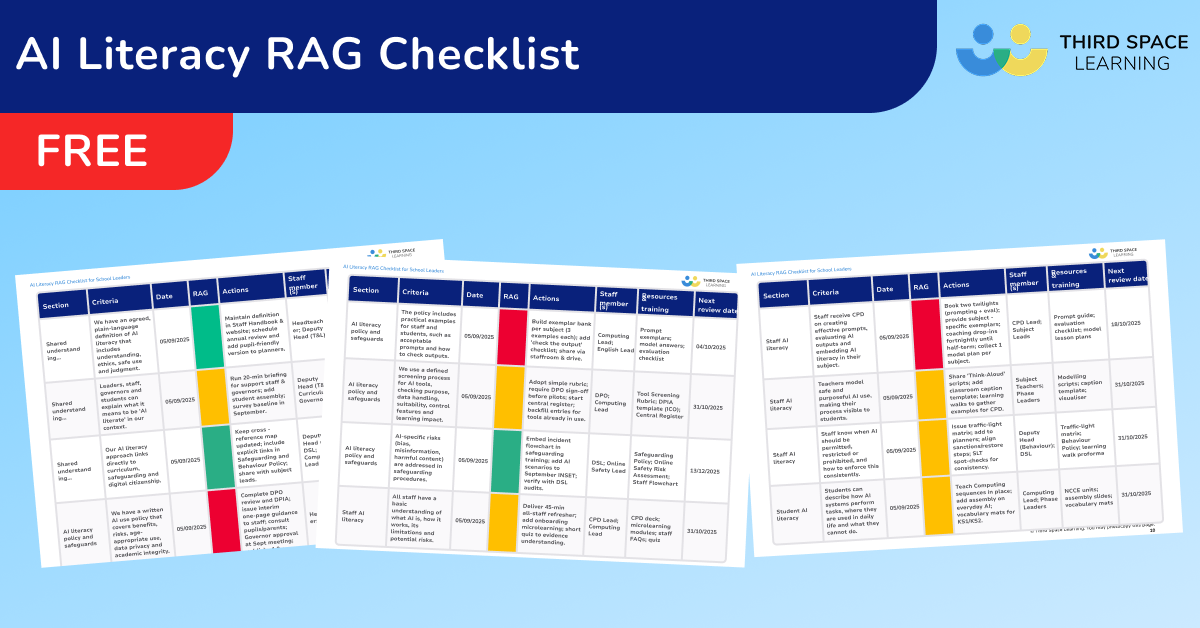
AI Literacy RAG Checklist
A practical AI literacy audit aligned with the DfE’s guidance on AI use in schools. A good place to start with AI literacy training and assign planned actions to staff members to ensure whole school AI readiness
Download Free Now!Teachers and leaders need different things from AI training
A course that teaches your staff to write effective prompts for generative AI is not the same as a course that prepares you to lead an AI-literate school.
What teachers need
Teachers need to gain the knowledge and confidence to use AI tools in their day-to-day work:
- lesson planning
- creating resources,
- giving feedback,
- adapting materials to personalise instruction for different students.
They also need to understand the context behind the AI tools they’re using. For example
- how generative AI tools actually work,
- how to spot when AI generated content is wrong or misleading, or shows bias.
- how to protect academic integrity and data protection.
- strategies to enhance teaching and personalised learning with AI responsibly
Understanding prompt engineering and how to use AI technologies effectively for lessons is genuinely valuable. We’d recommend it for every member of staff.
What AI training school leaders need – and why most courses don’t cover it
Leaders face questions that no amount of prompt engineering will answer.
- How do you evaluate an AI tool’s claims about safeguarding before you let it anywhere near your students?
- How do you build a culture where staff gain the expertise to experiment with AI without creating risk?
- What should your AI policy actually say?
- How do you integrate AI into your school’s strategy without letting the technology lead the pedagogy?
- How can you build engagement, parity and knowledge sharing across a trust.
These are not effective prompt questions. They’re governance, culture, ethics and compliance questions – and the importance of getting them right can’t be overstated.
Without strategic AI literacy at the leadership level, schools tend to end up in a messy middle ground: staff are using generative AI – some enthusiastically, some reluctantly, most without clear boundaries.
Ofsted has flagged exactly this concern. The risks AI presents to schools are manageable, but only when leaders understand what they’re deciding.
AI technologies are changing fast. The specific AI tools your school uses this year may look completely different by 2028. What won’t change is the need for leaders with the expertise to make informed decisions, who have a genuine understanding of the risks AI presents to their community – whether from misleading information, bias in AI systems, threats to academic integrity, or the quieter risk of staff using AI without fully understanding its limitations.
The future of AI in education depends on leaders who can integrate AI into their school’s practices while protecting what matters: creativity, human judgement and the relationships that sit at the heart of good teaching.
The best AI training courses for classroom teachers
Below is our assessment of what’s available for educators who want to use AI in their teaching practice – from a foundational understanding of artificial intelligence through to hands-on experience with generative AI tools in a range of educational settings.
Inevitably this is just a snapshot of courses created with teachers in mind and we’ve tried to focus on those most relevant to UK schools.
For each course, we’ve included the cost, format and a direct link. (Looking specifically for AI tutoring? That’s a separate question – this guide covers broader AI literacy and skills.)
DfE + Chiltern Learning Trust + Chartered College of Teaching
If you only use one course for whole-staff training, this is the one. Four modules covering AI foundations, practical applications, safe use and ethical use, developed specifically for UK schools and colleges and available free on gov.uk.
You can find out more about how to use the guidance on AI in schools here.
Staff who complete the training can take a free certified assessment through the Chartered College of Teaching, earning five credits toward Chartered Status. We’ve seen schools run these as twilight CPD sessions, INSET activities or department-led discussions – they flex well for different levels of AI experience. Staff gain knowledge and confidence in the practices needed to use AI effectively, and students benefit from teachers who understand both the opportunities and the risks. The lessons can be adapted for whole-school or department-level use.
Strong on classroom safety and practical strategies. Lighter on strategic leadership – but that’s not what it’s trying to do.
- Cost: free
- Format: self-led slides, video presentations, planning templates
- Certificate: yes (via Chartered College)
- UK-specific: yes
- Link: gov.uk – Using AI in education settings: support materials
The National College: AI certificates for educators
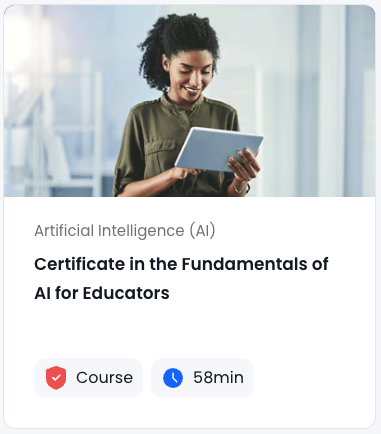
The National College offers two CPD-certified courses worth knowing about. The Certificate in the Fundamentals of AI for Educators covers how generative AI works, practical applications in the classroom, and UK safeguarding and compliance standards. The Certificate in Teaching AI Skills goes a step further – it’s designed for educators who want to teach AI literacy to students across the curriculum, building critical thinking about AI outputs and ethical awareness.
Both are well-structured, UK-specific and grounded in the realities of school life. The trade-off is cost – you’ll need a National College subscription.
- Cost: paid (National College subscription required)
- Format: online, CPD-certified
- Certificate: yes
- UK-specific: yes
- Links: Certificate in the Fundamentals of AI for Educators | Certificate in Teaching AI Skills
STEM Learning: AI resources and AI Sprints
STEM Learning’s AI Sprints webinar series brings in leading voices on AI in education to discuss everything from AI in assessment to ethics and safety. Sessions include practical experience through classroom examples and real world case studies.
Available both live and on demand, all free. STEM Learning is also supporting AI Awareness Day in June 2026 – a useful anchor for school-wide professional development.
- Cost: free
- Format: webinars, on-demand videos, community resources
- Certificate: no
- UK-specific: yes
- Link: stem.org.uk/artificial-intelligence
OpenAI Academy: ChatGPT for Teachers
OpenAI’s own training programme includes sessions developed for educators. The ChatGPT for Teachers series gives staff hands-on experience with lesson planning, resource creation, assessment design and administration using ChatGPT.
Useful for building confidence with one particular AI tool. The obvious drawback: it’s tool-specific, and the content wasn’t developed for UK educational settings, the UK curriculum or UK compliance requirements. If you want broader guidance on AI in the classroom, you’ll need to combine this with something else.
- Cost: free
- Format: online workshops, self-paced content
- Certificate: planned (certifications piloting 2025/26)
- UK-specific: no
- Link: academy.openai.com
The other leading LLMs also provide similar free tool specific training:
UK Government AI Skills Boost
Launched in January 2026 as part of the government’s goal to upskill 10 million workers by 2030. Fourteen free short courses developed by Google, Microsoft, Amazon and others, each under 20 minutes. Complete a benchmarked course and you earn a government-backed AI foundations badge.
Good for building general AI confidence across your whole education workforce – support staff, admin teams, site managers. Not designed for schools though, and doesn’t address AI in education, safeguarding or the specific ethical considerations educators face.
- Cost: free
- Format: short online courses (under 20 mins each)
- Certificate: yes (AI foundations badge)
- UK-specific: yes (workforce-focused, not education-specific)
- Link: gov.uk – AI Skills Hub
Jisc / National Centre for AI: AI literacy curriculum
Jisc’s three-module curriculum covers understanding AI, essential AI skills and ethical and responsible AI use for teaching and learning staff. Sessions are delivered as live webinars and self-paced digital learning modules.
Developed by the National Centre for AI in Tertiary Education, so the focus is FE and HE rather than primary and secondary. Free for Jisc member institutions (universities, colleges and specialist providers). Schools and MATs will need to pay – contact Jisc for pricing. The challenges of using AI safely in education are covered well, though the examples lean towards further and higher education rather than the primary and secondary contexts most of our readers work in.
- Cost: free for Jisc members; paid for schools and MATs
- Format: live online sessions plus self-paced modules
- Certificate: no
- UK-specific: yes (tertiary education focus)
- Link: nationalcentreforai.jiscinvolve.org
Toddle: AI literacy skills
A free, self-paced online course covering AI literacy basics for educators. It walks through what artificial intelligence is, how generative AI tools work and how they can support teaching and learning. A reasonable starting point for staff who haven’t engaged with AI at all yet.
Doesn’t go deep on UK context, machine learning concepts or the challenges around safeguarding and compliance that UK schools face.
- Cost: free
- Format: self-paced online course
- Certificate: yes
- UK-specific: no
- Link: toddleapp.com/learn/ai-literacy-skills/about-the-course
Flint K12: AI literacy for teachers
A structured course built for classroom teachers, covering how to use AI tools effectively and responsibly in educational contexts. Practical and focused on real tasks – creating resources, giving feedback, adapting materials.
More guided than a webinar series, which some staff prefer. Entirely teacher-focused though – doesn’t touch leadership or whole-school adoption.
- Cost: free
- Format: structured online course
- Certificate: yes
- UK-specific: no
- Link: flintk12.com/ai-literacy-for-teachers
The best AI training courses for school leaders
For those headteachers and school leaders looking to build their own knowledge and lead significant AI change in their school we found four options worth recommending; one of them is ours.
DfE Leader Toolkit
The DfE’s AI guidance package includes strategic material for senior leaders alongside the teacher-facing modules. It covers embedding AI into your school’s digital strategy, evaluating tools and managing risk. Free and government-endorsed.
Where it falls short is depth. It’s a guidance document, not interactive training – you read it rather than work through it. Limited real world examples, no downloadable implementation tools. Think of it as a useful reference rather than a CPD programme.
- Cost: free
- Format: guidance document with planning templates
- Certificate: no
- UK-specific: yes
- Link: gov.uk – Using AI in education settings: support materials
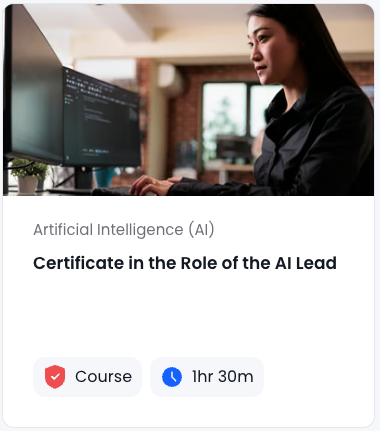
The National College: Certificate in the role of the AI lead
The National College has developed a course specifically for the emerging AI leadership role in schools and colleges. It covers strategic AI adoption, governance, compliance and how to lead AI implementation in line with the DfE’s generative artificial intelligence guidance.
One of the few structured CPD courses that treats AI as a leadership responsibility rather than a classroom skill. UK-specific, CPD-certified and designed for senior leaders, digital leads or anyone coordinating AI across a school or trust. Requires a National College subscription.
- Cost: paid (National College subscription required)
- Format: online, CPD-certified
- Certificate: yes
- UK-specific: yes
- Link: Certificate in the Role of the AI Lead
NAHT: AI in education guidance
NAHT maintains a curated hub of advice and resources for school leaders on AI in education. It signposts to DfE guidance, offers policy templates and case studies, and keeps pace with how the landscape is developing.
Useful for staying current. But it’s a guidance hub, not structured CPD – reading about AI governance is not the same as working through scenarios and building frameworks for your own context.
- Cost: free for NAHT members
- Format: guidance hub, articles, signposting
- Certificate: no
- UK-specific: yes
- Link: naht.org.uk – Artificial intelligence (AI) in education
Third Space Learning: AI literacy course for school leaders
We built this course because while plenty of AI for educators training exists very little addresses what leaders actually need: the strategic side of AI adoption, including questions around school culture, the compliance obligations, the risks and judgement calls that end up on the headteacher’s desk, not to mention modelling to the rest of the staff what good AI usage looks like.
Five video modules, 75 minutes total, completely free. Developed and presented by Laura Knight – teacher, digital education and AI specialist and TechWomen100 Award Winner 2025. Every module includes downloadable resources and a certificate of completion.
- Cost: free
- Format: video modules with downloadable resources
- Certificate: yes (per module and full course)
- UK-specific: yes
- Link: thirdspacelearning.com/cpd/ai-literacy-course
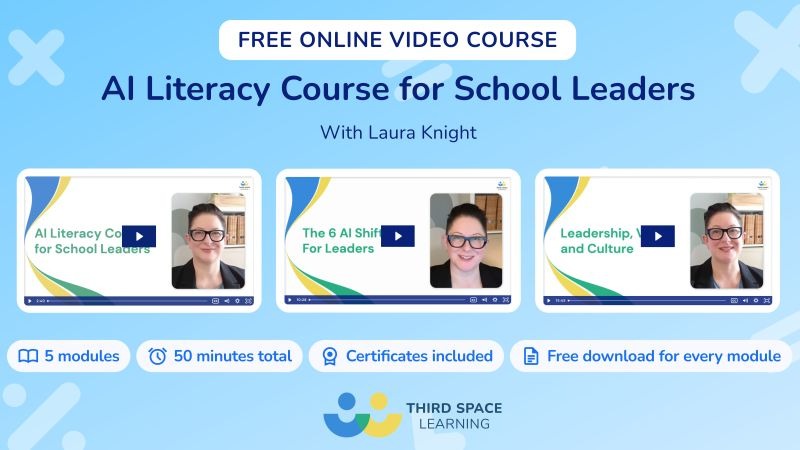

What’s inside the Third Space Learning AI literacy course
The course is built around five practical modules, each 10–18 minutes:
- Safeguarding, compliance and data – GDPR questions for your DPO, vendor evaluation criteria, consent and accountability frameworks, and an Ofsted-ready evidence planner
- The 6 AI shifts for school leaders – moving from routine task automation to building confident, reflective practice across your school as an introduction to AI literacy.
- Leadership, vision and culture – shaping your school’s AI direction with purpose, creating conditions for safe innovation, and learning from staff resistance rather than overriding it
- Enabling excellence in the classroom – six hallmarks of excellent AI-enabled teaching mapped to Rosenshine’s principles for AI in the classroom, with a lesson observation framework you can use immediately
- Risks and limitations – how to spot hallucinations, protect academic integrity, address bias and equity, and prevent overreliance on AI
It’s deliberately tool-agnostic. We don’t teach you how to use any one AI technology – instead, the course gives you the frameworks to evaluate any AI tool and lead adoption across your school or trust with critical awareness.
Each module includes free downloadable resources (templates, checklists, observation frameworks) and a certificate of completion. For a quick-start alternative, see our AI kickstart guide for school leaders.
Choosing the right AI training for your school
| Course | Provider | Audience | Format | Cost | Certificate | UK-specific |
| AI in education modules | DfE / Chiltern Learning Trust / Chartered College | All staff | Self-led, video, templates | Free | Yes | Yes |
| AI Sprints | STEM Learning | Teachers | Webinars, on-demand | Free | No | Yes |
| Fundamentals of AI / Teaching AI Skills | The National College | Teachers | Online, CPD-certified | Paid | Yes | Yes |
| ChatGPT for Teachers | OpenAI Academy | Teachers | Workshops, self-paced | Free | Planned | No |
| AI Skills Boost | UK Government / tech partners | All staff | Short online courses | Free | Yes (badge) | Workforce (not education) |
| AI Literacy Curriculum | Jisc / National Centre for AI | Teachers (FE/HE) | Live + self-paced | Free for members; paid for schools | No | Tertiary focus |
| AI Literacy Skills | Toddle | Teachers | Self-paced | Free | Yes | No |
| AI Literacy for Teachers | Flint K12 | Teachers | Structured online | Free | Yes | No |
| Leader Toolkit | DfE | Leaders | Guidance document | Free | No | Yes |
| Role of the AI Lead | The National College | Leaders | Online, CPD-certified | Paid | Yes | Yes |
| AI guidance hub | NAHT | Leaders | Articles, signposting | Free (members) | No | Yes |
| AI literacy course | Third Space Learning | Leaders | Video + resources | Free | Yes | Yes |
Where to start
Start with the DfE modules for whole-staff professional development across your schools and colleges. They’re free, UK-specific and give everyone a shared foundation. Then add a leadership-specific course for your SLT – either the Third Space Learning free AI literacy course developed with Laura Knight or the National College’s AI Lead certificate.
If you’re coordinating across a small trust, the same sequence works – but you’ll want to think about who completes the leadership training first and how learning gets shared between schools. Running the DfE modules as a trust-wide INSET gives you a common language; the leadership course then equips whoever is coordinating AI across your schools.
The leadership gap is real
The range of AI training available in 2026 is growing, but the challenges for school leaders remain real. Knowing which practices to embed, which future risks to plan for, and how to effectively build the knowledge your team needs – that requires more than a webinar. The lessons from schools that engage with this early are clear: leaders who access structured CPD on AI adoption make better decisions for their school community. Some university-led research is beginning to address AI leadership in education, but for now, the best structured CPD comes from the courses listed above.
The question to ask before you commit
Does this teach me to use a tool, or does it teach me to make decisions about tools? Your school needs people who can do both. (If you’re also evaluating specific AI tools for the classroom, our guide to the best AI for maths may help.) The strategies you develop now for AI adoption will shape your school for years – and that deserves at least as much thought as which AI tool to try first.
AI courses FAQs
Yes. The DfE modules developed with the Chiltern Learning Trust and Chartered College of Teaching are free, UK-specific and cover AI foundations, safe use and practical applications. STEM Learning’s AI Sprints webinars are also free. Internationally, OpenAI Academy and the UK Government’s AI Skills Boost programme offer free options, though neither is education-specific.
Leaders need training that goes beyond using AI tools. Strategic AI literacy covers how to evaluate AI tools before adoption, write an effective AI policy, manage safeguarding and data protection obligations, build school culture around responsible AI use, and prepare for Ofsted. The DfE Leader Toolkit, the National College’s Certificate in the Role of the AI Lead and Third Space Learning’s free AI literacy course all address this.
It helps. Understanding how to write effective prompts for generative AI can save time on lesson planning, resource creation and assessment. But prompt engineering is a practical skill, not a substitute for broader AI literacy – teachers also need to understand accuracy, bias, academic integrity and data protection when using AI in education.
Start with a whole-staff foundation – the DfE modules work well for this. Then differentiate: classroom teachers benefit from practical, tool-focused training, while senior leaders need strategic AI literacy covering governance, compliance and culture. Most schools will need a combination of courses rather than a single programme.

DO YOU HAVE STUDENTS WHO NEED MORE SUPPORT IN MATHS?
Skye – our AI maths tutor built by teachers – gives students personalised one-to-one lessons that address learning gaps and build confidence.
Since 2013 we’ve taught over 2 million hours of maths lessons to more than 170,000 students to help them become fluent, able mathematicians.
Explore our AI maths tutoring or find out about the AI tutor for your school.