

What Is The Current Evidence On AI Tutoring And Its Impact On Students In School?

Could AI tutoring give more students the one-on-one support that has always been too expensive to offer at scale? The federal government thinks it might, and its 2025 guidance on AI in schools says so. Until recently, though, there was little research on AI tutoring itself. That is changing quickly, and studies are now under way into how well different models of AI tutoring work.
Here is what the research tells us about effective tutoring, and how far AI tutoring now matches it.
Key takeaways
- One-on-one tutoring is one of the most effective interventions available to schools, but it has always been expensive to offer at scale.
- Tutoring works best when it is frequent, aligned to the curriculum, built around conversation and overseen by people.
- Generic generative AI tools used for studying can harm learning. In one randomized controlled trial, students who studied with ChatGPT scored around 17% lower in the exam.
- AI tutoring systems built on proven tutoring principles are showing measurable learning gains within a session.
- Federal guidance now allows grant funds to be spent on AI-enhanced high-impact tutoring, so school leaders need a clear way to judge which products are worth it.
- We suggest five questions to ask before adopting any AI tutoring system.

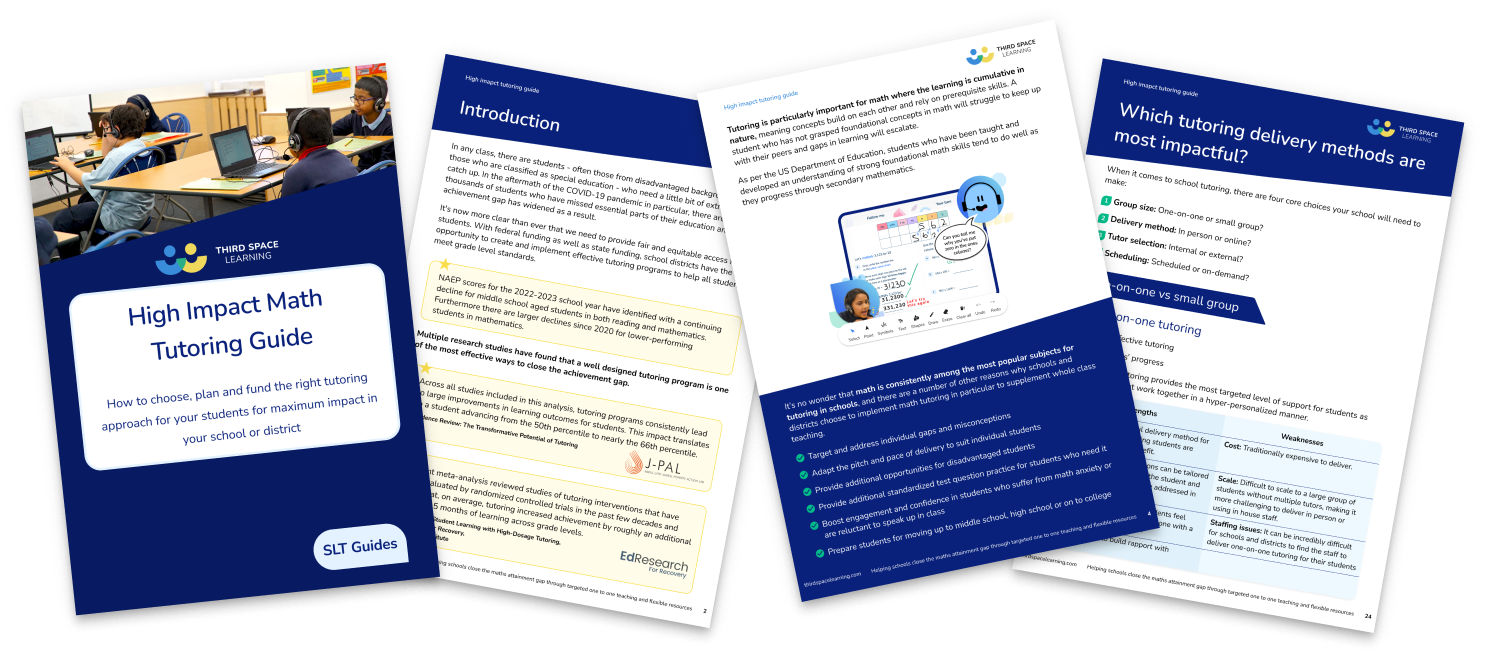
High Impact Tutoring Guide for Schools and Districts
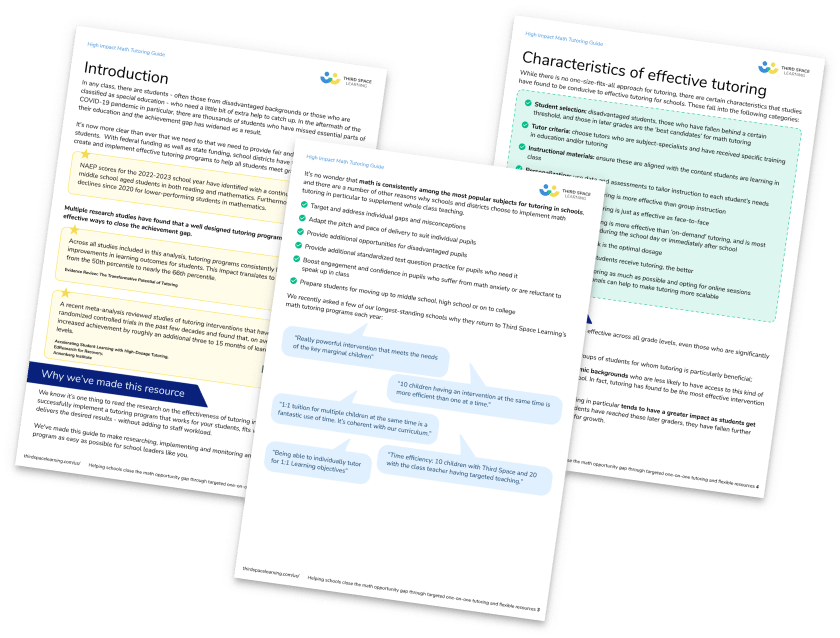
Download our free High Impact Tutoring Guide to help you plan, fund, and choose the right math tutoring for your school.
Download Free Now!Federal policy on AI tutoring
On July 22, 2025, the U.S. Department of Education sent a Dear Colleague Letter to grantees explaining how federal grant funds can support the responsible use of AI in schools. AI-enhanced high-impact tutoring is one of three uses it names. The other two are AI-based instructional materials and AI for college and career advising. The letter followed the April 2025 executive order, Advancing Artificial Intelligence Education for American Youth, and Education Secretary Linda McMahon said at the time that AI “drives personalized learning.”
The guidance puts AI alongside the virtual tutoring and other high-impact tutoring that districts already fund. Other countries are moving the same way. In England, the Department for Education plans to trial AI tutoring tools with up to 450,000 disadvantaged students by 2027. The aim is to reach students whose families cannot afford private tutors.
It has been hard to fund one-on-one tutoring, one of the most effective forms of additional academic support, for every student who needs it. AI tutoring could make it affordable at a scale schools have not managed before.
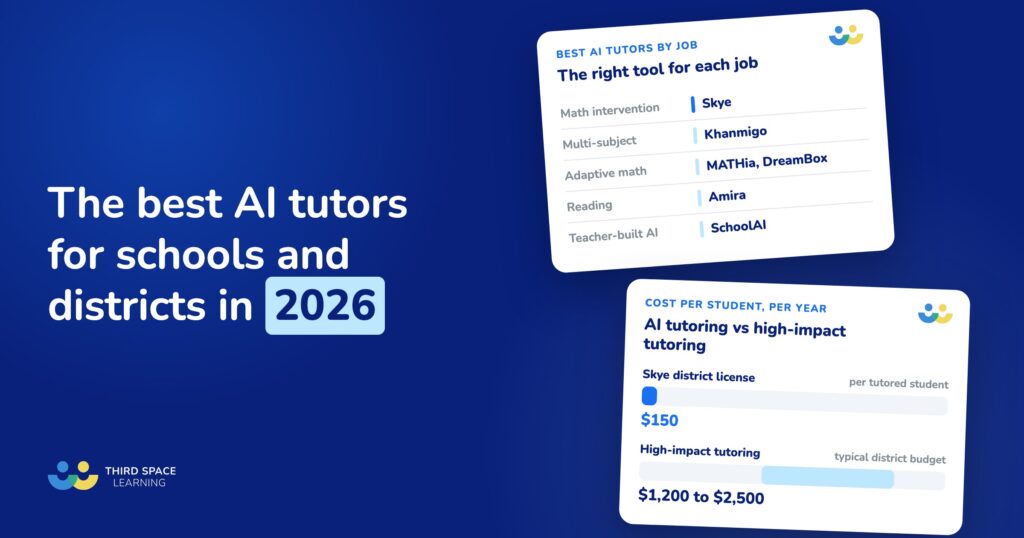
Some of the funding is also coming from outside government. In the 2026/27 school year, the Gates Foundation is funding high-impact AI math tutoring with Skye for 3,000 students in grades 3 to 8, as part of a research partnership with Stanford and Cornell that compares AI tutoring with human high-dosage tutoring. Districts can apply for fully funded AI math tutoring through the program.
Defining AI tutoring
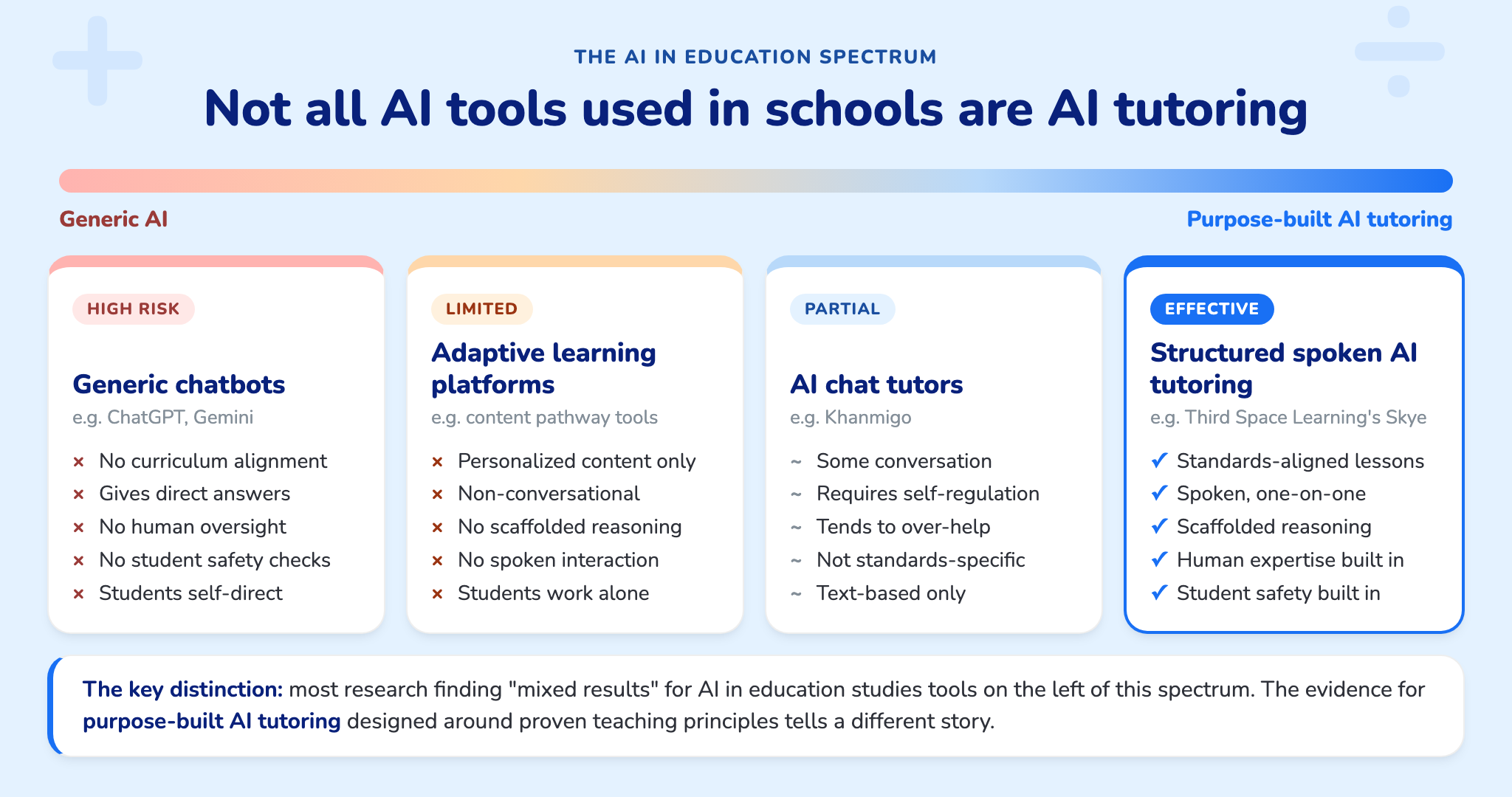
One difficulty with the AI tutoring evidence is that the term covers several different kinds of AI-assisted instruction. At one end are homework-help chatbots. At the other are adaptive learning systems that adjust content after assessing what a student needs. Vanacore et al. (2026) note that on-demand artificial intelligence tools tend to suit students who already manage their own learning well and go looking for help.
At Third Space Learning we start from a simpler definition. AI tutoring should reproduce, as closely as it can, what has made traditional tutoring so good at closing achievement gaps, especially for students who have struggled with math or who are unlikely to find their own way to improve.
We already know what makes traditional tutoring effective, so as educators we can build an AI tutoring model on the same principles.
What makes traditional tutoring effective
The research on effective tutoring is well established, and it gives us the yardstick for judging any AI tutoring system’s effect on student learning.
In the US, high-dosage tutoring is one of the few interventions with strong evidence of improving math achievement. The National Student Support Accelerator at Stanford University describes the high-impact tutoring model as sessions held at least three times a week, led by the same trained tutors, with high-quality materials and data guiding instruction. In the UK, the Education Endowment Foundation reaches a similar conclusion and estimates that one-on-one tutoring adds an average of five months’ progress.
Across the research, effective tutoring programs have four things in common:
- High-dosage programs
- One-on-one or small-group delivery
- Curriculum alignment
- Human oversight throughout
Why the conversation matters
A 2026 review by Vanacore, Baker and colleagues looked at what makes human tutoring work so well, and they put it down to the quality of the conversation. Good tutors scaffold a student’s reasoning instead of explaining the answer. They keep students motivated through dialogue and build the trust that keeps a student willing to stick with a hard problem. In human-led tutoring, much of the benefit comes from that exchange.
The same research points to a practical limit. As tutoring programs grow, their impact tends to fall, because good tutors become harder to hire and keep. Large programs often end up relying on novice tutors with little training.
AI tutoring could offer the individualized instruction the evidence calls for, with structured conversation tied to the curriculum, at a scale human-led tutoring programs have struggled to sustain.
What effective AI tutoring needs to look like
Once you know what makes tutoring effective, the requirements for AI tutoring follow. As well as delivering individualized content, the system has to hold a conversation with the student.
Adaptive learning platforms have adjusted content to each student for years, but they do not talk with students. Vanacore et al. (2026) note that they lack the back-and-forth of reasoning and feedback that makes human tutoring effective. A student working through an adaptive platform gets individualized content with no tutoring conversation around it.
On-demand chat tools have the opposite problem. They can hold a conversation, but students have to steer it themselves and decide when to push further or stop. The same review found that large language models tend to over-help, which takes away the mental effort students need to learn.
An AI tutoring system should meet the same standard as a good human tutor. It should talk students through their reasoning instead of handing over answers, let them work through the difficult part of a problem, and be designed with teachers involved from the start.
When you compare products, check whether each one was built on the tutoring evidence or simply on what AI in education can do.
AI tutoring at Third Space Learning
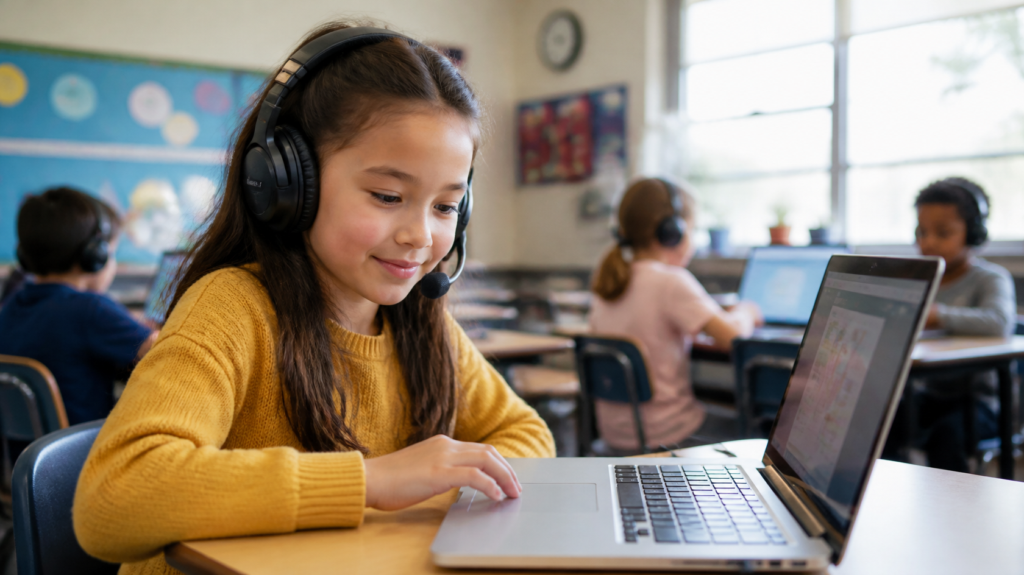
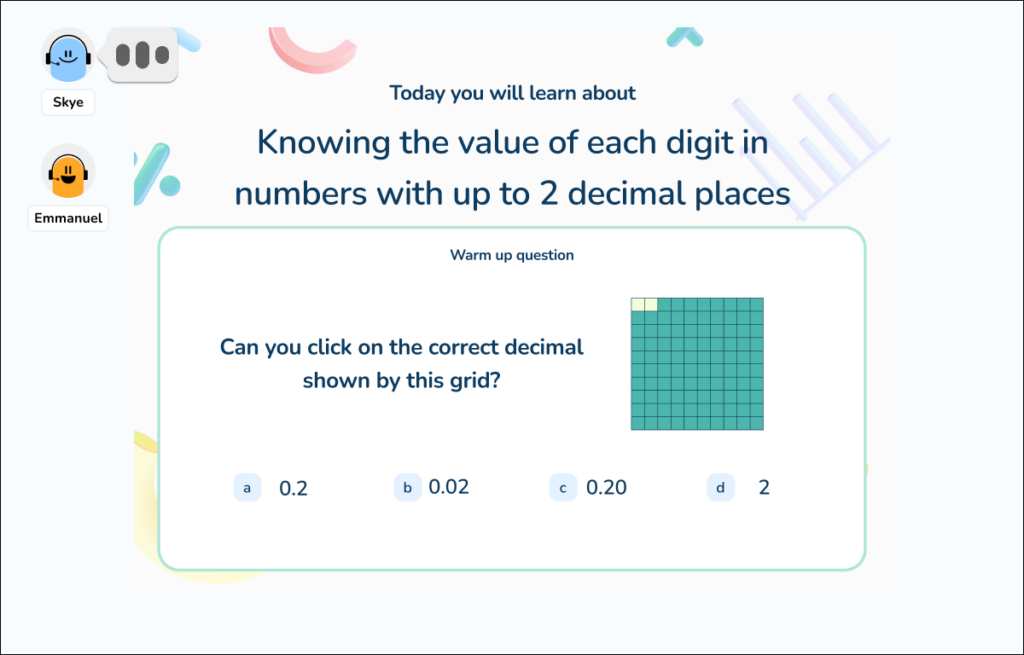
Our AI math tutor, Skye, was designed around these principles. Its spoken sessions use lessons written by teachers and aligned to state math standards. Skye talks one-on-one with each student and guides their thinking with spoken hints and questions, so the student still does the work. Each lesson builds toward skill mastery on a single objective.
Kathy Garcia, Principal of Moffat PK-12 in Moffat Consolidated School District, Colorado, described the difference this makes in one of our US school case studies:
“We had been using IXL, but many students would simply click through explanations when they got questions wrong. It isn’t really an intervention if they’re not taking the time. With Skye, students have to take the time. They have to listen, work with Skye, and understand what was wrong, why it was wrong, and how to fix it before moving on.”
Where the AI tutoring research stands
The evidence for AI tutoring is much newer than the evidence for one-on-one tutoring, and there are two reasons for that.
The best-known negative result, Bastani et al. (2025), comes from a study of a general-purpose large language model, rather than a tutoring system built around the principles above. So far, little academic research has looked at the kind of structured, school-led tutoring model we have been describing.
The studies we have seen mostly look at students using generative AI on their own, often with no link to the curriculum. They test generic AI tools in an educational setting, which tells us little about systems designed to produce learning gains.
The AI tutoring research that does exist suggests that when AI tutoring follows the same principles that make human tutoring effective, it can produce measurable learning gains.
Why the evidence on AI tutoring is still developing
Peer-reviewed research can take well over a year to go from design to publication. Generative AI moves much faster than that, so a lot of research is out of date by the time it reaches schools.
The quality of the research is a second problem. Stanford’s SCALE Initiative reviewed 20 high-quality causal studies and found that gains from AI tools can weaken or disappear when students are assessed without them. The review did not find a single high-quality causal study of students in US K-12 schools. Some studies even let students use AI during the final assessment, and a good score under those conditions shows only that a student can complete the task with help.
Where AI in education falls short
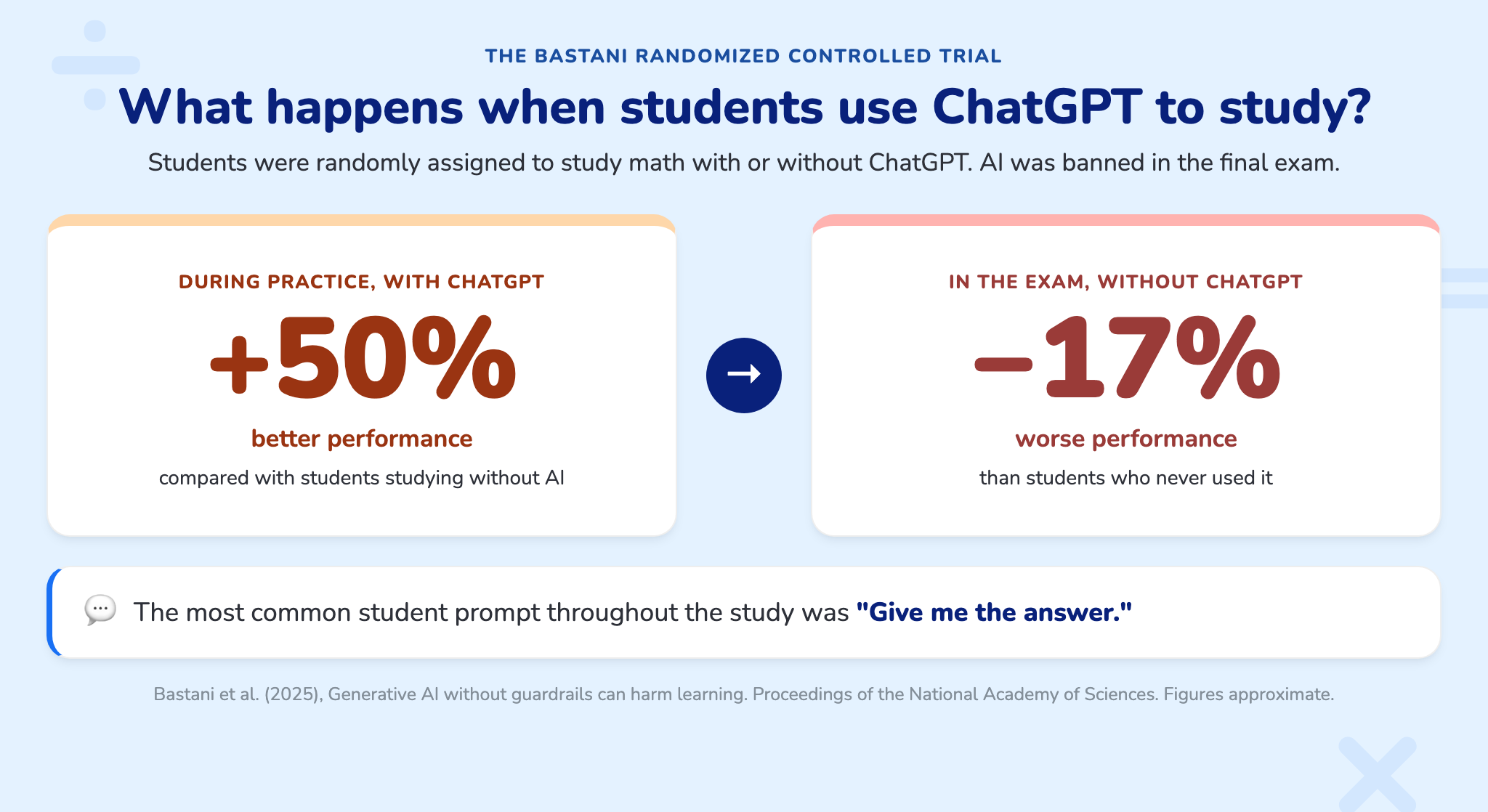
Bastani et al. (2025) ran one of the first well-designed randomized controlled trials in this area. High school students were randomly assigned to study math with or without ChatGPT. AI was banned in the final exam, as it would be in a real test, and the control group studied without AI assistance throughout.
Students who had AI support while studying did around 50% better in practice sessions, and then around 17% worse in the exam. The prompt they used most often was “Give me the answer.”
General-purpose generative AI is built to complete the task it is given. Unlike a well-designed AI tutoring system, it does not build retrieval practice into the learning process or leave students room to work things out.
Tools built for education can fall short too. A qualitative evaluation of Khanmigo, Khan Academy’s AI tutor, found that it did not adapt tasks to individual students’ needs or ability, and did not support metacognitive skills (Vanacore et al., 2026).
School leaders should ask whether a particular AI tutor was designed to improve student outcomes, and what independent evidence shows that it does.
Where carefully designed AI tutoring systems show promise
When AI tutoring is built to withhold answers and manage cognitive load, the results are much more encouraging.
The Harvard physics trial
Kestin et al. (2025) published one of the strongest randomized controlled trials so far, comparing a carefully designed AI tutor with active learning in an introductory physics course at Harvard University. Each student experienced both conditions on different topics. For one topic they used the AI tutor, and for the other they had an in-class active learning session, where experienced course staff led group instruction. Both covered the same introductory material.
Median learning gains with the AI tutor were more than double those in the active learning sessions, with effect sizes of 0.73 to 1.3 standard deviations. That is among the largest recorded in higher education research. Students also did better on follow-up questions that needed advanced problem solving.
The researchers built the tutor to keep students working through problems and to manage cognitive load, and they credit that design for the gains.
The study has important limits. It took place in higher education, and a college physics student’s experience is far removed from a 5th grader’s in a structured math session. We do not yet know whether results like these carry over to younger students in K-12 schools. The Educate Ventures Research evaluation of Skye, below, found a similar pattern in elementary schools, although schools need extra safeguards and closer involvement from teachers to make it work.
Cognitive outsourcing and the case for purposeful design
Oakley and Sejnowski’s Memory Paradox (2025) describes what they call cognitive outsourcing. When generative AI does the thinking for students, they do not learn. Active learning depends on productive struggle, so an AI tutor that uses hints and scaffolded steps to manage cognitive load works differently from one that hands over answers.
The Eedi and Google DeepMind trial shows what this looks like in a school subject.
Eedi and Google DeepMind RCT (2025)
In November 2025, Eedi and Google DeepMind published the results of a randomized controlled trial of AI tutoring with human oversight. Their AI tutor, LearnLM, took a Socratic approach. It prompted students to spot their own mistakes and explain their thinking in their own words, instead of correcting them directly.
Human tutors supervised every piece of AI support and had the final say on every message. They approved 82.3% of the AI’s suggestions with little or no editing, but that level of real-time oversight would be hard to sustain at scale. The tutoring model tested was also text-based, whereas the tutoring evidence favors spoken, one-on-one sessions tied to the curriculum. To reach the students who need it most, AI tutoring has to run effective, structured sessions without a person approving each message.
Both the Harvard and Eedi tutors kept people overseeing the AI and were built to keep students actively learning from material tied to the course. In our view, AI tutoring that improves student outcomes needs both.
Evidence of within-session learning gains: the Educate Ventures Research evaluation of Skye
Schools should look for independent evidence on any AI tutor, so we asked outside researchers to evaluate ours.
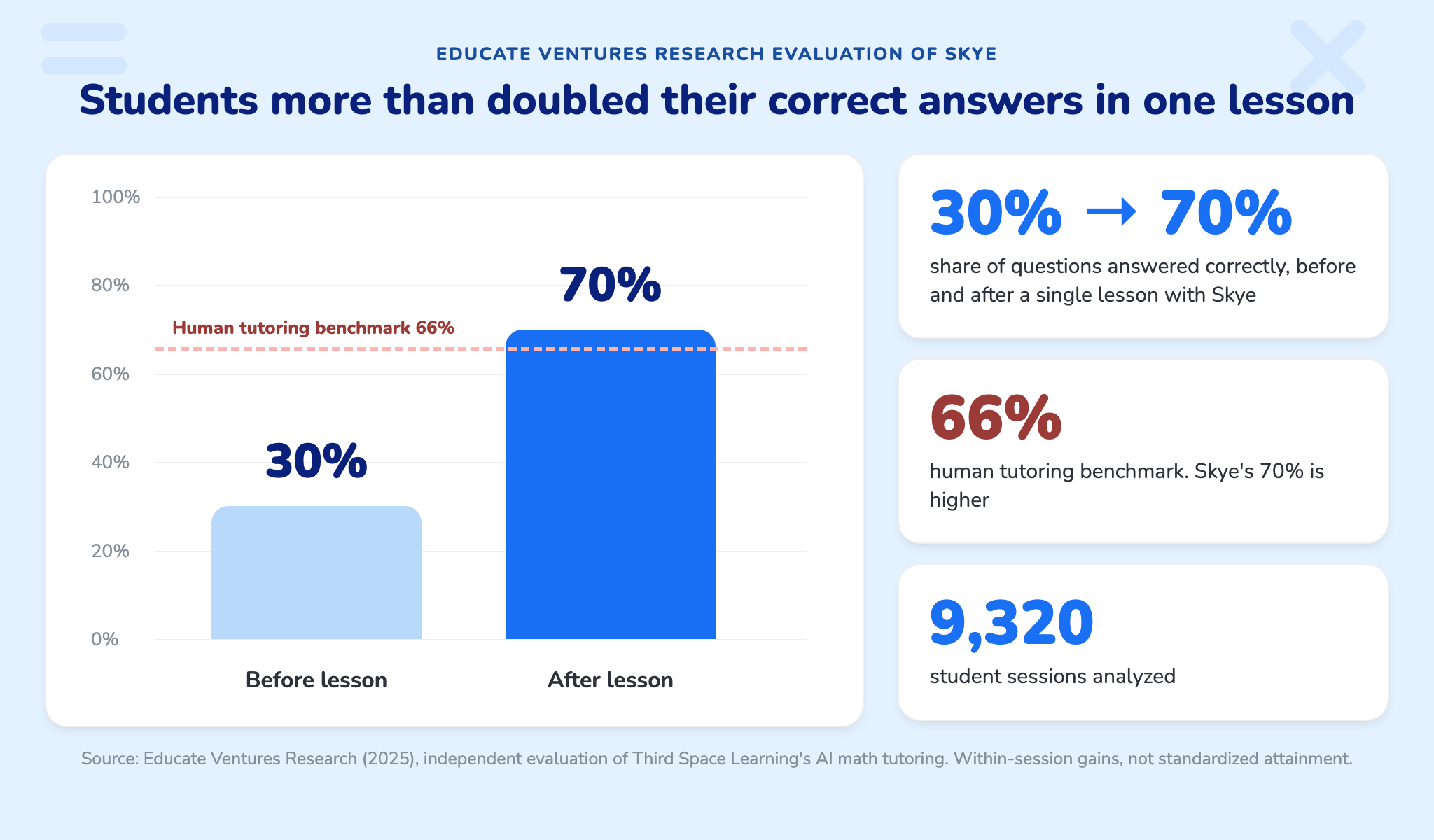
Professor Rose Luckin’s Educate Ventures Research carried out an independent evaluation of our AI math tutor Skye. The evaluation analyzed 9,320 student sessions in schools in England. The researchers also interviewed six elementary school teachers who used Skye in different ways, and surveyed students.
What the data shows
Educate Ventures Research found that individual students more than doubled the share of questions they answered correctly after a single lesson with Skye, from 30% to 70%. That is higher than the human tutoring benchmark of 66%. The researchers describe this as strong, consistent learning gains within sessions across a large dataset, and say that measuring the effect on standardized attainment would need a controlled design.
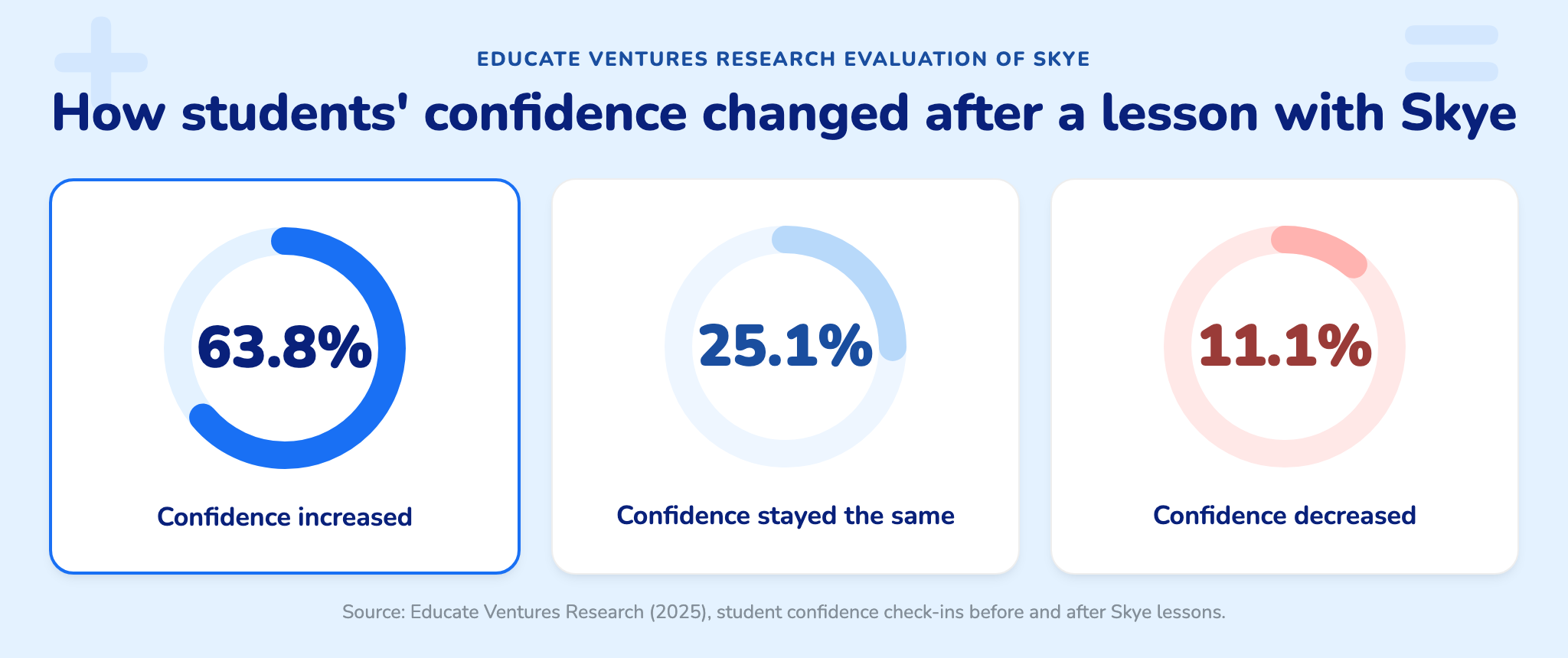
Students’ confidence rose too. 63.8% of students ended a session more confident than they started it, and 11.1% ended less confident. Tracking the same students over time, roughly 66% grew in confidence from one session to the next.
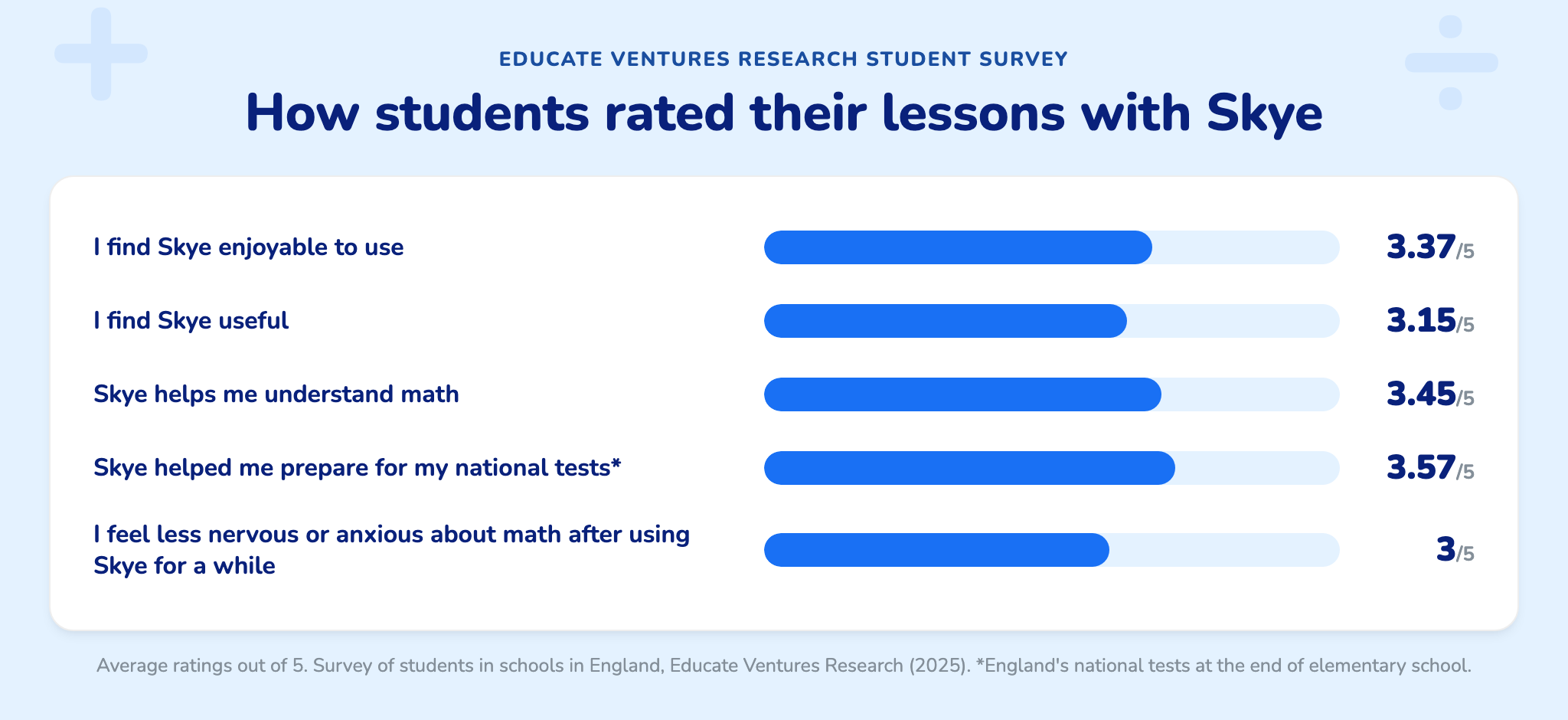
Students rated Skye out of 5 on several questions:
- Helpful for understanding math: 3.45
- Enjoyable to use: 3.37
- Helpful in preparing for England’s national tests at the end of elementary school: 3.57
Who benefits most from AI tutoring?
Educate Ventures saw a particular benefit for students who find math hard, and for those who hesitate to ask for help in class. Higher-achieving students also grew in confidence, especially on challenging material they would not normally ask for help with.
The researchers found that students felt less judged when Skye corrected them, which made them more willing to have a go, and that the relationship with their classroom teacher stayed intact. School leaders in the study called Skye a “force-multiplier for practice” and a “launchpad” for consolidation after teaching. Results also depend on how students use AI tutors, which the limits below make clear.
Where the impact of AI tutoring still needs to be proved
The evaluation is open about the difficulties. English learners and students with speech recognition difficulties found it harder to use, and students with behavioral needs needed an adult close by. Measuring the effect on standardized attainment will need a controlled study.
What federal guidance and privacy law expect from AI tutoring
Unlike England, the US has no single national product standard for AI tutors, which leaves more of the checking to school and district leaders. Federal guidance and federal privacy law still give you a framework, and it matches what the research says.
Responsible use and human oversight
The Department of Education’s July 2025 guidance sets out principles for adopting AI responsibly, including attention to user privacy and involving parents and the wider school community in decisions about new technology. The department’s earlier report, Artificial Intelligence and the Future of Teaching and Learning (2023), recommended keeping “humans in the loop,” with AI that supports the decisions teachers make.
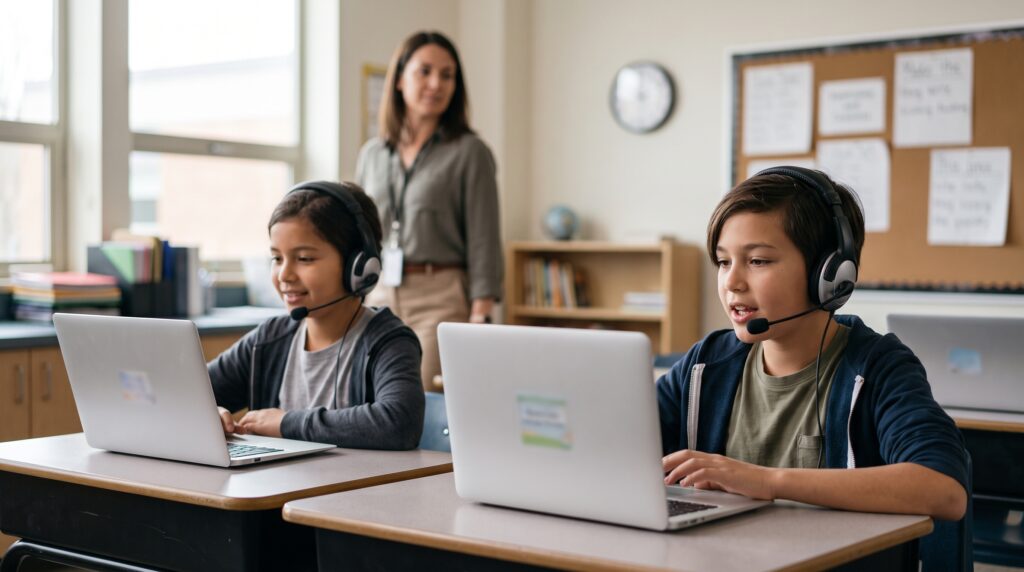
An AI tutor that keeps teachers in charge is good pedagogy, and it also fits what federal guidance describes as responsible adoption.
Hold back direct answers by default
Student-facing generative AI tools should hold back direct answers and full solutions by default. Hints and prompts that ask students to try the problem first are the active learning strategies research supports for building reasoning and understanding.
Used this way, one-on-one AI tutoring could give students who need to catch up in math the kind of support that adjusts to their pace and prior knowledge, which is hard to do in whole-class or group instruction.
Student privacy and student safety
Student data privacy is a legal requirement. FERPA protects student education records at schools that receive federal funds. The Federal Trade Commission’s amended COPPA Rule, effective June 23, 2025, tightens the rules for online services that collect personal information from children under 13. Many states add their own student privacy laws and AI guidance.
An AI tutor used with children also needs to spot signs of distress and flag them to an adult in school, so staff can follow your existing reporting procedures.
5 questions every school leader should ask before adopting AI tutoring
The behaviors responsible-use guidance asks for are the same ones the research links to learning, so school and district leaders now have a clearer basis for choosing an AI tutoring program than they did even a year ago.
Whichever AI tutoring program you are considering for your school, ask these five questions first:
- Does it guide students through their thinking, or does it provide direct answers? Students learn through productive struggle, so a good AI tutor should manage cognitive load while leaving the thinking to the student.
- Is human expertise built into the design? The research and federal guidance on responsible AI use both expect teachers to stay involved.
- Does it meet FERPA, COPPA, and your state’s student privacy requirements? Ask how student data is collected, stored and used, and how the tool flags safety concerns to adults in school.
- Is there independent, third-party evidence of impact on student learning? Look for evaluation by independent researchers with no stake in the result, as well as the vendor’s own data.
- Is the AI tutor designed specifically for your students’ grade level, standards, and educational settings? A general AI tool built for a broad audience will not reflect what works for your students and curriculum.
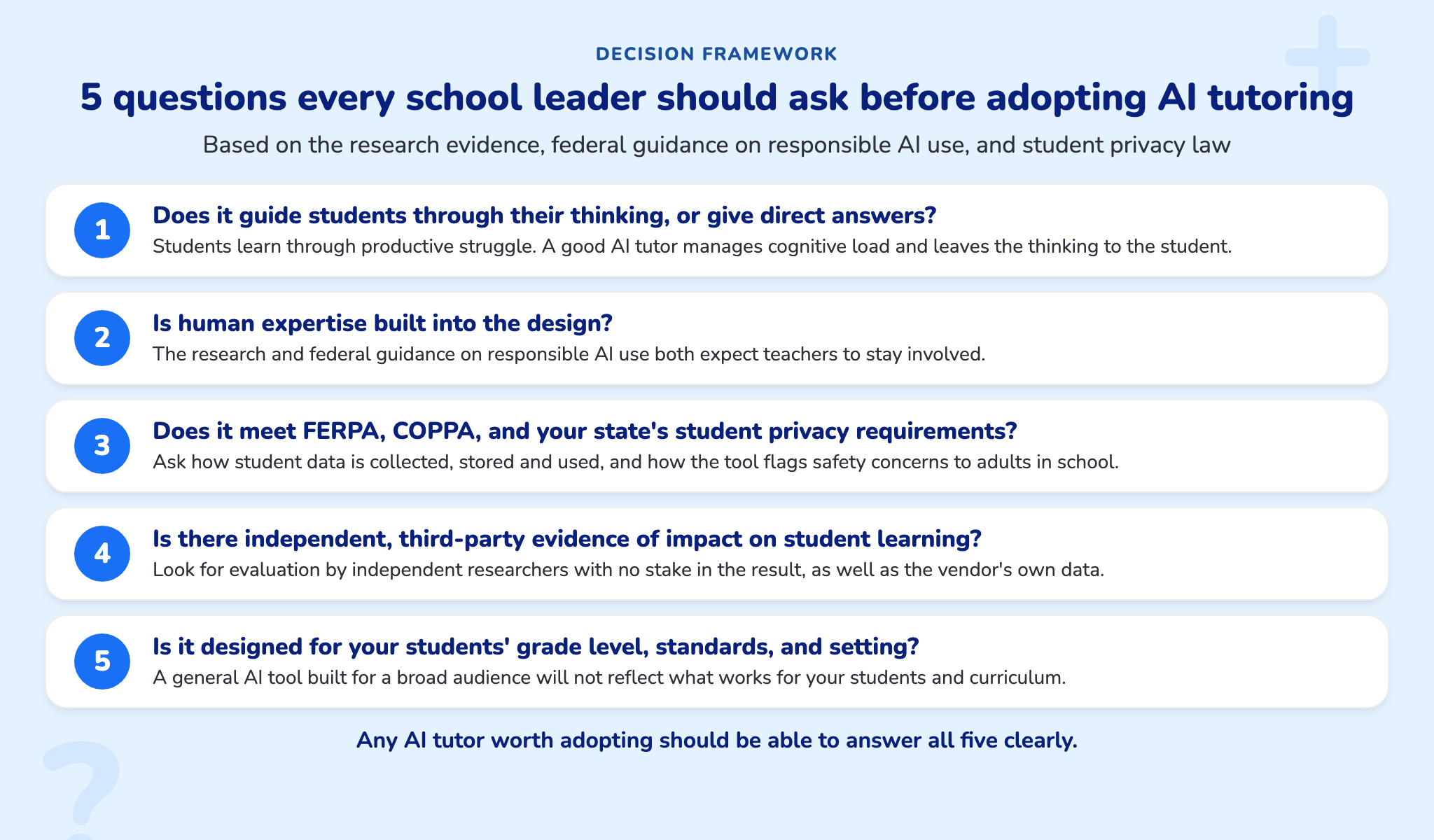
Any AI tutor worth adopting should be able to answer all five clearly, and if it cannot, treat that as a warning sign. You can also read the questions schools ask most about AI math tutoring, from cost to classroom setup.
For other screen-based activities, our guide to screen time at school suggests two similar questions: what is the evidence, and is it worth the time?
The verdict on AI tutoring: what the evidence says
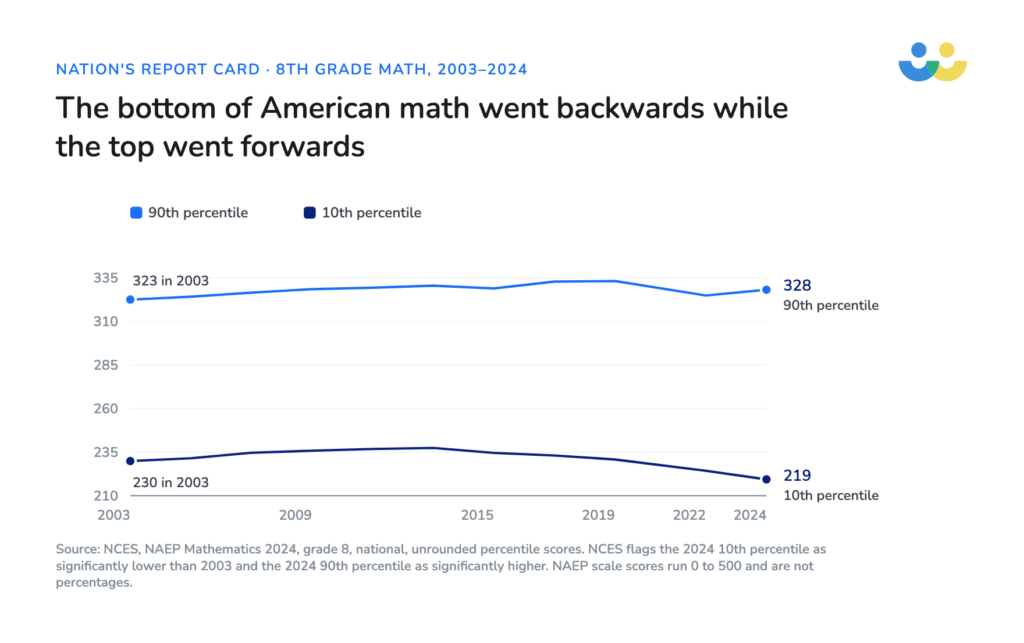
In the 2024 National Assessment of Educational Progress, 28% of 8th graders performed at or above NAEP Proficient in math, and 39% scored below NAEP Basic. AI tutoring could help schools address learning gaps on that scale, provided what schools adopt is built on the tutoring evidence. Our guide to the AI tutoring schools adopt compares the main options.
Where AI tutoring guides students and keeps teachers involved, the early evidence shows measurable improvements in learning. AI that hands over answers can leave students doing worse in the exam, as the Bastani trial showed.
Our position is that schools should judge AI tutoring the way they would judge any intervention, by its design and by independent evidence of impact. Held to that standard, AI tutoring has a good chance of giving one-on-one support to students who have never had it.
AI tutoring FAQs
Yes, when the AI tutor is built on proven teaching principles. That means it guides students instead of handing over answers and follows state standards, with a qualified teacher kept in the loop.
The strongest evidence shows that human connection and human expertise remain essential in AI tutoring. Well-designed AI tutoring works alongside human teaching as a force multiplier for practice and consolidation, and the teacher–student relationship stays at the center.
No. ChatGPT is a general-purpose generative AI tool that runs on a large language model. It responds to whatever it is asked, while an intelligent tutoring system follows a teaching sequence. In one randomized controlled trial, students who studied with ChatGPT scored around 17% lower in the exam than students who did not. A purpose-built AI tutor uses active learning strategies and high-quality explanations to build understanding.
AI tutoring and project-based learning do different jobs. Tutoring systems are most useful for building core knowledge, particularly in math, where students need structured practice. Schools get the most from AI tutoring when they use it to strengthen foundations, so students come to collaborative, applied work with more confidence.
References
Bastani, H., Bastani, O., Sungu, A., Ge, H., Kabakcı, Ö. and Mariman, R. (2025). Generative AI without guardrails can harm learning: Evidence from high school mathematics. Proceedings of the National Academy of Sciences.
Eedi and Google DeepMind (November 2025). New Exploratory Research from Eedi and Google DeepMind Reveals Human-in-the-Loop AI Tutoring Outperforms Human-Only Support.
Education Endowment Foundation (2024). Teaching and Learning Toolkit: One to One Tuition. UK.
Federal Trade Commission (2025). Children’s Online Privacy Protection Rule. Federal Register, April 22, 2025.
Kestin, G. et al. (2025). AI tutoring outperforms in-class active learning: a randomized controlled trial introducing a novel research-based design in an authentic educational setting. Scientific Reports.
Luckin, R. et al. (2025). High-impact AI math tutoring: a case study of Third Space Learning. Educate Ventures Research.
National Assessment Governing Board (2025). The Nation’s Report Card: 2024 Mathematics and Reading results.
National Student Support Accelerator, Stanford University. Elements of High-Impact Tutoring.
Oakley, B. and Sejnowski, T. (2025). The Memory Paradox: Why Our Brains Need Knowledge in an Age of AI.
U.S. Department of Education (July 22, 2025). U.S. Department of Education Issues Guidance on Artificial Intelligence Use in Schools, Proposes Additional Supplemental Priority.
U.S. Department of Education, Office of Educational Technology (2023). Artificial Intelligence and the Future of Teaching and Learning: Insights and Recommendations.
Vanacore, K., Baker, R.S., Closser, A.H. and Roschelle, J. (2026). The path to conversational AI tutors: integrating tutoring best practices and targeted technologies to produce scalable AI agents. arXiv:2602.19303v1.
Stanford SCALE Initiative (2026). The Evidence Base on AI in K-12 Education.
The Science of Learning Podcast (2025). AI in Education with Daisy Christodoulou.
Do you have students who need extra support in math?
Skye – our AI math tutor built by experienced teachers – provides students with personalized one-on-one, spoken instruction that helps them master concepts, close skill gaps, and gain confidence.
Since 2013, we’ve delivered 2,295,000 math tutoring sessions to 196,000 students, guiding them toward higher math achievement.
Discover how our AI math tutoring can boost student success, or see how our math programs can support your school’s goals:
– 3rd grade tutoring
– 4th grade tutoring
– 5th grade tutoring
– 6th grade tutoring
– 7th grade tutoring
– 8th grade tutoring