

All Your AI Tutoring Questions Answered: How Does It Work, How Effective Is It, And How Safe Is It?

Every school has more students who need one-on-one math support than the budget or the schedule can stretch to. AI tutoring can help close that gap, but it’s still relatively new to the tutoring space, and it can be hard to tell what it is and how effective it is. So here are honest answers to the questions school leaders and teachers like you actually ask us: what the evidence says, what AI tutoring can and cannot do, and what to check before you invest.
Where there is solid research, we point to it; where the honest answer is “it depends,” we say so. The questions below come in groups: does it work, is it as good as a human, is it good for learning, can we trust it, is it safe, who it is for, and what it costs. Skip to whichever one is on your mind.
Unlocking Funding for Math Interventions
Everything school and district leaders need to know about the federal funding initiatives available for tutoring, including what you will receive, when you will receive it, how it can be spent and how to maximize your intervention funding. 
The evidence on AI tutoring
Does AI tutoring actually work, and what does the evidence say?
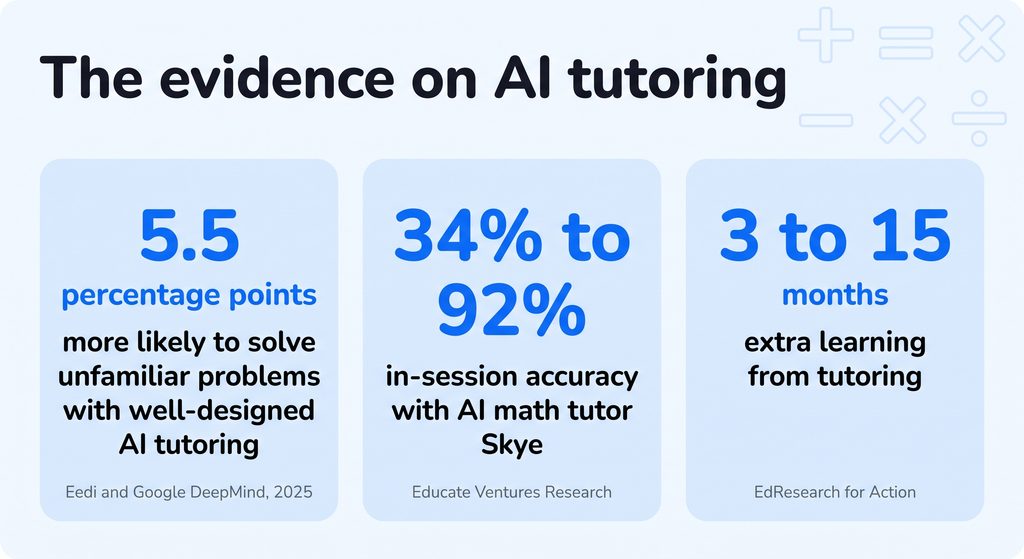
One-on-one tutoring is one of the most effective approaches a school can use to support student learning. Reviewing the evidence for US schools and districts, EdResearch for Action found tutoring adds roughly three to 15 months of additional learning across grade levels. High-dosage tutoring is one of the few school-based interventions with large, demonstrated positive effects. AI is starting to make that kind of individualized support more affordable and accessible. However, the evidence suggests AI tutoring works best when it is structured and supervised, rather than left to run on its own.
Promising, and increasingly backed by real trials, but the results of AI tutoring depend on how it is used. In a 2025 randomized trial by Eedi and Google DeepMind, students using carefully designed, human-in-the-loop AI tutoring were 5.5 percentage points more likely to solve unfamiliar problems than those receiving human tutoring alone, and the AI made errors on just 0.1% of turns. Used the wrong way, AI can backfire: in a large field experiment led by researchers at the University of Pennsylvania’s Wharton School, high school math students who used an unrestricted GPT-4 chatbot performed 17% worse on a subsequent exam when the AI was taken away. A version designed with learning safeguards largely avoided this negative effect, suggesting that how an AI tutor is designed and used matters.
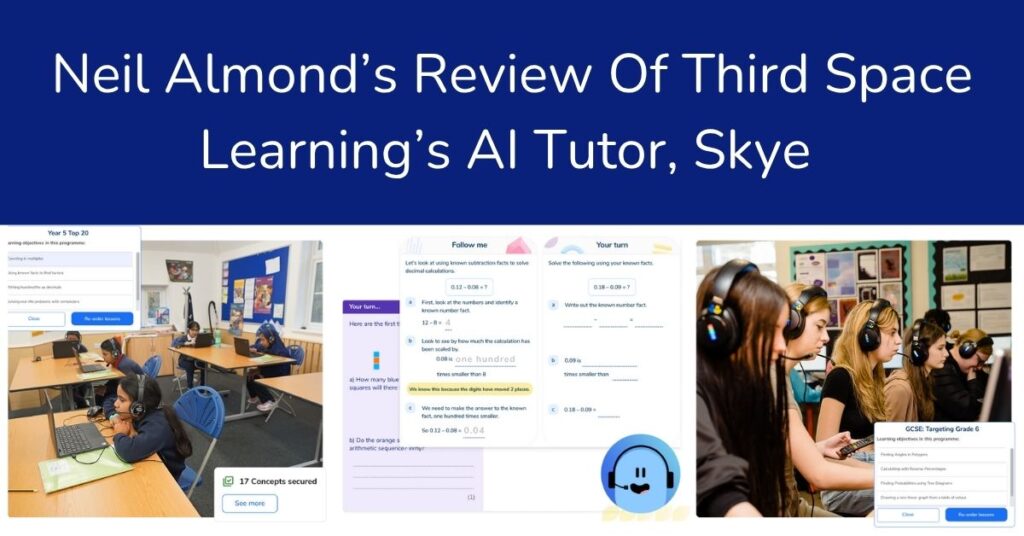
Additionally, Educate Ventures Research, an independent education research and consulting firm focused on AI and EdTech, evaluated AI math tutor Skye. It found students’ in-session accuracy rose from 34% to 92%.
What subjects and grade levels is AI tutoring for, and can it help with state tests?
Math is a great subject for AI tutoring, which is no surprise: it is a subject with clear right answers and well-mapped misconceptions, so it suits the technology. AI tutoring is also being used across other subjects, including English/ELA and science.
It is primarily being developed and used across K–12 education, from elementary through high school.
Whether an AI tutor can effectively support preparation for a specific state test depends on how closely its content, grade level, and instructional approach align with that state’s standards and curriculum, so parents and schools should check those details before committing.
AI tutors and teachers
Is an AI tutor as good as a human tutor, and could it replace teachers?
AI tutors cannot replace teachers. Think of it as another pair of hands, not a replacement pair. An AI tutor can give a student patient, one-on-one practice on demand, at a scale no school could ever staff by hand.
What AI tutors cannot do that teachers can is know a student: spot that the wobble in fractions is really a wobble in confidence, notice when something is off at home, or be the person a reluctant student turns up for. So, it’s not AI versus teachers, but which parts of tutoring AI should take on so teachers get their time back for the parts only a human can do.
In the conversations we have with schools, the ones getting the most from AI tutoring never asked it to replace anyone; they use it for one-on-one practice and keep teachers for the parts only a teacher can do.
AI tutoring and learning
Will relying on AI make learners lazy or stop them thinking for themselves?
Relying on AI in the wrong way can make students lazy, and pretending otherwise would be dishonest. If AI simply hands over the answer, students quickly default to cognitive offloading.
But that is a design choice, not a law of nature. Ask a general chatbot to “do question 4” and it will. A well-built AI tutor does the opposite: it withholds the answer, offers a hint, and makes the student take the next step themselves, so the effort stays where it belongs, with the learner. Which is exactly why supervision and the right tool matter far more than whether AI is “allowed” at all.
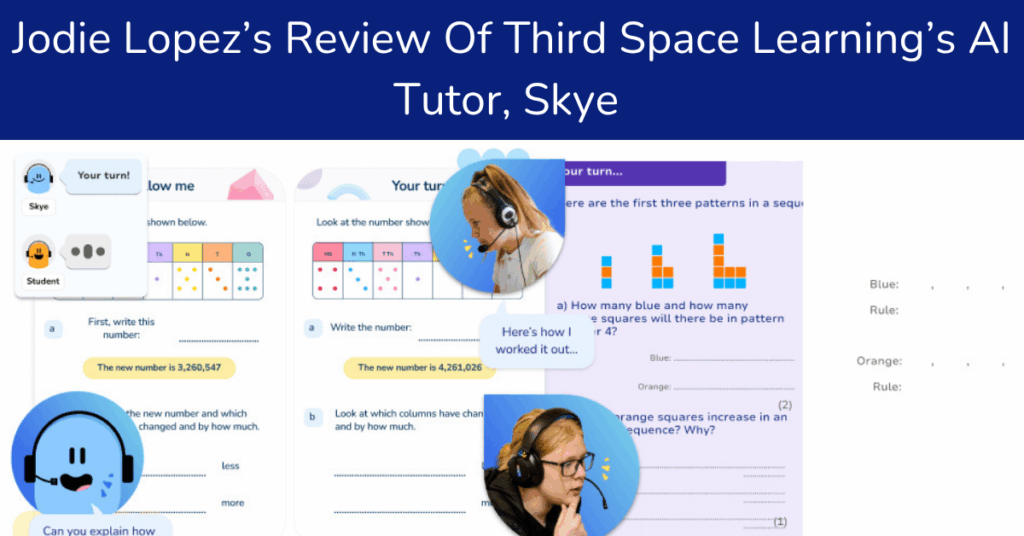
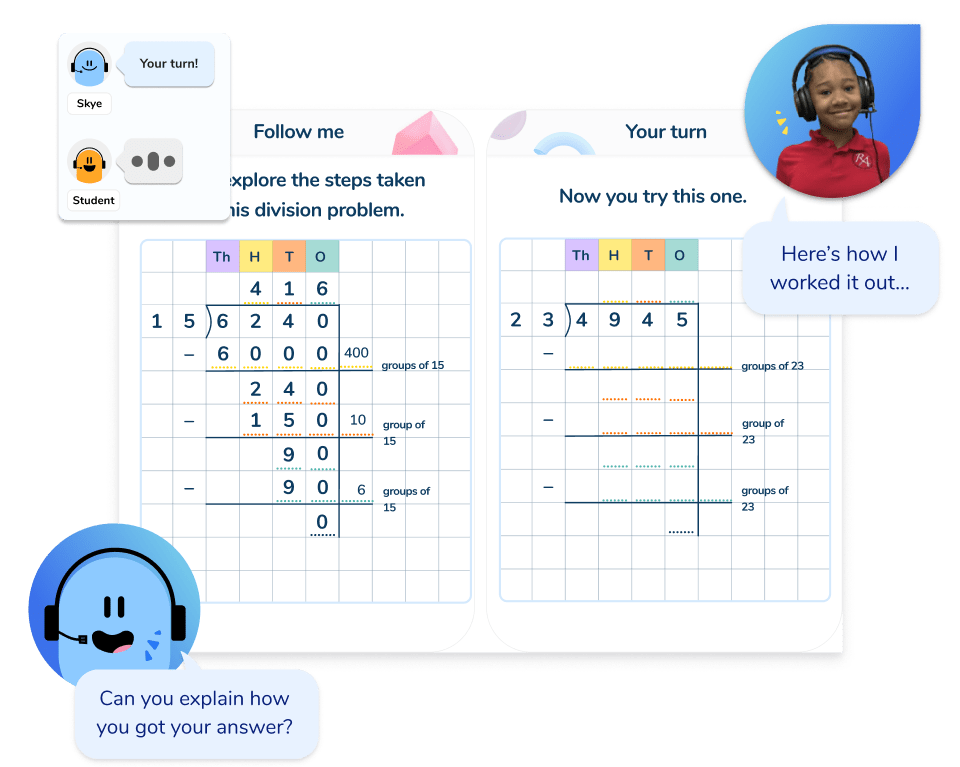
With Third Space Learning, when a student demonstrates an incorrect answer or misconception, spoken AI tutor Skye provides a verbal hint. If the student answers incorrectly again, Skye provides another hint. If the student answers a third time incorrectly, Skye scaffolds the learning and models the correct steps the learner needs to take.
Is using an AI tutor cheating?
No, using an AI tutor is not cheating. Using an AI tutor to understand a method, practice, or get feedback is learning; this is no different from sitting with a tutor. However, a student using generative AI to produce a piece of work and pass it off as their own is cheating.
The line is simple: is the student doing the thinking, or outsourcing it? That is why a flat AI ban tends to backfire – it pushes the tool underground instead of teaching students to use it well. Most schools are getting further by naming that line clearly, setting work that rewards reasoning over a tidy final answer, and writing it into a school AI policy everyone understands.
Trustworthiness of AI tutoring
How do we know an AI tutor is teaching students the right things?
This is the question that should decide which tool you pick, because not all AI is built the same. A general chatbot generates every answer on the spot, which means it can sound completely confident and still be wrong.
A purpose-built AI tutor works differently: it teaches from lessons written and checked by teachers, so what a student sees has been vetted before it ever reaches them, not improvised mid-session.
Third Space Learning’s AI tutor Skye, for instance, only teaches lessons written and checked by qualified teachers, so nothing is made up on the spot. The question to put to any AI tutoring vendor is a blunt one: where does your content come from, and who has checked it?
AI tutoring and student safety
Is AI tutoring safe for students, and what happens to their data?
Safety is not a given; it is something to check, because “AI tutor” is a broad term that can cover everything from a locked-down, curriculum-only tool to a general chatbot. Responsible companies limit what the tool can say and do, record sessions, and are clear about students’ data: where it is stored, who can see it, and whether it is used to train the model.
Two things to insist on: a real answer on the applicable US student-data law, and a straight answer on data use. Third Space Learning’s spoken AI tutor Skye is designed to meet US student privacy expectations, with FERPA and COPPA compliance and compliance with applicable state student-privacy laws. Student data is never sold, used for advertising, or used to train third-party AI models, and schools remain in control of their data under a signed data privacy agreement. Data is protected with encryption, access controls, and annual independent penetration testing, and schools can request deletion of their data. Third Space Learning is also working toward SOC 2 Type II certification.
Choosing the right students for AI tutoring
Can AI tutoring help students with disabilities or those on an IEP?
For some students, AI tutoring is a real help; for others it is not the right tool. A calm, low-stakes, one-on-one setting, especially a spoken one, can suit students who freeze when asked to speak up in class, or who need the same concept explained again without any sense of judgment.
What it is not is a replacement for special education services and support from qualified educators, and tools vary a lot in how well they adapt to different needs. So treat it as one option to trial with specific students in mind, watch how it works for the students in front of you, and build from there rather than rolling it out blind.
How can AI tutoring be used to support inclusion?
AI tutoring works best as part of inclusive teaching rather than instead of it – but used well, it helps far more students get the support that used to reach only a few.
For the schools we work with, the biggest inclusion advantage is reach. One-on-one support is often limited to a small number of students, while AI tutoring can offer individualized support to everyone who needs it, not just a few students. In the classroom, that can make a real difference: every student can work at their own level and pace, so students with different abilities can each get the right level of challenge or support without feeling singled out.
A one-on-one setting can also give English learners, or those working well below grade-level expectations, the space to have a concept revisited as many times as they need, without stigma.
Cost and choosing the right AI tutor
How much does AI tutoring cost, and are free tools good enough?
AI tutoring can range from free to a few thousand dollars a year, and the price often reflects the level of support and functionality you get. Free tools like Khan Academy can be useful for self-directed students, while paid platforms typically add curriculum-aligned content, reporting, student safety features, and teacher oversight – the kinds of tools schools need to implement AI tutoring effectively.
For a school, however, free versus paid is the wrong comparison. The more useful question is cost per student reached against the alternatives. High-impact tutoring typically costs schools around $1,200–$2,500 per student per year, whereas an unlimited AI tutoring model can work out at a far lower cost per student. Third Space Learning’s spoken AI math tutor Skye offers unlimited one-on-one math tutoring for a fixed annual price. Prices for school licenses start at $5,000 per school for 200 students enrolled, or $150 per tutored student per year for a district license. Skye helps bring the cost of individualized tutoring down significantly while allowing schools to reach many more students.
How do we choose an AI tutor, and can we just use ChatGPT?
You can use ChatGPT as a study aid, but know what you are getting: it is a general model and it can be wrong; it does not follow your curriculum, and it will hand over answers unless a student knows exactly how to stop it. A purpose-built tutor is designed to teach rather than answer.
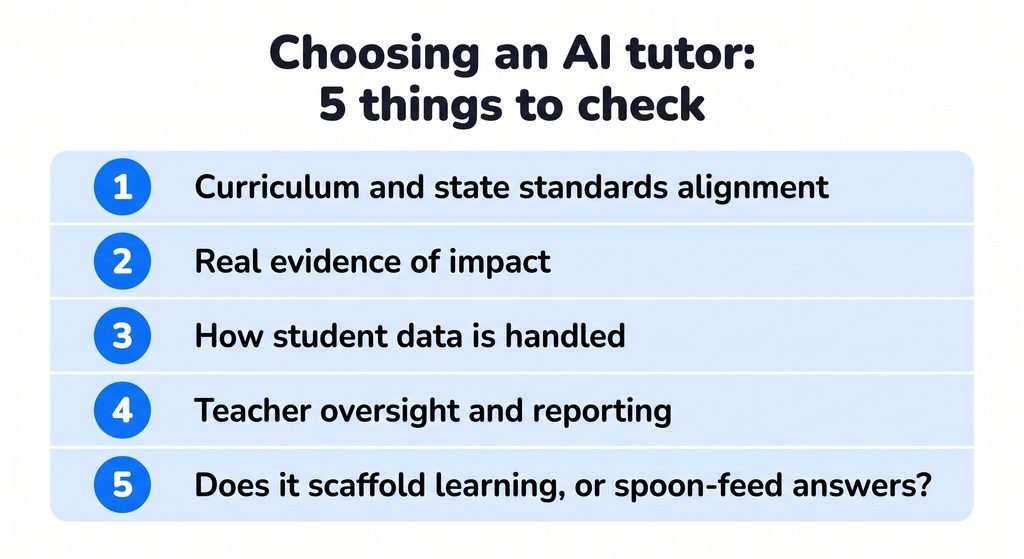
When you compare tools, five things separate the serious ones from the rest:
- curriculum and state standards alignment
- real evidence of impact
- how student data is handled
- the level of teacher oversight and reporting
- whether it scaffolds learning or simply spoon-feeds answers
If an AI tutor vendor cannot give you a straight answer on all five, that tells you something.
Where Skye fits in AI tutoring
If one thread runs through all of these answers, it is that the outcomes depend far less on the idea of AI and far more on how a particular tool is built and how a school chooses to use it. The strong ones scaffold rather than spoon-feed, teach from content that real teachers have written and checked, are clear about students’ data, and work best with a staff member in the room. The weak ones are a general chatbot.
So the more useful question is not “is AI tutoring any good?” but “is this AI tutor well-built, and will we use it well?” The evidence is encouraging where those two things line up, and thin where they do not. In practice, that means trialing a tool with specific students in mind, asking vendors the blunt questions: where the content comes from, what happens to the data, whether it teaches or just answers, and keeping teachers in the loop rather than handing the job over.
Skye, Third Space Learning’s spoken AI math tutor, is built around the answers above: one-on-one lessons written and vetted by qualified teachers, designed to give hints rather than hand over answers, with sessions recorded and built-in student safety measures designed to help keep students safe throughout their learning. Schools comparing Skye against the five checks above usually want detail on where its content comes from, how student data is handled and what teachers see.
Do you have students who need extra support in math?
Skye – our AI math tutor built by experienced teachers – provides students with personalized one-on-one, spoken instruction that helps them master concepts, close skill gaps, and gain confidence.
Since 2013, we’ve delivered 2,295,000 math tutoring sessions to 196,000 students, guiding them toward higher math achievement.
Discover how our AI math tutoring can boost student success, or see how our math programs can support your school’s goals:
– 3rd grade tutoring
– 4th grade tutoring
– 5th grade tutoring
– 6th grade tutoring
– 7th grade tutoring
– 8th grade tutoring