

The Best AI Tutors For Schools And Districts: What To Look For And How The Top Tutors Compare

The best AI tutors help schools give more students personalized, one-on-one support than a tutoring budget would usually stretch to, and at a lower cost than human tutors. As more schools adopt an AI tutor or AI tutoring platform, the harder question is which AI tutor is right for a particular school, subject and grade level.
There is no single best AI tutor, because the AI tutors on the market do quite different jobs, from one-on-one math intervention and reading practice to homework help and language learning. This guide sets out the key features to look for in an AI tutor and groups the best AI tutors by the job they do best, so you can match the right one to your students and their learning goals.

Unlocking Funding for Math Interventions
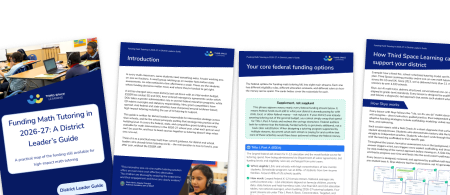
Find out which federal funding programs your school can use for math intervention, how much you can expect, when it arrives and how it can be spent. This free guide for district and school leaders also covers how to stretch your intervention budget further and make every intervention cost-effective, with links to free math intervention resources.
Download Free Now!How AI tutors and AI tutoring platforms work
The best AI tutors are intelligent tutoring systems that combine machine learning with human-designed pedagogy to give students a personalized learning experience at scale. A good AI tutor goes beyond a chatbot that produces instant answers. Many use natural language processing and adaptive learning algorithms to analyze a student’s strengths and weaknesses in real time. AI tutors adapt teaching and difficulty as they go, and let each student learn at their own pace. Through deep learning and natural language processing, AI tutors personalize the process and offer support that helps students work through complex subjects and concepts. This helps enhance learning at every stage.
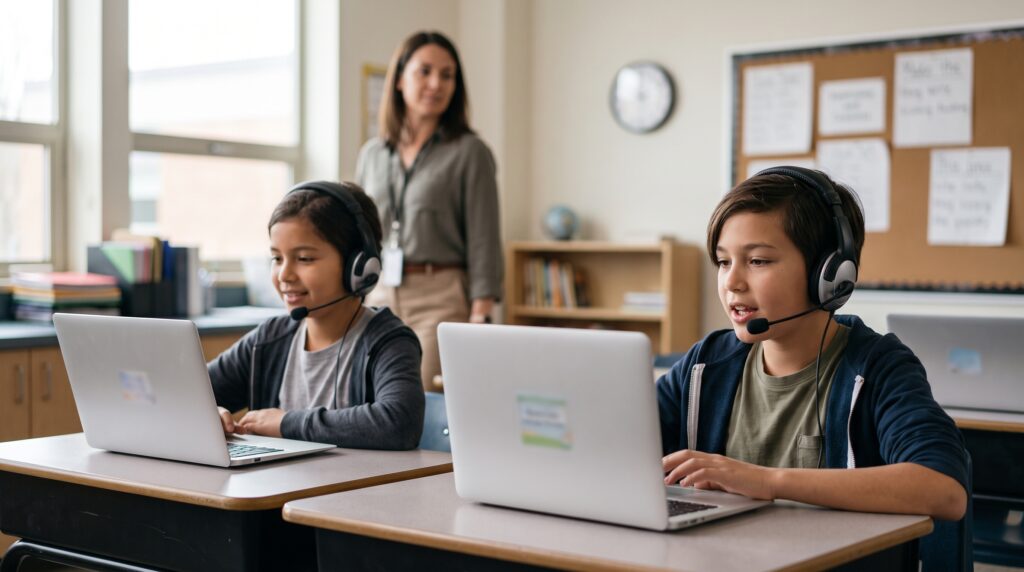
How students interact with an AI tutor varies too. A spoken AI tutor builds reasoning through dialogue, so students explain their thinking out loud. A text-based platform sets interactive lessons and practice tests, tracks student performance and gives teachers dashboards for progress tracking. Whichever format you choose, an AI tutor only deepens understanding if it is built on teacher expertise and keeps humans in the loop.
Benefits of AI tutors
Used well, an AI tutor lets a school extend one-on-one help to far more students than a traditional schedule allows. The main benefits schools tell us about are:
- Accessible any time: AI tutors offer real-time support during or after a lesson so students can access sessions for catch-up, review or test prep without waiting for a human tutor to be free.
- Personalized learning: by analyzing each student’s learning needs, an AI tutor adapts content and pace to the individual, meeting diverse learning needs the way a good human tutor would.
- Real-time feedback: learners receive hints, instant explanations and real-time feedback at the point of need, and that instant feedback helps them reinforce concepts and correct misconceptions quickly.
- Track progress: dashboards track progress against learning goals and student performance, so teachers can target lesson plans and interventions where they are needed.
- Cost-effective at scale: because one AI tutoring platform can act as a personal tutor for many students, an AI tutor is an affordable way to supplement human tutors, and many tools offer a free plan.
The best AI tutors also promote critical thinking rather than simply providing answers. This promps students to explain their reasoning and reach the solution themselves. AI tutors work best alongside teachers rather than in place of teachers: the strongest results come when a teacher sets the learning goals, and the tutor delivers the extra one-on-one practice, with the personalized, real-time feedback a single teacher cannot give thirty students at once.
What to look for in an AI tutor: key features
Before comparing the best AI tutors, it helps to agree what a good AI tutor looks like for a school. These are the key features and factors we would judge any AI tutor against.
- Learning goals: be clear on the job, whether that is catch-up intervention, homework help, state test prep, exam prep and practice tests, or independent practice.
- Subject and grade level: some AI tutors cover a broad curriculum across grade levels; others go deep in one subject, such as math or reading, or specialize in language learning. Choose the tool for your context.
- Teaches or answers with human expertise: a good AI tutor guides students toward the answer and builds a deeper understanding; a tool that only generates answers invites cognitive offloading. Look for lessons built with teacher input, so responses address misconceptions.
- Standards alignment: an AI tutor that follows your state standards will fit your scope and sequence. Ask each vendor how their lessons map to your state’s grade-level expectations and state tests.
- Spoken or text: a spoken AI tutor lets students reason out loud and lowers the reading and typing load. Most AI tutors are text-based.
- Personalization: look for adaptive learning paths and personalized feedback that tailor the learning experience to each student with scaffolding.
- Key features and interactivity: check the key features available, such as quizzes, practice questions, interactive lessons and progress tracking, and whether the user experience keeps students engaged.
- Student safety and data privacy: for anything students use directly, check the AI tutor is FERPA and COPPA compliant, that the vendor will sign your district’s data privacy agreement, that student data is not used to train AI models, and that it fits your AI policy for schools. Check age limits too: several tools require users to be 13 or older.
- Evidence and cost: look for real impact, ideally research that meets an ESSA evidence tier, and weigh the pricing model, including any free plan, against how many students you want to reach.
Questions to ask any AI tutor vendor
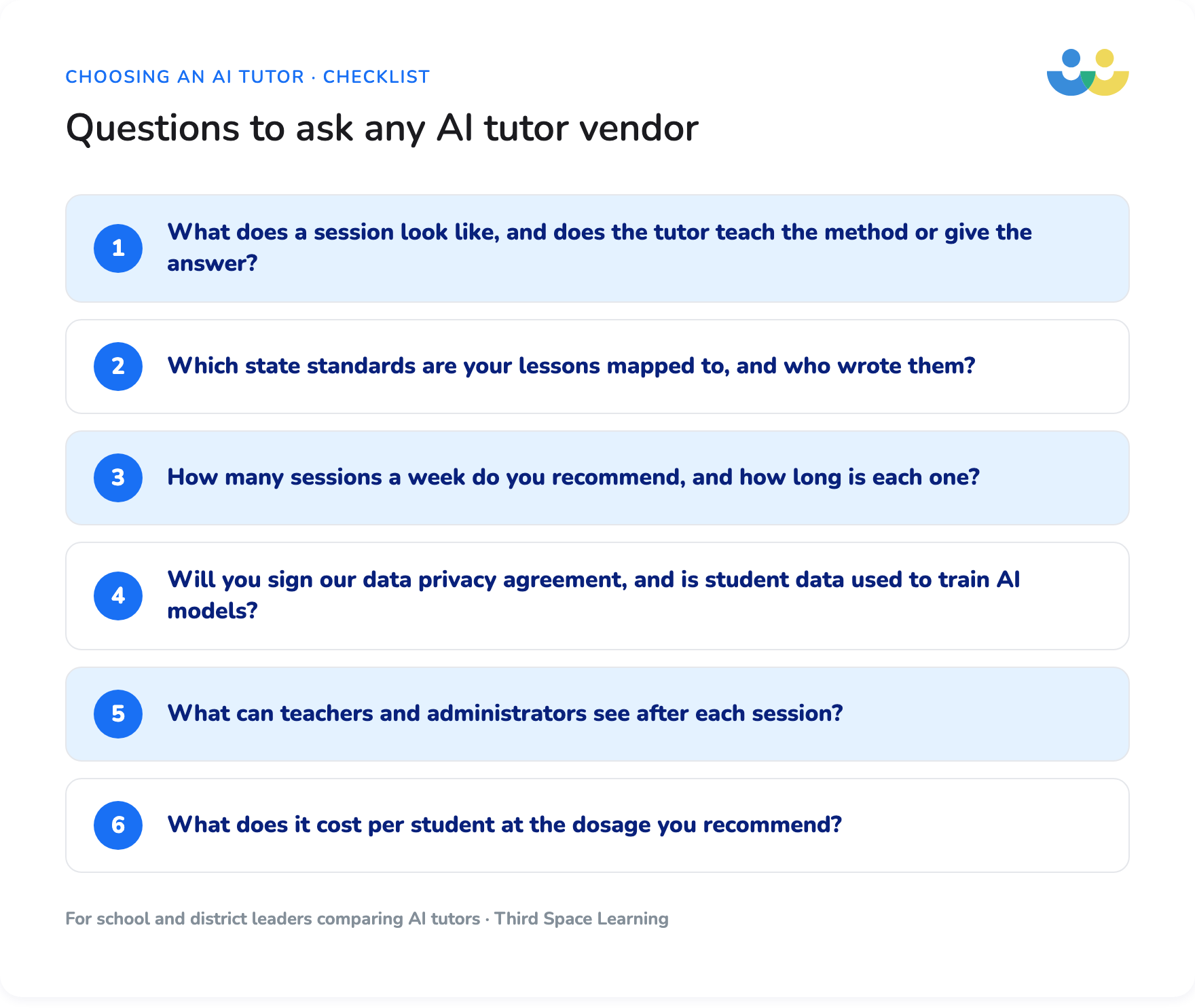
- What does a session look like, and does the tutor teach the method or give the answer?
- Which state standards are your lessons mapped to, and who wrote them?
- How many sessions a week do you recommend, and how long is each one?
- Will you sign our data privacy agreement, and is student data used to train AI models?
- What can teachers and administrators see after each session?
- What does it cost per student at the dosage you recommend?
The best AI tutors, by what you need them for
Rather than a single ranking, here are the best AI tutors grouped by the job each one does best. Every entry links out to the tool.
How we chose these AI tutors
We included AI tutors that are active in the US, have public pricing or a visible school customer base, and do at least one job well for schools, districts or families. We checked each tool’s website for pricing, student data privacy and recent changes in October 2026, and we review the list every quarter. Third Space Learning makes Skye; we have no commercial relationship with any other tool listed.
Best AI tutor for one-on-one math intervention in schools: Skye (Third Space Learning)
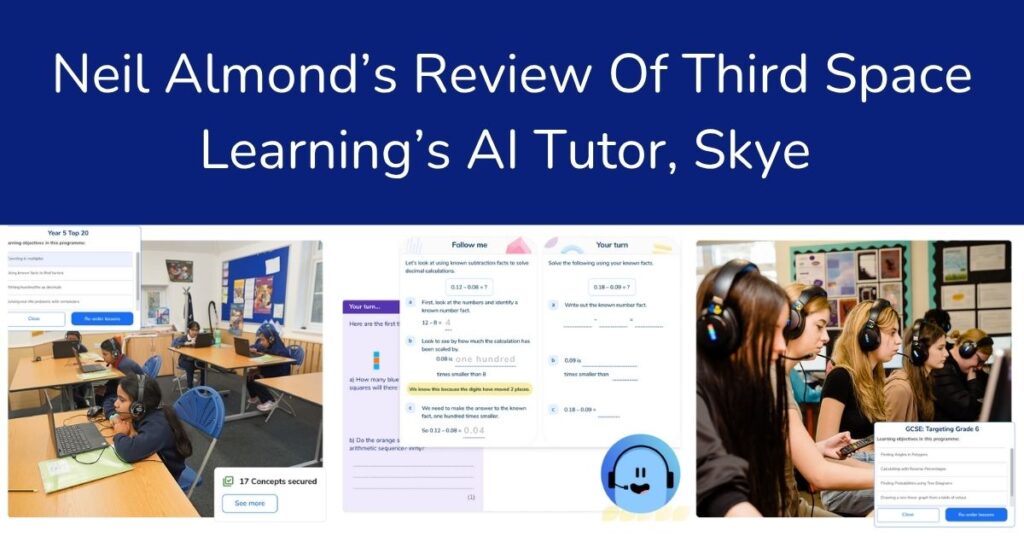
Skye is a spoken, one-on-one AI math tutor whose lessons are written and reviewed by qualified teachers, and built on more than a decade of Third Space Learning’s one-on-one tutoring. Skye covers grades 3 to 8, with high school support for students who still have middle school gaps to close. It talks students through each step, gives real-time feedback and instant feedback, and reports back to the school after every lesson. It suits schools running structured math intervention across a group of students, including state test prep, and it works well for students who benefit from a spoken AI tutor, including many English learners. More on why below.

Best AI tutor for multi-subject Socratic tutoring: Khanmigo (Khan Academy)
Khanmigo, the AI-powered tutor from Khan Academy, guides students across multiple subjects, including math, science, coding and the humanities, using Socratic questioning that promotes critical thinking rather than giving instant answers. It is free for teachers, a genuine draw, and links to Khan Academy’s large library of lessons and practice tests, and its Writing Coach gives students feedback on essays. Families can subscribe for $4 a month, and districts get the full student version and reporting through a paid district partnership, priced by quote. Khanmigo is mainly text-based, so students type rather than speak, though a microphone option turns speech into text.
Best AI tutors for adaptive math practice: MATHia and DreamBox Math
MATHia, from Carnegie Learning, is an adaptive AI-powered platform for grades 6 to 12 that coaches students skill by skill with hints and feedback, and it has some of the strongest evidence of any tool here: a RAND randomized trial across 147 schools in seven states found growth in test scores nearly doubled in the second year. DreamBox Math, now part of Discovery Education, is adaptive, game-based math practice for K-8 that adjusts to how each learner solves a problem, at their own pace. Both are text and click-based, and both are an AI-powered platform as much as an AI tutor. For more math-specific tools, see our comparison of the best AI for math.
Best AI tutor for reading: Amira
Amira is an AI reading tutor for PreK to grade 8 that listens to students read aloud and responds by voice, in English or Spanish, so it doubles as a reading assessment. An ESSA Level II study covered more than 79,000 students across 12 Louisiana districts. It is built for reading only, and pricing is not public.
Best AI tutor for teachers who want to build their own AI activities: SchoolAI
SchoolAI lets classroom teachers set up their own AI “Spaces” for students in any subject, choose the prompts and topics, and watch student progress in real time. It is free for individual teachers to try, with paid plans for schools and districts. Because teachers design each activity, the quality of the learning experience depends on the Spaces they build, and teachers need time to build them.
Best AI tutor for hybrid human and AI tutoring: Tutor.com
Tutor.com, from The Princeton Review, is a tutoring platform that combines AI tools with access to human tutors in more than 250 subjects, which suits districts that want human interaction alongside the technology. Its AI tools are aimed mostly at older students and don’t yet cover math, so for K-12 the main value is still the human tutors.
Best AI tutor for studying your own materials: Gemini Notebook (formerly NotebookLM)
Gemini Notebook, which Google renamed from NotebookLM in July 2026, turns a student’s own study materials, such as lecture notes, readings and course materials, into an interactive study partner, letting students create flashcards and quizzes, answer practice questions and get instant feedback and explanations grounded in their sources. It is free for schools on Google Workspace for Education. It works well for exam prep and independent study for high school students, though it does not follow a curriculum or adapt to each student’s gaps.
Best general chatbots with a learning mode: ChatGPT Study Mode and Gemini Guided Learning
ChatGPT Study Mode and Google’s Gemini Guided Learning, part of Gemini for Education, turn a general chatbot into a step-by-step tutor that asks questions, explains concepts and checks students understand, across multiple subjects. They have a free tier, but students can switch the learning mode off and get instant answers, and teachers get no student-level reporting. ChatGPT requires users to be 13 or older.
AI tools students may use at home
These are consumer apps rather than school purchases, and some require users to be 13 or older. Students are likely to use them anyway, so it helps to know what each one does.
Best AI tutors for homework help: Photomath and Brainly
Photomath, owned by Google, is an AI-powered homework-help tool that scans a math problem and returns step-by-step explanations, which supports self-paced learning at home. Brainly is a question-and-answer AI tutoring platform with a community and AI features, useful for quick help across subjects, though answer quality varies and it is worth checking responses against a reliable source. Both are consumer apps, and Brainly users must be 13 or older.
Best AI tutor for language learning: Duolingo Max
Duolingo Max is the AI-powered tier of the best-known app for language learning, with short, gamified lessons that keep learners engaged. Its AI-powered features let language learners practice pronunciation and speaking, hold real-life conversations through Video Call, and learn new skills at their own pace for an enjoyable learning experience. Duolingo Max is built for language learning rather than the wider curriculum, and AI-generated content can occasionally contain inaccuracies.
Best AI tutor for round-the-clock support: Tutor AI
Tutor AI is an AI-powered tutor and learning platform offering on-demand, round-the-clock explanations across topics, from general knowledge to exam prep. Tutor AI is closer to a self-paced learning platform than a true one-on-one AI tutor, and it is text-based, so it suits independent practice rather than structured intervention.
Where AI tutoring fits: high-impact tutoring and MTSS
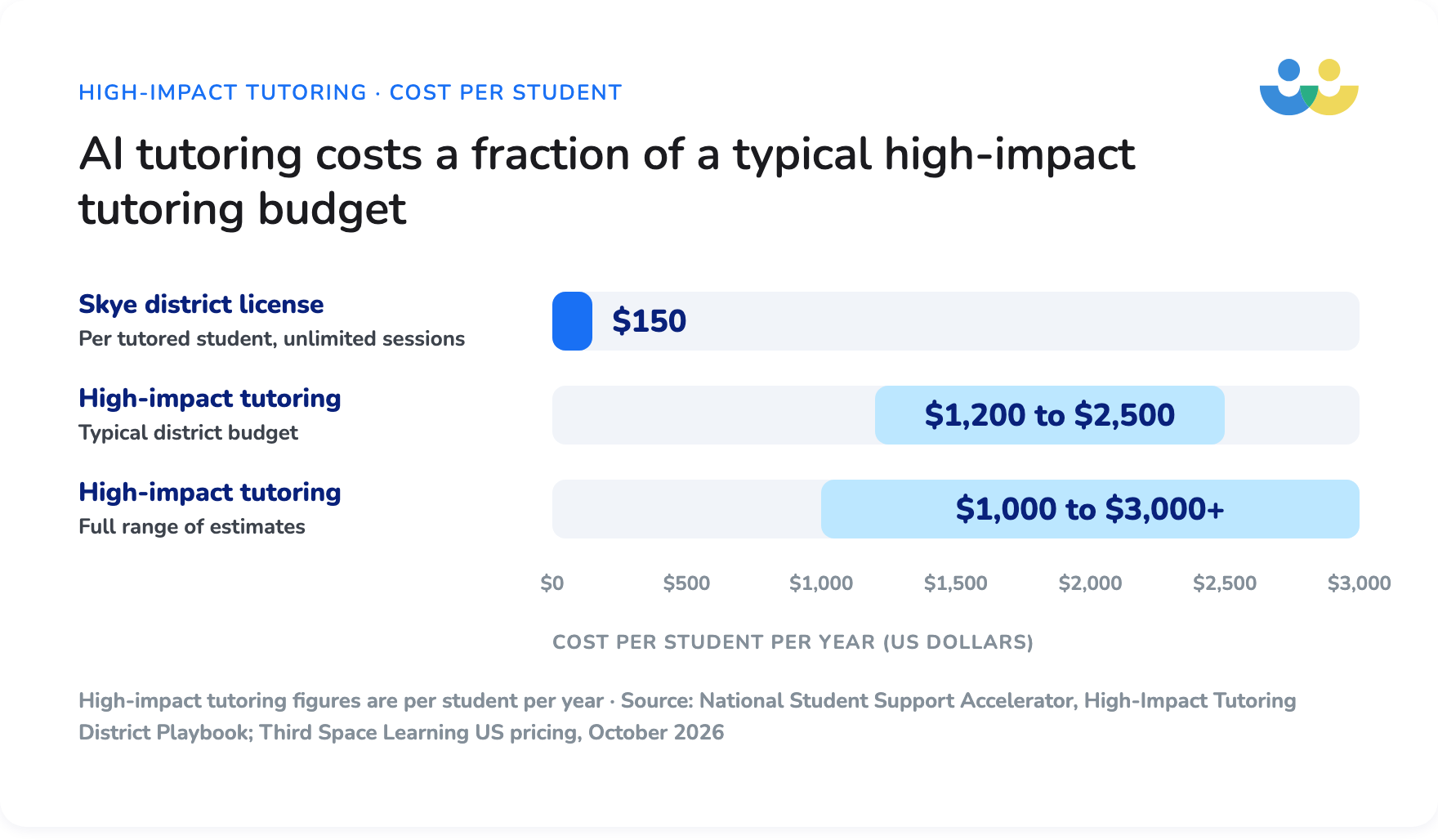
Most US districts judge tutoring against the National Student Support Accelerator’s standards for high-impact tutoring: at least three sessions a week, of at least 30 minutes for younger students, aligned to what students are learning in class and guided by data. The Accelerator’s district playbook puts high-impact tutoring programs at $1,000 to over $3,000 per student a year, mostly because of tutor time. An AI tutor can deliver that dosage to far more students for less, as long as it teaches to your standards, a staff member oversees sessions and the session data reaches teachers. Skye is designed for three 30-minute sessions a week.
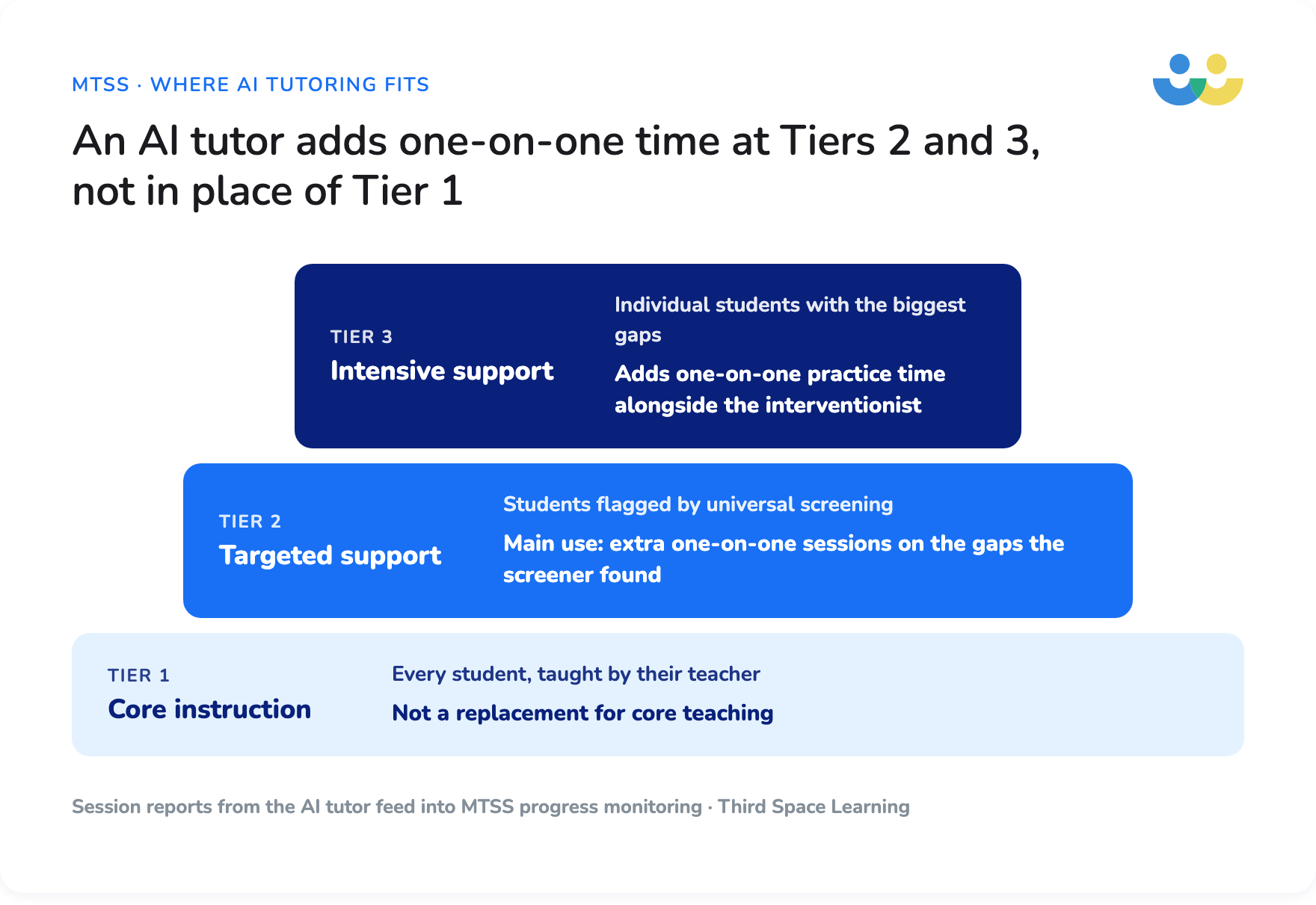
Within MTSS, an AI tutor sits alongside core Tier 1 instruction, not in place of it. Most schools use it as a Tier 2 intervention for students flagged by universal screening, or to add one-on-one time to Tier 3 support, while interventionists keep the small-group and intensive work that needs a person. Session reports then feed into progress monitoring, the same way any MTSS intervention should.
Why Skye is our pick for school math intervention
Skye is our own AI tutor, so we have placed it in the one segment it genuinely serves: schools running one-on-one math intervention. Here is how Skye holds up against the key features above.
Built and checked by teachers
Qualified teachers write and review every Skye lesson, drawing on the pedagogy behind more than a decade of Third Space Learning’s one-on-one tutoring. Skye never invents its own questions. Schools choose which students take part and can reorder topics to match what classes are covering, without writing anything.
Skye teaches rather than answers: each lesson opens with a diagnostic Skill Check-In that sets the student’s route, adapts as they work (a hint after one wrong answer, clearer scaffolding after two, a fully worked model after three), and closes with a Skill Check-Out so the teacher can see what stuck.
Because Skye is spoken rather than text-based, students reason out loud. The supervising teacher can hear their thinking, which supports the kind of math talk that builds a deeper understanding of math.
Evidence of impact
In an independent evaluation by Educate Ventures Research across 9,320 student sessions, students more than doubled their correct answers after a single lesson with Skye, from 30% to 70%, beating the human tutoring benchmark of 66%. Educate notes they are not yet estimating standardized attainment impact; that would require a controlled design.
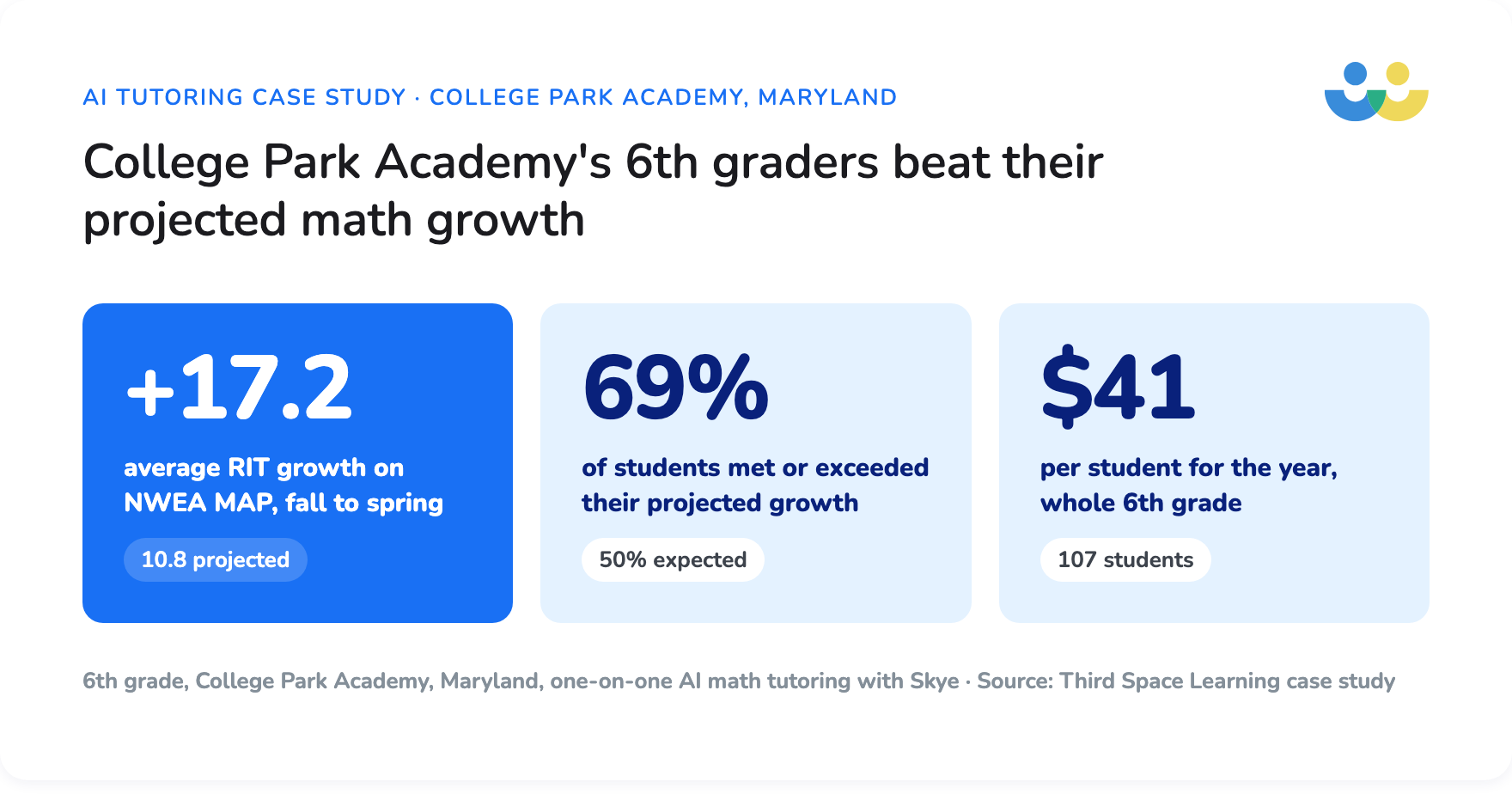
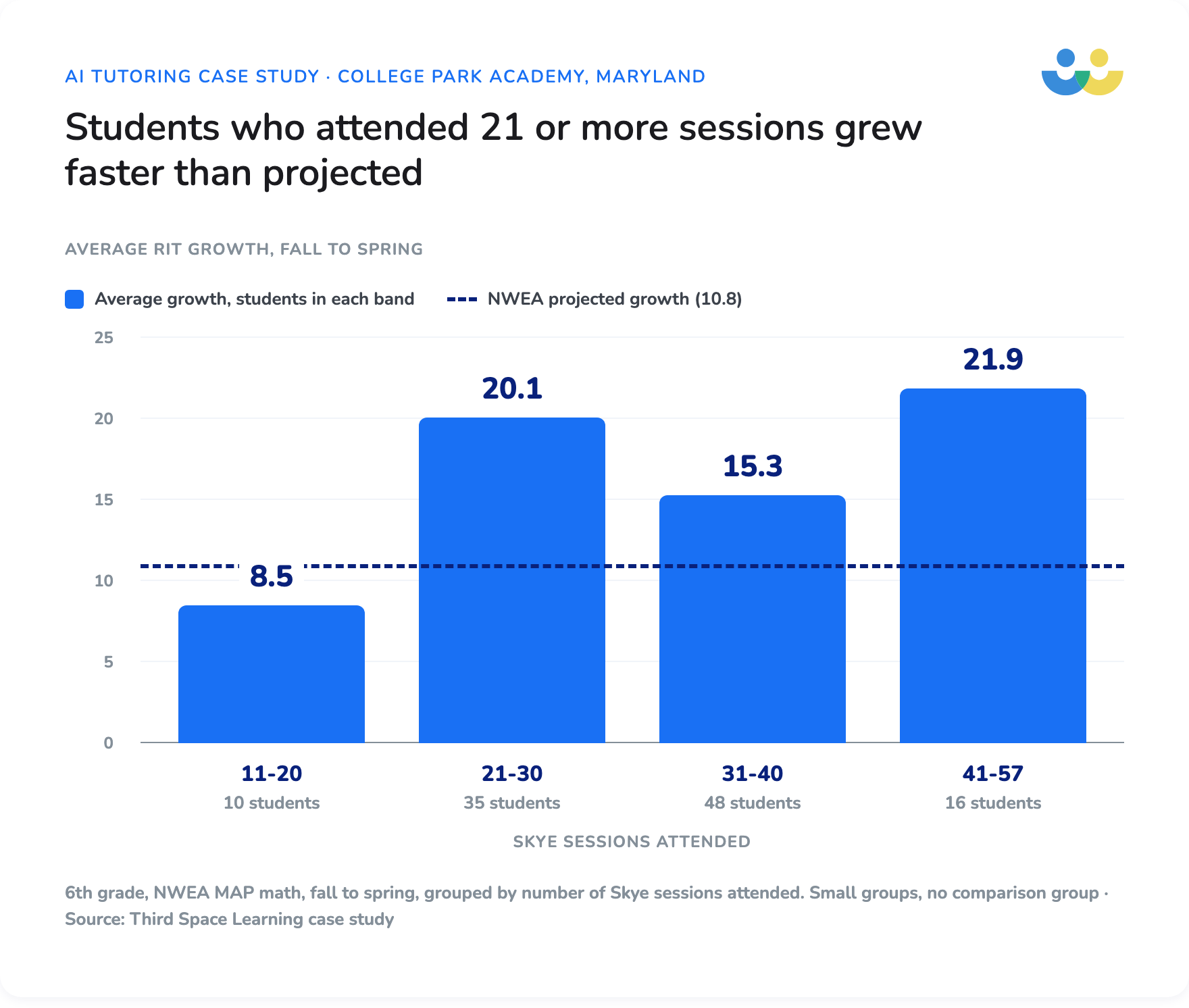
In the US, College Park Academy in Maryland gave its whole 6th grade, 107 students, one-on-one math tutoring with Skye for $41 a student for the year. On the NWEA MAP test, students grew by an average of 17.2 RIT points from fall to spring, against the 10.8 points projected, and 69% met or exceeded their projected growth, where 50% would be expected.
Third Space Learning is also in a two-year research partnership with Stanford University and Cornell University, funded by the Gates Foundation, studying how AI tutoring compares with human high-dosage tutoring.
Student safety and data
Skye is built for schools and designed to meet US student privacy expectations, with FERPA and COPPA compliance and a signed data privacy agreement, and student data is never sold, used for advertising or used to train third-party AI models. Sessions are supervised by school staff, recorded and transcribed, and anything that raises a concern is flagged for review. Skye uses Clever SSO and rostering, and Third Space Learning can sign the SDPC National Data Privacy Agreement or your district’s own data privacy agreement.
Cost
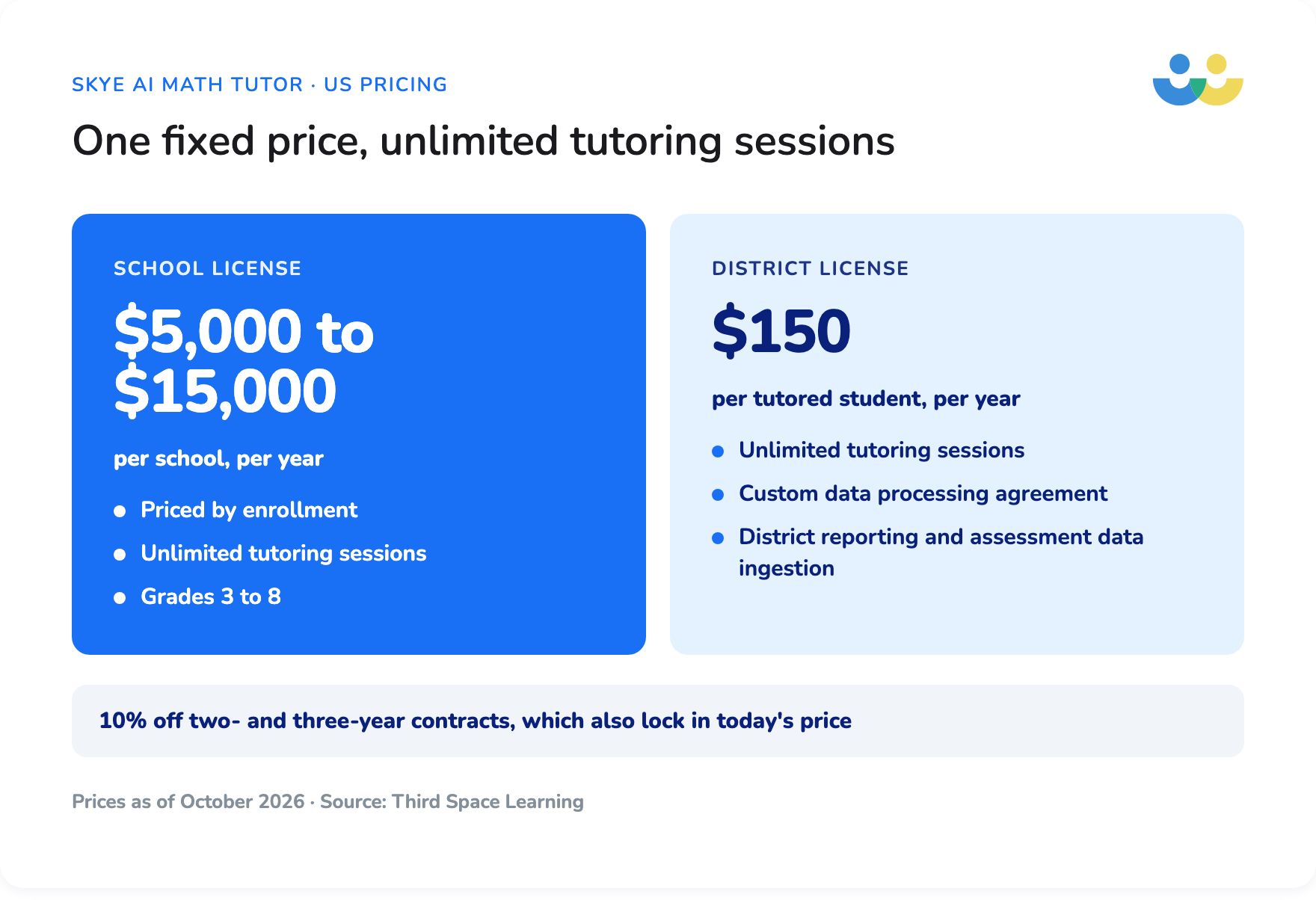
Skye is one fixed annual price for the whole school, from $5,000 to $15,000 depending on enrollment, covering unlimited tutoring sessions, rather than a per-session charge. Districts can choose a district license at $150 per tutored student per year.
“With Skye, students have to take the time. They have to listen, work with Skye, and understand what was wrong, why it was wrong, and how to fix it before moving on.”
Kathy Garcia, Principal at Moffat PK-12 in Colorado
Where Skye is not the right choice: Skye covers math only, so if you need a multi-subject AI tutor, a reading tutor, a language learning app or a homework helper, one of the AI tutors above will serve you better.
Best AI tutors at a glance
The comparison keeps to what schools weigh up.
| AI tutor | Best for | Subjects | Spoken or text | Student data privacy | Starting price |
|---|---|---|---|---|---|
| Skye (Third Space Learning) | One-on-one math intervention in schools | Math (grades 3-8) | Spoken | Built for US schools: FERPA, COPPA, signed data privacy agreement, supervised and recorded | $5,000 a year per school (unlimited sessions); districts $150 per student |
| Khanmigo | Multi-subject Socratic tutoring | Many | Text | District accounts handled under FERPA; data not used to train AI | Free for teachers; families $4 a month; districts by quote |
| MATHia | Adaptive math practice | Math (grades 6-12) | Text | Student Privacy Pledge signatory | By quote |
| DreamBox Math | Adaptive math practice | Math (K-8) | Text and visual | Check with vendor | By quote |
| Amira | Reading | Reading (PreK-8) | Spoken | FERPA and COPPA; school-created accounts | By quote |
| SchoolAI | Teacher-built AI activities | Many | Text | FERPA, COPPA, SOC 2 Type II | Free to try; paid plans by quote |
| Photomath | Math homework help | Math | Text and camera | Consumer app | Free; paid Plus tier |
| Brainly | Quick homework answers | Many | Text | Consumer app; 13+ | Free; paid plans |
| Duolingo Max | Language learning | Languages | Text and audio | Consumer app | Paid subscription |
| Tutor.com | Hybrid human and AI | Many | Text and voice | Check with vendor | By quote |
| Gemini Notebook | Studying your own materials | Many | Text and audio | Google Workspace for Education | Free with Google Workspace for Education |
| ChatGPT Study Mode / Gemini Guided Learning | General help in a learning mode | Many | Text and voice | ChatGPT 13+; Gemini via Workspace for Education | Free tiers |
| Tutor AI | Round-the-clock support | Many | Text | Consumer app; check for school use | Free; paid from $13.33 a month |
AI tutor FAQs
It depends on the job. For one-on-one math intervention aligned to grade-level standards, a spoken AI tutor such as Third Space Learning’s Skye is built for that. For reading Amira, and for language learning, Duolingo. Decide on your learning goals, subject and grade level first, then choose the tool that matches.
The cost of an AI tutor varies widely. Some AI tutors have a free tier or are free for teachers, such as Khanmigo, and school platforms may charge per student. Skye works differently, with one fixed annual price for the whole school, from $5,000 to $15,000 depending on enrollment, covering unlimited sessions. Most districts pay for AI tutoring from Title I, state tutoring grants or the general fund, and there are more ways to fund math interventions now that ESSER has ended.
For language learning, Duolingo Max is the best-known AI tutor, with gamified lessons that let language learners practice pronunciation and speaking and build new skills at their own pace. Other AI-powered language apps create real-life conversation scenarios for practice. These are separate from the math and multi-subject AI tutors covered above.
Used well, yes. In a RAND randomized trial across 147 schools, students using Carnegie Learning’s adaptive math program nearly doubled their growth in test scores in the second year, and an AI tutor lets schools give one-on-one support to far more students than a traditional tutoring budget allows. The value depends on choosing an AI tutor that teaches rather than just answers, and that fits your standards.
Disclosure and update note
Published by Third Space Learning, which makes Skye, an AI math tutor. We have placed Skye in the one segment it serves, school math intervention, and linked competitors with followed links. Last reviewed: October 2026.
Do you have students who need extra support in math?
Skye – our AI math tutor built by experienced teachers – provides students with personalized one-on-one, spoken instruction that helps them master concepts, close skill gaps, and gain confidence.
Since 2013, we’ve delivered 2,295,000 math tutoring sessions to 196,000 students, guiding them toward higher math achievement.
Discover how our AI math tutoring can boost student success, or see how our math programs can support your school’s goals:
– 3rd grade tutoring
– 4th grade tutoring
– 5th grade tutoring
– 6th grade tutoring
– 7th grade tutoring
– 8th grade tutoring