



Curriculum And Assessment Review, Report and Response: How To Prepare Your School For Curriculum Change

In November 2025, having published an interim report in March 2025, the Curriculum and Assessment Review (CAR), headed up by Professor Becky Francis CBE, published its final report. The government response to the recommendations was shared hours later. Here we reflect on the findings of the CAR and the curriculum changes agreed by the government and recommend a structure and approach for your own curriculum planning over the next few years.
Key takeaways: TL;DR
- The independent Curriculum and Assessment Review led by Professor Becky Francis CBE, and the government’s response, represent the biggest changes to our national curriculum and assessment system since 2013.
- A new curriculum will be published in spring 2027, for first teaching from September 2028.
- Primary schools can expect revised writing expectations, updated SATs, new maths sequencing, and additional curriculum content aimed at preparing pupils for today’s world.
- For secondary schools, Year 8 diagnostic tests, a redesigned KS3, changes to GCSEs, and potential expansion of vocational qualifications are on the way.
- In maths, expect a full resequencing of Key Stages 1–3 content, Year 8 progress checks, revised SATs, and shorter GCSE exam papers from 2029.
The Curriculum and Assessment Review, and the government’s response
Last November, having published an interim report in March, the Curriculum and Assessment Review (CAR), headed up by Professor Becky Francis CBE, published its final report. The government response to the recommendations was shared hours later. In her foreword, Bridget Phillipson, Secretary of State for Education, thanked the expert panel for bringing us closer to the “precious goal” of igniting curiosity, nurturing talents and growing a love of learning that will carry all pupils through school and on into rich and fulfilling lives.
Although the review says “Young people in England perform relatively strongly in Maths relative to other jurisdictions”, the response points out that “26% of children do not meet the expected standard in maths at key stage 2” (KS2 attainment data 2024/25) and that “31% did not achieve level 2 by age 16” (DfE (2025) – Attainment by characteristics based on 2018/19 cohort), highlighting the importance of further work in maths.
Read more: GCSE grade boundaries
And that’s just in maths. There are plenty of other potential changes in the pipeline that schools will eventually have to respond to. Although the CAR report is made up of recommendations for the DfE, their response gives us a glimpse into changes that almost certainly will be coming our way. Even though those changes may seem distant, there are things schools can do to be ready.
This article provides a shared overview of what the review and DfE response commit to, then splits into clear action plans: first for primary schools, then for secondary settings.

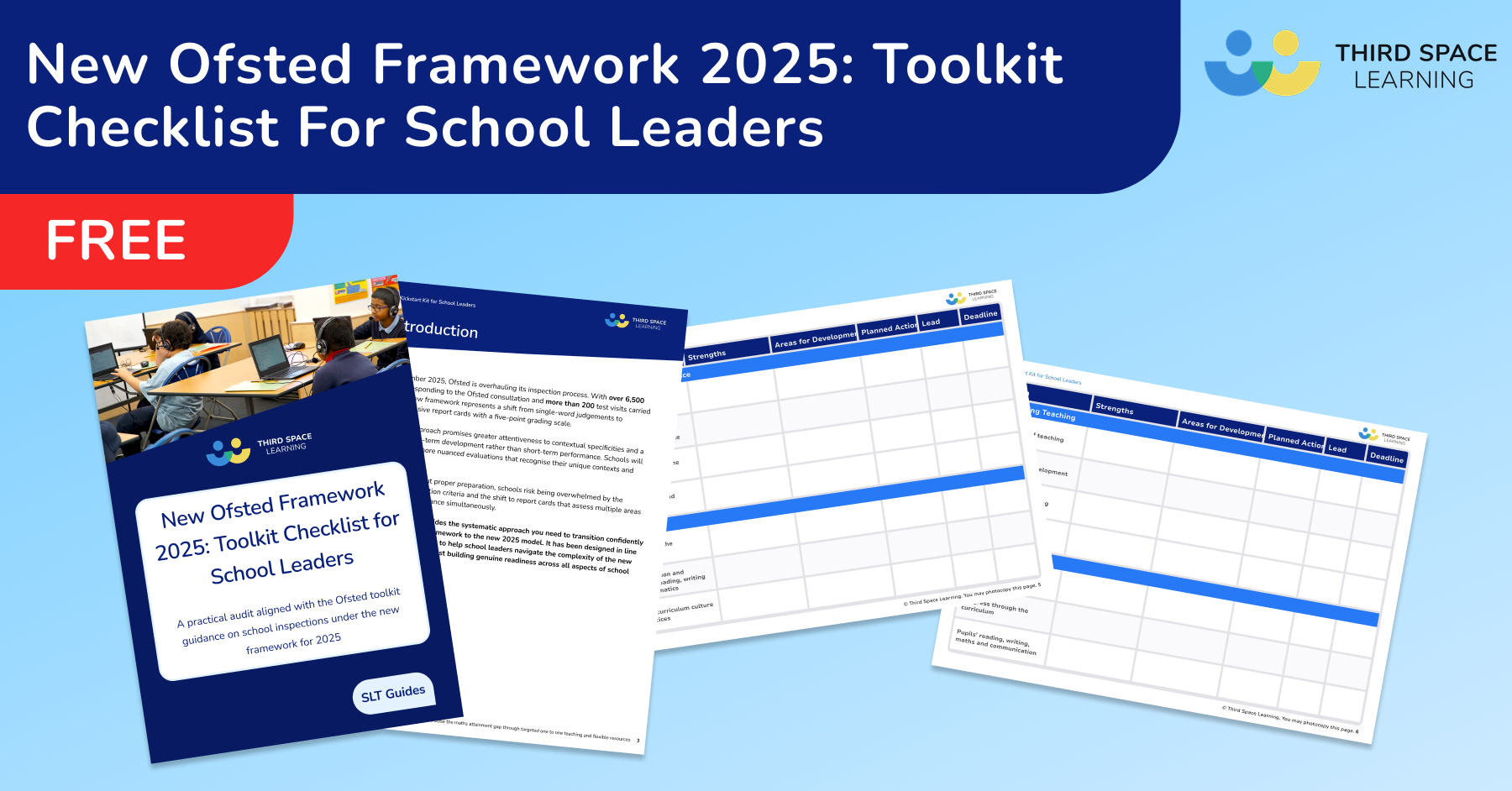
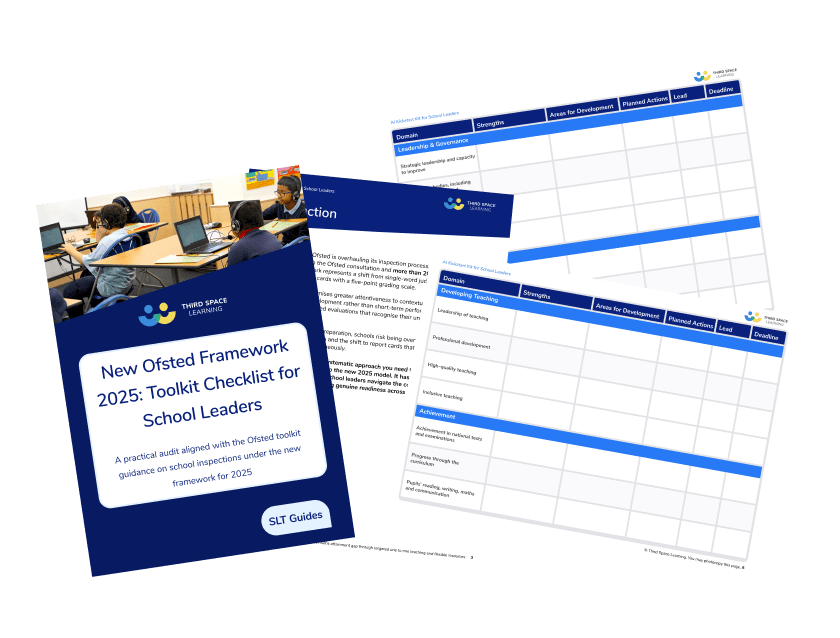
New Ofsted Framework 2025: Toolkit
A practical audit aligned with the Ofsted toolkit guidance on school inspections under the new framework. Use the checklist to assess school readiness.
Download Free Now!What’s changing in the new curriculum
With the mantra of ‘evolution not revolution’, the government plans to publish a revised national curriculum in spring 2027, for first teaching from September 2028. This updated curriculum will be a fully digital product, deliberately structured to make visible the progressions and links across key stages and across subjects. The aim is to give schools clarity and coherence – something long advocated in discussions about curriculum drivers and the need for a clear backbone for all subjects.
Current assessment arrangements will also be reworked. The existing EBacc accountability measure will be scrapped, with a new approach designed to be broader, more inclusive, and representative of a “world-leading curriculum for all”.
Literacy and oracy
Literacy provision will be revised: a new framework for oracy, reading, and writing is to replace or complement existing literacy approaches.
Computing and digital education
Computing and digital education are due for an upgrade: the narrow Computer Science GCSE will be replaced with a broader, future-facing Computing GCSE. The government intends to explore a post-16 qualification in data science and AI, supporting pupils in both academic and vocational subjects.
Financial and media literacy
The curriculum review also emphasises embedding digital literacy, media literacy, financial literacy, and citizenship education across schooling, often from primary onwards. This reflects an understanding that children and young people need skills and understanding to participate effectively in modern society.
Climate Change and Sustainability
The CAR report prioritizes climate education within Geography, Science, and D&T. Headteachers should prepare for a new statutory requirement in primary Citizenship to cover sustainability, ensuring students understand environmental challenges and green-economy opportunities from an early age.
Religious Education (RE)
The Review recommends moving Religious Education into the national curriculum to address inconsistent provision. While a sector-led group co-creates a new draft curriculum, schools should note the proposed removal of the statutory requirement for RE in sixth forms.
Science Qualifications (Triple Science)
The report introduces a statutory “student entitlement” to Triple Science to remove socio-economic barriers to STEM careers. Headteachers must plan for this gradual implementation, ensuring any student wishing to study separate sciences has the opportunity
Additional subject-specific changes
Minor changes are suggested for many specific subjects, with a view to bringing greater clarity to the national curriculum. The review proposes a stronger focus on streamlining content so that subject syllabuses are sufficiently specific, better balanced and more manageable for staff and students.
These suggested changes aim to sharpen what is taught in core and foundation subjects, clarify statutory versus optional elements, and reduce unnecessary complexity. Crucially, the response commits to support teachers through adaptive teaching guidance and new resources.
Assessment changes
The government plans to modestly reduce assessment burden: GCSE exam time will fall by approximately 2.5–3 hours on average (compared to the proposed 10%+ reduction) while maintaining rigour and high standards.
For post-16 pupils, including students needing resits, there is a commitment to improved support, offering more flexible vocational qualifications and alternative pathways such as T Levels, V Levels, and other vocational pathways beyond traditional academic routes.
SEND and inclusion
Although not a change per se, there is a commitment to support teachers in the hard work they are already doing to ensure that curricula reflect diversity and support students with special educational needs and disabilities (SEND), ensuring every learner can access ambitious knowledge and make strong progress. The review argues that clearer curriculum design, sufficient time and well-planned pathways can help reduce long-standing attainment gaps, while the government response reinforces that a broad, high-quality curriculum must stretch all pupils and be supported by adaptive teaching and early intervention.
What’s staying the same for the new curriculum
- The fundamental structure of the system stays intact, keeping the breadth of subjects and the holistic ethos of primary education that many schools value.
- Key stages remain as they are, providing a familiar rhythm to schooling and a stable framework within which school staff can plan for progression.
- Schools keep the flexibility to move beyond national curriculum requirements, protecting the professional freedom that enables leaders and teachers to shape learning for their communities.
- Core national assessments stay in place, including the Phonics Screening Check, the Multiplication Tables Check and Key Stage 2 assessments with teacher-assessed writing.
- The government confirms that subjects, key stages, assessments and qualifications will continue, offering stability while allowing minor refinements aimed at better alignment with curriculum intentions.
Which recommendations were not adopted by government
Several recommendations from the Francis Review were not accepted:
- While the review advised keeping Progress 8 and Attainment 8 largely as they are, the government has committed to redesigning the accountability system.
- The review suggested a phased introduction of the refreshed curriculum, yet the government opted for a single nationwide launch in 2028.
- The review proposed removing or significantly reworking the KS2 SPaG test, but this was retained with only minor refinements.
- The review encouraged caution around expanding non-exam assessments, whereas the government has allowed flexibility for their use where appropriate.
Implications for maths across primary and secondary
As so many of the readers of this blog are maths teachers and leaders, here we look at specific implications of the curriculum review for maths.
Early years maths in the curriculum
The review makes it clear that the earliest mathematics children encounter really matters, and the implication is that schools must continue to invest time and expertise in those foundations. Number sense, early calculation and pattern-spotting remain central, but the message is not about pushing content earlier – it is about strengthening high-quality, play-based mathematical experience.
With the government emphasising diagnostic and formative assessment, particularly for children with SEND, the expectation is that early-years teams will need sharper insight into what children understand, not more testing.
KS1 maths in the curriculum
Key Stage 1 continues the steady building work begun in Early Years. The review implies that schools should double down on the essentials: number, calculation and measurement. With assessments staying largely formative and teacher-led, the message is that teachers’ professional judgement remains central.
Digital curriculum resources will grow in prominence, meaning schools will need to decide how these tools support rather than replace pedagogical thinking. The Standards and Testing Agency are to be tasked with exploring ways to improve participation in optional key stage 1 tests.
KS2 maths in the curriculum
In Key Stage 2, the implications are about coherence and clarity. Strengthened national guidance and updated resources indicate that schools will need to revisit their schemes of work, checking that concepts build in a sensible and connected way towards the demands of Key Stage 3.
The focus on number sense, reasoning and problem-solving confirms that mathematical thinking is still at the heart of the curriculum. Statutory tests, remain with minor refinements, so the priority for schools is not adapting to new KS2 SATs maths tests but refining curriculum sequencing and teaching approaches.
KS3 maths in the curriculum
For Key Stage 3, the review acknowledges what schools already know: transition from Year 6 maths into Year 7 maths is a persistent weak point. The implication is that KS3 maths teachers will need a clearer window into KS2 learning and that departments may need to rethink their Year 7 and Year 8 maths offer.
The expansion of the Securing Foundations programme, increased professional development and more diagnostic assessment all point towards an agenda of early clarity about gaps and next steps.
The emphasis on small-group work and targeted intervention for students below age-related expectations or with SEND means schools will need robust systems to provide support without lowering expectations.
GCSE maths and post-16
At GCSE, stability is the message. Schools should continue to refine rather than overhaul their existing provision. Exams remain the primary mode of assessment, although slightly streamlined, and the core body of GCSE maths content – including algebra, number, geometry and statistics – remains consistent.
Post-16, the implications broaden: stepped qualifications at Level 1, strengthened support for learners without a grade 4, and a growing landscape of T Levels, V Levels and potential data science or AI-related courses mean schools and colleges will need to consider how their offer serves all learners.
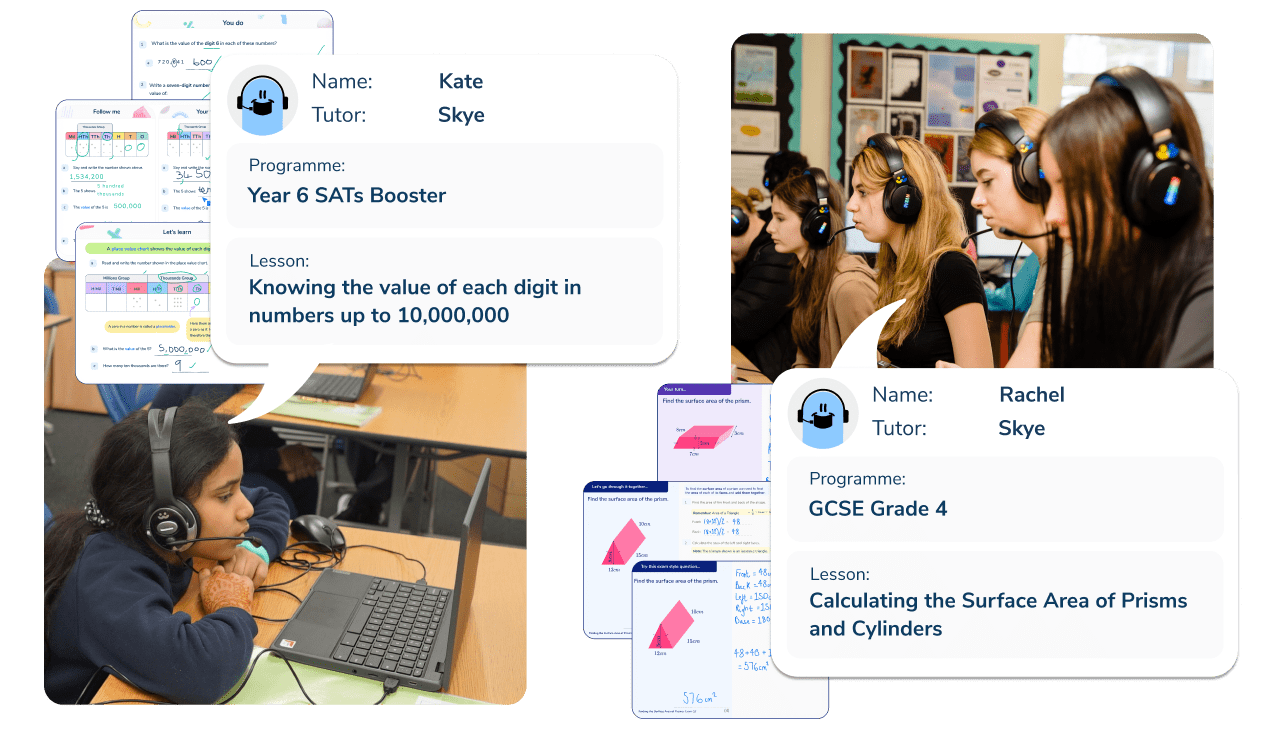
Meet Skye, the voice-based AI tutor making maths success possible for every student.
Built by teachers and maths experts, Skye uses the same pedagogy, curriculum and lesson structure as our traditional tutoring.
But, with more flexibility and a lower cost, schools can scale online maths tutoring to support every student who needs it.
Watch Skye in actionIntervention strategies
Now we have the direction of travel for the curriculum priorities from the government response. Time spent thinking about your intervention strategies now will not be wasted.
Given the emphasis on Year 8 diagnostics, KS2–KS3 transition, and the persistent attainment gap in maths, it’s worth focusing on what effective maths intervention looks like across both phases.
Primary intervention strategy
- Prioritise early identification (Y2–Y4) for number fluency and conceptual gaps
- Use short, frequent diagnostic tests that feed directly into group interventions
- Plan a transparent KS1–KS2 intervention map (who delivers what, how often)
- Ensure interventions address conceptual misunderstanding, not just procedures
- Prepare targeted Year 6 reasoning-led interventions ahead of revised SATs
- Strengthen communication with secondaries so interventions don’t “reset” at KS3
Secondary intervention strategy
- Build a structured Y7–Y8 intervention model aligned to Year 8 diagnostic test expectations
- Choose diagnostic tools that provide sub-domain insights (ratio, algebra foundations, fractions, etc.)
- Establish scalable models: small-group, maths tutoring or blended support
- Build intervention timetables around peak diagnostic windows (autumn/spring Y8)
- Use KS2 question-level data to pre-identify pupils needing immediate Y7 support
- Align interventions with GCSE changes and formula requirements
Scaling one-to-one interventions
One consistent challenge across both phases is scaling one-to-one support. The EEF evidence is clear that individual tutoring has significant impact, but traditional models are difficult to resource – particularly when you’re trying to reach every pupil who needs it, not just a small cohort.
This is where AI maths tutoring can play a role. Third Space Learning’s Skye, for example, delivers structured, curriculum-aligned one-to-one sessions that schools can schedule during the school day without the staffing constraints of traditional tutoring. For schools preparing for Year 8 diagnostic expectations or looking to strengthen KS2 intervention capacity, it offers a way to provide consistent, high-quality support at scale and for a very low cost.
Feedback from unions and subject bodies
Unions such as National Education Union (NEU) and NASUWT praised the review for proposing a curriculum with more breadth, better representation of arts and creative subjects, and a reduced focus on rote learning. However, they warned that the retention of statutory tests and exam-only assessments means many schools will continue to “teach to the test”, limiting genuine curriculum breadth and risking overload.
Meanwhile, unions representing leaders and support staff flagged serious concerns over whether schools will have the specialist staff, resources and time to deliver the proposed changes without reducing quality or increasing teacher workload.
Subject associations, such as the Joint Mathematical Council, welcomed the emphasis on the significance of mathematics for everyday life but noted the absence of data science integration. Charities such as National Numeracy support modular qualifications but warn against deepening inequalities.
New curriculum: a timeline
| Date | Milestone |
|---|---|
| Spring 2027 | New national curriculum (digital product) published; assessment consultation opens; schools begin familiarisation. |
| September 2028 | First teaching across KS1–KS3 |
| September 2029 | Phase 1 GCSE first teaching |
| Summer 2030 | Phase 2 GCSE first teaching |
| Summer 2031 | First exams for Phase 1 GCSEs |
| Summer 2032 | First exams for Phase 2 GCSEs |
How should schools start tackling the curriculum and assessment changes
First and foremost, it is crucial that school leaders do not panic or do anything designed entirely to try to get ahead. As time goes by we will learn more about what things will look like when changes begin to be implemented. With the promise of support and resources, there is no need to reinvent the wheel before it has even been created.
The priority for school leaders is, as ever, to ensure that the needs of the pupils are being met. Meaningful curriculum development work and measures to support teachers will support this goal.
However, that is not to say that preparations can’t be made and a degree of readiness achieved. A greater focus on developing some of the intended improvement areas could lead to a smoother transition in September 2028, although schools must be ready to make final adjustments upon the publication of the revised national curriculum in spring 2027.
Any work done in the interim period should meet the needs of pupils in the here and now, even where it is an attempt to align with coming changes. Schools must be aware that any such development may be subject to further change.
In seeking the views of many teachers and leaders, the review’s recommendations reflect the concerns of a proactive profession. Some schools will already have identified the needs that the CAR picked up on and will be addressing them.
Step-by-step preparation plan
The following plan helps leaders build the habits and systems for curriculum change management – the transferable leadership skills that will matter regardless of what the final curriculum contains.
Now – Summer 2026
The timeline of the forthcoming curriculum changes gives school leaders the perfect chance to take their time to get prepared.
Research suggests that there are clear steps to take before any changes are implemented in a school and this applies to your implementation of the new curriculum in spring 2027.
The main thrust of any preparation between now and summer 2026 should be towards adopting the behaviours that drive effective implementation. The people – leaders and teachers predominantly – who will be involved in the eventual implementation need to be engaged and united, and together they need to reflect on the school’s current situation.
Focus engagement on ensuring that everyone knows the nature of the changes coming and when they are likely to happen. Reassure staff that their experience and opinions are valuable and that they will be involved in implementing the change.
This stage is the perfect opportunity to promote discussion around concerns that teachers might have about forthcoming change.
How to engage staff in readiness for future change
- Share clear, high-level information early – communicate what is known about the forthcoming changes, the anticipated timeline, and what is still uncertain, so staff feel informed rather than unsettled.
- Create structured opportunities for dialogue – use staff meetings, briefings or surveys to invite questions, surface concerns, and encourage open discussion.
- Acknowledge emotions and uncertainty – explicitly recognise that change can feel challenging, and validate staff concerns to build trust and psychological safety.
- Reinforce collective purpose – connect the upcoming changes to shared values around pupil outcomes, professional growth and school improvement.
- Signal genuine collaboration – make it clear that staff expertise will shape future decisions, and outline how teachers will be involved in reviewing, planning and trialling new approaches.
Lines of enquiry for pre-implementation reflection
- What are the key strengths of our current curriculum, and which aspects are most closely aligned with the direction of the proposed changes?
- Where do pupils currently thrive, and where do outcomes, engagement or inclusion suggest that curriculum adjustments may be most needed?
- How confident and consistent is teaching practice across the school, and what professional development needs are already apparent?
- What systems, structures or routines are currently supporting effective implementation, and where do these need strengthening?
- What potential barriers (time, workload, expertise, resources) might hinder future curriculum change, and what existing enablers can we build upon?
Monitoring and evaluation activities
- Review existing curriculum documentation, schemes of work and assessment materials to evaluate coherence, progression and alignment with pupil needs.
- Analyse pupil outcome data alongside attendance, behaviour and inclusion indicators to identify patterns, strengths and areas requiring attention.
- Conduct lesson visits, learning walks or work scrutinies with a clear focus on curriculum intent, implementation and classroom practice.
- Gather staff voice through surveys, focus groups or structured conversations to understand confidence levels, perceived barriers and professional development needs.
- Map current systems, routines and resources to assess readiness for change and identify where capacity can be built ahead of implementation.
Summer 2026 – Spring 2027
The focus during this period is still not yet on designing or rewriting curriculum content, but on ensuring that the school’s context, systems and people are ready to support change well.
Implementation is ultimately carried by people. During this phase, leaders should focus on ensuring that the right people are in position to lead on implementing the change and that these people are suitably trained.
Building implementation capacity
This might involve:
- Clarifying roles related to implementation – identifying subject leaders, senior leaders, implementation leads or working groups who will carry responsibility at different stages.
- Building implementation expertise – providing development for those leading or supporting change, such as training in facilitation, curriculum design, or evidence-informed practice.
- Creating agency and ownership – ensuring that those involved feel empowered to shape decisions within their remit, rather than simply deliver predetermined plans.
- Drawing on diverse perspectives – including early adopters, support staff and, where appropriate, pupil voice to broaden insight and strengthen buy-in.
A CPD plan for curriculum readiness
To ensure leaders are ready, you could design a bespoke CPD plan following these steps:
Step 1: Build shared understanding of curriculum and implementation
Focus on developing a common understanding of high-quality curriculum principles – coherence, progression and inclusion – alongside the behaviours that support effective implementation.
Step 2: Clarify roles and responsibilities
Leaders should clarify how existing roles contribute to curriculum thinking, decision-making and implementation support. Focus on developing agency and how to generate staff buy-in.
Step 3: Develop curriculum design knowledge
Professional development should strengthen understanding of curriculum principles and allow leaders to put this knowledge into practice using current curriculum materials as case studies.
Step 4: Build skills for leading collaborative curriculum work
Train leaders to facilitate productive curriculum conversations and structured collaborative meetings that build shared understanding and collective ownership.
Step 5: Embed coaching and peer support
Introduce coaching and peer-support structures to help leaders reflect, share challenges and adapt their approaches.
Step 6: Review readiness for curriculum publication
Evaluate leadership capacity, curriculum knowledge and supporting systems ahead of the new curriculum to identify final adjustments needed.
Spring 2027 – Autumn 2028
If you’ve put the groundwork in place earlier in the timeline, the publication of the new national curriculum curriculum for England in Spring 2027, should not cause additional stress.
The identified leaders and their working groups can then follow this pattern to ensure that the school is ready ready to make a real success of the new, refreshed curriculum:
Step 1: Establish shared clarity on purpose and direction
Begin by developing a shared understanding of why curriculum and assessment changes are taking place and what problems they are intended to address. Focus on the key messages from the new curriculum and exam reforms, clarifying the intended outcomes for pupils.
Step 2: Collaboratively plan how curriculum change will be implemented
Share implementation plans and seek input from teachers. Treat these plans as living documents, revisiting and refining them as curriculum redesign unfolds.
Step 3: Provide high-quality professional development
Design professional development using evidence-informed mechanisms: building knowledge, modelling practice, rehearsal, feedback and reflection. Sequence training over time and closely link it to curriculum development work.
Step 4: Design curriculum content aligned with new expectations
Focus on curriculum design that reflects the new national curriculum and assessment requirements. Support teachers to review sequencing, progression and assessment alignment.
Step 5: Monitor and refine curriculum plans
As curriculum changes are made, leaders should review these plans to ensure whole-school coherence. Leaders with curriculum responsibility can act as overseers while respecting subject-specific characteristics.
Step 6: Support staff wellbeing and sustain engagement
Throughout curriculum development and early implementation, maintain good staff wellbeing by sharing responsibility, protecting time for collaboration, setting realistic expectations and removing unnecessary workload.
Inclusion, SEND and curriculum equity
Focusing on meeting the needs of your current pupils is crucial not only for those pupils but for readiness for future changes. By prioritising equity, accessibility and meaningful learning for all – particularly those with SEND or disadvantage – schools can make immediate improvements that will stand them in good stead for the future.
Primary phase
- Audit curriculum to reduce overload and focus on core knowledge and skills for all pupils, especially those with SEND or disadvantage
- Write clear, precise curriculum statements to make learning accessible and predictable
- Make assessment accessible and flexible, using scaffolding and teacher-led methods
- Schedule explicit teaching of vocabulary and procedural knowledge
- Plan lessons using universal design principles
- Make time for enrichment activities which boost social, emotional and physical learning
Secondary phase
- Review subject breadth to maintain arts, humanities, languages, vocational and practical subjects
- Use flexible, mixed-ability teaching and targeted differentiation
- Strengthen formative, teacher-led assessment and feedback
- Embed enrichment and life skills opportunities
- Plan lessons using universal design principles
Inclusion and SEND teams
- Ensure SEND is central to leadership and planning, with whole-staff understanding – preferably bringing the SENDCO onto SLT if they aren’t already
- Allocate resources and teaching time first to pupils with SEND or with greatest disadvantage eg in receipt of pupil premium
- Adapt learning environments to remove barriers
- Make inclusive assessment, monitoring and feedback the baseline
- Provide CPD opportunities centred on universal design and meeting diverse needs efficiently
- Plan for transitions and long-term equity

RELATED RESOURCES
New curriculum FAQs
The new national curriculum will be published in spring 2027 as a fully digital product. First teaching begins in September 2028 for Key Stages 1–3 and Phase 1 GCSEs. Year 8 diagnostic tests will also begin from September 2028.
KS2 SATs will remain in place with minor refinements. The review proposed removing or significantly reworking the SPaG test, but the government chose to retain it. The Phonics Screening Check and Multiplication Tables Check also continue unchanged.
No. The government has adopted an “evolution not revolution” approach. The fundamental structure – key stages, subjects, and the breadth of primary education – stays intact. Changes focus on resequencing content (particularly in maths at KS1–3), adding clarity and coherence, and embedding areas like financial literacy, media literacy, AI literacy, and climate education more explicitly.
Final thoughts
The timeline gives schools a long runway – but that’s not an invitation to wait. The most useful work you can do now is work that serves your current pupils: strengthening intervention strategies, embedding inclusive practice, and building the leadership capacity to manage change well.
None of this requires you to predict the final curriculum. It requires you to get better at the things the review already tells us matter.
When the new curriculum lands in spring 2027, schools that have invested in their people, their processes, and their most vulnerable learners won’t be scrambling. They’ll be ready to adapt.
REFERENCES
- Curriculum and assessment review final report (GOV,uk)
- Government response to the Curriculum and assessment review final report

DO YOU HAVE STUDENTS WHO NEED MORE SUPPORT IN MATHS?
Skye – our AI maths tutor built by teachers – gives students personalised one-to-one lessons that address learning gaps and build confidence.
Since 2013 we’ve taught over 2 million hours of maths lessons to more than 170,000 students to help them become fluent, able mathematicians.
Explore our AI maths tutoring or find out about school tutors for your school.