



Ofsted Report Cards: A Complete Guide for School and College Leaders

Ofsted report cards represent a one of the biggest shifts in how Ofsted evaluates schools. Introduced in November 2025 alongside the new Ofsted Framework, these report cards replace the previous system of single-word grades and assess school performance across 11 key areas from teaching quality to student well-being.
This change addresses longstanding concerns from the education sector about oversimplified judgements. For school leaders, the new framework and report cards means demonstrating evidence of quality provision across multiple dimensions, rather than being defined by a single overall grade.
In this guide, primary SENCO lead, Zoe, explains how Ofsted report cards work, what inspectors will assess, and how your school can prepare for this more nuanced evaluation system.
Why Ofsted is introducing a new system
Ofsted inspections have faced growing scrutiny over their impact on teacher well-being and workload. The tragic death of headteacher Ruth Perry in 2023, where a coroner ruled that an Ofsted inspection contributed to her passing, brought these concerns into sharp national focus and intensified calls for a more compassionate inspection process.
The need for reform was reinforced by concerns raised across the education sector. Chief Executive Sinead McBrearty highlighted workload and well-being as critical priorities, urging Ofsted to reduce the high-stakes accountability that had made inspections a source of anxiety rather than improvement.
His Majesty’s Chief Inspector Sir Martyn Oliver responded with a more collaborative approach. He gathered feedback from parents and education professionals to shape reforms that would raise standards without adding to workload pressures. The result is a framework designed to inspect schools objectively, in the best interests of children and parents, while remaining committed to the needs and well-being of education professionals.
Sir Martyn Oliver, Ofsted chief inspector, stated that the new system will ‘raise standards for all children’ and be ‘better for parents’. However, The National Association of Head Teachers said it remains ‘unsafe, unfair and unsustainable’.

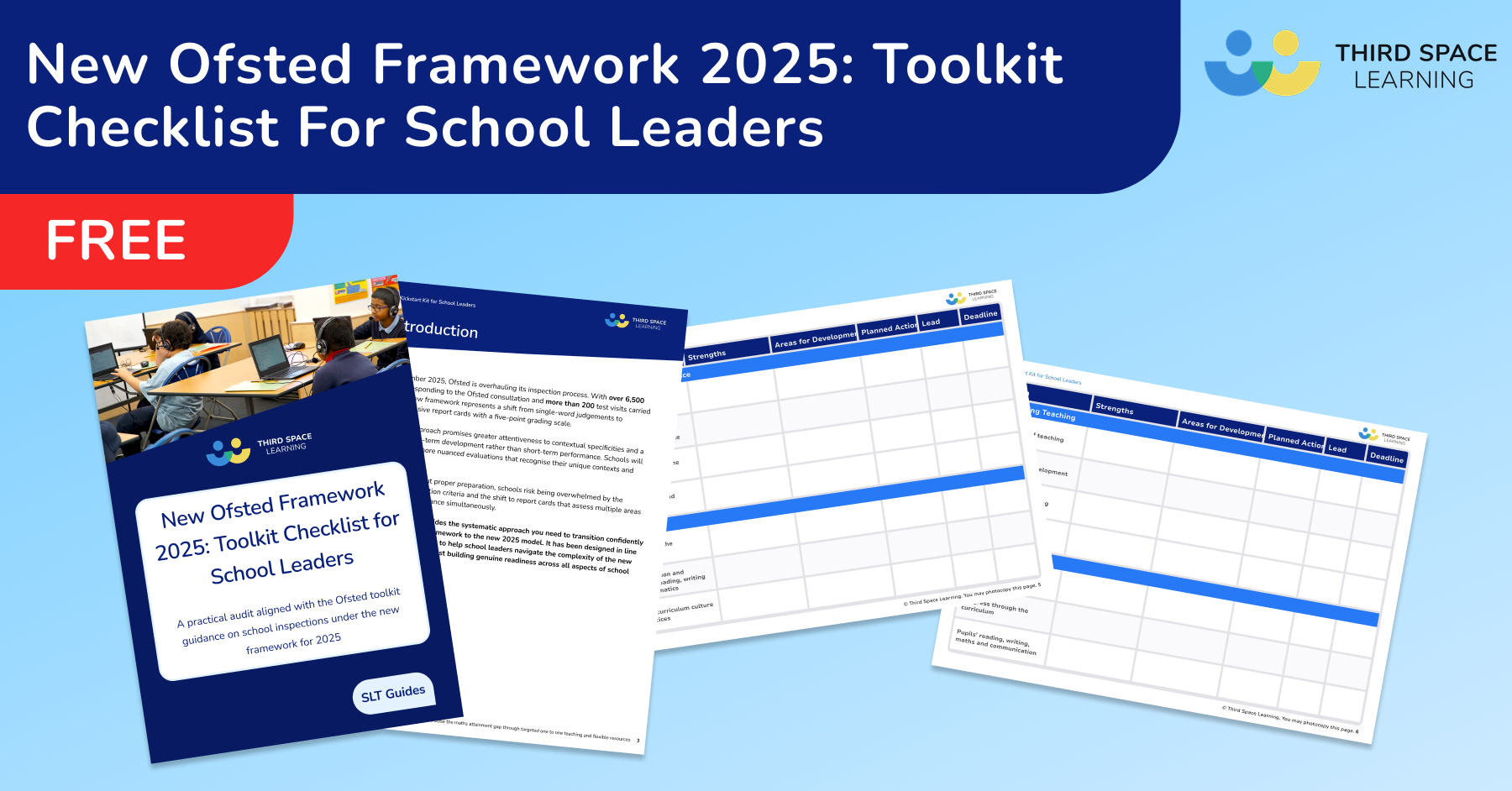
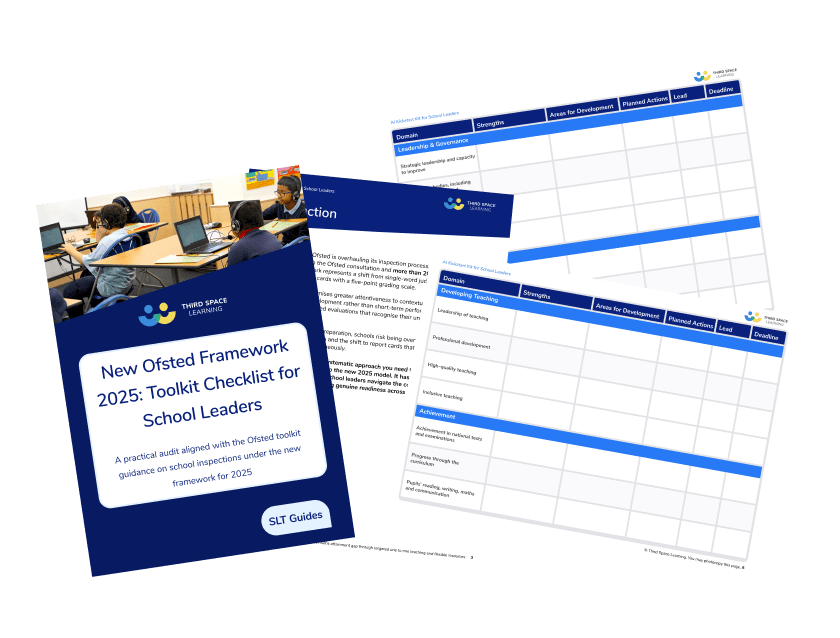
New Ofsted Framework 2025: Toolkit Checklist
A practical audit for school leaders aligned with the Ofsted toolkit guidance on school inspections under the new framework for 2025.
Download Free Now!Key changes to the inspection process
The new framework introduces several practical improvements:
- A five-point grading system to mark schools replaces binary judgements, with ‘Urgent improvement’ identifying critical areas that need immediate action. This targeted approach allows for focused intervention and monitoring where it’s needed most. YouGov polling suggests parents welcome this more detailed grading across various areas of school performance.
- Additional inspector support has been added to inspection teams, with one extra inspector per visit. This allows the lead inspector to spend more time with school leaders, while additional inspector training ensures consistency and raises standards across all inspections.
- Greater transparency runs throughout the process, with clearer explanations of judgements and more detailed ratings reporting to help schools understand their strengths and areas for development.
What the new Ofsted report cards are and why they matter
Ofsted report cards are the central feature of the new Ofsted inspection framework, providing detailed, bullet-pointed summaries that evaluate school performance across 11 key areas. Unlike the previous system’s single-word judgements, these report cards are designed to highlight excellence and give a comprehensive view of provision covering everything from teaching quality and curriculum design to staff well-being and pupil support.
Parents deserve the best possible information, and education professionals deserve to have their work fairly assessed by experts. The new school report cards are intended to be easy to use for schools and helpful to parents, making informed decisions about their child’s education.
The background: why Ofsted changed its approach
The new framework emerged from Ofsted’s ‘Big Listen’ review, which gathered feedback from education professionals across the sector. The consultation revealed widespread concerns about workload pressures, over-reliance on data, and the perception of inspections affecting both school leaders’ and inspection teams’ well-being.
The resulting framework includes:
- Removal of single-word judgements: replaced by detailed report cards
- Emphasis on inclusion: specific evaluation areas ensure that inclusion underpins the entire system
- A more ‘human’ approach: concentrating on the mental health and well-being of headteachers, school leaders, and inspection teams as education professionals deserve
- Clearer standards: providing stability across all state-funded schools
What this means for schools
The shift away from data-driven judgements toward assessing teaching quality, staff well-being, and pupil support aims to give school leaders clarity on what to expect. Parents also benefit from more detailed information about their child’s school and the quality of education in their local area.
However, the shift from a single grade to so many judgements across multiple evaluation areas inevitably brings challenges. Schools must now demonstrate quality across 11 dimensions, requiring strategic preparation and clear evidence of impact in each area.
How report cards present school performance
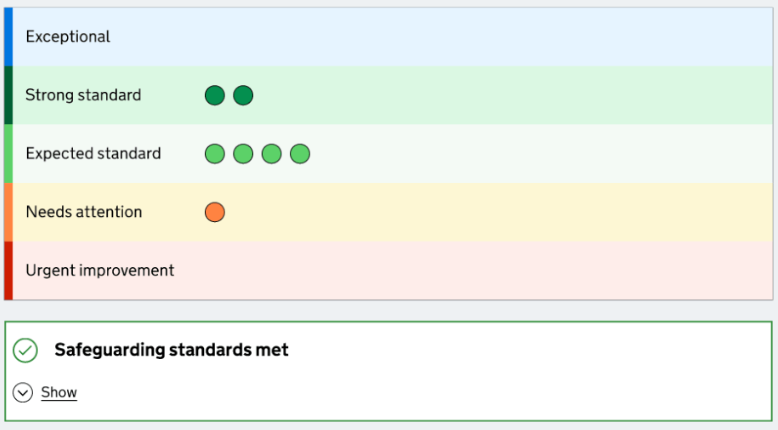
The new report card will be designed to be accessible on both desktop and mobile devices using colour-coded grades to show performance across different aspects of education provision. Each evaluation area receives its own grade, making it immediately clear where a school excels and where development is needed.
The design prioritises transparency and accessibility. Take safeguarding, for example (see fig.1 below): the report card shows at a glance that standards have been met, with a ‘show more’ dropdown providing detailed narrative evidence to support the judgement.
This two-tier structure gives parents a quick overview while offering school leaders and governors access to the substantive detail behind each grade.
(fig.1)
Understanding the five point grading scale
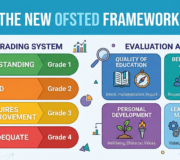
One of the most noticeable changes within the new inspection framework is the removal of the single-word grading system. The inspection teams now have a 5 point grading scale to assess the new evaluation areas as follows:
- Exceptional practice
- Strong
- Expected standard
- Needs attention
- Urgent improvement
The five point grading scale
Grading Scale | 5 point grading scale explained |
Exceptional Practice ( Ofsted report card: blue) | Educational professionals, school leaders and head teachers are providing provision that is among the very best nationally at an exceptional standard that should be shared with other schools to help them improve. Practice has evidently been sustained over time. |
Strong (Ofsted report card: dark green) | Educational professionals, school leaders and head teachers are providing excellent and consistent provision that is making a significant impact on learners. |
Expected standard (Ofsted report card: green) | Educational professionals, school leaders and head teachers are doing everything that they should be doing. The new inspection framework sees this as a high standard and a secure grading. |
Needs attention (Ofsted report card: orange) | Work needs to be done to meet the expected standard. Inspection teams will highlight areas to develop to prevent the setting requiring urgent improvement. |
Urgent improvement (Ofsted report card: red) | The provider is not meeting fundamental standards, particularly concerning safeguarding or overall effectiveness, and schools need to take action to protect children and improve overall quality. |
The expected standard sits at the centre of the five-point grading scale, and this is where Chief Inspector Sir Martyn Oliver predicts most schools will be judged. It forms the foundation for all inspection judgements, with school inspection toolkits built around this benchmark.
These toolkits draw on statutory duties, non-statutory guidance, professional standards, research evidence, and previous inspection findings. They’re designed to provide transparency for school leaders on what inspectors will assess, while giving inspection teams clear, consistent guidance for making judgements across all evaluation areas.
How the new grades compare to the old system
Ofsted emphasises that the five-point scale represents a completely new approach to inspections and reporting. That said, the parallels are difficult to ignore. ‘Urgent improvement’ closely aligns with the previous ‘Inadequate’ judgement, triggering immediate intervention. At the other end, ‘Exceptional’ mirrors the former ‘Outstanding’ grade, recognising schools that go significantly beyond expectations.
The key difference lies in the three middle grades, which provide much greater nuance than the old ‘Good’ and ‘Requires Improvement’ categories:
- Strong: Excellent provision making a significant impact, exceeding expectations consistently
- Expected standard: Meeting all requirements solidly, doing everything schools should be doing
- Needs attention: Not yet meeting the expected standard, requires development to prevent urgent improvement
This allows inspectors to distinguish between schools that are solidly meeting expectations, those exceeding them, and those falling slightly short.
Breaking down the evaluation areas in the new inspection framework
The main evaluation areas for maintained schools and academies are as follows:
- Safeguarding
- Inclusion
- Curriculum and teaching
- Achievement
- Attendance and behaviour
- Personal development and well being
- Leadership and governance
- Early years and sixth form within schools where applicable.
Ofsted will provide detailed toolkits outlining the standards and criteria for each assessment area to help schools prepare for inspections. The table below explains the evaluation area from the school inspection toolkit in more depth.
Core Standards
Evaluation area | Main considerations | Key factors within the evaluation area |
|---|---|---|
Safeguarding |
| • Effective whole-school approach to safeguarding |
Inclusion | How leaders and staff identify and support: | • Setting high expectations for all pupils |
Teaching and Learning
Evaluation area | Main considerations | Key factors within the evaluation area |
|---|---|---|
Curriculum and teaching |
| • Ambitious, broad, balanced curriculum informed by evidence |
Achievement |
| • Pupils know more, remember more and can do more from their starting points |
Pupil Development
Evaluation area | Main considerations | Key factors within the evaluation area |
|---|---|---|
Attendance and behaviour |
| • Clear routines and expectations for behaviour across school life |
Personal development and well-being |
| • Curriculum contributes to personal and SMSC development |
Leadership
Evaluation area | Main considerations | Key factors within the evaluation area |
|---|---|---|
Leadership and governance |
| • Clear strategic approach addressing most significant barriers to learning |
Phase-Specific Areas
Evaluation area | Main considerations | Key factors within the evaluation area |
|---|---|---|
Early Years |
| • Leaders understand strengths and areas for development of early years provision |
Sixth form |
| • Identifying and tackling barriers for disadvantaged students and those with SEND |
Changes to evaluation areas
Other changes have been made to what are now called the key aspects of education that form the narratives within Ofsted report cards. These changes reflect Ofsted’s consultation document and priorities around inclusion, well-being, and curriculum breadth.
Safeguarding
Safeguarding will be assessed as a separate core evaluation area, judged as either ‘met’ or ‘not met’, removing it from the five-point grading scale while maintaining its importance as a baseline standard.
Quality of Education
The Ofsted framework now splits ‘Quality of Education’ into two evaluation areas. When inspecting schools, the focus remains on intent, implementation, and impact, with particular emphasis on a broad and rich curriculum, especially for pupils with SEND and disadvantaged children.
Attendance and Behaviour
‘Behaviour and Attitudes’ has been renamed ‘Attendance and Behaviour’, reflecting links between behaviour, attendance, and well-being. Inspection teams will assess how schools create positive and inclusive cultures.
Personal Development and Well-being
Well-being has been explicitly added to Personal Development. Inspectors assess schools beyond one-off interventions to evaluate how providers support both pupil and staff mental health and well-being.
Leadership and Governance
‘Leadership and Management’ has become ‘Leadership and Governance’, giving governing bodies a more explicit role in the inspection process. School and college leaders are assessed on how they understand their organisation’s strengths and weaknesses, the effectiveness of their improvement actions, and how they support staff well-being.
Changes for early years settings
Early years providers face greater scrutiny on how they identify additional needs early and adapt teaching approaches to ensure inclusion for all children, especially those with SEND.
From April 2026, the inspection cycle reduces from six years to four years. New providers will be inspected within 12–18 months of registration.
Changes for further education and skills providers
The theme of inclusion continues into further education settings. Inspectors will assess:
- Transition planning for learners moving from school into FE
- Whether apprenticeships and vocational programmes are accessible to all learners, particularly those with SEND
Colleges have an additional evaluation area: ‘Contribution to meeting skills needs’. New inspection toolkits and guides have been introduced specifically for further education.
How inspection teams use the report cards during visits
Inspection teams will use the new report cards as a structured tool to gather evidence and facilitate professional conversations with school leaders. The lead inspector is always an HMI (His Majesty’s Inspector), and the additional inspector being added to teams will allow the HMI to spend more time with school and college leaders.
New inspection toolkits provide transparency within the inspection process. They outline that inspectors will collect first-hand evidence of how the school typically operates – mainly through professional conversations and observation, often alongside leaders. Inspectors still view specific documentation, limited to documents relating to statutory requirements or those produced as part of normal business processes. Inspectors will be proportionate in weighing evidence, balancing strengths and areas for development across evaluation areas.
Monitoring inspections and the new schedule
Under the new system, ungraded inspections are no more. Inspections are fully graded with school report cards, and more monitoring inspections will be in place for schools needing improvement. These monitoring inspections check progress towards identified weaknesses. A trigger for monitoring inspection is grading of ‘Needs attention’ or ‘Requires improvement’ in any evaluation area.
The frequency of inspections will be determined by risk and continuous evidence gathering about service quality. From 10 November, the new framework began on a voluntary basis, with the normal schedule commencing in December. For state funded schools, the normal schedule returns with full inspections every four years.
How report cards reshape school performance assessment
The new system fundamentally changes how school performance is understood, communicated, and improved. One of its central changes is the link between Ofsted report cards and broader performance measures.
Report cards now form part of a wider performance picture that shows progress, not just attainment. This ensures individual student progress, classroom practice, and whole-school development are all reflected in a more balanced way through the five-point grading scale and detailed narrative summaries. Crucially, the new framework aims to raise standards while keeping workload manageable.
A shift from high-stakes evidence gathering
The new inspection framework reduces school pressure by integrating Ofsted inspection insights into a supportive process. Instead of relying solely on high-stakes visits, the approach uses:
- Ongoing dialogue between schools and inspectors
- Lighter-touch evaluations
- Data that schools already collect as part of normal operations
This maintains accountability while promoting professional trust, ensuring education professionals have their work fairly assessed and supporting long-term improvement rather than snapshot judgements.
What the new framework means for school and college leaders
With a clear focus on inclusion and staff well-being, the new framework brings specific implications for school and college leaders. Leaders must manage communication effectively with parents and the wider community, as detailed report cards are likely to show variation across evaluation areas (as shown in fig.1).
Demonstrating inclusion in practice
School leaders must demonstrate the impact of their inclusion strategies in practice, not just in policy, giving the lead inspector genuine insight into successes, challenges, and school context.
Managing workload and well-being
School and college leaders need to demonstrate concrete actions to manage workload and create a positive culture, staff surveys and reviewing unnecessary tasks may be required.
To reduce burden, schools can now nominate a senior staff member as the central point of contact for the lead inspector. With an additional inspector allowing the lead inspector more time with leaders, collaboration sits at the heart of the new inspection process.
Supporting teacher development
At the heart of school improvement, developing teaching is explicitly evaluated. The framework encourages schools to build expertise, shifting judgement away from isolated lesson observations toward evaluating how systems support professional growth over time.
Early years, further education and skills provider considerations
The model adapts for early years settings, further education, and skills providers, grading them separately to reflect different provision types.
Early years adaptations
When evaluating mixed-age classes, Ofsted inspectors assess how leaders and teachers balance the needs of youngest and oldest children. For children with SEND in mainstream and specialist settings, inspectors consider developmental differences, starting points, and progress from these baselines.
Evaluation areas differ slightly: Attendance and Behaviour includes Attitudes, while Personal Development and Well-being is accompanied by Establishing Routines.
Post-16 and further education adaptations
Post-16 provision is graded separately, accounting for different provider types. In a UTC, for example, inspectors work with leaders to understand the setting’s unique nature and context, including curriculum offer, links to the world of work, and career preparation.
Assessment structure varies: All settings are assessed against Leadership and Governance, Safeguarding, Inclusion, and Contribution to Skills Needs. Each provision type is then assessed against Curriculum, Teaching and Training, Achievement, and Participation and Development.
This ensures the inspection framework adapts appropriately for different educational contexts while maintaining consistent standards across state funded schools and further education settings.
Preparing for the new inspection framework
Senior leaders and governors should review governance frameworks, policies, curriculum progression, safeguarding, and data quality to align with the new grading descriptors. Identify any urgent improvement needs, collect examples of exceptional practice, and ensure staff are familiar with the revised inspection toolkits.
Step-by-step preparation checklist for school leaders
Below are some considerations to make when preparing for the new framework.
Safeguarding along with Attendance and Behaviour
- Review behaviour logs, exclusion data, attendance patterns, and related interventions.
- Ensure safeguarding documentation is fully compliant, up to date, and ready for scrutiny.
- Prepare DSLs to explain referral pathways, early help, and recent safeguarding trends.
- Gather evidence that pupils feel safe and behaviour expectations are understood across the school.
Leadership and Governance
- Ensure the school’s self-evaluation is concise, accurate, and clearly aligned with the framework.
- Prepare a clear school improvement narrative showing what has improved and why it matters.
- Ensure governors/trustees understand key talking points, strategic priorities, and their role in oversight.
- Gather evidence of actions taken to reduce workload and improve staff wellbeing.
Understand the framework
- Review each evaluation area and gather supporting evidence aligned to the new criteria.
- Summarise key changes in the new framework and share a simple briefing with staff and governors.
- Audit current school practices against the framework’s expectations to highlight strengths and gaps.
Assessment and Monitoring
- Ensure monitoring and assessment cycles reflect the expected standard
- Review internal data narratives—focus on story and impact rather than spreadsheets.
- Prepare examples of how assessment informs teaching and intervention, especially for vulnerable groups.
- Consider how mobile devices, digital portfolios, or online data dashboards help illustrate progress and curriculum impact.
Prepare Staff
- Prepare staff for how the new inspection team will work
- Ensure teachers can articulate curriculum intent and pedagogy in their subjects or year groups.
- Provide subject leaders with opportunities to rehearse conversations.
- Strengthen staff understanding of safeguarding, behaviour systems, and statutory responsibilities.
Curriculum Intent, Implementation and Impact
- Review curriculum intent and implementation documentation for clarity, coherence, and subject specificity.
- Check that curriculum sequencing is clear and that subject leaders can articulate progression.
- Confirm that SEND pupils can access the full curriculum and staff can articulate how adaptations are made.
- Ensure work samples and pupil books (or digital alternatives) demonstrate progression and ambition
Final Readiness Check
- Conduct a brief mock inspection or leadership scenario rehearsal.
- Double-check accessibility of key documents: safeguarding, curriculum, assessment, and governance.
- Ensure leaders, teachers, and support staff understand the inspection timetable and expectations.
- Maintain calm, clear messaging focused on what the school genuinely values and does well.
What the new report cards mean for education professionals
The new Ofsted framework refocuses inspection on what matters most: providing brilliant education for every child. It strengthens trust, transparency, and fairness, aligning with the real work happening in schools, early years settings, and further education.
The framework offers a clearer way to recognise strengths, address challenges, and celebrate professional expertise. Strong leadership, fair inspection, and unwavering commitment remain essential because children deserve high-quality schooling and the very best start in life.
Ofsted report cards FAQs
Exceptional: The highest standard of performance.
Strong Standard: A very positive rating.
Expected Standard: Meeting the typical requirements.
Needs Attention: Requires improvement.
Urgent Improvement: The lowest grade, indicating immediate action is needed.
If you care for a child under 8 for more than 2 hours a day for payment, you must register as a child care provider. It is a criminal offence not to register when required.
Expected standard indicates a competent and acceptable education for children.
The old four key judgement areas:
Quality of Education: Assesses the curriculum’s intent, implementation, and impact (the “3 I’s”), ensuring a rich learning experience.
Behaviour and Attitudes: Looks at pupil conduct, discipline, and a positive attitude towards learning.
Personal Development: Evaluates the broader growth of pupils, including SMSC (Spiritual, Moral, Social, Cultural) development.
Leadership and Management: Judges how well leaders run the school, including safeguarding, inclusion, and strategic vision.

DO YOU HAVE STUDENTS WHO NEED MORE SUPPORT IN MATHS?
Skye – our AI maths tutor built by teachers – gives students personalised one-to-one lessons that address learning gaps and build confidence.
Since 2013 we’ve taught over 2 million hours of maths lessons to more than 170,000 students to help them become fluent, able mathematicians.
Explore our AI maths tutoring or find out about school tutors for your school.