FREE DOWNLOAD
Factors And Multiples Worksheet
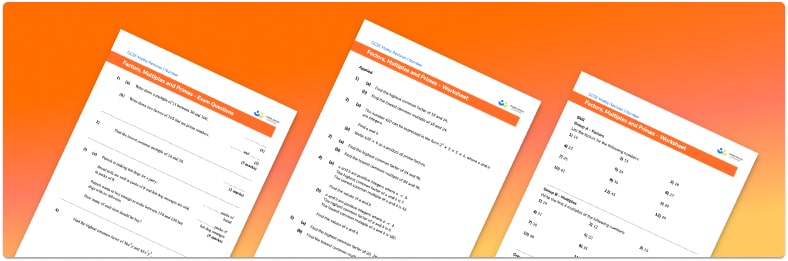
Help your students prepare for their Maths GCSE with this free factors and multiples worksheet of 45 questions and answers
- Section 1 of the factors and multiples worksheet contains 36 skills-based factors and multiples questions, in 3 groups to support differentiation
- Section 2 contains 5 applied factors and multiples questions with a mix of worded problems and deeper problem solving questions
- Section 3 contains 4 foundation and higher level GCSE exam style factors and multiples questions
- Answers and a mark scheme for all factors and multiples questions are provided
- Questions follow variation theory with plenty of opportunities for students to work independently at their own level
- All questions created by fully qualified expert secondary maths teachers
- Suitable for GCSE maths revision for AQA, OCR and Edexcel exam boards

Raise maths attainment across your school with hundreds of flexible and easy to use GCSE maths worksheets and lessons designed by teachers for teachers.
Factors and multiples at a glance
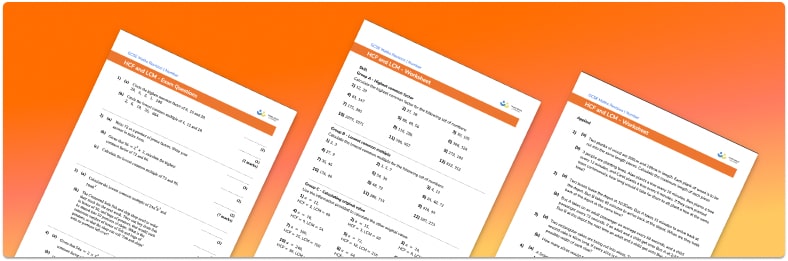
Factors are numbers that divide exactly into other numbers. For example, the factors of 12 are 1, 2, 3, 4, 6 and 12. When finding factors of a given number, it can be helpful to think of factor pairs as this will help to ensure we don’t miss any factors. It is important to remember that 1 and the number itself are factors of a number. The highest common factor (HCF/greatest common factor/GCF) of two numbers is the biggest number that is a factor of both.
Multiples are the numbers you get when you multiply a number by any integer. For example, the multiples of 5 are 5, 10, 15, 20, 25 and so on. The lowest common multiple (LCM or least common multiple) of two different numbers is the smallest number that is a multiple of both.
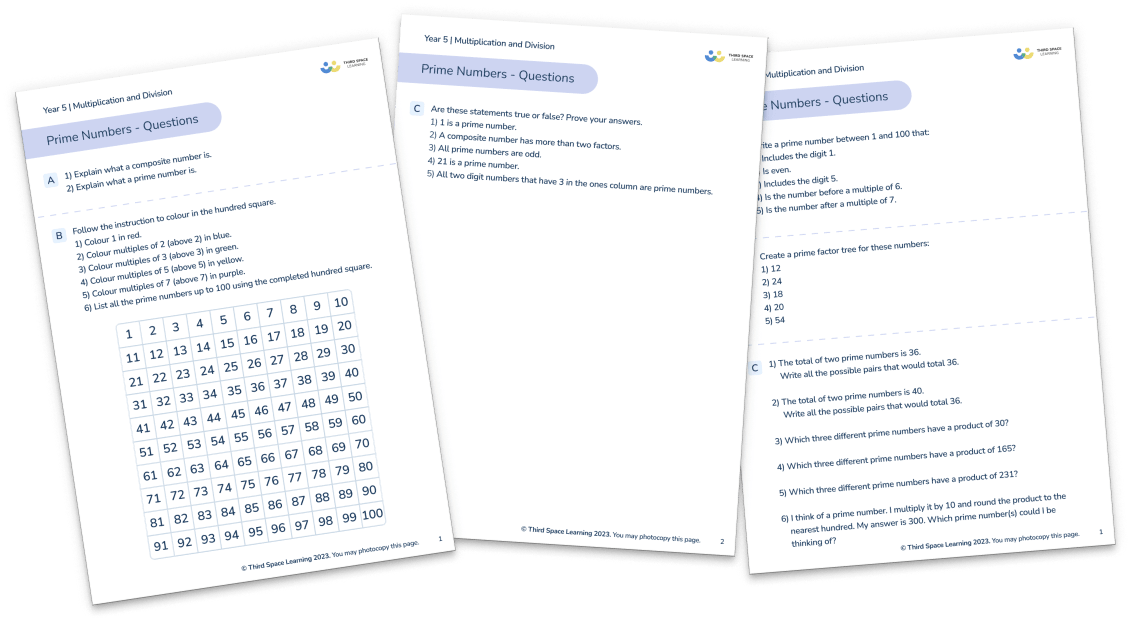
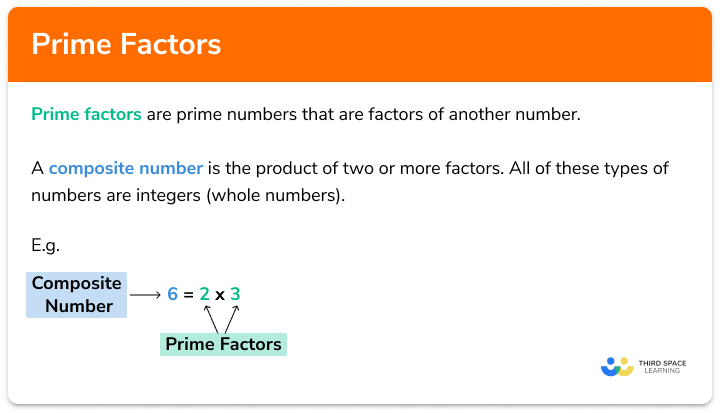
Prime numbers are numbers that only have two factors: themselves and 1. The first few prime numbers are 2, 3, 5, 7 and 11. Numbers that have more than two factors are called composite numbers and any composite number can be written as a product of two or more prime numbers. To find the prime factors of a number we can use a factor tree. The prime factorisation of two or more numbers can be used to find the HCF and LCM of those numbers.
It is helpful if students are confident with multiplication and division facts as well as working with square numbers, cube numbers and higher powers when covering these topics.
Looking forward, students can then progress to additional number worksheets, for example an equivalent fractions & ordering fractions worksheet or simplifying fractions worksheet.

For more teaching and learning support on Number our GCSE maths lessons provide step by step support for all GCSE maths concepts.
Do you have students who need additional support?

With Third Space Learning's secondary maths tutoring programmes, students in Year 7-11 receive regular one to one maths tutoring to address gaps, build confidence and boost progress.
"My confidence in the tutoring is high. We've had some phenomenal results. I even had one girl get a Grade 8 this year; she came to every tutoring session."
Stacey Atkins, Maths Director, Outwood Grange Academies Trust