California Common Core State Standards: CA Math Standards
All Third Space Learning math resources and tutoring align with California’s CA CCSSM and CAASPP assessments.
High-impact tutoring personalizes instruction to help students master grade-level content and excel in state math assessments.
Math instruction integrates problem-solving with reasoning, ensuring students develop deep mathematical understanding across all domains.
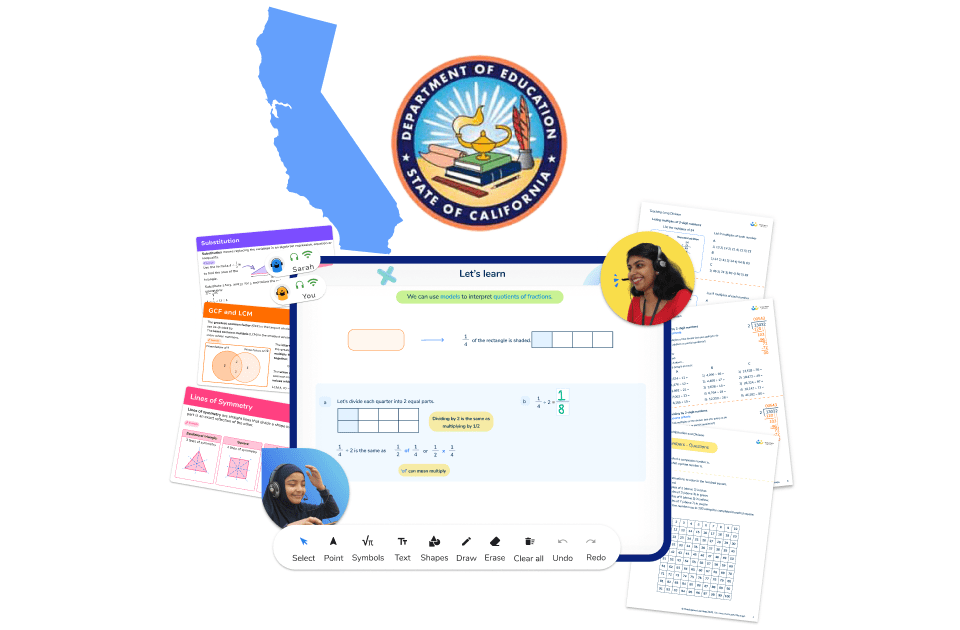
Understanding California math standards
The California Common Core State Standards for Mathematics (CA CCSSM) were adopted in 2010 and modified in 2013 to meet the unique needs of California students. Developed through collaboration with educators, curriculum experts, and policymakers, these standards align with college and career readiness goals. State assessments like the California Assessment of Student Performance and Progress (CAASPP) measure conceptual fluency, reasoning, and real-world problem-solving skills.
The 8 Standards for Mathematical Practice
Alongside the grade-level content standards, California’s state standards set out 8 practice standards. The content standards say what students learn at each grade; the practice standards describe how students work as mathematicians. By focusing on how students think as well as what they answer, these practices run through every grade from kindergarten to grade 12.
Make sense of problems and persevere in solving them: read a problem closely, identify what it asks, and keep going when a first approach stalls.
Reason abstractly and quantitatively: move between a real situation and the numbers and symbols that represent it, then apply the same idea in different situations.
Construct viable arguments and critique the reasoning of others: justify their own thinking and analyze a classmate’s.
Model with mathematics: use math to represent real world problems, from a weekly budget to a science measurement.
Use appropriate tools strategically: decide when a ruler, a calculator, or an estimation best fits the task.
Attend to precision: calculate accurately and explain clearly.
Look for and make use of structure: identify the structure inside numbers, shapes, and expressions, and use that structure to simplify a task.
Look for and express regularity in repeated reasoning: analyze what repeats and use it to work more efficiently.
These practices matter because state assessments reward them. The CAASPP rewards the reasoning behind an answer, often through open-response tasks where students analyze a situation, construct an argument, and show their problem solving. Teachers can use the same practices to identify where a student is stuck, and tutoring helps teachers track each student’s progress and monitor understanding over time, feeding back useful insights. A student who can solve problems, reason clearly, and use the right tools builds deeper understanding of the concepts they meet in later grades, and is readier for the math they will use in college and beyond. These practices are essential to how California assesses math, and they shape the development of content at every grade. Strong tutoring reinforces the same practices in each session, so students build understanding and problem solving through regular use, returning to each concept until it sticks.
Key features of the California math standards
Mathematics instruction follows cognitive research principles and aligns with California’s standards for conceptual understanding and fluency.
Structured learning progressions ensure students master arithmetic, algebra, and higher-level math.
Emphasizes reasoning, critical thinking, and data analysis for real-world applications.
Supports all learners, including English Language Learners and students with disabilities.
Prepares students for success in STEM careers, college math, and applied problem-solving.
Encourages the use of technology, digital tools, and inquiry-based learning to deepen understanding.
How Third Space Learning aligns with California math standards
TSL’s expert-designed lessons scaffold California’s standards content, guiding students from conceptual understanding to mastery.
Each tutoring session aligns with grade-specific standards and classroom instruction, reinforcing foundational math skills.
Personalized instruction helps students develop confidence in solving mathematical problems and justifying their reasoning.
Weekly progress monitoring ensures achievement against California’s CAASPP assessment benchmarks.
“Third Space Learning meant we could provide more attention than we can in class. Particularly for those who are shy in class and don’t want to put their hand up because they’re scared of getting it wrong. Now, if they do get a question wrong in their session, the tutor is there to explain why they got it wrong and talk through what they can do to get to the correct answer.”

Tim Jackson, Mathematics Instructional Coach
Pangbourne Primary School
California-aligned math tutoring
Our AI math tutor delivers lessons built by math experts and aligned to California’s math standards, including assessment preparation and inquiry-based learning.
Learn moreCalifornia-aligned math lessons
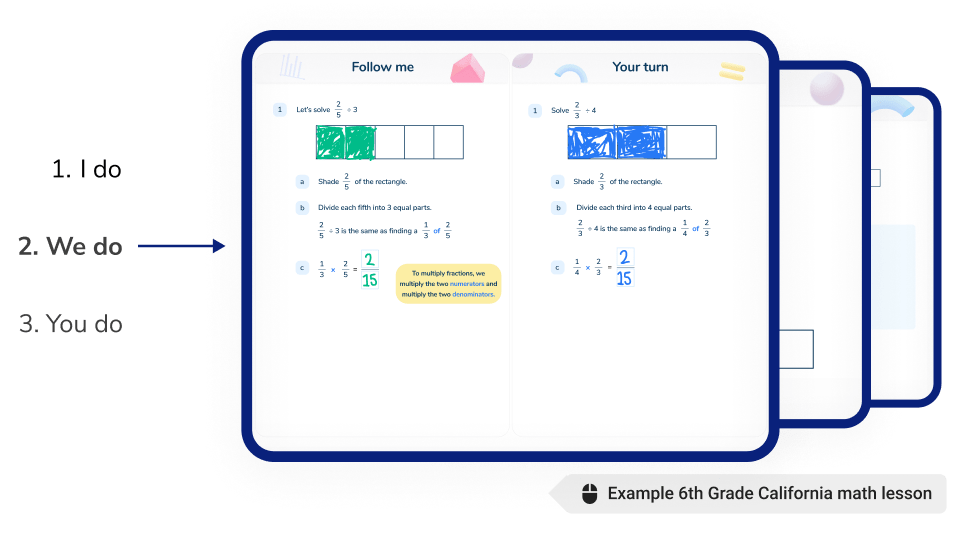
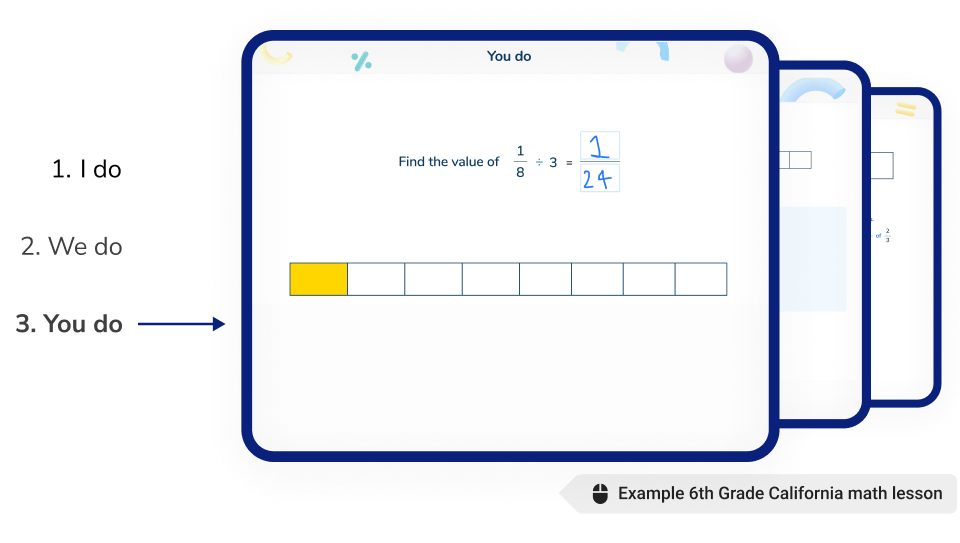
Lessons follow the state’s structured progression, helping students develop conceptual fluency, procedural skills, and problem-solving abilities.
Download sample lessons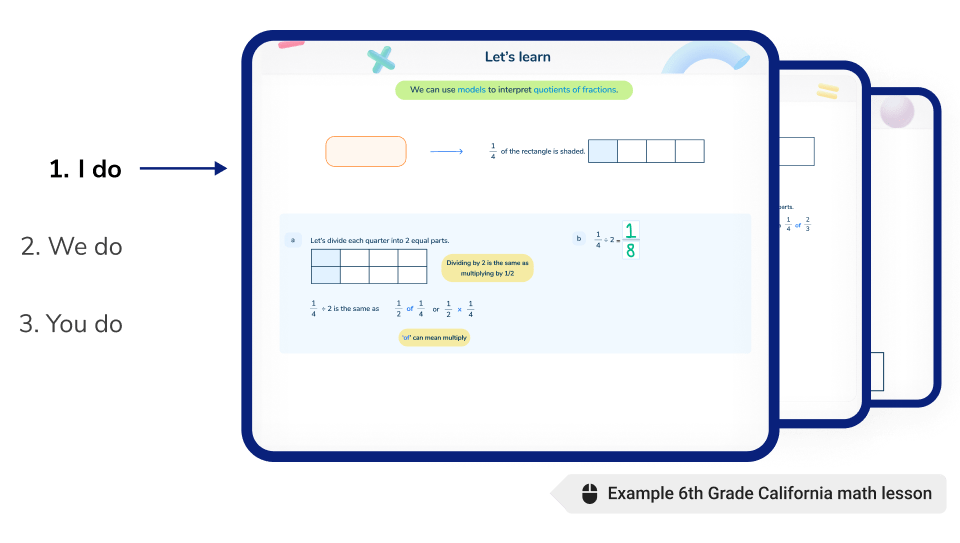

California-aligned assessment preparation
Practice materials mirror California’s CAASPP assessment format, reinforcing test-taking strategies.
Explore free state tests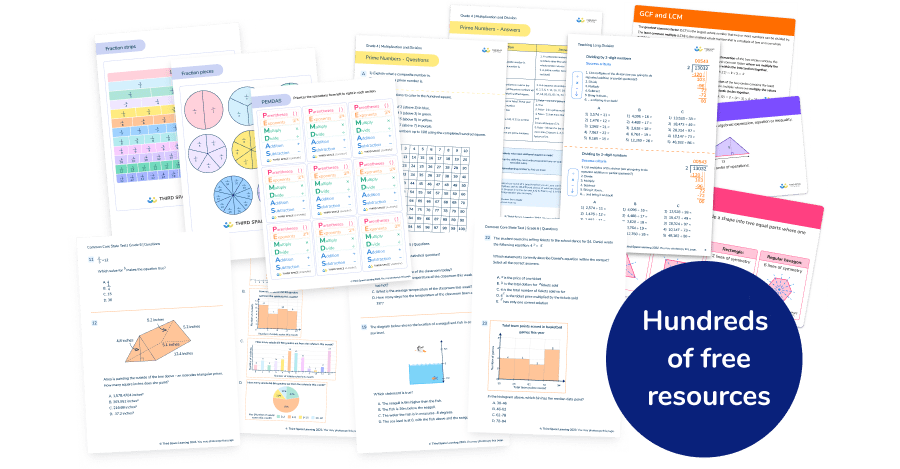
Math resources for California educators
Our complete resource collection includes lesson slides, practice problems, and instructional materials aligned to California’s standards.
Explore resources
Grade-level California math standards overview
Find California Common Core State Standards-aligned tutoring, resources, and CAASPP practice materials for each grade below.
California Math Standards for elementary school
Kindergarten math
Counting and Cardinality
Operations and Algebraic Thinking
Number and Operations in Base Ten
Measurement and Data
Geometry
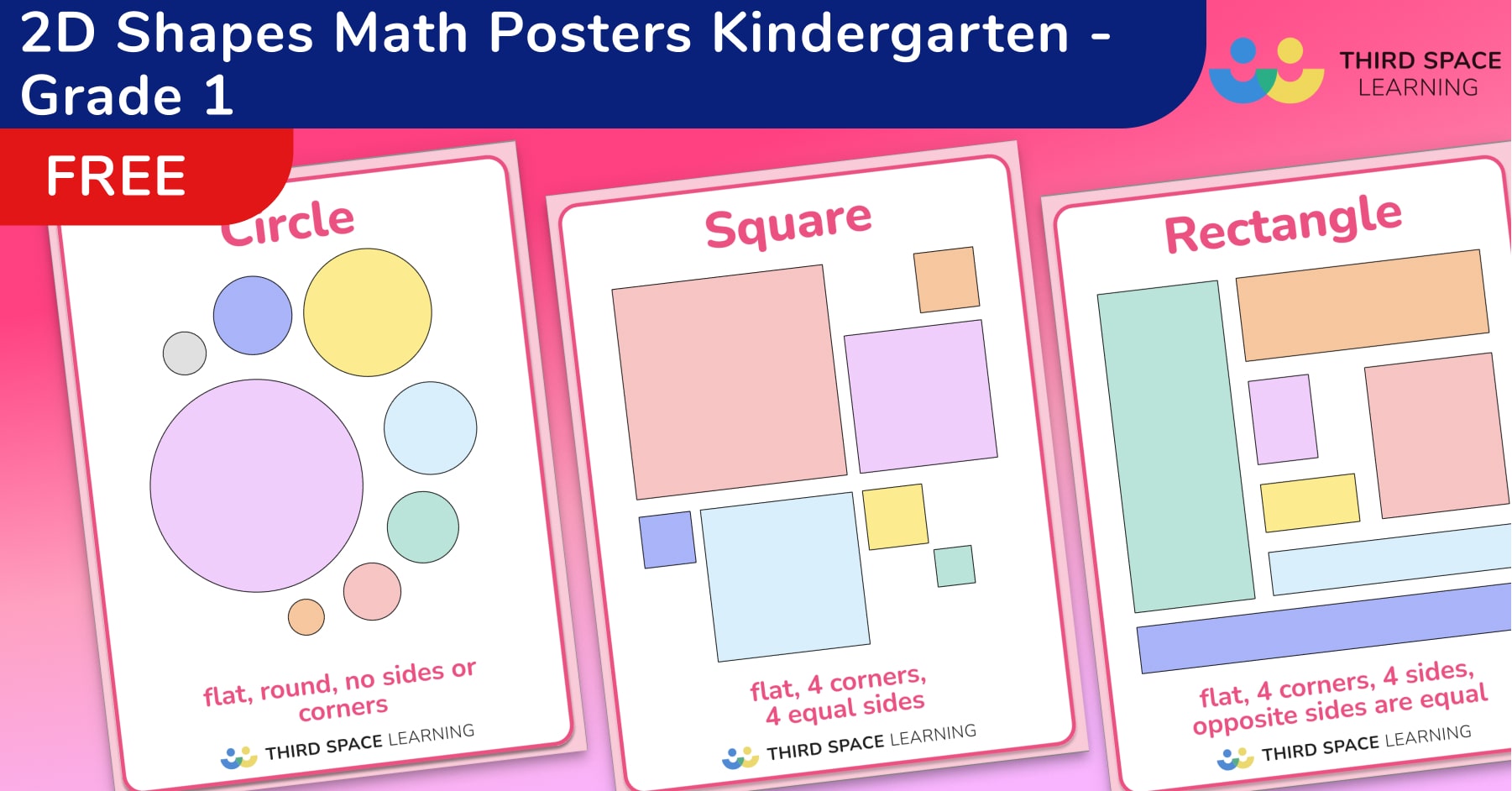
2D Shapes Math Posters Kindergarten – Grade 1
These math posters are designed to display key information on 2D Shapes for Kindergarten and Grade 1.
Download freeGrade 1 math
Operations and Algebraic Thinking
Number and Operations in Base Ten
Measurement and Data
Geometry

1st Grade Math Curriculum Toolkit: Guidance, Tips, And Resources For Elementary Teachers
Expert insights and resources for mastering your teaching of the 1st grade math curriculum. All free. Share with a 1st grade teacher.
Download freeGrade 2 math
Operations and Algebraic Thinking
Number and Operations in Base Ten
Measurement and Data
Geometry
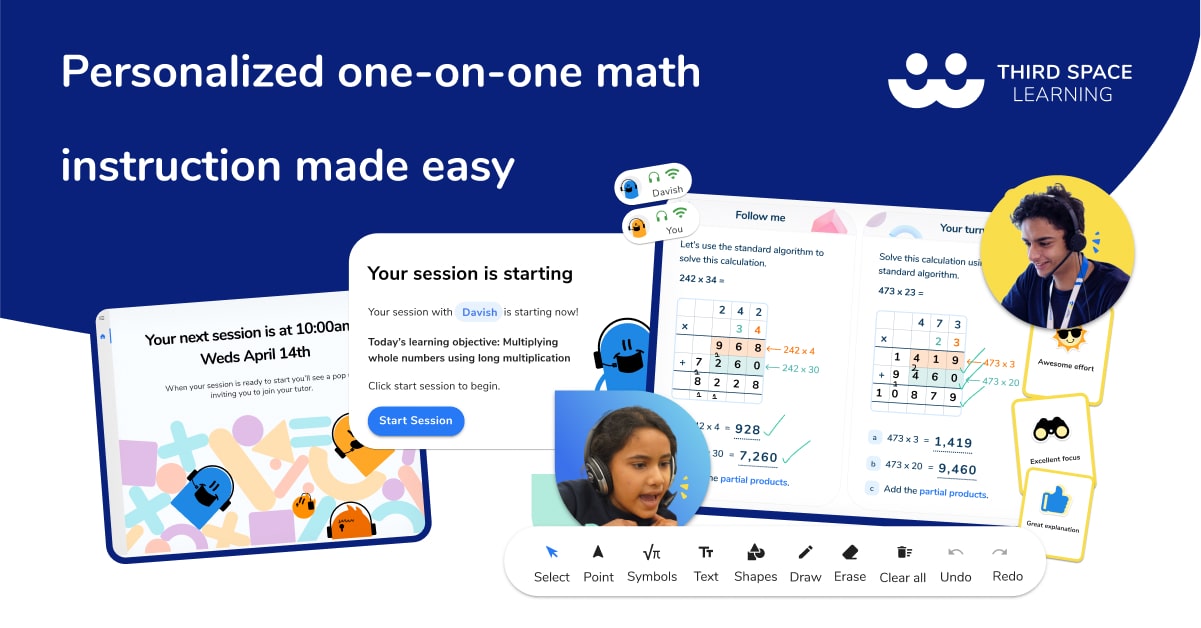
Grade 2 Math Tutoring
Differentiated one-on-one online math tutoring programs to help students master math skills in 2nd – 8th grade.
Learn more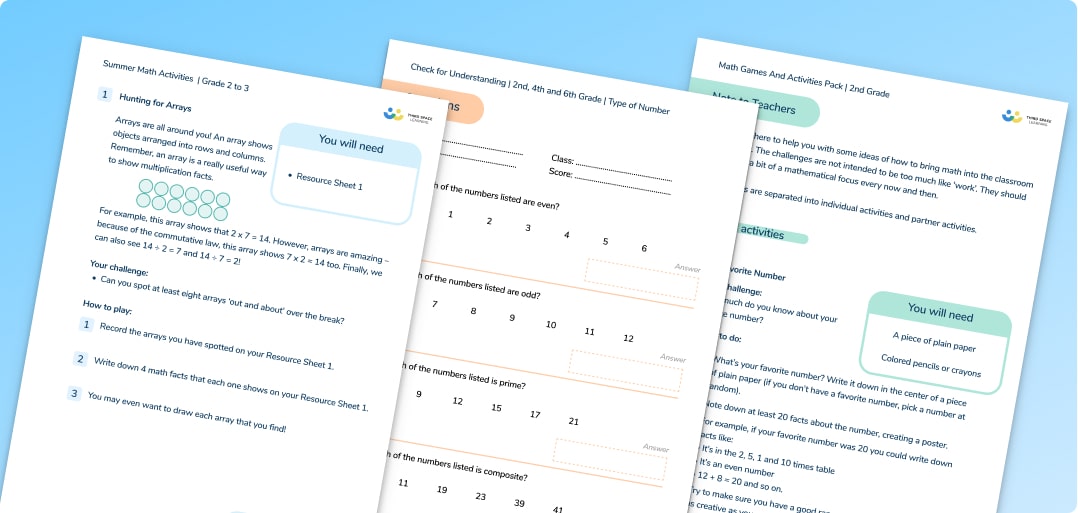
Free 2nd Grade Math Resources
Discover free 2nd-grade math resources, including worksheets and activities, aligned with educational standards to enhance student learning experiences.
Explore resourcesGrade 3 math
Operations and Algebraic Thinking
Number and Operations – Fractions
Measurement and Data
Geometry
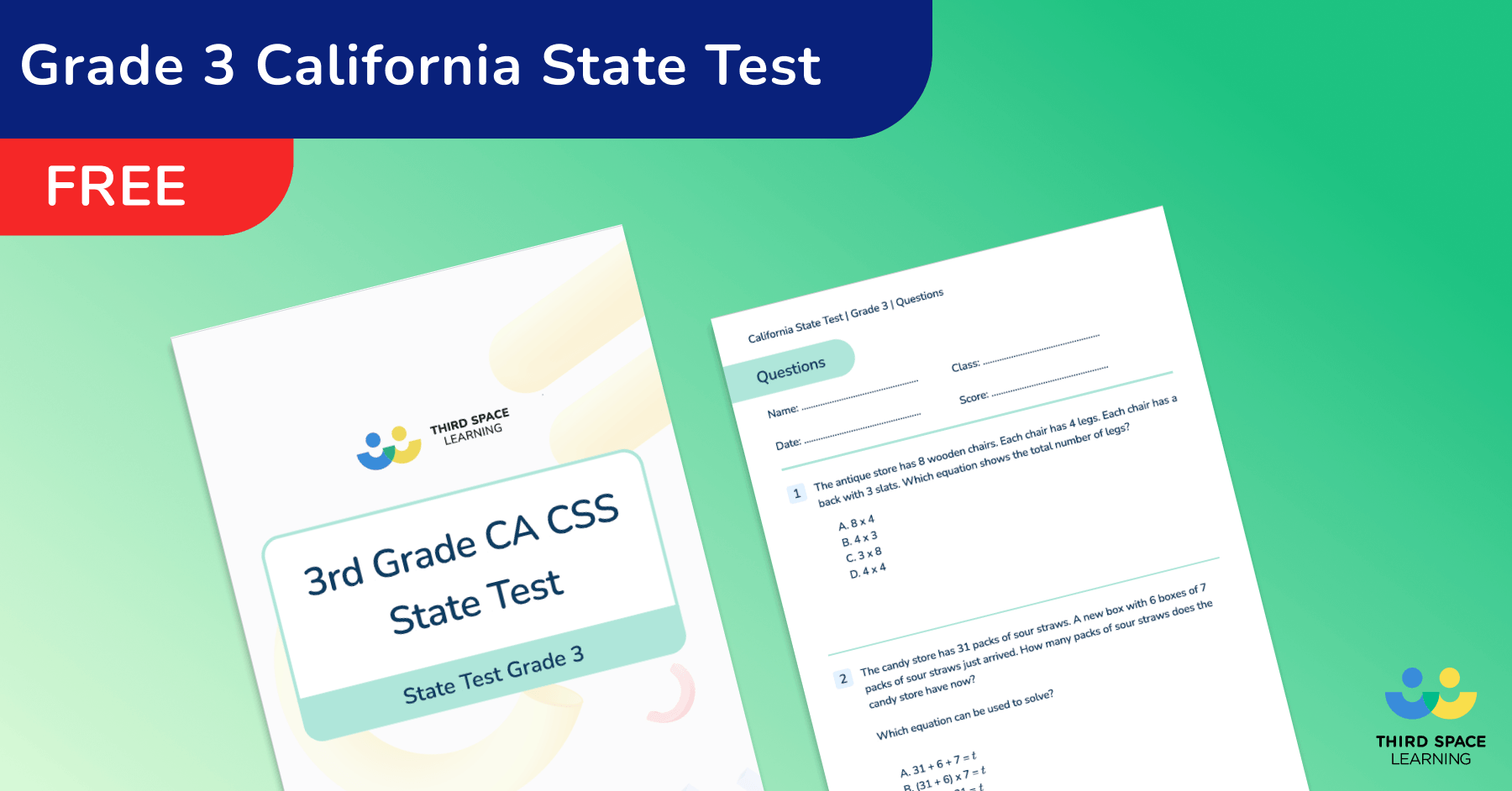
3rd Grade California CAASPP Practice Test
Prepare for the California state math test with this Grade 3 practice assessment.
Download free
Grade 3 Math Tutoring
Differentiated one-on-one online math tutoring programs to help students master math skills in 2nd – 8th grade.
Learn more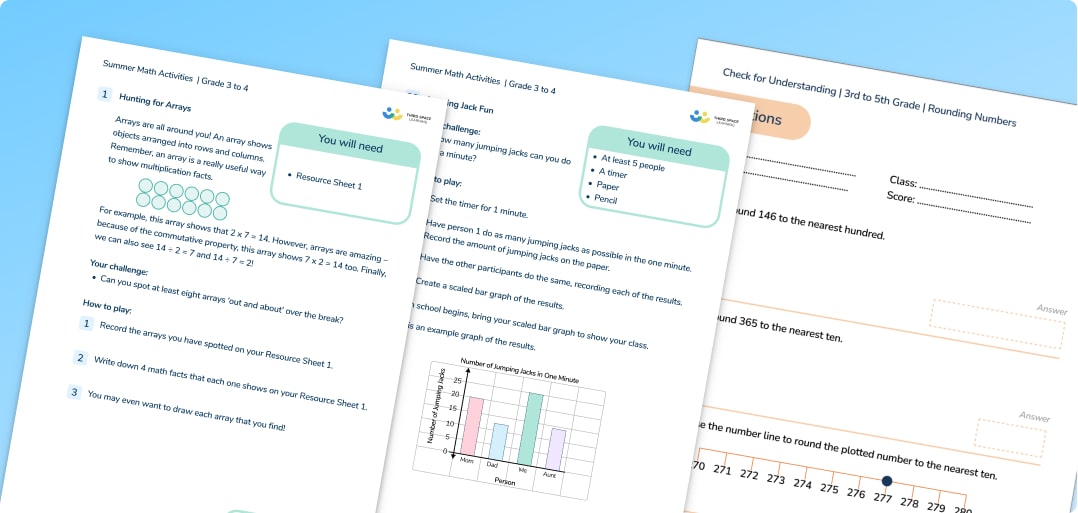
Free 3rd Grade Math Resources
Enhance your 3rd-grade math lessons with free resources, including worksheets and interactive activities, aligned with educational standards.
Explore resourcesGrade 4 math
Operations and Algebraic Thinking
Number and Operations – Fractions
Measurement and Data
Geometry
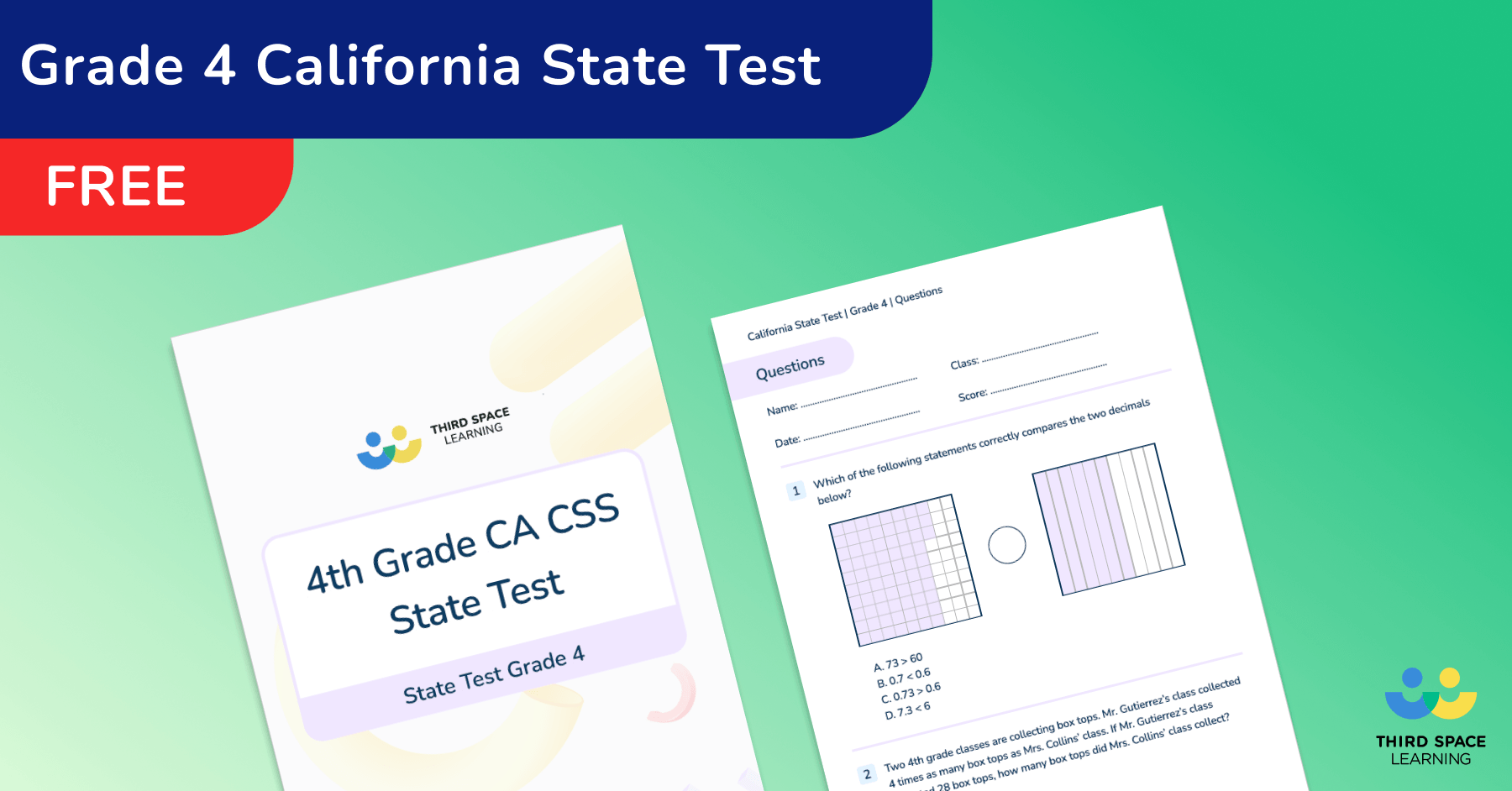
4th Grade California CAASPP Practice Test
Prepare for the California state math test with this Grade 4 practice assessment.
Download free
Grade 4 Math Tutoring
Differentiated one-on-one online math tutoring programs to help students master math skills in 2nd – 8th grade.
Learn more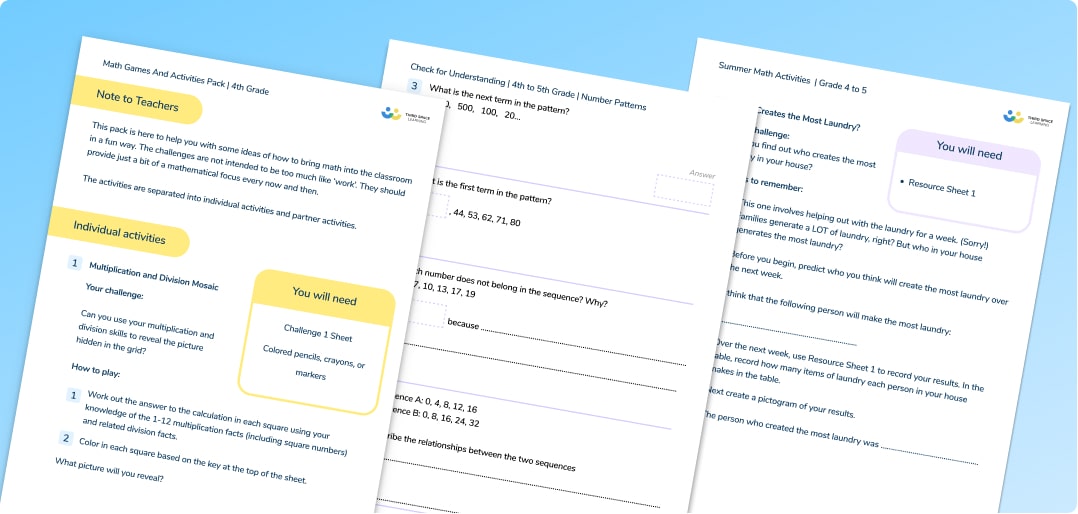
Free 4th Grade Math Resources
Explore free 4th-grade math resources, including worksheets and activities, designed to align with educational standards and enhance student learning.
Explore resourcesGrade 5 math
Operations and Algebraic Thinking
Number and Operations – Fractions
Measurement and Data
Geometry
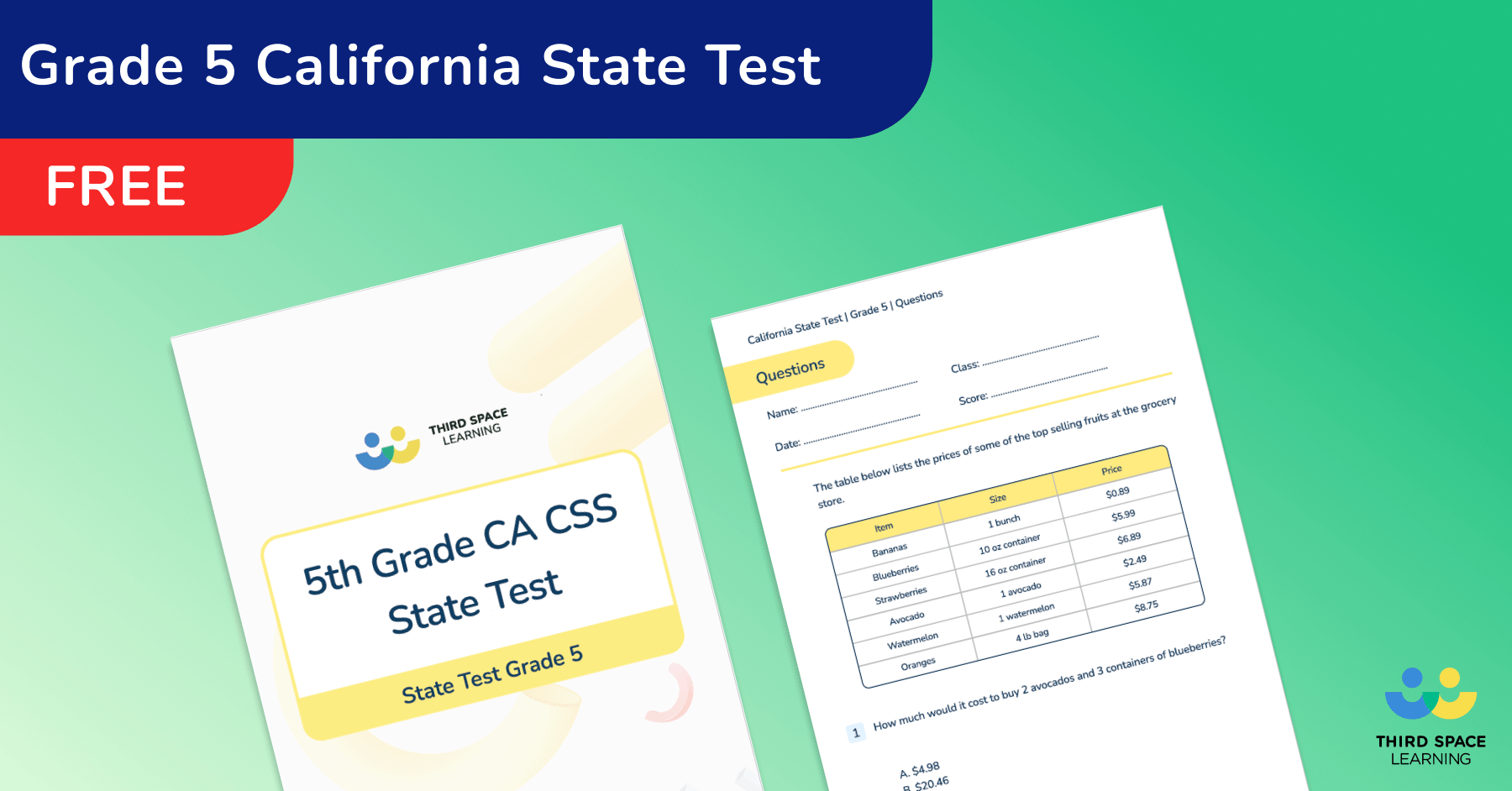
5th Grade California CAASPP Practice Test
Prepare for the California state math test with this Grade 5 practice assessment.
Download free
Grade 5 Math Tutoring
Differentiated one-on-one online math tutoring programs to help students master math skills in 2nd – 8th grade.
Learn more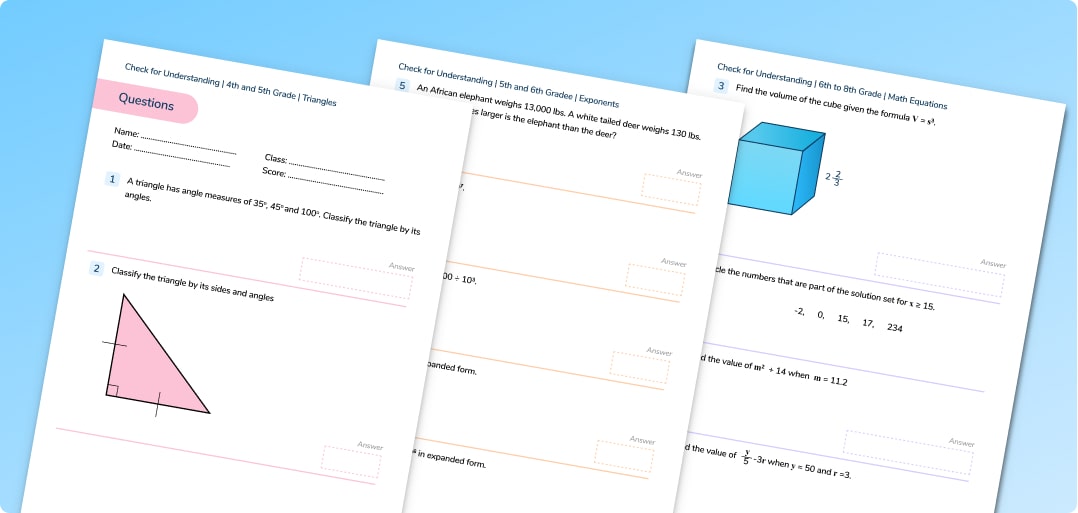
Free 5th Grade Math Resources
Access free 5th-grade math resources, including worksheets and activities, aligned with educational standards to support your students' learning.
Explore resourcesCalifornia Math Standards For Middle School
Grade 6 math
Ratios and Proportional Relationships
The Number System
Expressions and Equations
Geometry
Statistics and Probability
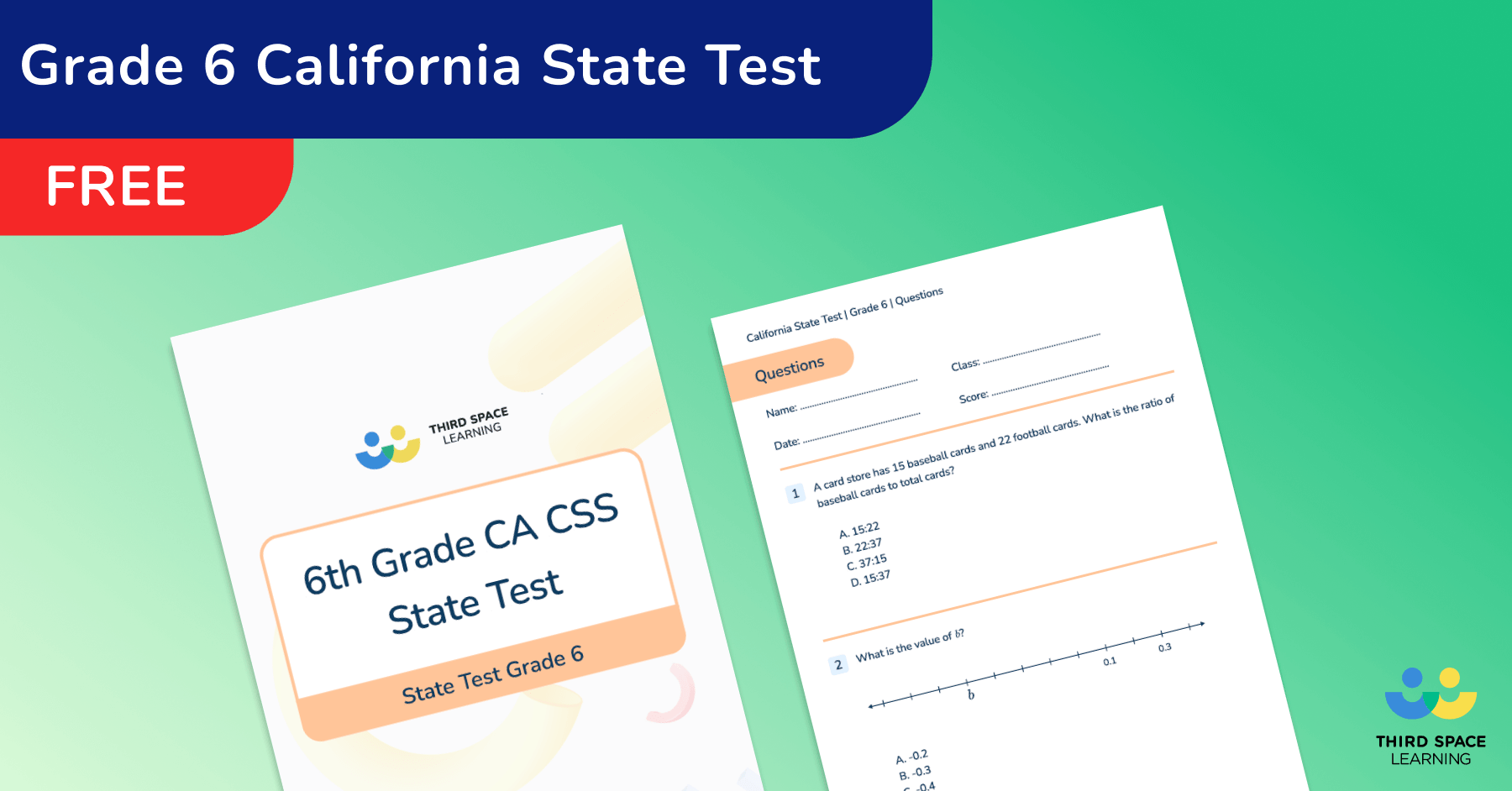
6th Grade California CAASPP Practice Test
Prepare for the California state math test with this Grade 6 practice assessment.
Download free
Grade 6 Math Tutoring
Differentiated one-on-one online math tutoring programs to help students master math skills in 2nd – 8th grade.
Learn more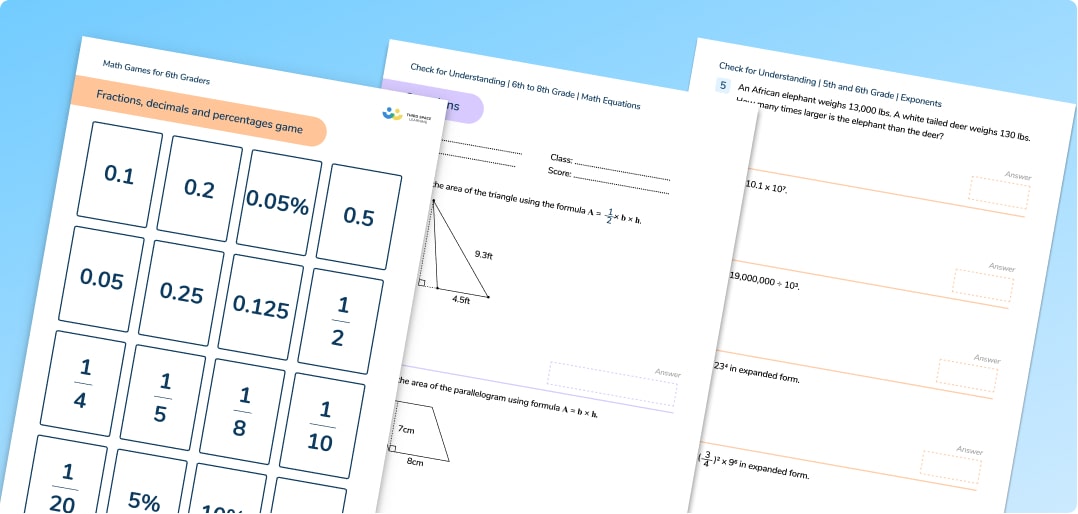
Free 6th Grade Math Resources
Discover free 6th-grade math resources, including worksheets and activities, to align with educational standards and enhance student learning.
Explore resourcesGrade 7 math
Ratios and Proportional Relationships
The Number System
Expressions and Equations
Geometry
Statistics and Probability
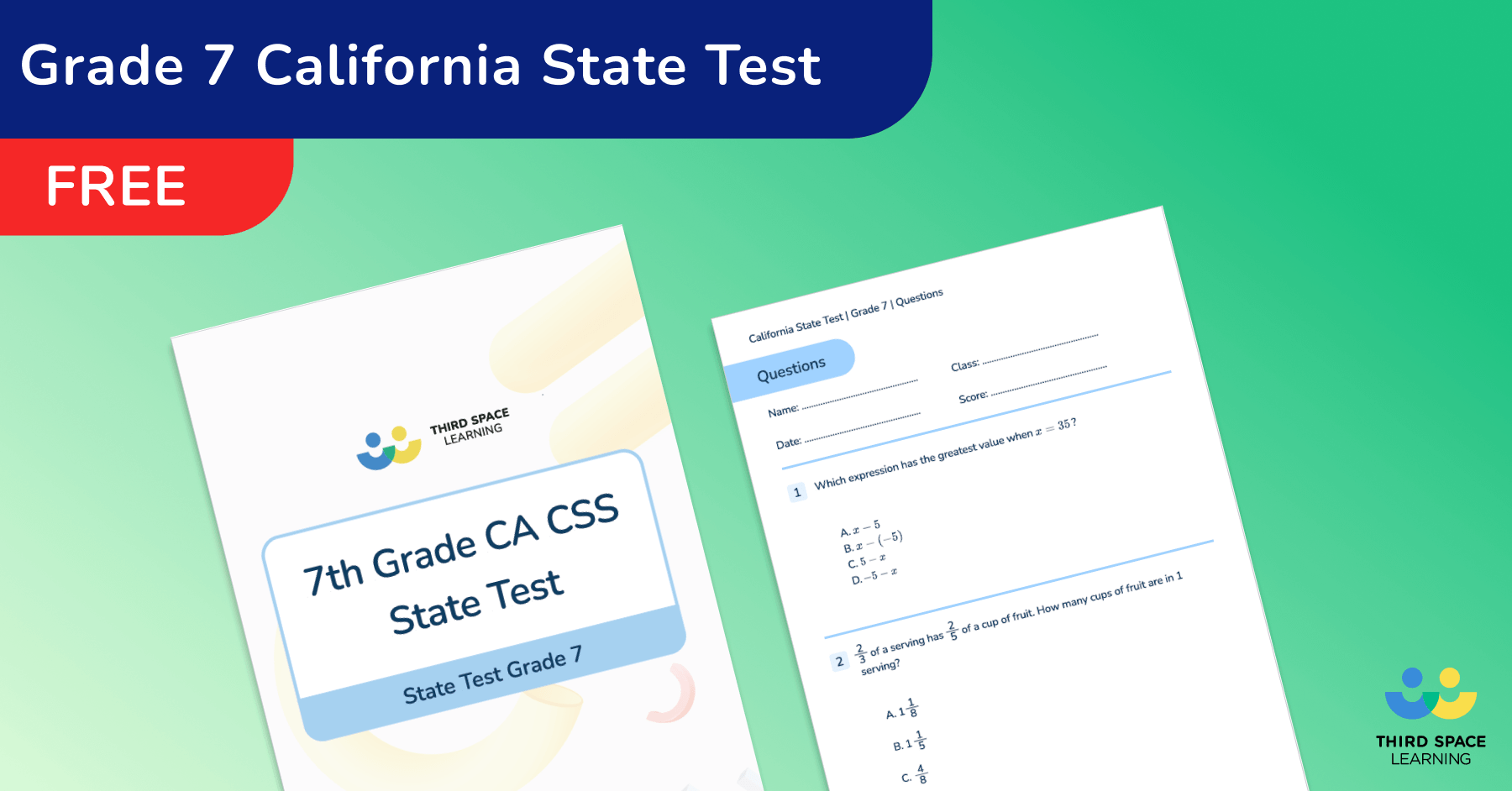
7th Grade California CAASPP Practice Test
Prepare for the California state math test with this Grade 7 practice assessment.
Download free
7th Grade Math Tutoring
Differentiated one-on-one online math tutoring programs to help students master math skills in 2nd – 8th grade.
Learn more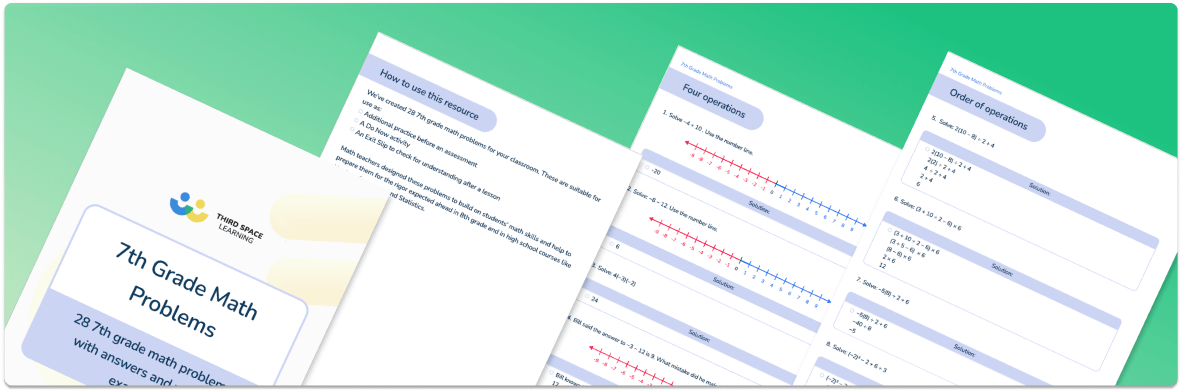
Free 7th Grade Math Resources
Enhance your 7th-grade math lessons with free resources, including worksheets and activities, aligned with educational standards.
Explore resourcesGrade 8 math
The Number System
Expressions and Equations
Functions
Geometry
Statistics and Probability
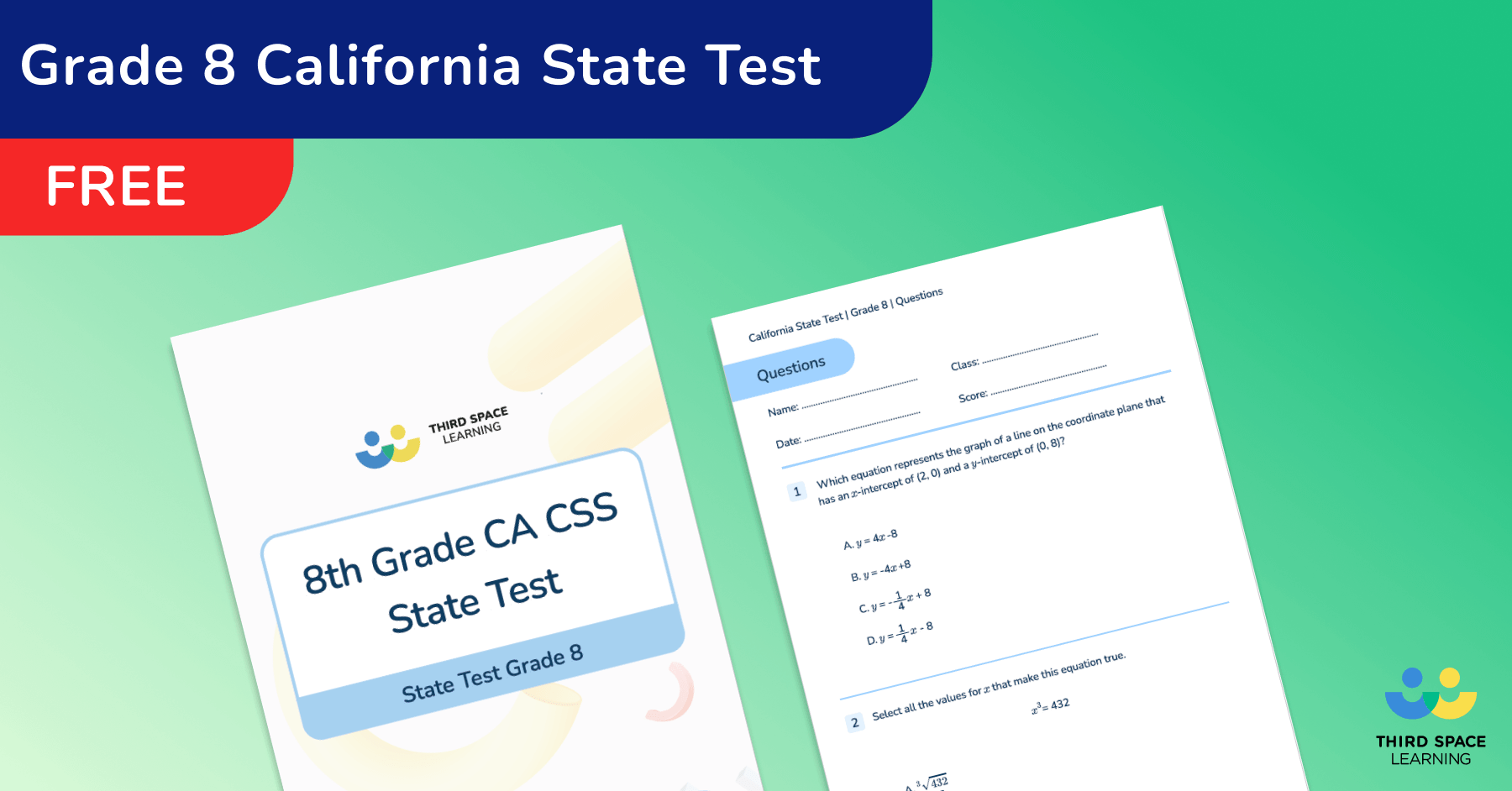
8th Grade California CAASPP Practice Test
Prepare for the California state math test with this Grade 8 practice assessment.
Download free
8th Grade Math Tutoring
Differentiated one-on-one online math tutoring programs to help students master math skills in 2nd – 8th grade.
Learn more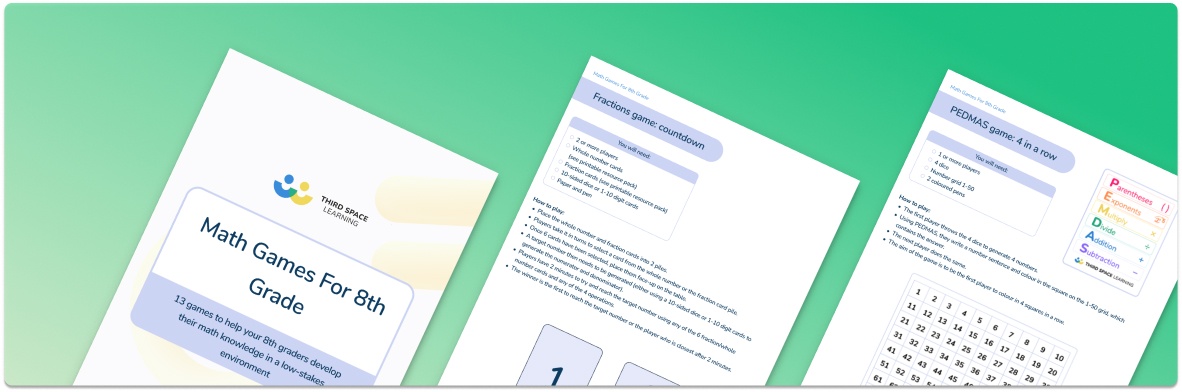
Free 8th Grade Math Resources
Explore free 8th-grade math resources, including worksheets and activities, designed to align with educational standards and prepare for high school.
Explore resources
Does your school follow common core curriculum math standards?
Support all your math teachers and students with Third Space Learning
Educators trained in California’s standards help schools implement state-aligned instruction.
All tutoring materials align with California’s CAASPP expectations for assessment preparation.
Personalized, one-on-one math tutoring supports individual student needs.
State-approved tutoring vendor with experience in districts across California.
Flexible scheduling supports intervention, acceleration, and differentiated instruction.
📢 Discover how affordable, California-aligned math tutoring can improve student proficiency – book a consultation today!
Frequently asked questions
Which grade levels do the CA CCSSM cover?
The California Common Core State Standards for Mathematics (CA CCSSM) apply to K–12 education and ensure students build the foundational skills necessary for college and career readiness. Find out more here: www.cde.ca.gov/ci/ma/
How are California’s math standards structured?
The CA CCSSM is organized into domains and grade-level expectations, ensuring a clear learning progression from arithmetic to algebra, geometry, and advanced math.
How does a CA CCSSM-aligned math lesson work?
TSL tutoring sessions follow California’s structured math framework, starting with conceptual understanding, guided practice, and real-world applications to ensure fluency.
What is the California Mathematics Framework?
The California Mathematics Framework is a guidance document developed by the California Department of Education. It supports the implementation of the California Common Core State Standards for Mathematics (CA CCSSM) by helping educators design instruction that promotes deeper understanding, equity, and student agency in math. The framework emphasizes mathematical reasoning, problem-solving, and real-world application. It also offers recommendations for grade-level content progressions, assessment practices, and strategies to meet diverse learner needs across K–12
What are the California math standards called?
California’s math standards are called the California Common Core State Standards for Mathematics, usually shortened to CA CCSSM. California adopted them in 2010 and modified them in 2013, then published the California Mathematics Framework in 2023 to guide the teaching of math in every classroom. You will also see them called the California Common Core standards or simply the state math standards.
What kind of math is required in California?
California requires math at every grade from kindergarten to grade 12. Elementary students focus on place value, number sense, and the core concepts of arithmetic and fractions. Middle school adds ratios, proportional relationships, expressions, and early algebra. High school students take either an integrated pathway or traditional courses in algebra, geometry, and statistics. This progression, from place value to algebra, is central to math education in California, and across different grades students are expected to solve problems, reason about their answers, and build the problem solving they need for real world problems.
Which state has the best math standards?
There is no official ranking, and most states now build on the same Common Core foundation. California’s standards are among the most demanding, focusing on conceptual understanding, coherence across grades, and the 8 practices. National measures like NAEP let you compare how students perform across states, and tracking that progress over time gives a fuller picture than any single ranking of state standards. Results depend on far more than the standards alone: funding, staffing, and the support each student actually receives all shape the outcome.
Does California still use Common Core math?
Yes. California still uses Common Core math. It is California’s version of the Common Core standards, adapted for the state and kept in place through the 2023 framework. Schools still teach the same core concepts, including place value, operations, fractions, ratios, and algebra, in the structured progression the California Common Core standards introduced.