

Will AI Replace Teachers? And Why The Answer Matters More Than You Think

It is a universal truth that every conference, email chain, or conversation between school leaders, teachers, parents, and anyone involved in education, will eventually end up asking the question: “Will AI replace teachers?” or the closely related “Will our teachers be replaced by robots using technology like generative AI?”
It’s an understandable fear. With 67% of US school teachers reporting they’ve experimented with artificial intelligence tools in the last year, and education technology promising to solve everything from workload to student outcomes, it’s easy to wonder if we’re heading towards classrooms run by algorithms rather than traditional teaching.
And the truth is that artificial intelligence will replace much of what we currently think of as a teacher’s role and many routine tasks. But, here’s what any teacher who’s actually stepped into a classroom knows: the idea of AI replacing teachers isn’t just unrealistic – it fundamentally misunderstands what teaching is.
Why teaching will always need human teachers
The truth about teaching becomes crystal clear in the final weeks of each school year, when parents suddenly have very strong opinions about which teacher their child gets in September. And those reasons are never about educators’ subject knowledge or curriculum delivery.
Some want the strict teacher who’ll help their child focus. Others want the warm, nurturing one who’ll build confidence. The reasons are always human-centered – personality, relationships, and the intangible qualities that make each teacher unique. Teachers act as mentors, guiding and inspiring students beyond academic instruction and supporting their personal growth.
This tells us something crucial: parents instinctively understand that teaching is fundamentally about human connection. This human connection in education not only shapes individual students but also benefits society as a whole, fostering a more connected and supportive community.

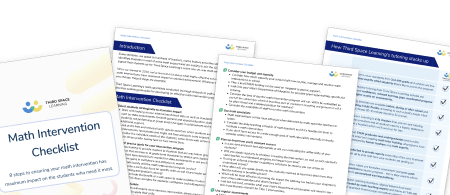
Math Intervention Checklist
Download this essential step-by-step checklist to help you select, manage and evaluate the best math intervention programs for your students.
Download Free Now!The human connection factor
Teaching starts long before any instruction or curriculum content gets delivered. It begins with making children actually want to learn in the first place. And that requires understanding not just what a child knows, but who they are.
When a usually cheerful 5th Grade student storms into morning registration after a row with their sibling, it’s the teacher who reads that mood and adapts accordingly. Maybe today isn’t the day for challenging that student in front of the class. Maybe it’s a day for quiet encouragement and a chance to rebuild confidence – something even the most advanced generative AI technology would struggle to read.
When an 8th Grade student who struggles with confidence finally attempts a challenging algebraic equation, it’s the teacher who knows exactly how to encourage without overwhelming. They know this student’s learning path, their previous struggles with similar concepts, and precisely the right moment to step in with support or step back to let independence flourish.
Or the high school student who’s always been strong at math but freezes during mock test week, suddenly convinced they’ll fail. It’s the teacher who recognizes this isn’t about mathematical ability but test anxiety, who knows to focus on coaching, confidence-building and alleviating the student’s concerns, rather than more content drilling and assessment to better prepare students.
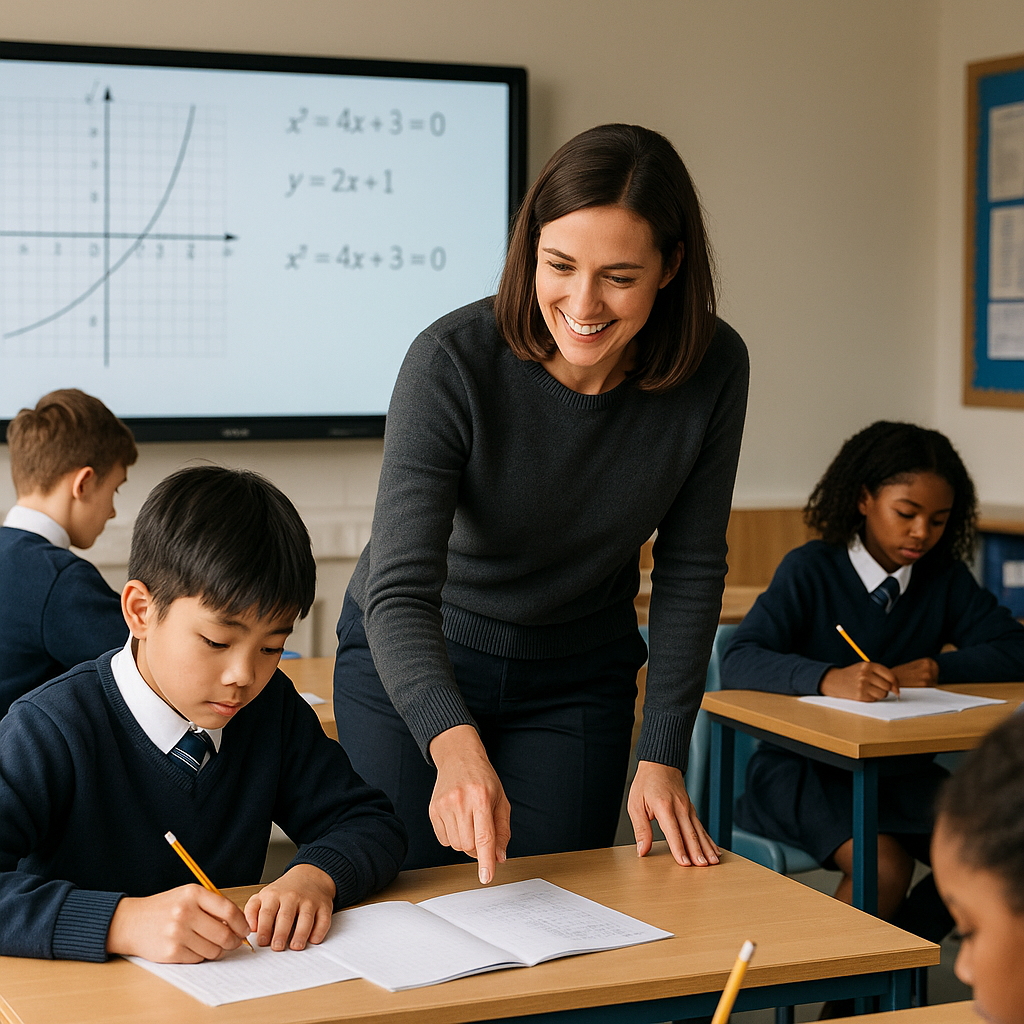
Research shows that whole-school or targeted approaches that strengthen teacher-student interactions and behavior management yield +3 months of extra progress on average. But more importantly, every experienced educator knows this instinctively. They’ve seen the transformation that happens when a child feels truly seen and understood.
The irreplaceable classroom dynamic
During the 2020-21 lockdowns, many of us became acutely aware of what was missing from home learning. I could deliver content to my own children just fine, but we lost the crucial role of class talk and discussion.
There’s something irreplaceable about the moment when one child’s idea sparks another’s thinking, when a reluctant learner gets pulled into a debate about whether zero is a number, when the “aha” moment happens not from the teacher’s instruction but from a peer’s perfectly-timed comment: “Oh, it’s like when we’re sharing sweets!”
These interactions that support students’ learning can’t be programmed or predicted by generative AI. They emerge from the complex social dynamics that happen when you put 30 students in a room together with a skilled adult facilitating their learning.
Beyond academics: human development
Perhaps most importantly, schools do far more than deliver curriculum content. They are where kids go through significant personal growth; they begin to evolve into the person they want to become, step into the world, learn to navigate relationships, handle disappointment, celebrate others’ successes, and develop resilience.
When a 6th Grade student is struggling with friendship dynamics, when a 10th Grade student is paralyzed by the pressure of college applications riding on their high school grades, when a 5th Grade student is experiencing anxiety about upcoming standardized tests, or even when a child in early elementary just can’t get their drink open – these are the moments that require human empathy, not algorithmic responses.
Skilled, supportive educators navigate these moments with emotional intelligence that has been developed through years of experience and ongoing professional development. They know when a behavior issue is actually a safeguarding concern, when academic struggle masks emotional difficulty, and how to balance individual needs with whole-class management.
64% of teachers report they now spend more time on student care than a year ago. And, almost 90% of educators feel more involved than ever in students’ mental-health; no parent would want these crucial interactions handed over to a machine or ill-designed technology.
The training parallel: why expertise matters
Here’s where an interesting parallel emerges between human teachers and AI systems – both require extensive, ongoing training over the course of months and years to be effective and make a significant impact.
Think about the path of a newly qualified teacher. They arrive with subject knowledge and theoretical understanding, but it takes years of classroom experience, mentoring, and continuous professional development to become truly skilled and gain the valuable insights they need to develop. They learn to read a room, adapt their explanations in real-time, and develop instinctive responses with that careful human touch that makes teaching look effortless.
The same principle applies to AI systems in education
The most effective educational AI tools aren’t general-purpose chatbots thrown into classrooms. They’re systems that have been extensively trained by former teachers and pedagogy and AI experts, informed by thousands of hours of real teaching interactions, and continuously refined based on educational research on how children actually learn.
Take Third Space Learning’s experience creating Skye, their AI math tutor. This isn’t a system that was trained on general internet content and then expected to teach. Its lesson delivery is built on a foundation of over 2 million one-to-one tutoring sessions. Experienced math teachers analyze every interaction to understand what works and what doesn’t.
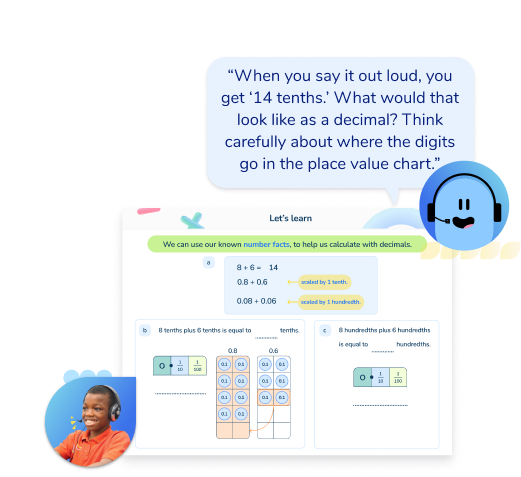
Just as a human teacher learns that certain explanations work better for different types of learners, Skye has been trained to recognize the difference between a child is struggling with place value versus when they’re confused about the operation itself. This level of nuanced understanding doesn’t happen accidentally. It requires the same kind of deliberate, expert-led training and coaching that we expect for human teachers.

Where AI genuinely helps education
But acknowledging that artificial intelligence can’t replace teachers doesn’t mean dismissing its potential. AI is not about eliminating jobs; rather, it serves as a supportive tool that helps teachers reduce workload and improve educational outcomes while maintaining the essential human elements of teaching. Used thoughtfully and with strong AI literacy, AI can support teachers and enhance what teachers do best by handling the tasks that drain their time and energy.
Giving teachers their weekends back
The biggest wins are happening in routine administrative tasks. The Alex Ferry Foundation has found that teachers spend approximately 20 hours per week on admin, planning, marking, and management tasks, almost as much time as teaching, time that could be spent on lesson planning, professional development, or simply having a life outside school.
AI tools are already helping with:
- Report writing: Many teachers are amazed at how well AI tools can capture their voice and tone when trained properly while helping to save time. But the key word here is “trained” – the most effective implementations involve teachers working with the AI over time, improving its understanding of their communication style and the specific needs of their students.
- Data analysis: Data tracking and identifying trends and deeper insights into student progress without hours of spreadsheet work. AI tools can quickly track progress, identify patterns across grade levels, flag students who might need additional support, and generate insights that would take human analysis hours to uncover.
- Resource creation and differentiation: Generating multiple versions of worksheets for different ability levels, creating reading-age appropriate texts on specific topics, and producing grading rubrics that align with school policies.
I’ve become particularly fond of asking AI for reading-age appropriate texts on specific topics, complete with comprehension questions. What used to take an hour of my planning time now takes one minute – but only because I’ve learned how to prompt the system effectively and I know what to look for in the output.
While some out there fear that new technology and generative artificial intelligence may eliminate jobs, high schools across school districts in the US report ongoing math teacher shortages, which makes these time-saving tools all the more valuable.
Comprehensive intervention strategies
Perhaps the most promising area for AI in schools is as part of a comprehensive math intervention strategy – not replacing human support, but filling gaps in provision that education systems simply can’t resource through traditional means.
Every teacher knows which students have gaps in their learning, but finding the capacity to address these individually while maintaining quality whole-class teaching is the eternal challenge. The reality is that most schools need multiple intervention tools in their toolkit, and human tutors, while excellent, simply aren’t available at the scale required.
EEF research shows that there are significant benefits of one on one tutoring, accelerating learning by over 5 months; but with the average cost of quality traditional tutoring at more than $50 per hour, most schools can only afford to support a fraction of the students who would benefit. Finding, hiring, training, and scheduling several one-to-one tutors who can come into your school to support all the students who need it takes time and resources.
This is where AI tutoring systems become part of the solution rather than a compromise.
How AI tutoring fits in
The key to understanding AI tutoring is to recognize it as a valuable component in a comprehensive intervention strategy. Schools have always needed multiple tools to support different types of learners and different types of gaps.
Some students need the intensive, relationship-based support that only a traditional tutor can provide. Others need quick, targeted practice to consolidate specific skills. Some benefit from peer tutoring, others from small group tutoring. AI tutoring, done well, fills a particular spot in this system – and it can also be provided at a much lower cost than using traditional tutors.
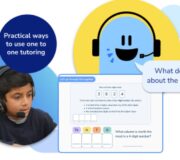
Unlike chatbots waiting to answer random questions, well-designed intelligent tutoring systems provide structured, curriculum-aligned lessons that walk students through math concepts at their own pace, paying attention to mistakes and misconceptions. Skye, for example, has been built on Third Space Learning’s decade of experience delivering traditional tutoring – they know what works and have translated those principles into AI.
The training advantage in action
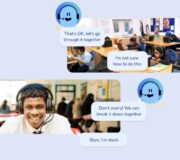
This training shows up in practical ways. When a student says “I don’t know” to a question about equivalent fractions, Skye doesn’t just repeat the explanation. Like great teachers, it’s been trained to recognize this as potentially meaning several different things:
- The students might not understand what “equivalent” means
- They might not remember how to simplify fractions
- The students feel overwhelmed by the numbers involved
- They might lack confidence rather than understanding
The system then provides scaffolded hints based on patterns learned from thousands of human tutoring interactions.
Maintaining teacher oversight
The system maintains teacher oversight throughout. You select which gaps each student needs to work on based on your assessment and knowledge of their needs. You track their progress and integrate findings back into classroom teaching. You remain in control of the learning path.
The AI handles the labor-intensive delivery – providing immediate feedback, offering multiple explanation approaches, and maintaining engagement through interactive elements that would be impossible to resource through human tutors alone. But the educational decisions remain firmly in professional hands.
Any AI teaching program or tool requires teacher oversight throughout. Whether that is in selecting the students to work on the program, checking that their learning plan is suitable for them, connecting their intervention work with their classroom teaching, teachers need to remain in control.
While an AI tool can handle the labor-intensive delivery, and in Skye’s case, provide instant feedback and offer multiple explanation approaches, it should never replace teachers’ educational decisions; they must remain firmly in professional hands.
Read my full review of AI tutor Skye and Deputy Headteacher Neil Almond’s AI tutoring review.
Making AI work for your school
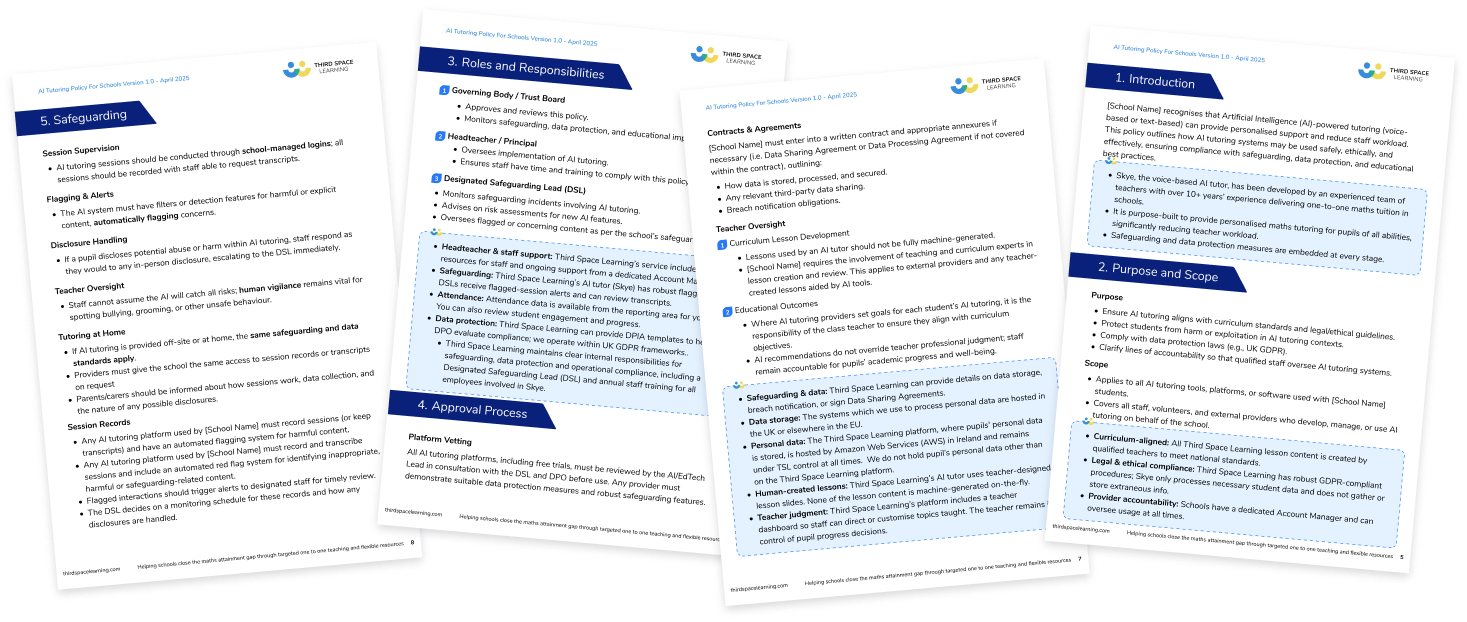
If you’re hesitant about using AI tools in the classroom, the key is starting with clear policies and safeguards before diving into specific platforms.
Invest in the foundations
- Develop strong AI policies that protect data privacy and ensure appropriate use
- Train staff on effective prompting and how to safely use AI – this isn’t optional
- Choose tools built by education specialists who understand schools and child development
- Start small with low-risk applications like lesson planning and resource creation before moving to student-facing systems
Keep teachers central
- AI should enhance, not replace teachers, especially the human connection element
- Maintain teacher oversight of all AI-powered tools and learning
- Use time savings to focus on relationship-building, creativity, and professional development
- Regularly evaluate the impact on both workload and student outcomes
Invest in training
Just as we wouldn’t expect a newly qualified teacher to be immediately effective without support, AI tools require proper training and setup to deliver results. Budget time and resources, supporting educators in learning how to use these systems effectively.
The U.S. Department of Education’, Office of Educational Technology’s Artificial Intelligence and the Future of Teaching and Learning: Insights and Recommendations report provides a helpful framework for US schools to begin developing their own policies. It is built on foundational principles such as:
- Promoting transparency.
- Centering people (parents, educators, and students).
- Advancing equity.
- Ensuring safety, ethics, and effectiveness.
While there is no official guidance on AI, this report highlights the key themes that can be inferred when considering AI use in your school.
Next steps and practical tips for school leaders:
- Audit your current administrative burden and identify AI opportunities
- Develop clear policies before implementing any AI tools
- Start with low-risk applications like resource creation
- Consider AI tutoring for students who need intensive intervention support
- Focus time savings on what teachers do best: teaching
The future is human-led, AI-enhanced
We’re definitely past the point where AI in education will “go away”. The question isn’t will AI replace teachers, it’s how do we engage with these tools thoughtfully?
The teachers who thrive will be those who embrace AI powered tools as an assistant while remaining firmly in control of the human elements that make teaching impactful. AI can handle repetitive tasks, generate resources, help with fresh ideas for lesson planning, and provide personalized drills and practice.
But it’s teachers who will continue to inspire curiosity, build relationships, navigate complex emotional situations, and create the classroom cultures where deep learning flourishes.
The future of education isn’t about choosing between human teachers and AI – it’s about combining the irreplaceable humanity of teaching with the efficiency and customization that technology and machine learning can provide when underpinned by solid pedagogical research.
Because ultimately, no parent will ever say in the last week of school: “I hope my child gets the AI with the warmest personality next year”.
Will AI replace teachers FAQs
While AI has the potential to automate administrative tasks and even provide customized learning experiences through AI tools and AI tutoring, it will never completely replace teaching positions and the need for human connection and a positive learning environment. Teachers who use AI can enhance teaching and learning by freeing up their time to do what they do best – teach. AI can also be a useful tool to address the teacher shortage and the challenge of mass job vacancies currently facing education systems in the US.
Some AI tools can save teachers time on administrative tasks, such as report writing and data tracking, but they absolutely cannot replace the essential rapport teachers build with students. So, while AI and generative AI can effectively assist teachers and save them time on the admin tasks teachers spend so much energy on, teaching jobs will not be replaced as the central figure in the classroom. AI is a powerful tool, not a substitute for human connection. However, AI can help to alleviate some of the challenges facing education systems around the world today, including teacher shortages.
Do you have students who need extra support in math?
Skye—our AI math tutor built by experienced teachers—provides students with personalized one-on-one, spoken instruction that helps them master concepts, close skill gaps, and gain confidence.
Since 2013, we’ve delivered over 2 million hours of math lessons to more than 170,000 students, guiding them toward higher math achievement.
Discover how our AI math tutoring can boost student success, or see how our math programs can support your school’s goals:
– 3rd grade tutoring
– 4th grade tutoring
– 5th grade tutoring
– 6th grade tutoring
– 7th grade tutoring
– 8th grade tutoring