

The Top 20 Year 6 Maths Revision Topics To Help Your Pupils Meet Age-Related Expectations and Achieve 100 in SATs [2026 UPDATE]

Year 6 revision time always feels limited, especially when pupils have varied gaps and confidence levels. As SLT, a maths lead or a Year 6 teacher, you need to know which topics will secure the marks that move pupils over the scaled score of 100.
Each year, our academic team analyses every SATs paper, alongside data from more than 2.1 million Third Space Learning lessons, to identify the content that matters most.
This guide shares the top 20 highest-impact topics for SATs 2026, how they were chosen, and how to structure revision so your pupils gain the marks they are capable of.
SATs revision takeaways:
- Year 6 SATs revision time is tight; schools need a clear focus on the topics that carry the highest number of marks.
- Third Space Learning analysed 8 years of SATs papers and 2.1 million maths lessons to identify the 20 topics that make the biggest difference to pupils reaching 100.
- These topics inform a 60-lesson structure built around diagnostic checks, fluency, and reasoning to help schools plan targeted, high-impact revision across the spring term or earlier if needed.
- Use the analysis, topic list, and lesson structure to build a revision plan that meets your cohort’s needs.

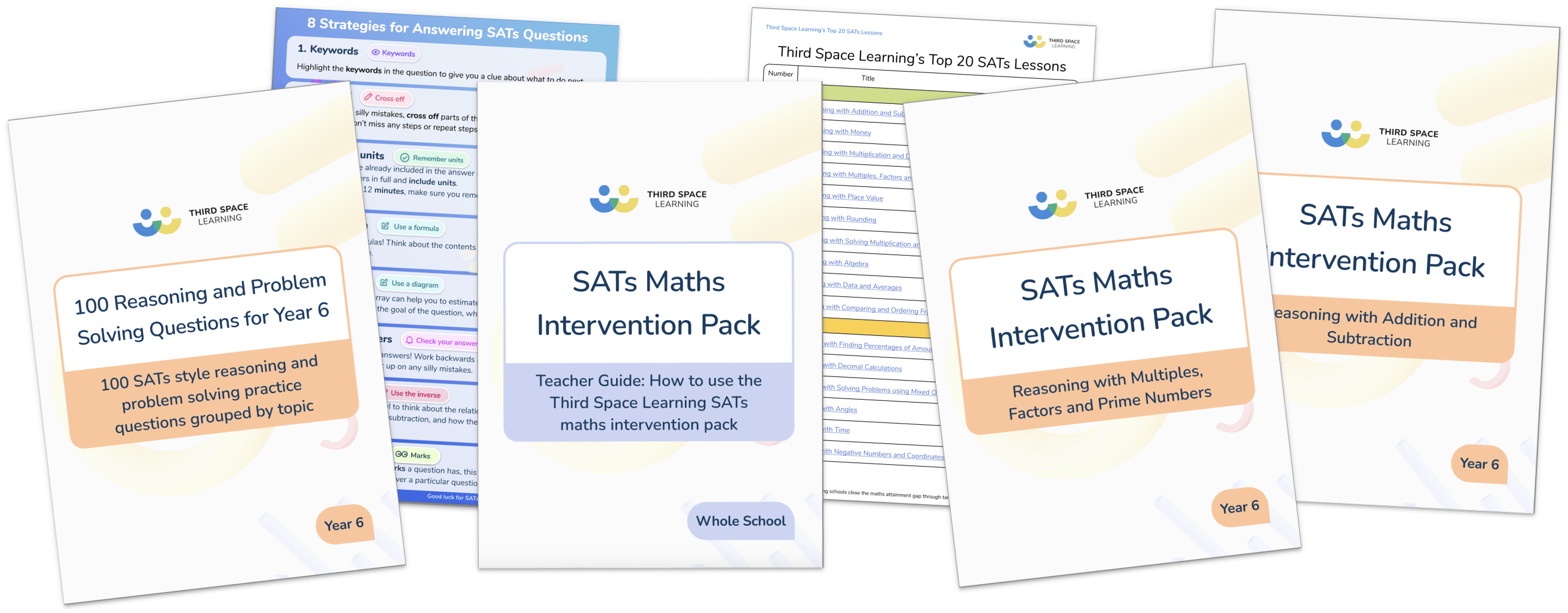
KS2 SATs Maths Preparation Pack
Want to supercharge SATs results in your school year after year? Download our SATs maths preparation pack to boost your pupils' results.
Download Free Now!SATS 2026: STAY UP TO DATE
Join our email list to stay up to date with the latest news and free resources for SATs 2026. As usual our expert teachers will be on hand to provide one to one tuition support, revision resources, expert paper analysis, SATs teacher survey results and the SATs results 2026.
Sneak peek: your top 5 SATs revision lessons
Before we share the full list and methodology behind the recommended maths revision in Year 6, here are the top 5 highest impact topics for the 2026 SATs.
These topics appeared most frequently across the papers between 2016-2019, and 2022-2025, carry the most marks, and form the foundation of targeted revision in our one-to-one SATs Booster Programme:
- Addition and Subtraction
- Money
- Multiplication and Division
- Multiples, Factors and Prime Numbers
- Place Value
Looking for the full list of high-impact revision topics? Keep reading to discover the rest of the top priority topics worth including in your SATs preparation.

How we identified the top 20 topics
Your Year 6 cohort may show familiar patterns each year, but these insights come from a relatively small sample. To build a clearer picture of the concepts that matter most, we combined national SATs data with large-scale evidence from our one-to-one lessons.
Our academic team analysed:
- 8 years of SATs papers (2016–2019, 2022–2025): every question, content domain, and mark allocation
- 2.1 million one-to-one lessons delivered to 170,000+ pupils across 4,000+ schools
- 101 practice SATs questions from our revision programme, including pupil responses and common misconceptions
- Feedback from teachers, session reports, and lesson observations, combined with 40+ years of classroom experience
This mixed dataset reveals which strands appear most often, carry the most marks, and cause the greatest difficulty for pupils. From this, we created a ranked list of the 20 SATs revision topics that matter most for reaching the scaled score of 100 in SATs 2026.
We’ve made our SATs revision programme analysis freely available to help you inform your SATs 2026 revision too.
The top 20 topics to maximise KS2 maths SATs revision for your pupils
Everyone’s SATs revision timetables will look different. Here at Third Space Learning, pupils enrolled on our SATs revision programme, available during the spring term, can partake in sessions spanning approximately 15 weeks.
Every lesson counts. And it’s one of the reasons we can achieve an average of double expected progress over a 14-15 week period.

Schools using the programme consistently see strong results. For example:
We used AI tutor Skye this year. 93% of our Third Space Learning pupils reached the expected level. One child, who had been struggling with maths, attained at greater depth (scaled score 110).
Deb Harris, Assistant Headteacher and Maths Lead, Wormley CofE Primary School
Below are the 20 high-impact topics broken down into 60 short lessons that we recommend prioritising during revision, in short, sharp revision lessons. They represent the greatest opportunity for pupils to secure marks and build confidence ahead of SATs.
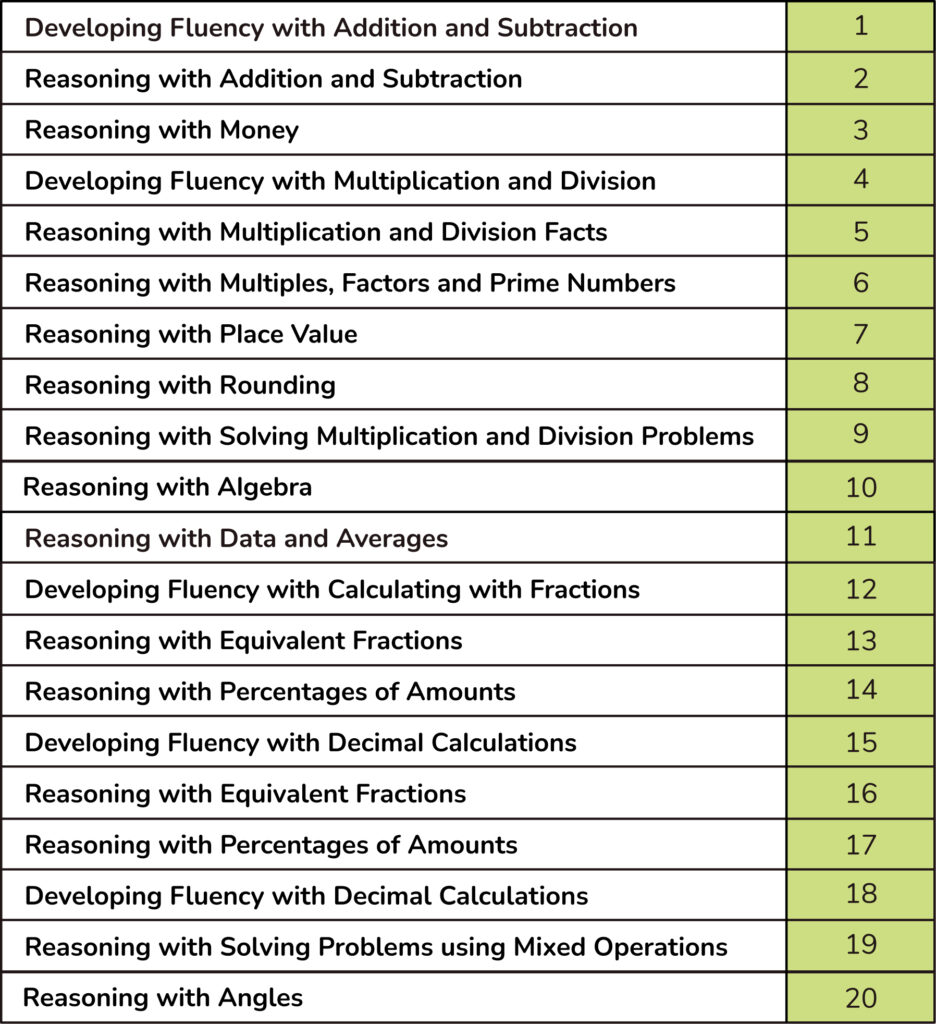
Mini revision lessons derived from the strands
Our analysis of KS2 SATs papers showed that certain strands appear far more often and carry most of the available marks in the SATs papers.
To help pupils secure these marks, we grouped the highest-frequency strands into 60 short 20-minute, focused lessons.
For 2026, each of the top 20 high-impact topics is divided into three smaller learning objectives. This gives pupils a clearer route for the spring term through complex content and reduces cognitive overload.
Benefits of shorter lessons:
- Support pupils who work at a slower pace
- Build confidence by allowing pupils to make visible progress in every session
- Give teachers precise information about specific concepts pupils find difficult within a topic
- Make it easier to target whole-class or group revision when several pupils need support with the same objective
For example, instead of seeing a general difficulty with “Reasoning with addition and subtraction”, teachers can identify that pupils are struggling with “finding the difference”.
This strand-level design ensures revision time is spent on the concepts most likely to appear in the SATs papers and contribute towards the scaled score of 100.
We used Third Space Learning to support our more able pupils. They all achieved greater depth. The use of vocabulary helps prepare them for SATs – they need to explain the thinking process. I’d recommend Third Space Learning to other schools.
Andrea Jaeger, Assistant Headteacher, Moor Nook CP School
Your 60 lessons from the top 20 high-impact topics

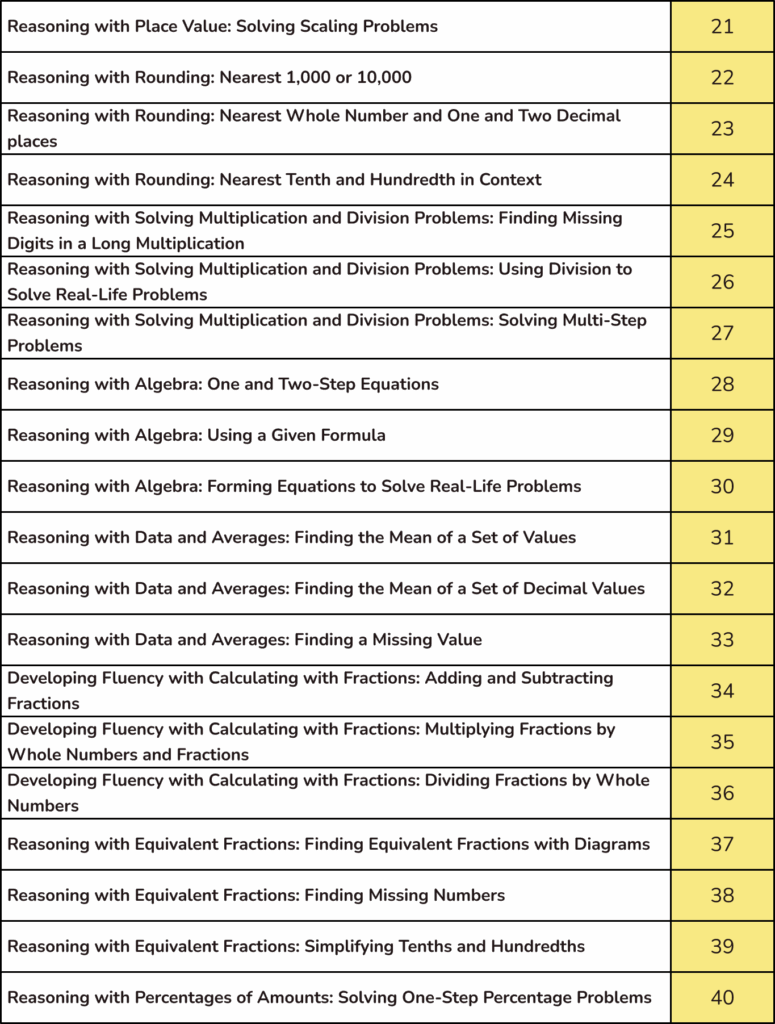
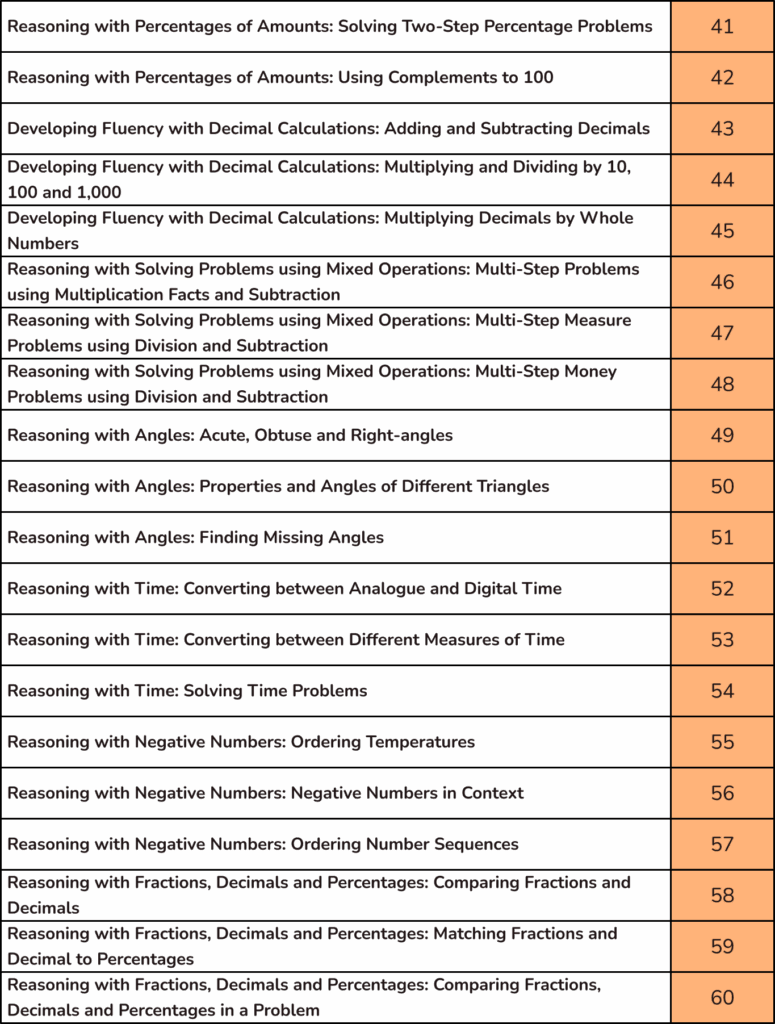
Using these topics as the basis for your revision sequence ensures pupils gain frequent exposure to the concepts that matter most while reducing time spent on low-yield areas.
Considerations
Adapting this list for your school:
- Starting earlier? Use these topics to inform your autumn-term planning or begin with fluency before reasoning.
- Starting later? Focus on the top 10 topics and spend more time on reasoning practice.
- Different lesson length? Adjust the number of questions per session, but keep the diagnostic – fluency – reasoning – assessment structure.
Want these topics delivered as structured, ready-to-teach lessons? Our SATs Booster Programme breaks each topic into three focused objectives with diagnostic checks, fluency practice, and reasoning questions built in. Schools using the programme typically complete three lessons per week during the spring term. Try a free session with Skye.
We had the benefit of targeted Third Space Learning interventions to support with maths. The one to one support means it is bespoke and goes at the pace of the learner.
Chris Harris, Deputy Headteacher, Admirals Academy
How to structure your SATs revision lessons to help pupils gain more marks
Now you know which topics to prioritise, the next step is choosing a lesson structure that helps pupils secure as many marks as possible.
Many pupils find the reasoning papers challenging, so a clear routine that secures fluency before reasoning is essential.
Our SATs revision strategy for 2026 uses short, focused lessons built around:
- Diagnostic checks,
- Targeted scaffolding, and
- Reasoning practice.
This approach reduces cognitive overload and strengthens the mathematical language pupils need to explain their thinking.
Here’s how you can apply the same structure in your own SATs revision lessons:
1. Start with an independent skill check in
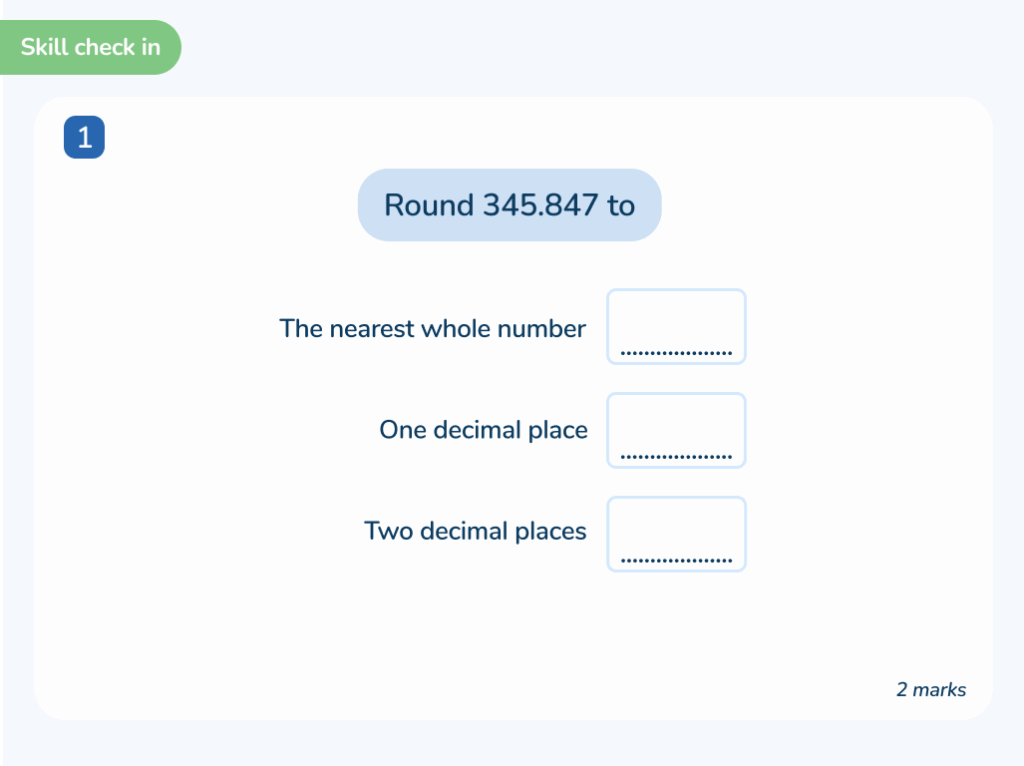
Begin every lesson with a diagnostic question to assess your pupils’ prerequisite knowledge.
- Give one short, independent diagnostic question linked to the day’s learning objective.
- Pupils complete this independently, so you can identify who needs more scaffolding.
Every one of our SATs Booster lessons begins with a skill check in question that tests the knowledge pupils need to complete the lesson. Pupils complete this independently, so Skye can assess their understanding before proceeding through the lesson.
2. Build in discrete fluency lessons

Focus on fluency to ensure pupils are confident with the arithmetic skills and maths concepts they’ll need to be able to pick up as many marks as possible in the arithmetic paper to achieve the golden scaled score of 100.
Fluency also builds and boosts your pupils’ confidence and stamina in maths, and frees up their working memory for reasoning.
- Model one worked example using the “I do, we do, you do” strategy.
- Practise 3–5 fluency questions directly linked to the reasoning objective.
- Use consistent strategies (e.g., adjusting, partitioning, efficient written methods).
3. Revisit reasoning
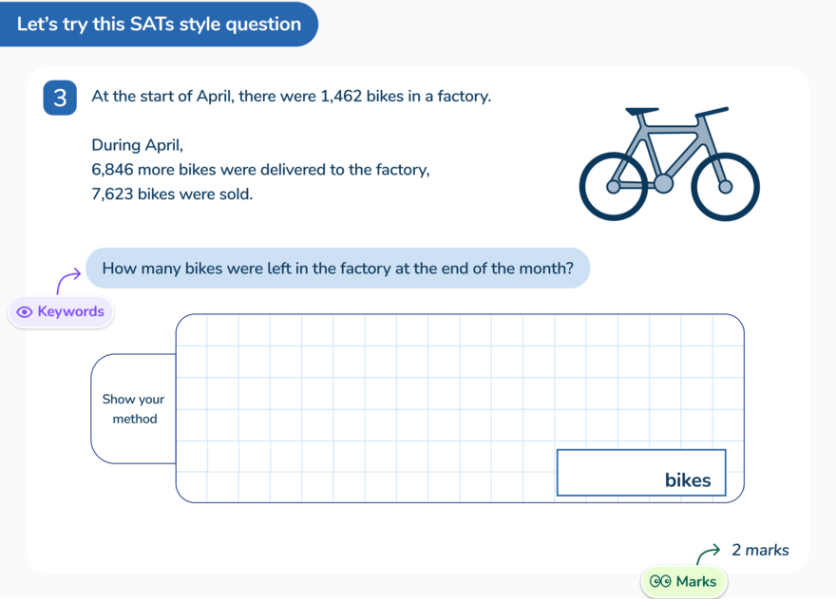
Incorporating reasoning builds confidence for pupils who find problem solving overwhelming while developing the habit of showing all of their working out and methodology.
It also helps you identify the pupils who have truly mastered a skill or concept and those who require extra help.
- Use 3 reasoning questions targeting the same learning objective.
- Teach test-taking behaviours: show all working, underline key information, sanity-check answers.
- Ask pupils to verbalise thinking with paired talk or whole-class modelling.
AI tutor Skye delivers three reasoning questions per objective, increasing complexity as understanding grows. This provides pupils with the opportunity to practise their verbal reasoning with Skye, a skill they often struggle with.
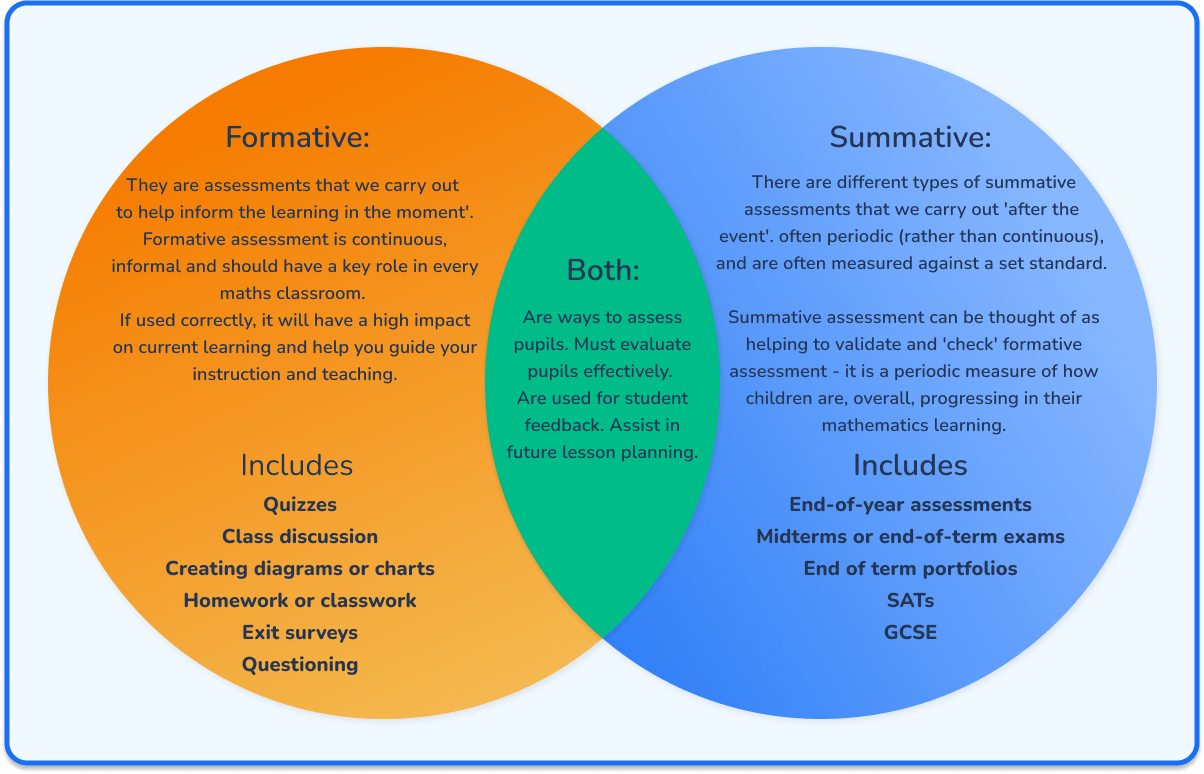
4. Use formative and summative assessment

Include formative and summative assessment opportunities throughout each revision lesson, as some topics and concepts may need repetition.
Whether it’s questioning, independent tasks, or exit tickets, it’s key to include both examples of formative assessments and summative assessments regularly in revision lessons to help you adapt your teaching strategies for maximum impact.
- Give one independent question mirroring the opener.
- Record whether the pupil:
- Mastered,
- Partially secured, or
- Needs further support.
Every SATs Booster lesson includes an objective-aligned skill check out, used to determine whether pupils have fully understood the learning objective, and inform school-level pupil progress reports.
The SATs revision programme has been fantastic for our Year 6 pupils. The fact that the questions that come up are really similar to the ones that crop up in SATs papers has worked really well for us.
Nicola Glover, Headteacher, Castlechurch Primary School
Even after reading our data analysis and revision programme suggestions, you must consider your current Year 6 cohort when completing your SATs revision programme. Every cohort is slightly different; any suggestions should be adapted to meet their needs.
SATs analysis: question-level breakdown 2016–2025
For those who want to understand the data behind our recommendations, here’s a full breakdown of how questions are distributed across year groups and content domains.
KS2 SATs questions by year group
Across the papers, the majority of questions continue to assess upper KS2 content:
- Year 1 and 2 content has not appeared since before 2016
- ~40% of questions in the 2025 papers assessed Year 6 content
- Year 5 content increased by nearly 10% compared with 2024
- Year 3 and 4 content remained stable
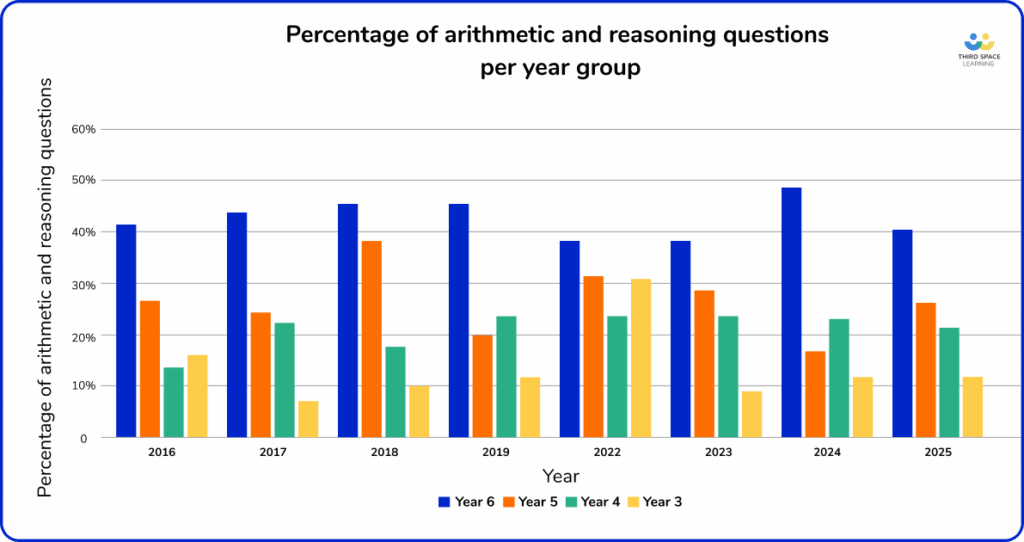
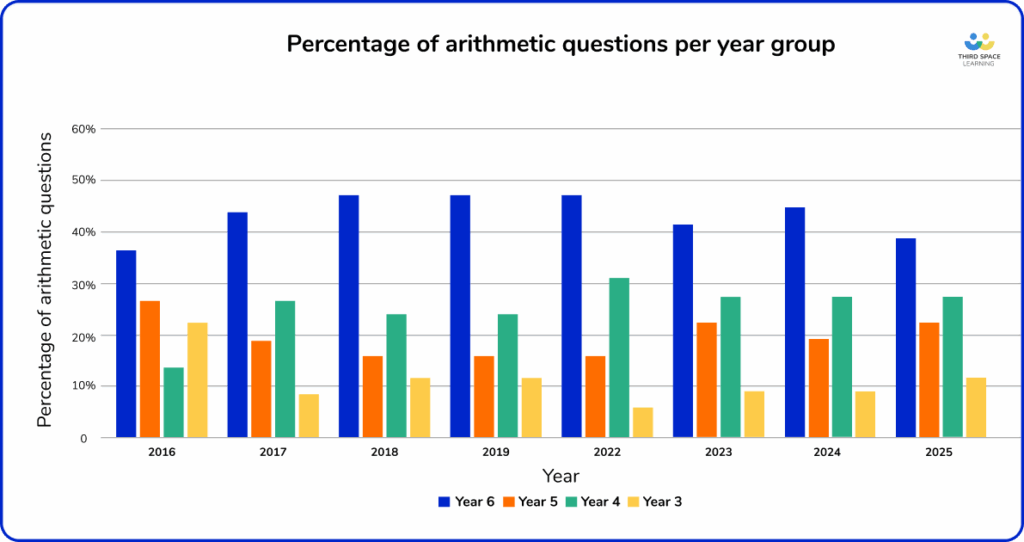
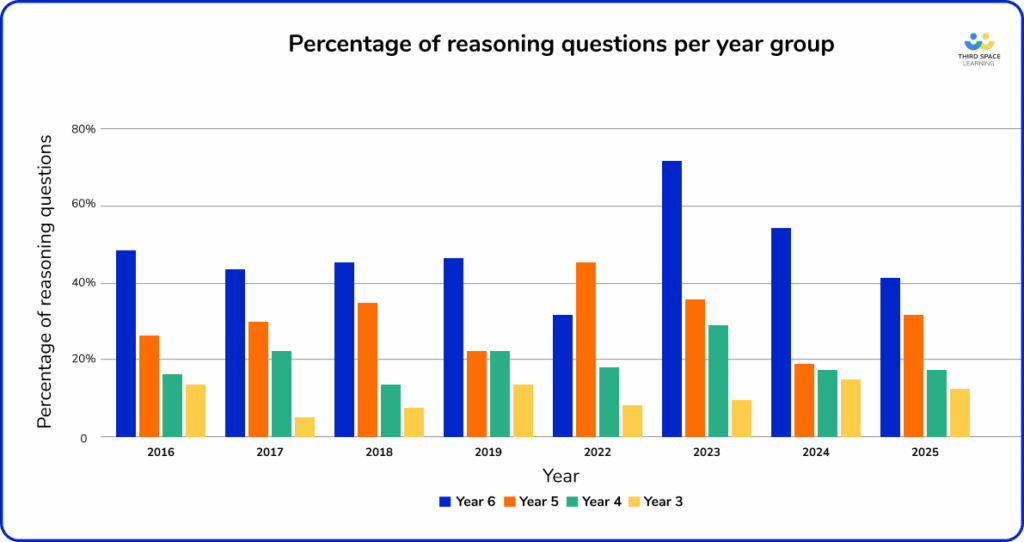
This confirms the need for strong coverage of Year 5 and 6 strands during revision, even when pupils have mixed attainment.
Why this matters for your planning
Together, this analysis gives a clear and dependable foundation for your SATs revision sequence. It highlights:
- Where pupils are likely to struggle,
- Where the largest clusters of marks sit,
- Which strands must be secured for pupils to achieve or exceed the scaled score of 100.
This evidence underpins both our SATs Booster Programme and the recommended lesson order included in this guide.
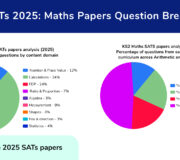
KS2 SATs questions by content domain
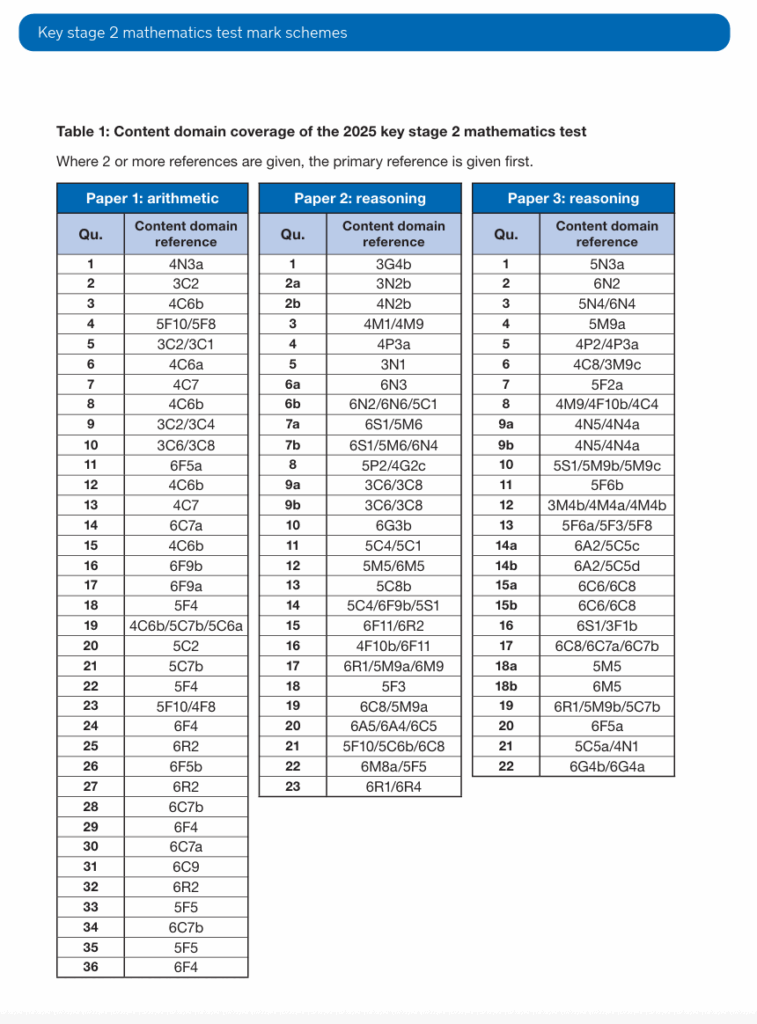
What can we learn from this content domain coverage table?
The DfE’s content domain tables show how skills are grouped. However, these tables are difficult to interpret quickly. To make the data more usable, our team reorganised the content domains into broader strands that map directly to SATs-style questions.
This provides a clearer picture of which strands consistently appear across papers and where marks accumulate.
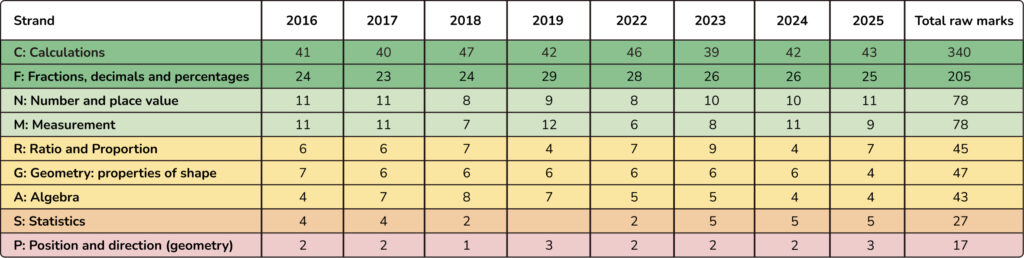
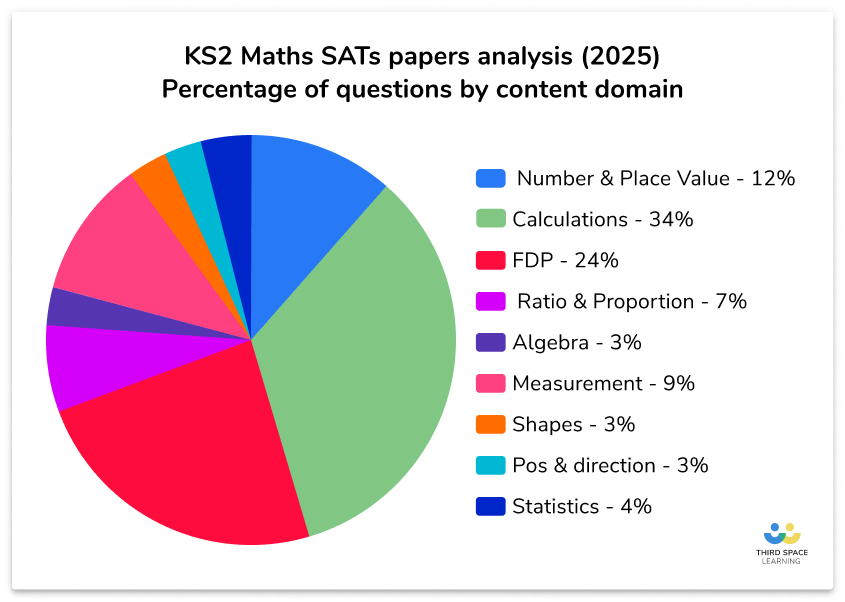
Note: For this blog, where there are multiple year groups and content domains attributed to a question, we have analysed the data based on the first year group or content domain listed. All percentages have been rounded to the nearest whole number and may be just shy of, or over, 100%.
GET THE ANALYSIS ON PREVIOUS SATS
SATs have been running in their current incarnation for 7 years; there were no government standardised assessments in 2020 and 2021 as a result of the Covid-19 pandemic. Get all the analysis and results from previous national assessments below.
And find out which are the top 20 year 6 maths revision topics to focus on this year.
– SATs papers 2025
– SATs results 2025
– SATs papers 2024
– SATs results 2024
– SATs papers 2023
– SATs results 2023
– SATs papers 2022
– SATs results 2022
– SATs papers 2019
– SATs results 2019
– SATs papers 2018
– SATs results 2018
– SATs papers 2017
– SATs results 2017
– SATs results 2016
Final word on KS2 SATs preparation
Careful analysis of past SATs papers and real pupil learning has shaped a revision sequence that focuses on the concepts that matter most.
Using the top 20 high-impact topics and the 60 short lessons built from them gives pupils regular practice with the strands most likely to secure marks and helps teachers target support where it has the greatest effect.
As you plan your Year 6 SATs revision, review your current approach and identify any gaps in coverage or opportunities to streamline lessons. A clear, focused structure will give your pupils the best chance of reaching the scaled score of 100.


DO YOU HAVE STUDENTS WHO NEED MORE SUPPORT IN MATHS?
Skye – our AI maths tutor built by teachers – gives students personalised one-to-one lessons that address learning gaps and build confidence.
Since 2013 we’ve taught over 2 million hours of maths lessons to more than 170,000 students to help them become fluent, able mathematicians.
Explore our AI maths tutoring or find out about year 6 SATs for your school.