Here at Third Space Learning, we’re on a mission to help schools close the math attainment gap. We started our journey in 2013 with just a handful of schools and one ambitious goal; to help make one to one math support more accessible for schools.
We first did this by connecting schools’ students – the ones they believe need it most – to our dedicated team of specialist math tutors, and taking them through a personalized learning program designed to plug gaps, build confidence and boost progress.
Over the last 9 years, our community of schools has grown and, on May 6, 2021, we delivered our 1,000,000th one to one math lesson to Jacob, a ten year old student at Tendring Primary School in the UK, bringing our total impact to 86,976 students across 2,821 schools. The majority of the students we’ve supported are eligible for Free or Reduced Lunch.
It’s been an incredible journey so far and, while our goal hasn’t changed, we’ve certainly learned a thing or two about providing effective one to one math support along the way! Indeed, we have now utilized our decade of experience to develop Skye, the AI math tutor, to provide schools with an even more affordable, scalable approach to one to one tutoring.
In 2021, to mark this momentous milestone, we spent some time reflecting on these lessons and what we see as the essential insights for any teacher or school leader looking to incorporate one to one math teaching into their classrooms.
High Impact Tutoring Guide for Schools
How to choose, plan and fund the right tutoring approach for your students for maximum impact in your school: how much tutoring costs, what funding is available, and how to ensure it’s cost-effective
Developing the best possible program of one to one support
With each of our lessons now having been delivered to thousands of students, we’ve had lots of opportunities to analyze and improve their effectiveness.
Through this process of regular review, we’ve learned a great deal about all the best ways to teach math in a one to one environment, including:
1. The importance of an adaptive, personalized curriculum
With around 20,000 students currently taking part in our lessons each week, we know that it’s never going to be as simple as implementing a one-size-fits-all curriculum.
Each of those 20,000 students has slightly different knowledge gaps, learns at a slightly different pace and has a slightly different attitude towards their learning.
We knew back in 2013 that we wanted to be able to identify these specific needs and personalize learning accordingly, and over the years we’ve been able to make our programs even more targeted.
The first step towards this hyper-targeted approach came with weaving assessment into the fabric of our interventions through the introduction of the ‘Diagnostic Program’.
This option automatically selects the most appropriate lessons for each student each week based on the results of their initial and ongoing assessments.
Our Senior Product Manager, Ellie McCann, tells us how ‘this diagnostic assessment allowed us to make our intervention more targeted to individual student needs and also saves time for the student’s teacher,’ as they no longer need to choose the specific lessons for each student each week – although this option is still available for those schools who know they have very particular topics to cover.
Having introduced the Diagnostic Program, we then looked at how we could make this option even more effective for the schools who wanted this automatic gap-plugging approach.
We broke each lesson down even further into distinct Learning Objectives (LOs), and ensured that each of the questions we ask in the assessments is clearly mapped to one of these individual LOs.
This has enabled us to pinpoint – and fill – even more granular gaps in each student’s knowledge.
“The personalized approach for children is fantastic, meeting individual needs and narrowing gaps. The children enjoy the lessons, make good progress and their skills are clearly transferred to class lessons. Thank you!” – Danielle Lewis, Senior Leadership Team, Highfield Primary School, Trafford (UK)
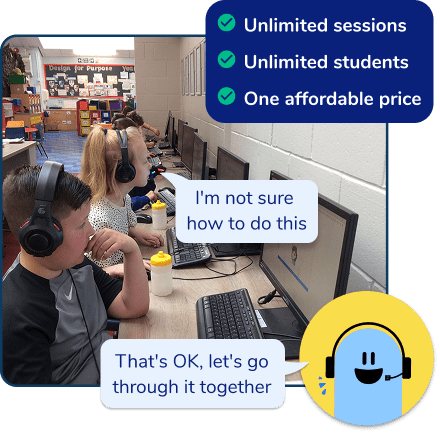
Meet Skye, the voice-based AI tutor making math success possible for every student.
Built by teachers and math experts, Skye uses the same pedagogy, curriculum and lesson structure as our traditional tutoring.
But, with more flexibility and a low cost, schools can scale online math tutoring to support every student who needs it.
As well as these unique gaps, every student will also have a different attitude towards math and, over the past 9 years, we’ve seen first-hand just how much these attitudes impact each student’s experience.
As part of our Global Tutoring Program, we trained our tutors to reward students who demonstrate effort and a willingness to give-it-a-go, not just those who reach the right answer. We do this through ‘effort points’ and effort-based stamps, which Skye also now utilizes to motivate learners.
In more recent years, we’ve been able to incorporate this into the way we measure the success of our programs and report impact back to the class teacher.
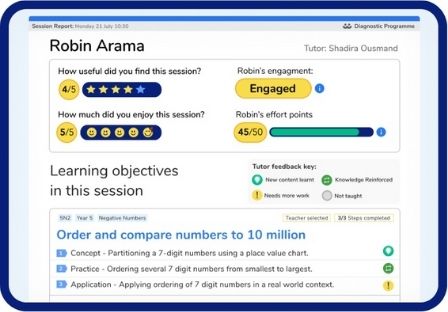
As well as communicating the progress made by each student in academic terms, we also now report on how our programs are impacting each student’s mindset, including changes in confidence levels and engagement as well as the value and enjoyment they get from their math lessons. Collectively, these metrics are known as the Affective Domain.
Our Head of Academic Standards, Candida Crawford, describes how ‘we learned that mindset is a different metric and we wanted to test this and show the results to teachers.
We know that our intervention programs help boost these skills as there is something to interact with; there is accountability as the student can’t hide, but also they feel confident and comfortable enough to learn.
We wanted to be able to relay this clearly in our session reports.’
A Third Space Learning student’s session report showing engagement, enjoyment, value, and effort
“A number of student’s parents have told me how much their child enjoys the sessions and how they look forward to them every week! Teachers have also been saying how they have noticed a significant increase in the confidence levels of their students who do Third Space Learning – both in math and in other subjects!”– Tim White, Assistant Headteacher, Morland Primary School (UK)
3. How to make learning easily digestible
Over time, we’ve seen that the best way to ensure a student has grasped the core skills of a topic is to adopt a ‘smaller steps’ approach. By breaking up our lessons into mastery units of smaller concepts, we’re now able to ensure that each student understands each one before they move onto the next.
This idea of breaking lessons down into small steps has become key to our intervention structure and has allowed us to really think deeply about pedagogy and the mechanics of teaching a topic.
“The 1:1 sessions are perfect at aligning the small steps, gaps or misconceptions that need to be addressed to enable more confident learners and see rapid progress.”– Christine Spain, Headteacher, Stapleford Primary School, Cambridge (UK)
This approach has also helped us to combat one of the most common pitfalls for tutors and teachers when teaching math, particularly to elementary students; the curse of knowledge.
Adults with a strong understanding of math can sometimes internalize a lot of their key mathematical skills, not consciously thinking about how they know how to do basic math because it has become automatic to them.
This can sometimes hinder a teacher in their explanation of a math concept as that level of understanding has not yet been developed by the child.
Candida believes that one of the best solutions to the curse of knowledge is ‘atomisation’, explaining that ‘atomisation pulls apart and helps teachers understand what the components of teaching a concept are, helping them deliver the lesson better.’
“My tutor is very kind and explains things to me so I understand it and she never rushes when I am figuring something out!”– Third Space Learning student, Year 4, Kingston-Upon-Thames (UK)
4. The importance of flexibility
Ultimately, any intervention program needs to fit with the requirements of the school and students in question. It’s essential for us that we build our programs in a way that enables schools to use the intervention in a way that suits them best.
Over time, we’ve been able to develop in this area, such as giving schools the opportunity to more easily reschedule sessions and introducing new options for lesson selection.
Over the last few years, with schools facing disruption and changing requirements at every corner, flexibility has become more important than ever.
We’ve worked to ensure as many students as possible have been able to continue their lessons during school closures, and have introduced new tracking systems to ensure lessons taking place from students’ homes go just as smoothly as they do in school.
“I have been with Third Space for a number of years now. I’ve got to say that I have seen the company improve year on year and this kind of flexibility has definitely improved since we first subscribed.”– Deputy Headteacher, Rochdale (UK)
Using technology to enhance the teaching experience
Technology has advanced at an astonishing rate over the past 9 years, and so too has our intervention program evolved.
Clearly, we’ve had to keep up with the rate at which technology is advancing, but we’ve also been able to harness the power of technology to make our intervention more effective and accessible for schools.
This can largely be boiled down to three key areas; data, interface and automation.
1. Data: using what we know to improve what we do
With tens of thousands of students completing our lessons every week, and every lesson recorded for safeguarding purposes, we’re lucky to have a wealth of data to work with.
Every month, we analyze our lessons with certain metrics, such as time spent on a lesson and student feedback and which questions are being answered incorrectly most often.
From there, we conduct a qualitative dive into whether these are the result of a wider issue. We’re constantly looking at data to determine which lesson objectives students are taking longer to complete, feeding this back into our curriculum design to improve our lessons.
For example, when we noticed that one of our long division lessons appeared to be particularly challenging for students – no matter their prior attainment – and we were able to dive into the data to see how we could improve the lesson.
We identified three areas that we felt we could improve to make a real difference to our students; differentiation, language, and visuals.
First, we made changes to give the students choice over which method they wanted to proceed with; chunking or the standard algorithm for division.
Next, we changed the lesson’s accompanying tutor notes to ensure tutors were using clear, simple language to help demystify this potentially confusing topic, information that has now been directly embedded into Skye’s training.
Finally, we updated the visuals of the lesson to help make it more digestible for students.
2. Interface: creating an effective and engaging learning environment
When we first set out on our mission to provide online one to one math tutoring, we used a third-party shared meeting service to deliver our lessons. However, we found that, because this was not geared towards students, we were missing opportunities to really engage our learners.
So, in 2014 we built our own, child-friendly, online classroom that puts the student front and center with an interactive interface, engaging classroom tools and plenty of opportunities for praise and reward.
An example of the interactive interface in Third Space Learning’s classroom
By observing how students interact with this new online classroom, we’ve been able to learn a great deal about what makes an effective online learning environment. Although it sounds counter-intuitive in the age of Zoom, we’ve found that by not having any video functionality, we’re able to minimize distractions for our students.
We’ve aimed to strike a balance between building something that is engaging and fun for children to use, without creating anything that takes away from the ultimate purpose of the intervention: learning.
Chief Technical Officer, Sam Stagg, tells us how ‘our purpose-built online classrooms facilitate a knowledgeable and empathetic tutor in helping their students build new connections with math’.
“There are actually a number of students who, when I see them around the school, will ALWAYS ask me if today is ‘their Third Space day’! We even have one student, a boy in 3rd grade, who recently said that Third Space Learning is ‘his favorite lesson of the week – even better than gym class’ – rare praise from a 3rd grade boy!”– Will Marsburg, Head of Online Learning, Morland Primary School (UK)
3. Automation: blending intelligent technological processes with the human approach
Over the years, we’ve been able to use automation to build a robust system that can diagnose gaps in a student’s math learning and set out the most effective sequence of lessons to plug these gaps.
However, the magic really happens when it’s not only individual gaps that are being diagnosed, but also the specific misconceptions a student has that’s causing this lack of understanding.
We’ve built our assessment in multiple choice format – with one correct answer and three carefully chosen detractors – to help us understand exactly why a student struggles with a particular topic.
We’re then able to identify even more precise Learning Objectives to go through with each student to help plug these gaps and address these misconceptions.
Third Space Learning’s multiple choice diagnostic assessment
“The tutoring sessions are having a really positive impact. We find that they really help the students to focus on resolving their specific misconceptions and they enjoy the interactive nature of the sessions.” – Headteacher, Northumberland (UK)
Our biggest takeaways
As we draw this reflection to a close, we’ve asked some of the Third Space Learning Team for their number one pieces of advice for teachers looking to close the math attainment gap in their classroom…
Tom Hooper, CEO and Founder of Third Space Learning: ‘Intervention is a small piece of a much bigger picture that includes the school, the teaching strategy, and how the teacher is leading their class. We’ve learned that if we don’t fit into this holistic approach, then it will be hard to have an impact – we’ve tailored Third Space to be easy to use for teachers within their wider teaching strategy.
For any schools looking to incorporate one to one teaching into their math rotation, it is essential that this complements the work being done in class and the wider math strategy adopted by the school.’
Sam Stagg, Chief Technical Officer: ‘Micro rewards – such as effort points or the tutor sharing pictures of a student’s favorite football team or animal – are very encouraging to the students and boost their engagement in the intervention.’
Candida Crawford, Head of Academic Standards: ‘Use stamps like ‘great explanation’ and ‘well tried’, to foster a growth mindset, and use quick assessment techniques in the classroom to start off lessons by assessing and understanding where students are at.’
Ellie McCann, Senior Product Manager: ‘Know the goal that you want your students to achieve and plan backwards from there. If your goal is for your students to hit the ready to progress criteria, then know what those requirements are and plan your lessons accordingly.’
We’d like to thank all of our schools, teachers, and students for coming along on this journey with us. We know that the past few years have been incredibly challenging for many, and yet we are constantly enamored by the resilience of both students and teachers in continuing their math learning.
We know the need for what we do is now greater than ever, with the math attainment gap growing wider and wider. It will take years to close this gap, but at Third Space Learning, we believe we have the experience to be part of a solution to help tackle this problem.
We are determined and committed to continuing this journey with you, and we can’t wait to see where our next one million lessons take us.
Do you have students who need extra support in math?
Skye—our AI math tutor built by experienced teachers—provides students with personalized one-on-one, spoken instruction that helps them master concepts, close skill gaps, and gain confidence.
Since 2013, we’ve delivered over 2 million hours of math lessons to more than 170,000 students, guiding them toward higher math achievement.
The content in this article was originally written by a member of the content team Amelia Coen and has since been revised and adapted for US schools by elementary math teacher Christi Kulesza.
We use essential and non-essential cookies to improve the experience on our website. Please read our Cookies Policy for information on how we use cookies and how to manage or change your cookie settings.Accept
Privacy & Cookies Policy
Privacy Overview
This website uses cookies to improve your experience while you navigate through the website. Out of these, the cookies that are categorized as necessary are stored on your browser as they are essential for the working of basic functionalities of the website. We also use third-party cookies that help us analyze and understand how you use this website. These cookies will be stored in your browser only with your consent. You also have the option to opt-out of these cookies. But opting out of some of these cookies may affect your browsing experience.
Necessary cookies are absolutely essential for the website to function properly. This category only includes cookies that ensures basic functionalities and security features of the website. These cookies do not store any personal information.
Any cookies that may not be particularly necessary for the website to function and is used specifically to collect user personal data via analytics, ads, other embedded contents are termed as non-necessary cookies. It is mandatory to procure user consent prior to running these cookies on your website.